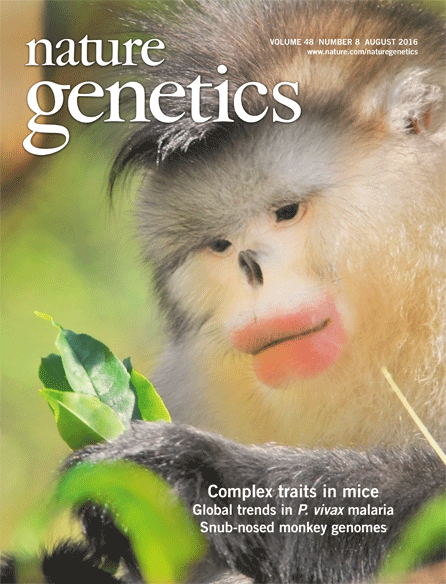
August issue cover: What’s going on here?

Rhinopithecus bieti

Rhinopithecus bieti{credit}Yong-cheng Long{/credit}

This month’s cover image is inspired by the paper on page 947 reporting the reference genome sequence of the black snub-nosed monkey, the second snub-nosed monkey genome paper published in Nature Genetics. The golden snub-nosed monkey genome was published in 2014.

In their paper, Li Yu and colleagues present the de novo genome sequence assembly of Rhinopithecus bieti as well as whole genome resequencing of all four other snub-nosed monkey species. All five species are among the world’s most endangered primate species. Three species, R. bieti, R. roxellana and R. strykeri, live at very high altitudes—above 3,000 meters. R. bieti lives exclusively on the Yunnan and Tibetan plateaus. The other two species, R. brelichi and R. avunculus, inhabit lowland regions. The authors compared the genome sequences between these species to identify genomic regions showing evidence of positive selection that could be related to living at high altitudes.

The photograph on the cover image was taken by one of the study’s co-authors, Dr. Yong-Cheng Long, who was profiled by the Nature Conservancy for his work on conservation of R. bieti (also called the Yunnan golden monkey by the locals). We asked Dr. Long to tell us a little about the monkey shown in the picture.

“The monkey is [a] male, whose name is ‘Big Guy’, and he is feeding on some leaves,” he said by email. “The Big Guy used to have 4 wives (about 6 years ago) and now has only 2, as he is getting old and is not strong enough to hold all of them because the females are more likely to find a strong shoulder to cry on.”

Dr. Long said there are 57 R. bieti individuals in the habituated “Yunnan snuby” group, which is open to the public. Because many of the individuals in the area are fully habituated to human presence, it is not difficult to get photographs of them. The group is only a small portion of the largest natural monkey troop (approximately 1,000 in total) in the world. Dr. Long emphasized the impact that illegal poaching has had on the monkeys. “This species has been endangered by human’s killing, and the monkeys can certainly survive once the killing is stopped.” In China, 2016 is the Year of the Monkey, and it has turned out to also be a lucky year for these particular monkeys. “We found the monkey group has boomed,” said Dr. Long. “12 of the 57 are the infants born this year.”
monkey

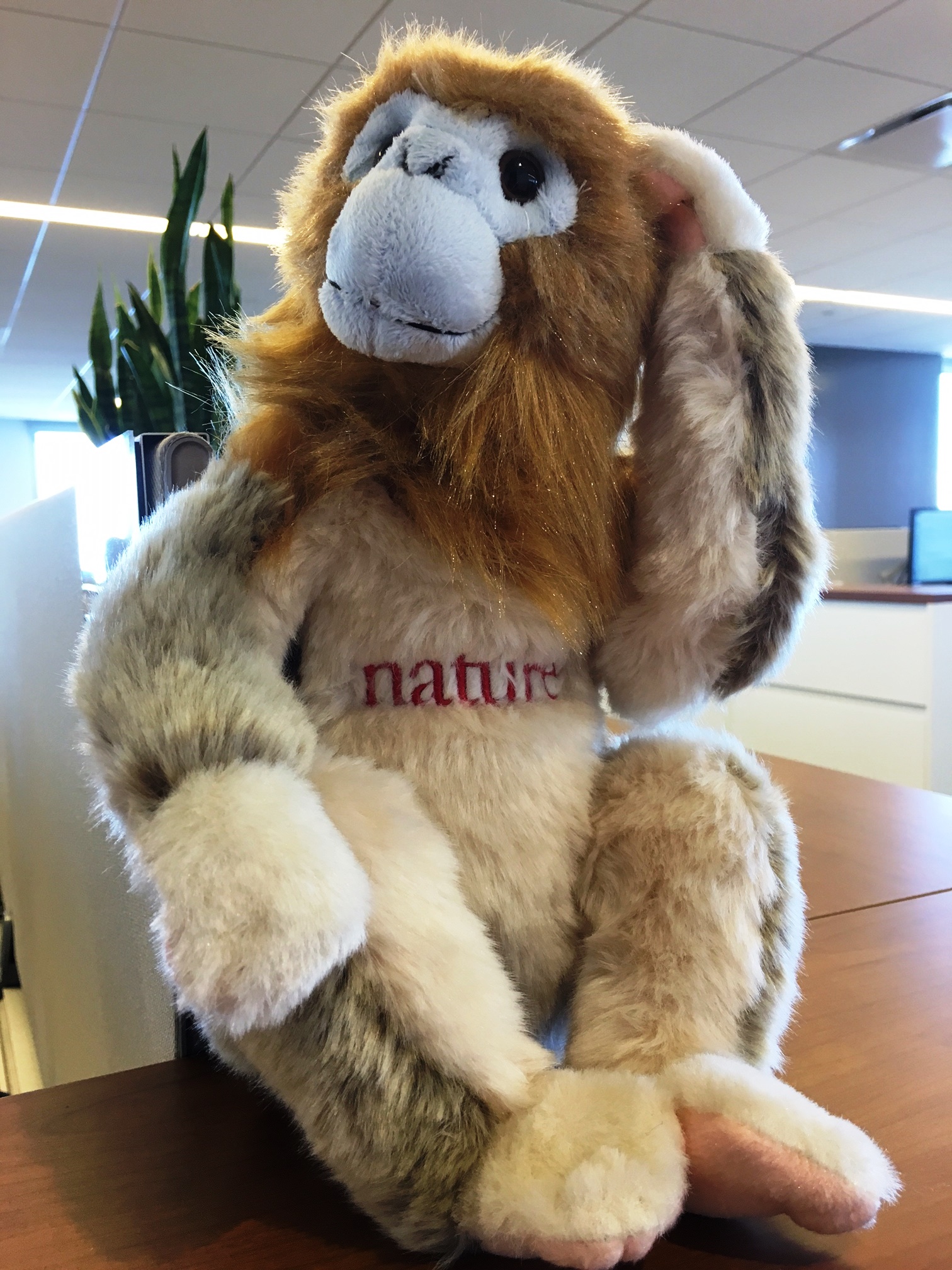
Nature Genetics office mascot

The lead author of the study, Dr. Yu, became interested in studying these species because of his focus on conservation genetics of endangered mammals distributed in Yunnan Province, China. This is one of the core regions of biodiversity in the world. “The most notable among the endangered mammals distributed in Yunnan Province is R. bieti, which is found exclusively on Yunnan and Tibetan Plateau”, said Dr. Yu by email. “It is unique in that it is the only primate having a red mouth like most humans, which [is why it’s called] one of the most beautiful animals.” Dr. Yu also noted that it is the highest altitude-dwelling nonhuman primate. It can survive in very cold and hypoxic environments that other primates cannot tolerate. “So, I was deeply attracted by this mysterious and interesting species, and was eager to come to understand it.”

 

IMG_1863We at Nature Genetics are also celebrating the Chinese Year of the Monkey. Our office mascot is this golden snub-nosed monkey (right), which was produced for marketing purposes in China (I snagged one during a recent visit to the Shanghai office). Scanning a barcode on the monkey’s rear end (left) will take you to the publication of the R. roxellana (golden snub-nosed monkey) genome paper.
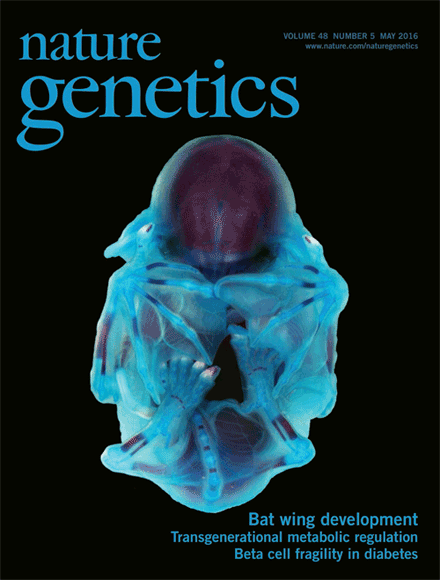


May issue cover: What’s going on here?

May2016This month’s cover image is inspired by the Article on p. 528 of this issue, by Jeff Wall, Nicola Illing, Nadav Ahituv and colleagues. The paper reports the genome of the bat Miniopterus natalensis and transcriptional dynamics in the developing bat wing. This species, one of a group known as vesper bats, is also known as the Natal long-fingered bat and is found in parts of Africa.

The image chosen for the cover is a frontal view of a bat embryo at a late stage of development (stage CS21) taken by study co-author Mandy Mason. This developmental stage is known as
“Translucent Wing”, as you can clearly see the skeletal structures in the wing and the membrane between the outstretched digits. The embryo in this image was stained with Alizarin red (maroon-red-pink) for bone and Alcian blue (blue-cyan) for cartilage. The image was actually taken as part of an earlier study to understand the progression of limb development in this species and to compare it with that of the mouse.

The current study presents not only the genome sequence of the Natal long-fingered bat, but also RNA-seq and ChIP-seq (for H3K27ac and H3K27me3) profiling of the developing limbs. The authors identified more than 7,000 genes that were differentially expressed between the forelimbs—the eventual wings—and the hindlimbs. Through comparative genomics analyses, they found nearly 3,000 regions showing evidence of accelerated evolution along the bat lineage that overlapped with H3K27ac peaks, suggesting that these are candidate enhancer regions for wing development. “This study offers a comprehensive resource for future work in comparative limb development,” co-author Mandy Mason told us. “Aside from the results that we have presented in this paper, these open datasets can be queried to help answer additional questions that may be asked by both our and other research groups.”


Highlighting genomes for DNA Day 2016

October 2015 cover

October 2015 cover “Histone butterflies” by Luisa Lente. Inspired by Salvador Dalí.

Today is national DNA day, celebrating the completion of the Human Genome Project in 2003 and the publication of the proposed structure of DNA in 1953 by James Watson and Francis Crick (PDF here).

This year for DNA day, we wanted to highlight papers reporting new genome sequences of organisms from peanuts to Papilio butterflies published in Nature Genetics over the last year. All reference genomes are published open access under a CC-BY licence.  Continue reading

What makes a parasite?

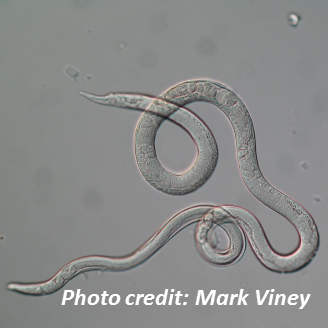
Stronglyoides worm

Genetic clues to what makes parasitic worms different from free-living worms are reported in a paper published online this week in Nature Genetics. Groups led by Mark Viney, Matthew Berriman and Taisei Kikuchi carried out the sequencing and assembly of genomes from six nematode species from the clade that includes the human parasitic roundworm Strongyloides stercoralis. We asked one of the authors, Professor Mark Viney of the University of Bristol, to tell us a little bit about the study.

Although the genomes of several parasitic worm species have been published to date, Strongyloides represents a unique opportunity to learn some of the general rules of being a parasitic worm. According to Mark Viney, “what makes Strongyloides so special is that this clade contains parasites, facultative parasites and free-living species that are all close relatives. This gives us real power to our analysis.  Our work will be used by the international research community who work on these globally important parasites of people and other animals.”

S. stercoralis infects approximately 30-100 million people worldwide and causes a wide range of symptoms. Closely related species in the clade Strongyloides include both free-living and parasitic species that infect a wide range of hosts. In parasitic species, generations alternate between parasitic and free-living, resulting in genetically identical females with starkly different lifestyles.

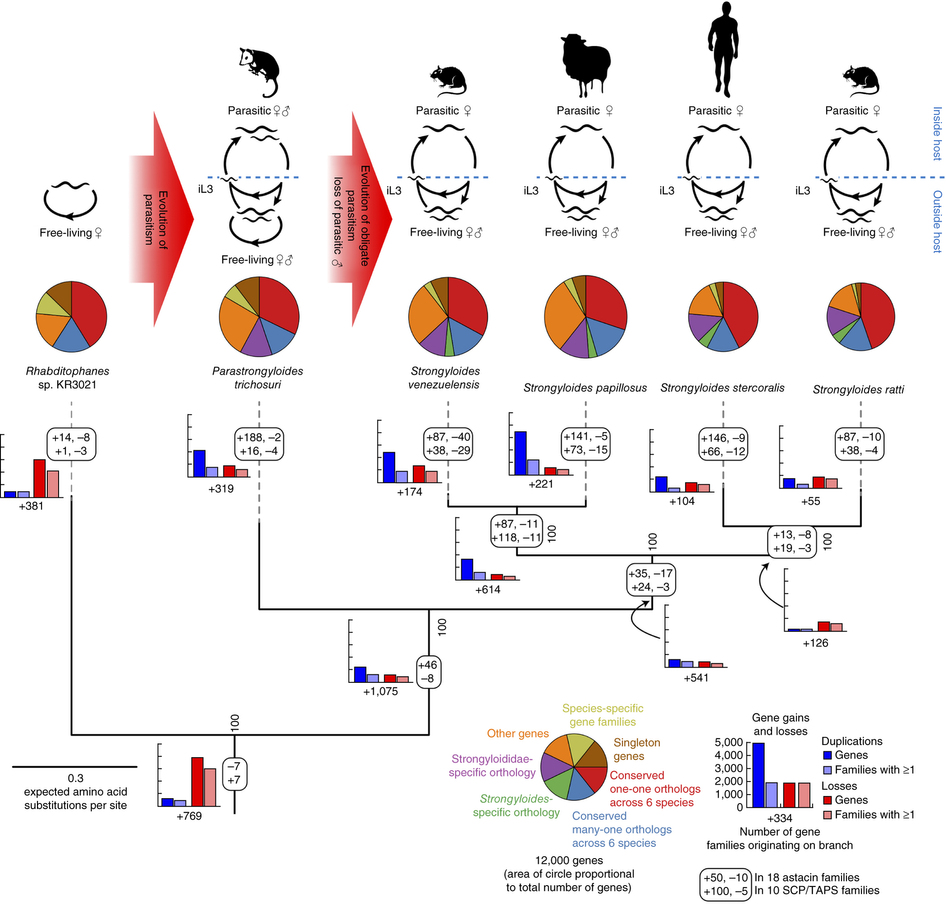
The authors first compared the genomes of free-living and parasitic species to identify genes specific to the parasites. They found that acquisition of 1,075 gene families was associated with the evolution of parasitism and parasitism was associated with greater expansion of genes and gene families overall.

When asked what the most unexpected aspect of the study was, Professor Viney said, I think the really surprising thing that we found was just how largely expanded some gene families were in the parasitic species. This is quite unprecedented in the nematodes.” The authors also found that most parasitism-related genes were located in genomic clusters. “The important thing about these clusters is that nothing like this has ever been seen before in parasitic worms and it certainly speaks to the possible importance of these in their evolution of parasitism,” said Professor Viney.


The life cycle of the 6 sequenced species and the gene gains and losses in each lineage.

The life cycle of the 6 sequenced species and the gene gains and losses in each lineage. {credit}Hunt et al. Nat. Genet. 2016{/credit}

Two gene families were especially expanded in parasitic genomes—those encoding SCP/TAPS and astacin-domain proteins—and based on RNA-sequencing studies, these were also much more highly expressed in parasitic females than free-living females of the same species. This suggests that these gene families in particular are important for the ability of the worm to infect its host. In support of this hypothesis, the authors found that proteins from these two families are secreted by the worms, and would therefore be able to interact with host tissues to aid in invasion and migration.

Asked about the next steps that need to be taken for these findings, Mark Viney said, “For these SCP/TAPS coding genes what we really need to do is to find out what these genes are doing—this is completely unknown at the moment. For the astacins we can probably guess what they do—being involved in digesting host tissue so that the parasites can feed. They might be potential drug targets.”

The study brought together groups from the UK, Japan, Taiwan, Germany, USA, Mexico and Australia and is one of many examples of successful collaboration in science. “The field of parasitology is a very friendly and interactive community,” said Professor Viney, “so this collaboration was very easy to bring together, and worked extremely well—and will do in the future as well.”


To learn more about this study, check out this blog post from one of the co-first authors, Adam Reid, at the Wellcome Trust Sanger Institute. More coverage can also be found at the University of Bristol website.


Reference:

Hunt, V.L., Tsai I.J., Coghlan, A., Reid, A.J., et al. The genomic basis of parasitism in the Strongyloides clade of nematodes. Nat. Genet. (doi: 10.1038/ng.3495, 1 February 2016)

The paper is available for free online: https://www.nature.com/ng/journal/vaop/ncurrent/full/ng.3495.html