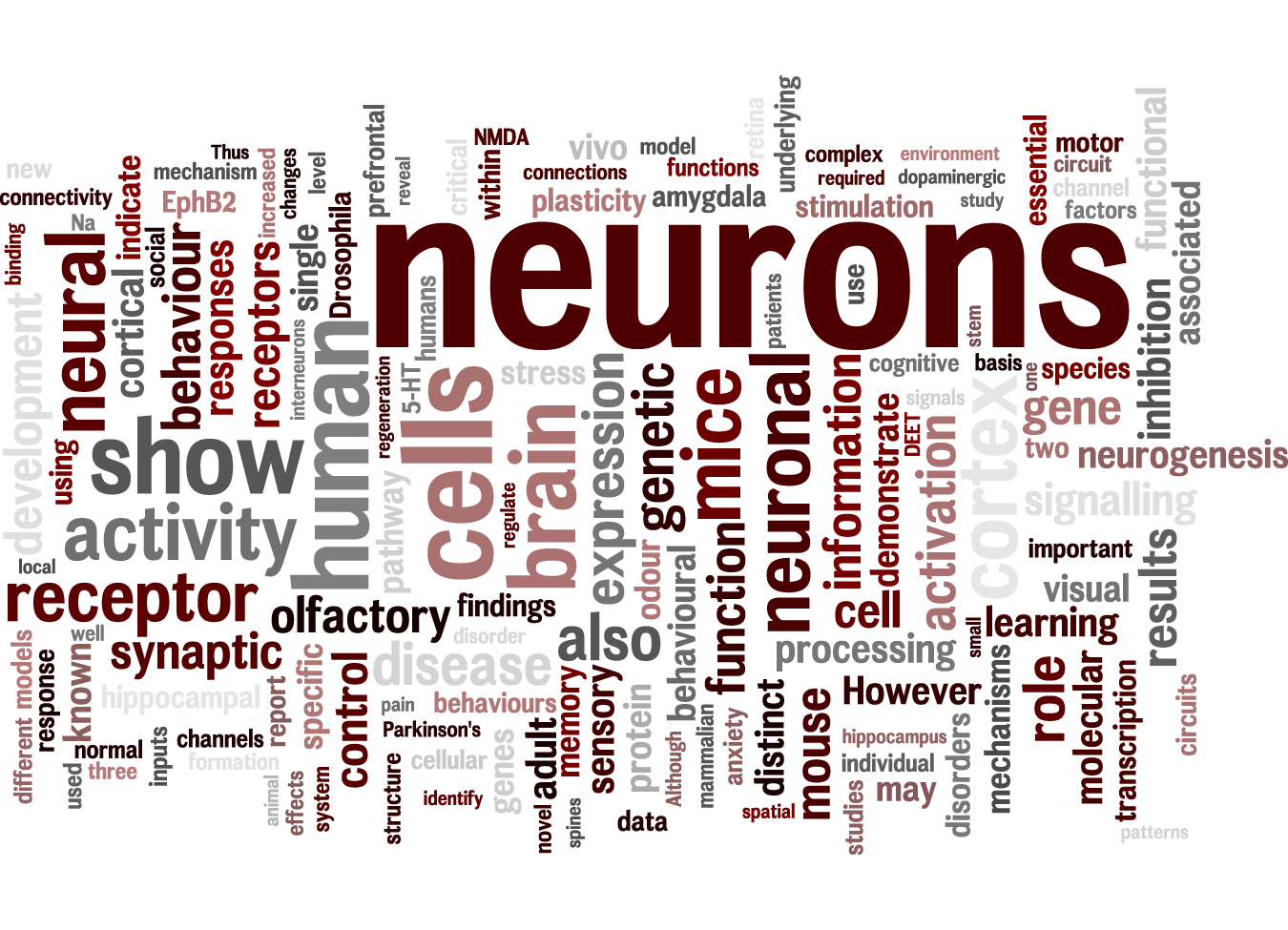
A year of neuroscience in Nature

Something light for the weekend: deconstruction of a year of neuroscience in Nature. This text cloud was created from the titles and abstracts of 83 neuroscience papers published in Nature in 2011. Click on the image to see a larger version. Frequency is represented by font size and common words such as “the” and “and” are excluded. Not too surprisingly, “neurons” came out on top (149 occurrences).

Continue reading

Vote for “Method of the Year”

Last year, the editors of Nature Methods chose a “Method of the Year” (MOY) and the winner was next generation sequencing. This feature included an editorial, commentaries, news features and other types of content discussing the winning technique.

This year, the editors want input from the scientific community. Go here to see the nominees and cast your vote. Interestingly, you can vote positively or negatively for a technique as well as leave comments in discussion forums. Although the ultimate choice will still remain an editorial decision, at least the editors will get feedback from the community.

This is some great use of Web2.0 to get the community engaged and I hope that you will participate.

Getting into and out of character

A great discussion over at Nature Network inspired me to initiate a similar conversation here at Action Potential. Corie Lok asked the question “What is fair play in the blogo/commentosphere?” A fair question indeed. The responses have produced some interesting discussion fodder, but got me thinking about my own experiences on several science blogs. Although this conversation is equally applicable to any type of blog, let’s stick with those dedicated to or mainly engaged in conversations about science.

Continue reading

Big Pharma and academia becoming more and more cozy

I recently attended the Alzheimer’s Disease Keystone meeting in Keystone, CO and became more acutely aware of something than ever before: academia and drug companies really like one another. Sure, the latter always loved the former, since collaborating with university-based scientists often made the publications arising from the private sector look a little more legit. On the contrary, the reciprocity in this relationship has not always been there. There is without a doubt some sub-disciplinary differences in this complex relationship, but in the basic science departments that I lurked around, if you were associated with a company (or worse, left academia for a position there, succumbing to the power of the Dark Side), there was always talk of whether or not you could be trusted. Because companies need publications to prove the legitimacy of their product, right? And the legitimacy determines how much money everyone makes, right? So with such conflicts of interest, could the scientist, or the data being produced by these people, be trusted?

Continue reading

What to do with your unfunded proposals – place them in a centralized repository?

I would say no. Grant proposals are a precious commodity, especially in this day and age of reduced funding and evaporating money. However, in a recent Nature correspondence, Dr. Noam Harel describes his vision for a centralized grant repository, ideally open to the public, where researchers could place their best ideas, allowing various funding agencies to discover the plans most-suited to their respective agendas. Dr. Harel likens this potential web manifestation to something like eBay, Facebook or Google, but for scientists and funding agencies. A more apt analogy might be Monster.com, with both sides searching for their ideal match, and a long-term relationship (perhaps I am now making it sound more like eHarmony.com…).

When it comes to the integration of scientific communication and technology, I am extremely optimistic, and although I don’t reject Dr. Harel’s idea entirely, I just don’t see it taking off in its presently-proposed form.

Continue reading

Haihong Ye: Amazing changes in Chinese neuroscience over the past decade

[This is the inaugural post for a new feature at Action Potential. Periodically, we will provide insights from a regional correspondent on the interesting news, changes, or issues particularly affecting neuroscience in a particular location. Today’s post is from one of our Asian correspondents, Haihong Ye of the Institute for Biophysics in the Chinese Academy of Sciences. She reflects on the dramatic changes that have occurred within Chinese neuroscience during her decade-long absence from this now-flourishing community. We examined these issues in our March editorial, but now invite you to provide your opinion. – N.G.]

Over the past 10 years, especially the last five, the whole world has been amazed by the Chinese economy. To me, however, the improvement in biological science research in China is much more amazing. In the summer of 1998 I left Beijing and went to the US to pursue a Ph.D. in neuroscience. In 2007, after nine years of graduate study and post-doc training abroad, I came back to Beijing, seeking opportunities for further career development. What a difference some strong funding and visionary directives, not to mention a decade, can make.

Continue reading

Neuroscience and Web 2.0: Participation may vary

In the last couple of years, after the recent explosion in the number of resources where scientific discussions can take place rapidly and without boundaries (i.e., using the internet), one could easily have predicted that we were on the cusp of a revolution; the way in which scientists communicated with each other regarding data was about to change forever. Although poster session chatter at your favorite scientific meeting was never going to be replaced, now researchers could interact, trade ideas and get feedback from anyone, anywhere, at any time. Sounds pretty good, right? Unfortunately, it doesn’t seem like neuroscientists are taking advantage of these cool new offerings. I could extrapolate to biology in general, but for more simplicity (and other obvious reasons), let’s stick to what we know best.

Continue reading

Pet sematary

A woman in the US has decided that she loved her pit bull (named Booger) so much, that having him all over again is definitely worth the $150,000 price tag. I saw this story in the BBC, reporting how a Korean company, RNL Bio, has taken its initial order for pet dog cloning, the first such venture of commercial scientific canine cloning (a pet cat was first cloned in 2004). The lead scientist at RNL Bio, Dr Lee Byeong-chun, had previously worked with disgraced stem cell scientist Dr Hwang Woo-suk, whose fraudulent publications created quite a stir (we referred to that scandal on Action potential here.)

The client, Bernann McKunney, gave RNL Bio ear tissue from “Booger”, preserved by an American biotech firm before the dog died 18 months ago. Ms. McKunney had become quite devoted to her dog after she claimed it saved her life, coming to her aid while she was being attacked by another dog, an encounter that cost her an arm. For those of you wishing you had the six figures required to re-create your close canine companion, never fear, RNL Bio’s marketing director, Cho Seong-ryul believes that the cloning costs should come down to be under $50,000, as the industry begins to “take-off”.

Continue reading

What are you doing for Darwin Day?

The Darwin Day celebration was initiated by Dr. Robert Stephens and was held at Stanford University on April 22, 1995 to celebrate the scientific accomplishments of Charles Darwin. In subsequent years, the event was changed to be on or around the birthday of Darwin (February 12, 1809) and has had many illustrious speakers take part, including Richard Dawkins and Donald Johanson. The celebration has become a global one, with museums, academic institutes, private foundations, and others sponsoring some form of a tribute to this famous scientist.

A consolidated list of this year’s events, held around the world, is here. Tell us what you plan to do on Darwin day, and if you take part, report back here on what you learned, disagreed with, or experienced. If we get a nice response here, perhaps we can prepare an event synopsis for ARJ, in case their readers miss out on the celebration.

Easing back into it

Well, now, it has been a nice long break since the last post, but time to get this blog rolling again here in 2008. Let’s start light, while I finish cooking up the stuff I want to discuss. Let’s return to a request I buried in a previous post that received no response:

With regards to moving on, I have plenty of ideas for new discussions, but would also like to offer up the concept of “reader-generated content.” If I receive enough participation, I’m willing to discuss what you find interesting as often as you send me promising topics. For now, let’s set the modest goal of one reader-selected topic every 2 weeks, and go from there. If you would rather keep your communications and ideas private, feel free to email me at ‘Actionpotential’ at natureny dot com.

This can take any form, including a nomination for a new study that you think might stimulate conversation, or for clarification on a Nature Neuroscience paper that was recently published (I especially encourage the non-scientist readers to take us up on this offer!).

In addition, if you haven’t noticed, we have been working on a modest facelift of the blog homepage, with more organization and categorization. I’d love to hear any feedback on any of these new aspects and will take any other suggestions that might make the blog more user-friendly. Here’s looking towards a captivating survey of neuroscience in 2008!