Contamination created controversial ‘acid-induced’ stem cells

Stem cells that were claimed to be created simply by exposing ordinary cells to stress were probably derived from embryonic stem cells, according to the latest investigation into an ongoing scientific scandal. How that contamination occurred, however, remains an open question.

The investigation was instigated by RIKEN, the Japanese research institution where the original claims were made, and carried out by a committee composed of seven outsiders.

The committee analyzed DNA samples and laboratory records from two teams behind the original papers describing STAP (‘stimulus-triggered acquisition of pluripotency’) cells.  Those papers — published in Nature but later retracted  — were once heralded as describing a shortcut to producing stem cells: rather than expressing specific genes or carefully transplanting a nucleus from one cell to another, researchers could, it seemed, create stem cells by exposing them to stress, including bathing the cells in acid.

The latest investigation suggests that the STAP findings were merely the result of contamination by embryonic stem cells. Investigators found signs of three separate embryonic stem cell lines. They noted that it is difficult to imagine how contamination by three distinct lines could be accidental, but that they could also not be certain that it was intentional. 

“We cannot, therefore, conclude that there was research misconduct in this instance,” the committee wrote. It did, however, find evidence that lead investigator Haruko Obokata, formerly of the RIKEN Center for Developmental Biology in Kobe, had fabricated data for two figures in the original STAP publications.

The committee’s report, released on 26 December, is the latest in a series of damning revelations about the STAP cells originally described in two Nature papers in January 2014. The approach quickly came under scrutiny as other researchers failed to reproduce its results, and as suspicions grew that images in the original papers had been manipulated. In March, another RIKEN investigation found Obokata guilty of scientific misconduct; in July, the STAP papers were retracted  and in August another co-author, Yoshiki Sasai, took his own life. Earlier this month, Obokata resigned her position at RIKEN.
 

Work still needed to reduce animals in research

Replace, refine, reduce. Those are the goals of a centre founded 10 years ago to improve the welfare of animals used in research. But more still needs to be done to embed these ideas, according to the head of the centre.

Lab_mouse_mg_3140

{credit}Wikimedia Commons{/credit}

Vicky Robinson, chief executive at the London-based National Centre for the Replacement, Refinement and Reduction of Animals in Research (NC3Rs), says that when the centre was launched 10 years ago there was “some uncertainty” in the scientific community about it. The organization has since funded research that ranges from using facial expressions of animals to assess pain and improve welfare to growing ‘micro-cancers’ in a dish in order to reduce the use of animals used in drug development.

Last week, launching the NC3R’s strategy for the next decade, she said: “Ten years on I think the transformation has been huge. Getting a grant from the NC3Rs really does count these days.”

But she added that there were still “too many scientists who think that the 3Rs belong in the animal house” and do not apply to their research. And she admitted that there were still concerns in the scientific community to be overcome around whether changing laboratory conditions to improve animal welfare could also negatively impact research outcomes. The new NC3Rs strategy includes working to ensure that standardised measures of animal welfare can be used to improve both the welfare of animals and scientific results, that all scientists are committed to the ‘3Rs’ and that this is expanded to other countries.

Jim Smith, chief of strategy at the UK’s Medical Research Council, told the meeting that the work of the NC3Rs had been “enormously influential”. He cited the widely-backed  ARRIVE guidelines, which lay down how researchers using animals should report their work in journal papers, as an example (although there is some debate over how effective the guidelines have been).

Despite the work of the NC3Rs, Smith admitted, the statistics show an increase in animal use in UK research every year. However, much of this is down to the UK measuring procedures, rather than animals used; breeding counts as a procedure, meaning that simply producing genetically modified animals needed for scientific research is a huge contributor to the overall rise.

Stephen Holgate, the chair of the NC3Rs board, told the meeting that the centre had created a community of like-minded animal-welfare scientists that did not exist before.

“The success of the NC3Rs is without doubt,” he said. “Our challenge now is to get adoption and uptake.”

STAP co-author offers yet another recipe for stem cells

A senior co-author on controversial, and now retracted, stem-cell papers has quietly posted new tips on how the research can be replicated.

Two papers claiming that stressing the body’s cell could produce embryonic-like stem cells, a process called stimulus-triggered acquisition of pluripotency (STAP), were heralded when published in Nature in January but thrashed soon after when problematic images and figures were soon found.

That might not have been so worrisome if the experiments, which the authors called easy to do, were replicated, but various external groups tried and failed to do so. Co-authors in Japan responded with a tip sheet. Soon after that, the lead author on the paper laying out the fundamental STAP technology, Charles Vacanti of the Brigham and Women’s Hospital in Boston, Massachusetts, released his own, quite different, list of tips for reproducing STAP. Still no one succeeded in replicating the findings.

Since April, Hitoshi Niwa, a well-respected mouse-stem-cell specialist at the RIKEN Center for Developmental Biology (CDB) in Kobe and a co-author on the papers, has been giving a focused, last-ditch effort to replicate the experiment; on 27 August, he reported no luck so far and suggested that light emission from dying cells, known as autofluorescence, might have been confused with fluorescent tags meant to signal conversion to the embryonic-like state.

During that period, the lead author on both papers, the CDB’s Haruko Obokata, was found guilty of misconduct and both papers were retracted. Obokata’s supervisor at the CDB, Yoshiki Sasai, committed suicide, and Vacanti stepped down as chairman of Brigham and Women’s department of anaesthesiology, perioperative and pain medicine. The CDB itself has halved in size.

One might have thought that STAP was finished. But Vacanti is not one to give up so easily.

Even when he finally agreed to retract the papers, he maintained, in a post on his department’s website, that “there has been no information that cast doubt on the existence of the stimulus-triggered acquisition of pluripotency (STAP) cell phenomenon itself.” Vacanti said that he was confident that Niwa would “replicate the core STAP cell concept that my brother Martin and I originally hypothesized, and trust that it will be verified by the RIKEN as well as independently by others.”

Now, in a note posted without fanfare on Vacanti’s department’s website and dated 3 September — one week after Niwa announced failure to replicate the findings — Vacanti has offered his second revision to the STAP protocol.

In comparison with his first revised protocol in March (‘Refined protocol for generating STAP cells from mature somatic cells’), the new one (‘REVISED STAP CELL PROTOCOL. 09.03.14’) highlights the use of ATP in the solution, in combination with two stresses — exposure to acid and physical pressure on the cell membranes — that he used in the previous recipe. “In recent months, our lab decided to re-explore the utility of a low pH solution containing ATP in generating STAP cells,” Vacanti writes in the revised protocol. “We found that while pH alone resulted in the generation of STAP cells, the use of a low pH solution containing ATP, dramatically increased the efficacy of this conversion.  When this acidic ATP solution was used in combination with mechanical trituration of mature cells, the results were even more profound” (emphasis original).

“We made a significant mistake in our original declaration that the protocol was ‘easy’ to repeat,” the protocol continues. “This was our belief at the time, but it turned out to be incorrect. Many of the steps described appear to be a function of the technique of the individual investigator. Consequently, the revised protocol below should increase the likelihood of success.”

Japanese lab at centre of stem-cell scandal to be reformed

The Japanese research centre where one researcher was found guilty of scientific misconduct and another died in an apparent suicide this year will be renamed and reduced in size, the institute announced today.

The RIKEN Center for Developmental Biology (CDB) in Kobe is renowned as a world-leading organization for studying stem cells. But its reputation has been severely damaged by this year’s scandal: CDB biochemist Haruko Obokata was found guilty of scientific misconduct in work that claimed an easy way to make embryonic-like stem cells, but which no-one has been able to replicate. In July, her two Nature papers published on the technique, called stimulus-triggered acquisition of pluripotency, or STAP, were retracted. In August, Yoshiki Sasai, a senior co-author of the papers and a pioneering researcher at the CDB, was found dead: he left a suicide note that blamed the storm of media attention around the retraction of the two papers.

An independent RIKEN reform committee had recommended in June that the CDB be entirely dismantled. But that call led to a groundswell of support for the centre from stem-cell researchers around the world. They argued that one case of research misconduct did not mean an entire institute should be closed, even if a new centre replaced it. The committee’s proposals for the CDB “may even be more damaging than the incident itself”, noted Maria Leptin, a molecular biologist and director of the European Molecular Biology Organization in Heidelberg, Germany.

On 27 August, RIKEN said that the centre would be renamed, and its number of laboratories cut. It was not clear how many of its 540 staff would lose their jobs, if any. Masatoshi Takeichi, who has led the CDB since it was founded 14 years ago, will step down.

RIKEN also revealed in an interim report that its attempt to replicate the stem-cell findings have been unsuccessful. Histoshi Niwa, who is leading the replication effort and was a co-author on the original STAP papers, said he hadn’t yet managed to generate embryonic-like stem cells after treating mouse spleen cells with acid. The final report is expected by March. Obokata is also working on a replication attempt.

Science shut down at crippled UK Antarctic base

UPDATE – 12/8

The British Antarctic Survey has confirmed that the problem at the base was caused by a coolant leak in the heating systems, which prompted the generators to overheat and shut down.

“Scientific instruments that are used for atmospheric research remain switched off so that the electrical energy can be used to heat the living accommodation,” said BAS in the 12 August update. “Planned station engineering and research for the forthcoming season is being rescheduled.”


Original story

Science has ground to a halt at the UK’s Halley Research Station in Antarctica in the wake of a mysterious power failure.

The British Antarctic Survey (BAS), which runs the station, says that staff on the site are safe but are still attempting to determine the exact cause of “a serious operational incident” on 30 July that took down both electrical and heating systems.

The Halley Research Station just recorded a record low temperature

The Halley Research Station just recorded a record low temperature{credit}British Antarctic Survey{/credit}

Although some power and heating has been restored, “all science, apart from meteorological observations essential for weather forecasting, has been stopped”, says a BAS statement. Exactly what this will mean for ongoing research is unclear, but the BAS say it is likely that ozone monitoring, meteorology related to climate science and studies of the upper atmosphere used for forecasting space weather have all been disrupted.

As it is currently winter in Antarctica, the base was not fully operational, but still had 13 staff maintaining various functions through the seasonal darkness. Two staff members tweeted that during the power outage, the base recorded its lowest ever outside temperature: –55.4 degrees Celsius.

“Throwing a cup of boiling water into the air resulted in a small explosion as the water instantly turned into a cloud of ice crystals. This obviously didn’t help us on station at the time but it was nice to see a record set!” wrote Anthony Lister, an electrical engineer at Halley, on his blog.

Scripps president resigns after faculty revolt

The president of the Scripps Research Institute intends to leave his post, according to a statement from Richard Gephardt, the chair of the institute’s board of trustees. The announcement came in the wake of a faculty rebellion against the president, Michael Marletta, who had attempted to broker a deal in which the research lab, in La Jolla, California, would be acquired by the Los Angeles-based University of Southern California (USC) for US$600 million.

In the statement, posted on 21 July, Gephardt said that Marletta “has indicated his desire to leave” Scripps and that the board “is working with Dr Marletta on a possible transition plan”.

Scripps Research Institute president Michael Marletta resigned after clashing with faculty over a proposed merger.

Scripps Research Institute president Michael Marletta resigned after clashing with faculty over a proposed merger.{credit}Scripps Research Institute{/credit}

Scripps faculty members see Marletta’s departure as a victory. They had been angered by the terms of the USC deal, which was scrapped on 9 July, and by the fact that Marletta did not consult with faculty during his negotiations with USC. Faculty members told the Scripps board of trustees earlier this month that they had an almost unanimous consensus of no confidence in Marletta.

“I think we are more optimistic than we have been in many years, because we feel like we have some control over our own fate,” says Scripps biologist Jeanne Loring.

Loring said that at a meeting with a majority of Scripps faculty on 21 July, Gephardt indicated that the board had thought that Marletta was communicating with the faculty as he negotiated the USC deal. Gephardt also promised that faculty would involved in choosing Marletta’s successor.

Whoever replaces Marletta must find a way to close a projected $21-million budget gap this year left by the contraction of funding from the US National Institutes of Health (NIH) and by the virtual disappearance of support from pharmaceutical companies, who had provided major support for Scripps until 2011.

How Scripps solves its funding issue will be watched by other independent institutes, which have been hard hit by the contraction in NIH dollars. Scripps’ neighbour institutes have brought in hundreds of millions of dollars in philanthropy, and many involved see that as part of the solution for Scripps as well. But, Loring says, “the funding that other institutes have got from philanthropy is going to be a short-term solution, because even though it seems like an awful lot of money, they have to spend it, so they will eventually be facing the same issues.”

Follow Erika on Twitter: @Erika_Check.


Chimps from controversial lab move to retirement home

Posted on behalf of Katia Moskvitch.

Juliussohappy_AF-300x199

Julius, 46, is one of 110 research chimps who are now permanently retired at a sanctuary in Louisiana.
Credit: Chimp Haven

Tosha, Sassy, Paula, Julius and their 106 friends will now be munching peppers and bananas without worries of being used to test new drugs. The chimpanzees, formerly used for biomedical research by the US National Institutes of Health (NIH) facility New Iberia Research Center (NIRC) in Louisiana, have now arrived at Chimp Haven, a federally funded sanctuary in Keithville, Louisiana.

“Our dreams have finally been realized for these amazing animals,” said Chimp Haven’s president Cathy Willis Spraetz in a statement.

The move comes two years after the NIH announced it would retire the NIRC’s 110 chimps, following an undercover video investigation by the Humane Society of the United States that exposed animal mistreatment at the facility (see ‘NIH retires research chimps at troubled facility‘).

Initially, the NIH had planned to send only ten of the animals to Chimp Haven and the rest to the Texas Biomedical Research Institute in San Antonio. The NIH changed its mind after the sanctuary embarked on an extensive campaign that resulted in making extra room at Chimp Haven to accommodate many more animals and raising money for their care.

Although experiments on chimps contributed to several medical breakthroughs, such as vaccines against hepatitis B and polio, recent scientific developments have created viable alternatives to primate research.

The retirement plan for the NIRC’s chimps was just the first step in scaling back the NIH’s primate research. In June 2013, the NIH announced it would retire to sanctuary nearly all of its research chimpanzees, about 310 of them, leaving only up to 50 for scientific experiments. NIH director Francis Collins said at the time that chimps, as humans’ closest living relatives in the animal kingdom, “deserve special respect”.

The decision followed a landmark report by the US Institute of Medicine published in December 2011, which outlined strict criteria for the use of chimps in biomedical and behavioural research.


Nominations Open for Nature Awards for Mentoring in Science 2014

Nominations are now open for the annual Nature Awards for Mentoring in Science, this year celebrating outstanding scientific mentors in Ireland and Northern Ireland.

Launched in 2005, the global awards celebrate scientific mentors in a specific country or countries each year. The awards have previously focused on Australia, Canada, France, Germany, Japan, the Nordic countries, South Africa and the UK.

Two prizes of €10,000 will be awarded, one for a mid-career mentor and one for life-time achievement in mentoring.

Continue reading

The decline and fall of Microsoft Academic Search

Five years after it launched, Microsoft’s free scholarly search engine has fallen into shabby disrepair, failing to track even a fraction of papers published since 2011. But the team behind the product says that they are shifting their focus to a yet-to-be-released, next-generation version of the service.

A few years ago, Microsoft Academic Search (MAS) was vying with Google Scholar to be the web’s pre-eminent free scholarly search engine. Both products indexed tens of millions of scholarly documents, tracked their citations, and made profile pages for academics. MAS, which seemed to be envisaged as a research project as well as a free tool, seemed to have the edge on some features — visualizing connections between research fields, for instance. The stage was set for bibliometric battle.

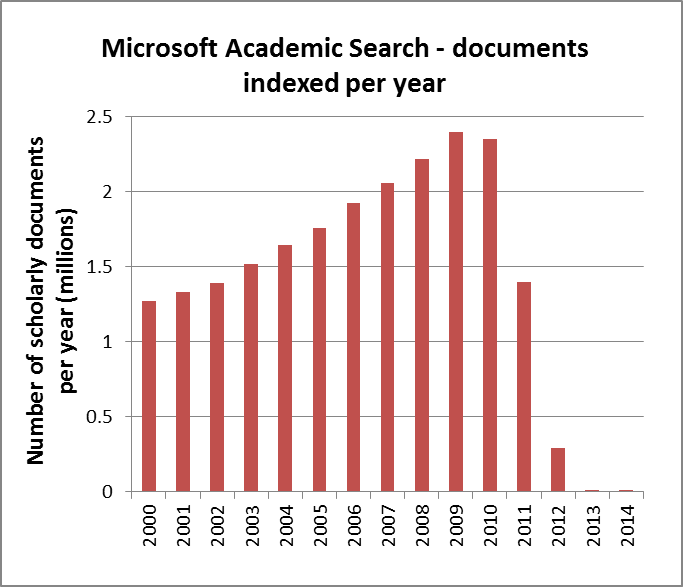
But the competition never happened.  A team of Spanish researchers who study science communication at the University of Granada, led by Emilio Delgado López-Cózar, decided to compare Google Scholar and MAS. They discovered — to their surprise — that Microsoft’s product had been failing to efficiently index scholarly documents since around 2011. (Last year, it captured only 8,000-odd documents.) “Is Microsoft Academic Search dead?” they asked in a working paper published on the arXiv preprint server on 28 April.

Others had noticed the issue too, judging from complaints left on the service’s message board last year, to which the only answer given was that the company was “actively working on indexing additional content”.

A phoenix may be rising from the ashes. Asked about the collapse, a spokesperson for Microsoft Research declined to address the problem directly, writing in an e-mail:

“Microsoft Academic Search (MAS) continues as a research project within Microsoft Research. Over the years, we have used the service as a mechanism to explore various challenges related to searching scholarly works, including author disambiguation, relative influence of publications, and graphs of related authors.”

But, he added:

“In parallel, Microsoft Research began an initiative on a next-generation version of MAS, which focuses on enhancing the user experience and evolving it from a research project to an integrated offering within Microsoft’s services portfolio.  During this transition, Microsoft has maintained the features, functionality, and the ability for third parties to enter new and updated content into the existing search engine, but the majority of our focus has now shifted to this new initiative.”

He later clarified that the new version, yet to be released, would remain free. At one stage, the company had wondered whether to “evolve the service through third-party collaborators”, he said, but in the end decided to keep the product within Microsoft. The Spanish team notes that the lack of fuss about MAS’s sudden decline suggests not many people were actually using it.

Indeed, Google Scholar has far outstripped MAS by now.  It can find about 99.3 million, or 87%, of an estimated 114 million English-language scholarly documents on the web, according to an estimate published last week by Lee Giles and Madian Khabsa at Pennsylvania State University at University Park (PLOS ONE 9, e93949; 2014). ‘Documents’ include books, technical reports and other grey literature, and the computer scientists estimated the number by combining results from Google Scholar and MAS.

At least 24% are freely available, they added. In a score of well-known journals (those classified as ‘multidisciplinary’ under MAS, which includes not only Nature, Science, Proceedings of the National Academy of Sciences and PLOS ONE  but also Nano Letters, Journal of Applied Meteorology, Journal of the Royal Society Interface and others), 43%  are free, give or take an estimate error of 10%.

Even Google Scholar has its weaknesses, however, the team notes. One is that it doesn’t provide an automated way for computer programs to make searches in the tool through an application programmable interface (API), so searches must be made by hand. It was only by using MAS’s API that the team could download and randomly sample documents for their survey. And of course, quantity is not necessarily quality: Google Scholar indexes more documents than do subscription products such as Thomson Reuters’ Web of Science or Elsevier’s Scopus databases — but it may not yet match their reliability.

Nimble amoebas battle for world supremacy

dicty race

{credit}H. Ledford{/credit}

“Whoosh!” bragged geneticist Michael Myre, spreading his fingers and pushing his hands away from his body. “That’s what they’ll do.”

‘Whoosh’ is not a word often applied to the slime mould Dictyostelium discoideum — affectionately called ‘Dicty’ by its devoted following of cell biologists and geneticists — but Myre, a researcher at Harvard Medical School in Boston, Massachusetts, was feeling confident. It was 16 May, the start of the great Dicty World Race, and Myre had faith that his entry would be the first to glide across the finish line of the 800-micrometre-long track.

The results, announced today, show that Myre was not far off in his prediction. His strains, which lack a Dicty gene that is similar to a human gene linked to a childhood neurological disorder called Batten disease, placed fourth in the race. The champion was a strain from the Netherlands, engineered to be more sensitive to a signaling molecule used in the race as a chemical attractant.

D. discoideum is called a ‘social amoeba’ because single cells swarm together to form multi-cellular structures. That behaviour also makes the cells ideal models of cell movement and migration. Biochemist Arjan Kortholt of the University of Groningen, a member of the team that submitted the fleet-pseudopodded winning strain, says that when Dicty hits its stride it moves like an ice skater, with a right-then-left gliding motion.

The Dicty World Race encouraged genetic and chemical doping — anything that would help researchers learn more about what makes the slime moulds swift and smart as they scurried through the maze-like race track and dashed towards high concentrations of a signaling molecule called cyclic-AMP.

The race also pitted Dicty against leukemia cells called HL60 cells. Those cells are typically faster than Dicty but have more difficulty negotiating complex mazes.

Bioengineer Daniel Irimia of the Massachusetts General Hospital in Boston hosted the race in his lab, and said he hoped the effort would call attention to the research while also introducing the community to tools they could use to standardize their cell migration assays. Kortholt says the race particularly captured the imagination of students, and he thinks may have attracted a few to his laboratory.

The winning team gets US$5000 and an opportunity to speak at the annual Dicty meeting in Germany this August. Kortholt says his team also plans to celebrate with drinks this week, and a barbeque, weather permitting.

Videos of all the contestants are available at the Dicty World Race site.