When new drug development company H3 decided to throw a party to launch the opening of Kendall Square labs and offices, organizers didn’t have to go very far. They took the elevator downstairs.
Last week, local researchers, bio boosters and lots of men in dark suits from the Japanese drug company Eisai gathered in the trendy meetings room at the new Catalyst restaurant.
Floor to ceiling windows overlook a landscaped concrete plaza that joins the cluster of new and renovated mid-rises known as Technology Square. The landlord, lab developer Alexandria Properties, chose the restaurant — and the former chef of now closed Aujourd’hui — with meetings like this one in mind. Thus, 1,900-square-feet of meeting space behind the dining room can be split up into the Crick, Franklin and Watson rooms. (The rest of the restaurant is farm-to-table chic, with panelling made of old barn boards a “two-way fireplace” encased in glass.)
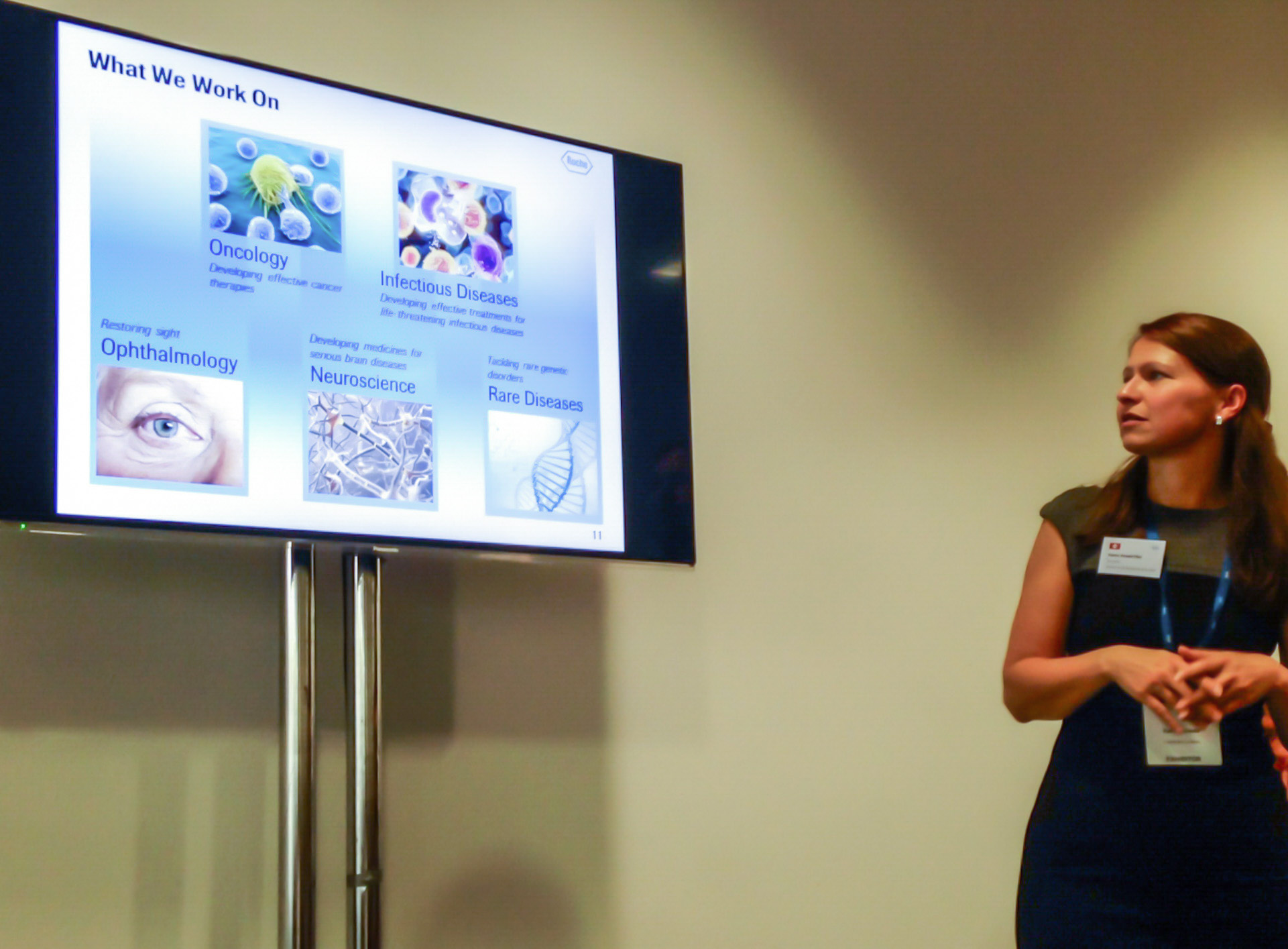
Before the ribbon cutting, waiters worked their way through the crowd with minted oysters on the half shell and tuna tartar. Slides with information about the H3—for “human, health and hope” — looped on two flat screens embedded in the blonde wood siding.
Betting on an approach emerging from the Broad Institute labs, the company plans on “integrating human cancer genomics with next-generation synthetic organic chemistry and tumor biology.” In other words, they plan to use genetic insights gleaned from actual cancer patients to identify therapeutic targets.
H3 Biomedicine is not your standard startup. Rather than seek out venture capital, the company arrives as a subsidiary of Japanese drug maker Eisai. In turn Eisai, which makes anti-cancer cancer drugs along with an epilepsy treatment, has invested $200 million into H3. Many gathered at the event had “Eisai” on their name tags and company president Haruo Naito flew in for the champagne toast. Click here’s for Mass High Tech’s take on the event.
Angus McQuilken, a spokesman for the Massachusetts Life Sciences Center, told the group that “If you stand in Kendall Square and throw a rock in any directions, you’ll hit a world class scientist.” Two of them are H3’s “scientific founders” Dr. Stuart Schreiber and Dr.Todd Golub, both of the Broad. The website Xconomy describes them as “scientific luminaries.”
More from that site.
H3 aims to discover small molecule drugs that target weak points in tumors that have been uncovered through genetic studies of people’s cancers. Fittingly, both Golub and Schreiber are founders of the Broad Institute of MIT and Harvard, one of the largest genomic research centers in the world. Schreiber, an expert at synthesizing drug compounds to home in on disease proteins, has been a founder of numerous biotech companies such as Vertex Pharmaceuticals and more recently Forma Therapeutics. Golub, a fellow scientific founder of Forma, is an authority on the genetics of cancer.
Always worth noting that much of the seed money that allows the Broad researchers to move into drug discovery comes from the feds. The National Institutes of Health database reports that for 2010 and 2011, Golub is working with grants worth $9 7 million, which included about $4 million for the Broad Cancer Center. Schreiber lists $22.3 million in grants, including $15 million money for including Broad comprehensive screening program