The faculty series: Top 10 tips on negotiating start-up packages

Negotiating the best deal for your research is something few junior faculty members are prepared for. Here’s some friendly advice.

New faculty are often given a start-up fund by their new department, which is designed to be enough to cover equipment costs and other expenses before the grants start knocking on the door. The sum of the start-up isn’t set in stone, and this leads to a dreaded period of negotiation; the difficult and lengthy process that few junior faculty members are prepared for. Here, Naturejobs offers help and advice that any new faculty member should bear in mind when trying to get the best deal to carry out their research.

piggy bank

{credit}ImageSource{/credit}

1. Know what you need before beginning any dialogue

Before beginning any negotiation, make sure to know what you absolutely need to carry out your research. Whether this is a telescope, the latest interactive graphics package, a peptide sequencer or a good old-fashioned centrifuge, getting your essentials right will put you in the right position to begin negotiating.

2. There’s no point having equipment if you don’t have any hands to use it

One of the largest costs you can expect to come out of your start-up fund are the salaries of PhD students and postdocs. They’re the most crucial components of the lab for almost all researchers. These are also expensive and, unlike equipment, you have to keep paying for them. If you don’t have the hands available to do the science, all of the new shiny equipment in the world isn’t going to make a difference. Factor trainee costs into your budget. Continue reading

Mobility: Moving within Europe

EURAXESS representatives shared online resources and funding opportunities for those seeking to do science abroad

Contributor Ada Yee

If you’re a student seeking experiences abroad, a newly-minted PhD wanting work in industry-leading countries, or an academic looking to settle in Europe, start by typing “EURAXESS” into your Web browser.  During the Naturejobs Career Expo 2015 in Boston, Massachusetts, we heard from representatives of EURAXESS, a European Commission[https://ec.europa.eu/index_en.htm] initiative designed to encourage researcher mobility and facilitate European research careers. The workshop showcased a range of funding opportunities and resources for researchers of all training levels and—although most attendees were European—all nationalities.

EURAXESS online resource community

For those just starting with their European job search, or for those navigating an overseas transition (including visa paperwork and finding a school for your kids), the session gave a guided tour of EURAXESS’s free-to-use online resource community.

Through the jobs section of the site, job seekers can access an online job portal and upload CVs for organizations’ perusal. So far, the site has collected more than 8,500 job ads, and about 8,000 organizations—including research institutions, universities, and companies—have registered to view CVs, noted Stephanie Jannin, one of EURAXESS’s North America regional representatives.

EURAXESS services also include centers dedicated to helping researchers and their families with the logistics of moving to Europe. Jannin described “a network of over 500 professionals working in over 200 offices across Europe.” Contact information for the centers is found in the services portion of EURAXESS’s site. Continue reading

Enough doom and gloom part 2: Curiosity is the currency of science

Science funding sources have varied over the decades, and will continue to do so as the sociological and political influences change, says Scott Chimileski.

Contributor Scott Chimileski

Twenty-first century science is global, rapidly communicated and irreversibly intertwined with virtually every aspect of society. This immensity creates the impression that our current scientific culture has been established for a very long time. However, the National Science Foundation (NSF), NASA and the Department of Energy (DOE), pillars of basic science that we recognize them to be, were all established after many of today’s senior investigators were born. In addition to appreciating the cyclical nature of funding (see part one), it is critical to consider how and why funding sources have changed throughout the history of science.

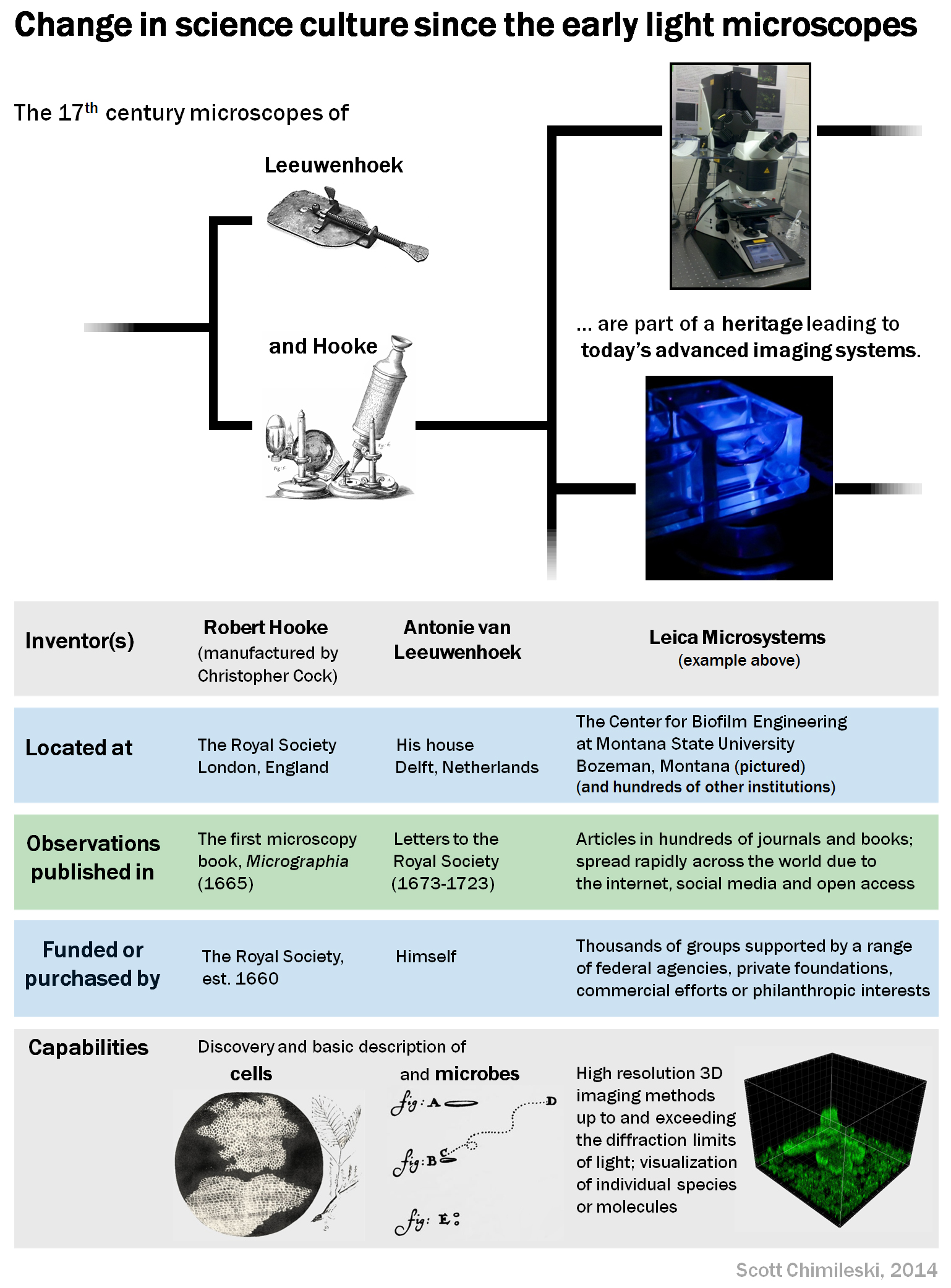
From the scientific revolution at the end of Renaissance through the 19th century, science was largely self-funded or driven by the patronage of other independently wealthy individuals. Many famous forefathers of science had side jobs. Antonie van Leeuwenhoek, whose observations of bacteria in the 17th century inspire microbiologists to this day, was a house manager. Little is known of how he made his microscopes, let alone exactly how he paid for supplies. His contemporary Robert Hooke, another pioneer of microbiology, was an architect and city surveyor. Johannes Kepler wrote horoscopes. And, Galileo Galilei – celebrated for early observations of Saturn’s shape and the Milky Way Galaxy – pitched his telescopes to the military of the Republic of Venice as naval instruments, and to the House of Medici in Florence as a means for naming distant moons after members of this powerful dynasty.

science-funding-inventors Continue reading

France Cordova voted NSF director

France Cordova is voted in as the new National Science Foundation (NSF) director: tackling the women in science and science funding debates head on.

France Cordova

{credit}MARK SIMONS, PURDUE UNIVERSITY{/credit}

Women in science. Not an easy topic to approach.

Funding in science. Another nasty.

What if you combined the two: a female astrophysicist takes on the starring role at one of the biggest science funders in the US?

Why not. Continue reading

This week on Nature Careers

“The disgruntlement is a by-product of how the review system works.”

Johan Bollen

Image courtesy: Johan Bollen

Says Johan Bollen in his Turning point interview. To receive grant funding, scientists have to act like contractors, and the system is extremely slow. So, Johan took things into his own hands, and he hopes to democratise science funding. His plan is that every scientist receiving a base amount of $100,000, and that they would have to divide this amongst they’re colleagues based on their scientific track record.

What do you think about this system? Do you think it will work as a good alternative to the current funding models? We would love to hear from you – leave a comment below and get the conversation started.


Finding a job in the fracking industry

Fracking

A fracking site in Williston, North Dakota. The state has suffered a housing shortage as a result of thousands of workers flocking to join the oil boom.{credit}Shannon Stapleton/Reuters/Corbis{/credit}

For a controversial industry, there do seem to be rather a lot of job openings. Geoscience: Fracking fundamentals looks at where the jobs are, and what they entail. The main problem that needs solving: how to get rid of the chemical waste water.

We’d love to hear from you if you work in the industry and have some advice for job seekers!

Brain initiatives galore, smiles aplenty

Vivien Marx reports on the Society for Neuroscience meeting in San Diego and the big brain projects in the EU and US.
SfN attendance sign

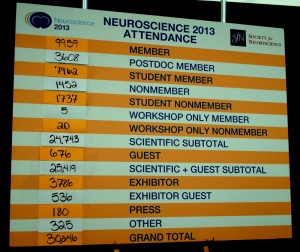
The Society for Neuroscience annual meeting in San Diego clocked record attendance.{credit}Vivien Marx{/credit}

The brain is hot.

Despite dismay about the recent 16-day US government shutdown, the impact of automatic budget cuts–the sequester–taking effect in light of federal budget disagreements in Washington, and the general economic malaise, there is palpable excitement. New large-scale initiatives are getting underway around the world to develop technologies to empower neuroscientists.

This year’s Society for Neuroscience (SfN) meeting in San Diego that has just ended, clocked a record attendance of over 30,000 attendees, noted society president Larry Swanson to attendees with a broad smile in one of his conference announcements. “It is an inspirational time to be a neuroscientist,” he said, with the field drawing attention, for example, across the European Union and in the White House. In a town hall meeting for the Brain Research through Advancing Innovative Neurotechnologies (BRAIN) Initiative, there was no lack of critical comments and suggestions of aspects to include in BRAIN. But smiles stayed plentiful as funders explained their plans.

The fact that the US president chose neuroscience as his multi-year, signature project is something “we should all be pretty excited about,” says Tom Insel, director of the National Institutes of Mental Health. In addition to projects in the US, such as  (BRAIN) Initiative and the EU’s Human Brain Project, large neuroscience projects are just emerging in Australia, China, Japan and Israel. “This is beginning to feel like a global movement,” he says. And projects are unfurling in the private sector, too.

The new tools, says Story Landis, director of the National Institute of Neurological Disorders and Stroke, will help neuroscientists do their work “bigger, better, faster” and expand the research strides made in recent years.

Much remains to be done. Compared to what is known about the kidney or heart, very little is known about the brain, says Insel. Adding to the neurological diseases, he noted, are the “invisible wounds of war” such as traumatic brain injury and post-traumatic stress disorder. Tools to help diagnose these illnesses are urgently needed.

Nora Volkow, director of the National Institute of Drug Abuse says that the BRAIN initiative stands to “act like a catalyst” in ways not unlike the decoding of the human genome and its successive “avalanche of discovery.”

Besides attending SfN’s hundreds of sessions and 17,000 posters, scientists had the chance to get up close and personal with representatives from the funding agencies and to hear about and discuss the new opportunities. Here is a snapshot of some of the announcements.

European Union
As Daniel Pasini from the European Commission’s programme on future and emerging technologies explained, the 10-year European Human Brain Project has invited the scientific community to present “grand ideas” for a massive effort to computationally reconstruct the human brain using supercomputers.

The model will help to study brain-related diseases, which are a major health challenge, an economic and social burden, and to pool data and expertise more effectively and translate results for treatments.

The project, which took three years of planning, involves over 250 scientists across Europe in 135 research groups in 22 countries, including groups in the US and Asia. The program began officially in October and has a budget of $1.6 billion. Half of the money will come from the EU the other will come from national funding sources, Pasini says. The first phase is slated to last 30 months and is funded with $100 million.

Six platforms are to be developed including, for example, the neuroinformatic platform as a single point of access to all neuroscience and clinical data along with software tools. The other platforms involve brain simulation, high performance computing, medical informatics, neuromorphic projects and neurorobotics. The idea is to keep improving the model as new data become available. All tools and data are set to be made available to the global scientific community. The plan is to create the ‘CERN for brain research.’ Not unlike a telescope facility or a super-collider, scientists will be able to perform experiments and use this platform to help continue to expand the model.
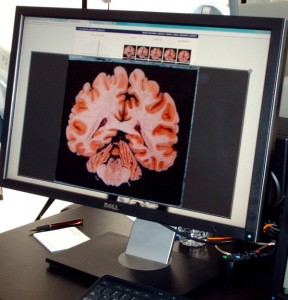
Deconstructing Henry

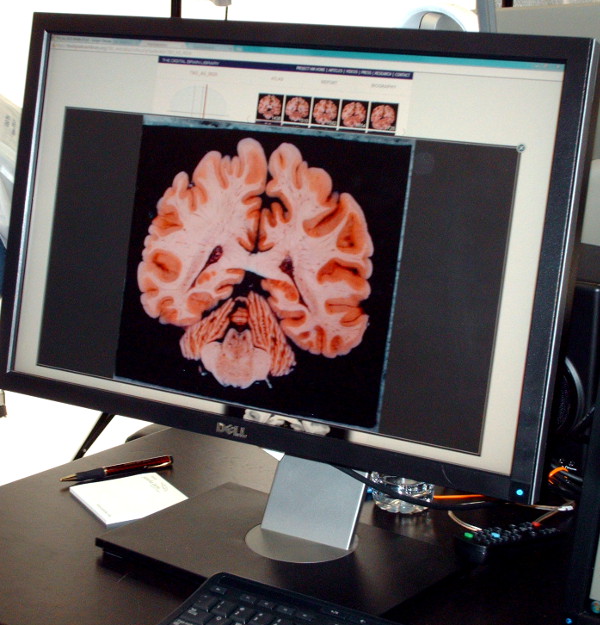
The Brain Observatory at UC San Diego is running ‘Deconstructing Henry’ an examination of the Brain of patient H.M.{credit}Vivien Marx{/credit}

US Defense Advanced Research Projects Agency (DARPA)
“Yes, we build guns and bombs, that is true,” says Colonel Geoffrey Ling of DARPA more generally. He is a neurologist who also served in Afghanistan and Iraq and currently deputy director of DARPA’s division responsible for defense sciences, which does not build bombs and guns. He and many other neuroscientists want to cure diseases ranging from Alzheimer’s to schizophrenia to post traumatic stress disorder to traumatic brain injury. DARPA is indeed “zeroed in” on the problems facing soldiers returning from the battlefield.

Speaking directly to fellow panelists from NIH, he says: “I wish they would double the budget yet again for you guys,” which was greeted by SfN attendees with vigorous applause.

Two DARPA solicitations for proposals are now open, offering “real money,” as Ling says, collecting projects that relate to memory dysfunction and psychiatric disorders. More solicitations are “in the works,” he says. “It’s not for us to decide what you’re going to build,” he says, highlighting the importance of imagination and taking a diversity of approaches.

The funding model at DARPA is shaped by use cases to assure that what is developed serves his constituency, the servicemen and women.

Multidisciplinary research, for example, is not achieved with the collaboration of a cellular neuroscientist, a neurophysiologist, and a neurologist. Rather, for DARPA interdisciplinary efforts can be a team comprised of a mathematician, a physicist and “a crazy guy in his backyard putting together some Rube Goldberg thing,” says Ling.

Unlike NIH, DARPA issues no grants but rather contracts, which are “deliverables-driven,” and may seem more rigid that NIH. But he sees strength in the synergy of the different funding approaches by NSF, NIH and DARPA. DARPA is committed to this project over the next decade, says Ling.

Data-sharing provisions are built into each contract, which DARPA takes “extremely seriously,” and breach of contracts are pursued. The DARPA solicitations issued are just the beginning, he says.

Systems based Neurotechnology for Emerging Therapies (SUBNETS)
Deadline: Dec. 17, 2013
This project seeks proposals to develop devices, perform model organism based research, or enable modeling of human neural systems, which are geared to help treat patients with neuropsychiatric and neurologic disease.

Restoring Active Memory (RAM)
Deadline: Jan. 6, 2014
This project seeks proposals in the area of analyzing and decoding neuronal signals which can be used to help patients recover memory function after injury.

SfN attendee bag

Companies in the neuroscience field may benefit from funding in the emerging large-scale projects. Here a scientst at SfN wears one company’s advertisement.{credit}Vivien Marx{/credit}

National Institutes of Health (NIH)
No grants have yet been awarded through the Brain Research through Advancing Innovative Neurotechnologies (BRAIN) Initiative. But grants are in the pipeline. True, says Insel, some see the project as a perhaps $40 billion dollar challenge, but he views the funding in 2014 as an “initial investment.”

The first report of the BRAIN initiative’s working group, says Landis, offers a guide for how the project could begin to move forward in its first year. The working group, is the advisory committee to the NIH director is chaired by Rockefeller University’s Cornelia Bargmann and Stanford University’s Bill Newsome. Landis says excitement is high in the Obama administration and across NIH. The hope is that this enthusiasm would be reflected in the budget allocations.

The NIH first year funding is “a down payment,” she says.

Insel says that the NIH’s $40 million to be allocated in 2014 is drawn from the following sources:

  • $10 million are coming from the NIH Director’s discretionary fund
  • $10 million are from the NIH Blueprint Neuroscience a program to enhance collaboration across NIH institutes
  • $20 million are split among four NIH agencies: National Institute of Neurological Disorders and Stroke (NINDS), National Institutes of Mental Health (NIMH), National Institute of Biomedical Imaging and Bioengineering (NIBIB), National Institute of Drug Abuse (NIDA)

These monies were previously slated for initiatives of the individual institutes’ choice. As Landis explains, these four agencies agreed that the BRAIN Initiative was the one they selected for fund allocation. She says she and her colleagues are “optimistic” that the excitement, opportunities and promise of the BRAIN initiative will power the budgets of the future. Throughout sessions at SfN, she, Insel and others were quick to squelch fears that BRAIN would draw funding away from investigator-driven grants.

The first NIH Requests for Applications (RFAs) are currently begin hashed out with cross-communication happening across NIH, NSF and DARPA, says Insel.

All BRAIN Initiative projects will be peer-reviewed and perhaps unlike the more classic grants, they will have milestones and there will be expectations of data-sharing. “That’s going to be baked into everything we do in this project,” says Insel. Evaluations will accompany the projects after they are funded.

A number of awards are likely to be cooperative agreements, which are part way between a contract with deliverables and R01s, says Landis. These agreements are accompanied by milestones. If researchers do not share data and that provision is in their notice of grant award “there can be consequences,” she says.

Update: In mid-December NIH announced six funding opportunities. Approximately $44 million will finance six new funding opportunities.

Sunset at SfN

Two of the 30,000 attending scientists take a break outside the SfN conference halls.{credit}Vivien Marx{/credit}

National Science Foundation (NSF)
Cora Marrett, the acting director of the NSF says her agency will “very energetically” support the BRAIN Initiative. She says that funders need to take “the long view” to let the forces of scientific discovery play out with a long-term commitment. “I’m feeling very optimistic, too, about what the long-run prospects for additional resources will look like.”

Evidence of NSF’s engagement with neuroscience in general can be seen in the recent $25 million grant to fund the Center for Brains, Mind and Machines at the Massachusetts Institute of Technology. The intent is to blend computer science, math, robotics, neuroscience and cognitive science.

The BRAIN Initiative will require intense collaboration across disciplines and scales, she says. Neuroscience has been more devoted to small science, she says, the work of individual principal investigators and small lab groups. Marrett agrees with Alan Leshner, the executive publisher of Science, that neuroscience’s strides will benefit from a change in the culture toward larger-scale, interdisciplinary efforts.

At the same time, this shift will occur without prescriptions that all work needs to be on “the huge scale” of a particle accelerator, for example. Indeed neuroscientists will need to integrate findings across the scales of their research and link physiology, biophysical and genetic data with cognitive and behavioral findings (see Leshner Editorial in Science).

The projects will require data management plans of the grantees, she says, to explain how they will handle data-sharing, which is to the benefit of the entire enterprise.


The NIH’s BRAIN Initiative interim report – notes and thoughts

The first official report lists the scientific priorities that will be funded by the NIH as part of the BRAIN Initiative

brain_map

{credit}Margrie & Osten, Nat. Methods{/credit}

Yesterday evening we heard the first official report that delivered some details about what scientific areas the BRAIN Initiative (at least the part coordinated by the National Institutes of Health) will focus on and what its general approach to science funding will be.

Cori Bargmann and Bill Newsome (co-chairs of the NIH-appointed panel that is advising the NIH-director about the plan) spoke through a webcasted seminar to explain the conclusions that arose from the series of scientific workshops and meetings that have been taking place over the summer to discuss what could be the scientific priorities of the BRAIN Initiative. These priorities will set the ground of the research areas to be funded by the BRAIN initiative NIH funding in Fiscal Year 2014 (with a budget of US $40M).

The overall goal of the project was summarized as focusing of developing tools and resources for analyzing neuronal circuits and their function in living organisms.

The two scientists delved on a number of principles that applied to the overall initiative, such as promoting platforms for data sharing, promoting interdisciplinary research and focusing on a variety of experimental organisms and studies across temporal and spatial scales.

The specific areas that will be funded through the Initiative are summarized below:

  1. Generate a census of cell types in the nervous system. Including neurons and glia and techniques for targeting them. To be attempted in parallel in human and animal samples. Methods developed for this should apply across species.
  2. Create structural maps of the brain. This means cell to cell level connections in different animal models. This would complement the Human Connectome project (based on macroscale neuroimaging approaches).
  3. Develop new large scale methods for recording chemical and electrical activity of neurons. Scaling up of electrophysiological and imaging methods as well as completely new technologies.
  4. Develop a suite of tools for circuit manipulation and perturbation of circuit function. A push for the development of technologies like optogenetics that enable manipulating nervous activity in ways that resemble natural activity patterns.
  5. Linking brain activity to behavior. Activity monitoring at the same time that behavior is monitored. Highlighting the importance of making simultaneous measurements during long periods of time and during different types of behaviors.
  6. Integrating theory, statistics and computation with experimentation. Importance of theoretical frameworks that could explain principles of brain function.
  7. Delineate mechanisms underlying macroscale brain imaging technologies, as used in humans.
  8. Create mechanisms to enable collection of human data.
  9. Provide training so that new methods reach the community and promoting interdisciplinary research.

Although these FY2014 research priorities are presented as 9 independent entities, the goal is really to integrate these approaches as much as possible —but how exactly this integration will take place or be promoted is to be revealed by June 2014.  The goals are also highly ambitious and will require much more funding than the BRAIN Intiative’s current budget.

The speakers noted that the goals were not “to develop tools for tools sake” but tools that could have applicability. Innovative tools, thoroughly validated and applied in real nervous systems, improved through iterations and to ensure that they are disseminated efficiently to the community.

The commission also highlighted that their goal was not to deliver the solutions but the problems. Solutions to addressing these challenges are to come from ‘bottom-up’ approaches proposed by the community of scientists.

Tools for studying individual cells in the brain or the entire brain as a whole exist and continue to be very useful. But methods for understanding how connected networks of cells in the brain work and relate to behavior are still largely missing. Even maps of these connected entities remain unknown. Focusing funding on better tools to close this gap will be exciting and productive for advancing neuroscience as a whole.

The conclusions disclosed in this interim report are very much in line with what was expected of the project as announced a few months ago. They also largely agree with the main scientific goals that were deemed to be the top funding priorities for the National Science Foundation for the BRAIN Initiative (which will have US$20M to contribute, as well). Indeed, many of the topics covered in these 9 areas were things we and others discussed in editorials and commentaries related to the BRAIN Initiative in our pages and in this blog. The working group that has developed these priorities has had an inclusive, overarching frame of mind and included most of the major challenges that neuroscience currently faces, as most scientists would probably agree.

As we’ve said before, a push for technology development in neuroscience, with clear goals and challenges that these tools need to tackle, will surely be an efficient way of advancing the science of the brain.

Scientists rally as sequester-based budget cuts loom

Vivien Marx reports from the AACR meeting and Rally for Medical Research in Washington, with details of the AACR plenary address by Harold Varmus.

Leaving the talks and conference halls behind, around 8,000 researchers and clinicians attending the American Association of Cancer Research (AACR) in Washington, DC joined patients and patient advocates on the Carnegie Library grounds to rally against cuts to research budgets. Members of Congress, patient advocates and celebrities involved in the organization Stand Up to Cancer, which also funds research, made their loud and forceful case against sequestration, the impending across-the-board forced 5% budget cuts facing government agencies, including the US National Institutes of Health.

Rally participant, University of Wisconsin scientist Nihal Ahmad, says that the sequester is already hitting his research, cutting into his ability to buy tools and reagents, which is work on signal transduction in tumors.

Overcoming cancer is a “very significant outcome for this country,” says Daniel Pollay of Weill Cornell Medical Center, explaining why he attended the rally. Andrea Russello, a product scientist at Cell Signaling Technology took part in the rally because her customers include academic scientists whose work is being affected by the sequester. She also knows many young scientists who cannot find jobs after their post-doctoral fellowships. The risk now is not just a budget plateau. “I think we’ll really regress if we can’t keep pushing forward,” she says.

Columbia University Medical Center researcher Jeanine D’Armiento looks at matrix metalloproteinases in tumors, in lung diseases in particular. Her latest grant scored in the 9th percentile. “Last year funding was at 10% and now it’s at 6%, if it were last year I would have received that grant. But right now, I don’t have it.” Staff cuts have been inevitable and she feels that her dream to move from mouse models into humans has to be put indefinitely on hold. According to NIH rules, the grant can only be resubmitted after 36 months.

Prior to the rally, National Cancer Institute Director Harold Varmus in his AACR plenary address encouraged delegates to attend it in order to highlight the importance of doing science to counter illness. The new BRAIN Initiative proposed by President Obama, may bode well for the future of science, he says, but it is an initiative that will “come too late” to address the problems cancer researchers face this fiscal year and the near future, he says.

Instead of just a fall over a fiscal cliff, research funding has actually been declining since 2003, he says. Inflation has eroded the agency’s spending ability to 2001 levels.

At the same time, he feels optimism about the new inroads against cancer that researchers are making and the possibilities the current $4.8 billion dollar budget provides. To manage the sequestration, his agency will keep the number of funding grants constant this year with a grant-funding success rate around 13%-14%.

He also took the opportunity to talk about initiatives the NCI is rolling out, also as a way to manage sequestration. The NCI is rolling out new initiatives geared toward ‘precision medicine’, including:

  • A Cancer Knowledge Commons, which is an informatics-based approach to aggregating data from many sources, will help to promote the use genomic analysis to improve research, treatment and outcomes.
  • A new Center for Cancer Genomics to continue the work of such projects as the The Cancer Genome Atlas
  • Clinical trials that find drugs that match the genomic profile of patients to drugs that stand to help them.
  • Continuation of the Provocative Questions Initiative, which is geared toward unanswered questions related to the biology of cancer and which are high risk but are also high reward opportunities.
  • A focus on RAS mutations, which are found in around one quarter of all tumors, leveraging proteomics and immunotherapies.
  • Looking at new ways to perform pre-clinical testing of drugs.
  • Global health initiatives.
  • Programs that take on the cultural change across the research community necessary to allow better sharing of results, reagents and reporting of outcomes from clinical trials.

An era for BRAIN technology

President Barack Obama has just proposed large investments in a project aiming to develop technologies that enhance our understanding of brain function.

In an official announcement from the White House, US President Obama just launched the BRAIN (Brain Research through Advancing Innovative Neurotechnologies) Initiative project. This basic research project is expected to receive large sums of public and private funding to promote technologies that expand our knowledge of brain function.

This was a much awaited announcement. From what can be read in the White House’s official Press release, the BRAIN Initiative will be a collaboration between the US National Institutes of Health, the Defense Advanced Research Projects Agency and the National Science Foundation, with an initial injection of funds going up to $100 million for 2014.

To set the goals and timeline of this project, the NIH will establish a working group composed of 60-80 scientists co-chaired by Cori Bargmann of Rockefeller University and Bill Newsome from Stanford University. Through workshops and meetings that will take place in 2013, the working group will define the detailed scientific goals and establish a multi-year scientific plan for achieving them. The workshops are to start in about one month.

In addition, the project will have several private sector partners: the Allen Institute for Brain Science, the Howard Hughes Medical Institute (HHMI), the Kavli Foundation and the Salk Institute for Biological Studies. Most of these institutions have already been investing in technology development to address the challenges of understanding the brain for some time. In fact, Nature Methods recently published work from HHMI investigators showing the first whole brain imaging of neural activity at the single-cell level. As the details of the goals and timelines of the BRAIN Initiative become clearer over the next few months, we will likely have a more concrete idea of how the budget for BRAIN will be projected in the coming years.

What is unique about BRAIN compared to other previous ‘big science’ projects like the Human Genome Project is that it is advocating for technology development first as it lays out its broad goals without indicating a particular biological idea or concept. The need for technology development is so dear in neuroscience that in our view devoting substantial resources to this is essential for understanding brain function, a view that appears to be shared by the HHMI as evidenced by the substantial technology development they are funding for brain research at the HHMI Janelia Farm Research campus.

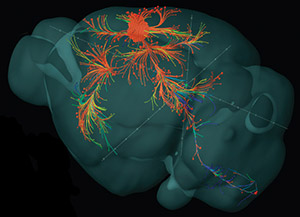
As we have discussed in previous posts on this site and in our April Editorial, to understand the brain we will need technologies that help large scale mapping of the structural wiring diagrams in the brain, that record the activity of whole brains in action at resolutions that mirror those of physiology and behavior and that link function and behavior. In all these areas, we first need to improve our tools and methods.

The progress that can be made by promoting technological development cannot be underestimated. Once more powerful methods are in the hands of researchers, knowledge will advance at a much higher speed and investments in science will be more productive and efficient.

A hit below the belt to Spanish science

In a report published last Thursday, the Spanish government released a sudden modification of the established rules pertaining to the financing of research projects sentencing the research community to more hardships.

Public funds are the main financing source that Spanish science relies on. These programs, which fund research projects as well as individual investigators (mostly young talented scientists starting their labs and returning from postdocs overseas) are granted every year and typically provide funds for projects spanning 3-to-5 years. In the present financial climate, the Spanish government has been continuously and drastically cutting funds for these programs.

In 2009 the Spanish government spent 547 million euros to support science. In the latest resolution of these programs, published last December, these funds were reduced to 309 million (a more than 40% reduction). Rubbing salt into the wound, these funds will also be significantly delayed according to the recent communication, which states that researchers will receive the funds in four years instead of the three that the original call had stipulated back in December 2011.

Making things even worse, the government has announced that during the first year, less than 10% of the funds will be made available to scientists. This is in direct contrast to previous resolutions, in which funds were administered following a 40% in year one, 40% in year two and 20% in year three formula that was deemed appropriate as projects typically require big investments in equipment and reagents during the first years.

In the past, it has been possible for universities or the CSIC (the Spanish National Research Council) to advance some of the funds to awardees, but now these institutions have no money to put forward.

This delay and changed formula for administration of funds will have a devastating effect on the vast majority of active Spanish scientists. In addition, the manner in which this new ‘rule’ has been communicated, late and by surprise, has angered a community of researchers that has already been particularly hit by the economic woes that the country is suffering.

During the 30 years before the 2008 crisis, Spanish research and development productivity had been steadily increasing and gaining visibility in the international community. Young investigators who had gone abroad to do science were returning to Spain aided by new grants and programs. Innovative, cutting-edge Spanish science was no longer a dream but a reality.

Since 2009, the Spanish government has been cutting science budgets relatively more than other areas (average ministries are experiencing cuts of 16%). It is clear that these cuts threaten to undermine the ability of scientific institutes across the country to hire and retain talented personnel. While Spain continues to reduce its support for research, other European countries and the European Union are proposing to increase their investment in science.

The Spanish science secretary Carmen Vela has proposed that Spanish scientists focus ‘on innovation and quality over quantity’ and that private funding of science should increase. But if policymakers continue to take measures that result in more labs closing down and the fleeing of scientists, there will be no talented people left in Spain to drive the innovation that will guarantee a sustainable economy in the future.

Links to other news coverage and political reactions to this resolution

https://sociedad.elpais.com/sociedad/2013/01/24/actualidad/1359061061_171675.html

https://www.abc.es/espana/20130126/abci-gobierno-reduce-ayudas-ciencia-201301261848.html

https://www.izquierda-unida.es/node/11697