
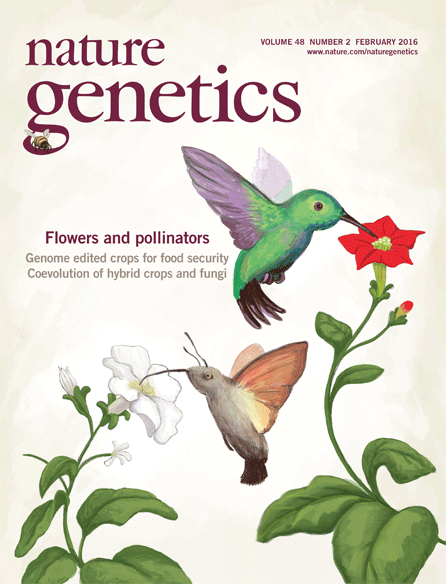
 This month, our cover portrays a trifecta of pollinators and the different flowers from which they feed. Centrally, you see a hawkmoth (left) and a hummingbird (right), with a bee watching the proceedings from above. They are very different organisms and all three pollinate different species of Petunia. The color, scent and morphology of the flowers all contribute to attracting the respective pollinators. The evolution of various floral traits dictates pollinator preference, leading to diversity and speciation of the plants.
The genetics underlying these changes are fascinating to explore. In this current issue, Cris Kuhlemeier and colleagues identified a gene controlling ultra violet (UV) light absorbance of flowers in three species of Petunia. The level of UV absorbance is inversely correlated with color; flowers with high levels of UV-absorbance are white or light colored, while flowers that do not absorb UV are more deeply colored, usually purple or red.
Using QTL analysis and a transposon mutagenesis screen, Kuhlemeier and colleagues discovered a gene that encodes a transcription factor that regulates UV absorbance levels. They characterized the locus in the different Petunia species and found mutations responsible for increased or decreased UV absorbance.
The genetic changes at this locus led to changes in UV absorbance with concomitant changes in flower color; these correlate with changes in pollinator identity. As such, bees and hummingbirds pollinate colorful flowers with low UV absorbance, while the nocturnal hawkmoth pollinates high UV absorbing white flowers. That is why the hummingbird is seen sipping from a red flower, while the hawkmoth helps itself to the white.
For more information and background on this interesting work, see our Q&A with the authors and the News and Views by Erich Grotewold.
Artist Erin Dewalt was inspired by classical drawings of flowers to help her illustrate this example of “Petunia pollinators”.