Sunset on the PSI

As discussed in this month’s Editorial, the Protein Structure Initiative (PSI), a 15-year, nearly $1 billion structural genomics project funded by the National Institute of General Medical Sciences (NIGMS), will be coming to an end in 2015. The impact of ending this project should be minimized to avoid the loss of valuable resources and expertise.

The PSI was begun in 2000 when the US NIH budget was in the midst of substantial growth, spurring the creation of many new “big science” projects. At that time, protein structure determination was painfully slow. The PSI’s initial goals were to develop tools and methods to improve the speed and ability to solve protein structures, as well as to generate a large resource of novel and unique protein structures to facilitate homology modeling and to promote follow-up functional studies.

Protein Structures

{credit}Image Credit: Erin Boyle{/credit}

The PSI drew criticisms from many in the structural biology community from its inception, however. Critics of the first two phases of the PSI pointed out that it focused mainly on solving small bacterial protein structures that were not biologically very interesting, simply because they were relatively easy to express, purify and crystallize. This led the PSI to substantially change course in the third and current phase, PSI-Biology, which began in 2010. The emphasis on throughput was diminished and shifted to solving important, difficult structures like human membrane proteins and drug targets. This change of course has led to several successful structures for highly interesting yet difficult proteins such as GPCRs.

In 2013, a scientific advisory panel produced a mid-point evaluation report of PSI-Biology for NIGMS (PDF), assessing its strengths and weaknesses. The panel commended the impressive number of high-quality structures and methodological advances of the PSI centers, but noted that outreach to the broader biological community was inadequate. The panel found that the PSI’s community resources – the Structural Biology Knowledgebase, a portal for research, news and resources produced by the PSI (in collaboration with Nature Publishing Group), and the Materials Repository, which provides over 80,000 plasmids and 106 empty vectors to the community – were not widely taken advantage of by researchers outside the PSI. The panel also noted that NIGMS should start planning to transition the PSI from its current set-aside funding structure to a different funding model that maintains its unique resources and capabilities – but that it should also extend PSI-Biology for another 3 to 5 years past 2015 to allow it to reach its full potential.

However, budget cuts and a reassessment of NIGMS’s large-scale research initiatives by its new director, Jon Lorsch, has led the institute to prematurely cut the program after the current phase, PSI-Biology, ends in 2015.

The loss of this large-scale program will certainly shake up structural biology in the US, particularly for all those involved in the PSI but also for the many researchers – even outside of traditional structural biology – who benefit from PSI resources. As we discuss in this month’s Editorial, NIGMS now has the opportunity to set an example for other funding agencies in how to wind down a big science project with minimal negative impact. Internal and external transition planning committees have been created by NIGMS to determine which resources and capabilities developed by the PSI should be preserved and how this can be done. NIGMS has also put out a Request for Information seeking community input on the utility of resources developed by the PSI; the response date (May 23, 2014) has only just passed.

NIGMS is expected to make a decision before the end of 2014 as to what will be done with the substantial high-throughput expression, purification and crystallization facilities developed during the PSI’s tenure. In the Editorial we argue that this infrastructure – and the large-scale raw data and metadata generated that is not in any database, but is valuable for mining and algorithm development – should be preserved as much as possible. We argue that a project to systematically sample protein folds should be continued on a smaller scale. We also argue that NIGMS should continue to facilitate team research – as the internal transition planning committee chair Douglas Sheeley has said it will – to tackle particularly challenging structural biology research problems that require hybrid methods to solve.

We will be watching closely to see whether the negative fallout from the end of the PSI can indeed be minimized.

Brain initiatives galore, smiles aplenty

Vivien Marx reports on the Society for Neuroscience meeting in San Diego and the big brain projects in the EU and US.
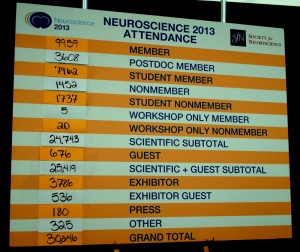
SfN attendance sign

The Society for Neuroscience annual meeting in San Diego clocked record attendance.{credit}Vivien Marx{/credit}

The brain is hot.

Despite dismay about the recent 16-day US government shutdown, the impact of automatic budget cuts–the sequester–taking effect in light of federal budget disagreements in Washington, and the general economic malaise, there is palpable excitement. New large-scale initiatives are getting underway around the world to develop technologies to empower neuroscientists.

This year’s Society for Neuroscience (SfN) meeting in San Diego that has just ended, clocked a record attendance of over 30,000 attendees, noted society president Larry Swanson to attendees with a broad smile in one of his conference announcements. “It is an inspirational time to be a neuroscientist,” he said, with the field drawing attention, for example, across the European Union and in the White House. In a town hall meeting for the Brain Research through Advancing Innovative Neurotechnologies (BRAIN) Initiative, there was no lack of critical comments and suggestions of aspects to include in BRAIN. But smiles stayed plentiful as funders explained their plans.

The fact that the US president chose neuroscience as his multi-year, signature project is something “we should all be pretty excited about,” says Tom Insel, director of the National Institutes of Mental Health. In addition to projects in the US, such as  (BRAIN) Initiative and the EU’s Human Brain Project, large neuroscience projects are just emerging in Australia, China, Japan and Israel. “This is beginning to feel like a global movement,” he says. And projects are unfurling in the private sector, too.

The new tools, says Story Landis, director of the National Institute of Neurological Disorders and Stroke, will help neuroscientists do their work “bigger, better, faster” and expand the research strides made in recent years.

Much remains to be done. Compared to what is known about the kidney or heart, very little is known about the brain, says Insel. Adding to the neurological diseases, he noted, are the “invisible wounds of war” such as traumatic brain injury and post-traumatic stress disorder. Tools to help diagnose these illnesses are urgently needed.

Nora Volkow, director of the National Institute of Drug Abuse says that the BRAIN initiative stands to “act like a catalyst” in ways not unlike the decoding of the human genome and its successive “avalanche of discovery.”

Besides attending SfN’s hundreds of sessions and 17,000 posters, scientists had the chance to get up close and personal with representatives from the funding agencies and to hear about and discuss the new opportunities. Here is a snapshot of some of the announcements.

European Union
As Daniel Pasini from the European Commission’s programme on future and emerging technologies explained, the 10-year European Human Brain Project has invited the scientific community to present “grand ideas” for a massive effort to computationally reconstruct the human brain using supercomputers.

The model will help to study brain-related diseases, which are a major health challenge, an economic and social burden, and to pool data and expertise more effectively and translate results for treatments.

The project, which took three years of planning, involves over 250 scientists across Europe in 135 research groups in 22 countries, including groups in the US and Asia. The program began officially in October and has a budget of $1.6 billion. Half of the money will come from the EU the other will come from national funding sources, Pasini says. The first phase is slated to last 30 months and is funded with $100 million.

Six platforms are to be developed including, for example, the neuroinformatic platform as a single point of access to all neuroscience and clinical data along with software tools. The other platforms involve brain simulation, high performance computing, medical informatics, neuromorphic projects and neurorobotics. The idea is to keep improving the model as new data become available. All tools and data are set to be made available to the global scientific community. The plan is to create the ‘CERN for brain research.’ Not unlike a telescope facility or a super-collider, scientists will be able to perform experiments and use this platform to help continue to expand the model.
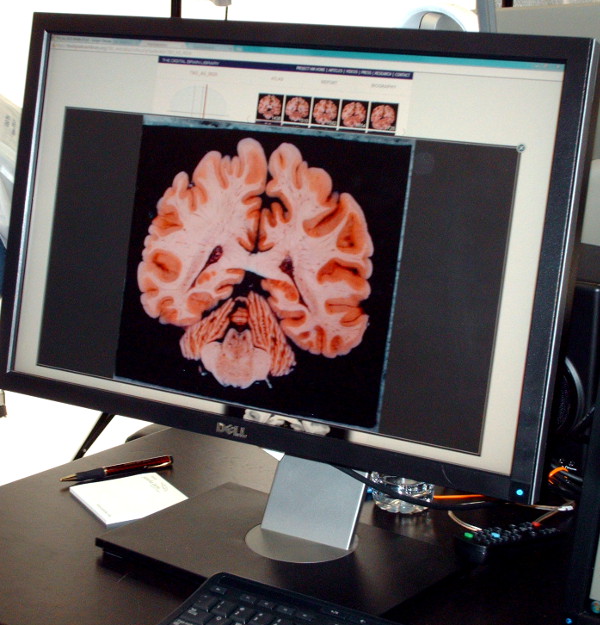
Deconstructing Henry

The Brain Observatory at UC San Diego is running ‘Deconstructing Henry’ an examination of the Brain of patient H.M.{credit}Vivien Marx{/credit}

US Defense Advanced Research Projects Agency (DARPA)
“Yes, we build guns and bombs, that is true,” says Colonel Geoffrey Ling of DARPA more generally. He is a neurologist who also served in Afghanistan and Iraq and currently deputy director of DARPA’s division responsible for defense sciences, which does not build bombs and guns. He and many other neuroscientists want to cure diseases ranging from Alzheimer’s to schizophrenia to post traumatic stress disorder to traumatic brain injury. DARPA is indeed “zeroed in” on the problems facing soldiers returning from the battlefield.

Speaking directly to fellow panelists from NIH, he says: “I wish they would double the budget yet again for you guys,” which was greeted by SfN attendees with vigorous applause.

Two DARPA solicitations for proposals are now open, offering “real money,” as Ling says, collecting projects that relate to memory dysfunction and psychiatric disorders. More solicitations are “in the works,” he says. “It’s not for us to decide what you’re going to build,” he says, highlighting the importance of imagination and taking a diversity of approaches.

The funding model at DARPA is shaped by use cases to assure that what is developed serves his constituency, the servicemen and women.

Multidisciplinary research, for example, is not achieved with the collaboration of a cellular neuroscientist, a neurophysiologist, and a neurologist. Rather, for DARPA interdisciplinary efforts can be a team comprised of a mathematician, a physicist and “a crazy guy in his backyard putting together some Rube Goldberg thing,” says Ling.

Unlike NIH, DARPA issues no grants but rather contracts, which are “deliverables-driven,” and may seem more rigid that NIH. But he sees strength in the synergy of the different funding approaches by NSF, NIH and DARPA. DARPA is committed to this project over the next decade, says Ling.

Data-sharing provisions are built into each contract, which DARPA takes “extremely seriously,” and breach of contracts are pursued. The DARPA solicitations issued are just the beginning, he says.

Systems based Neurotechnology for Emerging Therapies (SUBNETS)
Deadline: Dec. 17, 2013
This project seeks proposals to develop devices, perform model organism based research, or enable modeling of human neural systems, which are geared to help treat patients with neuropsychiatric and neurologic disease.

Restoring Active Memory (RAM)
Deadline: Jan. 6, 2014
This project seeks proposals in the area of analyzing and decoding neuronal signals which can be used to help patients recover memory function after injury.
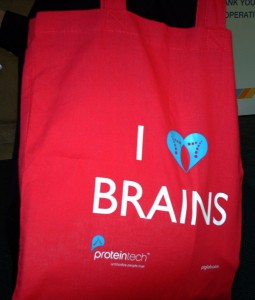
SfN attendee bag

Companies in the neuroscience field may benefit from funding in the emerging large-scale projects. Here a scientst at SfN wears one company’s advertisement.{credit}Vivien Marx{/credit}

National Institutes of Health (NIH)
No grants have yet been awarded through the Brain Research through Advancing Innovative Neurotechnologies (BRAIN) Initiative. But grants are in the pipeline. True, says Insel, some see the project as a perhaps $40 billion dollar challenge, but he views the funding in 2014 as an “initial investment.”

The first report of the BRAIN initiative’s working group, says Landis, offers a guide for how the project could begin to move forward in its first year. The working group, is the advisory committee to the NIH director is chaired by Rockefeller University’s Cornelia Bargmann and Stanford University’s Bill Newsome. Landis says excitement is high in the Obama administration and across NIH. The hope is that this enthusiasm would be reflected in the budget allocations.

The NIH first year funding is “a down payment,” she says.

Insel says that the NIH’s $40 million to be allocated in 2014 is drawn from the following sources:

  • $10 million are coming from the NIH Director’s discretionary fund
  • $10 million are from the NIH Blueprint Neuroscience a program to enhance collaboration across NIH institutes
  • $20 million are split among four NIH agencies: National Institute of Neurological Disorders and Stroke (NINDS), National Institutes of Mental Health (NIMH), National Institute of Biomedical Imaging and Bioengineering (NIBIB), National Institute of Drug Abuse (NIDA)

These monies were previously slated for initiatives of the individual institutes’ choice. As Landis explains, these four agencies agreed that the BRAIN Initiative was the one they selected for fund allocation. She says she and her colleagues are “optimistic” that the excitement, opportunities and promise of the BRAIN initiative will power the budgets of the future. Throughout sessions at SfN, she, Insel and others were quick to squelch fears that BRAIN would draw funding away from investigator-driven grants.

The first NIH Requests for Applications (RFAs) are currently begin hashed out with cross-communication happening across NIH, NSF and DARPA, says Insel.

All BRAIN Initiative projects will be peer-reviewed and perhaps unlike the more classic grants, they will have milestones and there will be expectations of data-sharing. “That’s going to be baked into everything we do in this project,” says Insel. Evaluations will accompany the projects after they are funded.

A number of awards are likely to be cooperative agreements, which are part way between a contract with deliverables and R01s, says Landis. These agreements are accompanied by milestones. If researchers do not share data and that provision is in their notice of grant award “there can be consequences,” she says.

Update: In mid-December NIH announced six funding opportunities. Approximately $44 million will finance six new funding opportunities.

Sunset at SfN

Two of the 30,000 attending scientists take a break outside the SfN conference halls.{credit}Vivien Marx{/credit}

National Science Foundation (NSF)
Cora Marrett, the acting director of the NSF says her agency will “very energetically” support the BRAIN Initiative. She says that funders need to take “the long view” to let the forces of scientific discovery play out with a long-term commitment. “I’m feeling very optimistic, too, about what the long-run prospects for additional resources will look like.”

Evidence of NSF’s engagement with neuroscience in general can be seen in the recent $25 million grant to fund the Center for Brains, Mind and Machines at the Massachusetts Institute of Technology. The intent is to blend computer science, math, robotics, neuroscience and cognitive science.

The BRAIN Initiative will require intense collaboration across disciplines and scales, she says. Neuroscience has been more devoted to small science, she says, the work of individual principal investigators and small lab groups. Marrett agrees with Alan Leshner, the executive publisher of Science, that neuroscience’s strides will benefit from a change in the culture toward larger-scale, interdisciplinary efforts.

At the same time, this shift will occur without prescriptions that all work needs to be on “the huge scale” of a particle accelerator, for example. Indeed neuroscientists will need to integrate findings across the scales of their research and link physiology, biophysical and genetic data with cognitive and behavioral findings (see Leshner Editorial in Science).

The projects will require data management plans of the grantees, she says, to explain how they will handle data-sharing, which is to the benefit of the entire enterprise.

The NIH’s BRAIN Initiative interim report – notes and thoughts

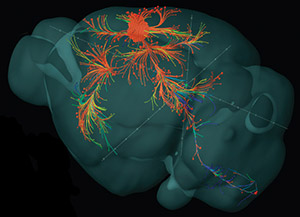
The first official report lists the scientific priorities that will be funded by the NIH as part of the BRAIN Initiative

brain_map

{credit}Margrie & Osten, Nat. Methods{/credit}

Yesterday evening we heard the first official report that delivered some details about what scientific areas the BRAIN Initiative (at least the part coordinated by the National Institutes of Health) will focus on and what its general approach to science funding will be.

Cori Bargmann and Bill Newsome (co-chairs of the NIH-appointed panel that is advising the NIH-director about the plan) spoke through a webcasted seminar to explain the conclusions that arose from the series of scientific workshops and meetings that have been taking place over the summer to discuss what could be the scientific priorities of the BRAIN Initiative. These priorities will set the ground of the research areas to be funded by the BRAIN initiative NIH funding in Fiscal Year 2014 (with a budget of US $40M).

The overall goal of the project was summarized as focusing of developing tools and resources for analyzing neuronal circuits and their function in living organisms.

The two scientists delved on a number of principles that applied to the overall initiative, such as promoting platforms for data sharing, promoting interdisciplinary research and focusing on a variety of experimental organisms and studies across temporal and spatial scales.

The specific areas that will be funded through the Initiative are summarized below:

  1. Generate a census of cell types in the nervous system. Including neurons and glia and techniques for targeting them. To be attempted in parallel in human and animal samples. Methods developed for this should apply across species.
  2. Create structural maps of the brain. This means cell to cell level connections in different animal models. This would complement the Human Connectome project (based on macroscale neuroimaging approaches).
  3. Develop new large scale methods for recording chemical and electrical activity of neurons. Scaling up of electrophysiological and imaging methods as well as completely new technologies.
  4. Develop a suite of tools for circuit manipulation and perturbation of circuit function. A push for the development of technologies like optogenetics that enable manipulating nervous activity in ways that resemble natural activity patterns.
  5. Linking brain activity to behavior. Activity monitoring at the same time that behavior is monitored. Highlighting the importance of making simultaneous measurements during long periods of time and during different types of behaviors.
  6. Integrating theory, statistics and computation with experimentation. Importance of theoretical frameworks that could explain principles of brain function.
  7. Delineate mechanisms underlying macroscale brain imaging technologies, as used in humans.
  8. Create mechanisms to enable collection of human data.
  9. Provide training so that new methods reach the community and promoting interdisciplinary research.

Although these FY2014 research priorities are presented as 9 independent entities, the goal is really to integrate these approaches as much as possible —but how exactly this integration will take place or be promoted is to be revealed by June 2014.  The goals are also highly ambitious and will require much more funding than the BRAIN Intiative’s current budget.

The speakers noted that the goals were not “to develop tools for tools sake” but tools that could have applicability. Innovative tools, thoroughly validated and applied in real nervous systems, improved through iterations and to ensure that they are disseminated efficiently to the community.

The commission also highlighted that their goal was not to deliver the solutions but the problems. Solutions to addressing these challenges are to come from ‘bottom-up’ approaches proposed by the community of scientists.

Tools for studying individual cells in the brain or the entire brain as a whole exist and continue to be very useful. But methods for understanding how connected networks of cells in the brain work and relate to behavior are still largely missing. Even maps of these connected entities remain unknown. Focusing funding on better tools to close this gap will be exciting and productive for advancing neuroscience as a whole.

The conclusions disclosed in this interim report are very much in line with what was expected of the project as announced a few months ago. They also largely agree with the main scientific goals that were deemed to be the top funding priorities for the National Science Foundation for the BRAIN Initiative (which will have US$20M to contribute, as well). Indeed, many of the topics covered in these 9 areas were things we and others discussed in editorials and commentaries related to the BRAIN Initiative in our pages and in this blog. The working group that has developed these priorities has had an inclusive, overarching frame of mind and included most of the major challenges that neuroscience currently faces, as most scientists would probably agree.

As we’ve said before, a push for technology development in neuroscience, with clear goals and challenges that these tools need to tackle, will surely be an efficient way of advancing the science of the brain.

Scientists rally as sequester-based budget cuts loom

Vivien Marx reports from the AACR meeting and Rally for Medical Research in Washington, with details of the AACR plenary address by Harold Varmus.

Leaving the talks and conference halls behind, around 8,000 researchers and clinicians attending the American Association of Cancer Research (AACR) in Washington, DC joined patients and patient advocates on the Carnegie Library grounds to rally against cuts to research budgets. Members of Congress, patient advocates and celebrities involved in the organization Stand Up to Cancer, which also funds research, made their loud and forceful case against sequestration, the impending across-the-board forced 5% budget cuts facing government agencies, including the US National Institutes of Health.

Rally participant, University of Wisconsin scientist Nihal Ahmad, says that the sequester is already hitting his research, cutting into his ability to buy tools and reagents, which is work on signal transduction in tumors.

Overcoming cancer is a “very significant outcome for this country,” says Daniel Pollay of Weill Cornell Medical Center, explaining why he attended the rally. Andrea Russello, a product scientist at Cell Signaling Technology took part in the rally because her customers include academic scientists whose work is being affected by the sequester. She also knows many young scientists who cannot find jobs after their post-doctoral fellowships. The risk now is not just a budget plateau. “I think we’ll really regress if we can’t keep pushing forward,” she says.

Columbia University Medical Center researcher Jeanine D’Armiento looks at matrix metalloproteinases in tumors, in lung diseases in particular. Her latest grant scored in the 9th percentile. “Last year funding was at 10% and now it’s at 6%, if it were last year I would have received that grant. But right now, I don’t have it.” Staff cuts have been inevitable and she feels that her dream to move from mouse models into humans has to be put indefinitely on hold. According to NIH rules, the grant can only be resubmitted after 36 months.

Prior to the rally, National Cancer Institute Director Harold Varmus in his AACR plenary address encouraged delegates to attend it in order to highlight the importance of doing science to counter illness. The new BRAIN Initiative proposed by President Obama, may bode well for the future of science, he says, but it is an initiative that will “come too late” to address the problems cancer researchers face this fiscal year and the near future, he says.

Instead of just a fall over a fiscal cliff, research funding has actually been declining since 2003, he says. Inflation has eroded the agency’s spending ability to 2001 levels.

At the same time, he feels optimism about the new inroads against cancer that researchers are making and the possibilities the current $4.8 billion dollar budget provides. To manage the sequestration, his agency will keep the number of funding grants constant this year with a grant-funding success rate around 13%-14%.

He also took the opportunity to talk about initiatives the NCI is rolling out, also as a way to manage sequestration. The NCI is rolling out new initiatives geared toward ‘precision medicine’, including:

  • A Cancer Knowledge Commons, which is an informatics-based approach to aggregating data from many sources, will help to promote the use genomic analysis to improve research, treatment and outcomes.
  • A new Center for Cancer Genomics to continue the work of such projects as the The Cancer Genome Atlas
  • Clinical trials that find drugs that match the genomic profile of patients to drugs that stand to help them.
  • Continuation of the Provocative Questions Initiative, which is geared toward unanswered questions related to the biology of cancer and which are high risk but are also high reward opportunities.
  • A focus on RAS mutations, which are found in around one quarter of all tumors, leveraging proteomics and immunotherapies.
  • Looking at new ways to perform pre-clinical testing of drugs.
  • Global health initiatives.
  • Programs that take on the cultural change across the research community necessary to allow better sharing of results, reagents and reporting of outcomes from clinical trials.

A hit below the belt to Spanish science

In a report published last Thursday, the Spanish government released a sudden modification of the established rules pertaining to the financing of research projects sentencing the research community to more hardships.

Public funds are the main financing source that Spanish science relies on. These programs, which fund research projects as well as individual investigators (mostly young talented scientists starting their labs and returning from postdocs overseas) are granted every year and typically provide funds for projects spanning 3-to-5 years. In the present financial climate, the Spanish government has been continuously and drastically cutting funds for these programs.

In 2009 the Spanish government spent 547 million euros to support science. In the latest resolution of these programs, published last December, these funds were reduced to 309 million (a more than 40% reduction). Rubbing salt into the wound, these funds will also be significantly delayed according to the recent communication, which states that researchers will receive the funds in four years instead of the three that the original call had stipulated back in December 2011.

Making things even worse, the government has announced that during the first year, less than 10% of the funds will be made available to scientists. This is in direct contrast to previous resolutions, in which funds were administered following a 40% in year one, 40% in year two and 20% in year three formula that was deemed appropriate as projects typically require big investments in equipment and reagents during the first years.

In the past, it has been possible for universities or the CSIC (the Spanish National Research Council) to advance some of the funds to awardees, but now these institutions have no money to put forward.

This delay and changed formula for administration of funds will have a devastating effect on the vast majority of active Spanish scientists. In addition, the manner in which this new ‘rule’ has been communicated, late and by surprise, has angered a community of researchers that has already been particularly hit by the economic woes that the country is suffering.

During the 30 years before the 2008 crisis, Spanish research and development productivity had been steadily increasing and gaining visibility in the international community. Young investigators who had gone abroad to do science were returning to Spain aided by new grants and programs. Innovative, cutting-edge Spanish science was no longer a dream but a reality.

Since 2009, the Spanish government has been cutting science budgets relatively more than other areas (average ministries are experiencing cuts of 16%). It is clear that these cuts threaten to undermine the ability of scientific institutes across the country to hire and retain talented personnel. While Spain continues to reduce its support for research, other European countries and the European Union are proposing to increase their investment in science.

The Spanish science secretary Carmen Vela has proposed that Spanish scientists focus ‘on innovation and quality over quantity’ and that private funding of science should increase. But if policymakers continue to take measures that result in more labs closing down and the fleeing of scientists, there will be no talented people left in Spain to drive the innovation that will guarantee a sustainable economy in the future.

Links to other news coverage and political reactions to this resolution

https://sociedad.elpais.com/sociedad/2013/01/24/actualidad/1359061061_171675.html

https://www.abc.es/espana/20130126/abci-gobierno-reduce-ayudas-ciencia-201301261848.html

https://www.izquierda-unida.es/node/11697

Transparency in NIH funding

Obtaining research funding, particularly from the NIH, is an increasingly daunting task that requires a lot of background information in addition to presenting a stellar proposal.

Researchers need to decide which of the 25 institutes at the NIH is most likely to fund a particular line of work. A new database, linked to RePORTER, NIH’s research portfolio reporting tool, will make this decision a bit easier.

The editorial in the June issue of Nature Methods highlights the importance of this database and a Correspondence in the same issue describes its functionality.

The developers of this database welcome community feedback and we encourage you to try it out.

Supporting young scientists

People have been expressing concern for years about the the continual increase in the age of US scientists receiving funding from the NIH. See for example this post and the links contained therein. Part of the concern is due to the observation, highlighted by a 1993 study, that most scientists do their groundbreaking work early in their careers and these people aren’t being adequately supported by the current system.

The National Academies organized a public workshop in 2004 to explore ways to address this issue and released the “Bridges to Independence” report in 2005 with a chilling but probably not too farfetched possible future outlined in the Foreward. The report called for many useful changes in funding and support by 2010 in an effort to promote effective independence for early career investigators. The NIH has implemented some of thse recommendations. Other countries are also attempting to improve funding prospects for young investigators.

An editorial in the March issue of Nature Methods discusses a different model, pioneered by EMBL and adopted to varying degrees by Janelia Farm and the National Institute of Biological Sciences in Beijing, which involves selective recruiting of talented scientists at an early stage of their careers and providing them with a high level of support that frees them from the need to compete for funding with established scientists and focus instead on high risk innovative research.

Neither model is sufficient on its own and even together they won’t fix the problem overnight but each has unique benefits and stronger efforts on both fronts would help turn things around before we find ourselves in a future similar to that envisioned in the “Bridges to Independence” report.