Why so serious? PowerPoint Karaoke at MRS Meetings

Guest post by Daniel Stadler, PhD student in Chemistry at the University of Cologne and organizer of the PowerPoint©  Karaoke at the Materials Research Society (MRS) meetings

The idea that karaoke is fun and a great ice-breaker is shared by all those who have ever participated in a karaoke event.  But karaoke in science — where you have a PowerPoint© slide instead of a teleprompter and music — can also be hilarious, as was shown at the recent Materials Research Society (MRS) meetings. What if you have never seen a slide you are asked to present: welcome to PowerPoint© Karaoke!

Power Point Karaoke at the Fall MRS meeting 2019 in Boston. Image courtesy of Daniel Stadler.

An initiative of the Student Engagement Subcommittee of the Materials Research Society dedicated to promote the engagement of the younger generation in science, the PowerPoint© Karaoke was coordinated and organized by a group of highly motivated volunteers, and the event was featured at both the Spring and Fall editions of the 2019 MRS meeting. In the words of Sanjay Mathur, a professor from the University of Cologne who chairs the broader committee of which the Student Engagement Subcommittee is part,a science karaoke can be both intimidating and thrilling at the same time, but it creates an excitement that is best described as an amalgam of a delightful social gathering and scientific presentation”.

At this event where you don’t know the content of your slide, you have to come up with your own interpretation and ideas. And because this slide was made by another person, it is sometimes difficult to get the intended message, but this gives the presenter the possibility to create their own, sometimes very entertaining story. A dozen of participants took part to the two editions of the MRS PowerPoint© Karaoke before an audience of more than 200 people, and really nailed it. In the serious and sometimes exhausting frame of a conference, with a lot of discussions, scientific networking and debating, people could see that there is also a room for entertainment and fun in science. Sometimes it just needs one presentation to remind people that this fun is needed to create new ideas.

The event also has some educational aspects. On the one hand, the slide authors have to prepare a clear, readable and – most importantly – understandable PowerPoint© presentation. On the other hand, the presenter needs to get the idea and come up with a catchy way to deliver the message. In fact, the presenter needs to be brave enough to give this kind of presentation in the first place. At this point, the audience comes into play. By cheering and supporting the presenter, the audience creates a relaxed environment: stuttering is not awful, missing a word not a big deal. From this, the role of an audience in any presentation becomes clearer, and should be a take home message for everyone. The interplay between presenter and audience is critical, and the beauty of PowerPoint© Karaoke lies in the fact that people are experiencing this without deliberately noticing.

Going up on stage and giving a three-minute performance on an unknown topic requires self-confidence and courage and I have great respect for everyone who was willing to participate in this very enjoyable event,” says Isabel Gessner, MRS PowerPoint© Karaoke enthusiast since day one. “All participants, presenters and slide authors did a fantastic job, and I am very thankful to the organizer who let us include this scientific and entertaining event in the MRS Meeting program.” 

During the organization of the first event, I did not know in which direction PowerPoint© Karaoke might evolve. Now, one year later, I look back on many wonderful talks and lots of good memories. A good presentation does not need to be only scientifically sound, but also natural. Be yourself, present yourself and deliver the message you see in the PowerPoint© slide. See you at the next MRS PowerPoint© Karaoke event!

Nuclear fusion: Creating artificial stars

Too little does the public hear about nuclear fusion — a process in which two light nuclei collide at high speed and fuse into a heavier nucleus — which is surprising considering the need for alternative energy sources and fusion’s promise to deliver limitless clean and safe energy. If the word fusion brings anything to the mind of the wider public, this is likely related to ITER, a research reactor under construction in France that has repeatedly made the news by over blowing its budget and being substantially behind schedule. Is this all there is to know about fusion? By all means, no. “Let there be light – the 100 years journey to fusion” brings the audience on a fascinating journey across time and ideas into the complex landscape of past and present fusion research.

The documentary, directed by Mila Aung-Thwin and Van Ryoko, was released in March 2017, and explores the world of fusion mainly through the eyes of four of its protagonists, each bringing a different point of view.

Credit: Heath Cairns

Mark Henderson works at ITER, a reactor based on a tokamak design, in which a powerful magnetic field confines the plasma in a toroidal shape. ITER is poised to become the biggest fusion reactor in the world, and its goal is to demonstrate that fusion at the power-plant scale is feasible. At ITER, Henderson is in charge of the systems heating the plasma.

Eric Lerner develops a fusion concept called dense plasma focus, in which large electrical currents run through the plasma, harnessing its natural instabilities to confine and compress it; this type of reactor has the advantage of being much smaller and cheaper than other designs, but technologically is not as advanced. “The first error of the governments in the 1970s was to put all their eggs in the tokamak basket”, he comments. “But actually we still don’t know which route will lead to practical and economical fusion: you should invest not in ideas you think will work, but in all ideas you can’t prove won’t work”.

Michel Laberge is the founder of General Fusion, a private company developing a fusion power device that, instead of employing magnetic fields, uses pistons to compress liquid metal surrounding the plasma to create fusion conditions. “It’s pistons and its’ rings, it’s metal and pipes, it’s plumbing,” he explains. “Turning that into a power plant would actually be not that complicated. I have a saying, I tell my engineers: if you can’t find it at Home Depot it doesn’t go in the machine.”

Finally, Sibylle Gunter is the scientific director of Wendelstein 7-X, an experimental reactor in Germany that is the largest stellarator device in the world. Stellarators, which have worst plasma confinement than tokamaks but can run continuously — an important advantage for future power plants — are based on complicated coils optimized to generate a specific magnetic field configuration. Although stellarators are technologically behind tokamaks, some believe it is stellarators that will eventually deliver fusion on the grid.

The documentary takes the audience right at the beginning of the history of fusion, to the time when, in 1939, Hans Bethe understood the proton–proton reaction that powers stars. A decade later, in the USSR, a self-educated Red Army sergeant posted to a remote island suggested a concept that would become the tokamak; physicist Andrei Sakharov completed the projects for the first reactor in 1950. That same year, the claim (then proven fraudulent) that fusion had been achieved in Argentina inspired Lyman Spitzer, an American physicist, to develop the stellarator. The importance of international collaboration to achieve fusion was recognized already during the cold war (it helped that fusion has no military applications), and in 1985 Gorbachev and Reagan agreed to start a collaborative international project to develop fusion energy, laying the basis for the ITER project.

Among scientists, a period of tremendous enthusiasm in the 1960s was followed by a decade of doubt and skepticism when it was realized that the problem was more complex than initially thought. In the 1980s, on the wake of a new wave of enthusiasm, it was believed that fusion would be on the grid within 50 years, and indeed until 2000 advances were fast. But to take the next step a new machine was needed, bigger, more complex: ITER, which is likely the most complex machine ever built.  I know I will be retired by the time ITER is successful” says Henderson, “so I’m like the guy building a cathedral, who knows he is gonna […] spend his entire career putting bricks together, but he will never see the end piece.

Indeed, ITER is more than a decade behind schedule — first plasma was originally planned for 2016 — and several billion dollars over budget. In a management assessment back in 2013 the problem was pinned down as poor management, ill-defined decision-making processes and poor communications within the project. In 2015 a new Director General was appointed, Bernard Bigot. ITER now has a new date for first plasma, Christmas 2025. “I think ITER will probably work; it will demonstrate that fusion is doable,” says Laberge. “They are gonna blow their budget and their schedule big time, it will burn money at twice the rate you need to, but it will get built and it will work, and this will give a big shot in the arm of fusion.”

One point everybody seems to agree on is that more funding is needed to develop fusion. “The more money you put in, the faster the return. And we have really being putting in peanuts,” comments Henderson. “Fusion is about 20 billions for 20 years. One billion a year. One fancy bridge a year. Peanuts! Let’s do it!” says Laberge. “How long it will take to achieve fusion? At current levels of financing, it will take approximately the age of the universe,” concludes Lerner.

With its beautiful images, helpful animations and an engaging soundtrack, the documentary, which is all narrated through interviews and original clips, is informative and enjoyable. It does not shy away from the challenges and doubts about the feasibility of a complex project such as ITER, but keeps a positive outlook.  It is a welcome reminder that achieving fusion is an extremely important goal, and all potential avenues need to be explored. Whether expert on fusion or curious onlooker, in “Let there be light” there is something for everyone.

Rivalry, crystal structure prediction and discovery of new materials

Post by Artem Oganov.

The review in Nature Reviews Materials can be read here.

The story of our review started in 2006 when my group and the duo of Chris Pickard and Richard Needs published papers that changed the view of the scientific community in an important way. Prior to this, it was widely believed that crystal structures are, in general, not predictable: the number of possible structures is just way too large, and going through all of them is impossible. Our works showed that this problem can be handled, and this opens a way for computational materials discovery. I developed an evolutionary approach, while Pickard and Needs used random sampling. Within a few years we found ourselves in an increasingly intense competition which drove us to develop our methods and explore new applications for them, which, of course, is good for science.

At some point it became clear that if the intensity of this competition was allowed to develop further it could slip into bitterness, and potentially outright hostility. Did I need to win such a fight, if it brought me nothing positive in the end? The question was how to change this. I knew two things: first, that every problem has a solution. Second, I knew that with the right approach every problem can be turned into an advantage. At some point Qiang Zhu, my former PhD student and now Assistant Professor, found a brilliant solution: to write together a review. First, we felt that the community really needed such a review of many years of hard work, now not just of two groups, but also of many others who joined this field later. Second, writing a review with your rivals makes the review actually better: reviews have to be balanced, and rivals are the best people for ensuring this balance! Third, working on something together helps to build bridges. So, with this in mind, after a thorough discussion with Qiang Zhu, Chris Pickard and Richard Needs, I talked to Giulia Pacchioni, an editor at Nature Reviews Materials, and convinced her that we could write something important for the community.

We began working on the review from a position of low trust. We had countless debates, and the writing initially went very slowly. This delay risked us losing the invitation. However, the editors were very patient and encouraging. However, the editors were very patient and encouraging. The first skeleton, basically, a set of bullet points, was sketched by Richard Needs, and then each of us expanded these points, transforming them into a more or less coherent text (I think I took the most bullet points, Chris Pickard took many as well). We tried different ways of co-writing, experimenting with Google-docs and Overleaf, but there was not one technical solution that everyone liked, so eventually we just created our own versions of the review and let Qiang Zhu merge and edit them all. Much later he told me that he quietly cut a lot of text which had a potential for igniting arguments; funny that at the time no one noticed this, which I guess shows that our differences of opinion are actually of little importance. Once we had a complete draft, everyone started editing the text written by everyone else. By the end of this process we were all on the same wavelength. After submission we had one round of peer review and quite a bit of proofreading, mostly handled by me. The end result is one we can be proud of: a nice review of a field that we were fortunate to catalyze. But also a human victory. Rivals becoming friends and gaining a shared understanding is so much more important than winning a competition.

Artem Oganov
Center for Energy Science and Technology
Skolkovo Institute of Science and Technology, Moscow, Russia.

Escape into the wonders of physics

Post by Giulia Pacchioni

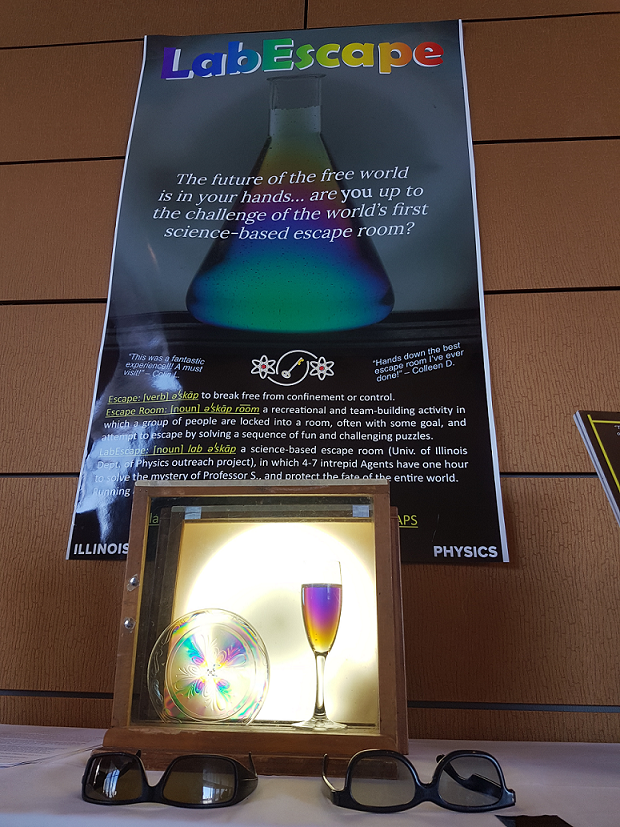
LabEscape is an escape room based on physics – I got the opportunity to explore it during the APS March meeting in Boston, where it was set up for one week away from its usual site in Urbana, Illinois.

Prof. Schrödenberg went missing, and an important grant needs to be submitted. As her new interns we need to log into the computer and hit the submit button. Easy… well, we need to figure out the password, but luckily the professor left hints around the lab in case she forgot it!

Together with a team of five other physicists (the other interns in the lab), before entering the room I was handled information sheets covering some essential physics concepts laid out in a very digestible way. Indeed, the room, which is the brainchild of Paul Kwiat, a physics professor at the University of Illinois, is by all means not designed for physicists (even though it’s an absolute delight for them). It was created to provide an experience that demonstrates to the general public that physics is useful, permeates everyday objects and is, yes, fun.

Peter recommended we read the material carefully no matter how well we thought we knew it already, as knowing which concepts are illustrated in the room can help understanding how to crack the puzzles inside. Apparently, a group of physicists who refused to go through the material couldn’t escape in the set time, whereas a family with no scientific background who did their reading (as any good intern should do!) aced the challenge.

The main suggestion from Paul was to work as a team, with two or three people looking at each hint or object to combine different points of view, and to share all information with the others. He had to help us a bit, reminding us to work together each time we went our separate ways exploring the fascinating bits and pieces scattered around the lab.

The room contains a clever mix of challenges ranging from the usual looking around for hints and tools to actual small experiments using lab equipment that needs to be manipulated and sometimes completed with missing pieces. As in any good lab, instructions on how to use the instruments are provided, accompanied by extra explanations about how each experience works for the curious explorer. I don’t want to give too much away, but we got to play with an oscilloscope and a laser, polarizing glasses and, of course, a dead/alive cat in a box!

The riddles are generally simple, but require some lateral thinking and careful observation, which makes the experience fun and varied without it ever getting boring or frustrating. The experiments use scientific instruments in very creative ways, the type that stimulates a wow reaction both in science novices who think ‘how is this even possible!’ and physicists who think ‘I never thought of using it like THIS!’ Marveling at the various tricks was so fun that escaping the room became a bit of a secondary focus. Even after we did work out the password and could have escaped, my fellow interns had plenty of questions for Paul about how everything worked and how they could use some of the ideas in their own outreach activities.

For me, the take home message is that that working on a problem together and listening to each team member’s ideas is essential for overcoming challenges in the lab. Also in real life.

The rise of open source in quantum physics research

Post by Nathan Shammah and Shahnawaz Ahmed.

Open-source scientific computing is empowering research and reproducibility. It forms one of the principles of the ‘open science’ movement, which aims to promote the spread of scientific knowledge without barriers. Open-source software refers to code which can be read, modified and distributed by anyone and for any purpose under the various open-source compliant licenses. This ‘open source way’ could extend beyond just software and is impacting quantum physics research in radically different ways.

Quantum-tech open source

Quantum computing represents a different computational paradigm from conventional computing: it exploits quantum mechanics at the algorithmic level. As quantum algorithms need to be run on quantum devices, advances in hardware development, currently underway, are crucial. At the same time also software for quantum computing needs to be developed for various purposes – compilation, control, noise modeling, simulation and verification. Open source is driving the development of the quantum computing software ecosystem [Fingerhuth18].

To some extent, the very structure of research in quantum technology is being reshaped by open-source projects to a new degree, for example allowing theorists to run quantum physics experiments from the cloud, without ever entering the lab (to the relief of experimentalists) [Zeng17]. In most cases, the tools are open source in a bid to involve the community of researchers and software developers to come together to build the next generation of software for quantum computing.

Beyond quantum computing there is also a broader area of quantum physics research that is being driven by open source. Some projects aim to provide a broad set of tools which can be used for quantum physics research, such as QuTiP, a Python toolbox for open quantum system simulations, which was started as early as 2011 [Johannson12]. Recently tools such as QuantumOptics.jl (a Julia package for quantum optics simulations) or Google-backed Open Fermion (simulating fermionic interactions and other chemistry problems) have been released for tackling different types of research problems. Other projects are purpose-specific, such as Pennylane (focussing on machine learning and quantum physics), ProjectQ (translating quantum programs to “any back-end”), and NetKet (Neural Network Quantum states for solving quantum many body problems). A community-maintained list of software can be found here.

 Factors contributing to the rise of scientific research with open-source software

Scientific progress is fueled by collaborations and development of ideas from others. In the same spirit, open-source is built upon the contributions of the community and there are several factors that are leading to its adoption beyond quantum physics research.

Firstly, open-source libraries allow fast reproducibility of results. By preventing the reinventing of the wheel and the need to start projects from scratch, they allow for a rapid development, testing and prototyping of ideas and extending previous work. This accelerates the rate of discovery, as new results can be investigated by other researchers tinkering with existing code.

Secondly, there are a variety of tools that increase productivity and collaboration. There is a general trend in scientific research in working in larger teams [Fortunato18] and open-source tools are helping in that. Github or Gitlab are websites that coordinate delocalized teams to work on the same coding project (similarly to Dropbox for file syncing and Overleaf for typewriting). One can also work interactively on code with solutions such as the Jupyter Lab computational environment, Google Colaboratory or CoCalc.

Then, there are well established tools for open-source software development from start to finish:  Travis CI, Anaconda, and the community-managed ‘conda-forge’ channel, can all be set-up easily to take care of testing, continuous integration and software packaging and distribution.

Finally, there are tools specifically crafted to better adapt to the modern characteristics of research publication, in which papers in journals have a background of data or software. Zenodo for example allows the publication of open-source software together with published papers and instantly attributes to it a DOI reference, without waiting for the (sometime lengthy) peer-review process. The crystallization of software is also a guarantee for reviewers and other researchers who might want to use the same code.

Python and machine learning as success stories for open source

 The benefits of the open-source approach can be clearly seen in machine learning, especially deep neural networks. Suddenly, it has become very easy to tinker and use even the most advanced methods in machine learning thanks to the availability of code and tools to modify and run them. With Google’s TensorFlow or Facebook-backed PyTorch, the power of deep neural networks reached the masses, leading to very creative applications.

As a result, we are also witnessing the impact of machine learning to all areas of natural sciences and tasks, from designing quantum experiments [Melnikov18] to detecting gravitational waves [Gabbard18].

An important factor for the wide adoption and use of machine learning tools is Python. It is an interpreted programming language that has seen a steady growth in adoption, based on a wide environment of modular independent software packages (libraries) that can be used together for numerics (SciPy), generating visualizations (Matplotlib), sharing code (Jupyter notebooks) and much more.

For some applications, Python’s limited computational performance (generally lower than C, C++ or FORTRAN) can be overcome by writing parts of the code in other languages and calling them from Python or using targeted solutions such as Numba or Cython to compile parts of the code into fast machine code.

But what really sets it apart its intrinsic code-writing efficiency and speed of developing prototypes, as one can more easily debug software on the go. As pointed out by Guido Van Rossum, the creator of Python, in a recent video interview for the MIT AI lecture series, scientific research through numerical means is usually a trial-and error creative approach, where the very investigative process benefits from an interactive feedback loop. The faster the loop, the faster the distillation of code.

Can quantum physics and quantum computing follow in this path by going the open-source way, accelerating the discovery of physical phenomena? Below we provide an example drawn from our recent experience.

PIQS: an example of open source package for physics research

 A major drawback in the development of quantum technology is the emergence of stronger noise as the system size grows, a process generally referred to as decoherence. The quantum system is never completely isolated, like Schrödinger’s cat inside the box, but is ‘open’ to interactions with the environments. The theoretical description of such coherence-averse processes in many-body quantum physics dynamics is itself problematic. This is because the very computational space grows exponentially with the number of qubits N, faster than 2^N (actually a daunting 4^N even if major assumptions simplifying the possible correlations of the open system are made).

We have recently released an open-source library, the permutational invariant quantum solver (PIQS) [Shammah18], to simulate a broad range of effects with an exponential advantage over the straightforward simulation of the open quantum dynamics. With PIQS, it is possible to include local effects in the noisy dynamics and energy dissipation, as well as the incoherent influx of energy from an external source, such as that mediated by a pumped cavity field by intermediate Raman processes in clouds of atoms illuminated by laser light [Baumann10,Bohnet12].

PIQS is quite versatile and addresses a series of open questions in the thermodynamics of quantum systems. This library can describe a broad range non-equilibrium effects in large systems of qubits, or ensembles of two-level systems, such as Dicke superradiance, which is the cooperative emission of light from an ensemble of identical two-level systems, in presence of sub-optimal experimental conditions, such as in solid-state devices, in which inhomogeneous broadening and local dephasing spoil the simple textbook picture of coherent light-matter interaction [Shammah17].

Due to the universality of the mathematical language in which quantum mechanics speaks, this tool can also describe spins in solid state materials and more generally, qubits engineered on a broad variety of platforms, from lattices of atoms to defects in diamond [Bradac17,Angerer18,Rainò18]. The use of permutational invariance has been crucial for the exponential reduction of the system space. The PIQS library joins other numerical investigations and libraries leveraging on symmetries in Lie algebras in tensor spaces [Kirton17,Gegg17].

By integrating the PIQS library into QuTiP, the quantum optics software in Python first released in 2011, this purpose-specific tool is now accessible to a wide community of users already familiar with this other well-established open-source software. This agility is another example of the modularity not only of the Python ecosystem, but of modular libraries themselves.

QuTiP itself is the example of a flexible library, which is used by theorists to test ideas or explore new physics, but also by experimentalists, who might want to analyze data or obtain predictions for how to tune the knobs of their experiments, including those involving the first error-prone quantum computers.

The future of quantum open source

 Open-source libraries like PIQS and QuTiP and the community of developers-researchers seem a key drive to the development of quantum technologies, as they offer the opportunity for creative interactions and novel solutions, as well as the capability to tinker with open problems.

Training more theoretical physicists and experimentalists on how to code collaboratively and develop open-source tools is another important aspect to train the next generation of future quantum programmers. At the same time, making this process easy and efficient, so that it can complement fundamental research, is paramount.

Involving the wider open-source community to use the knowledge and skills of expert software developers can also help to develop better simulation techniques or tools, for example for running simulations on GPUs or clusters. The two communities can learn from each other: one can help to adopt the best software development techniques and the other can demystify quantum quirkiness to facilitate the search for new and creative applications.

Finally, we look forward toward the development of institutional avenues to open-source quantum computing. Currently, only private ventures offer researchers cloud access to quantum machines [Zeng17], due to the costs of hardware development and software engineering infrastructure. As the community and tools of open-source software develop, we can envision in the future of quantum computing — and broader quantum technology research — also a network of scientific and institutional laboratories providing cloud access to experiments. This would contribute to reshape and possibly accelerate the rate of discovery in basic quantum physics research.

References

[Fingerhuth18] Mark Fingerhuth, Tomáš Babej, and Peter Wittek, Open source software in quantum computing, PLoS ONE 13 (12): e0208561 (2018).

[Zeng17] Will Zeng, et al. “First quantum computers need smart software.” Nature News 549.7671 (2017): 149.

[Johansson12] J. R. Johansson, P. D. Nation, and F. Nori: “QuTiP 2: A Python framework for the dynamics of open quantum systems.”, Comp. Phys. Comm. 184, 1234 (2013); J. R. Johansson, P. D. Nation, and F. Nori: “QuTiP: An open-source Python framework for the dynamics of open quantum systems.”, Comp. Phys. Comm. 183, 1760–1772 (2012)

[Fortunato18] Fortunato, S., Bergstrom, C. T., Börner, K., Evans, J. A., Helbing, D., Milojević, S., … and Vespignani, A. Science of science. Science, 359, 6379, eaao0185 (2018).

[Melnikov18] Alexey A. Melnikov, Hendrik Poulsen Nautrup, Mario Krenn, Vedran Dunjko, Markus Tiersch, Anton Zeilinger, and Hans J. Briegel, Active learning machine learns to create new quantum experiments, PNAS 115 (6) 1221 (2018)

[Gabbard18] Hunter Gabbard, Michael Williams, Fergus Hayes, and Chris Messenger, Matching Matched Filtering with Deep Networks for Gravitational-Wave Astronomy. Phys. Rev. Lett. 120, 141103 (2018)

[Shammah18] Shammah, N., Ahmed, S., Lambert, N., De Liberato, S., and Nori, F, Open quantum systems with local and collective incoherent processes: Efficient numerical simulation using permutational invariance. Phys. Rev. A 98, 063815 (2018)

[Baumann10] Kristian Baumann, Christine Guerlin, Ferdinand Brennecke and Tilman Esslinger, The Dicke Quantum Phase Transition with a Superfluid Gas in an Optical Cavity. Nature 464, 1301 (2010)

[Bohnet12] Justin G. Bohnet, Zilong Chen, Joshua M. Weiner, Dominic Meiser, Murray J. Holland and James K. Thompson, A steady-state superradiant laser with less than one intracavity photonNature 484, 78 (2012)

[Shammah17] Nathan Shammah, Neill Lambert, Franco Nori and Simone De Liberato, Superradiance with local phase-breaking effects. Phys. Rev. A 96, 023863 (2017)

[Bradac17] Carlo Bradac et al, Room-temperature spontaneous superradiance from single diamond nanocrystals. Nat. Commun. 8 1205 (2017).

[Angerer18] Andreas Angerer et al. Superradiant emission from colour centres in diamond. Nature Physics 14, 1168–1172 (2018)

[Rainò18] Gabriele Rainò, Michael A. Becker, Maryna I. Bodnarchuk, Rainer F. Mahrt, Maksym V. Kovalenko and Thilo Stöferle, Superfluorescence from lead halide perovskite quantum dot superlattices. Nature 563, 671 (2018)

 [Kirton17] Peter Kirton, and Jonathan Keeling, Suppressing and restoring the Dicke superradiance transition by dephasing and decay. Physical review letters 118, 123602 (2017).

[Gegg17] Michael, Gegg, and Marten Richter, PsiQuaSP–A library for efficient computation of symmetric open quantum systems. Scientific Reports 7, 16304 (2017).

 

How I wrote a graphic biography of physics Nobel laureate Maria Goeppert-Mayer

Post by Cliò Agrapidis — read the graphic novel here.

Being a female PhD student in theoretical condensed matter physics, I am part of a growing number of women in STEM. Being part of this group has made me aware of several initiatives related to it: from groups forming to reunite women scientist and/or to inform the public about women in STEM (500 women scientists, Women in research), to specific funding programs for women (like the one from the L’Oreal Foundation). Major journals (including Nature) publish editorials and data on the current situation for women in science and I find myself reading and sharing them almost daily. Being part of this group makes me feel invested in talking about this and other academia-related issues, acknowledging them among my peers and my colleagues and whoever is patient enough to listen to me.

This is how I found myself at the Lucca Comics&Games, the largest comics fair in Europe, talking about mental health in academia to a cartoonist, while other cartoonists and publishers were at our same table. Having finished with that, a young member of the BeccoGiallo publishing house asked me about the women in science issue, if it is something in which I am interested. After my affirmative response and some more small talk, he explained to me that he and a younger collaborator were launching a new comics website, with the intention of publishing short graphic journalism stories about current events but also, more in general, as a platform for informing the public about broader modern issues. They asked me whether I would write biographies of women scientists, with the intention of ‘going beyond Marie Curie’. I accepted and so I started collaborating with STORMI, an Italian online magazine dedicated to graphic journalism.

The next step I took was to write down a list of important female scientists from the past that not everyone knows. The first confirmation that many of these women are not widely known came when I showed the list to my partner, who is also a physicist: he did not know more than half of the people on the list. I sent the list to the two editors of STORMI with a short subject for the biography of Maria Goeppert-Mayer and a first suggestion for the order in which I would work on the list. As I expected, they did not know the names of the dozen scientists I had written down, but this is the core of the project: showing people how women have been part of science, not in big numbers as men (mostly because of regulations that did not allow women to do science), and how we, the public, have forgotten them: it is time we remember.

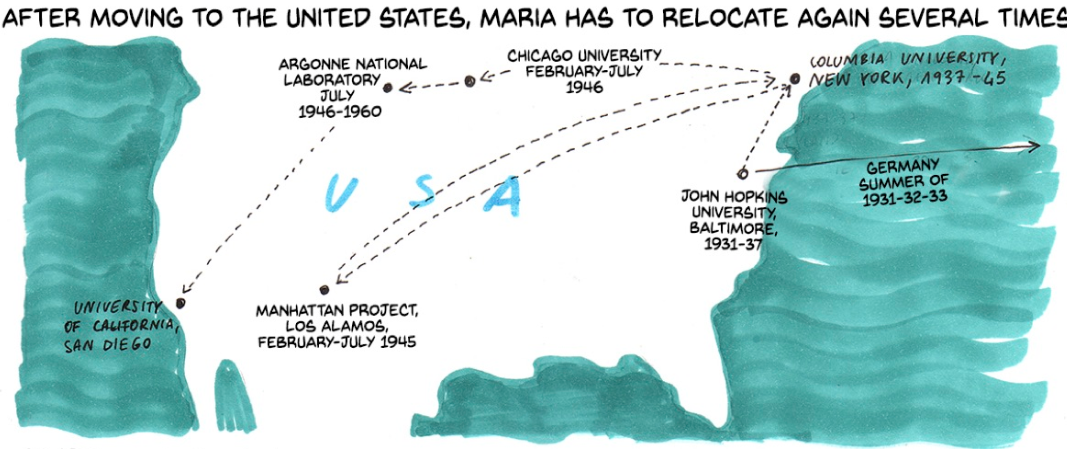
Comic as a medium has the advantage of using pictures. You can say a lot without too many words. For example, in Maria Goeppert-Mayer’s biography, one of my favourite illustrations is the one depicting Maria’s movements around the U.S.A. Sure, one can make a list, but it will not immediately show the distances she actually covered.

Another idea, which came from the illustrator I collaborated with, the talented Eliana Albertini, is to use different colors for different life periods. Again, one can divide the text in paragraphs, or chapters, but it does not have the same visual effect.

There was another problem that was very clear to me: the website is in Italian, but the language of science is English. So, I translated my own text into English and even asked my partner to make a German translation. That way, the comic is now available as pdf in three languages, and can reach a much broader audience.

I started with writing about a woman physicist because physics is my field and because when we ask people to name any female scientist they will most probably say Marie Curie and stop there. But there was another woman who got the Nobel Prize in Physics, and now we finally have a third one (which made our comic obsolete, but made us very happy). I will not restrain myself to physics: I have already written the text for Emmy Noether’s biography, my never-tired editor Mattia Ferri has contacted an illustrator, and we hope this story will be available soon. But there are other scientific fields to cover: biology and informatics, for example. I am now focusing on prominent female scientists of the past, but my hope is to be able to write stories about living scientists, maybe a graphic interview, in order to show to the public, but also to some fellow scientists, that science is not a men’s affair: women have been there, they are there, and they will be.

Metamaterial multiverse

Post by Igor I. Smolyaninov, Department of Electrical and Computer Engineering, University of Maryland.

How to build a ‘multiverse’ in a lab

Many physical properties of our universe, such as the relative strength of the fundamental interactions and the value of the cosmological constant appear to be fine-tuned for the existence of human life. One possible explanation of this fine tuning assumes the existence of a multiverse, which consists of a very large number of individual universes with different physical properties. Intelligent observers populate only a small subset of these universes, which are fine-tuned for life.

While this point of view may not be falsifiable based on astrophysical observations, one possible way to ascertain its viability may rely on macroscopic electrodynamics and condensed matter physics. In particular, the ‘optical spacetime’ in electromagnetic metamaterials (artificial structures patterned on a subwavelength scale to achieve unusual materials parameters) may be engineered to mimic the landscape of a multiverse that has regions with different topology and effective dimensionality. Nonlinear optics in metamaterials in these regions mimics Kaluza-Klein theories with one or more kinds of effective charges [1].

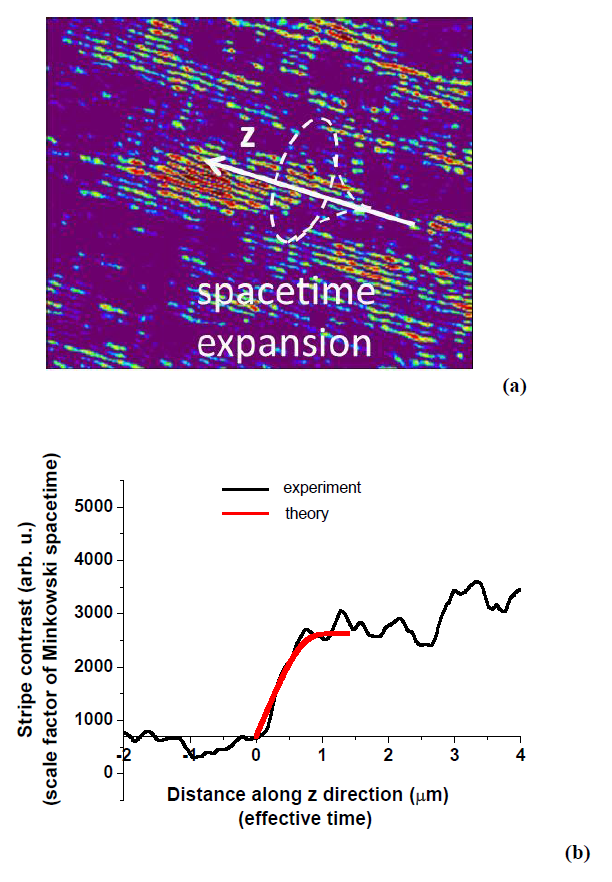
Another closely related model of a cosmological multiverse may be based on the electromagnetic properties of ferrofluids [2]. When a ferrofluid is subjected to a modest magnetic field, the nanoparticles inside the ferrofluid form small hyperbolic metamaterial domains, which from the electromagnetic standpoint behave as individual ‘Minkowski universes’. Microscopic spacetime defects and inflation-like behaviour appear to be generic within these individual Minkowski domains. It is remarkable that these non-trivial effects are accessible to direct experimental visualization using optical microscopy. Here I summarize several metamaterial systems that capture many features of cosmological models and offer insights into the hypothesized physics of the multiverse.

Electromagnetic metamaterials and transformation optics

The unconventional functional behaviors of the electric permittivity ε and magnetic permeability μ in metamaterials in the physical space lead to the creation of unusual ‘optical spaces’ that can be designed and engineered at will, opening the possibility of controlling the flow of light with nanometer spatial precision. Moreover, in a special class of hyperbolic metamaterials the optical space behaves like an ‘optical spacetime’, in which one of the spatial dimensions assumes a time-like character [3]. Hyperbolic metamaterials are extremely anisotropic electromagnetic materials, which behave like a metal in one direction and like a dielectric in the orthogonal direction. Hyperbolic metamaterials are typically composed of multilayer metal-dielectric or metal wire array structures. While in ordinary media all components of the ε tensor are positive, in hyperbolic metamaterials they have opposite signs in the orthogonal directions across quite broad hyperbolic frequency bands. Light can still propagate in such materials, but the direction of negative ε becomes time-like, so that the normally Euclidean optical space behaves more like a Minkowski spacetime at these frequencies. Light rays in this situation start to behave like evolving ‘world lines’.

 Modeling time with metamaterials: metamaterial models of the Big Bang

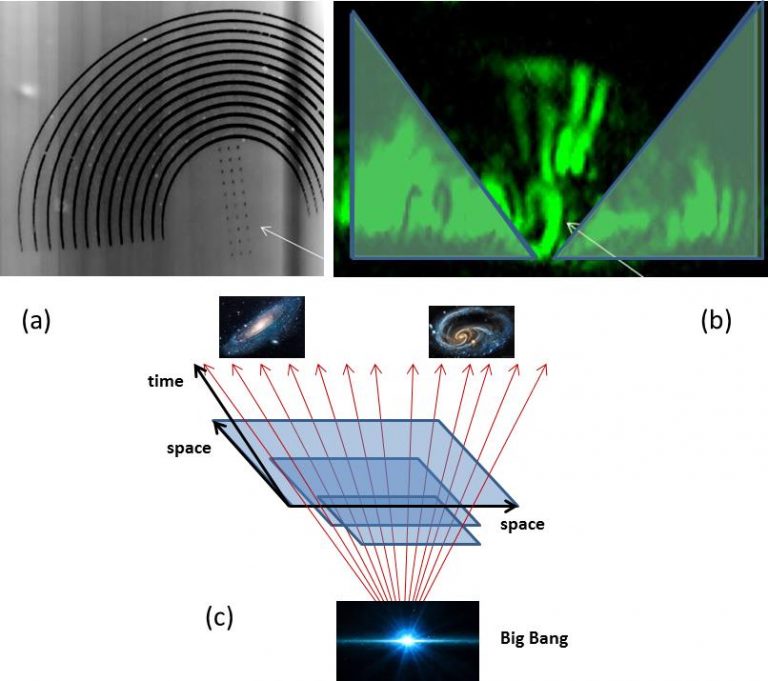
The nature of time has been a major subject of science, philosophy and religion. Our everyday experiences tell us that time has a direction. On the other hand, most laws of physics appear to be symmetric with respect to time reversal. A few exceptions include the second law of thermodynamics, which states that entropy must increase over time, and the cosmological arrow of time, which points away from the Big Bang. While it is generally believed that the statistical and the cosmological arrows of time are connected, we cannot replay the Big Bang and prove this relationship experimentally. However, it appears that electromagnetic metamaterials may provide us with interesting tools to better understand this relationship and, maybe, the physical origins of time itself. For example, an experimental demonstration of the behavior of a world line near a toy Big Bang in an expanding metamaterial universe as a function of a timelike radial r coordinate can be seen in Figure 1.

Figure 1 : (a) Atomic force microscopy image of a hyperbolic metamaterial structure. (b)  Light rays increase their separation as a function of a timelike radial coordinate. Light scattering at the edges of the structure is partially blocked by semi-transparent triangles. (c) Schematic view of world lines behavior near the cosmological Big Bang.

Light rays are launched into the hyperbolic metamaterial near the r=0 point via the central phase matching structure (marked with an arrow in the figure). Similar to the world line behavior near the Big Bang (Fig. 1c), light rays or ‘world lines’ indeed increase their spatial separation as a function of a ‘timelike’ radial coordinate. This experimental model may illustrate the relationship between the statistical and the cosmological arrows of time if disorder is introduced in this metamaterial structure [3].

Metamaterial multiverse experiments in ferrofluids    

Let us now turn our attention to self-assembled hyperbolic metamaterials made of ferrofluids, which share some common features with the class of cosmological models of the multiverse based on the loop quantum gravity [4]. This analogy relies on the fact that a modest external magnetic field aligns most of the individual magnetic nanoparticles in the ferrofluid into long parallel chains, so that the ferrofluid becomes a self-assembled hyperbolic metamaterial [5]. It appears that both loop quantum gravity models and the hyperbolic metamaterials may exhibit metric signature phase transitions [4], during which the spacetime metric used to describe the system changes its signature. Moreover, the metric signature transition in a ferrofluid leads to separation of the optical spacetime into a multitude of intermingled Minkowski and Euclidean domains, giving rise to a ‘metamaterial multiverse’ [2]. Inflation-like behaviour appears to be generic within the individual Minkowski domains (Fig. 2). Thus, studies of the optical spacetime in ferrofluids may illustrate the potential existence of parallel universes and shed some light on the ‘measure problem’ in a multiverse, which has to do with making probabilistic predictions of some particular measurement outcomes in a multiverse setting. All these effects may be studied in ferrofluids via direct microscopic observations.

Figure 2: (a) This magnified image of the Minkowski domains in a ferrofluid illustrates inflation-like expansion of the optical spacetime near the domain wall. (b) Measured and calculated  dependencies of the spacetime scale factor on the effective time.

Microscopic observation of spacetime melting in ferrofluids

Recent developments in gravitation theory provide numerous clues that strongly indicate that classic general relativity is an effective macroscopic theory, which will be eventually replaced with a more fundamental theory based on yet unknown microscopic degrees of freedom.  Unfortunately, these true microscopic degrees of freedom cannot be probed directly.  Our ability to obtain experimental insights into the future microscopic theory is severely limited by the low energy scales available to terrestrial physics and even to astronomical observations. In order to circumvent this problem, it is instructive to look at various examples of emergent gravity and analogue spacetimes [6] that appear in solid state systems such as superfluid helium, electromagnetic metamaterials and cold atomic Bose-Einstein condensates.

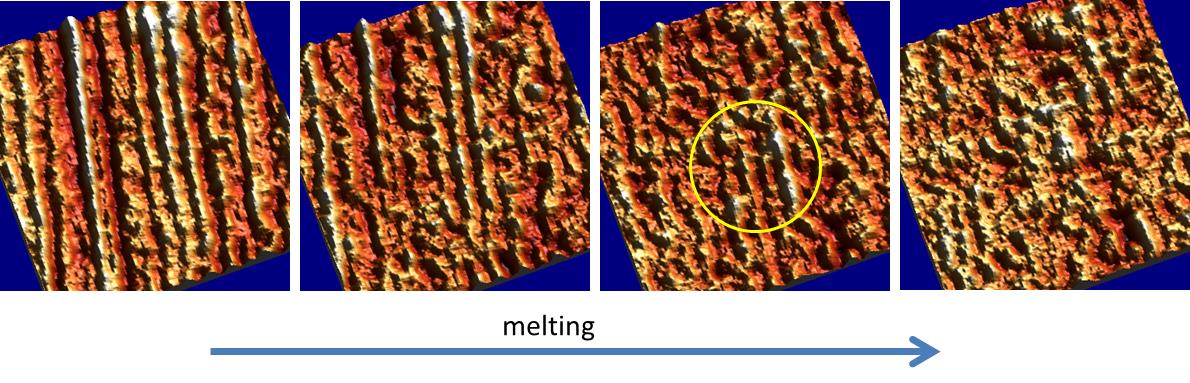
As discussed above, ferrofluids subjected to an external magnetic field have emerged as an interesting example of an electromagnetic metamaterial, which exhibits gravity-like nonlinear optical interactions, and which may be described by an emergent effective Minkowski spacetime. Unlike other more typical metamaterial systems, such a macroscopic self-assembled 3D metamaterial, they may also exhibit physics associated with topological defects and phase transitions. In particular, effective Minkowski spacetime melting may be observed and visualized in these metamaterials. If the magnetic field is not strong enough to hold nanoparticle chains together, the optical Minkowski spacetime gradually melts under the influence of thermal fluctuations. It may also restore itself, if the magnetic field is increased back to its original value. Such a direct microscopic visualization of Minkowski spacetime melting is depicted in Figure 3.

Figure 3: Magnified quasi-3D images taken from a movie of the effective Minkowski spacetime melting in a ferrofluid. A small region in the third frame, which remains in a microscopic Minkowski spacetime state (while the rest of the original spacetime has already melted) is highlighted by the yellow circle.

Outlook

The mutually related fields of electromagnetic metamaterials and transformation optics are experiencing extremely fast progress. While most of the experimental and theoretical work in these fields is devoted to revolutionary practical devices, such as super-resolution microscopes and electromagnetic invisibility cloaks, I have tried to show that they also have enormous potential in helping to shed light on some of the most fundamental problems of philosophy and science, such as the nature of time or potential existence of alternative universes. While the metamaterial systems considered here may or may not have anything in common with the real physical universe, they may still teach us a lot about the fundamental physics governing it.

References

  1. I. I. Smolyaninov, Journal of Optics 13, 024004 (2011)
  2. I. I. Smolyaninov, B. Yost, E. Bates, V. N. Smolyaninova, Optics Express 21, 14918 (2013).
  3. I. I. Smolyaninov, Y. J. Hung, JOSA B 28, 1591 (2011).
  4. M. Bojowald, J. Mielczarek. J. of Cosmology and Astroparticle Phys. 08, 052 (2015).
  5. V.N. Smolyaninova, et al. Scientific Reports 4, 5706 (2014).
  6. C. Barcelo, S. Liberati, M. Visser, Living Rev. Relativity 8, 12 (2005).


Interactions: Gaia Donati

Gaia Donati is an Associate Editor at Nature, where she handles papers in areas including quantum physics, particle physics, nuclear physics and mathematical physics.

What made you want to be a physicist?

I was good at both physics and chemistry in high school, and in fact I remember being drawn between the two… My fascination for physics was stronger though: physics could explain natural phenomena all around us by means of models and theories conceived to make sense of empirical observations while also offering a predictive tool (before being replaced by its better-working extension or alternative, of course). I could relate to the relentless search for unifying principles, and I very much liked the interplay between theory and experiment (which isn’t the case in mathematics, for example).

If you weren’t a physicist, what would you like to be (and why)?

Oh, you know, I would have gone into scientific publishing – wait, that’s what I’ve done! And now for a serious answer… Had I not taken up physics, I might have followed one of my two long-standing interests – music and photography. At some point I considered becoming a professional photographer (and join the legendary Magnum Photos agency); given that I am mildly obsessed with British, Irish and North American folk music, I did contemplate the idea of becoming an ethnomusicologist and traditional folk singer in order to study and preserve this rich musical heritage.

What is the development that you would really like to see in the next 10 years?

It would be fantastic to see physicists and biologists talking to one another ‘for real’ – collaborating on some of the challenges of our times, in other words. I am well-aware of the differences (in terms of mindset, approach to problems and communication practice to cite a few) between the two disciplines, but I am convinced that physics needs biology as much as biology needs physics. I feel that some progress has been made over the years, but there’s still a long way to go.

What’s your favourite (quasi-)particle?

My background is in experimental quantum optics, so my answer will be absolutely predictable – once on team photon, always on team photon.

What Sci-Fi gadget / technology would you most like to have / see come true (and why)?

A time machine, please. Several years ago I even bought the book “How to Build a Time Machine” by Paul Davies, which comes with some sort of blueprint for this technology. It’s a pity that I never took the time to follow the steps and see if I could build this…

What would your dream conference be like?

I recently read that scientists increasingly complain about how some conferences are becoming less and less useful – too crowded, more about showcasing one’s latest results to impress the audience than to share findings and engage in constructive discussions, too packed with sessions and events. I don’t know if this is true, but I’d say that the conferences I enjoy attending tick at least some of these boxes: a ‘human’ number of participants (not exceeding 200?), a topic not too narrow but not too broad either (which is tricky, I get that), speakers at different stages of their careers, and few parallel sessions (if any). Some meetings feature one or two days of tutorials or taught classes on top of their regular programmes; I think this is a good idea as well, especially for graduate students or for early-career researchers who might have just switched topics.

Interactions: Zala Lenarcic

Zala is a postdoc at the University of California, Berkeley, trying to understand which unexpected properties of interacting systems can be triggered by non-equilibrium dynamics. She won a Nature Reviews Physics poster prize at the Quantum Dynamics of Disordered Interacting Systems conference that took place in Trieste last June.

Can you briefly explain the results for which you got the award? 

The working principle of our suggestion is as elementary as that of a greenhouse. In a greenhouse weak sunlight compensates the energy losses though the windows, leading to a temperature of the interior which is much higher than of the exterior. Similarly, weak driving can activate approximate conservation laws of quantum systems. As an example we studied many-body localized (MBL) systems, characterized by macroscopically many local conservation laws. When isolated from the environment, such systems can exhibit localization up to arbitrary energies. However, due to the presence of phonons MBL does not occur in disordered solids, even if disorder is strong. Our work shows that weak driving can reactivate localization, since it pumps into the local conservation laws and compensates their decay due to coupling to phonons. We propose that MBL can be detected via measurements of local temperatures. The variation of local temperatures serves as a new, experimentally relevant, order parameter of the MBL phase.

What do you hope will be the impact of your research?

Our theory promotes the MBL and integrable systems beyond a pure theoretical discourse of idealized systems. It suggests that in the presence of driving their features are much more robust against seemingly detrimental perturbations. The impact of our work would be increased by an actual experimental confirmation, showing that MBL can indeed survive finite coupling to phonons. A possible application would be tunable properties of certain disordered materials, whose transport would be inhibited by a weak driving. Even higher impact could come from experiments confirming our related study, which suggests that in certain spin chain materials driving can activate spin and heat currents as these are the conservation laws of the XXZ Heisenberg model. That would open the venue for new types of spin and heat pumps.

 What made you want to be a physicist in the first place?

As a child I dreamed of being an astronaut. After having learned some math I realized one does not need to travel to the space; nature can be explored also in much more abstract ways. My fascination from the first classes of physics continues to this day.

 If you weren’t a physicist, what would you like to be (and why)?

A puppet designer. Puppetry, as an artistic medium, is to certain extend free from the limitations of reality, allowing for creative rethinking. I would be the master of aesthetics, creating beauty with my hand and ideas.

What would be your physics superpower?

Ultra-long coherence of my mind.

 Which historical figure would you most like to have dinner with — and why?

Mileva Marić Einstein. I would like to ask her how was it to be a female student at ETH in her time, why she decided to live with a genius and how did she accept her numerous pregnancies at her stage of career. I would like to know how much of her work was never acknowledged. I would like to give her a voice.

Interactions: Niccolo Somaschi

Niccolo studied physics at the University of Milano-Bicocca before joining a Marie Skłodowska-Curie PhD program at the University of Southampton and the FORTH research institute in Greece and then joining the group of Prof. Pascale Senellart at the Centre of Nanoscience and Nanotechnologies (CNRS & Université Paris-Sud) in Paris as a postdoctoral researcher. In 2017 he co-founded Quandela, a spinoff company from the same institute, that  fabricates and commercialises top-class quantum light sources to boost the development of quantum technologies from quantum computation to quantum communication and quantum sensing, and contribute to their spread outside the academic world.

How did you decide to embark on the adventure of creating a start-up? 

The choice of creating Quandela came directly and pretty naturally following the reaction to  the dissemination of some scientific results we achieved in 2016 on a new kind of semiconductor quantum light source, the core technology on which the group of Prof. Pascale Senellart works since 15 years. The reaction of the international quantum optics community was really unexpected: while people at conferences were taking pictures of the results, requests for collaboration were filling Pascale’s email inbox. The performance of our devices was in fact much better than that of the technologies (laser based) that researcher were using on a daily basis for their experiments, which normally last for several hours and in some cases even weeks. Their excitement was due to a simple fact: switching to the new technology would allow them to reduce the measurement’s time to few minutes or hours, allowing the design of more complex experiments to explore new regimes and new science.

As I was directly involved in the development of these devices and excited about the possibility of actively contributing to boost the field of quantum technologies, I tried to explore ways to continue working for the group as a permanent researcher. As for many others postdocs, this route proved to be non-viable. The creation of a self-sustained company aside the research group represented a good choice for two reasons: I could work to improve the technology, and at the same time we could assist the numerous interested researchers by providing them with devices without turning the research group in a fabrication facility. When I went to see Pascale proposing this idea she simply replied with a big smile, which was the best answer I could get.  We then asked Valerian Giesz, who together with Pascale and myself was at the origin of the latest developments, to join us in the project; and this is how the adventure started.

What was the biggest challenge you had to overcome to start the company? 

I would say that luckily we didn’t really have to face any big challenge. For me, the challenge was more psychological. Compared to the standard academic path, with well-defined projects and a clear progression with bachelor, master, PhD and postdoc, a start-up requires a totally different mind-set. I had to mentally prepare to achieve ‘multi-tasking on multi-domains’; dealing with unexpected, quick changes of any sort (bureaucratic, scientific, legal etc…); learn how to face good and bad news on a daily basis with the consequent sudden mood  changes; cope with uncertainty (“it will fail! No, it will be a success!”, “I will be unemployed soon! No, we will become …”) never knowing on how long it would take to reach our objectives. Besides, Valerian and I didn’t have a permanent position in any university or a job in a company, unlike several other quantum ‘start-uppers’, nor a big investor group that could safely fill our pockets from day zero while we learned how to move the first steps. At the same time, we were self-conscious that we were leaving academia for something that most people would define as ‘crazy science fiction’. But excitement and motivation never lacked and this temporary stressful situation ended when some pieces started to get into place, clearing the path ahead.

Can you share one positive and one negative side of the experience that you weren’t expecting? 

Most probably the negative experience I was not expecting is yet to come — hopefully I may never have to discover it. But surely the positive one is related to the human side of the adventure. In particular the personal relations constantly developing within Quandela, together with new unexpected ones with people we connected with during this first year and new people we keep meeting. Besides, I could not expect at all the great excitement of the first users who are taking advantage of the capabilities of the devices working at full regime; this was the best reward for the hard work of a year.

What are your tips for academics who are thinking of starting their own company? 

Very few tips, but very clear. Discuss with as many people as possible who have launched a company or participated in the process. Listen carefully to all the good, negative and scary stories while focusing on what is your actual final goal. Finally, find someone you trust and share your vision, and actually do it. Because at the end, wherever the adventure may lead, it is always fun to go, and the experience of doing it is already worth the journey.

Finally, what is the origin of the name Quandela?

The toughest part for sure! To quote a colleague, “getting a good name is much harder than finding the ones of my three children”…
We had few months of brainstorming putting down keywords and names, sometimes in a  totally random way; we got some nice ones, but most of them were bad. We got also several names with unwanted, embarrassing double meanings, resulting from mixing French, Italian, English and Greek. But finally Valerian came up with Quandela, and that was it. Because Candela is the unit of measure of light intensity and the word for ‘candle’ in Italian. The micrometre shape of our device is cylindrical, looking indeed like a candle, with quantum light emitted from its top, like a flame. Besides, the actual intensity of the emitted quantum light is one of its top features. Shortly afterwards, while we were in the middle of the process of officially creating the company, we read a report of the European commission on quantum technologies where someone was suggesting a new unit of measure for quantum light…. Quandela.

Interactions: Damian Wozniak

Damian is a recent theoretical physics graduate. In September he will start his PhD with Dr Anna Posazhennikova at Royal Holloway University of London to work on nonequilibrium dynamics of bosons in optical lattices. The aim is to study the role played by incoherent quasi-particles excited due to nonequilibrium and to study the role of disorder in dynamics, as well as possible thermalisation of superfluid optical lattices. He won a Nature Reviews Physics poster prize at the Condensed Matter Physics in the City conference in London.

Can you briefly explain the results for which you got the award?

The poster was based on work on analysing quantum phase transitions in a system of optical lattice bosons coupled to an array of atomic quantum dots. The hybrid system parallels the Bose-Hubbard model with a single difference of an additional assisted tunnelling via coupling to atomic quantum dots. Using mean field methods we show that the bosonic subsystem still undergoes a Mott-superfluid quantum phase transition. However, unlike in the Bose-Hubbard model transition, the transition boundary can be manipulated.

What do you hope will be the impact of your research?

I do not know enough about the field to say, but I hope it at least gives some thoughts to any of its readers.

What made you want to be a physicist in the first place?

I haven’t fully decided on it yet. At first, I liked doing maths and physics, I wondered what doing physics would lead to. Sometime throughout my A-levels, I decided to pursue physics. Getting better at physics and learning more of it has made it pretty fun and absorbed me more and more into it.

If you weren’t a physicist, what would you like to be (and why)?

Mathematician or doing some work involving programming, I like doing both of them.

Which is the development that you would really like to see in the next 10 years?

Different style of physics education. Physics books are hard to read through, the concepts they present are sometimes hard to understand with just what is written in them and different books cover things in different detail. It would be nice to have lectures online or podcast discussions on these books. I would like to see a single book/online course series which goes into varying depth on all physics topics (dependent on if someone is just curious or studying the topic seriously), with accompanying problems, discussions, and projects to push the understanding of students. Also, this series would need to be entirely self-sufficient.

What Sci-Fi gadget or technology would you most like to have / see come true (and why)?

A new electric propulsion engine, one that can be used to leave the surface of Earth: it might make things cheap enough to grab a ticket for a spaceflight around the Earth.

Interactions: Michael Baker

     Michael Baker is a research fellow at Diamond Light Source and at the University of Manchester.

      What did you train in? What are you working on now?

My training was in physics: a physics undergraduate followed by a PhD in magnetism. Today I’d describe my work as physical chemistry and bioinorganic chemistry with magnetism as a professional hobby. One of the freedoms I have now as an independent researcher is that I can interchange topics depending on the sorts of interesting problems that come about. I really enjoy using X-ray and neutron spectroscopies to solve problems that are hard to tackle by more routine methods. So whether it is a active site in an enzyme or an unusual quantum tunneling effect in condensed matter, it doesn’t matter to me how a subject should be categorized.

      Do you think of yourself as a physicist or as a biochemist?

Neither! However I like to think I can speak to both about their science. I think of myself as being somewhere between physics and chemistry I suppose.

      What motivated you to move to this field of research?

My transition from magnetism to bioinorganic chemistry was driven by a desire to be involved in doing something of general interest to people but also fundamental. An example is oxyhemoglobin, with its iron sites that bind and release oxygen for transport. It is  high-school biology, everyone appreciates its importance. Yet the electronic structure of that iron oxygen bond has been a very elusive problem and a contentious matter. So it is problems like this that made me realise just how many  important problems there are to work on in this area. However, above all it was the Human Frontier Science Program that made my move realistic. Their cross-disciplinary fellowship offers three years of funding for computer scientists, mathematicians and physicists to switch to working in the biological sciences.

      What did you find more difficult when you started working in an area out of your comfort zone?

When you don’t know a field or the people working in it the literature can be overwhelming. I spent months reading papers, following citations and reading more papers.

      And what did you find most helpful to familiarize yourself with new concepts and jargon?

Just getting on with it. Asking all the stupid questions as early as possible.

      Tell us about your experience the first time you went to a conference outside the field you trained in.

This is where not knowing the field makes things difficult. In molecular magnetism I knew many people and their work. Bioinorganic conference sessions were like a first day at a new school.

      What are the main challenges and the main advantages of working in an interdisciplinary team?

You are adaptable and able to move into new areas quickly. When people are given the opportunity to be the group expert on a particular topic, they expand into the role and become proud of it and generally excel. People can be proud of not knowing about some topics too, which makes a great incubator for knowledge exchange and collaboration.

      What would be your advice to a PI leading an interdisciplinary group?

Well this is too early on for me to have much insight. I am just getting started on that front.

      Do you find it particularly difficult to obtain funding? Or to get your research published?

I think being interdisciplinary is a great advantage when applying for funding. Knowing about how people from different fields speak and write really helps to put yourself in the shoes of the reader or audience. A greater sense of adaptability opens up more funding options too, although writing proposals on completely different topics in different fields is very time consuming. In my case there was certainly an impact on my publication output when switching research fields. This can be stressful, but I think I am getting there now.

Interactions: Stefanie Reichert

Stefanie worked as an experimental particle physicist at CERN before moving to Berlin, where she just started as Associated Editor at Nature Physics.

What made you want to be a physicist? 

In fact, I’ve tried everything to avoid physics when I was a teenager. In high school, I chose to learn Latin and then French as this would allow me to attend only two hours of physics per week. I grew up in Germany, and we had to do a one-week internship in 10th grade. Back then, I wanted to become a pathologist and hence I applied at the hospital nearby. As I wasn’t sure if they’d take me on, I looked for something else and then stumbled across books about the universe my parents gave me as a child. Turned out there was a Max Planck Institute for Astronomy in Heidelberg (MPIA) where I applied as well. Long story short: I got to do internships in both pathology and at MPIA but the latter blew me away: we got to observe the sun, count galaxies, learned about Rosetta, played with liquid nitrogen and then I was hooked! Funnily enough, I interned in an astronomy and a particle physics working group at university, and guess what?

If you weren’t a physicist, what would you like to be (and why)?

After the internship, becoming a pathologist was out of the question (too uneventful for my taste). I guess I would sell books now and force recommendations on people. Maybe along with running a café and roasting my own coffee.

Which historical figure would you most like to have dinner with — and why?

With Oscar Wilde, as I love his impeccable sense of humour and wit. If you haven’t read ‘The Importance of Being Earnest’, you are clearly missing out.

Which is the development that you would really like to see in the next 10 years?

I believe that in science we are a leading example for promoting peace, equality and anti-racism. But I do feel there’s more we can achieve, and I would like to see a greater diversity within our community, including more women in science and also increased opportunities for scientists or students studying science all around the globe.

What’s your favourite (quasi-)particle?

I have a background in experimental particle physics, and because some tensions between experimental observations and theory, the so-called Standard Model of Particle Physics, have emerged over the past few years in the flavour sector, I would go for the hypothetical leptoquark, which is a candidate for explaining those anomalies. Plus, those could mediate a decay I was searching for with colleagues from the LHCb experiment. Basically, a leptoquark can turn a quark into a lepton (e.g. an electron) and vice versa.

What is your non-scientifically accurate guilty pleasure (could be film/series/book)?

I love Star Wars, and my favourite is ‘The Return of the Jedi’. When the new movies started coming out, I was so excited – there’s nothing like watching the Millenium Falcon jump into hyperspace and then there are so many awesome female characters!

Interactions: Alexander Whiticar

Alexander is a PhD student at the Center for Quantum Devices at the Niels Bohr Institute in Copenhagen, and works on realizing topological states of matter in hybrid two-dimensional superconductor-semiconductor heterostructures. His primary research interest is observing Majorana zero modes in hybrid quantum dot geometries (Majorana islands). He won a Nature Reviews Physics poster prize at the Quantum Designer Physics conference in San Sebastian last June.


Can you briefly explain the results for which you got the award? 

The results that led to my award are based on observing phase coherent single-electron transport in a hybrid quantum dot interferometer in the presence of a discrete zero energy mode. This is of interest because Majorana zero modes are expected to allow for coherent single-electron transport due to their non-local properties.

What do you hope will be the impact of your research?

Many of the recent topological quantum bit (qubit) proposals rely on interferometric measurements as a form of read-out of the quantum state. Our results indicate that indeed this is possible. Furthermore, it is necessary that hybrid quantum dots preserve phase coherence for them to act as coherent links between qubits, which we have also demonstrated. I believe our research will aid in the design of future topological qubits based on Majorana islands.

What made you want to be a physicist in the first place?

Physics has always appealed to me because it not only has the ability to give detailed descriptions of our nature but also asks many fundamental questions yet to be answered.

If you weren’t a physicist, what would you like to be (and why)?

It is a difficult question to ask what could replace physics in my life. I would find it interesting to research the history of science, or to report on new scientific discoveries.

Which is the development that you would really like to see in the next 10 years?

I am eager to see the development of an inexpensive clean energy source that would allow for a global transition away from fossil fuels.

What Sci-Fi gadget or technology would you most like to have / see come true (and why)?

The ability to travel at the speed of light so we could discover many new wonders about our universe.


Interactions: Manisha Thakurathi

Manisha is a postdoc in the group of Prof. Jelena Klinovaja and Prof. Daniel Loss at the University of Basel, Switzerland. She is a physicist by training and her research interest lies in understanding the topological aspects of different quantum systems. She won a Nature Reviews Physics poster prize at the Quantum Designer Physics conference in San Sebastian last June.

Can you briefly explain the results for which you got the award? 

The award was based on a study of double Rashba nanowires coupled to an s-wave superconductor, which has been recently proposed as a versatile platform to generate Kramers pairs of Majorana bound states in the absence of magnetic field. We analyze the effects of electron-electron interactions and disorder on the system and find that the interactions drive the system into the topological phase. We further consider an external magnetic field along the nanowires and demonstrate that the setup exhibits a new previously overlooked Majorana phase that emerges at low magnetic field.

What do you hope will be the impact of your research?

The field of topological quantum computation with Majorana bound states (MBSs) has grown immensely in the past decade. We propose a new setup for the appearance of MBSs, where MBSs exhibit sufficiently short localization lengths, which makes them ideal candidates for future braiding experiments.

What made you want to be a physicist in the first place?

Ever since my school and college days, I enjoyed studying and understanding the universal laws of nature that govern things around us. Also I had an incredible physics teacher during my high school who inspired me towards the amazing science which happen to be Physics !!

If you weren’t a physicist, what would you like to be (and why)?

I also had interest in medicine, perhaps I would have been a medical professional (A REAL DOCTOR).

Which is the development that you would really like to see in the next 10 years?

A topological quantum computer or a room-temperature superconductor .

What’s your favourite (quasi-)particle?

Based on my area of research interest , two are my favourites: Bogoliubov quasiparticles and composite fermions.

Interactions: Marco Martini

Marco Martini is in  the Materials Science Department of the University of Milano-Bicocca.

What did you train in?
Nuclear physics, environmental radioactivity.

What are you working on now?
Experimental condensed matter, interaction of ionizing radiation with materials, dosimetry and its applications to archaeological dating.

What motivated you to move to this field of research?
I found it very appealing to apply my knowledge in radiation physics both on the side of the interaction of radiation with matter and of the properties of insulating materials. The application has been either on new materials, fiber optics and microelectronics, or on ancient materials, mainly ceramics. This latter application introduced me to a very different field, i.e. science for archaeology and history of art, which has been named “archaeometry” since the 1960s.

What did you find more difficult when you started working in an area out of your comfort zone?
The approach to works of art is completely different for a physicist and an archaeologist, at least a traditional one, in the sense that particularly in the Mediterranean area, and mostly in Italy, the study of archaeological pieces is mainly based on the individual experience of the archaeologist and the scientific approach has been almost neglected up to a few years ago. Nowadays things are changing and archaeometry is expanding, making scholars in the humanities and in hard sciences meet and contribute to common researches.

And what did you find most helpful to familiarize yourself with new concepts and jargon?
For many years is has been very difficult to find a common jargon with archaeologists and art historians. The interest in understanding ancient civilizations has always been the driving force in applying the scientific method and in explaining how helpful scientific data can be, provided that they are always compared with the experience of the archaeological team.

Tell us about your experience the first time you went to a conference outside the field you trained in.
I must say that it was not so challenging, because I was so eager to let my colleagues know the power of scientific data in contributing to archaeological research that I tried to make all the scientific data accessible to them.

What are the main challenges and the main advantages of working in an interdisciplinary team?
It is extremely interesting, also because you always see how physics can be useful in fields apparently very far removed from it. At the same time it must be considered that building a career is much more complicated than when remaining inside an orthodox physics field, mainly due to the difficulties in finding appropriate journals: only very few results are so important to be published in international journals of high impact. Most results are very useful in the field, but no as highly considered as traditional physics experiments. Furthermore the community is not so wide and the citation numbers increase very slowly.

What would be your advice to a PI leading an interdisciplinary group?
In my opinion it is essential that before contributing to an interdisciplinary field, a researcher has a consolidated knowledge of his own discipline. A physicist can be a good archaeometer if he is a good physicist first.

Do you find it particularly difficult to obtain funding? Or to get your research published?
Nowadays, particularly in Italy, but also at the international level, the attention for cultural heritage is increasing and experienced laboratories are supported by public and private institutions.

Is there any anecdote you would like to share?
The archaeometry community is very composite, and you can be invited to contribute to local workshops and national meetings. Long ago I was invited to present our results on the Valdivia South American culture, which turned out to be one of the most ancient ones in the American subcontinent. I prepared my talk in English, but after a while I was invited to talk in Spanish, because almost half of the audience, mainly archaeologists, was not familiar with English. I spent in the past a few short periods in Spain due to a scientific collaboration: even if the Spanish and Italian languages are related, my Spanish is very poor. Nonetheless, my Italian-Spanish talk was understood and appreciated!

Interactions: Maria Vozmediano

Maria Vozmediano is in  the Instituto de Ciencia de Materiales de Madrid and works on field theories in condensed matter physics.

What did you train in?
Particle physics and cosmology. String theory.

What are you working on now?
Condensed matter physics.

Do you think of yourself as a quantum field theorist or as a condensed matter theorist?
I consider myself a physicist.

What motivated you to move to this field of research?
As many string physicists, from the string worldsheet I moved to 2D quantum gravity, membranes, anyon physics and anyon  superconductivity. Also, fullerenes appeared to me through a solid-state friend, as Dirac physics at the surface of a sphere.

What did you find more difficult when you started working in an area out of your comfort zone?
The phenomenological assumptions of the new field. The Landau-Fermi liquid theory was a great mystery to me till I read an article from J. Polchinski showing it as a fixed point of a renormalization group. It is very hard not to understand what seems obvious to everybody.

And what did you find most helpful to familiarize yourself with new concepts and jargon?
The collaboration with a very good condensed matter practitioner was essential to identify the problems of interest and the approximations used in the field.

Tell us about your experience the first time you went to a conference outside the field you trained in.
I felt horrible. The “impostor syndrome” to a high power. Besides, no friends or well known people to help.

What are the main challenges and the main advantages of working in an interdisciplinary team?
The best is to recognize same problems in disguise. To see the appreciation of simple things when they are seen with different eyes.  It is a lot of fun when there is mutual respect and appreciation between people in the complementary field. The problems come from  average or mediocre physicists that feel challenged by a different point of view. I have been lucky as the quantum field theory techniques have become a necessity in condensed matter. It is not easy at the beginning when you are seen as an outsider from an “rival field”.

What would be your advice to a PI leading an interdisciplinary group?
To any PI: choose the best people, intelligent and imaginative  no matter their expertise.

Do you find it particularly difficult to obtain funding? Or to get your research published?
Publishing has never been a problem. Been accepted by the condensed matter community has been harder. As a theoretician, funding has also not been a problem.

Is there any anecdote you would like to share?
This is not really due to changing fields. Once I was introduced as Dr. Vozmediano to a colleague who told me it was not possible because Vozmediano was a man.

10 things to remember for when you have graduate students

Guest post by Charlie Ebersole, a social psychology graduate student at the University of Virginia.

Graduate school has been both a wonderful experience and incredibly challenging. When I will later look back on this period in my life, I’m sure that my memory will fail to accurately capture what it was like to be a graduate student. I’ll remember the highs, and more lows than I care to admit, but will likely lose some of what the day-to-day experience was like. If I have graduate students of my own someday, I want to have a more complete picture of what graduate school was like so that I can give them a better experience. With that goal in mind (and with some great suggestions from Twitter folks), I compiled the following list for my future self.   

Things to remember for when you have graduate students
Gentle reminders from past you to help current you give your students a better experience 

    1. There are a lot of little ways that you can make their lives easier. For instance, if you suggest a literature for them to search, try to give them some citations as a starting point. That way, they don’t have to guess which articles you were thinking about. Little things like this can really add up in the long run.
    2. Although class grades might not matter as much in grad school, your students got into grad school, in part, because they were good at getting good grades. That drive won’t go away immediately. Same goes for deadlines. Be patient while they figure out priorities.
    3. Tell your students: Wanting to look competent is natural and useful in some settings. However, it’s also important to admit when you don’t know things. Acting like you know more than you do stifles opportunities for others to teach you new things. This is probably going to be an ongoing struggle; that’s ok. Let me know how I can make it easier for you to say when you don’t know things.
    4. Remind them that they have/will develop expertise that will surpass you. Take opportunities to learn from them so that they recognize this.
    5. Remember that shielding your students from their weaknesses will hurt their development. Also remember that hearing critiques from your advisor can be hard.
    6. It’s hard to know when you’re doing well as a grad student. Be sure to tell students when they’re doing well and point out what you see as their strengths. That can help balance when you need to do #5.
    7. Things from outside of work will affect work. Try to create an environment where students feel comfortable letting you know those things. As an example from your time in grad school: Brian regularly asking about your life outside of work (e.g., “how was your weekend?” at the start of each meeting) made it easier for you to bring up struggles when they were affecting your progress.
    8. Sometimes fighting for your students is as important as the outcome. You’re not going to win everything (or, frankly, most things), but showing that you care enough to stick up for them goes a long way.
    9. Grad students don’t make a lot of money. They might not have a lot saved either. Keep that in mind. Things that might not seem like much to you (like being a few hundred dollars in debt while waiting to get reimbursed for conference travel) might be a serious strain for them.
    10. Finally, you were really bad at writing when you started grad school. It’s probably just good to keep that in mind when looking at your students’ writing.

Interactions: William Hamlyn

William was awarded a Nature Reviews Physics poster prize at ICAP 2018.

Please introduce yourself 

I am a 3rd year PhD student at Durham University, UK, I collaborate with the Max Planck Institute for the Science of Light, Germany, and I work with atoms. A single atom is cool because it is a ‘quantum’ object and studying it can teach us about fundamental physics. A single atom is also cool because it can interact with a single photon. Systems built of single atoms communicating via single photons offer some interesting and mysterious uses; one Holy Grail of this community being a universal quantum computer. The challenge currently is how do we acquire a single atom? And how can we manipulate it? This is what my experiment focusses on (pun intended). I use thermal vapours of rubidium confined within nanometre-scale glass cavities (e.g. a fancy double-glazed window). This offers a novel and relatively simple method to approach the limit of having a single atom, on demand.

1.  Can you briefly explain the results for which you got the award?

My award was mainly for the creation and characterization of the ‘nanocells’ that we make. We are able to confine atomic vapour in structures ~500 nm in size. As was mentioned, it is really the novel approach that we are taking and the methodology itself that is the most interesting to the atomic physics community. To give some context: A typical cold-atom experiment might use ~200 BNC connectors to control the experiment, I currently use just 6. This is the beauty and ‘simplicity’ of thermal vapour experiments.

2.  What do you hope will be the impact of your research?

This depends on scale. Within our field we hope to produce a robust platform for single atom – single photon experiments. In research physics as a whole I hope to prove that one can ‘dare to dream’ if that isn’t too cliché. That there may exist some radically different approaches to achieving a goal, and that we can learn a lot by looking at methods used by other fields. For example, my microscopy setup is also used commonly in bio-physics experiments. In a wider context, it is possible that the understanding of fundamental physics can later lead to the exploitation and harnessing of these effects. One parallel could be to look at Faraday. Faraday was a researcher and in his lab he experimented with the effects of electromagnetism (later formalised by Maxwell). He was studying fundamental physics, he was not an inventor. Yet, 150 years later we have electric motors, lights, kettles, and the national grid. All things made possible by first understanding nature, and then harnessing these effects.

3.  What made you want to be a physicist in the first place?

To be honest not much. We choose our GCSEs, A-levels and degree at quite a young age. Certainly without the experience of knowing different fields in depth. I was good at science and I enjoyed being able to get satisfying answers on how things worked, and so I pursued it. Moreover, I cannot say if I will always be in the field and so, despite the fact that I am a PhD student in physics, I would argue that I never really ‘chose’ to be a physicist. I had no particular goal in mind, I simply chose the local most interesting decision at the time, and this path has lead me to where I am now. Perhaps that is how a passion manifests itself. In short: there was no single event of inspiration, but instead an ongoing process of learning and following the course of making rather short-term decisions that has steered me to where I am now.

4.   If you weren’t a physicist, what would you like to be (and why)?

I think I would try to be a professional athlete. Another great joy in my life is sport, and I do as much as I can currently. I would be curious to see how far I could get if I were to give it my full attention.

5.   Which is the development that you would really like to see in the next 10 years?

In the past century or so we have seen a continuous improvement in the understanding of the natural world that has come about by major international collaboration. Gone are the days where a single person can witness a natural phenomenon by candle light (well you still can, but it is nothing new). Today the world is more connected, and we study physics with greater precision and reliability than ever before. Experiments often take years of setup, controlled lab environments, and this all takes funding and the sharing of expertise. Science is also more accessible too with social revolution driving equality and allowing all people to pursue a career in science. I would simply like to see this continue. No one can predict the events of the future, and aiming for what you cannot see is impossible. However, what we can do is build the most productive and healthy work environment that we can, and to allow people and ideas to flourish.

6.    What is your non-scientifically accurate guilty pleasure (could be film/series/book)?

Guilty pleasure? Definitely farming simulator. I’d say it’s non-scientifically accurate by the extraordinary plant yields that seem to defy any conservation law. The physics engine is quite primitive too.

Interactions: Jeanne Colbois

Jeanne is a first year PhD student in the chair of condensed matter theory lead by Professor Frédéric Mila at École polytechnique fédérale de Lausanne, in Switzerland. The general aim of the group is to explore new phases of matter induced by strong correlations in electronic systems, which is done by investigating analytically and numerically the role of frustration or competing interactions in lattice models of low-dimensional quantum magnetism. She is the recipient of one of the poster prizes sponsored by Nature Reviews Physics at the Machine Learning for Quantum Many-body Physics workshop that happen last June in Dresden.


1.    Can you briefly explain the results for which you got the award?

I have been mainly focusing on the Ising model with antiferromagnetic further-neighbour couplings on the kagomé lattice. I am doing Monte Carlo simulations to try and understand how the physics of this model changes depending on the range of the interactions taken into account. It was a nice surprise to get an award for my poster, given that the main focus of the conference was Machine Learning for quantum many-body physics, and I have not been doing machine learning so far.

2.    What do you hope will be the impact of your research?

I am looking at a very specific problem, so I think the dream would be that new, more general questions would arise from studying this system.

3.    What made you want to be a physicist in the first place?

For me, it is a good balance between trying to understand our surroundings, trying to solve interesting and challenging problems, and meeting dedicated people whom I have a lot to learn from.

4.    If you weren’t a physicist, what would you like to be (and why)?

I think, as long as I would be trying to solve some problems and would feel useful in some way, I would be happy.

5.    What would be your physics superpower?

Asking the right question right away.

6.    What is your non-scientifically accurate guilty pleasure?

Maybe I don’t feel guilty enough about it, but I spend a lot of time playing and listening to music.