Rosetta wakes up and phones home

The European Space Agency’s Rosetta spacecraft has successfully woken up after almost three years in hibernation.

The craft at the heart of ESA’s €1-billion (US$1.4-billion) comet-hunting mission was shut down in 2011 to save energy while travelling in deep space (see ‘Comet craft ready to wake’). Rosetta successfully re-established communications with Earth on 20 January.

With an alarm pre-set for 10:00 GMT, a signal was expected at any time from 17:30 GMT, once the spacecraft had warmed up and turned its antenna towards Earth. But Rosetta kept everyone guessing, with the first sign that everything had gone to plan only arriving around 40 minutes later.

ESA’s European Space Operations Centre erupted in cheering and hugging as small spikes appeared in radio signals received at NASA deep-space communications centres in Canberra and in Goldstone, California.

The first radio signal received from Rosetta

The first radio signal received from Rosetta

Messages take 45 minutes to travel the 807 million kilometres each way to the craft. This means ESA scientists will have to wait another 90 minutes after the first signal before receiving a health report from Rosetta.

All being well, the craft will now journey to its target, the comet Churyumov-Gerasimenko, which it will approach in August. Rosetta will observe the comet up close before landing a probe in November. This will be the first time a soft landing has even been attempted on a comet.

In the ESA control room, spacecraft-operations manager Andrea Accomazzo was delighted to see Rosetta come back to life. “I think it’s been the longest hour of my life,” he said.

US$21 million awarded to delighted scientists in glitzy ceremony

In a ceremony hosted by actor Kevin Spacey and featuring a live performance from singer Lana Del Ray, six biologists and two physicists took home a combined US$21 million last night at NASA’s Ames Research Center in Mountain View, California. It was the latest tranche of science megaprizes sponsored by philanthropic billionaires.

Since internet entrepreneur Yuri Milner announced last year that he would dwarf the Nobels by giving out $3 million prizes to theoretical physicists, the ‘Breakthrough prizes’ (which now have branched out of fundamental physics and into the life sciences) have given out more than $90 million and gained additional sponsors, including the founders of Google, 23andMe and Facebook. And more prizes are on the way: at the end of the ceremony, Milner announced that next year there would be a new award for mathematics.

In theoretical physics, Michael Green, of the University of Cambridge, UK, and John Schwarz of the California Institute of Technology (Caltech) in Pasadena, shared $3 million for their work on quantum gravity and the unification of forces.

In life sciences, the winners — each of whom received $3 million — were James Allison of the University of Texas MD Anderson Cancer Center in Houston, for work on cancer immunotherapy; Mahlon De Long of Emory University in Atlanta, for work on brain circuits that malfunction in Parkinson’s disease; Michael Hall of the University of Basel in Switzerland for discovering the protein kinase target of rapamycin (TOR); Robert Langer of the Massachusetts Institute of Technology in Cambridge for work on biomaterials and controlled drug-release systems; Richard Lifton of Yale University in New Haven, Connecticut, for work on hypertension; and Alexander Varshavsky of Caltech for work on intracellular protein degradation.

Green told the Guardian that he was “delighted and flattered” to have won. So far, the reaction from some scientists has been ambivalent: delighted at the attention and recognition, but unsure whether big prizes are the best way to promote research. Some of last year’s physics awardees have used their winnings to support funds for postdocs, PhD students and science teachers. 

X-ray observatory confirmed as ESA’s next big mission

The European Space Agency (ESA) has confirmed that its next ‘large’ (L-class) mission, dubbed L2, will be an X-ray telescope investigating the “hot and energetic Universe”.

At a meeting in Paris yesterday, the agency’s Science Programme Committee selected the theme on the basis of the recommendation of ESA’s director of science and robotic exploration, Alvaro Giménez, reported in Nature earlier this month.

Scheduled for launch in 2028, the L2 project will investigate how gas evolves into galaxy clusters and how black holes grow and shape the Universe. The exact mission will be selected through a call next year, with the Advanced Telescope for High-energy Astrophysics (Athena+), the mission outlined alongside the theme, a clear forerunner.

At the same meeting the committee confirmed “the gravitational Universe” as the theme for the following L-class mission, L3, in 2034, meaning advocates for space-based gravitational wave astronomy, a field never before attempted in space, will have to wait another two decades for their observatory.

Its associated mission, the evolved Laser Interferometer Space Antenna (eLISA), would detect the gravitational waves that are thought to stretch the fabric of space-time, opening a new window on the Universe outside the electromagnetic spectrum.  A pathfinder mission to test the necessary technology for the observatory — which would eventually hope to detect signals from colliding supermassive black holes and the early Universe — is set to fly in 2015 after several years of delays.

The L2 and L3 science themes were chosen from 32 proposals that the European science community had put forward since March. Total costs for the two selected will be in the order of €2 billion (US$2.7 billion).

ESA’s first L-class mission of its current programme, the Jupiter Icy Moons Explorer (JUICE), was approved last year and is set for launch in 2022.

(Additional reporting by Quirin Schiermeier)

Cutting-edge UK science facilities going unused

Scientific instruments that cost millions of pounds are standing idle in the UK because of a lack of money to run them, a new parliamentary report has revealed. There is a “damaging disconnect” between funding to build new facilities and the funding to actually run them, it concluded. This includes spending nearly £40 million on high performance computers, without budgeting for the electricity they use.

The report’s authors, a cross-party group of politicians in the House of Lords, are demanding that the government review its funding for large scientific infrastructure sites after conducting a wide ranging inquiry into the subject.

The House of Lords Science and Technology Committee cites examples such as the ISIS site in Oxfordshire, which produces beams of neutrons and muons that researchers use to probe the properties of materials. It has recently been operating for 120 days per year, down from a previous level of 180 days, despite only marginal cost saving from such truncated hours.

In evidence to the inquiry John Womersley, chief executive of the Science and Technology Facilities Council which oversees much of the UK’s government-owned science infrastructure, said: “It has been difficult to invest in the routine maintenance and upkeep of existing facilities, because [government] ministers very naturally are interested in new initiatives and transformative change in entirely new projects.”

Another example cited by the committee are the high performance computers at the Hartree Centre near Manchester. These were set up in 2012 with £37.5 million of government funding but the government has not provided enough money to run them, according to the committee’s report. Womersley told the committee that running the new computers at the Hartree Centre had come with “a significant electricity bill that we had not anticipated”.

In their report — released today — the committee says: “There is substantial evidence of a damaging disconnect between capital investment and the funding for operational costs.” They recommend that capital investment and operational funding should be “tied together in one sustainable package”.

The committee says it is broadly positive about the country’s science infrastructure, but its chair Lord Krebs notes that poor long-term planning places at risk the current excellent reputation of sites like ISIS. “The lack of a strategy and an investment plan risks the UK’s place at the forefront of scientific research,” he said in a statement.

Updated: White House announces Energy Department nominees

President Barack Obama today nominated Franklin “Lynn” Orr, a chemical engineer at Stanford University in California, as under secretary for science at the Department of Energy. Orr’s nomination was accompanied by that of Marc Kastner, a physicist at the Massachusetts Institute of Technology in Cambridge, to head the department’s office of science.

Orr joined the Stanford’s Department of Petroleum Engineering in 1985 and rose to become dean of the School of Earth Sciences in 1994. He led the university’s Global Climate and Energy Project before assuming his current post, in 2009, as director of the Precourt Institute for Energy.

Orr has proven his ability to integrate basic and applied research while focusing on big-picture energy questions, says James Sweeney, a colleague at Stanford who directs the Precourt Energy Efficiency Center, which is part of the institute headed by Orr. Sweeney says those skills will come in particularly useful now that Energy Secretary Ernest Moniz has given the under secretary for science oversight over both science and energy research. Orr is also co-teaching a freshman-level course on energy with Sweeney and another colleague, and Sweeney says Orr’s skills as a communicator will prove equally useful in Washington.

“Besides being a researcher and a manager, he is also an educator,” Sweeney says. “He’s got a little of everything.”

Orr’s appointment comes nearly two years after the departure of Steven Koonin, who went on to head New York University’s Center for Urban Science and Progress.

At the Energy Department’s office of science, Kastner would replace William Brinkman, who stepped down in April. Kastner joined MIT’s Department of Physics in 1973 and headed the department from 1998 to 2007. He has served as the dean of MIT’s School of Science since 2007 and remains active in semiconductor research.

Five physicists make the shortlist for $3-million award

Five theoretical physicists are in the running for the field’s most lucrative prize.

The winners of the 2014 Physics Frontiers Prize, who become nominees for the $3 million 2014 Fundamental Physics Prize, were announced on 5 November.

Michael B. Green of the University of Cambridge, John H. Schwarz of the California Institute of Technology, Andrew Strominger and Cumrun Vafa, both of Harvard University, and Joseph Polchinski, from the Kavli Institute for Theoretical Physics at the University of California, Santa Barbara were nominated.

If they fail to pick up the big prize, each will receive an award of $300,000 and automatically be re-nominated for the next five years.

Launched last year by Russian billionaire entrepreneur and former physicist Yuri Milner through the Fundamental Physics Prize Foundation, the awards are designed to provide recipients with more freedom and opportunity to pursue future accomplishments.

The foundation has already made millionaires of 11 physicists (plus handing a hefty cheque to seven CERN physicists who split a twelfth prize), and it has begun to do the same in biology.

But the prize is not without its critics who question whether their efforts to create “science superheroes” are the best way to drive the field.

Continue reading →

Crowdsourcing science site Marblar revamps patents-to-products contest

A website that gave out more than US$50,000 in cash prizes to visitors who suggested uses for patented research discoveries is changing tack, after a score of prizewinning ideas got nowhere.

Marblar, which launched a year ago in an effort to find uses for the vast pools of unused intellectual property produced by research organizations, is now partnering with electronics giant Samsung, based in Seoul, and giving the firm exclusive rights to commercialize any crowdsourced suggestions.

The new agreement has changed incentives: website visitors will get 10% of the royalty payments if Samsung makes a product out of their idea. Marblar is also adding around $500 million worth of patented work from NASA, the University of Pennsylvania in Philadelphia and South Korea’s Electronics and Telecommunications Research Institute. One of the new patents involves the famous ‘flying robots’ from Vijay Kumar’s laboratory at the University of Pennsylvania — apparently still looking for an application.

You are currently viewing a placeholder content from YouTube. To access the actual content, click the button below. Please note that doing so will share data with third-party providers.

More Information

Marblar’s founders — all young doctoral students — had hoped last October that their crowdsourcing site would solve an important problem: much interesting science that emerges from university labs lies fallow even when patented, because it’s hard to come up with useful commercial applications. So acute is the problem of patented but useless research that, increasingly, universities are simply selling their patents off to companies sometimes called ‘patent trolls’ — which stockpile intellectual property but rarely get inventions to market (see ‘Universities struggle to make patents pay’).

But though the website paid out more than $50,000 in prize money over 30 technology competitions — showing that their users are not short on invention — not a single idea has come close to commercialization. The problem, says co-founder Dan Perez, at the University of Oxford, UK, was that “we gave the universities back the ideas — but they couldn’t do much with them”. That was “demoralizing” for the site’s users, he says: “A lot of universities weren’t even reading the ideas for their own technology.”

The answer? Come at it from the side of the big corporate firms, who work from the view of product needs, rather than browsing lists of university patents, reckons Perez. Hence the link with Samsung, and Perez is hoping that other firms will come on board in future. Users will be able to mix and match different patents to suggest possible products. Will Marblar’s community — some 14,000 have signed up — be worried at Samsung’s entry into what started as a crowdsourcing effort for the good of science? Not a bit of it, says Perez — site visitors are keen to see their suggestions realized in products. (There’s also a strong sense that the site might serve as a recruitment opportunity, with those making the most useful suggestions essentially advertizing their entrepreneurial instincts to Samsung, or any other firm browsing the patents.)

Perez himself, a garrulous American, has essentially switched his PhD studies from biochemistry to technology transfer. He still thinks that Marblar, and its users, can do a better job of unlocking the value of research patents than technology-transfer offices have. “There is no reason for universities and government research labs to be sitting on piles of unused [public] innovation, or worse, selling that innovation to trolls. It’s time they opened up and allow new applications and products to be formed from their [intellectual property],” he says.

US experiment to vote on dark matter

A US experiment is poised to resolve confusion over whether dark matter has already been detected. The Large Underground Xenon Experiment (LUX) at Sanford Underground Laboratory in Lead, South Dakota — announced on 15 October that it will release its first results on 30 October.

LUX began taking data earlier this year, promising to rival or even surpass limits on dark-matter detection set by a competitor, XENON-100, which is located at Gran Sasso National Laboratory near L’Aquila, Italy. In 2011, XENON-100 ruled out many heavier and more strongly interacting dark matter particles, but its result is in tension with tantalizing data hinting at the existence of light dark-matter particles from two other US experiments, the Cryogenic Dark Matter Search (CDMS), and the CoGeNT experiment, both at Soudan Underground Laboratory in Minnesota. With more than 350 kilograms of liquid xenon held underground to snare dark-matter particles as they pass through the Earth, LUX might become the deciding vote. “I’m cautiously optimistic this could be the final word on the situation,” says dark-matter theorist Dan Hooper of Fermi National Accelerator Laboratory in Batavia, Illinois.

Of course the final word on whether CDMS and CoGeNT’s dark-matter particles are real is far from the final word on whether dark matter is detectable on Earth; more weakly interacting particles could still be out there, and plans exist to scale up both XENON-100 and LUX to try to find them.

Corrected October 24 to reflect that the CDMS is co-located with CoGeNT at Soudan Underground Laboratory.

Nobels 2013: Physics goes to Higgs and Englert

nature nobel

{credit}ALAMY{/credit}

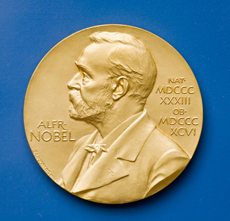
“This year’s prize is about something very small that makes all the difference,” said Staffan Normark, permanent secretary of the Royal Swedish Academy of Sciences, in making the announcement today that Peter Higgs and Francois Englert had won the physics Nobel. Normark also name-checked the ATLAS and CMS detectors at CERN in his announcement.

The award goes to Englert, of the Free University of Brussels, and Higgs, of the University of Edinburgh, “for the theoretical discovery of a mechanism that contributes to our understanding of the origin of mass subatomic particles”.

The researchers behind the so-called ‘Higgs particle’ have been widely expected to gain a Nobel at some point, especially after CERN confirmed the detection of such a particle in July last year, which is required in the standard model of physics.

The prize announcement states:

The entire Standard Model also rests on the existence of a special kind of particle: the Higgs particle. This particle originates from an invisible field that fills up all space. Even when the universe seems empty this field is there. Without it, we would not exist, because it is from contact with the field that particles acquire mass. The theory proposed by Englert and Higgs describes this process.

In an article on who should get credit published in 2010, Nature noted:

The authorship question is fraught because the mechanism was developed independently by three groups within a matter of weeks in 1964. First up were Robert Brout and François Englert in Belgium, followed by Peter Higgs in Scotland, and finally Tom Kibble in London, along with his colleagues in the United States, Gerald Guralnik (at the time in London) and Carl R. Hagen.

(Brout died in 2011 and so could not be awarded the prize.)

Researcher posts protected Science Curiosity papers on blog

Posted on behalf of Eliot Barford.

An American scientist and noted blogger has posted copies of newly published papers about NASA’s Curiosity expedition on his personal website, potentially breaking copyright laws.

Michael Eisen, a biologist at the University of California, Berkeley, reproduced the papers — originally published behind a paywall in the journal Science — on his blog yesterday, claiming he was motivated by public interest in the Curiosity project, which is funded by US taxpayers.

Eisen argues that the papers may not be under copyright as most of their authors work for NASA, and are therefore US government employees, who are whose work is not bound by copyright laws. He writes that “in the interests of helping NASA and Science magazine comply with US law, I am making copies of these papers freely available here”.

US law states that work prepared by “an officer or employee of the United States government” is not subject to US copyright, and can be reproduced and distributed. However, whether this restricts Science’s right to enforce a paywall on its published content is not apparent.

Eisen has previously campaigned in support of open access to scientific findings. He co-founded the Public Library of Science (PLoS), a non-profit open-access publisher of peer-reviewed scientific journals.

Science does not retain copyright of work it publishes, which remains with authors. Authors are permitted to distribute copies of final versions of articles after they are published by the journal, which also makes all peer-reviewed research content freely available a year after publication.

The papers in question describe findings by Curiosity in Mars’s Gale Crater, including a small proportion of water in a soil sample. For more on the articles, see Nature’s news summary.