Getting started on an academic book: five questions to ask

Turning your academic book ‘idea’ into a solid concept can be done, says Jessica Eise

Publishing an academic book is an accomplishment to which many aspire. A book is, essentially, your work, thoughts and research agglomerated in one neat, tidy package of bound paper. It’s rewarding both personally and professionally. Not only are you sharing your ideas and contributions to the broader world, but you can actually hold in your hands the fruit of your labor.writing-1043622_1920-smaller Continue reading

Job interviews: Prepare for success from failure

You can learn as much from the bad interviews as you can from the good ones, says Simon Peyda.

Guest contributor Simon Peyda.

Science is all about trial-and-error, and job interviews were no different for me. My job hunt began in the spring of 2014. With graduation rapidly approaching, and without any curricular preparation, I had to learn along the way. I would inevitably make mistakes but, as it turns out, failure is a great teacher.


Continue reading

The Fine Architecture of Learning and Joint Publication

(image courtesy of Svoboda lab, https://openwiki.janelia.org/wiki/display/SvobodaLab/Research)

You warily walk into a dark compartment, wondering if there is food inside. Suddenly there is a loud tone and you feel an uncomfortable surge of electricity through your feet. This goes without saying, but it won’t take long before you will learn to be afraid of that tone. However, over time, you hear the tone without the shock, and slowly (foolishly??) accept that the previous connection may no longer hold.

Or perhaps you are extremely motivated to work for food, given that in your home area, nutrition has been sparse and hard to come by. You see millet seeds seemingly just within the reach of your fore-limb. Though not a typical movement for you, you reach for it. In another instance, you find a different type of food that is difficult to handle. However, it is nourishment nonetheless, so you will learn the required motor skills.

SPOILER ALERT: In each of the above cases, you were a mouse the whole time (I know!) But this is a neuroscience blog, not M.Night Shyamalan’s IMDB page, so perhaps we should focus on what was taking place in the brain as each scenario played out. In both of the cases above, learning was occurring, with new information stored away within the appropriate neural connections of particular brain areas. These situations are on display in a pair of new(ish) papers out in Nature, exploring the structural substrates of such learning and identifying patterns underlying the observed structural changes as learning occurred. Continue reading

Lost in Translation — Chasing the Roots of Conditioned Fear Research

I’m currently attending the Winter Conference on Neural Plasticity in lovely St. Kitts & Nevis and I’ll be tweeting when I can from #wcnp12 when the Internet access in the room decides to cooperate.

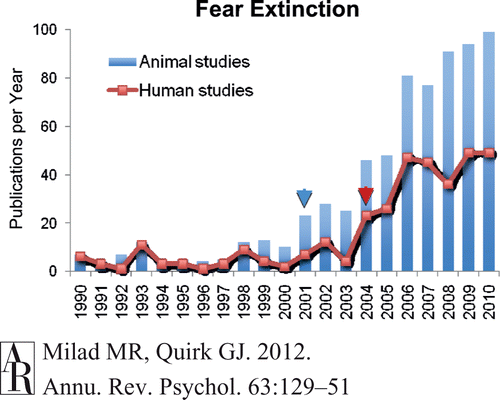
Today’s opening session at the meeting was a historical perspective on selected topics in neural plasticity. I thought I’d share an interesting piece of history about one topic that has exploded in terms of research output over the last 20 years: conditioned fear. Michael Fanselow gave the lecture on the history of fear research and focused on the era prior to the exponential growth of the literature, sticking to 1920-1980. Here’s a graph from a very recent review simply noting the number of “fear extinction” papers in the literature (one small sub-field in this topic,) just to give you a sense of how rapidly this field has grown:

Found on Google Images, not sure why it's in front of the paywall!!

I’ll do may best to channel Dr. Fanselow with the next few paragraphs:

Continue reading