June issue cover: What’s going on here?

Carrot canang sari by Rachel Meyer

Carrot canang sari by Rachel Meyer

As June comes to a close, it’s time to look back at our June issue and ask “what’s going on here?” with the cover image. As you may have guessed, the image is related to the publication of the carrot genome sequence in this month’s issue.

The cover image was provided by Rachel Meyer, a scientist who was not a co-author of the genome paper. Dr. Meyer was previously a postdoctoral researcher with Michael Purugganan at NYU and is an AAAS Science and Technology Policy fellow. She is also a co-founder of Shoots & Roots in New York.

Dr. Meyer gave us the following information about the carrot canang sari on the June cover:

Celebrating the recent availability of rainbow carrots year-round in Washington DC, I cut them in various ways and laid them out in a public dirt plot between the sidewalk and the street that was still bare because Spring had barely started and planting was far from beginning. The cold kept the carrots nicely preserved for three days. The installation took about 6 hours, and the design itself was lifted from a Persian carpet, sharing an origin with some of the earliest domesticated carrots. I had no intention to leave the installation there but people in the busy U-street/Shaw district, coming home late at night from the bars, would stop and photograph it, and even some of the suits interrupted their morning power walks to work to investigate it. After a few days, to my surprise it was not rats, but a middle-aged man who had decimated the carrots for a meal.

Shelby Ellison, an author of the carrot genome article this cover references, did this research as part of her NSF Plant Genome Postdoctoral Fellowship. We were in the same class of Fellows together and became friends because we would look for cool restaurants around DC together during our brief visits to NSF for annual Plant Genome meetings. I’m grateful to be able to explore the subject of her science through installation.

For more about the carrot genome paper, see our previous blog post, featuring Q&A with the corresponding author.
The Colorful Carrot Genome

Simon carrots 1

Iorizzo et al. Nature Genetics, 2016

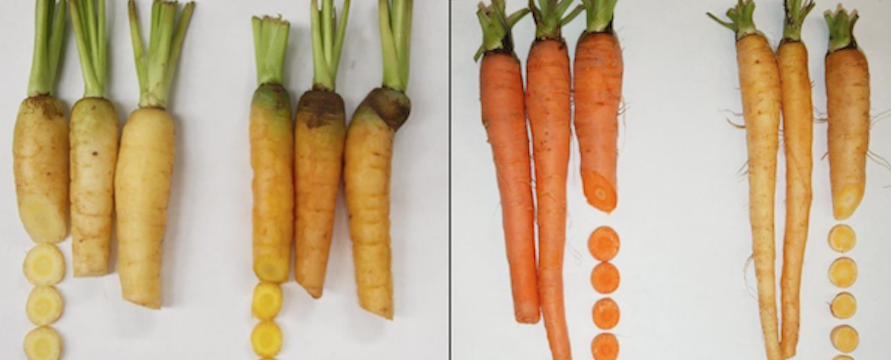
A high-quality assembly of the carrot (Daucus carota) genome is reported this week in Nature Genetics. Carrot is an important crop due to its high content of Vitamin A precursors, alpha- and beta-carotenes, as well as its popularity in global cuisines.  The bright orange color of the modern carrot and its high carotenoid content are features that emerged through selection and breeding- the complete genome sequence will serve as a resource to aid breeders in crop improvement strategies.

Iorizzo et al., 2016, Nature Genetics

Iorizzo et al., 2016, Nature Genetics

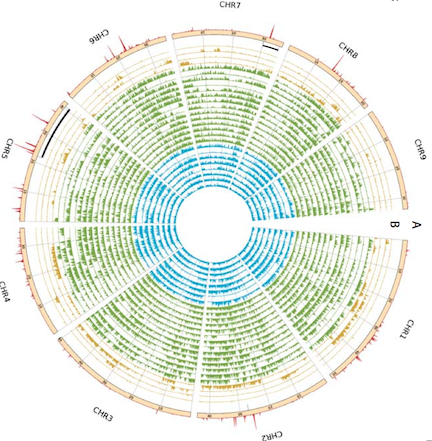
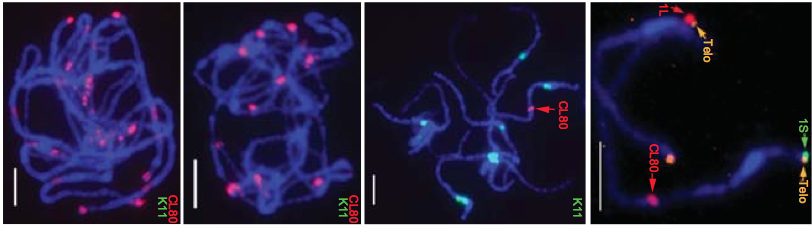
Sequencing the carrot genome allowed for the identification of two novel Whole Genome Duplication events and 634 proposed pest and disease resistant genes. In addition, a novel candidate gene regulating carotenoid accumulation was found. Finally, the authors re-sequenced 35 carrot species and outgroups to determine genomic regions associated with domestication and estimated genetic diversity. Further phylogenomic comparisons with other plants clarified evolutionary divergence between carrot and tomato, grape and kiwifruit.

Iorizzo et al., 2016, Nature Genetics

Iorizzo et al., 2016, Nature Genetics

We spoke with lead author Philipp Simon to get some background on the research.

How did you end up working on carrots?

The position I am in focuses on carrot genetics and breeding. It became advertised soon after I completed my Ph.D. in genetics. The ability to do genetic research on a crop with a strong positive impact on consumers appealed to me. I was fortunate enough to enter that position.

What do you consider your most surprising result coming out of sequencing the whole genome?

The discovery of a candidate gene for the Y locus, which conditions the accumulation of carotenoid pigments in carrot roots. In previous work we were able to map the trait and also genes for enzymes in the carotenoid biosynthetic pathway, but none of those genes involved in carotenoid biosynthesis mapped with the Y locus. With a well-characterized genome available, we discovered a candidate for that important gene. The Y locus is one of the two genes responsible for the domestication of wild white carrots (ancestral wild type) to orange.

What user group do you think will benefit the most from these data?

The immediate users of the whole genome sequence will be by plant breeders for marker-assisted selection they have underway for carrot disease resistance and seed production traits. There are also several public sector labs doing more basic research on carrot pigments, biotic and abiotic stress response, reproduction, and evolution that will find it useful.

You propose an interesting model for carotenoid accumulation in the carrot. How might this knowledge be applied to the potential improvement of other crops?

 There are several possibilities. The knowledge of this mutation in carrot may provide insights for identifying similar mutations in sequenced genomes of other crops, or generating similar mutations with genome editing technologies, for example. This could have application with other root crops such as cassava, but similar mutations are also known to influence pigment accumulation in fruit crops, so there may be applications beyond root crops.

What are some of your future directions going forward now that the genome assembly is complete?

 Now we are using the carrot genome to understand genes for other carrot traits, including traits influencing accumulation of carotenoids, anthocyanins, carbohydrates and flavor terpenoids; pest and disease resistance; abiotic stress responses; plant reproduction and growth.

Bonus- do you have a favorite carrot recipe?

Regarding carrots in my diet, I usually eat raw carrots, but roasted or stir-fried carrots are also very tasty.