Method of the Year 2016

As is our tradition every year we have chosen a method, or in this case a set of methods, that have experienced rapid growth in the last years. This year’s choice of epitranscriptome analysis does not comprise a single technique but is based on advances in detecting, enriching and profiling base modifications on all RNA species.

Some of these modifications are abundant and have known functions, others are rare and their role is still obscure. We believe recent methodological advances, as detailed in a Review by Chengqi Yi and colleagues, lay the groundwork for a comprehensive profiling of some of these marks that will shed light on their role in the cell.

Our selection of methods to watch highlights areas we think will experience growth in the coming year and be influential in biological research: from global metabolomics, to RNA-targeting CRISPR, to elucidating single cell function and faster brain imaging.  We do not claim to provide a comprehensive list and our choices may be biased by our fields of interest. We do hope you enjoy reading this feature and if you disagree with us, or if you think we have overlooked an important area, please let us know.

The Method of the Year for 2013 is… single-cell sequencing

Single-cell sequencing edged out other contenders as our choice of Method of the Year in 2013. These techniques really came into their own in 2013 and are fast providing new insights into the workings of single cells that ensemble methods are incapable of.
Method of the Year 2013Back in 2008 we chose next-generation sequencing as our Method of the Year not only because of how the new techniques would improve performance in conventional sequencing applications, but also because they opened up whole new applications, unthinkable with traditional Sanger sequencing. Our choice of Method of the Year in 2013 bears this out, as none of these single-cell sequencing applications would be possible without next-generation sequencing. And in some applications the sequencing is used almost exclusively for identifying and counting tagged molecules.

Our choice likely comes as a surprise to all those who were certain that we would pick CRISPR/Cas9 technology for targeted genome modification. This is certainly an exciting technology, and not only for genome engineering, but also for epigenome editing as described in a Method to Watch. But genome editing with engineered nucleases was our pick for the 2011 Method of the Year and although CRISPR/Cas9 provides a huge practical improvement by largely dispensing with the need to engineer the nuclease and relying instead on a programmable guide RNA, the advance over 2011 is mostly one of ease-of-use.

Methods to investigate biology at the level of single cells have been of keen interest to Nature Methods since the journal started. Our first research article from Robert Singer described a paraffin-embedded tissue FISH (peT-FISH) method to simultaneously detect expression of several genes in situ in single cells while maintaining tissue morphology (Capodieci, P. 2005). This was followed by many other imaging-based methods for such things as measuring cell growth (Groisman, A. 2006), quantifying mRNA (Raj, A. 2008) and protein (Gordon, A. 2006) levels, profiling intracellular signaling (Krutzik, P.O. & Nolan, G.P. 2006)(Loo, L.-H. 2007) and DNA insertion-site analysis (Schmidt, M. 2008) in single cells.
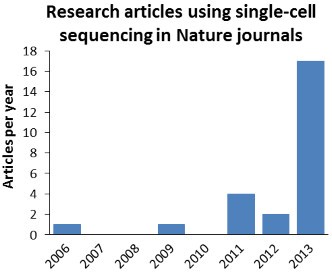
The number of original research articles published in Nature journals exploded in 2013

The number of original research articles published in Nature journals exploded in 2013. These numbers may not be complete.

The publication of M. Azim Surani’s article on mRNA-Seq whole-transcriptome analysis of a single cell (Tang, F. 2009) in 2009 helped signal the rise of sequencing-based methods for single-cell analysis. But even two years later the Reviews and Perspectives in our supplement on single-cell analysis were more focused on imaging-based than sequencing-based aproaches to single-cell analysis.

It was only in 2013 that we finally saw an explosion of original research articles using or reporting single-cell sequencing methods in Nature-family journals. Numerous studies reported new biological results that relied on sequencing of whole or partial genomes or transcriptomes from single cells.

Our Method of the Year special feature has three Commentaries by researchers in the field, including some of the earliest developers and users of methods for single-cell analysis. An Editorial, News Feature and Primer describe our choice and provide helpful background information. We hope you enjoy the selection of articles in our special feature.

A different kind of Method of the Year for 2012

Our choice of Method of the Year in prior years has tended to be methods that generally didn’t even exist only a few years earlier but which had quickly bounded onto the scientific stage and attracted the attention of a large portion of the scientific community. Targeted proteomics, our choice for 2012, on the other hand has existed for years in scaled-down forms using methods based on antibodies. Western blotting, immunofluorescence, antibody arrays, etc. can all be used to detect and measure targeted subsets the proteins expressed in cells and tissues.

During this time the workhorse of proteomics, the mass spectrometer, has been used mostly for shotgun proteomics experiments in which the goal was to analyze all the proteins in a sample. But the means to use these machines for targeted detection of defined subsets of proteins and obtain more reproducible measurements than shotgun experiments can typically provide have been around for decades.

Shotgun methods have been mostly confined to specialist laboratories as many biologists have been intimidated by the complexity of implementing and analyzing these experiments properly. Targeted proteomics on the other hand offers a tantalizing opportunity to bring a sampling of the power of mass spectrometry to the wider community of biologists. The assays are simpler, easier to run and well suited to the hypothesis-driven experiments that are the mainstay of biological research.

The ubiquitous Western blot has long filled a central role or functioned as a crucial control in many research studies. Unfortunately performing a high-quality Western blot can feel a bit like roulette. Sometimes you get a fantastic looking blot with an accurate antibody but other times either the blot is blank, the bands may look like they ran through some carnival ride or it might suffer from any number of other problems. This might prompt people to either look for a goat to appease the Western blot gods or take unscientific liberties with the presentation of the data in order to make it look like they are believe it should. It also lessens the likelihood that important replicates are performed or reported.

Targeted mass spectrometry offers the possibility for thousands of labs to move away from, or supplement, Western blots; and improve the quality and quantity of their protein measurements. This is not as sexy as next-generation sequencing, super-resolution imaging or optogenetics, some of our prior choices of Method of the Year, but the potential for revolutionizing an arguably mundane but indispensable technique was compelling enough that it played no small role in our decision. Only time will tell what impact the method has and we eagerly look forward to the answer.

Method of the Year 2010: Optogenetics

The time to celebrate methods has come and this year we have chosen to devote our end of year special feature to Optogenetics.

While neuroscientists will hardly need any introduction to this booming technology, recent developments have shown that this technique can go beyond controlling the activity of neurons in the brain and has the potential to open new avenues of experimentation across multiple other biological fields as well.

The term optogenetics was only coined 4 years ago but the technology has already matured to the point that it is having a substantial impact on basic biological research. Because of the transformative effect that it has already had in neuroscience studies and the excitement of its future prospects in other fields, it’s nomination as Method of the Year has not been a difficult one.

You can read more about this choice in the editorial of our January issue and access all the content of our special issue here.

We hope that you will share our excitement for this technology and we welcome any comments on our selection!

Method of the Year 2009

Thanks again to all our readers who took the time to nominate and vote for methods important for biology.

As you probably know by now (and if you don’t, visit our January special issue), we picked induced pluripotent stem cells as Method of the year 2009 for their potential as tools for studying both disease and basic biology. iPS cells did not in fact do too badly among our voters, coming out fifth, both in total votes and in positive votes.

To read our editorial on iPS cells as tools for biology, go here.

The clear method on top in our voting gallery this year was mass spectrometry-based proteomics: the two top vote getters were a paper using peptide ligand libraries for the analysis of the cytoplasmic proteome of human erythrocytes and a paper using targeted proteomics to analyse the proteome of yeast. We certainly agree that these are areas of a lot of interest and included targeted proteomics as a method to watch.

Considering methods that received a minimum of 20 votes (either positive or negative) as a cut-off, the others that stand out in your votes are label-free imaging, single-molecule detection methods inside of cells and methods for studying genome structure. In this case too, your votes dovetail with our selection of methods to watch, here and here.

We’ve solved some of the problems of the voting process from last year but the numbers of votes are still quite low. We welcome suggestions from you as to how we may improve the process.

And tell us what you think of our selection of iPS cells as tools for biology!