Method of the Year 2016

As is our tradition every year we have chosen a method, or in this case a set of methods, that have experienced rapid growth in the last years. This year’s choice of epitranscriptome analysis does not comprise a single technique but is based on advances in detecting, enriching and profiling base modifications on all RNA species.

Some of these modifications are abundant and have known functions, others are rare and their role is still obscure. We believe recent methodological advances, as detailed in a Review by Chengqi Yi and colleagues, lay the groundwork for a comprehensive profiling of some of these marks that will shed light on their role in the cell.

Our selection of methods to watch highlights areas we think will experience growth in the coming year and be influential in biological research: from global metabolomics, to RNA-targeting CRISPR, to elucidating single cell function and faster brain imaging.  We do not claim to provide a comprehensive list and our choices may be biased by our fields of interest. We do hope you enjoy reading this feature and if you disagree with us, or if you think we have overlooked an important area, please let us know.

Ten years of Methods

Our tenth anniversary is an occasion to celebrate methods development!

In our Anniversary Issue, we highlight ten areas of methods development, among many candidates, that have had a lot of impact on biological research over the last decade. We also take the opportunity to look back at the papers we have published in some of these areas. We hope to add similar descriptions for all our ‘top-ten methods’ in coming months.

You can look back at the last ten years of Nature Methods in the following areas here:

Microbial sequencing

Super-resolution microscopy

Optogenetics in neuroscience

Light-sheet imaging

Mass-spectrometry based proteomics

High-throughput sequencing data analysis

Guidelines for algorithms and software in Nature Methods

A large proportion of original research published in Nature Methods relies to varying degress on custom algorithms and software developed by the authors. Here we provide guidance on our relevant material sharing and reporting policies.

Nature Methods first outlined our material sharing and reporting standards for algorithms and software in a March 2007 Editorial. Now, after seven years of experience applying those policies we updated and expanded on them in our March 2014 Editorial. On this page we provide more detailed guidelines for authors submitting manuscripts containing unpublished algorithms and software they created. We are posting this information here because we’d like these guidelines to evolve and we want input from our communities on how they think this should happen. Please comment below and let us know your thoughts. We will update this document as our policies change.

Manuscripts published in Nature Methods include methods and tools in which algorithms and software represent an increasingly important methodological component. However, the degree to which they are central to the reported methodology can vary considerably. The algorithm or tool may be the entire motivation for publishing the work or it may be ancillary to it. Additionally, the methodology may be a novel algorithm of value in and of itself but a coded implementation is still necessary for the authors to show that it works as expected. Finally, the software tool may implement existing algorithms in a user-friendly form to deliver high value functionality of substantial general interest. Because of this wide variety it is inappropriate to enforce one-size-fits-all standards for algorithms and software reported in Nature Methods. The guidelines below represent our current editorial position on software reporting and release.

Client-side Software
This is software that is installed and used on a personal computer and not intended to be accessed remotely as a web service. It can be entirely stand-alone on a commonly available operating system (Windows, Mac OS X, or *nix) or can require the user to have a popular software platform installed (MATLAB or LabVIEW). In all cases, but particularly when using MATLAB or LabVIEW, all platform versions and software dependencies must be detailed in the supplied documentation.

At Submission

  • If the custom algorithm/software is central to the method and has not been reported previously in a published research paper it must be supplied by the authors in a usable form including one or more of the following.
    1. Source code
    2. Complete pseudocode
    3. Full mathematical description of the algorithm
    4. Compiled standalone software

    We strongly urge that full source code be provided. A compiled executable alone is not sufficient but may be required if the tool is intended to be of wide general use. Final acceptable forms of release of the algorithm, software and code will be determined by the editor after consultation with referees. This decision will be influenced by the editorial motivation for publishing the work (i.e. high novelty, satisfies wide general need, etc).

  • If the software is ancillary to the methodology being reported or is a routine implementation of obvious processes, such as microscope control software or analyses that are otherwise adequately described, the software need not be supplied to reviewers at submission but final release requirements may change in the course of the review process.
  • Supplied source code or software must be accompanied by documentation sufficient for a typical user to compile, install and use the software. Depending on the nature of the software tool, how central it is to the manuscript and our editorial motivation for considering the work, the minimum documentation may be a simple readme file or a full manual in PDF format.
  • If appropriate, sample data known to work on the software should be provided along with the expected output. Referees are encouraged to try and use the tool to analyze their own data.
  • The software and associated files may be supplied for reviewers as either:
    1. A single Supplementary Software zip file up to 200 MB in size
    2. Four DVDs to be mailed to the reviewers.
  • Any restrictions on the availability of software or code used to implement novel algorithms must be specified at the time of submission. Editors will decide whether any restrictions are acceptable in consultation with the reviewers. If some restrictions are deemed acceptable, they must be clearly explained in the methods section of the manuscript. Authors must supply all information needed for the reviewers to properly evaluate the software or code. If the motivation of the submitted manuscript is to provide a useful tool, rather than report a new algorithmic development, there should be no substantial restrictions on software or code availability.
  • We encourage authors to provide a license with the software or code.
  • A narrative description of key algorithmic components should be provided in the main text. Extensive equations, pseudocode or snippets of source code should be confined to the Online Methods or a Supplementary Note.

At Acceptance

  • If the software is central to the methodology and non-obvious, the source code should be provided in a Supplementary Software zip file as described above so that readers can easily access the exact code used to obtain the results in the paper. There are some possible exceptions:
    1. If the author’s institution requires a user to accept a license agreement or if the author has other reasonable grounds for not providing the source code as Supplementary Software, it may be acceptable for the author to host source code on an institutional server and require that users fill out an online form and agree to a license before downloading the software. In this instance the software must have version numbering and a link to the version used in the work must be provided in the manuscript.
    2. In some situations it may be permissible for authors to supply only compiled software as Supplementary Software but the source code to academic users upon email request. Details of availability must be clearly stated in the manuscript.
    3. It is not acceptable to make software and code available by email request only.

  • If the software or code isn’t the main tool/method being reported in the manuscript the authors may provide a note in the readme file of the Supplementary Software cautioning users that the code is unsupported and not intended for general use. In this case it is permissible that the software or code be made available only by email request but the authors must state this availability in the manuscript.
  • Regardless of how the software is made available, the code supplied with the manuscript must be identical to that used to obtain the data in the paper. An exception can be made for changes that don’t alter the processing of input data. The authors may however provide a link to access new versions of the software.
  • We strongly encourage authors to include a license with all published software and code.
  • We encourage authors to provide macros for recording the software version and parameter settings during analyses or to integrate this functionality into the software itself.

Web Tools/Resources
These represent a special class of software that many times can’t be expected to follow the same guidelines outlined above. This is particularly true if the web tool or resource is being supplied as a service and has few, if any, novel computational aspects to it. The only end-user requirement for web tools is that they be freely accessible with any modern web browser.

Nature.com provides a proxy server for reviewers to access web tools and resources anonymously.

At Submission

  • The authors must supply a working link and any necessary log in information.
  • Any unpublished algorithms central to the operation of the tool should be supplied in forms a), c) or d) detailed above.

At Acceptance

  • The authors should supply written confirmation that they will keep the website and tool operating and freely accessible for the foreseeable future.

The dos and don’ts of communicating with editors and reviewers

Some thoughts and advice from the editors at Nature Methods on communicating with us and our reviewers, particularly on matters of disagreement.

In the over nine years that we at Nature Methods have been interacting with authors and reviewers we have experienced a great variety of communication strategies. Some work well…others don’t. In our October Editorial we discuss how neglecting to word criticism productively can undermine the value of the criticism and short-circuit this critical aspect of scientific discourse.

In the three posts that follow we provide practical advice for communicating with editors and reviewers during three critical steps of the publication process. These are: the cover letter, the rebuttal letter and the appeal letter. We hope you find these guides useful and encourage readers to comment on the points made and suggest dos and don’ts of their own.

How to write a cover letter
How to write a rebuttal letter
How to write an appeal letter

Update: It has been suggested that we write a dos and don’ts for reviewers. We agree this could be just as useful for improving the peer review process, possibly more so, and hope to be able to provide this soon.

Let’s give statistics the attention it deserves

This month we launch a new column ‘Points of Significance’ devoted to statistics, a topic of profound importance for biological research, but one that often doesn’t receive the attention it deserves.

For the past three years Nature Methods has been publishing the Points of View column, one page a month dedicated to practical advice for researchers on how to create accessible and accurate visualizations of their data. The response to the column articles has been fantastic and most recently we organized them by topic here on our blog.

Unfortunately, a truth about data visualization is that no matter how good the visualization, if the experiment wasn’t appropriately designed and the data wasn’t analyzed correctly, the resulting visual depiction of the data will be inherently flawed. Nature Methods and the other Nature journals recently made changes to improve data and methods reporting as part of a reproducibility initiative. We feel this is an important first step in improving experimental reproducibility and repeatability, but unfortunately by the time work is submitted for publication it can be difficult to correct shortcomings in experiemntal design and analysis.
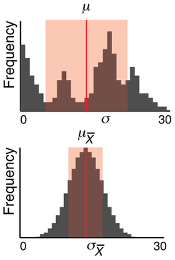
A population distribution and a distribution of sample means.

A population distribution and a distribution of sample means.

In our September issue readers will find a new column, Points of Significance, that we hope will be as useful as the column that preceded it, perhaps more so. Martin Krzywinski, who has been writing the visualization column, is now joined by Naomi Altman, Professor of Statistics at The Pennsylvania State University. Among other things, Naomi will be responsible for ensuring that the information and advice we provide about statistics in every Points of Significance article is accurate.

The column has been expanded from one to two pages and will often have an Excel spreadsheet associated with it. This expansion will help us better communicate information that is less well served by display items. However, as illustrated by the figures in the first article of the column and the accompanying spreadsheet, visual displays will continue to play a vital role due to their strength in providing easily interpretable examples that can often be more readily grasped than mathematical or narrative descriptions.

We will strive to present the material so that each article in the column builds on prior ones. In this spirit the first article discusses populations and sampling, a foundation for nearly all topics to follow. The accompanying spreadsheet allows readers to play around with sampling and see for themselves how often values obtained from samples deviate substantially from the real population. It can be disconcerting to see just how often ‘bad luck’ can give a ‘wrong’ result in one set of measurements while in another set of measurements the ‘right’ result is obtained but statistical measures would suggest that the former is more likely to be ‘correct’ than the latter. This excellently highlights how statistics is unable to tell you if you are right. But this doesn’t suggest statistics has limited value. Instead, readers of scientific articles reporting statistical results need a healthy grasp of the limitations of statistical analysis and users of statistics can always learn ways to improve the power of their analysis.

The “aura of exactitude” that often surrounds statistics is one of the main notions that the Points of Significance column will attempt to dispel, while providing useful pointers on using and evaluating statistical measures. We expect that readers will find the upcoming October Points of Significance article on error bars and confidence intervals with its practical tips on interpreting these graphical elements to be particularly useful almost every time they read a manuscript containing these popular visual representations of uncertainty.

We hope readers enjoy Points of Significance. It is appropriate that the column is debuting during the International Year of Statistics. To allow readership by a wider audience each article will be free to access for a period of one month after it is published.

Update: All Points of Significance articles are now free access and have been collected together on a dedicated page in the nature.com “Statistics for biologists” resource.

For more on statistics, and particularly statistics training, don’t miss this September’s Editorial.

. . . . . . . .

Update: Below is a continuously updated list of the Points of Significance articles.

Importance of being uncertain – September 2013
How samples are used to estimate population statistics and what this means in terms of uncertainty.
Error Bars – October 2013
The use of error bars to represent uncertainty and advice on how to interpret them.
Significance, P values and t-tests – November 2013
Introduction to the concept of statistical significance and the one-sample t-test.
Power and sample size – December 2013
Using statistical power to optimize study design and sample numbers.
Visualizing samples with box plots – February 2014
Introduction to box plots and their use to illustrate the spread and differences of samples.
Comparing samples—part I – March 2014
How to use the two-sample t-test to compare either uncorrelated or correlated samples.
Comparing samples—part II – April 2014
Adjustment and reinterpretation of P values when large numbers of tests are performed.
Nonparametric tests – May 2014
Use of nonparametric tests to robustly compare skewed or ranked data.
Designing comparative experiments – June 2014
The first of a series of columns that tackle experimental design shows how a paired design achieves sensitivity and specificity requirements despite biological and technical variability.
Analysis of variance and blocking – July 2014
Introduction to ANOVA and the importance of blocking in good experimental design to mitigate experimental error and the impact of factors not under study.
Replication – September 2014
Technical replication reveals technical variation while biological replication is required for biological inference.
Nested designs – October 2014
Use the relative noise contribution of each layer in nested experimental designs to optimally allocate experimental resources using ANOVA.
Two-factor designs – December 2014
It is common in biological systems for multiple experimental factors to produce interacting effects on a system. A study design that allows these interactions can increase sensitivity.
Sources of variation – January 2015
To generalize experimental conclusions to a population, it is critical to sample its variation while using experimental control, randomization, blocking and replication to collect replicable and meaningful results.
Split plot design – March 2015
When some experimental factors are harder to vary than others, a split plot design can be efficient for exploring the main (average) effects and interactions of the factors.
Bayes’ theorem – April 2015
Use Bayes’ theorem to combine prior knowledge with observations of a system and make predictions about it.
Bayesian statistics – May 2015
Unlike classical frequentist statistics, Bayesian statistics allows direct inference of the probability that a model is correct and it provides the ability to update this probability as new data is collected.
Sampling distributions and the bootstrap – June 2015
Use the bootstrap method to simulate new samples and assess the precision and bias of sample estimates.
Bayesian networks – September 2015
Model interactions between causes and effects in large networks of causal influences using Bayesian networks, which combine network analysis with Bayesian statistics.
Association, correlation and causation – October 2015
Pairwise dependencies can be characterized using correlation but be aware that correlation only implies association, not causation. Conversely, causation implies association, not correlation.
Simple linear regression – November 2015
Linear regression is a flexible way to predict the values of one variable using the values of the other to find a ‘best line’ through the data points.

Data visualization: A view of every Points of View column

We’ve organized all the Points of View columns on data visualization published in Nature Methods and provide this as a guide to accessing this trove of practical advice on visualizing scientific data.

As of July 30, 2013 Nature Methods has published 35 Points of View columns written by Bang Wong, Martin Krzywinski and their co-authors: Nils Gehlenborg, Cydney Nielsen, Noam Shoresh, Rikke Schmidt Kjærgaard, Erica Savig and Alberto Cairo. As we prepare to launch a new column in our September issue we felt this would be a good time to collect and organize links to all the Points of View articles together in one place to make it easier to navigate this wonderful resource that the authors have provided us. For the month of August we will be making all the columns free to access so everyone can benefit from this practical advice on data visualization.

This should not be the end of the Points of View column though. We will be inviting new visualization experts to author articles on new topics that have not been covered so far or which can be expanded on. This page will be continuously updated whenever a new article is published so stay tuned. If you have a suggestion for a topic you would like to see covered in a future points of view article please comment below.

Update of March 28, 2015: A PDF eBook of the 38 Points of View articles published between August 2010 and February 2015 is now available at the Nature Shop for $7.99 under the title “Visual strategies for biological data: the collected Points of View”. The article summaries below provide a nice overview of what is contained in that eBook collection.

. . . . . . . .

Introduction
Visualizing biological data – December 2012
Data visualization is increasingly important, but it requires clear objectives and improved implementation
The overview figure – May 2011
An economic overview figure to convey general concepts helps readers understand a research study

. . . . . . . .

Composition and layout
The design process – December 2011
Use good design to balance self-expression with the need to satisfy an audience in a logical manner
Figure design and layoutLayout – October 2011
Proper layout reveals the hierarchical relationship of informational elements
Gestalt principles (Part 1) – November 2010
Gestalt principles (Part 2) – December 2010
Exploit perceptual phenomena to meaningfully arrange elements on the page
Negative space – January 2011
Whitespace is a powerful way of improving visual appeal and emphasizing content
Salience to relevance – November 2011
Ensure that viewers notice the right content by making relevant information most noticeable
Elements of visual style – May 2013
Translate the principles of effective writing to the process of figure design
Storytelling – August 2013
Relate your data to the world around them using the age-old custom of telling a story

. . . . . . . .

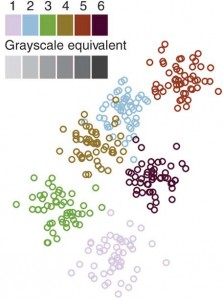
Using colorUsing color in data visualizations
Color coding – August 2010
Choose colors appropriately to avoid bias and unwanted artifacts in visuals
Color blindness – June 2011
Make your graphics accessible to those with color vision deficiencies
Avoiding color – July 2011
Improve the overall clarity and utility of data displays by using alternatives to color
Mapping quantitative data to color – August 2012
Color is useful for compact visualizations of large data sets but must highlight salient features
Heat maps – March 2012
Color, clustering and parallel coordinate plots are essential for using heatmaps effectively

. . . . . . . .

Elements of a data figureElements of a figure
Typography – April 2011
Choose typefaces, sizes and spacing to clarify the structure and meaning of the text
Axes, ticks and grids – March 2013
Make navigational elements distinct and unobtrusive to maintain visual priority of data
Labels and callouts – April 2013
Figure labels require the same consistency and alignment in their layout as text
Plotting symbols – June 2013
Choose distinct symbols that overlap without ambiguity and communicate relationships in data
Arrows – September 2011
Use well-proportioned arrows sparingly and consistently as a guide through complex information

. . . . . . . .

Plot types
Bar charts and box plots – February 2014
Choose the appropriate plot according to the nature of the data and the task at hand
Sets and intersections – July 2014
Euler and Venn diagrams are appropriate for up to three sets but for greater numbers use more scalable plots
Heat maps – March 2012
Color, clustering and parallel coordinate plots are essential for using heatmaps effectively
Temporal data – Feb 2015
Use inherent properties of time to create effective visualizations
Unentangling complex plots – July 2015
Carefully designed subplots scaled to the data are often superior to a single complex overview plot
Pathways – January 2016
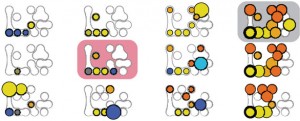
Apply visual grouping principles to add clarity to information flow in pathway diagrams
Neural circuit diagrams – March 2016
Use alignment and consistency to untangle complex neural circuit diagrams

. . . . . . . .

Improving figure clarityImproving figure clarity
Simplify to clarify – August 2011
Simplify your presentation to improve clarity
Design of data figures – September 2010
Improve figure decoding by using strong visual cues to encode data
Salience – October 2010
Use salience to differentiate graphical symbols and speed up figure reading
Points of review (Part 1) – February 2011
Examples of figure redesigns
Points of review (Part 2) – March 2011
Simple tips to improve pie chart, scatter plot and color scale data displays

. . . . . . . .

Multidimensional data
Visualizing multidimensional dataInto the third dimension – September 2012
3D visualizations are effective for spatial data but rarely for other data types
Power of the plane – October 2012
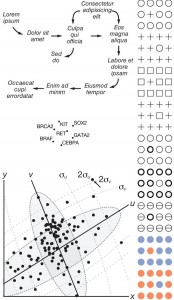
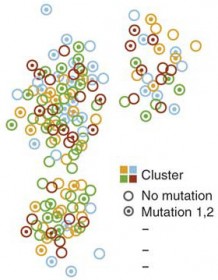
Combine 2D plots for effective visualization of multivariate data
Multidimensional data – July 2013
Visually organize complex data by mapping them onto familiar representations of biological systems

. . . . . . . .

Data exploration
Pencil and paper – November 2012
Quick sketches and doodles of data or models aids thinking and the scientific processVisualization for data exploration
Data exploration – January 2012
Create ‘slices’ of data to enhance the process of pattern discovery
Networks – February 2012
Choose your network visualization based on the patterns you are looking for
Heat maps – March 2012
Color, clustering and parallel coordinate plots are essential for using heatmaps effectively
Integrating data – April 2012
Combine visualizations of multiple data types to find correlations and potential relationships
Representing the genome – May 2012
Limit what is displayed based on the question being asked
Managing deep data in genome browsers – June 2012
Compaction and summarization help find patterns in overwhelming data
Representing genomic structural variation – July 2012
Use arcs, color, dot plots and node graphs to show relations between distant genomic positions

. . . . . . . .