The perfect pitch

Do you have a good idea for a Review article, or perhaps a Comment? Here’s a brief guide on how to pitch ideas to editors.

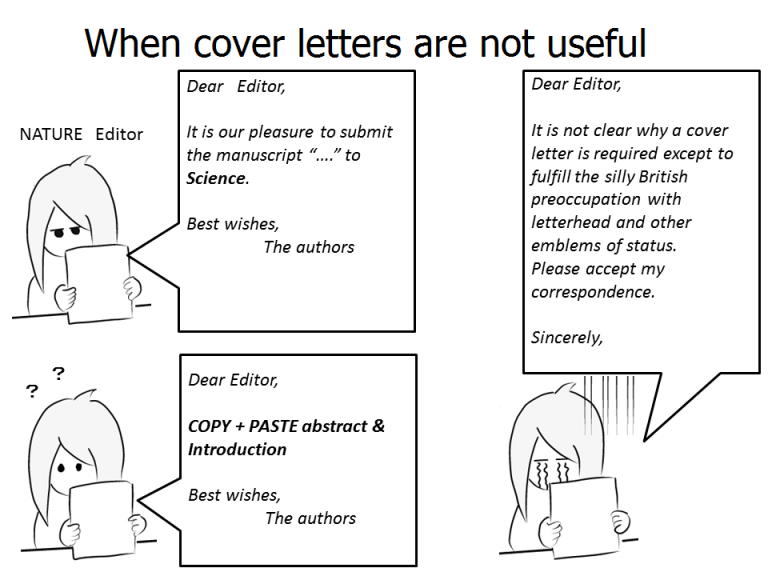
How to write a cover letter? That is a question Nature editors are often asked. When submitting a primary research article, a cover letter is only needed if the authors wish to convey some additional information not included in the manuscript (Some editors still love a good old cover letter. Here are some great tips for writing cover letters for primary research). However, if you want to propose a Review article or a Comment piece, a good cover letter is essential. Here is how to write it:

Dear Editor,

[Spend a few seconds to check the relevant editor’s name on the website, you would not like to receive emails everyday starting with Dear Researcher. It is good practice to get the name of the journal and editor right. Cover letters addressed to another journal suggest that the paper has been rejected by the other journal, which is not necessarily flattering. (Rest assured that this will not lead to the immediate rejection of the proposal, but it does say something about your attention to detail. This is a good moment to double-check the date and the correct spelling of the editor’s name)]

Who are you?

[Introduce yourself very briefly]

Why are you writing to us?

[I would like to propose a Review article, a Comment piece]

Why this topic?

[This is the most important part. Keep it concise, but at the same time convincing. Bring solid arguments but don’t overdo it. Some tips:

  • It has to make us think “what a great idea”!
  • It’s an interesting and relevant topic that has not been covered too recently in the journal. Do check that we have not published this before!
  • Recent findings opening up a new field
  • New insights/new angle into an existing field
  • Bringing together two/more fields
  • Explain the main findings, avoiding peripheral circumstances
  • Be clear, concise, and provide context, but don’t go into a full bibliographic analysis
  • Are there competitor reviews? How are they different from your idea?]

Why now? [This is also very important. Why is the proposed piece timely? Why now and not two years ago or in two years’ time? Highlight recent papers that demonstrate the timeliness of the topic.]

Why you? [Are you are expert in the field, a ‘key opinion leader’ and have an established research background in the field? Will people want to hear what you have to say, are you a good communicator? What new angle are you bringing? If you are a team of authors how do you complement each other?]

Why us? [Why do you want to write in this journal and not in another? Take the time to check the journal website and see what it published in term of article types and content. Is this really the right outlet for your proposed article? Think of your audience: who would you like to read this Review?]

Other information. [When are you available to write, do you have any restrictions, requirements?]

Looking forward to hearing from you.

Yours’


Here are some further tips:

Do:

  • Mention if you had contact with the editors, perhaps we met and chatted at some point.
  • If there are recent meetings on the topic that showcase the interest of the community in this topic.
  • Mention any related developments in the field: projects, facilities, collaborations.

Don’t: [no, no,no]

  • Copy and paste the abstract as the cover letter.
  • Get the journal name wrong.
  • Name-drop “I ran my idea by (famous) Prof so-and-so and he/she think it’s a great idea for a Review”.
  • Include hype, clichés, empty statements.

[All these Donts are worth keeping in mind for primary research cover letters too]
{credit}Iulia Georgescu{/credit}

As editorial lore goes there is a saying: “For a good Review you need the right topic, the right author and the right time”. So the pitch in the cover letter should make it clear why this article, why you, and why now. Good luck!


Many thanks to Linda Koch (Nature Reviews Genetics) and Annette Fenner (Nature Reviews Urology) for sharing their tips.


Interactions: Conversation with Sabine Hossenfelder

Post by Iulia Georgescu.

Sabine Hossenfelder talks to us about her provocative upcoming book “Lost in math: How beauty leads physics astray”. The book will be available in June, but below you can get a sneak preview (with no spoilers).

You mention that some of your colleagues tried to dissuade you from writing this book. Why? What were their arguments?

“Don’t write a popular science book before you are tenured. It takes up too much time and doesn’t count on your CV. And even then, better don’t because it will look like you aren’t serious about doing research.”

They were right, of course, it took up time – time I did not spend doing research.

Hossenfelder, Sabine (Sabine Hossenfelder)

Was it worth it, then or is it too early to say?

The book has not yet been released, so I can’t tell whether it will cause the rethinking that I hope for. But from a personal point of view it was totally worth it, more so than I could have anticipated. I have been writing a blog for more than 12 years, but books are a different kind of beast. I wasn’t at all sure I could pull it through. But, well, I did. And along the way I’ve proved – to myself more than anybody else – that theoretical physics isn’t the only thing I can do with my life. So from the perspective of self-development it has been an asset already.

How do you expect this book will be perceived by physicists and the broader scientific community?

I expect most researchers in the areas that I criticize will complain that I should not have made this criticism publicly. But I don’t think the community will take on this problem without significant external pressure. So that was my only option. Besides, I have raised this criticism “internally” before (see my comment) which (unsurprisingly) led to zero rethinking.

As for the physicists outside the community: I really don’t know. The topics that I write about (as with multiverses and new particles and dark energy and such) get a lot of media attention despite the lack of scientific relevance, and I know that physicists in fields which get less attention are sometimes annoyed about that. So maybe they’ll be sympathetic to what I have to say.

Do you worry that it can be wrongly used to undermine the general public’s trust in science?

In my book I highlight problems with the present organization of scientific research. These problems make scientists untrustworthy. What undermines the public’s trust in science is ignoring these problems, not speaking about and trying to solve them. If nothing changes, of course you can use my book to argue that scientists shouldn’t be trusted, because in fact they cannot be trusted.

What do you think is the extent of the aesthetic bias in other areas of physics? Should we start questioning our compasses in other fields as well?

I don’t know, really. You should ask some people in other disciplines. It has not been all that easy to disentangle the aesthetic criteria from the mathematical ones in the areas I wrote about. You have to dig deeply into the literature to get to the bottom of what are now commonly used arguments. It was not fun, didn’t make me friends, and I am not keen on becoming the aesthetic-bias doctor of physics. But yes, by all means, question everything.

The theoretical particle physics community appears very isolated. Shouldn’t it try to come out and take other people more seriously, not only philosophers as you suggest in the book, but also physicists from other fields? What can one do to start the dialogue?

I am not opposed to specialization. Specialization has benefits. It allows researchers to use resources efficiently to solve specific problems. And science needs that. But science also needs a healthy dose of dialogue across disciplines because there is unexplored potential in applying insights from one discipline to the other. So we need a balance of both. But, where exactly that balance lies, I don’t know. I therefore think we should just avoid directing researcher’s interests by incentivising specialization. It’s easier to produce five papers on one topic than to produce five papers on different topics. Hence, if you look at productivity, sticking to one topic is a benefit. This leads me to think presently the balance is likely off in favour of specialization. How much, I can’t tell you.

But remove the obstacle and we’ll see if makes a difference.

Hossenfelder-Lost In Math

But what is the use of even trying to develop these theories?

For one, I think knowing how the world works has a value in and by itself. And that there is a market for books and movies about the foundation physics shows to me that this value isn’t merely recognized by those who do the research themselves. I believe people want to understand natural laws out of a basic sense of curiosity, or maybe a desire to know what is their own place in this universe. This isn’t a desire that’s reserved to theoretical physicists.

Having said that, it is arguably true that high energy particle physics doesn’t presently have much practical use. There really isn’t a lot you can do with a 25 km particle collider other than colliding particles. But I don’t think this research will remain useless forever. I am thinking here not about what will happen in 10 or 100 years, but maybe in 1000 or 5000 years. Who knows what this technology will one day be good for? I don’t. But, I would find it very surprising if it would remain an academic pursuit.

I think particle physics suffers from a lack of vision, or you could even say a lack of science fiction. This has been on my mind a lot while writing the book. See, astrophysicists have all the good stories about space-travel and alien life and warp drives and Dyson spheres and all that. And computer scientists have tales about sentient robots and omniscient AIs and, omg, we may live in a computer simulation. But particle physicists have nothing comparable. They have no stories. Give it 5000 years of technological development and what may particle colliders be good for? I think the field could benefit from some wild speculations here.

What is your bet as to where clues are likely to come from and solve the current crisis in particle physics?

I bet on dark matter and quantum gravity. Dark matter because at least we know it’s there. So, keep poking it, I say, sooner or later we’ll figure out what it is. Quantum gravity because we know there must be something new to find. As I lay out in the book it’s a good problem, a problem of mathematical consistency, not just an aesthetic itch. And I don’t think that it’s impossible to measure quantum gravitational effects. I wrote about proposals to measure it here.


The book Lost in Math will be released on June 12, 2018.

Follow Sabine Hossenfelder’s popular blog Backreaction.

Behind the paper: Serendipitous encounters

Post by Iulia Georgescu

If you meet an editor of the Nature journals they will likely assure you that to get published you just need good science. But, the truth is there is some luck involved too – especially for interdisciplinary work. Sometimes the editors accidentally come across gems of papers. Bart Verberck and Liesbeth Venema tell two such stories.

Bart Verberck: Mathematics and lizards

One of the most pleasant aspects of being a Nature Physics editor is the need to be in touch with the scientific community, which means a fair share of your time is spent away from your desk, at conferences and institutes.

On one such occasion, I found myself attending a conference called “Science of the Future” in Kazan, Russia.  The event was memorable for a number of reasons.  On the plane from Moscow to Kazan, for example, I happened to sit next to a French physicist checking his presentation for the conference, in which he referred to a (Physical Review B) paper I had co-authored back in the day when I was an active researcher.  And at the conference, as soon as I had expressed an interest in seeing the museum–room of Yevgeny Zavoisky — credited with the discovery of electron paramagnetic resonance, at the University of Kazan — hey presto, I was given a tour.

The scope of the conference was extremely broad; in one session of plenary talks one could hear from a historian (a first for me), a bioinformatician, a physicist and a mathematician.  The mathematician was Stanislav Smirnov, recipient of the 2010 Fields Medal.  His presentation touched on percolation and cellular automata, a subject I had been fascinated by for many years.

At the conference dinner, I approached Smirnov.  I wanted to know his opinion on Stephen Wolfram’s viewpoint that cellular automata are a sort of governing principle in nature, as expressed in his book A New Kind of Science.  After chatting a bit, Smirnov mentioned he was involved in a piece of work at the boundary between mathematics and biology.  He wondered whether, scope-wise, it would fit Nature

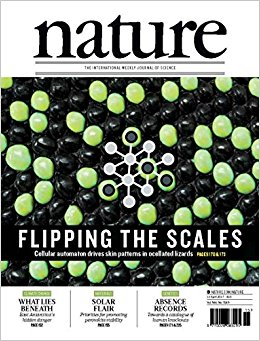
I would have loved to see the work submitted to Nature Physics, but, when I got an e-mail from Smirnov a few weeks later, asking for advice on where and how to submit, I did the honourable thing and put him in touch with Liesbeth Venema from Nature.  He submitted the paper — on how the pattern formation on the skin of a particular type of lizard is governed by, yes, a cellular automaton — to Nature, where it successfully went through peer review.  The paper’s publication in 2017 coincided with the centenary of “On Growth and Form” by D’Arcy Thompson and was on the cover of Nature.  Of course, I wrote a research highlight  about it in Nature Physics.

naturecover

Liesbeth Venema: Pyramids and robots

Another main attraction of being a Nature manuscript editor has always been, for me, the chance to learn a new scientific topic every week. This never gets boring. Admittedly, it helps if lizards are involved. Or sharks, spiders and tree frogs – all have played their parts in Nature papers I handled over the years.  Continue reading

More or more diverse?

Post by Iulia Georgescu

The amount of scientific literature is growing at a staggering rate. In physics alone, more than 19,000 articles were published in 2016 and this is only what is indexed by Web of Science, excluding unpublished arXiv preprints, some conference papers, technical reports and PhD theses. There is little hope that anyone can keep up with what is going on outside their area of expertise and even that is a challenge. Review articles come in handy, but even reading just the physics review articles published in 2016 is hard — there’s more than 860 of them!

The scientific literature is expanding, but is it also becoming more diverse? Not really. A quick look back at the history of scientific publishing will remind us that innovation is not something publishers can really take pride in. The format and type of narrative of the scientific article has changed little since the early days of the Philosophical Transactions of the Royal Society of London, the oldest scientific journal still publishing today. In the more than 350 years of existence, scientific journals have transitioned from print to online. Articles can now link to external content, have some limited interactivity in the figures, and can sometimes include embedded videos, but essentially the working horse of scientific publishing remains the two-column dull-looking pdf, not too different in style and format from the papers published in print in the 19th and 20th centuries. The scientific article of the future – a hub for multimedia resources used to illustrate the narrative – remains a dream, mainly due to the technical challenges involved in integrating all the parts, but also to the inertia of both the academic and publishing worlds.

However, we start to see signs of change. In the past few years we have seen the rise of truly new article types like data descriptors, and software journals are starting to take off. These changes reflect the growing importance of scientific software and data analysis in science and the spreading awareness of the relevance of non-traditional research outputs. Such new formats and outlets are very welcome and as they become more accepted and used, they can hopefully trigger more innovation.

How about reviews? Review articles are a young format, at least when compared to traditional articles – dedicated reviews journals started to emerge in the 1920s. But in almost a century they have not changed much. With the notable exception of Living Reviews – review articles regularly updated by their authors, we have not seen much innovation, at least in physics. Standard reviews are long, authoritative and exhaustive pieces. Shorter reviews on fast-growing fields have only become popular in during the past decade or so.

Continue reading

Confused: review, Review or review?


Post by Iulia GeorgescuReviews

As a scientist you’re likely using the word ‘review’ every day. “I hope my article makes it through peer-review”, “We’re thinking of submitting to Physical Review A”, “I read a really good review of this field”, and so on. You probably gave little thought to this humble word, but interestingly it has slightly different meanings in all these examples. Why is a review article called as such, and why do we call the peers who referee our papers reviewers? And above all, why was the Physical Review called a Review in the first place, when it did not publish review articles, nor was it peer reviewed in the beginning?

I confess I only recently asked myself these questions after reading a survey. Some respondents answered the question “What is your main source of reviews in physics?” with “Physical Reviews Letters”. Yes, it makes you wonder, but the confusion is not entirely ridiculous, because most physicists are not aware of the origin of these terms.

Take peer-review, although the practice itself was thought to date back to the 17th century workings of the Philosophical Transactions of the Royal Society of London, more recent research suggests that it emerged in the 1830s at another Royal Society publication, the Philosophical Transactions. For many publications, including Nature, peer-review was not standard practice until well into the 20th century and Einstein’s indignation and subsequent refusal to submit to the Physical Review after the editor dared send his article to an anonymous expert shows how little scientists knew and cared about the process. The term peer-review came up in the 1960s in the medical community, not in journals, but in relation to funding applications. It stood for the review committees looking into proposals and awarding grants. The term was later adopted by other scientists and editors in the 1970s and despite criticisms it is now an important and integral part of scientific publishing in all disciplines. For a brief history of peer-review check Melinda Baldwin’s “In referees we trust?” appeared in Physics Today.

What about review articles? Their origin and naming are not entirely clear. Although the genre existed in 19th century scattered throughout various publications, including a special section of Physicalische Zeitschrift, the large reviews of the Encyklopädie der Mathematischen Wissenschaften or book series (Handbuch der Physik), Nature, Science, Journal of the Franklin Institute, there were no dedicated journals until the 1920s. The Reviews of Modern Physics (1929) likely followed the model of Chemical Reviews (1924), or the earlier Physiological Reviews (1921).

“I think that the history of the review article as a genre still needs to be written. In doing so, one should ask when and how review articles became a different genre with respect to handbooks and textbooks as well as whether and to what extent the creation of journals completely dedicated to review articles were important to establish the genre itself.” Says Roberto Lalli, historian of science at the Max Planck Institute for the History of Science.

The use of the plural in journal titles signals that the publications are dedicated to review-type articles. The plural meaning is quite clear, but the singular stands for something else. Back to why the Physical Review got its name, the journal was established in 1893 by Cornell University and was originally called The Physical Review: a Journal of Experimental and Theoretical Physics. J. Gould Schurman was then the president of Cornell University, and coincidentally, or not, he was the editor of two other journals: the Philosophical Review and School Review. The word review almost certainly comes from the French revue, with its Latin-language equivalents rivista (Italian) or revista (Spanish). It was a popular name for periodicals towards the end of the 19th century.

“The word ‘review’ often indicated a periodical with long, intellectually weighty articles.” Says Melinda Baldwin, historian of science and Books Editor at Physics Today.

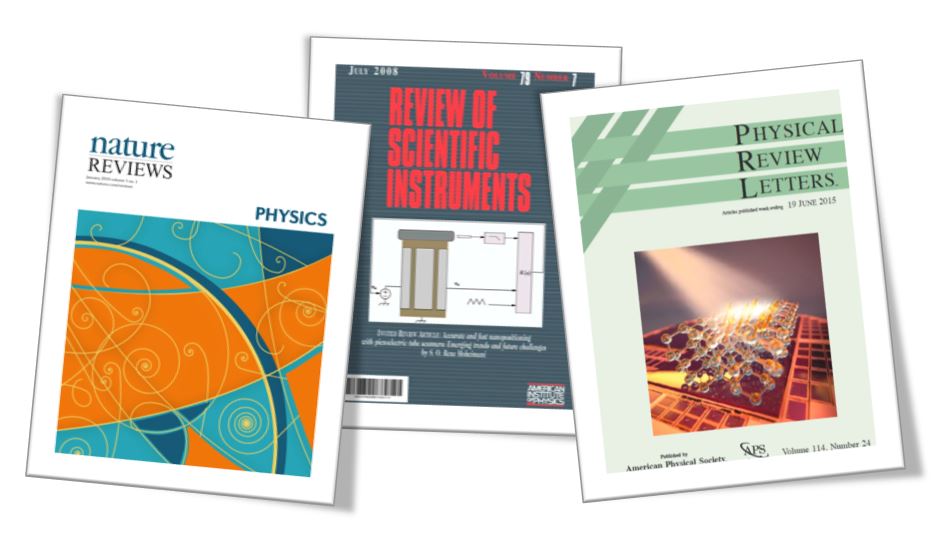
Physicists are perhaps more prone to confusion around the word review because of the numerous journal titles containing the word: the Physical Review … titles, Annual Reviews of …, Living Reviews in …, Review of Scientific Instruments and so on. But Surface Review and Letters (yes Review not Reviews) probably wins a prize for the most misleading journal title, as it seems to be an exception to everything mentioned before. It leaves the reader wondering what Review could mean in this context. As for Letters, that is another abused term whose story I wrote about a while back.