Interactions: Ankita Anirban

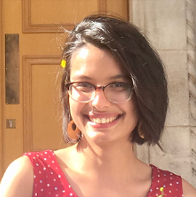
Ankita joins Nature Reviews Physics after a brief period as locum associate editor at Nature Reviews Materials. After a BSc degree from King’s College London, Ankita went on to pursue an MPhil at the University of Cambridge, on low-temperature transport of one-dimensional electron systems. She then continued with PhD studies on the theme of electron transport of topological insulator heterostructures at the Cavendish Laboratory in Cambridge.
What made you want to be a physicist?

As a child, I loved fantasy novels and used to wish that I lived in a world with magic, elves and dragons. Physics classes at school seemed dull in comparison, until I discovered quantum mechanics through popular science books as a teenager. Suddenly it seemed that our world could be as crazy as Alice in Wonderland with strange phenomena like entanglement and superposition of particles. This seemed cooler than dragons as we could actually “see” these things happen in a lab – and so I became a physicist!

If you weren’t a physicist, what would you like to be (and why)?

A travel writer/journalist. I’d love to explore lots of interesting and remote places around the world and write about the stories and people I met.

Which is the development that you would really like to see in the next 10 years?

I want science to become more accessible. So many non-scientists are intimidated by the idea of science and maths. I would love for science to become “dinner table conversation” in the way politics or books or films are for the general public.

What would be your (physics) superpower?

To have magic eyes – that can work as a microscope (maybe even an electron microscope!) and zoom into all the details of things around me, and also as a telescope to see distant galaxies.

What’s your favourite (quasi-)particle?

Probably the humble electron. It’s not a glamorous particle, but I’ve spent years making electronic devices which I think of as “electron playgrounds” so I have grown attached to them.

What Sci-Fi gadget / technology would you most like to have / see come true (and why)?

Definitely a time-machine. Ignoring all the related paradoxes I’d have to deal with, I want to be able to transport myself to the past and actually find out what history was like.
What it’s like to be a Reviews editor

Have you ever wondered what reviews editors do? Chasing authors to submit and making edits to the text of the reviews? That is just a small part of it.

In this editorial we outlined the story of a Review from commissioning to publication. As editors, we spend a lot of time searching for ideas for potential reviews. We travel to conferences and visit labs to find out what the community is interested in and whet types of reviews are missing. Then we work closely with authors to develop the idea of the review, and then polish the text before publication to make it accessible and self-contained so that physicists from other fields can follow, make use of — and enjoy — the article.

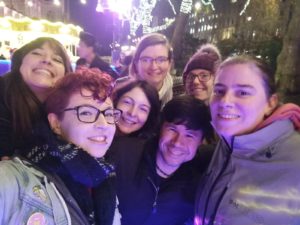
Some of the crew on an ice skating trip last winter

Being an editor is a busy and stimulating job. Producing monthly issues means regular deadlines and a lot of planning ahead. We coordinate and liaise with authors, referees, art and production editors to make sure that the content is published regularly as the readers expect. The job is also very sociable. We are part of the journal teams and the wider physical sciences reviews journal teams and even wider reviews team. We also interact a lot with our colleagues at Nature, Nature Communications and the Nature research journals. All editors have academic backgrounds and we all share the love of science and common experiences from our PhD and postdoc years.

Here are some comments from editors of Nature Reviews journals in the physical sciences:

Iulia Georgescu, Chief Editor of Nature Reviews Physics: I think the role of reviews editors is not well understood. We are not gate-keepers, but guides walking together with the authors all the way from idea to publication. We often think of manuscripts as ‘our babies’ because we are as invested as the authors who wrote them. It is a wonderful thing to see a Review evolve from a vague idea, to a well-structured outline and then a full manuscript. We feel great satisfaction when we see the reviews we worked on published and take pride when they are well-received by the community. I often think: look at my baby and how well it’s doing.

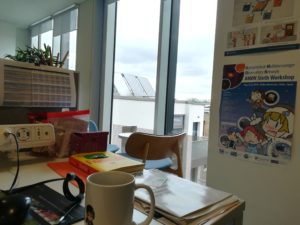
The editor’s natural habitat

Giulia Pacchioni, Senior Editor at Nature Reviews Materials: Being a Reviews editor is a lot of fun — I like keeping an eye on how ideas evolve from initial results presented at a conference to a flurry of publications as the topic becomes more established, and deciding when is the perfect moment to commission a Review. I am lucky to have the opportunity to travel to plenty of conferences and lab visits to keep in touch with the community, and to spend a lot of time reading and thinking about science.

Claire Ashworth, who works for our inter-journal team providing support to Nature Reviews Physics, Nature Reviews Materials and Nature Reviews Chemistry: I enjoy seeing an idea develop into a published Review and working with authors at each stage of the publication process to achieve this. I think that Reviews editors are quite unique in terms of the amount of time that we invest into each article and the extent to which we use both our scientific knowledge and editorial experience to help to ‘shape’ an article.

Stephen Davey, Chief Editor of Nature Reviews Chemistry: The Reviews editor role is rather different to that of a primary research journal editor – and not just because I spend my time chasing authors rather than being chased by them. I get to put a lot into every manuscript that I handle. And I do it all while travelling the world, meeting interesting people and slaking my thirst for knowledge.

Zoe Budrikis, Associate Editor at Nature Reviews Physics: Every day — every hour, sometimes! — in this job is different. I can go from looking for commissioning ideas in soft matter physics, to line-editing a review on the physics of climate modelling, to discussing with editors in other journals about what the latest trends in complexity research are.

Interactions: Luke Fleet

Luke Fleet is a Senior Editor & Team Leader at Nature. He joined Nature Research in 2013 as an editor at Nature Communications, before moving to Nature Physics in 2014, and then to Nature in 2017. He’s responsible for selecting the research papers that are published across a range of fields, including applied physics and electronics, and also assists in devising and delivering the goals for the physics team.

 What made you want to be a physicist?

It was more chance than an active decision, so let’s go with luck and curiosity. Like many people, I didn’t really know what I wanted to do when I was younger and so I decided to carry on in education to basically avoid having to choose. In doing so, I pursued something that I found interesting. Luckily for me, that was physics!

If you weren’t a physicist, what would you like to be (and why)?

If I could choose anything, then I’d want to be a musician or a footballer, as these are my hobbies, but I think people have already said these so I’m going to go with joiner. I actually worked for several years when I was a teenager building things like rabbit hutches and dog kennels, and there are lots of things about working outside crafting something that are satisfying so that’s my back-up if this career goes south.

Which historical figure would you most like to have dinner with — and why?

There are so many to choose from but let’s go with Leonardo Pisano (Fibonacci). He convinced Europeans to switch from Roman numerals to Hindu-Arabic numbers and if you ever have the pleasure of visiting Pisa you’ll see that he also inspired the Church to put a Fibonacci sequence-based artwork above the main entrance to the church of San Nicola. Relatively little is known about Fibonacci so I’d love to know how he managed to convince so many people to embrace arithmetic mathematics during the Middle Ages.

What would be your (physics) superpower?

When I was a researcher I worked with magnets and if they were big enough then then I liked to think that I was like Magneto from the X-men, so that’s the superpower I want: mastery of electromagentism, without trying to instigate a civil war.

What’s your favourite (quasi-)particle?

I’m really a condensed matter physicist at heart, so is has to be a quasiparticle. And whilst there are so many to choose, I’d have to say Weyl fermions. Physicists had been searching for these particles for decades but they were discovered not long after I started working as an editor. It was pretty exciting covering these advances at the time, so I think I’m always going to have a Weyl soft spot.

If you could have an effect or equation named after you, what would it be?

I love playing football and like to think I have some mastery over the Magnussen effect. I know that already exists but I’d like to discover a new effect related to spinning objects so that I can improve my shooting, which is definitely getting worse with age.

Interactions: Federico Levi

Federico Levi is a Senior Editor at Nature Physics.

What made you want to be a physicist? 

I was a rather curious kid — the annoying kind that asks a lot of ‘why’ questions. But I never found my interests to be limited to the natural world. The adolescent me somehow decided that good learning opportunities would come from a degree in physics or history or English literature. While I like to think that some natural inclination towards analytical thinking nudged me in the direction of physics, the reality is that my parents were pretty persuasive in their case against a career in the humanities. But once I started learning physics for real, I was hooked. When I got to quantum mechanics, I was totally sold.

If you weren’t a physicist, what would you like to be (and why)?

I would like to write novels, I think. Too bad I’m not very good at it.

Which historical figure would you most like to have dinner with — and why?

Thomas Kuhn, to thank him for having written a great book.

What is the development that you would really like to see in the next 10 years?

Understanding so much better the foundations of quantum mechanics, cosmology or the interplay between quantum physics and general relativity to realize that what we all assumed was clearly right is actually rather wrong.

What would be your (physics) superpower?

Skipping stones for hundreds of meters.

What Sci-Fi gadget / technology would you most like to have / see come true (and why)?

A time machine to undo stupid mistakes. Could probably have other uses too.

Interactions: David Abergel

David Abergel is an Associate Editor at Nature PhysicsBefore joining Nature Physics in 2017, David carried out theoretical research on graphene and other two-dimensional crystals, and quantum topological materials. 

What made you want to be a physicist? 

When I was a kid, I was really into astronomy, so I guess I’ve always had an inclination towards science. Then, as a teenager, I read John Gribbin’s In Search of Schödinger’s Cat. I loved it. The vivid picture he painted of how quantum mechanics works, how it’s so different from the classical world that we experience, and most importantly how we can use maths to understand it had me hooked. From that point on I never wanted to be anything else.

If you weren’t a physicist, what would you like to be (and why)?

I would probably have ended up as a forensic scientist working for the police. I’m sure it’s nowhere near as cool as it looks on TV, but the idea of trying to piece together a lot of small clues to provide evidence for case seems like a really interesting type of problem solving.

What would be your (physics) superpower?

Getting code to compile first time!

What’s your favourite (quasi-)particle?

Undoubtedly the Cooper pair. I find it counterintuitive that the jiggling of an atomic lattice can make two negatively-charged electrons ‘stick’ together. And the fact that there is most likely a completely different mechanism that we don’t understand going on in high-Tc superconductors is a fascinating mystery.

What Sci-Fi gadget / technology would you most like to have / see come true (and why)?

Apart from the obvious ones like time travel and teleportation, I want someone to come up with a material that is soundproof, but allows cool air through. It would be the perfect window covering for warm summer nights.

Which physicist would you like to see interviewed on Interactions — and why?

Is this like one of those facebook things where you have to nominate five of your friends to keep the game going??!! But more seriously, seeing as he kind-of came up with the idea, I want to hear what Lev Landau’s favourite quasiparticle is.

Interactions: Elena Belsole

Elena Belsole is the Chief Editor of Communications Physics. An astrophysicist by training, Elena was the executive editor of New Journal of Physics, before joining Nature Research.

What made you want to be a physicist? 

Since the age of 8 I wanted to be a medical doctor. I have always been a very inquisitive person and I would have pursued any direction that was giving me as many answers as possible on what the world is all about. But the truly determining factor was meeting my physics teacher in high school. He was so inspirational and made things look so fascinating; he even introduced the Schrödinger equation to the class. I could not leave it at that. I had to learn more.

If you weren’t a physicist, what would you like to be (and why)?

An herbalist I think. I love how you can forage and use herbs for medicinal use and being able to find a remedy for any minor ailments.  I also considered theatre acting for a short time.

Which historical figure would you most like to have dinner with — and why?

Since I started University I had Richard Feynman lecture notes on my bedside table and always found the simplicity of his explanations fascinating, but I would probably not want to go for dinner with him. If I have to choose one person to take out for dinner I would go for `the queen of carbon’, Millie Dresselhaus. She has guided and inspired so many people and she was a great physicist in an environment that was (and to some extent still is) quite adverse to women, while also having a family. I would like to know how she did it all.

Which is the development that you would really like to see in the next 10 years?

I would like to see physical methods effectively used for controlling and stopping cancer and other diseases in a way that is not intrusive and not damaging for the patient.

What would be your (physics) superpower?

Definitely teleportation. I cannot even imagine how many places on Earth and beyond I could visit if that was true.

What’s your favourite particle?

The neutrino. It is such a versatile particle. Perhaps it is because of my fascination with cosmic rays from astrophysical objects, perhaps because it can be used to probe the Standard Model, or maybe just because thousands of them cross our body every second and are impossible to see and difficult to detect. Regardless, they are fascinating and may be a key to solve the mysteries of the Universe.


Interactions: Anastasiia Novikova

Anastasiia Novikova will join Nature Reviews Physics in January after a PhD at Synchrotron SOLEIL and a postdoc at CEA Saclay in France.

What made you want to be a physicist? 

I was always curious to understand natural phenomena, and physics seemed to explain how almost everything worked in the Universe. Besides, I enjoyed the scientific approach used in physics: experiment and demonstration.

If you weren’t a physicist, what would you like to be (and why)?

If not a physicist, I would definitely be an artist. As a child, I was passionate about drawing and painting (and I still am). Shapes and colours of nature were always hypnotizing me.

Which historical figure would you most like to have dinner with — and why?

I have a whole list of historical figures but the one I would really like to meet is Richard Feynman. To me, he is a person remarkable for his manner of popularizing physics and capturing the audience. The first thing I would ask him: “What is your secret? “

Which is the development that you would really like to see in the next 10 years?

I would like to see the development of Artificial Intelligence in the domain of Genetics to help us understand such issues as genetic disorders.

What’s your favourite particle?

While studying the Physical Chemistry module at Pierre and Marie Curie University, I was fascinated with how the electronic structure of a compound could influence its colour. In this regard, my favourite particle is, definitely, the electron.

What would your dream conference be like?

The conference I dream of would be dedicated to the greatest discoveries of all time. And being imaginary, it would be organized by the pioneers, with, for example, Isaac Newton giving a Welcome speech.

Interactions: Zoe Budrikis

Zoe Budrikis joined Nature Reviews Physics after postdoctoral research at the ISI Foundation in Turin and at the Center for Complexity and Biosystems at the University of Milan and a PhD from the University of Western Australia.

What made you want to be a physicist?
In high school, I didn’t plan to study physics. I wanted to take Ancient History instead. But the timetable didn’t work out so I took physics classes and enjoyed them, and then I took some physics courses at university and enjoyed them so much I changed my degree. The rest, as they say, is history.

If you weren’t a physicist, what would you like to be (and why)?
It’s a cliché, but my backup plan/daydream is to open a bakery. I love seeing people enjoy food I’ve made, which is easy to do with cake! Plus, thinking about how to put unusual flavours and ingredients together is the kind of problem-solving I find relaxing. Of course, there’s a lot of physics involved in understanding how food works.

Which is the development that you would really like to see in the next 10 years?
Interdisciplinary science has really come to the fore in recent years, and I’m excited to see where that will take us. Especially because so many of the big problems in science and society – climate change springs to mind – require people with different backgrounds to work together to find a solution.

Which historical figure would you most like to have dinner with — and why?
I’d love to meet some of the everyday people of the past. Any era, really. Most of what I know about history is about big political figures, or famous authors/artists/inventors, and I think it would be fun to sit down with someone not at all famous and find out what their life was actually like.

What Sci-Fi technology would you most like to have (and why)?
I’d like everyone to have the Babel Fish from Hitchhiker’s Guide to the Galaxy.

What is your non-scientifically accurate guilty pleasure (could be film/series/book)?
I watched a lot of classic Dr Who as a teenager, and I retain a soft spot for alien planets that look remarkably like quarries.

Interactions: Giulia Pacchioni

Giulia Pacchioni played a big part in the launch of Nature Reviews Physics, but will return to Nature Reviews Materials next month. Still, she will always be part of the team.

What made you want to be a physicist? 
Feynman’s autobiography, Surely You’re Joking, Mr. Feynman! I read it as a teenager and it kicked off a long-lasting fascination for physics. For a while I also thought about becoming a mathematician, but then I was drawn by the richness of physics, a subject that stretches from the understanding of the origin of the universe to the conception of next-generation electronic devices. As many others I entered university thinking I wanted to be an astrophysicist, but after finding out more about the marvels of solid-state systems I ended up being a condensed matter physicist instead.

If you weren’t a physicist, what would you like to be (and why)?

I considered studying classics — I was particularly fascinated by the evolution of the Greek ancient language, as it gives insight on how languages developed. However, my secret plan has always been to open my own factory of soft toys. I would make fluffy versions of all the cutest animals, from the domestic to the rare. But I haven’t totally discarded the idea of owning a chocolate factory either.

Which historical figure would you most like to have dinner with — and why?

Dinner with Aristotle would be cool. He was such a great thinker I suspect there would be no shortage of topics to discuss, starting from his deep questions about the physical world. Maybe he could bring along his pupil Alexander the Great. He must have had a magnetic personality.

What would be your (physics) superpower?

Teleportation! I could pop in for lunch with friends in Paris, and chill on a beach in Sardinia in the afternoon. Coffee and cake on the Amalfi coast.

What’s your favourite (quasi-)particle?

Definitely skyrmions. They look so awesome with their arrangement of colourful spins. There is a lot of fascinating materials research going on to obtain smaller and more controllable skyrmions, and they have cool potential applications. Lately I’m getting into Majorana quasiparticles as well, as their observation requires top-notch condensed matter physics experiments and they might enable error-protected quantum computers. In preparation for when I will have my toy shop, I made a soft Majorana fermion that keeps me company in the office.

What Sci-Fi gadget / technology would you most like to have / see come true (and why)?

In Italy there is a comic-book character,  Eta Beta, who wears a little black skirt in which he can stock anything, a bit like in Mary Poppins’ bag, as objects become incredibly small (and hopefully light!) as they are stored in the pockets. I find such a garment would be practical, provided the storage is organized enough to find stuff speedily.

Interactions: Iulia Georgescu

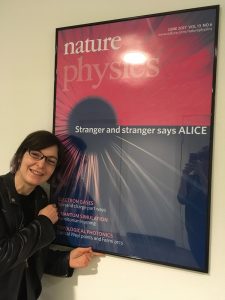
Iulia Georgescu is the Chief Editor of Nature Reviews Physics. Previously, she was an editor of Nature Physics, where she managed to sneak in three original “Alice in wonderland” illustrations (1, 2, 3) and the self-declared best cover-line ever.

What made you want to be a physicist? 

Star Trek. More precisely Mr Spock and Mr Data. Do I need to say more?

If you weren’t a physicist, what would you like to be (and why)?

A SF/fantasy writer or a manga artist because I love daydreaming about fantastic adventures. I hope it’s not too late, and my best-selling work is yet to be published (well, written first).

Which is the development that you would really like to see in the next 10 years?

Detection of dark matter or anything else beyond the standard model.

What would be your (physics) superpower?

Flying would be pretty cool. What is nice about this superpower is that you can imagine various ways in which flight would work with its strength and limitations.

What Sci-Fi technology would you most like to have (and why)?

Teleportation would come in very handy, in particular to save my commute time.

What is your non-scientifically accurate guilty pleasure (could be film/series/book)?

As you might have guessed by now SF/fantasy books and manga/anime, although I do not feel guilty in the least.

Interactions: Andrea Taroni

Andrea Taroni is the Chief Editor of Nature Physics.

What made you want to be a physicist? 

Being the enlightened souls that they were, my parents told me I could study anything I wanted, provided it was a science. So I chose chemistry, because it was somehow in the middle between biology (which I tended to like) and physics (which I tended to find quite boring, at least at school) – but long term I had no intention of staying in science. Anyway, as things went on I realised that I hadn’t quite appreciated that a) chemistry is only in the middle if you imagine the spectrum between the sciences to be on a logarithmic scale (that is, physics explains A LOT more than I had initially thought); b) physics research is a lot more interesting than physics lessons; and c) I wasn’t very good at chemistry to begin with. I was lucky to work with a chap called Steve Bramwell in my last year of university: thanks to the project I worked on with him, I realised I liked magnetism. And in order to study that, I had to get a better grasp of fundamental ideas rooted in statistical physics and, ultimately, symmetry. This struck is very deep and very beautiful and it had the effect of helping me to start thinking like a physicist.

If you weren’t a physicist, what would you like to be (and why)?

I’m now beyond the age where it is even possible for me to cling on to my dream of being a footballer, but that was, alas, my burning ambition when I was growing up. I enjoy what I am doing right now a lot, but compared to football it is a very distant plan B. Had a pro football career come off, I would be now be looking at investing my money in property on the Mediterranean coast…and I can’t say I would be too disappointed with that. But you ask what I would like to be, and “property developer” is not something I ever aspired to be. The people I admire the most these days are, for want of a better description, practitioners: people that have dedicated themselves with passion and discipline to a particular art or craft. You can just tell when you meet such people – they might be famous artists or simply very good teachers that don’t get as much recognition as they deserve – but measured over time their influence over the people around them is huge.

Which historical figure would you most like to have dinner with — and why?

I answered this question the last time I did this kind of Q&A, and I said Julius Cesar and Cleopatra. I’m going to stick with that.

What would be your (physics) superpower?

Without doubt it would be the power of flight. Am I aiming to low? Because that still strikes me as a cool thing to be able to do.

What’s your favourite (quasi-)particle?

Probably the magnon, as I worked with it while I was doing research. It’s a nice, simple quasi-particle with a distinguished history in the physics literature. And once you understand how they work, you understand how a lot of other quasiparticles work too.

Which physicist would you like to see interviewed on Interactions — and why?

If you could go back in time, I would suggest Ludwig Boltzmann. As you can’t, I’m going to say Philip Anderson.

Interactions: Gaia Donati

Gaia Donati is an Associate Editor at Nature, where she handles papers in areas including quantum physics, particle physics, nuclear physics and mathematical physics.

What made you want to be a physicist?

I was good at both physics and chemistry in high school, and in fact I remember being drawn between the two… My fascination for physics was stronger though: physics could explain natural phenomena all around us by means of models and theories conceived to make sense of empirical observations while also offering a predictive tool (before being replaced by its better-working extension or alternative, of course). I could relate to the relentless search for unifying principles, and I very much liked the interplay between theory and experiment (which isn’t the case in mathematics, for example).

If you weren’t a physicist, what would you like to be (and why)?

Oh, you know, I would have gone into scientific publishing – wait, that’s what I’ve done! And now for a serious answer… Had I not taken up physics, I might have followed one of my two long-standing interests – music and photography. At some point I considered becoming a professional photographer (and join the legendary Magnum Photos agency); given that I am mildly obsessed with British, Irish and North American folk music, I did contemplate the idea of becoming an ethnomusicologist and traditional folk singer in order to study and preserve this rich musical heritage.

What is the development that you would really like to see in the next 10 years?

It would be fantastic to see physicists and biologists talking to one another ‘for real’ – collaborating on some of the challenges of our times, in other words. I am well-aware of the differences (in terms of mindset, approach to problems and communication practice to cite a few) between the two disciplines, but I am convinced that physics needs biology as much as biology needs physics. I feel that some progress has been made over the years, but there’s still a long way to go.

What’s your favourite (quasi-)particle?

My background is in experimental quantum optics, so my answer will be absolutely predictable – once on team photon, always on team photon.

What Sci-Fi gadget / technology would you most like to have / see come true (and why)?

A time machine, please. Several years ago I even bought the book “How to Build a Time Machine” by Paul Davies, which comes with some sort of blueprint for this technology. It’s a pity that I never took the time to follow the steps and see if I could build this…

What would your dream conference be like?

I recently read that scientists increasingly complain about how some conferences are becoming less and less useful – too crowded, more about showcasing one’s latest results to impress the audience than to share findings and engage in constructive discussions, too packed with sessions and events. I don’t know if this is true, but I’d say that the conferences I enjoy attending tick at least some of these boxes: a ‘human’ number of participants (not exceeding 200?), a topic not too narrow but not too broad either (which is tricky, I get that), speakers at different stages of their careers, and few parallel sessions (if any). Some meetings feature one or two days of tutorials or taught classes on top of their regular programmes; I think this is a good idea as well, especially for graduate students or for early-career researchers who might have just switched topics.

Interactions: Abigail Klopper

Abigail Klopper is a Senior Editor at Nature Physics. She previously worked at the Max Planck Institute for the Physics of Complex Systems in Dresden, Germany, where she pursued theoretical research in aspects of soft-matter and biological physics.

What made you want to be a physicist?

A love of maths and a distinct (if pretentious) feeling that it was the only truly relevant thing to learn about the Universe. My biggest regret as a nineteen year old was that I wasn’t allowed to double up physics with philosophy. I’d started as a double major in electronic engineering — an insurance policy of sorts — and evidently the faculty thought that that would have made a ridiculous triple.

If you weren’t a physicist, what would you like to be?

I come from a family of architects — physics is my rebellion — so I would likely be designing houses had I not gone down this road.

What would be your (physics) superpower?

Time dilation please. I could definitely use a way to squeeze some extra hours out of the day.

What Sci-Fi gadget / technology would you most like to have / see come true?

Anything that could get me back home to the beach in Australia in the time it takes to traverse London.

What is your non-scientifically accurate guilty pleasure?

I do have quite the penchant for vampires — the sassy backtalking type found in Buffy and True Blood over the sappy Twilight variety. I’m fairly sure we’re yet to find evidence of fanged humanoids in our midst.

What would your dream conference be like?

The Physics of Living Matter symposium run by the Universities of Cambridge and Marseille is pretty much my ideal conference. It’s two full days in a room with physicists and biologists who are all really keen to convey their research in a way that meets everyone in the middle. The breadth of topics covered is impressive, and the quality of the students’ presentations is always rather humbling.

Interactions: Magdalena Skipper

Magdalena Skipper is the Editor in Chief of Nature. She has spent over 15 years working for Nature Research in various roles at Nature Reviews Genetics, Nature, the Nature Partner Journals and Nature Communications.

What did you train in? What areas have you handled for the Nature Research journals over the years?

My background is in genetics. Life sciences fascinated me from an early age, but once I discovered genetics at school I knew this specific discipline was something I wanted to delve into deeper. I studied genetics for my first degree (at the University of Nottingham, in the UK) and then went to do a PhD researching sex determination in a classic genetic model organism – a small round worm Caenorhabditis elegans. Throughout my PhD and postdoc years, I always found using genetics to help answer research questions to be the most elegant and satisfying approach. And it was genetics and genomics that were my core areas as an editor, but since genes and genomes are involved in all aspects of life sciences my focus broadened and I developed an understanding of most, if not all, life science disciplines. More recently, as I took on more senior editorial roles I also began to delve into the physical sciences.

You are the first editor of Nature not coming from a physical sciences background. Do you find this a challenge in championing physical sciences in the pages of Nature?

It is true that to date Nature has had at its helm editors trained mainly in the physical sciences. In my opinion, the most influential paper published by Nature during my predecessor’s tenure was the sequencing of the human genome. I hope that during my time we can publish the greatest and most important advances in any field. Learning is a life-long passion for me and so as I grow my knowledge and appreciation for the physical sciences I also develop a growing enthusiasm for this branch of science.

You led Nature Communications and now Nature. What has that taught you about multidisciplinary journals?

My time as Editor in Chief of Nature Communications has reaffirmed my conviction about the importance of multidisciplinary journals in modern research. It has also taught me to appreciate the challenges and needs of different scientific communities which are often shaped by their very discipline; these discipline-specific needs must be respected, but multidisciplinary journals find themselves in a unique and privileged position to share solutions developed within one field so that they may be adopted (and/or modified) by other fields.

How can we move from multidisciplinary to interdisciplinary?

This is a fascinating challenge and an important opportunity. While this transition need not be complete – in so far that some questions may always be answerable without reaching beyond one specific discipline – true interdisciplinary approaches open entirely new avenues of investigation. As so often is the case the transition needs to start with researcher training, and we have seen increasing trend in this direction in a number of academic establishments. We as editors have an important role to play too, by recognising potential in interdisciplinary submissions. Multidisciplinary journals can be perfect incubators, if you like, in which interdisciplinary papers can flourish.

What is your vision on interdisciplinary research in the pages of the Nature Research journals?

Our Nature Research portfolio of journals offers a fantastic environment for championing and disseminating interdisciplinary research. Our classic, discipline-specific journals are complemented by so-called thematic journals; for these multidisciplinarity and interdisciplinarity lies at the very heart of their editorial scope. And then of course there are the broad scope, multidisciplinary journals like Nature and Nature Communications. What excites me the most is that the breadth of our portfolio allows us to really delve into all aspects of contemporary research questions. Take climate change for example: one can think of research questions the answers to which require approaches from physics, material science, ecology, economics and social sciences, all at the same time. We can and should be increasingly considering more and more work along these lines.

Interactions: Stefanie Reichert

Stefanie worked as an experimental particle physicist at CERN before moving to Berlin, where she just started as Associated Editor at Nature Physics.

What made you want to be a physicist? 

In fact, I’ve tried everything to avoid physics when I was a teenager. In high school, I chose to learn Latin and then French as this would allow me to attend only two hours of physics per week. I grew up in Germany, and we had to do a one-week internship in 10th grade. Back then, I wanted to become a pathologist and hence I applied at the hospital nearby. As I wasn’t sure if they’d take me on, I looked for something else and then stumbled across books about the universe my parents gave me as a child. Turned out there was a Max Planck Institute for Astronomy in Heidelberg (MPIA) where I applied as well. Long story short: I got to do internships in both pathology and at MPIA but the latter blew me away: we got to observe the sun, count galaxies, learned about Rosetta, played with liquid nitrogen and then I was hooked! Funnily enough, I interned in an astronomy and a particle physics working group at university, and guess what?

If you weren’t a physicist, what would you like to be (and why)?

After the internship, becoming a pathologist was out of the question (too uneventful for my taste). I guess I would sell books now and force recommendations on people. Maybe along with running a café and roasting my own coffee.

Which historical figure would you most like to have dinner with — and why?

With Oscar Wilde, as I love his impeccable sense of humour and wit. If you haven’t read ‘The Importance of Being Earnest’, you are clearly missing out.

Which is the development that you would really like to see in the next 10 years?

I believe that in science we are a leading example for promoting peace, equality and anti-racism. But I do feel there’s more we can achieve, and I would like to see a greater diversity within our community, including more women in science and also increased opportunities for scientists or students studying science all around the globe.

What’s your favourite (quasi-)particle?

I have a background in experimental particle physics, and because some tensions between experimental observations and theory, the so-called Standard Model of Particle Physics, have emerged over the past few years in the flavour sector, I would go for the hypothetical leptoquark, which is a candidate for explaining those anomalies. Plus, those could mediate a decay I was searching for with colleagues from the LHCb experiment. Basically, a leptoquark can turn a quark into a lepton (e.g. an electron) and vice versa.

What is your non-scientifically accurate guilty pleasure (could be film/series/book)?

I love Star Wars, and my favourite is ‘The Return of the Jedi’. When the new movies started coming out, I was so excited – there’s nothing like watching the Millenium Falcon jump into hyperspace and then there are so many awesome female characters!