Communicating with Generation Y

This post was originally published at MassBioHQ on March 25th 2014

As a leader in your company or team, it is important to be able to communicate effectively with your staff.

In small start-ups and in the fast-paced biotech world, there are many opportunities for young graduates to help build a business and kick-start their careers. Many of these new recruits will be fresh-faced, eager-to-learn students straight from university: Generation Y, born in the 1980’s and 1990’s. This group has grown up in a digital world to which they’re constantly connected. For the same reason, they’re always curious about what others are doing, and this flows right into the way they work.

They have a different way of getting things done, so it’s worth finding out what makes them tick.

74773

{credit}PhotoDisc/ Getty Images{/credit}

Continue reading

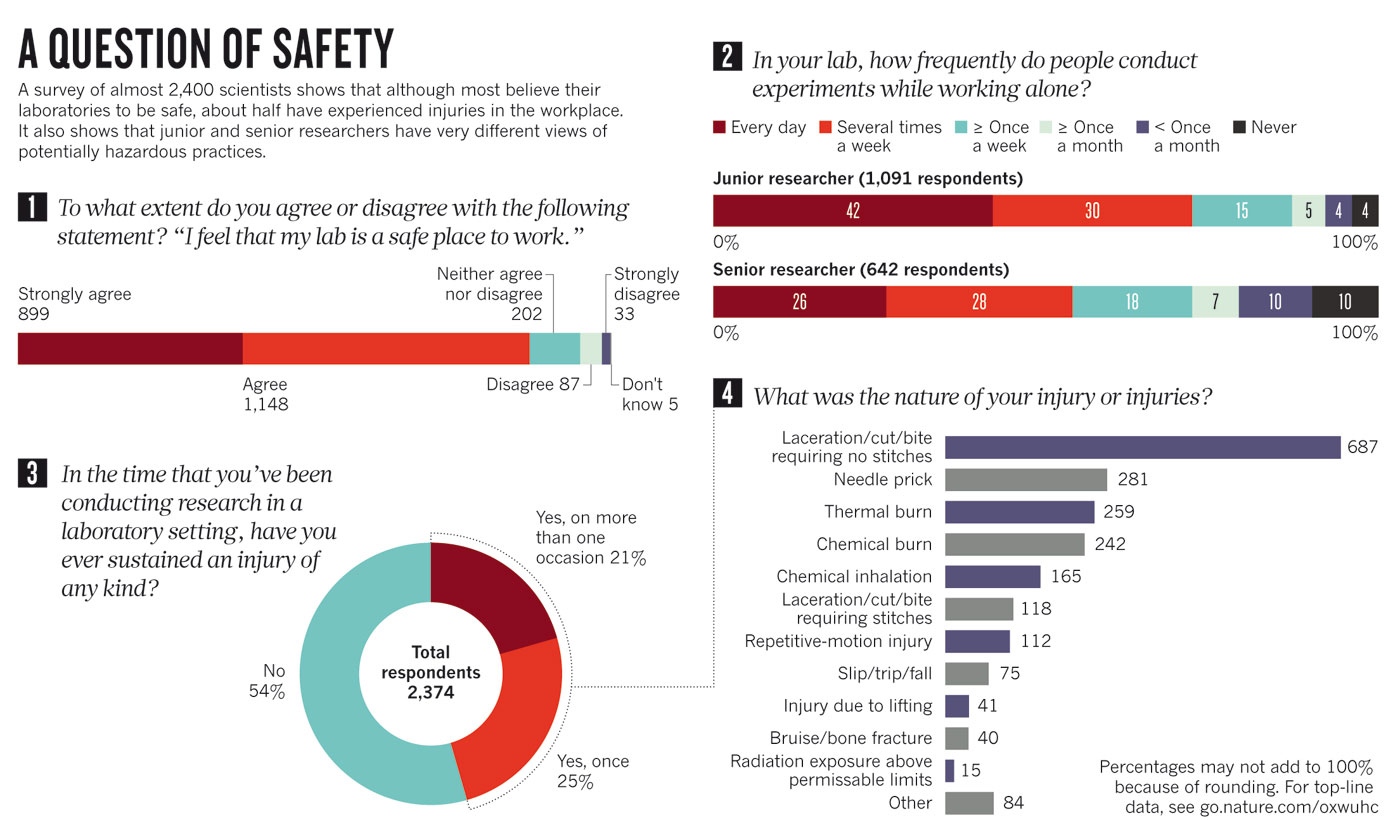
How safe is your lab?

{credit}SOURCE: Center for Laboratory Safety, UCLA/NPG/Bonamy Finch{/credit}


From snake bites to acid burns, accidents in the lab are a fairly common occurrence, according to the results of the first international survey of scientists’ attitudes and practices regarding safety in the workplace.

The survey of around 2,400 scientists was commissioned by the University of California in Los Angeles (UCLA) Center for Laboratory Safety, in collaboration with Nature Publishing Group and BioRAFT – a company providing software for safety compliance, which receives funding from Digital Science, a sister company to Nature Publishing Group. The survey was in part commissioned in response to the death of research assistant Sheharbano Sangji following a lab fire at UCLA in 2009, and a first analysis of the results was published in the news section of Nature this week. Continue reading

10 tips for surviving the office Christmas party

{credit}iStockphoto/Thinkstock{/credit}

We all like to let our hair down, but the work Christmas party is a potential minefield. Whilst a drunken slip-up at the end-of-year bash is unlikely to annihilate your career, it may crush your reputation. To prevent you spending the next 12 months laughing off jokes about that time you threw-up in a colleague’s handbag (yes, this really can happen) the Naturejobs team has compiled their own anecdotes and advice on how to have a good time, without leaving your reputation behind at the bar come the end of the night. Take heed!

  1. Have fun, drink, be merry, but remember to do it within reason…these are still your co-workers and you don’t want to be the topic of conversation the next day as the drunkest person at the holiday party.
  1. Holiday parties give you the platform to get to know people you wouldn’t normally interact with at work; it’s a good opportunity to meet new people, network, and get to know colleagues who work in different departments, so don’t be cliquey, and speak to everyone. Try to speak to the CEO/boss/PI and other senior people at the start of the night when you’re at your most coherent. This will prevent you falling over drunk in front of the CEO like one ill-fated Naturejobs team member. Luckily, it was his last day.
  1. If it’s fancy dress, don’t go overboard with your costume, and read the labels of any products used. Take it from one ex-Naturejobs employee, who dressed up as Hulk Hogan. He already had the muscles so all he needed was to invest in some fake tan lotion. Inexperienced as he was in the use of such products, however, he did not see any noticeable difference in skin colour after the first liberal application of the product and hence applied several more layers to get the full effect. It worked, as he was a lovely orange for the X-mas party, almost like the great man himself. The rude awakening came when he went home and discovered the tan did not wash off. Walking to the office the next morning, head held low in shame, he seemed even more orange than the night before – despite a few hours in a bath, scrubbing to no avail. He then spent a rather quiet week at work as he tried to run into as few people as possible…
  1. On the subject of fancy dress, here is some very specific practical advice from one Naturejobs team member: make sure your fancy dress outfit has an accessible zip, or else you may need a toilet buddy – and that’s how rumours start!
  1. Plan your escape route. Investigate how you’re getting home from the party beforehand, and make enquires about local cab numbers in advance. Take out the cash you need to get home, and check you haven’t left your house keys or travel card in the office before you went out. We have heard of colleagues who ended up sleeping in the park…
  1. If you think you might be liable of going overboard, buddy up with a colleague you get on well with and look out for each other during the night. That way they can stop you making a beeline for unsuitable colleagues you don’t fancy without your beer goggles on, and send you safely on your way home if you look worse for wear.
  1. Don’t talk about work! Parties are meant to be fun.
  1. Get everything you need ready for the next day at work before you go out, to make getting up in the morning as pain-free as possible. Then, have some breakfast and get on with it. Whatever you do, don’t call in sick – just get to work on time and laugh off any embarrassing moments from the night before. Everyone will be in the same boat.
  1. At the same time, know what you’re capable of the next day. “Never plan to load an electrophoresis gel the day after the Christmas do,” says one Naturejobs staffer who used to work in a lab. “Hands shake, pipettes burst, preps don’t work and you end up with DNA all over the place and paranoid fears of sabotage when you can’t interpret the results. Best thing to do is to lock yourself up in the electron microscope room and sleep.” We won’t tell.
  1. And finally, have plenty of tea and good mince pies (they’ve got to be good ones!) both before and after the party. And from everyone at Naturejobs: have a great time!


Where did I put my party hat?{credit}iStockphoto/Thinkstock{/credit}

Sexism in science means men more likely to get hired

It is no secret that women are vastly underrepresented in many scientific fields, particularly the further you look up the career ladder. The explanations for this disparity vary, but perhaps one of the most common arguments is that women feel forced to choose between a family and their career, and leave science early whilst men continue to progress.

But a new piece of research suggests this reasoning may only be part of the story, instead pointing the finger at a subtle yet pervasive gender bias in the scientific community which is working against women – making them miss out not only on jobs, but also on financial and professional support when they are hired.

Corinne Moss-Racusin, a psychology postdoc at Yale University, and her colleagues, devised a simple test to work out whether there is any bias against women applying for a job in science.

The team got 127 university professors working across biology, chemistry and physics, to give feedback on what they believed were the application materials from a real student applying for a job as a laboratory manager.

Each professor received exactly the same application materials, except for the name of the applicant. Half of the professors were told they were reviewing an application from somebody called John, whilst the other half were told the applicant’s name was Jennifer. Apart from the name, all the other information was identical.

The professors were asked to rate how likely they would be to hire the applicant, as well as how competent they thought the applicant was. They were also asked to suggest a starting salary  and say how much mentoring they would offer the applicant in their new role.

Despite the fact that the application materials were identical apart from the applicant’s name, the professors – regardless of whether they were men or women – were significantly more likely to hire the applicant when they thought he was called John. Although they said they liked the female applicant, the scores suggest she was rated as less competent than the man, even though they had identical skills.

Continue reading

Female scientists in UK report improved prospects – but there’s still a long way to go

The gap between men’s and women’s careers in academia in the UK is closing as women become more ambitious, according to the 2010 Athena Survey of Science, Engineering and Technology (ASSET) summary report published earlier this month.

The 2010 survey, which included responses from over 7,000 male and female academics and postdocs from 84 UK universities, found that women are increasingly likely to aspire to senior leadership positions and are as likely as men to hold posts such as head of research and director of postgraduate studies.

Female postdocs are more positive about their career success to date than female academics, suggesting a more positive outlook for younger generations of scientists, and the availability of flexible working is having a beneficial effect on career development.

However, there are still significant differences between men’s and women’s experiences at every career stage. For example, on average:

  • Women are more likely to be employed on temporary contracts
  • Men are more likely to receive routine appraisals
  • Women have less understanding of the promotion process and criteria
  • Men feel more valued and visible in their departments and have more control over their employment choice

In the foreword to the report, Royal Society president Paul Nurse said there is still a long way to go before the UK can be confident it is making the most of the talents of female scientists. “It is more important than ever that we ensure the best scientists can flourish,” he wrote. “All groups should be able to participate to the full extent of their abilities.”

What is your opinion on prospects in the UK? Share your thoughts below.

Do women need to act like men to be successful managers?

Women who take on leadership roles in academia and business should resist the urge to adopt ‘masculine’ traits such as aggression to get results and use emotional intelligence instead, says psychologist Paula Nicolson from Royal Holloway, University of London in the United Kingdom.

In a recent study of leadership and management in the UK’s National Health Service (NHS), Nicolson found that women in senior positions tend to behave as they think men behave. “This notion drives women away from a healthy assertiveness into emulating more aggressive male models,” she says.

Nicolson says the issue is exacerbated by a lack of support at the top. “Organisations feel that provided they have appointed enough women at a certain level, their job ends there,” she tells Naturejobs. “There don’t seem to be enough role models who [use] emotional intelligence.”

Both women and men should use emotional intelligence more to understand the needs and motivations of employees, says Nicolson: “There are different approaches for different situations, but you still need to make it worth their while to do something with and for you and the organisation.”

Although the study was conducted in the healthcare sector, Nicolson says the findings also apply to labs and research departments. “As the primary investigator, you still need to think about how your staff are managing their own roles,” she says. “You can’t make assumptions.”

Rachel Webster, an astrophysicist at the University of Melbourne in Australia and winner of one of Nature‘s 2006 mentoring awards, is a good example of how using emotional intelligence can help you succeed as a leader in science. In her nomination for the mentoring award, she was commended for recognising the skills of individuals in her team and for appreciating that not everyone will have the same career trajectory as her. “She assumes you are a complex person who also happens to be a scientist, instead of a scientist who it so happens turns out to be a complex individual,” says Maurizio Toscano of the University of Melbourne (see ’Model mentors’ for more).

Webster says she works hard at using emotional intelligence in her professional interactions. “As a supervisor, I try to work as a collaborator, to allow my students to develop their own agendas rather than imposing my own,” she says. Her management style eschews the stereotypical ‘male’ model of leadership, which she says is characterised by traits such as low levels of empathy, a rigid hierarchy and a reluctance to express divergent opinions. “I try to understand things from my students’ point of view,” she says.

What do you think? What is your experience of different management styles, and what style would you say is most effective in a research environment? Share your thoughts below.

UPDATE: 14 July, 2011 – A new meta-analysis published in Psychological Bulletin supports the notion that men fit the cultural stereotype of leadership better than women, but shows that the perception of women in leadership roles is improving.