How do you draw the line between volunteer work and unpaid labour?

A US university’s plan to recruit volunteer PhD-holders who are alumni to lecture classes, write grant proposals and serve on graduate thesis committees has raised concerns of possible exploitation of early-career researchers.

Ideas-naturejobs-blog

{credit}Topp_Yimgrimm/ThinkStock{/credit}


But questions remain about the plan’s actual intent and its potential impact on US universities’ current and future policies around existing faculty members.

In April, Michael Molino, an English professor and an associate dean at Southern Illinois University (SIU) in Carbondale, sent an email to department chairs that outlined a plan to seek “qualified alumni to join the SIU Graduate Faculty in a zero-time (adjunct) status.” The appointments would last for three years. The letter encourages department chairs to nominate “some of your finest former students who are passionate about supporting SIU.” Continue reading

Securing workplace rights for scientists in the age of Trump

Unions could be the best way to protect scientific jobs in uncertain times, says union president Anke Schennink.

In the wake of Donald Trump’s election, the scientific community is on edge. The future of federal science funding remains unclear, campus inclusivity is under threat, immigration policy is in disarray, and entire academic fields – such as climate change research – fear the worst.

2017-03-24 SF Barg Action pic

UC Postdocs in solidarity at UCSF on a day of bargaining.

Continue reading

The hidden costs of a career in scientific research

Does a career in science select against those unable to afford frequent relocation, unpaid work and short-term contracts?

Nick Riddiford

That a career in science is demanding is unsurprising. But alongside long hours spent in the lab grappling with abstract concepts, the number of years of education it takes to enter the professional ranks and the increasingly unstable nature of such employment, exists a further demand: money. It’s no secret that science costs money — building the Large Hadron Collider (LHC) and sequencing the human genome cost around €3 billion each — but what is less obvious is that entry to a career in science often requires considerable personal financial sacrifice.

save-money-1362382_1920 Continue reading

Top paid jobs: Where are the scientists?

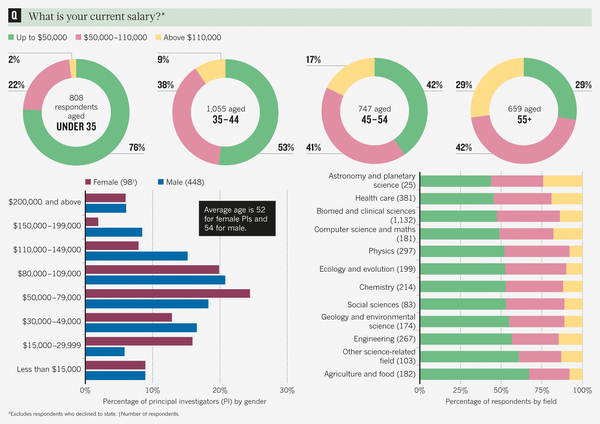
David Payne investigates the wide gaps in salary between academics.

nj7621-573a-i5

The Office of National Statistics (ONS) issued its annual survey of hours and earnings last month. Scientists are conspicuously absent from The Guardian‘s subsequent trawl of the data to highlight the UK’s top 10 best paid jobs. These include brokers (1), CEOs (2), pilots (4) air traffic controllers (7), and doctors (8). Continue reading

The art of negotiating a better salary

Andy Tay picked up some tips on negotiation at the Naturejobs Career Expo, San Francisco. Here they are.

Naturejobs career expo journalism competition winner Andy Tay

Negotiation is a powerful skill. And, whilst graduate education arms you with technical credentials for a career, it often misses out training for soft skills like negotiation. An ability to negotiate effectively can convince your counterparts to care for your interests, allowing you to maximise personal gains such as pay or career development.

{credit}iStockphoto/Thinkstock{/credit}

At the recent Naturejobs Career Expo, San Francisco, Doug Kalish shared some pieces of advice with the participants on the art of negotiating for one’s interests. Here’s some of his tips on negotiating job offers and salary. Continue reading

Sexism in science means men more likely to get hired

It is no secret that women are vastly underrepresented in many scientific fields, particularly the further you look up the career ladder. The explanations for this disparity vary, but perhaps one of the most common arguments is that women feel forced to choose between a family and their career, and leave science early whilst men continue to progress.

But a new piece of research suggests this reasoning may only be part of the story, instead pointing the finger at a subtle yet pervasive gender bias in the scientific community which is working against women – making them miss out not only on jobs, but also on financial and professional support when they are hired.

Corinne Moss-Racusin, a psychology postdoc at Yale University, and her colleagues, devised a simple test to work out whether there is any bias against women applying for a job in science.

The team got 127 university professors working across biology, chemistry and physics, to give feedback on what they believed were the application materials from a real student applying for a job as a laboratory manager.

Each professor received exactly the same application materials, except for the name of the applicant. Half of the professors were told they were reviewing an application from somebody called John, whilst the other half were told the applicant’s name was Jennifer. Apart from the name, all the other information was identical.

The professors were asked to rate how likely they would be to hire the applicant, as well as how competent they thought the applicant was. They were also asked to suggest a starting salary  and say how much mentoring they would offer the applicant in their new role.

Despite the fact that the application materials were identical apart from the applicant’s name, the professors – regardless of whether they were men or women – were significantly more likely to hire the applicant when they thought he was called John. Although they said they liked the female applicant, the scores suggest she was rated as less competent than the man, even though they had identical skills.

Continue reading

Getting a pay rise in academia

How long has it been since your last pay rise? For almost half of current respondents to a recent Naturejobs poll, the answer is more than two years – and with ever-increasing inflation, that’s effectively a year-on-year pay cut. So is there anything you can do to improve your salary prospects, particularly in academia, where there is often a lack of flexibility in pay?

Know your opportunities

Setting your starting salary

At universities in the UK, where research positions are appointed at a particular grade, there is often a window of opportunity to negotiate the precise point within the grade after you have been offered the job. “That depends on your level of experience and what you’re earning already,” says Rob Hardwick, co-chair of the UK Research Staff Association (UKRSA) and a postdoc at the University of Leicester. It’s likely you will be able to match your current salary, and you may be able to move up one additional point. If you find yourself applying for a position at a lower grade due to the current economic climate, propose that you are appointed at the top of that grade’s scale. In Germany, where positions in public universities are also appointed at a set grade within each district, with defined increments every two years, there are fewer options to discuss the fine details. “The public wage agreements leave no space for negotiation,” says Ute Heckel, project leader for Kisswin, a career development and information platform for young researchers in Germany. “Scientists have fixed contracts, and the contracts have fixed wages.”

In the United States, PhD students can earn a few extra thousand dollars a year by becoming teaching assistants, but there is little else you can do to improve your pay at that stage. The starting salary for postdocs in academia depends on whether your university follows the National Institutes of Health (NIH) guidelines of a minimum stipend of just over $38,000 per year. If it does, there is not much negotiation to be had, says Zoe Fonseca-Kelly, chair of the US National Postdoc Association (NPA). “For the most part, to negotiate a higher salary you’re looking at a promotion,” she says.

Securing higher pay

Pay at UK universities usually increases by a small increment each year until you reach the top of your grade. If you’ve hit the ceiling, make the case to the university that you should be promoted up to the next grade — you’ll need a letter of support from your supervisor for this. Also ensure you double-check your contract — one of Hardwick’s fellow researchers was automatically promoted up a level as they were appointed at the top of a grade, but their contract still said they were entitled to annual increments.

In the US, if you’re getting paid less than the NIH minimum guideline, Fonseca-Kelly recommends that you try to secure your own funding: “A postdoc’s best way to make sure they get at least the NIH minimum is to apply for their own training grants and get their own money.” If you are able to secure funding that can also benefit your career in general by demonstrating early independence. Scientists in Germany searching for funding at a more senior level to develop their career should apply for several grants or prizes at the same time, says Heckel. “You will be more successful if you hand in more applications. That’s perfectly all right.” She also cautions against having a single narrow research focus. “We advise people to have at least two specialisations that they follow in order to increase their chances of getting funded.”

Gather evidence of your value

Whichever opportunity for a pay rise you pursue, you’ll need to justify why you should get more money. “Frame the request in terms of the value you bring to your employer,” says Deb Koen, president and chief executive of Career Development Services in Rochester, New York (see ‘Salary boost’ for more of Koen’s advice).

If there’s an appraisal system in place at your institute, make sure you use it. “People don’t really do that enough,” says Hardwick. He also recommends using self-help tools such as Vitae’s Researcher Developer Framework to self-assess and quantify your full range of skills. “The research things go without saying,” he says. “Aside from that, there are many [other skills] you can use to your advantage.”

The US NPA provides a similar resource called the Postdoctoral Core Competencies Toolkit. Fonseca-Kelly suggests using the toolkit to set a two- or five-year plan either by yourself or with the help of a mentor. “That gives you bargaining ground and a results-orientated output you can use as a negotiating tool to get a promotion,” she says. “The people that I’ve seen successfully get a promotion in academia have had a very good plan of what they want to do and have been able to market themselves to their PI. It takes a lot of planning and communication skills.”

As well as identifying your full range of skills, remember that your publication record is still one of the main ways your value is judged. “That’s always been the most important thing,” says Hardwick.

Do you have any other advice to add? Have you recently secured a pay rise or a promotion? Share your thoughts below.


Faculty salaries worth less while presidents see real-terms rise

Average faculty salaries in the United States increased at less than the rate of inflation for the second year in a row, according to a report released today by the American Association of University Professors (AAUP) – but many college and university presidents saw substantial increases.

The overall increase in faculty salaries was 1.4% between 2009/10 and 2010/11, while the AAUP’s favoured measure of inflation, the consumer price index for urban consumers (CPI-U), increased by 1.5% during 2010.

The change in remuneration varied between categories of institutions, with faculty at public institutions receiving an average increase of just 0.9%, compared with 2.1% at private institutions. And, despite the recession, the average pay increase for presidents was twice that of faculty at public institutions and nearly three times higher at private institutions.

AAUP director of research and public policy John Curtis said he was particularly surprised that presidential pay continued to increase in real terms during the recession. “When other staff are required to take unpaid furloughs, salary and hiring freezes, and cuts to benefit programmes, it seems especially inappropriate for presidents to receive double-digit salary increases,” he told Naturejobs.

Curtis said presidential salaries seemed to be primarily driven by a type of prestige competition. “Each board justifies the president’s salary by paying more than a competitive institution,” he explained. “The cycle then just keeps repeating itself, ratcheting the salaries upward.”

The report, based on a survey of over 1,100 institutions, also showed that while the number of faculty members grew, most of the new appointments were in non-tenure-track positions.

What’s your reaction to the report? Should presidents get bigger pay increases than faculty? Are you considering a move to a private institution because of your pay? Share your thoughts below.