More to science: working as a Science Policy Analyst

This piece was originally published on the BioMed Central blog network, part of Springer Nature.

There is more to science than being a scientist! As part of our ‘Science > Careers’ series, Dana Berry asks Chris Pickett from The American Society for Biochemistry and Molecular Biology more about his role as a Science Policy Analyst.

Chris Pickett is a Policy Analyst at the American Society for Biochemistry and Molecular Biology in Maryland, USA. You can read more from Chris on the ASBMB Policy Blotter, or follow him on Twitter.

How did you get interested in science?

I always had an interest in science, but my passion for it grew through high school. I enjoyed biology and physics and started studying both as an undergraduate. About a year in, I realized physics wasn’t for me, and I was also losing interest in biology. After a particularly difficult semester, I seriously considered dropping biology altogether.

However, I had already enrolled in Molecular Biology for the spring semester, and I decided I would make my decision about my major during the summer. About two weeks into the class, I was hooked again. For good this time. This class reignited my passion for biology, and it was in this semester that I decided to go to graduate school.

What is your scientific background?

I earned my BA in Molecular, Cellular and Developmental Biology from the University of Colorado at Boulder. For two years during my studies, I worked in a lab helping them with their contributions to the Human Genome Project.

I moved on to the University of Utah for graduate school. My thesis work characterized orthologs of putative oncogenic transcription factors in the nematode, Caenorhabiditis elegans. I then worked as a postdoc at Washington University in St. Louis for five years. Here I used C. elegans again to study the intersection of aging and reproduction.

Toward the end of my graduate studies and then through my postdoc, I became increasingly fascinated by the role federal policy plays in the functioning of the scientific enterprise. Specifically, I was interested in policies that affected the training of graduate students and postdocs.

Once I realized I was more interested in policy rather than academic jobs, I began applying for science policy fellowships. The American Society for Biochemistry and Molecular Biology offered me its fellowship in 2012 and I’ve been here ever since.

How do you spend your day in your job?
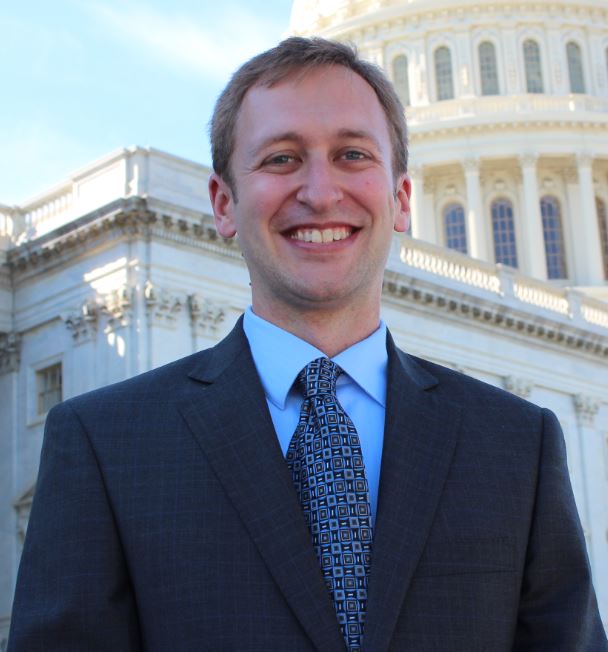
ChrisPickett

Congress and federal agencies appear to move quite slowly, but science policy is a pretty fast-paced field. Because of this I’ve found it difficult to describe a standard day. However, my days are often characterized by four different activities:

Research: Keeping up to date on current events and the actions of Congress and the administration is essential to a job in policy. It also means taking closer looks at policies or legislation that the society is interested in so that we can determine our best course of action.

Meetings: We meet regularly with members of Congress and their staff, staff at the NIH, the NSF and other science-related federal agencies, and representatives of other scientific societies. These meetings can be 30-minutes long, or they can take an entire day.

Organization: Keeping all of my projects on schedule can require a fair amount of organization. Furthermore, large events, like coordinating the ASBMB Student/Postdoc Hill Day, takes a lot of preparation and organization.

Writing: I would say 85% of my time is spent writing, and it’s all kinds of policy writing. Position statements, white papers, news releases, blog posts and even emails. Clear written communication is vital to a career in science policy.

Each day brings a different mix of these four tasks. Some days I’m on Capitol Hill all day, whereas others I’m writing one specific document because of a time crunch. And then some days see a healthy mix of all four.

What makes this a science job and what do you like most about it?

Many of the skills needed for science policy do not differ so much from the skills gained working at the bench. First, you need to think critically, and be able to discern changes to the forest and the trees. Policy and politics have many moving parts, and you need to understand how your group’s position or policy will affect other parts of the research enterprise.

Second, you need to pay attention. While at the bench, you read scientific publications. In policy, you read the news and policy-specific publications. Understanding what is going on in the larger government is essential.

However, some skills need to be learned on the job. I had limited policy-writing experience before landing my fellowship. But once I arrived, I was writing many different pieces, sometimes in the same day, for a variety of audiences. This is actually what I like most about the job.

News releases have a different audience than blog pieces, for example. Being able to switch communication styles depending on the audience takes quite a bit of practice. Similarly, understanding how each federal agency works with one another and how they work with Congress is something that is best learned while doing the job of policy.

What advice would you give your younger self?

It’s a romantic notion that putting all of your effort into a single career path, like becoming academic faculty, will result in success. So many things, foreseen and unforeseen, can alter your path and planning for only one outcome is foolish.

To put it another way, do you focus all of your time on a single line of experiments, or do you mitigate the risk of failure and work on multiple lines of experiments?

I would tell myself to sit down and figure out Career Plan A. And once that was mapped out, to figure out what Career Plans B, C and D were. Then I’d tell myself to put the majority of my effort into Plan A, and recognize just how much of that work is also relevant for following Plans B, C and D.

Furthermore, should the opportunity arise to participate in something that improves your resume for one of your possible career paths, take it. If Plan A works out, you will be able to contribute much more to your organization due to your broad experiences and training.

Should the time come to bail on Plan A, you will already have a body of work for your other career paths, and it will be straightforward to gauge what you need to do to follow one of these paths.

danaberry

Dana Berry graduated with a MS in Microbiology from New York University before joining BMC in 2014, where she manages the infectious diseases portfolio.


Suggested posts

Finding job satisfaction as a policy analyst

Q&A with Gerjon Ikink: Using policy to change science

Science careers are careers that involve science

 

How do you draw the line between volunteer work and unpaid labour?

A US university’s plan to recruit volunteer PhD-holders who are alumni to lecture classes, write grant proposals and serve on graduate thesis committees has raised concerns of possible exploitation of early-career researchers.

Ideas-naturejobs-blog

{credit}Topp_Yimgrimm/ThinkStock{/credit}


But questions remain about the plan’s actual intent and its potential impact on US universities’ current and future policies around existing faculty members.

In April, Michael Molino, an English professor and an associate dean at Southern Illinois University (SIU) in Carbondale, sent an email to department chairs that outlined a plan to seek “qualified alumni to join the SIU Graduate Faculty in a zero-time (adjunct) status.” The appointments would last for three years. The letter encourages department chairs to nominate “some of your finest former students who are passionate about supporting SIU.” Continue reading

March for Science 2018 gears up

Organisers of the second annual March for Science , scheduled for 14 April in Washington DC, are hoping to recapture the energy and enthusiasm that prompted more than 1 million researchers and others to march together last year across 600 cities around the world in support of evidence-based policy and upholding science for the greater good.

MarchforScience-Judith-2-smaller

Caroline Weinberg, an organizer for the upcoming march in Washington DC, expects smaller crowds than last year, although she admits her prediction may again be off the mark. “Last we expected 40,000 people, and we got around 100,000,” she says. She adds that most of the marchers in the nation’s capital city were concerned citizens, not practicing researchers.

In Washington DC and elsewhere, organisers envision events with fewer marchers, placards and chants but more advocacy-related activities. Weinberg and others aim to offer hands-on projects for those taking to the streets in Washington DC. In Berlin, Germany, organisers are planning a “local hero” programme where scientists will give public talks at bars, cafes and other venues. March-related activities in Portland, Oregon, will include speeches by local politicians and a science expo with at least 30 presenters, including a juggler who demonstrates the principles of physics.

The election and inauguration of Donald Trump for US president helped to spur marchers last year, and Weinberg says that she suspects that some scientists this year may be motivated to speak out against Trump’s recent budget proposal, which called for drastic cuts to the US Centers for Disease Control and Prevention spending plan . But she adds that the march and other forms of science activism shouldn’t depend on crises to draw interest and participation. “Our challenge is to build up a huge crowd and send a message that galvanizes everyone but to also make it sustainable,” she says. “We can’t allow our advocacy to be tethered to those moments.”

Roughly 15,000 people attended last year’s march in Portland, but that kind of enthusiasm will be hard to replicate, says Denesa Oberbeck, a behavioral neuroscientist at the Oregon Health & Science University in Portland and a member of the steering committee for this year’s march. “There’s some fatigue and some burnout, but we need to keep fighting,” she says. “We have to maintain an activist stance.”

Kristine Wadosky, a cancer researcher at Roswell Park Cancer Institute in Buffalo, New York, marched in Washington DC last year carrying a sign that read “Curing cancer is non-partisan.”  This year, she plans to join the march in Chicago, Illinois, where she will give a talk on advanced prostate cancer for the annual meeting of the American Association for Cancer Research. She says that she’s just as energized about science advocacy as ever before, and she thinks that many other young scientists feel the same way.

This time, Wadosky says, she won’t need a sign to send her message, which isn’t especially complicated. “I just want to go to show that I’m a scientists, and I exist,” she says.


Chris Woolston is a freelance writer in Billings, Montana.


Suggested reading:

Growing pains
In support of the March
Reflections on a movement

Marketing yourself, politics and post-truth

Successful marketing can land you your dream job, but does this really mean you are the best person for the role?

Achieving your dream job is always going to be a bit of a challenge. You may have a great degree, and maybe relevant experience, but getting your potential employer to believe you are absolutely the right person for the job means marketing yourself correctly. This can be tricky, particularly if you are starting off new in a field with no established reputation behind you.

Continue reading

#ScientistOnTheMove in January 2015

From academia to medical writing, editing, policy, further research and a swap from communications to a PhD in later life.

In 2015, Naturejobs is celebrating mobility in science, where researchers are changing labs, moving countries or transitioning into something completely different. In January 2014, all of these things hapenned. Below, we’ve selected just a handful of job changes to give you a flavour of the variety of things you can do with a science degree.

viviane-callier-naturejobs-blog

Viviane Callier

Viviane Callier was a postdoctoral fellow from 2011-2013. In late 2013, she transitioned to a technical writing position for a consulting company in the Washington DC area. In her new role as a Scientific Communications Editor at the National Cancer Institute, which she started in January 2015, her main challenges are the more frequent and stricter deadlines. But during the transition, it was the leap into the unknown, leaving friends behind and feeling like “I had to start all over from scratch,” that were the three biggest challenges.


Lucy-Craggs-naturejobs-blog

Lucy Craggs

Lucy Craggs held a postdoctoral research at the University of Newcastle, where she was working in the field of neuroscience. The decision to leave academia was difficult, but difficult supervisory relationships, feeling undervalued and realising that if she wanted to stay in academia she would need to relocate, meant that it was the right thing to do. In January 2015 she started working as a medical writer for MediTech Media, part of the Nucleus Group of companies, focussing on the communication of the drug discovery process.
Continue reading

Most read on Naturejobs: December 2014

So far, in December 2014, you’ve done a lot of reading and writing! We want to thank our wonderful contributors this month: Shimi Rii and Frances Saunders. Thank you both very much.

Here are the 5 most popular posts from this month.

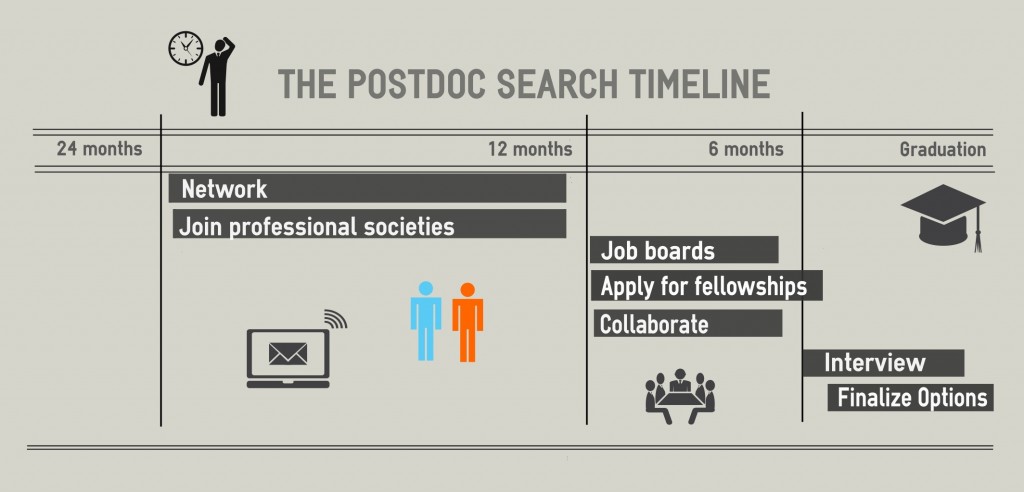
postdoc-search-timeline

The postdoc search timeline. Image credit: Shimi Rii

1) The postdoc search timeline. Shimi Rii interviews fellow postdoc researchers about their job hunt, in particular, she focuses on how long they spent looking.

2) Ask the expert: Can research ever be a ‘9-5’ job? Dr Frances Saunders, president of the Institute of Physics in London, tries to answer this question for you. The conclusion: it is possible, but it requires a joint effort from many people.

3) How to cope when things go wrong in academia. This short Q&A film from the 2014 London Naturejobs Career Expo highlights some of the coping strategies that academics have when things go wrong.

4) How to publish your data in a data journal is a piece in which we highlight the main tips from Andrew Hufton at a recent Scientific Data event on publishing your data in data journals.

5) From academia to policy with David Carr is a Q&A interview about his transition into policy work at the Royal Society in London.

Merry Christmas everyone!

From academia to policy with David Carr

An interview with David Carr about his transition from academia to science policy.

David-Carr-Wellcome-Trust

David Carr, Policy Advisor at the Wellcome Trust

Staying in touch with science was the one thing David Carr wanted when he left academia in 1998. After spending a year working  in a scientific consultancy organisation whilst also writing up his masters, Carr joined the Wellcome Trust. Since joining he has become more and more involved in science policy. In this interview I ask Carr why science policy is important, why he enjoys it and what advice he has to offer to those who wish to work in this field.

Why did you initially decide to pursue a PhD?

I was interested in and passionate about genetics (which I specialised in during the final year of my undergraduate degree), and at the time it seemed like the logical next step to continue to postgraduate research. Looking back, I really drifted into it – I didn’t really look enough at other options or really consider what the day-to-day work involved in doing a PhD would be. I thought that getting a PhD would be a good thing to do in terms of keeping open career options within science and outside, and that it would be a natural continuation of my undergraduate studies, but quickly discovered the reality was quite different! Continue reading

How to publish better science through better data

Scientific Data and Nature host an event that explores how different stake holders can collaborate with researchers to publish better science through better data management.

Data, without a doubt, are the foundation of science. If you’re a researcher, your life is data: you spend your days generating it, analysing it, and writing papers about it. You share it with colleagues and collaborate on projects that will build on it and find new and exciting things. But policy makers, funders and universities are also involved in the conversation – each trying to solve the problem of managing the increasing influx of data whilst keeping the integrity of science high.

Last Friday, PhD students and postdoctoral researchers came to the Nature offices to learn about how research data affects a scientist’s ability to publish and get research funding. The event, Publishing Better Science through Better Data, consisted of a series of talks from editors, data curators, software developers and funding body representatives, all giving their perspective on how data affects scientific research and publishing.

Phil-campbell-scidata14

{credit}Image credit: Nandita Quaderi (@DrNandiQ){/credit}

The editor’s perspective

Philip Campbell, Editor-in-Chief of Nature and its sister journals provided an editor’s perspective and shared how Nature journal was handling the reproducibility problem: “It mostly consists of things that are bad or sloppy science, not fraud.” To minimize the amount of “sloppy science” being published in Nature, editors have put a check-list in place for scientists that they submit along with their papers, making the research process more transparent. “It’s improving the reliability of the design of experiments, which is what we want to see happening.” Continue reading

Let’s do an unconference

Guest Post by Martin Fenner.

Martin Fenner 
is the technical lead for the PLOS Article-Level Metrics project. Before taking this position in 2012 he worked as a medical oncologist at the Hannover Medical School Cancer Center in Germany. He has served on the ORCID Board from 2010 to 2012 and is a member of the ORCID Outreach Steering Group.

This year’s SpotOn London conference takes place November 14-15 and registration opened this Monday. I have been helping to organize this conference since 2009, and I again look forward to the sessions, and – more importantly – the discussions with people in and between sessions this year.

The name (ScienceBlogging London, ScienceOnline London, SpotOn London), the location (Royal Institution, British Library, Wellcome Conference Center), the people organizing (too many to mention, but Nature Publishing Group always at the core), and the fringe events (lots of cool things from science tours toStory Collider) and the format have always changed slightly over the years, and this year again is a bit different. The biggest change is obviously that Lou Woodley is no longer an organizer (as she announced at last year’s conference), but this is also the first SpotOn conference with a theme:

The challenges of balancing the public and the private in the digital age

This is obviously a very broad topic, but nicely encompasses many important issues that we are dealing with in scholarly communication today. The draft program is posted here, and I’m helping organize the sessions on sharing sensitive data and open peer review. More details will follow for all these sessions.

Continue reading