Tips to identify the perfect employer

Knowing yourself, what you want and what motivates you should be the foundation of your job hunt, says Ulrike Träger.

Finding the right job and organization to work in after your PhD can be a daunting task. Coming from an academic setting, researchers tend to struggle to identify skill sets needed for a change in their career paths, asking questions like ‘what skills should a medical writer have?’ Job titles sometimes explain little about the actual work responsibilities—did you know, for example, that an ‘Innovation Facilitator’ communicates science and sets up links between academia and industry, to help speed up drug development or begin business opportunities?

Different_ iStockphoto_Thinkstock

{credit}iStockphoto/Thinkstock{/credit}

Continue reading

The hidden job market

As the majority of jobs aren’t publicly advertised, job seekers should make sure they know where to look for them, says Barry O’Brien.

Contributor Barry O’Brien

magnifying-glass-naturejobs

{credit}Design Pics/Thinkstock{/credit}

Depending on which article you read, you will see stats that say that anywhere from 70 to 85% of job vacancies are never actually advertised. How these stats are ever calculated, no one knows. What is important is that any job seeker should ensure that their job search strategy involves spending time trying to unearth good roles, whether temporary or permanent, beyond job boards and LinkedIn ads.

One of the most soul destroying things any job seeker can do is spend eight hours a day firing off CVs in reply to job adverts that, often, are clearly not a good match to their skill set. It is essential that you make an effort to discover the unadvertised vacancies out there.

Why aren’t jobs always publicly advertised?

There are several reasons why the hidden job market exists, but the high price of recruiting is one of the main ones. The average cost of hiring someone through a recruitment company is over 4000 GBP, but the larger costs due to lost productivity whilst the position is vacant, can be much higher. Continue reading

Most read on Naturejobs: December 2014

So far, in December 2014, you’ve done a lot of reading and writing! We want to thank our wonderful contributors this month: Shimi Rii and Frances Saunders. Thank you both very much.

Here are the 5 most popular posts from this month.

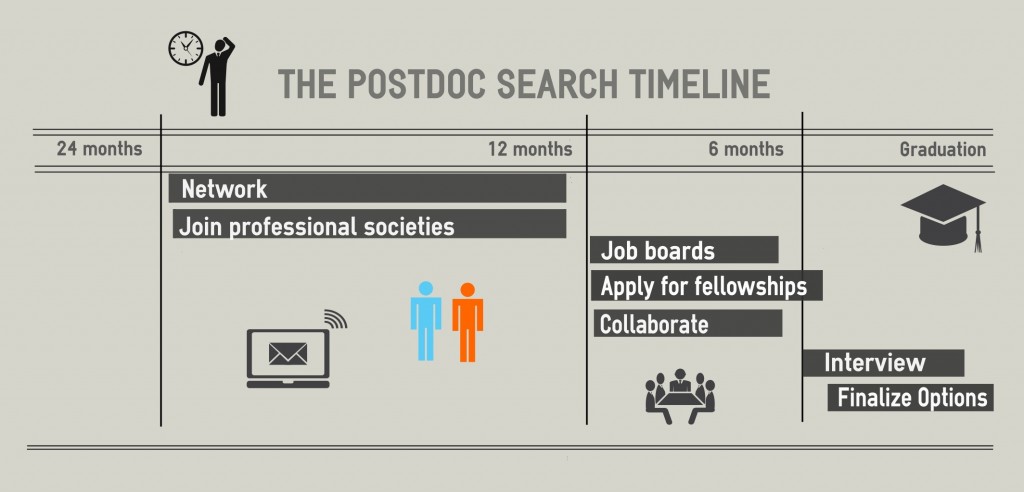
postdoc-search-timeline

The postdoc search timeline. Image credit: Shimi Rii

1) The postdoc search timeline. Shimi Rii interviews fellow postdoc researchers about their job hunt, in particular, she focuses on how long they spent looking.

2) Ask the expert: Can research ever be a ‘9-5’ job? Dr Frances Saunders, president of the Institute of Physics in London, tries to answer this question for you. The conclusion: it is possible, but it requires a joint effort from many people.

3) How to cope when things go wrong in academia. This short Q&A film from the 2014 London Naturejobs Career Expo highlights some of the coping strategies that academics have when things go wrong.

4) How to publish your data in a data journal is a piece in which we highlight the main tips from Andrew Hufton at a recent Scientific Data event on publishing your data in data journals.

5) From academia to policy with David Carr is a Q&A interview about his transition into policy work at the Royal Society in London.

Merry Christmas everyone!

When a PhD isn’t enough

Contributor Bianca Marcolino

165492777_decisions_istockphoto_thinkstock

{credit}Credit: Thinkstock{/credit}

“You need to beg, borrow and steal” was the advice I was given by a Pfizer medical director on how to enter the pharmaceutical industry after graduate school. The medical director also had a Ph.D., and I had met him through a common friend. He had transitioned from academia into industry, and was personally aware of the difficulty in making the switch. It is especially challenging if you’re looking for a scientific role away from the bench. Hence, the dramatic advice that you need to do whatever it takes, get as much outside experience as you can, to land the first job post-graduate school. Having a Ph.D. is one thing, knowing how to sell it in the non-academic market is another.

My undergraduate research helped me decide that I wanted to become an independent scientist. I went to graduate school to study biology, because I loved science and wanted the training that only designing and executing experiments can offer. Towards the end of my Ph.D., I had my mid-Ph.D. crisis. Am I ever going to defend? If I manage to survive, do I want to do a postdoc afterwards? These were the questions that plagued me and probably many other Ph.D. students. In the end I couldn’t see myself doing a postdoc, and wondered what do next. Were there any suitable jobs for a Ph.D. graduate without experience outside of academia?

After countless applications and hours spend steaming my interview blazers, I am now working as a medical writer for a healthcare agency. I enjoy applying my science background towards solutions for constantly changing projects.  Continue reading