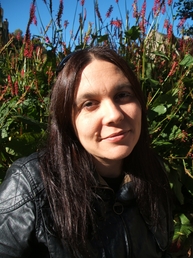
 Dr Fern Elsdon-Baker is Director of the British Council’s Belief in Dialogue Programme. Belief in Dialogue is a new intercultural programme, which explores how people in the UK and internationally can live peacefully with diversity and difference in an increasingly pluralistic world. Fern currently serves on the UK Arts and Humanities Research Council’s Science in Culture Advisory Group. A passionate believer in the interactive communication of science, history and philosophy, in her spare time she is the recorder for the History of Science section for the British Science Association. She also serves on the programme’s committee for the British Society for the History of Science.
This blog post is coming to you from the United Arab Emirates. I am at a British Council conference organised with the American University of Sharjah, in association with the International Society for Science and Religion. The title of the conference, Belief in Dialogue: Science, Culture and Modernity, may at first seem a little challenging to some regular readers of Nature. How can there possibly be a dialogue of this kind?
One of the key questions we will be asking at the conference is what factors need to be in place in any society or culture for scientific endeavour or inquiry to flourish. At first these might seem like quite simplistic questions – surely it’s just about good science education and funding for scientific research institutions? However, I would argue it takes much more than that to build a thriving scientific economy. There are certain building blocks needed in areas of society that we might not readily recognise.
The role technological and medical advances can play in our daily lives is clear. We are all aware where the ethical boundaries may lie, whether this be around a range of questions from stem cell research, reproductive technologies, climate change through to water security.
However, to get to the root of what makes science flourish we need to make one fundamental observation – what we mean when we use the terms ‘science’, ‘technology’ or ‘medicine’ are all different. Intrinsically intertwined with shared – yet in places divergent – historical contexts, they have different approaches to methodology or their philosophical underpinning.
For technology to flourish you do not necessarily need a flourishing ‘scientific’ culture – significant societal drivers such as industry and entrepreneurship play perhaps a bigger role than a purely ‘scientific’ approach. Scientific inquiry is as much a way of thinking, seeing and asking questions about the world around us, as it is a consensus on a type of agreed methodological approach.
‘Science’ in this way, whether we recognise it or not, is an integral part of our daily lives. It is the very fabric of our cultural context but in different ways. I am far from arguing that there is no hope of an ‘objective science’ in the way that many scientists would argue – I am certainly not suggesting that the very stuff of science is culturally relative. But the cradle of all scientific inquiry is the broader societal and cultural context in which it sits. Not just the cultural perspective of the individual or team of researchers, but the context of the political system which supports or suppresses, the funding stream that can inadvertently create fashions and trends, and those of us in wider society who are ultimately the end users of any research and in turn fuel both political and funding priorities. This rich tapestry of influences ultimately shapes the scientific discourse of the day.
The answer then to my question lies outside of the science faculty or classroom. It is becoming increasingly recognised in developing scientific economies that the humanities play a key part in helping to frame the systems of thinking that are needed to engage both critically and analytically with the world around us. In the UK, we have long recognised the role of strong multidisciplinary discourse and it is to our credit that our research funding councils see the critical value in this interplay between sciences and humanities – even in these difficult economic times.
Another factor that we are growing to value more and more is the open engagement with wider society and cultures in science communication. Gone are the days when we would expect to disseminate ‘knowledge’ to an uninformed and apparently wilfully ignorant public. We are all members of that amorphous mass we like to call public and we cannot assume that we are all uninformed, uninterested or do not have valid questions about the role of science in society today or how it relates to our own individual cultural perspectives.
Freedom of thought and expression play a key role here too. Too often fundamentalists at the extremes of the spectrum close down on other’s perspectives not because of any epistemological impasse, but merely due to an unwillingness to even engage with another’s cultural perspective. Too often when we communicate science we cleave to polarising narratives that create an ‘us’ and ‘them’ approach to science communication – which can exclude a large proportion of the world’s population. There is no ‘them’, there is only an ‘us’.
In an increasingly globalised world where we all have multiple identities it is not possible to delineate between communities or cultures in the simplistic ways of the past. We cannot therefore assume, as has been done in previous years, that it is possible to create divisions between any culture – be that a disciplinary cultural divide between science and humanities or a cultural divide between world views.
In my work I have had the opportunity to meet a number of people from many different cultures, communities and faiths. Sometimes my perspective on how we view the world might differ from those I meet, but I have as yet not had the misfortune to meet someone who is so set in his own world view that we cannot openly engage in a discussion about those differences. In some surprising and heart-warming circumstances I have found considerable common ground with those who initially felt they were in opposition to my work communicating evolutionary science but have since become firm supporters. At other times I have come away with my own prejudices and misconceptions challenged and found a new respect or understanding of another’s world view even if it is one I do not wholly share.
What I hope we will see at the conference at the American University of Sharjah is an opportunity to openly share different perspectives on the issues and challenges at the core of scientific discourse that are fundamental to all societies’ growth. But more importantly I would hope that by bringing people together from different countries with different beliefs and world views, we will each take our part of the jigsaw and place it together – so that in the future we can build a clearer global picture of how to communicate science in a more effective way as we face the many challenges ahead of us all in the 21st century.
To join in the discussion on Twitter, the conference hashtag is #BIDSCM and you can find the official Belief in Dialogue Twitter account here.