

This week’s guest post features an interview with Michael Brooks. As well as holding a PhD in quantum physics, Michael is an author, journalist and broadcaster. He’s a consultant to New Scientist, has a weekly column for the New Statesman, and is the author of the bestseller in non-fiction titled ‘13 Things That Don’t Make Sense’. As part of an ongoing cycle of lectures, the City of Arts and Sciences in Valencia, Spain, together with the British Council, recently invited Michael Brooks, to explain the simple question of the origins of the universe.
Nicolas Jackson, from North by Southwest, a partnership between National Radio of Spain (RNE) and the British Council, caught up with Michael Brooks on the occasion.
For a quick taster, here are a few snippets from Michael’s interview, but you can listen to the full interview in the podcast at the end of the post.
Q When did humans first begin to take an interest in discovering the origins of the universe?
Michael Brooks It’s a really interesting phenomenon that today, in 2011, we think of there being an origin to the universe or a beginning, because actually that’s a relatively new idea. It wasn’t really put out there till the 1920s by a Belgian catholic priest called Georges Lemaître. He came up with this idea of a day without yesterday, and there was a kind of firestorm, fireworks and suddenly, what he called the primeval atom, kind of exploded… and from this came the universe.
And… he kind of put this out in the late 1920s, and when Einstein heard about it in 1933, he said: “This is the most beautiful idea I’ve ever heard of”. In the meantime Edwin Hubble, the astronomer, had been gathering data that showed that most of the galaxies that surround us are moving away from us very fast, and if you wind that back, that implies that somehow they were all together in one place at the same time, which we would consider to be the beginning of the universe.
This seems like a common-sense idea to us now, actually it wasn’t accepted until the 1960s; it did 30 years in the cold and there were various debates over whether the universe had always existed. You couldn’t say anything about a beginning until we discovered the cosmic microwave background radiation, which was the echo of the Big Bang, and proved that there was some kind of cosmic explosion, like Lemaître had said. And that was the point at which we just dropped the idea of there being a steady state, always existing universe, and decided that there had to have been a beginning of everything.
Q Might the idea of the origins of the universe be challenging for certain religious sects in the same way that Darwin’s Origin of the Species has been?
Michael Brooks It’s very important to realise that scientists aren’t deliberately undermining people of faith and religious ideas. What they are doing is looking out into the cosmos and finding evidence for this and for that, and with that evidence we adjust our ideas – of course with Galileo we adjusted our ideas about whether the earth was at the centre of the universe. Based on the evidence we had to change that to having the sun as the centre of the solar system and the earth spinning around it.
Now, there is some backlash against this, particularly in the United States, where people want to only deal in terms of what their faith tells them to believe, or what their religious leaders tell them to believe. Science is no respecter of that really, in many ways, science comes in and says, “this is just what the evidence says, and this is what our experiments tell us,” or, “this is what we uncover in the fossil record.” I don’t think there is a deliberate attempt to create trouble; it’s certainly not an attempt to undermine some of the other benefits of faith communities and everything else. I think it’s just that there are historically always areas where science just treads on the toes of people who hold religious faiths, and whereas science doesn’t really kind of pull any punches, the religious people, the religious leaders have to bend and accommodate the new scientific understanding. So this is always going to happen, I think.
Q Scientific discovery is obviously accelerated massively in the last hundred years. How much more is there for mankind to discover?
Michael Brooks Science is actually very humble in a sense, in that we’ve had 400 years of discovery, and cosmology has uncovered the history of the universe – 13.7 billion years old. But at the same time we realise how little we know, and we’ve discovered that 96% of the universe is in some form that we don’t understand, 72% is dark energy, a mysterious force that seems to be pushing on the very fabric of the universe, and 24% is dark matter, the stuff that exists out there, we know it must be there, or we think it must be there, or our calculations say it must be there. And we then have to work out what it is and look for it, and we’ve actually been looking for it properly for about 40 years now and still not found any clue about where it might be, or what kind of particles these might be.
So it keeps us humble, in a sense inside, and that’s one of the great things, [that] for every discovery that we make, there seem to be about ten more unanswered questions coming. And I think that’s one of the beauties of science, that it never seems to end, it seems to provoke more and more curiosity and questions.
Q You and the City of Arts and Sciences in Valencia coincide in their desire to bring science closer to ordinary people and to make it accessible. Many people might see this as the exact opposite of the arts, where great art is not always meant to explain itself. Why is this?
Michael Brooks I think science takes the trouble because some of the concepts that we deal in are so abstract and so difficult to grasp. You can look at a painting and appreciate a painting without really knowing an awful lot about who painted it, or why, or what they were trying to get across, and you get this aesthetic beauty. Whereas some of the aesthetic beauty in science lies in very complicated equations, or in complicated ideas about, for instance, the beginning of the universe.
And so scientists are really taking it upon themselves to explain. And also there is a passion as well, about what we’ve discovered. It’s an extraordinary thing to be able to discover these things about the universe and how they work. So it’s very rewarding in and of itself to actually explain these to people and see their faces light up.
So maybe some of the arts, certainly painting and writing, people can take it in at whatever level they want to take it in at. So they don’t need so much kind of advocacy, they don’t need so much explanation and communication, whereas science is actually quite inaccessible until somebody is there acting as a bridge between the scientific community and the general public.
Podcast
North by Southwest 50 – Michael Brooks at The City of Arts and Sciences by British Council
North by Southwest is an English-language radio programme giving a taste of British and international culture and arts in Spain and also explores social, scientific and educational issues. North By Southwest is broadcast every week on RNE’s Radio Exterior (World Service) as part of its English-language programming.
 Dr Fern Elsdon-Baker is Director of the
  This week’s guest blogger is James Hannam, he has a PhD in the History and Philosophy of Science from the University of Cambridge and is the author of
  Few topics are as open to misunderstanding as the relationship between faith and reason. The ongoing clash of creationism with evolution obscures the fact that Christianity has actually had a far more positive role to play in the history of science than commonly believed. Indeed, many of the alleged examples of religion holding back scientific progress turn out to be bogus. For instance, the Church has never taught that the Earth is flat and, in the Middle Ages, no one thought so anyway. Popes haven’t tried to ban zero, human dissection or lightening rods, let alone excommunicate Halley’s Comet. No one, I am pleased to say, was ever burnt at the stake for scientific ideas. Yet, all these stories are still regularly trotted out as examples of clerical intransigence in the face of scientific progress.
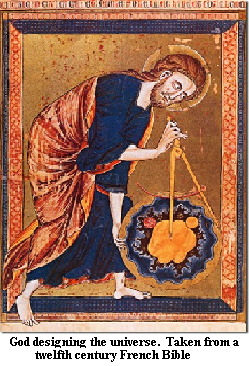 But religious support for science took deeper forms as well. It was only during the nineteenth century that science began to have any practical applications. Technology had ploughed its own furrow up until the 1830s when the German chemical industry started to employ their first PhDs. Before then, the only reason to study science was curiosity or religious piety. Christians believed that God created the universe and ordained the laws of nature. To study the natural world was to admire the work of God. This could be a religious duty and inspire science when there were few other reasons to bother with it. It was faith that led Copernicus to reject the ugly Ptolemaic universe; that drove Johannes Kepler to discover the constitution of the solar system; and that convinced James Clerk Maxwell he could reduce electromagnetism to a set of equations so elegant they take the breathe away.