Remapping the scientific landscape: moving from a closed to open science world

Science is changing – and we will change with it, says Anastasia Greenberg

Better Science through Better Data writing competition winner Anastasia Greenberg

“Information is power. But like all power, there are those who want to keep it for themselves.” Those were the words of Aaron Swartz, a young programming prodigy and the creator of Reddit, in his Guerilla Open Access Manifesto. In 2011, Swartz wrote some code that systematically downloaded millions of academic papers from the JSTOR database onto his computer, which was hidden in a basement closet at the Massachusetts Institute of Technology (MIT). This act of hacktivism resulted in felony charges, with potential for decades of jail time. Swartz hanged himself in 2013.

To some, Swartz’s story embodies the open-science movement, but it is far from clear what his motives for downloading JSOR’s database were, and which, if any, segments of the open science movement Swartz identified with. Continue reading
How not to respond to reviewers: Eight simple tips

Responding to reviewer reports is a key part of publishing academic work in peer reviewed journals. But if you’ve received mixed reviews of a paper or are publishing for the first time, where do you start?

This piece was republished from Sophie Lewis’ blog.

My first attempt at publishing a paper was a breeze. A collaborator was asked to contribute to a special issue and offered me the opportunity to lead the paper. I was a PhD student at the time, and spent two months visiting her lab overseas and writing. By the end of my visit, I’d carved out a draft that I left behind for comments. After a bunch of emails and several rounds of revisions over the next month, we were ready to submit.

Flickr/AJ Cann, CC BY-SA

Flickr/AJ Cann, CC BY-SA

Continue reading

Science communication: The predatory open access “journals”

Having a web page with scientific articles isn’t all it takes to be a scientific journal, says Victor Morais.

Guest contributor Victor Morais

The number of open access journals available to scientists has grown enormously in recent years. They offer the possibility of fast and easy publishing to get research out in the world as soon as possible. Unfortunately, not all open access journals are as they appear.

Photo 2

Victor Morais

Every day, email invitations to new open access journals drop into my inbox. Recently I decided to investigate further. On the publisher’s site I found more than 30 journals covering a variety of areas, but fewer than half of them had published articles and none of them had more than 10 articles. There were more places to publish than there were publications!

I wondered if these journals were real. They could be predatory journals – a web page where scientists publish papers in a form more like a personal page or a blog than a legitimate scientific journal. The real purpose of a scientific journal is to share and preserve knowledge and to protect the minimum quality requirements of a scientific publication. If scientists publish their work on personal web pages, there are no quality controls and it’s not possible to guarantee the visibility or protection of articles. Predatory journals do not do the job of a scientific journal in terms of quality, visibility or preservation, and most of the time lack the peer review process that makes science reliable. As a researcher, how do I guarantee that as soon as I’m charged for publication, my work won’t be lost in the ether?

In my ensuing research, I found some interesting resources like Think. Check. Submit that give guidelines to choose the right journal. Here, I want to share some of the clues that helped me to distinguish between established, emerging and predatory journals.

Continue reading

Most read on Naturejobs: December 2014

So far, in December 2014, you’ve done a lot of reading and writing! We want to thank our wonderful contributors this month: Shimi Rii and Frances Saunders. Thank you both very much.

Here are the 5 most popular posts from this month.

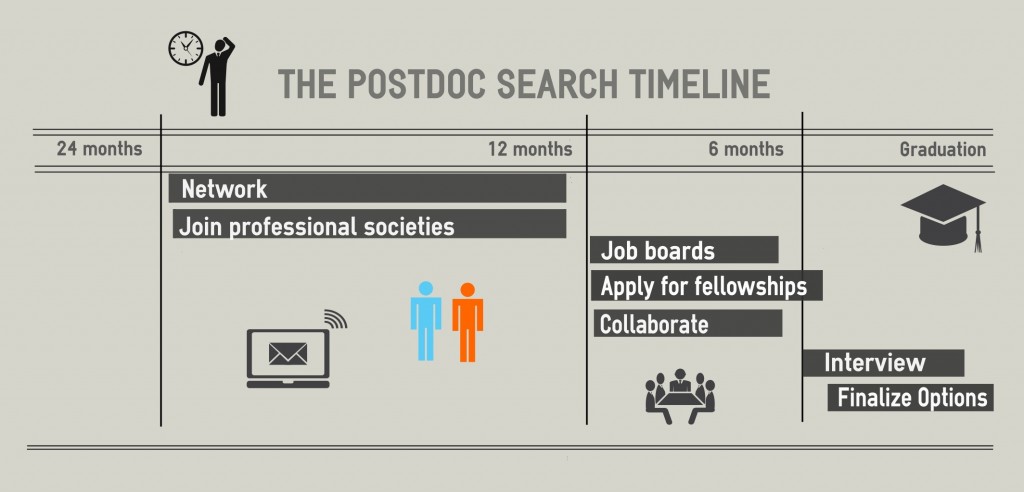
postdoc-search-timeline

The postdoc search timeline. Image credit: Shimi Rii

1) The postdoc search timeline. Shimi Rii interviews fellow postdoc researchers about their job hunt, in particular, she focuses on how long they spent looking.

2) Ask the expert: Can research ever be a ‘9-5’ job? Dr Frances Saunders, president of the Institute of Physics in London, tries to answer this question for you. The conclusion: it is possible, but it requires a joint effort from many people.

3) How to cope when things go wrong in academia. This short Q&A film from the 2014 London Naturejobs Career Expo highlights some of the coping strategies that academics have when things go wrong.

4) How to publish your data in a data journal is a piece in which we highlight the main tips from Andrew Hufton at a recent Scientific Data event on publishing your data in data journals.

5) From academia to policy with David Carr is a Q&A interview about his transition into policy work at the Royal Society in London.

Merry Christmas everyone!

How to get published in high-impact journals: Big research and better writing

Getting your work published is about more than good science, it’s about good communication too, say Macmillan and Nature editors at the London Naturejobs Career Expo in September 2014.

Contributors Samuel Brod and Simon Hazelwood-Smith

Getting your research into an influential journal is certain to give a healthy boost to both academic standing and future career prospects (scientific or otherwise). Accordingly, it is a competitive business: many articles are put forward but few accepted. In fact, of the almost 11,000 articles submitted to Nature last year only 856 (7.8%) were published. What does it take?

“Data should be at the heart of everything you do,” says Peter Gorsuch, an editor at Macmillan Publishers Ltd., Nature’s parent company.  Indeed, without excellent data, it is virtually impossible to publish in high-impact journals — if at all. Still, even with high-quality data, you can jeopardise your chances of publication if you don’t have a high-quality paper.

At the Naturejobs Expo on 19 September in London, Macmillan publishers hosted two workshops on how to publish in high impact journals. Gorsuch was joined by Sadaf Shadan, an editor at Nature and they offered insights on the dos and don’ts of scientific publishing. The second workshop was run by Nicky Dean, a senior editor and team manager at Nature Communications. He gave some insights into what makes research worthy of a high impact journal. Continue reading

Writing a paper: habits of successful authors

If you’d like to boost your chances of getting your research published in the right journal, it’s worth knowing some of the habits of successful authors. Bernd Pulverer, head of scientific publications at the European Molecular Biology Organisation (EMBO), shared some insights with attendees at last week’s Naturejobs Career Expo in Heidelberg, Germany.

Consider the final paper when you first plan your project

Pulverer advises authors to “plan carefully and think holistically”.

Choose your journal with care

“There are many good journals out there,” Pulverer says. Study what kind of papers the journal publishes to see if its scope is suitable.

Don’t hold back data

“I can’t emphasise this enough,” Pulverer says, adding that the “cat and mouse game” between authors and referees is a huge problem. Don’t hold back data that you think the referees will ask for later in order to please them — include it with your initial submission.

Write a cover letter

Pulverer says a cover letter allows you to explain the importance of your research to editors and referees in a less formalised manner than in your paper. “It’s not essential, but it provides a good opportunity to give a different flavour to the results,” he says.

Tell a story, but avoid spin

Think about the ‘story’ of your paper, but don’t over-labour it — and don’t oversell your findings.

Be thorough when responding to referees

If you make it to peer review and get recommended changes from referees, “make sure you address every single point raised”, says Pulverer. If you don’t agree with something, write a thorough, point-by-point rebuttal.

Respond well to rejection

If your paper is rejected, don’t simply resubmit it to the same journal with a different title and list of authors. “It sounds trivial, but we see this quite a lot,” says Pulverer. “There are many other good journals at the same level.”

Have your say

Do you have any other tips or advice to share? Let us know below.