Remapping the scientific landscape: moving from a closed to open science world

Science is changing – and we will change with it, says Anastasia Greenberg

Better Science through Better Data writing competition winner Anastasia Greenberg

“Information is power. But like all power, there are those who want to keep it for themselves.” Those were the words of Aaron Swartz, a young programming prodigy and the creator of Reddit, in his Guerilla Open Access Manifesto. In 2011, Swartz wrote some code that systematically downloaded millions of academic papers from the JSTOR database onto his computer, which was hidden in a basement closet at the Massachusetts Institute of Technology (MIT). This act of hacktivism resulted in felony charges, with potential for decades of jail time. Swartz hanged himself in 2013.

To some, Swartz’s story embodies the open-science movement, but it is far from clear what his motives for downloading JSOR’s database were, and which, if any, segments of the open science movement Swartz identified with. Continue reading
Why I will not be marching for science

Virginia Schutte says the March for Science won’t meet her goals or those set out by the organizers. Here, she shares some alternatives.

When I was in graduate school, I learned to create classes using backward design. Backward design encourages setting goals and then planning a course of action to meet those goals. This strategy can be applied to almost anything in life. “What do I want for dinner?,” for example, can transform into “I need dinner to be quick” or “let’s get rid of what’s about to go bad in the fridge.”

crowd-1294991_1280 Continue reading

#scidata16: Open data should be easy

There’ll always be reasons not to share data. It’s time we stop making excuses and start making plans, says Atma Ivancevic.

On the morning of October 26, 2016, a group of scientists convened in London to discuss the state of open data. The third Publishing Better Science through Better Data conference kicked off with morning tea, international introductions, and furious scribing from @roystoncartoons. The premise was simple: “Today is all about being open”, said conference chair Iain Hrynaszkiewicz. We settled in to learn the advantages of data sharing at both the individual level and for the scientific community at large.

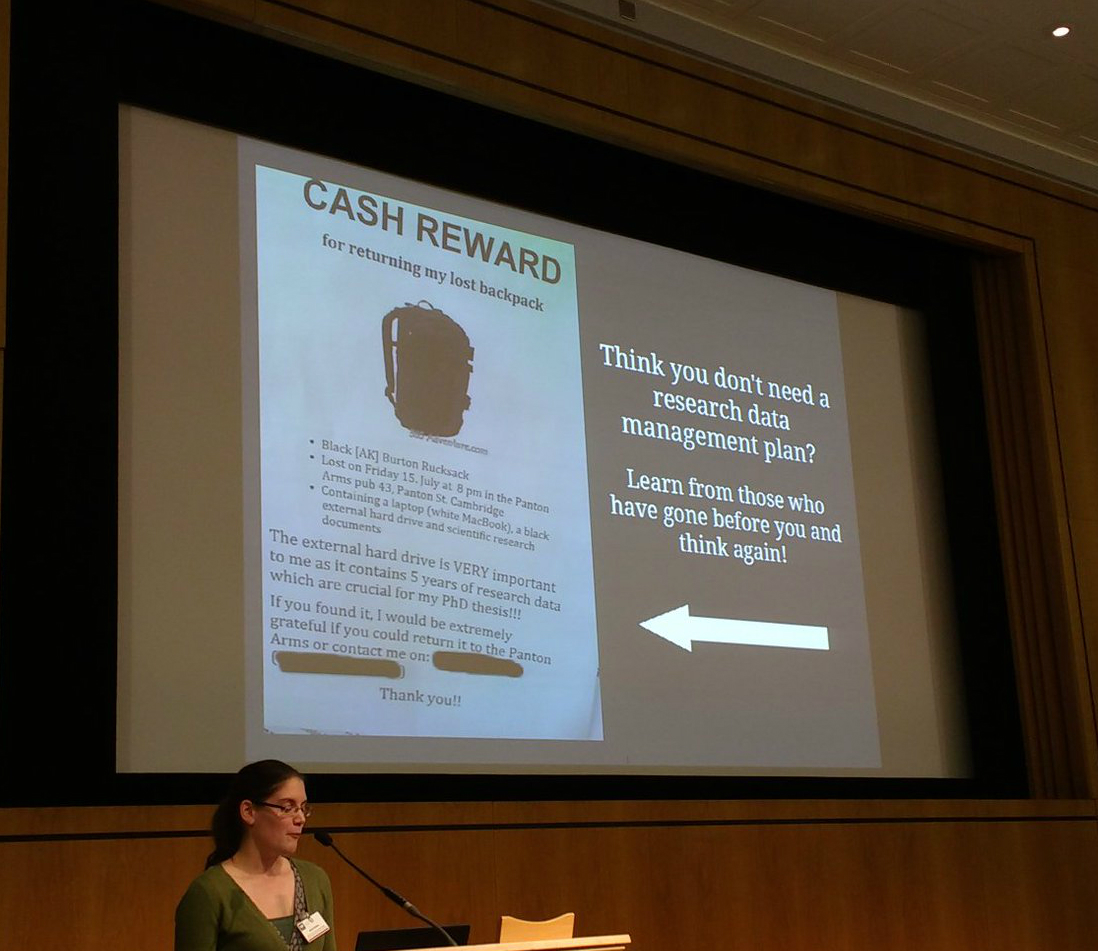
“Open data should be easy,” said Dr Jenny Molloy from the University of Cambridge as she explained the importance of building a data management plan. She pulled up a poster of a missing black backpack: “CASH REWARD” it read, “contains 5 years of research data which are crucial for my PhD thesis!”  I laughed along with everyone else, internally reflecting how similar my life had been before I discovered version control.

IMG_20161102_213011-smaller

Think you don’t need a research data management plan?

Continue reading