
This Time May Be Different

time-1191842-1280x960

Today’s Biotech Market In Context

The past five years have been the greatest bull run in the history of the biotech industry. Stock market outperformance, significant fundraising levels both private and public, more IPOs in this window than every before, and huge volumes of M&A. As we head into the annual JPM Healthcare Conference next week, it’s worth reflecting on the state of the industry:

  • Valuations remain very strong. The NASDAQ Biotech Index has never been at 3500 heading into a new year (or 3300-ish into a JPM conference) before; despite the volatility, the index was up nearly 11% in 2015 – as compared to the S&P500 being down nearly 1%. Lots of star-performing small-cap biotech names are off their all-time-highs, but many still maintain attractive multi-billion dollar valuations today. Dozens of pre-data preclinical and Phase 1 stage companies are being valued north of $300M.
  • The IPO window is still open. Over 140 biotech companies had closed successful, significant IPOs since the spring of 2013, marking the most prolific IPO window in history. The sector had at least sixteen biotech IPOs since mid-September, and the queue for new issuances later in January and February of 2016 has ballooned.  At least eight S-1’s on file went public Tuesday and Wednesday of this week – including CRISPR play Editas, epigenetics/combo story Syndax, and gene therapy play Audentes, among others (here, here). There will undoubtedly be a substantial number of biotech IPOs in 2016.
  • Deal-making continues at a feverish pace. We’ve witnessed tens-of-billions in R&D-stage M&A annually over the past few years. Further, Pharma is engaging in earlier stage partnering more actively; yesterday, we announced two R&D collaborations with structured M&A components – so called “Build-to-Buy” acquisition option deals – with Quartet-Merck and Rodin-Biogen (here).

The big question, though, is whether this cycle, in place since the bottom in 2009, is truly unique or special relative to past investment cycles, and how that might affect its sustainability.

As I outline in a new paper in the January 2016 issue of Nature Biotechnology, titled “This Time May Be Different,” there’s a strong case to be made that indeed this time is different. I know those are the four most dangerous investing words, and ignoring history is folly.  So I’ll hedge and say that it may be differentA summary of the article is below, but I encourage readers with interest to click the title above for the PDF, which contains figures and data supporting each of the points below.

The Commentary first sets some of the context for the current cycle relative to past environments. Since the industry’s inception in the early 1980s, we’ve experienced at least eight cycles, with the current one exceptionally sustained and dynamic.

This Time Is Different

Against this historic backdrop, there are at least four things about the current cycle that make it different than past periods:

  • Advancing Products Over Promise. We are in the midst of a biomedical renaissance that is delivering transformative medicines, like Solvaldi, Ibrutinib, Zydelig, anti-PCSK9s, anti-IL17s, CAR-Ts, gene therapy, and many many others. The industry’s pipeline is incredibly rich today, with over 3400 active clinical stage projects, 70% of which are being advanced by small companies. After nearly four decades of promises, the biotech industry is truly delivering in earnest on its potential for high impact therapeutics; this is indeed a significant new feature of today’s environment versus past cycles.
  • Maturing Industry Players. Biotech is no longer an emerging sector as it was in its first few decades. There are 2500 US biotech companies, including over 400 traded on major public market exchanges. Further, many have real financial metrics: examining the companies in the NASDAQ Biotech Index in aggregate, the industry’s revenues and earnings have more than doubled over the past five years. In addition, the number of biotech companies with more than $1 billion in market capitalization has gone up 3x during that time. We have a robustly capitalized biotech sector today.
  • Deepening Capital Markets. Past bull markets in biotech had very shallow institutional investor pools; when these investors got anxious, sentiment rapidly went negative, provoking a feast-or-famine, open-or-closed market environment. Today, the breadth and depth of the equity capital markets have never been more extensive, across both specialist and generalist firms. Hundreds of institutional IPO buyers have participated frequently over the past three years, not dozens like in past cycles. Positive fund flows in biotech have been a critical driver of demand for biotech over the past five years; watching fund flows in 2016 will be important. Given the lack of other compelling equity sector options, and low interest rates, biotech may resume neutral to positive flows in 2016. So while it remains to be seen how this will play out in 2016, the depth of the biotech capital markets today is very different and reflective of a much deeper and more resilient investor pool – and has supported the longest IPO window ever in biotech (nearly 32 months and counting). The volume of IPO activity in the first quarter of 2016 will be a test of this part of the thesis.
  • Improving R&D Productivity. The last point of difference is that after years of declining R&D productivity, the sector may be at a turning point: the ROI on R&D may be improving, according both BCG and McKinsey. In addition, as a lagging indicator, the number of FDA approvals reached a nearly two-decade high with 44 new therapeutics approved in 2016. These positive R&D productivity trends likely reflect better decision-making and a shift towards more “External R&D” strategies (here).

The above four elements strongly support the idea that this investment cycle may offer some structural differences versus past periods.

What’s Not Different.

To be balanced, it’s worth calling out a few things about the current environment that aren’t different from past expansionary cycles; here are highlights of three:

  • Valuation Inflation. Every bull market sees an uptick in valuations, and this one is no different. P/E ratios have expanded, and pre-money valuations for both IPOs and private rounds have moved upwards (here). Historically, when valuations overshoot, two possible outcomes occur: either companies quickly grow into their valuations (newsflow around compelling data, perhaps), or they see their share prices drop back to earth. We’ve seen some of both in recent months.
  • Event-driven Hyper-volatility. Biotech is an event-driven sector, and blockbuster clinical data can move stocks, even large ones. Since the launch of the NASDAQ Biotech Index in 1993, one out of every five months has a 10% move up or down in the index. That’s enormous volatility. Furthermore, it’s been there for twenty years and it’s not going away.
  • Payor and Reimbursement Challenges. Pricing is the perennial issue that plagues our sector; public debate about it (and tweets on the topic) always spooks investors, with fears of price controls cutting back the premium for innovation. That would certainly have dire consequences. We need to get out in front of this issue and focus on value-based pricing, but its an issue we’ve been wrestling with for decades and this cycle is no different.

Conclusion

I’ll leave specific stock predictions to other pundits, but do believe there’s strong support for the premise that structural changes in the industry have enabled a “new normal” today that is intrinsically a more robust biotech investing climate.

While we certainly face common cyclic issues like expansionary valuations, volatility, and pricing concerns, there’s multiple reasons to believe we’ve matured as a sector, and along with that comes deeper, more sustained capital market access that can fuel the continued advancement of new medicines.

This time may indeed be different.
Bruce Booth

Assessing VC funding in biotech

Ever since Prospect Ventures handed back $150M of committed money to its limited partners, there has been plenty written on the lack of venture capital funding for the life sciences.

However, a deeper dive provides a better picture. Bruce Booth has done the diving, and he wrote a blog post about it.

His findings are similar to what we found when digging up research for a news analysis, scheduled for publication in the December issue of Nature Biotechnology. That piece looks at new funding models for today’s startups, and I’ll get it removed from behind our firewall and post a link on the blog next week, after embargo lifts. Until then, you can read Bruce Booth’s piece here.

Brady Huggett

Financing early stage biotech

I read Bruce Booth’s blog, Life Sci VC, when I get the chance, and he’s often lent his skills to Nature Biotechnology. We had him into our offices as part of our Meet the Author series, for example, where he discussed his article on biotech IPOs.

We’ve been cross-posting relevant material from his blog on Trade Secrets, rebuilding the posts from scratch. The truth is, they never look quite as good rebuilt as the do in the original, so I’m providing the link this time. He’s written an interesting piece on funding for early stage biotech. Read it here.

Brady Huggett

Four Types of “Premature Scaling” in Biotech

Earlier this week the Startup Genome project released a report on the DNA of internet startups. Essentially what attributes lead to success or failure. One of the things they found was that 74% of startups failed because of “premature scaling”. Sounds like an unfortunate medical condition. Its when internet startups build their companies too fast and spend too much money before they really know what they have – their product, customer, market, etc…

While reading it, and my Tech partner Fred Destin’s blog on it, I couldn’t help but think about the issue of premature scaling in life science startups. *Spending too much, growing too fast – not an uncommon characteristic in Biotech. It almost always leads to shareholder pain and a loss of invested capital.

Here are four types of premature scaling (or inappropriate scaling) I can think of in biotech, and we try to avoid them all:

1. Building a Big Science story too fast. This is the “Go big or go bust” strategy with a group of Nobel laureates: raise enormous amounts of capital to fund a novel discovery or research platform without enough evidence of target validation in a disease setting, confidence in chemical (or biological) tractability, progress on a lead program, etc… This generates big teams, big footprints, big stories – and massive burns. If the substance, and in particular the rapid progress on product development, doesn’t get in line quickly, a big gap in valuation emerges that can crush these investments. I can think of a few that are active right now but will leave names out to protect the innocent. The right way to build a Big Science story today involves scaling consistent with a science-led, capital efficient approach: build a sound platform with 15-20 FTEs on modest equity raises, find partners to help offset the growth and validation of that platform, and then grow into the Big Science story as R&D evolves. The wrong way to build these is through rapid scaling around a hype-led fundraising machine. More often than not, investors get burnt with these. Synta is a good rapid scaling example. They have raised and spent $350M, had at one time a team of 150+ FTEs or more, and built a big broad portfolio, but their investors have suffered considerably. Story is far from over, but at the 10-year point its looking tough for the early investors. Sometimes this model works, at least for investors. If the company can achieve escape velocity with enough hype and buzz in the market, they can get public or acquired early. Sirtris is a good example of a high escape velocity ‘big science’ deal that made it pubic and was acquired; its fair to say that many spectators wonder if GSK is regretting its $720M acquisition, but at the time the story had a ton of public relations momentum.

2. Building a big company when it’s really a project. Lots of venture money is wasted building “companies” when they are really just product development vehicles. I covered this theme under a prior blog around new liquidity theses. By stapling multiple programs together, building a big team especially on G&A, and running multiple studies at once, investors often think they’ve diversified their risk. Most of the time they’ve just raised the capital intensity of their deal such that one product bump and the whole thing gets revalued enormously. Big Pharma buys these plays for single programs typically and so if a company is lucky enough to have two winners, say a Phase 2 and preclinical program, they leave real value on the table. If you’ve got an interesting asset, then develop it. But there’s little reason to put the expensive trappings of a bigger company around it. Leverage a part-time group where possible; you probably don’t need a CFO or god forbid an HR person. Focus on lean product development. Stromedix and Zafgen are great examples in our portfolio.

3. Building too fast on back of a partnership. Biotechs often get seduced in premature scaling by the siren song of partnering: they do a big deal on their platform, and then expand their organization and footprint, and try to work on more projects – all increasing their net burn. In short, its often an illusion that the partnership actually brought non-dilutive runway extension to the company. Sadly, when the sugar daddy partner terminates the deal, the biotech is left way out of balance and has to RIF its staff. In the public markets, this has recently happened to Alnylam with Novartis and Targecept with AZ. Its much more painful for private companies with weaker cash positions. This strategy – of aggressively funding internal burn rather than buying runway – can work if the company is lucky enough to develop some interesting assets with the free cash from their partner. But there’s alot of luck involved (true of all of biotech, I guess). The alternative is to truly scale your organization to the partnership. Vitae has managed this reasonably well. It last raised equity in 2004, and has used its pair of deals with Boeringher to extend its runway while selectively advancing internal projects. Plexxikon was similarly successful; hadn’t raised equity for years before it was bought for >$800M by Daiichi.

4. Building out before a big outcome. Drug approval, for instance. In Big Pharma, having product to sell into the channel the day after approval is the goal for most blockbusters; in the event of a CRL rejection, they can eat the costs. But in cash-strapped biotech, this tends not to work. Small companies that build out aggressively before an approval more often than not get crushed. Vicuron a few years back. Adolor. ARCA. All hired sales reps prior to a pending approval, failed to get approval, and had to RIF large numbers of their employees. This is not only tragic for those sales folks, but it also exacts a huge tax on the capital intensity of these businesses (especially the small ones). Hubris and excessive optimism are the typical causes of this one, but sadly Boards still let this happen. Horizon Pharma *recently did it right – kept the company under 20 FTEs through approval of its new drug Duexa in April 2011. Its now public and working on the sales & marketing organization.

The counterpoint to premature scaling is what we at Atlas coined P/B/S. Its not Phosphate Buffered Saline. It’s Prove/Build/Scale. Thinking through small bets to prove a hypothesis, slightly more to test the programs, when to spend to grow a company, etc… Most of our seed investing is done to Prove concepts. Building requires partners (which is where we often exit). And scaling requires functioning capital markets so rarely happens today.

Premature scaling can kill companies and investments. Worth keeping that in mind for the next budget cycle.

Reposted with permission from the LifeSciVC blog.

Bruce Booth

Starting a biotech? Advice for how to pitch VCs

Lots of great advice exists for tech entrepreneurs trying to pitch to VCs, but very little for the aspiring life science entrepreneur, especially for therapeutics startups. Since that’s the type of deal we invest a good portion of our fund at Atlas, I thought I share a few thoughts.

While some of this is probably helpful for approaching any venture firm, I can’t claim that they all are. Every firm, and every partner in every firm, is different – and so the “best pitch” likely to get them interested will certainly be different.

Lets start with how to get a meeting. Like most VCs, we are inundated with proposals for startups and requests for funding. Don’t send your ‘business plan’ in over the transom or even by just guessing our email addresses. Reality is a cold-call-style email into a venture firm is a surefire way to the recycle bin. I don’t think we’ve ever funded a business that came in via that route. Find a person who can refer you to someone at the fund. Work your network, or be proactive about reaching out to an entrepreneur who has or is working in the fund’s portfolio. A little research goes a long way. A qualified referral usually attracts our interest, even if just out of courtesy to the colleague that referred it.

Make sure the substance of your pitch fits what we do. Its amazing how many business plans come to us that are just so far off from what we do (e.g., PIPES into pink sheet companies selling OTC lotions). Here’s the quick summary of what Atlas (and most early stage VCs) are looking for in new therapeutics deals:

  • Stage: We focus our time on venture creation (seed-stage, idea-stage) and early rounds of companies, rather than later stage “older” deals. If you’re a Series C/D/E, you’re unlikely to turn heads. We like to help shape the DNA of the companies we back, and that can really only be done if we help co-create them.
  • Science: We like to start with great science and great medicine. World-class founding science, big unmet needs, high-end innovation, and breakthroughs with an application focus. Don’t bother pitching us on a reformulated generic product for an unimportant condition. “Late stage, low-risk, specialty pharma” hasn’t actually turned out to be low risk when adjusted for the high burn rates. In any case, its just not our bailiwick.
  • Strategy: We are disciples of strategic capital efficiency. We don’t like deals that require lots of equity capital. Big rounds, like a $40M+ Series A, aren’t our thing. We want to see lean organizations, scaled appropriately for their strategy (i.e., many platforms require internal labs, many asset-centric plays don’t). Evidence that the team knows how to outsource selectively and aggressively, and leverage non-dilutive sources of capital is good to hear.

So now we’re on to the Pitch. Here are six bits of advice about how to have a great initial meeting with us:

1. Know your audience. I very much like quote from Deming: “**in god we trust, all others must bring data”**. Like many early stage Life Science teams, we’re all scientists or clinicians at Atlas. We like to engage on a cool scientific hypothesis, a hot new target, next generation scaffolds, novel modalities, creative clinical strategies, robust drug packages, etc… We get into the science. We really want to see data. Please don’t come expecting to gloss over the scientific substance, or to focus on banalities like the high level difference between T-cells and B-cells. We’ll get bored or frustrated, or both. We’ll want to see real substance on the specifics.

2. Leave general market stuff to generalists. Related to the first point, but warrants it own delineation. Its annoying when an entrepreneur touting a discovery-stage cancer program has multiple slides on how big the market is for cancer drugs, what the sales of Avastin were last year, what the annual incidence of the big four cancers are, etc… These slides give me a huge urge to reach for my blackberry. We know cancer is huge. Unless you’ve got a particular angle on a disease or market that’s unique or unappreciated, don’t bother wasting time on the macro metrics of these diseases, especially when you’re in drug discovery.

3. Celebrate the strength of the team, but do it succinctly. A great way to throw cold water on a deal is to take the first 20 minutes of an hour-long pitch to describe each of the awesome founding team members, every scientific advisor, every Board member… We know a great biotech team when we see one, and it usually has some folks with serious scar tissue from prior drug development failures. The overwhelming youthful optimism common in social media tech startups today isn’t a great thing in a biotech startup, frankly.

4. Share the hope, forget the hype. We’re in this sector to do well by doing good. But we are also sector that’s been plagued by over-promoting and over-promising. The Human Genome Project was supposed to have helped us cure most diseases by now. We like entrepreneurs who can paint the success story for us, especially the impact on patients potentially helped by the product, but don’t respond well to even the whiff of ‘hype’ and ‘snake oil’ (which may still have medical uses). Hand-waving miraculous data without the substance to back it up classifies as hype as well.

5. Close with realistic exit scenarios. Be prepared to discuss how much equity capital you think it will take to bring this deal to a liquidity event (almost certainly an M&A with Pharma). Unless you are really convinced you have a special story that Wall Street will love, please don’t use that three-letter word synonymous with so much value destruction: I-P-O.

6. Manage the meeting’s agenda and time. Don’t think we’re managing the clock, because we don’t. And don’t guess at how much time you have, ask explicitly for how much time has been alloted. Plan to save time at the end for discussion. For a one-hour meeting, plan to talk for no more than 30 minutes. If its interesting, we’ll easily be pushing an hour. ..

Hope that’s helpful. Looking forward to hearing about your startup.

Reposted with permission from the LifeSciVC blog.

Bruce Booth

AVEO: An early stage VC perspective

I heard AVEO Pharmaceuticals’ CEO Tuan Ha-Ngoc speak at Convergence last month and decided AVEO would be a superb company to profile as a way to highlight the triad we all dream of in biotech venture investing: great science, great companies, great investments.

Founded as GenPath in 2001 by such academic all-stars as Ron DePinho and Lynda Chin of the Dana Farber, it’s mission was to make better cancer drugs by exploiting better animal models of cancer. Xenograft tumor models were as poorly predictive then as they are now, and they believed inducible cancer models would better reflect the disease. A well funded platform and pipeline evolved out of this vision. Today, AVEO (name was changed in 2005) has an interesting multi-kinase inhibitor tivozanib in Phase 3 for renal cell cancer, and their second program is an anti-HGF mAb. Its very clear that AVEO has all the hallmarks of being about Great Science.

And it’s a Great Company. Strong management team, impressive staff (150+ employees), super strong board (e..g, Tony Evnin, Ken Bate, Henri Termeer, many other luminaries of biotech). The investor roster is a solid list of A-grade venture firms: Venrock, Highland, Prospect, MPM, Flagship, Oxford, Bessemer, etc… And they’ve done lots of corporate partnerships over the years bring in heaps of non-dilutive capital: Merck, Lilly, Schering, OSI Pharma, Biogen all did deals with them related to the platform, and just this week J&J did a deal for anti-RON pathway antibodies.

With its lead program getting closer to an NDA, AVEO is well on its way to possibly becoming a sustainable biotech company: a feat only a rarefied few biotechs ever achieve.

So does a Great Company with Great Science mean it’s been a Great Investment? Sadly no, at least not for the private venture investors. Its been a long road with only a very modest return to date. Including the public offerings, AVEO now raised over $300M in equity capital to date and closed today with a market cap of $680M. So a little over 2x in aggregate.

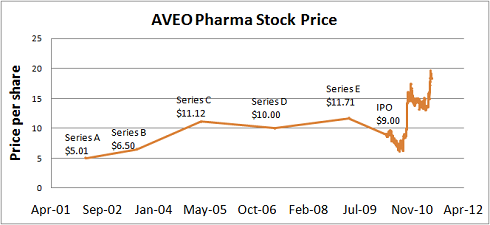
Here’s the chart and table that captures the Series A through E rounds and their split-adjusted price per share according to their S1 last year:

AVEO-Stock-chart.png

The average private investor stock price per share was $8.97 – essentially flat with the IPO offering price and only about 2x to today’s price. For Series A shares, it is close to a 3.7x multiple today – a reasonable win. However, since most investors do their part in subsequent rounds of financing, I’d speculate that for most of the Series A and B round venture investors, they are sitting at 2.5x or so. Better than the 50% of LS deals that lose money, but this is probably not a top quartile deal compared to other LS deals in the 2000s.

Although flat into the IPO, AVEO is now up over 100% and is one of the high fliers of the Class of 2010. So its been a great deal for the IPO buyers. But its been a rollercoaster even as a public company. It dropped down below its 2003 Series B price per share within the first four months of trading, seven years later. The first real jump in the stock occurred in early Oct 2011 when Merck gave back the anti-HGF program unexpectedly after their acquisition of Schering Plough. A great example of some positive serendipity. The stock continued its climb as news of the tivozanib trial results from Phase 2 and the rapid enrollment in Phase 3 occurred.

I hope that for cancer patients and shareholders of AVEO that their star keeps rising with strong clinical data – and that the investors who help provide the risk capital in the early days manage to drive a big return. These long roads have led to good endings before: Myogen was flat for the first eight years or so before skyrocketing in the public markets on good clinical data to an acquisition by Gilead at least 10x above its venture round prices. But unfortunately that’s not the most common outcome.

As an early stage VC, I’d certainly like to believe that a biotech worth more than $680M, built over nearly a decade with great science and strong leadership, should be celebrated as a huge winner. It should be a top decile, 10x+ deal that returns a large chunk of a venture fund. But the reality is that raising $150M+ privately makes it very hard to get to high multiple exits when the public capital markets aren’t there with some irrational exuberance. This model of “raise as much as you can, when you can” worked well in the 1980s and 1990s because the public markets were accommodating. But no longer, even for great companies like AVEO.

The key challenge is the equity capital intensity. The answer is simple: capital efficiency. We need to create winners with a lot less equity capital.

Trying to figure out the new models that address this issue is both the opportunity and challenge of early stage venture investing today. We’re experimenting with lots of approaches (asset-centric models, virtual companies, project-financings, leaner platforms), but only time will tell.

What is clear is that finding deals that actually fit the “Great Science, Great Company, Great Investment” triad is very tough to do.

Bruce Booth

Academic-Pharma Deals: A threat or opportunity for VC?

Academic-industry partnerships are popping up all over the place these days to fund early stage programs as part of ‘“open innovation” initiatives and “external sourcing” of new pipeline projects. Here’s a non-exhaustive list of a few such deals this year alone:

  • Sanofi announced a deal with the Bio-X program to fund five programs a year at Stanford University (April 2011)
  • UCB and Harvard are collaborating on programs in neurology and immunology, and are already funding their first program (Feb 2011)
  • GSK is going direct to a handful of “academic superstars” to fund their translational work (Feb 2011)
  • Gilead and Yale announced a four-year, $40M partnership to work together on a set of cancer programs (Mar 2011)
  • Bayer has now inked a “10-year master R&D agreement” with UCSF (Jan 2011)
  • Even regional pharma is in the mix: Italy-based Zambon is funding a lab at UCSF to do drug delivery work (Feb 2011)

Late last year, several big ones were anounced: Pfizer-UCSF announced an $85M deal over 5 years, Sanofi-Harvard will be working on multiple programs, Pfizer-Wash Univ will collaborate on indications discovery, and the Sanford-Burham Institute tied up with both J&J and Takeda in Alzheimer’s and obesity, respectively. And there are probably others I missed.

The big question I always get about these: are these a threat to the early stage venture capital model?

Perhaps I’m biased to say this, but I don’t think they are at all. Here are a few reasons:

1. Early stage VC isn’t about market share. No one will ever “buy up” all the exciting early stage concepts coming out of top tier academic labs. The NIH funds some $50B worth of research alone, most of which gets done in academia. There’s an enormous amount of exciting substrate for startup formation. Most of these deals don’t even scratch the surface on the supply side: let’s take the Sanofi deal announced with Stanford earlier this week that “supports, organizes, and facilitates interdisciplinary, collaborative and innovative research projects in the early phases of development”. That sounds significant, and is. But importantly, its not a monopoly on access to the Bio-X program or Stanford. Its only five programs per year, while Stanford’s Bio-X program has 450 affiliated faculty from 50 departments and its Interdisciplinary Initiatives Program seed program has funded 113 projects involving hundreds of faculty. So put in context, hard to see this as fundamentally restricting access away from novel discoveries.

2. More industrial engagement in academia will help build a translational mindset. The beneficial presence of having seasoned Pharma R&D managers engaging with academics in these alliances will undoubtedly help foster an appreciation for challenges of drug development, the key questions to be asking beyond the “Science or Nature” paper questions, the importance of general reproducibility, what a lead optimization campaign really looks like, the attributes of a development candidate, etc… This sharing of knowledge can only be helpful.

3. There’s an academic funding gap and its great to see Pharma stepping in to fill it. In addition to providing valuable support to specific labs and programs, these Pharma alliances support the academic institution via overheads – which support core translational facilities at academic institutions that are of benefit to the whole ecosystem. Many top tier academics have Indirect Cost Reimbursement rates north of 60%; not sure how Pharma negotiated, but I’d be surprised if universities didn’t extract their pound of flesh here. Academic funding is only likely to be tighter over time with the budget challenges on the US government: will the 80% grant failure rate for federal research funding move to 95+%? If so, it’ll be great to have “Daddy” Pfizer-Warbucks and his Uncles around to help support these labs.

4. There’s also an early stage venture funding gap. With less and less venture firms playing in the early stage biomedical arena, its good to see Pharma helping to move promising projects forward, both for society and for future opportunities. I’m sure many of these won’t be licensed in by their funding partner for a variety of non-program reasons (e.g., strategic portfolio rationalizations, shifting therapeutic area priorities), and VCs in the future will be able to jump in and fund them. How many programs did J&J or Pfizer ever get from their Scripps collaborations in the 1990s?

Several comments from the protagonists of these deals make it seem like it’s attempting to replace or offer an alternative to venture investing.

GSK’s Patrick Vallance says GSK’s approach with academic superstars will “provide an alternative to the often arduous task of developing a drug via a biotech spin-out. Biotech entrepreneurs spend much of their time raising funding for their research, but this has become increasingly difficult in the last few years.” It may be true that its tough to raise money for startups today and this could be a good alternative, but ceding downstream rights to GSK in exchange for funding might not solve all their problems. Many of the pharma incubators in recent years have attempted to do this but have largely strugggled.

– Some of the lessons from early stage VC are being used here. As Pfizer’s Anthony Coyle says ”It’s almost like VC-based funding… ” where the deals have small upfronts and “and then projects are funded as they are successful. If there’s no success or a project didn’t meet the appropriate milestone, then there’s no additional funding.” Couldn’t agree more with Tony that milestone-driven funding is a good thing.

Lastly, its worth noting that once an academic project from one of these collaborations enters a Big Pharma R&D organization, it will be one of literally hundreds of projects in the pipeline. Will academics be able to influence and shape those projects the same way they can in biotech? Will these newly minted programs get the mindshare of seasoned, creative R&D managers to push them forward? Will those programs succeed against the tyranny of big bureaucracy better than others? I’m sure in some cases the answers will be positive on these questions, but academic labs should certainly consider them when they strike these deals.

At the end of the day, I think there’s a (mostly) healthy vetting process conducted by early stage VCs in evaluating, co-creating, funding, and helping govern new startups out of academic labs. When done well, Pharma benefits from this, as does academia. I don’t see these broader partnerships as threatening or significantly reshaping this important role of VC and their startups in the process of translating discoveries into clinical innovations.

Bruce Booth

Academic bias and biotech failures

I just met with an entrepreneur who was the founding CEO of a company created around an academic lab’s discoveries. It was fascinating new approach to drugging hot receptor targets. To protect the innocent I won’t mention the names, but Atlas Venture looked at in back in 2008 and, although intriguing, we ended up passing on the deal. Thankfully, because we missed a bullet – it recently was shut down.

The reason: the foundational academic science was not reproducible outside the founder’s lab.

The company spent $5M or so trying to validate a platform that didn’t exist. When they tried to directly repeat the academic founder’s data, it never worked. Upon re-examination of the lab notebooks, it was clear the founder’s lab had at the very least massaged the data and shaped it to fit their hypothesis. Essentially, they systematically ignored every piece of negative data.

Sadly this “failure to repeat” happens more often than we’d like to believe. It has happened to us at Atlas several times in the past decade.

The unspoken rule is that at least 50% of the studies published even in top tier academic journals – Science, Nature, Cell, PNAS, etc… – can’t be repeated with the same conclusions by an industrial lab. In particular, key animal models often don’t reproduce. This 50% failure rate isn’t a data free assertion: it’s backed up by dozens of experienced R&D professionals who’ve participated in the (re)testing of academic findings. This is a huge problem for translational research and one that won’t go away until we address it head on.

Reality is we live in a tournament model world of academic research: winners get the spoils, losers get nothing. Publish or peril.  Grants are really competitive, and careers are on the line. Only positive findings are typically published, not negative ones.  This pressure creates a huge conflict of interest for academics, and a strong bias to write papers that support the hypotheses included in grant applications and prior publications.  To think there is only objectivity in academic research, and pervasive bias in industry research, is complete nonsense.

But what about academic bias?  Or the lack of repeatability of academic findings? I couldn’t find a single paper in PubMed over the past few years.

So what can drive the failure to independently validate the majority of peer-reviewed

published academic findings?I’m sure there are cases where it’s truly fabrication or falsification of data, but as an optimist I believe that must be a tiny percentage: most of the time I think its just the influence of bias.  A few possible hypotheses exist for how this bias could manifest itself:

1. Academic investigator’s directly or indirectly pressured their labs to publish sensational “best of all experimental” results rather than the average or typical study;
2. The “special sauce” of the author’s lab – how the experiment was done, what serum was used, what specific cells were played with, etc.. – led to a local optimum of activity in the paper that can’t be replicated elsewhere and isn’t broadly applicable; or,

3. Systemically ignoring contradictory data in order to support the lab’s hypothesis, often leading to discounting conflicting findings as technical or reagent failures.

Importantly, how are venture capitalists who invest in biotech supposed to engage on cool new data when the repeatability is so low? Frankly, most VCs don’t do early stage investing these days, and this resistance to fund early academic spin-outs is in part due to the insidious impact of the sector’s high failure rate with academic reproducibility (a.k.a. ‘bias’). But for those of us who remain committed to early stage investing, I’d suggest there are at least two key takeaways for VCs:

  • Findings from a single academic lab are suspect. If other labs haven’t validated it in peer reviewed literature, it’s very high risk. It’s probably bleeding edge rather than cutting edge. If it’s only a single lab, it’s likely only a single post-doc or grad student who’ve actually done the work. Given the idiosyncrasies of lab practices, that’s a concentrated risk profile. Wait for more labs to repeat the work, or conduct a full lab notebook audit.
  • Repeating the findings in an independent lab should be gating before investing. Don’t dive in with a Series A financing prior to externally validating the data with some real “wet diligence”. Sign an option agreement with an MTA, repeat the study in a contract research lab or totally independent academic lab.

These two conclusions should help reduce the “reproducibility problem” for startups.

There are other implications of this problem, more than I can discuss here. But one is around the role of tech transfer offices. Although many TTOs are keen to start “seed funds” to spin-out new companies, this seems like a waste to me. I’d argue that the best use of these academic “seed” funds would be to validate the findings of an investigator’s work in a reputable contract research lab that industrial partners and VCs would trust. If a TTO could show 3rd party data supporting a lab’s striking findings, the prospects for funding would increase significantly. This is the type of de-risking that TTOs should focus on.

The bottom line is we need to confront the issue and figure out how to reduce academic bias and improve the external validation of published findings – this will undoubtedly reduce the failure rate of new biotechs and bring more capital back into the early stage arena.

Bruce Booth

Fighting gravity: venture-backed biotech returns

I thought I’d tackle the question of what are the actual return distributions of venture capital investments in biotech startups (e.g., how many losers, how many winners) to set some context.

As a community, we’re full of faith-based believers in the biotech startup world – we all always believe the next one we start or invest in is going to be the big win. Along with that optimism, there’s a ton of mythology out there about which venture-backed biotech deals drove 20x returns, mostly nostalgic for the 1980-1990s. “Raise as much as you can, when you can” and other untrue axioms became dogma during those days. Lots of snippets of anecdotal evidence and hand-waving don’t overcome the reality though.

Gary Pisano at Harvard has written a good deal on overall public biotech returns and the sector’s underperformance, in part due to the certainty of scientific uncertainty. But on the private biotech side, we’re all so protective of specific deal returns and often bound by confidentiality, very little actually gets public. I’ve not seen a good piece of literature on venture-backed biotech distributions so I’ve done a quick-n-dirty analysis and compiled it with some Cambridge Associates data that Pete Mooradian helped provide me with.

To get to a credible dataset, I looked at 270+ biotechs formed between 1996-2003 and the amount they raised, and then made some simplifying assumptions to get to guesstimate multiples on invested capital (ignored liquidation preferences, step-ups or down-rounds, common holdings). It’s by no means a comprehensive review. But what reassures me is that it’s in the ballpark and nearly perfectly traces Cambridge Associates data. They tracked over 1600 individual biotechs from the year of first investment and the returns. As you can see below, the curves almost totally overlap.

image 1.PNG

Some conclusions:

■As if we needed to be reminded of this, roughly half of venture-backed biotech’s lose money. The total losses for the recent cohort are over-estimated as I didn’t have the detailed data on salvage values, but both sets of data have about 50% with a loss of capital.

■Real winners above 5x make up about 12-15% of biotech deals. So roughly 1 out of 6-8 deals. Not a bad hit rate.

■The failure rate hasn’t changed much. See the chart below. While the post-bubble 2000′s have had slightly higher failure rate, the 1990s were nearly as bad. The curve for the recent vintage is slightly up-shifted but not sure how statistically relevant that is. [What has probably changed, and I don’t have the data here, is that the winners in the 1990s were more likely to be above 10x invested capital, whereas today that’s a far less common experience. We’re trying to change that, but the numbers are what they are.]

image 2.PNG

An obvious question then arises – what are the characteristics of the outlier returns in the top two deciles? The biggest driver I can tell is the inverse correlation between capital intensity and returns. If you can achieve a successful exit and still spend less equity capital, you’re likely to generate a much better return. Seems intuitive to some degree, but only if you assume that the exit values are largely capped. Reality in biotech is most “successful” exits are in the $200-500M range, despite the occasional outlier like the recent Plexxikon deal. Raising $150M+ in equity capital to get there isn’t so interesting. Raising $15-30M on the other hand…. But this cap on returns with capital intensity isn’t always the rule on the Tech side of the venture business. It is for some (like capital equipment plays, semi’s, etc..), but many number of their business models can just keep scaling. Facebook and Groupon have all raised a ton, but are worth gazillions more than that now. Biotech just isn’t scalable over the same time horizons as Info Tech. I won’t belabor the topic here, or go through the analytics, but if you’re interested it’s a prior article in Nature Biotech.

I think there are a few implications for early stage biotech investment strategies:

1.Be conscious of gravity. Within the existing set of business models, failure rates have been a relative constant like gravity, given the reasonably unchanged 20 year hit rate. Investors should assume half their biotech deals will fail, and 15% are real hits; and entrepreneurs should at least know the odds. Channeling more capital to the 15% and less to the 50% is a key to success.

2.We’ve got to do something radically different to change the model. Everyone says biotech takes a lot of money because its “regulated drug development” etc… We need to figure out how to do it differently, while improving the odds that winners emerge with more limited capital. We’re experimenting with ultra-virtual models, tighter links with pharma, deeper academic links, new corporate structures, etc… (Lots of good substrate for blog posts in the future).

3.Improve the existing models. If #2 doesn’t work and we’ve got to keep building bricks-and-mortar biotech companies, we need to figure out how to live with the gravity of #1 by spending less equity capital to get to the “no-go” decision and shut down unsuccessful deals. Use other sources of capital like partnering dollars. Kill the losers fast, as often as required, and hopefully cheaply. And try to preserve a large piece of your winners so you can invest more in them.

In some ways, successful early stage biotech venture investing today is all about balancing a portfolio between smarter approaches to the realities of gravity and an appreciation of new potentially ‘zero gravity’ virtual worlds.

Hence the subtitle of my blog. A biotech optimist fighting gravity.

Reposted with permission from the LifeSciVC blog.

Bruce Booth