For June, we’ve got Ireland, UK, Australia and friends giving us their biotech news. (Click to enlarge.)
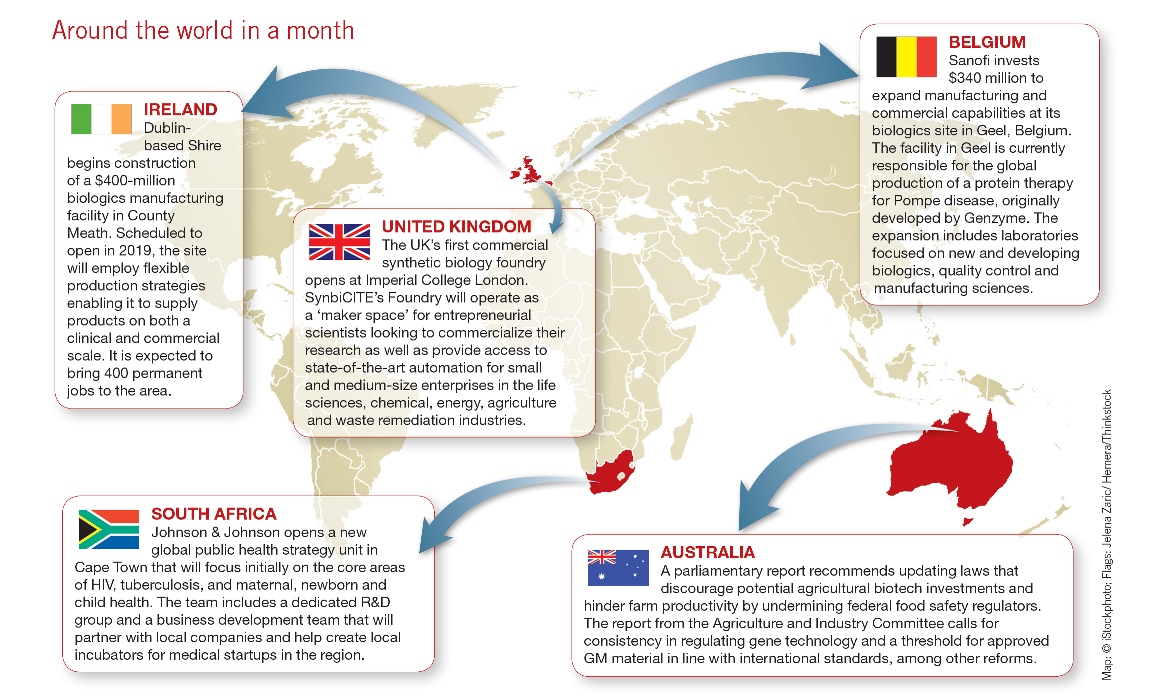

For June, we’ve got Ireland, UK, Australia and friends giving us their biotech news. (Click to enlarge.)
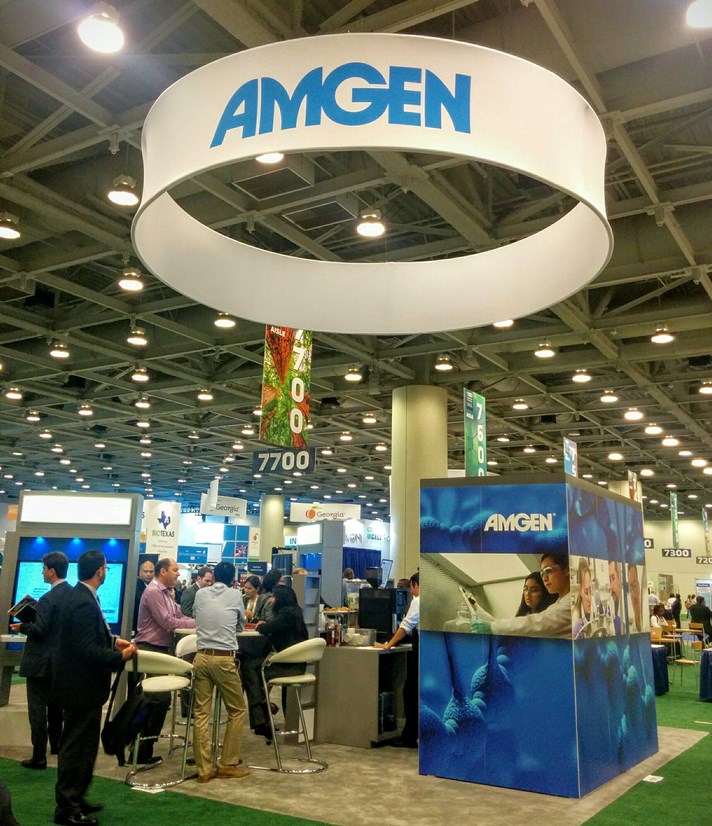
Amgen’s pavilion at BIO 2016. The company has been involved in several cases involving biosimilars of its blockbuster drugs.
The first day of BIO 2016’s Intellectual Property track featured three sessions that eventually dovetailed into what’s increasingly becoming a thorn in the side of drugmakers: the challenging of drug and biologics patents on multiple fronts and, in theory, without end. In addition to regular patent litigation under the Hatch-Waxman Act, the Patent Trial and Appeal Board (PTAB) formed in late 2012 as part of the America Invents Act gave rise to inter-partes reviews (IPRs) seeking to invalidate patent claims and entire patents. In just over three years, the number of IPRs have increased to the point that the process has come to be seen as a road block for patents. By all accounts, instituting IPR proceedings is good practice: in the first 18 months, PTAB invalidated 16 of the 19 patents it reviewed. Since then the percentage has decreased, though the number of proceedings continues to rise. Patent challengers have included competitor drug companies (most often generics manufacturers) and non-practicing entities (a.k.a. patent trolls) focused on either extracting settlements or shorting stock.
The Biologics Price Competition and Innovation Act (BPCIA) of 2009 defines a process for resolving patent disputes before the launch of a biosimilar product by an exchange of information including a list of patents that may be infringed and responses by the parties – termed the “patent dance.” How patent litigation under Hatch-Waxman and administrative IPR proceedings before the PTAB are affecting the patent dance is currently the question for drugmakers, as we all navigate the uncharted waters of these relatively new processes.
Source: The Center for Bioethics and Human Dignity
In a week when two state legislatures passed bills requiring drug companies to justify drug prices, a panel at the BIO convention Monday on the ethics of drug discovery drew perhaps 50 people – a stark contrast to the standing-room only sessions in which biotech company execs presented boilerplate PowerPoint presentations.
The rest of the attendees missed a timely discussion of the complex issues facing biotech, including how to price drugs so the interests of both companies and the patient population are best served, and what a biotech company can do – or should so – about the increasing calls for transparency.
BioCentury’s Washington Editor Steve Usdin has been hosting interactive panels for several years at BIO, structuring them as a mock board-of-directors meeting. These fictional board members debate a series of questions Usdin poses, and the audience weighs in by casting votes via smart phone app.
This year’s panelists brought together a variety of perspectives. J. Leighton Read, a partner at Alloy Ventures, served as CEO. Hank Greely, from Stanford’s Law School; Pamela Gavin, of the National Organization of Rare Disorders; and the FDA’s Richard Moscicki took on the roles of board members of a company called iCures. This pretend company has not one, but two potential leads for serious illnesses with unmet needs – Alzheimer’s and type 2 diabetes. The board debated how to allocate limited resources, how to price the therapy, and whether to in-license a drug and quadruple its price (simply because they could).
The board agreed on a few things, such as securing partnerships to finance their drugs. They debated the wisdom of keeping the price of a drug lower than it might receive in the open market, as a way of insuring greater uptake, which ultimately would bring greater rewards to the company (and would be a good PR play), although they mused over whether there were any good models for determining the kinetics of uptake for maximizing profits.
Yet the issue of transparency scored the highest cohesion – to a person, the board was against supporting legislation that requires it, though not entirely for the same reasons. The arguments included the unfairness of singling out one industry for scrutiny, although one board member pointed out that iPhones and drugs are quite different animals, as not everyone wants or needs an iPhone, but everyone at some time in their life will need healthcare. And there was the argument that the data might not make much sense to the public anyway, given the complexity of developing a drug and bringing it to market. And finally, quite apart from ethical considerations, there was the idea that it is just plain bad policy for the government to get involved with pricing drugs (although we might be the only industrialized nation that doesn’t allow it in some form or another.)
So it’s a pity that more people didn’t attend this panel. In general, it seems the emphasis on ethics has taken a back seat at BIO this year. There was a time when BIO had a robust ethics track, but here in San Francisco the offerings are paltry. Is this because there simply weren’t many submitted, or because BIO’s selection committee did not see fit to choose them? Either way, ethical issues are at the forefront for a public that already views drug makers unfavorably. The BIO convention needs more panels like this, and fewer sessions in which industry folks pat each other on the back for a job well done.
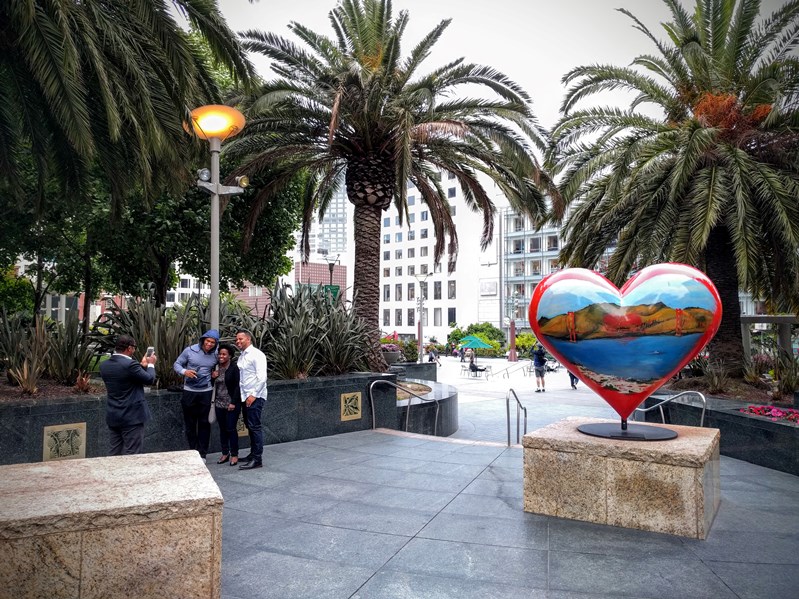
Northwest corner of Union Square, San Francisco.
The annual JP Morgan healthcare conference is held every January in the cramped halls of the Westin St. Francis hotel on the edge of Union Square, here in San Francisco. Because the conference is selective in its attendees anyway, and because the number of registrants is constrained by walls of the Westin, for the duration of the conference a massive overflow of biotech investors, executives and personnel conduct a torrid business in the lobbies and hotel rooms surrounding Union Square. This sideshow has swelled in recent years to even include smaller conferences running concurrently.
So perhaps I was reminded of JP Morgan today simply because the Biotechnology Innovation Organization (BIO) convention is held in the same city this year, with scores of biotech people walking the same sidewalks, show badges swinging from necks like pendulums. And, similar to attending JP Morgan, I began my day with a meeting in a hotel restaurant just up the hill from Union Square, and spent a portion of my afternoon speaking with small phalanx of Thai delegates in a ballroom at the InterContinental hotel.
Ajarin Pattanapanchai, the Deputy Secretary General of Thailand Board of Investment, took me through a pitch for drawing foreign biotech investment to her country. It included the familiar exemptions on foreign income tax for R&D activity/manufacturing of biopharmaceutical agents, as well as permissions to bring along expatriates to the country, and own land in Thailand.
But Thailand offers a few other interesting things. Its location, for instance, places it right between the burgeoning pharmaceutical markets of India and China. It is a top medical tourism destination for everything from cancer treatment to laser eye surgery to “weight loss surgeries,” due to Thailand’s more than 50,000 “well-trained physicians” and more than 1,300 hospitals, according to promotional material.
It is a rising destination for running clinical trials, says Sakarindr Bhumiratana, president of King Mongkut’s University of Technology Thonburi. A trial in Thailand could save a company 30-40%, he says, because of the lower pay nurses and doctors receive in Thailand versus the US, and the currency exchange.
Thailand also has drawbacks it needs to address. First, though Thailand has seen an increase of corporate venture arms, such as ones wielded by the Siam Cement Group and Crown Property Bureau, it still lacks venture capital for company creation – a complaint heard from life science sectors the world over, including those seeking to start biotechs in the US. And while the Thailand Center of Excellence for Life Sciences (TCELS) provides consultations on commercialization, there are no pharma headquarters in Thailand, and the supporting bioeconomy, so crucial to areas like San Francisco and Cambridge, Massachusetts, is missing.
We spent some time discussing entrepreneurism (also on the rise in Thailand), and when I got up to leave, the ballroom was just filling with attendees for a full afternoon of presentations breaking down Thai investment and collaboration opportunities. Thailand also has a pavilion in Moscone (booth 7301 in the West hall), and I suppose I could have gathered all this information there, but it feels like getting the most out of BIO this year means spending time outside the convention center.
That’s Will Smith up there, talking to Dr. Bennett Omalu about the movie “Concussion,” which Will starred in and is based on the life of Dr. Omalu. The trailer tells you enough, but the idea is Dr. Omalu came to America and discovered Chronic Traumatic Encephalopathy (CTE), and when he raised the flag on this disease to the National Football League (NFL), they tried to keep it buried. This is a still-unfolding story in the world of sports. It’s been suggested the movie was “softened” to avoid antagonizing the NFL, and the NFL has pulled funding for studies examining the effects on the brain of repeated head trauma. There is growing evidence that football players, especially at the highest levels where the competition is fastest and the hits hardest (caution: the video makes me queasy), are putting their bodies at severe risk. The list of players with confirmed CTE is quickly growing, yet the NFL is hardly tackling this issue head on, if I may use that analogy here.

And we’re losing
From January last year until November, Brazil had 1.5 million people infected with dengue[1]. This is 176% more than 2014 when the numbers were about 555,400. Mosquito larvae can be found in about 4% of Brazilian homes[1]. Army troops go from house to house eliminating stagnated water, in the hopes of stifling larval growth.
And it’s not working.
Even worse than the annoyance of mosquitoes is that they can spread dengue, chikungunya and Zika viruses. Sixty-three percent[1] of dengue cases occurred in the Southeast of Brazil. Eight hundred and eleven people died of dengue in 2015 – 79% more than in 2014. Seven hundred and thirty-nine cases of microcephaly caused by Zika virus were counted in Brazil in 2015, 487 of those in Pernambuco, in the Northeast[1]. Last November 17,146 people were suspected to have chikungunya, but only 6,726 cases were confirmed[1].
Can the mosquito be controlled? Oxitec has been successful at this through genetic engineering, by introducing two genes into the mosquitos. The genetically modified males do not suck blood but when they breed with the females the offspring never reach adult phase. More than 90% of the mosquitos were suppressed by this GM method in six locations: four in Brazil and two abroad.
If this method works, why is it not being used extensively? The answer is, for bureaucratic reasons. The technology was approved by CTNBio – The National Commission of Biosafety approved the technology to be used commercially, but Oxitec inadvertently asked to register the technology commercially to our regulatory authority, ANVISA. This was the wrong strategy. The Ministry of Agriculture Animal Husbandry and Food Supply (MAPA) should be asked for permission, because the mosquito is not a drug. This technology is a form of biological control.
I emailed this to Maria Emilia Pedroza Jaber, then Vice Ministry of MAPA, but received no answer.
One year later, ANVISA still does not know what to do with the mosquito. ANVISA deals with drugs. The GM mosquito is not a drug, and people do not eat it. The technology is similar to another method in progress with Wolbachia. So the mosquito is shelved and people are dying and getting sick. Today Oxitec can use only the technology experimentally, not on a large scale that could be funded by Intrexon, the company that owns Oxitec. Legally CTNBio approval should be enough but it is not. Bureaucracy is causing deaths.
Luiz Antonio Barreto de Castro
[1] All data from the Ministry of Health, Brazil.