More on the Shelf

In my last post, I wrote about shelf registration filings among small cap biotech companies. I defined a small cap biotech company as one engaged in drug development with a market capitalization of less than $1 billion. Often referred to by their SEC form designation, S-3, shelf registrations are prospectuses that allow companies to issue securities at any time within three years of the date of filing. Data from the past four years, specifically second quarter of 2010 to second quarter 2012, revealed that approximately 1/3 of US small cap biotechs use S-3 shelf registrations. Of those, however, around 80% of shelf-filing companies subsequently employ them, i.e., sell securities and raise additional capital, though the timing and the size of the first financing varies considerably. Thus, a company’s decision to put a shelf in place does indeed foreshadow a likely future financing, usually within six months.

I gathered a lot of extra data in conducting that analysis. Several readers put forth follow-up questions, which I address here. My database includes new shelf filings as recently as the end of Q2 2012, so many of the S-3s under consideration are still active. I should note that in the two months since I last wrote, numerous public companies have raised money by drawing upon securities registered in their S-3s. January 2013 was a particularly robust month for fundraising in the biotech sector. I’ve updated my data to account for the recent financings through January 2013.

@biotechbaumer asked, Would be interested to know how stock trades post S3 filing until the financing event(s) occurs.” 

Similarly, John Dyer of advisory firm Aquilo Partners asked, What’s the normalized stock price reaction (filing + one day, + 5 days) to a shelf filer? and “What is the normalized return of shelf users from filing?”

These are great questions, as they address both the market’s initial reaction to a shelf filing and the ability of an S-3 filing company to raise money at higher prices.

Looking first at short-term price movements, I examined the percentage change in share price one day after the S-3 was filed. For the 268 new S-3 filing made between Q2 2008 and Q2012, the average change was -1.5%, but there was wide range of -24.3% to +34.3%. The majority of 1 day price changes were negative; specifically, ~67% of S-3 filers experienced share price decreases the day following their shelf filing. The full distribution is shown in Figure 1.
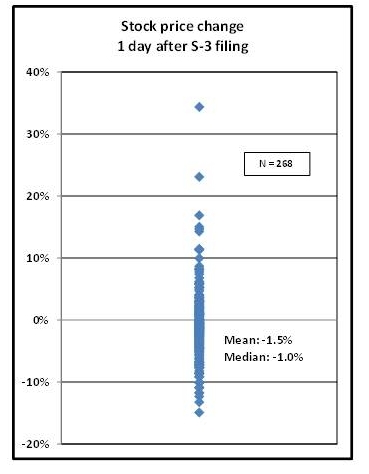
Figure 1

Of course, one day stock movements can be strongly influenced by overall market conditions on the same day. To account for this potential confound, I looked at the concordance between the one day stock movement for the S-3 filer and the one day movement of the NASDAQ Biotech Index (NBI). In the scatter plot blot below (Figure 2), when I plotted the percent change in S-3 filer stock price one day after filing versus percent change of the NBI that  same day. The data are pretty noisy, but I think it’s fair to say that the relationship between the two price movements is weak, which indicates that when the markets are up, the S-3 filer stock price is not necessarily up, as well. Further, if one creates a 2×2 matrix of price movements, it’s clear that even on days when the NBI is up, stock prices of S-3 filers are mostly down. Rarely is the converse true.
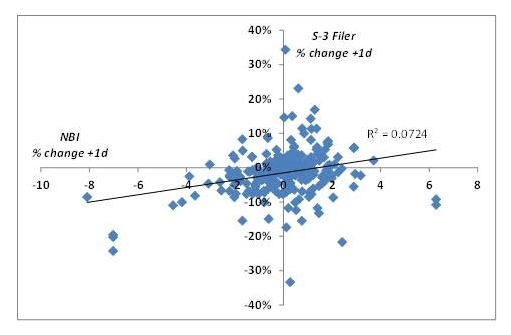
Figure 2

As I wrote previously, S-3s provide a mechanism to sell securities opportunistically. The hope, of course, is that if S-3 filers sell securities, they do so at a higher price to minimize shareholder dilution. How often do companies that finance off the shelf do so at a price above where before the shelf was filed?

Of the 268 S-3 filings, 215 companies subsequently raised money. Slightly less than have half, or 94/215 (~44%), raised subsequent money at share prices higher than the share price at the time of the S-3 filing.  The range in share prices at the first financing varied dramatically, however. As can be seen in the plot in Figure 3, the range was -91.4% to +1,467%, the average change was +13.6%, but the mean was much lower at -8.7%, indicating the effect of positive outliers. Indeed, price decreases are limited to 100%, but share increases are theoretically limitless.
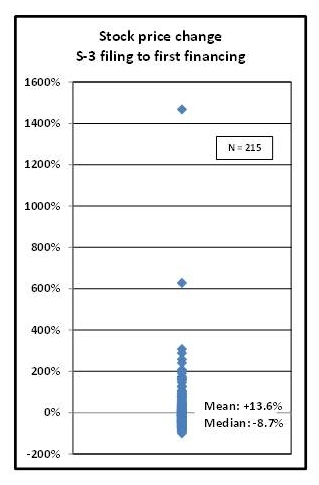
Figure 3


Lastly, @colinmagowan asked, “Did you track lead asset stage and disease, or say # of therapies in clinical trials when S-3 filed?”

I can see where the questioner is coming from; drug development costs vary by therapeutic areas. Thus, companies working in these areas may need to file larger shelves for more money. Further, the capital markets tend to value later stage assets more highly, as they are presumably closer to market. Late stage clinical trials cost more, too, so perhaps shelf filers and shelf size are related to stage of development.

I needed to go back and do some additional work for this question. To avoid the subjectivity of categorizing companies’ therapeutic area, I simply used the classification scheme put forth in each quarterly and yearly roundup issue of BioCentury. I realize that many readers do not have access to this industry publication, but suffice it to say that in these summary issues, the editors of BioCentury sort the majority of public biotech companies by therapeutic focus area. In Figure 4 are the data of S-3 filers, sorted by BioCentury classification, on shelf size and “implied dilution,” or the ratio of shelf size to market cap at filing. There may be hints of differences among companies focused on cardiovascular (CV) and pulmonary (Pulm.) regarding use of S-3s, but the sample sizes (Ns) are somewhat small in those categories. Otherwise, across therapeutic areas, it appears that implied dilution is in the 60-80% range on a shelf size of $50-$75 million dollars. (Recall that I define implied dilution as the ration of shelf size to market cap at the time of filing. The implied dilution is therefore a measure of the dilution that current shareholders would experience if all of the securities in the shelf were issued.)
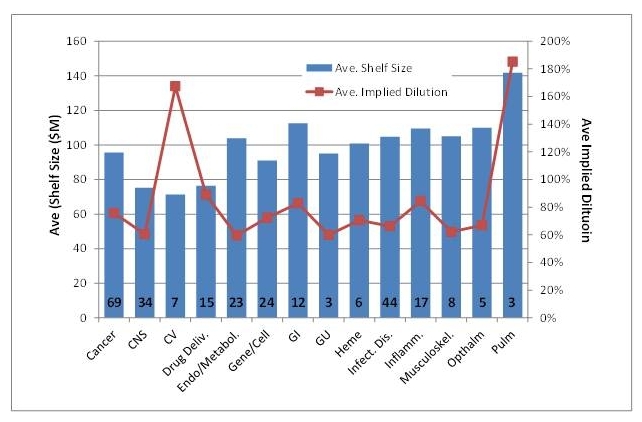
Figure 4

So, putting it all together, I’d say the takeaways are:

  1. The immediate market sentiment to the filing of an S-3 statement tends to be slightly negative, as suggested by 1 day stock movements in the context of broader market movements. That said, the price changes are usually less than 10%, which a long-term investor can generally accept.
  2. Whether the S-3 filing company subsequently raises capital at higher prices is not predictable; roughly half of them do, half of them don’t, with wide variations in between. Clearly, companies thrive or struggle based on their unique prospects. Another reason to do your due diligence.
  3. Therapeutic area doesn’t seem to impact S-3 shelf size. However, this conclusion is based on small Ns in some cases and the categorization of companies by therapeutic area is difficult, as lead programs may change, they might be based on platform technology that is broadly-applicable, etc.


Adam Bristol

Interdisciplinary Research: Solution or Hype?

In the last week of January, I attended the Global Young Scientists Summit 2013, in Singapore. Modeled after the prestigious Lindau Nobel Laureates meeting held annually in Germany, the week-long Summit was organized by the Singapore National Research Foundation (NRF) under the theme of “Advancing Science, Creating Technologies for a Better World.”

About 280 invited post-doctoral fellows and PhDs attended talks, panel discussions and informal master classes. I spoke with Rendong Fang, a Ph.D. candidate in microbiology at KyotoUniversityin Japan, who studies the mechanisms of bacterial infection by Streptococcus pneumoniae. I also spoke to Andreas Braun, a computer scientist working at the Fraunhofer-Institut für Graphische Datenverarbeitung (Fraunhofer IGD) in Germany, who told me that ‘pervasive computing,’ where sensors and actuators are incorporated into the living environment, is the way of the future. Kelvin So, of the University of California, Berkeley, in the United States, told me he is working to use brain waves to remotely control prosthetic devices.

There were also participants from industry at the Summit, including Mingmin Wang, who graduated from Tsinghua University in 2007 and then joined GE Global Research in Shanghai, China, where he is now a lead scientist working on increasing the efficiency of solid oxide fuel cell (SOFC) systems.

The broad range of talent at the meeting was well paired with a discussion topic at one of the plenary sessions. Chaired by Prof. Bertil Andersson, President of the Nanyang Technological University of Singapore, the panel comprised Prof. Sir Anthony Leggett, 2003 Nobel Laureate in Physics; Prof. Hartmut Michel, 1988 Nobel Laureate in Chemistry; and Dr. Sir Richard Roberts, 1993 Nobel Laureate in Physiology or Medicine.

The panelists suggested that the boundaries between scientific disciplines are becoming less distinct, as scientists try to answer complex questions that require expertise from various fields. Andersson said that the borders between physics, biology, chemistry, earth sciences and the like are becoming “a little bit blurred,” and he said that major scientific challenges “probably need more than one expertise.” Michel, a biochemist, noted that he himself is “already interdisciplinary,” and suggested that science needed more mathematicians in biology in order to make use of all the data. And Roberts talked about his journey from childhood passion in mathematics to an undergraduate degree in chemistry, followed by a doctoral thesis in molecular biology and a career in bioinformatics.

It’s been a recent trend to mix disciplines and hope the results will solve some of science’s stickier problems. But is it possible the pendulum has swung too far? Leggett told the audience the term ‘interdisciplinarity’ is often “abused.”

“I don’t myself feel it is a good thing for government committees and so forth to encourage interdisciplinarity for its own sake. Some of these committees – at least in my experience – seem to be under the impression that interdisciplinarity is a sort of sauce, which you can put on otherwise unpromising ingredients, to improve the whole collection,” Prof. Leggett said. “I don’t really think that is right. The problem with that kind of approach is that sometimes people get the impression that simply to attack a problem in biology for the sake of attacking a problem in biology is itself a virtue.”

This raises a lot of questions. Is the term ‘interdisciplinary research’ an administrative label, describing scientific dilettantes without a core? Or should cross-boundary research always involve a team of researchers from various backgrounds? Should granting organizations do a better job of recognizing singular expertise?

And finally, does interdisciplinary research actually produce results?

Juliana M. Chan

The News Net


News Net brings you news you may have missed in the world of bioentrepreneurism. Today, an expert’s thoughts on what makes a successful life science cluster, and two Mid-Atlantic regions stake their claim.


  • Two recent reports highlight the growth of North Carolina’s life science sector—specifically the Raleigh-Durham area. Battelle ranks NC third behind California and Massachusetts, and Jones Lang LaSalle puts Raleigh-Durham area as the fourth largest life sciences cluster in the US based on employment, number of companies and the amount of VC and NIH funding. Read more here.
  • Newark, New Jerseys future biotech cluster has gained another tenant: French CRO Biotrial plans to create an estimated 100 jobs at its new North American headquarters. Biotrial will join other biomedical organizations and five universities in at the University Heights Science Park. More details here.
  • Houston BizBlog asks what the secret is to a successful biotech cluster. Money, surprisingly, isn’t the answer. According to Mass Bio’s Peter Abair, the key is having institutional leaders who can wear multiple hats. “It’s really having that cadre of entrepreneurs who have the experience and … can flow freely among the different sectors of academia and hospitals and private sector.” Read his thoughts.

Israeli Ag Bio

Israeli biotech comes full circle with the recent Rosetta Green success story. Rosetta Green, a company that specializes in identifying unique genes and developing improved plant traits for the agriculture and biofuel industries, has been purchased by Monsanto for $35 million.

It is the first Israeli biotech in the agriculture sector to make headlines in a long time, but it could be the beginning of a new trend. Today more than 90% of Israel’s life science companies, including well-known ones as Teva Pharmaceuticals and Protalix (developer of a new drug for Gaucher’s disease), are all in the biomedical domain, but it wasn’t always like that, and maybe things are changing.

The country’s first biotech startup, Bio-Technology General (BTG), today known as Savient Pharmaceuticals, was founded more than 30 years ago in order to commercialize a bovine growth hormone invented at the Weizmann Institute. It was typical at that time for talented researchers to be focused on agriculture, which then made up more than 75% of the country’s economy.

But BTG soon realized that there were greater opportunities in the human health market, and that its core growth hormone technology could be readily adapted to treat dwarfism and other disorders. As BTG began to develop the first human growth hormone, more and more researchers from Weizmann Institute and other Israeli universities began to work on drug-related topics, including the inventor of the growth hormones, Prof. Haim Aviv, who became a serial entrepreneur and founded several biopharm startups.

So perhaps it is not surprising that Rosetta Green is a spin-off of a parent human genomics company, Rosetta Genomics. Rosetta Green’s location in Israel works to its advantage, as plant genomics is heavily dependent on skills related to algorithms and other mathematical areas in which there is an interface between high-tech and biotech, and Israel has a growing pool of researchers who have acquired these skills in the country’s dynamic high-tech industry.

There is a second success story in the ag field: Evogene. Like Rosetta Green, it was created as a spin-off from a parent drug development company – Compugen, which specializes in bioinformatics. Evogene has a number of collaborative agreements underway with Monsanto and provided its investors with one of the highest returns for a biotech over the past year, as shares rose about 25%. These two companies might be at the forefront of a wave of successful, ag-biotech Israeli firms.

Bernard Dichek

Out of Step

In our current issue of Nature Biotechnology, Randy Osborne presents an overview of some of the most notable drug approvals in 2012 in our annual feature, Fresh from the Biotech Pipeline. Although 2012 was a bumper year for drug approvals, the types of treatment approved suggest commercial developers are insufficiently incentivized to develop products addressing major health needs.

Much has been made in recent weeks of this list of 2012 US drug approvals, and indeed, the topline numbers provide several highs. The FDA registered 37 new drugs last year—the highest number since 1999. Fourteen of these drugs were biologics—the highest number of such drugs ever approved by FDA. And around two thirds of the inventions behind these drugs originated within a biotech company or an academic institution—the highest proportion from outside of big pharma for the past five years.

There were other firsts in the past year: the approval in Europe of UniQure’s Glybera (alipogene tiparvovec) for lipoprotein lipase deficiency—the first gene therapy to be approved in the West; the registration of Protalix/Pfizer’s Elelyso (taliglucerase alfa), the first FDA-approved recombinant therapeutic protein purified from plant cell culture; and several first-in-class mechanism drugs, such as Genentech/Roche’s Erivedge (vismodegib), Vertex’s Kalydeco (ivacaftor), Pfizer’s Xeljans (tofacitinib), NPS Pharmaceuticals’ Gattex (teduglutide), Janssen’s Sirturo (bedaquiline), Human Genome Sciences’ raxibacumab and Aegerion Pharmaceutical’s Juxtapid (lomitapide medylate).

Looking at all this, there is much to be proud of from an industry standpoint. More drugs made it to market last year than any year since 1997. More biotech companies successfully brought their first products to market (41% of approvals in 2012 compared with 37% in 2011). And more cancer drugs (11 out of 37 approvals in 2012) were approved than in the past three years, providing patients with more precious months of survival.

This is a strong indication of success for the industry, but there is another way of looking at these numbers: How many of the product approvals actually address the priorities of our healthcare systems?

A closer look at the approvals reveals an increasing proportion of approvals of orphan drugs (13 in 2012). Indeed, such products account for around one third approvals in each of the past 6 years. The list is: Kalydeco, Cometriq, Gattex, Juxtapid and Elelyso, as well as BTG’s Voraxaze (glucarpidase), Onyx’s Kyprolis (carfilizomib), Pfizer’s Bosulif (bosutinib monohydrate), Ivax’s Synribo (omacetaxine mepesuccinate), Ariad’s Iclusig (ponatinib), Exelixis’ Cometriq (cabozantinib) and Novartis’ Signifor (pasireotide diaspartate).

And the trend is not just to orphan, but to ultra-ophan (mere thousands of patients). In a wry aside, the Drug Baron notes that one drug, raxibacumab, has no patient population whatsoever (unless we have an anthrax outbreak)!

So how do these numbers relate to the major health needs? According to the US Department of Health and Human Services, chronic diseases account for 75% of total outlay of the US healthcare system. These disorders not only include cardiovascular disease, diabetes and obesity, but also increasingly diseases of aging, such as Alzheimer’s and Parkinson’s, as the demographics of populations across the world continue to change. Even a cursory scan of 2012 suggests a paucity of drugs to address these conditions.

There are many reasons why commercial developers are making slow progress in developing drugs to tackle the major chronic diseases. One is that the biology of these conditions is complex, involving numerous molecular pathways and redundancies, with genetic modifiers that remain poorly understood, not to mention numerous environmental, nutritional and lifestyle factors that contribute to disease risk and progression.

Regulatory and financial pressures also conspire to make drug development against complex disease an formidable challenge, at least to any company that does not possess deep pockets and resources. Human trials for complex diseases are becoming cripplingly expensive (in the region of hundred of millions of dollars for cardiovascular disease)—so much so they are now becoming the sole domain of all but a few multinational pharmaceutical companies.

As chronic conditions mean chronic use, regulatory agencies are increasingly placing greater emphasis on proof of safety as well as efficacy. And because there are already drugs on the market for many chronic conditions (albeit effective in only a portion of the entire patient population), the burden of proof required for approval of a new drug sets the bar higher than for many other conditions (especially orphan diseases) where there are no treatments.

With these factors shaping where commercial drug development – particularly innovative drug development – is heading, the concern is that there will continue to be more products for expensive oncology indications and more products for rare disease indications that have lower regulatory challenges. Of course, current incentives for driving development for orphan diseases remain an important priority; the question is whether there are sufficient incentives for treatments for major disease.

For these reasons, governments and regulators should be thinking about incentivizing drugmakers to focus on the extremely difficult indications that account for such a large proportion of the healthcare budget (which will grow in the coming decades). Some of the initiatives in US regulation, such as the new designation of ‘breakthrough therapy’ for accelerating the development and regulatory assessment of drugs for serious diseases that have the potential to offer substantial benefit over existing options, are certainly a step in the right direction. But are they enough?

Certainly, they will not change the landscape of approvals for several years to come. It should be recognized that drug development is a timely endeavor: counting the years back to the initial public disclosure of each approved product, the current crop took 10 years. For the next 10 years, then, it is difficult to see recent incentives playing a big part in changing the nature of future approvals. By that time, the burden on healthcare of chronic disease will look considerably worse than today.

So whichever way one looks at these numbers, it is difficult to see where tomorrow’s innovative treatments for chronic complex diseases are going to come from. The class of 2012 represents 37 small steps in our fight against major common diseases. To address the increasing burden of chronic disease, we need more giant leaps.

New Drug for an Age-Old Disease

At the end of 2012, the US Food & Drug Administration approved Sirturo, also known as bedaquiline as a viable treatment option for patients with drug-resistant strains of tuberculosis.  This was an important announcement for the TB drugs community as the last drug with a new mechanism of action approved for TB was rifampicin in 1963. Innovation in tuberculosis drugs and antibiotics in general, since then, has languished.

Unlike other bacterial infections that can be cleared within a few days/weeks with a short course of antibiotics, tuberculosis requires a lengthy chemotherapy regimen of rifampicin and isoniazid, supplemented with pyrazinamide and ethambutol[1].

Strains of M.tuberculosis bacteria that are resistant to at least one or more of the standard first-line antibiotic treatments are defined as multi-drug resistant TB (MDR-TB). The standard treatment will not cure patients with MDR-TB.   Expensive second line drugs have to be used with lower levels of efficacy, more toxic side effects and a longer treatment regimen.  The MDR-TB treatment regimen extends to two years and on average costs $5000/patient[2].  Drug resistance severely threatens the millennium development goals and infectious disease control of TB as it may return the world to an era where drugs are no longer effective.

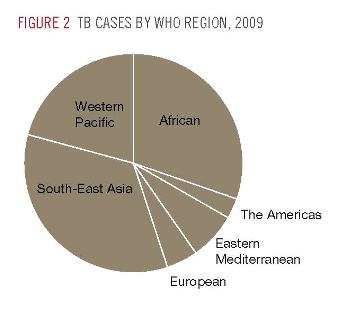
What surprised me on the press releases and news articles announcing the Sirturo approval was the clear admission by Johnson & Johnson that the Sirturo “commercial opportunity is very limited.” As the following diagram shows, TB is predominantly a disease that affects low and middle-income countries. However, there may be other value created for J&J that are not directly tied to top-line Sirturo sales.

{credit}Global Plan to Stop TB{/credit}

In the research & development process for Sirturo, management would have considered additional joint value propositions of a novel TB drug offering. For example, the successful commercialization of Sirturo for J&J can potentially win them a Priority Review Voucher (PRV) from the US Food & Drug Administration.  PRVs are administered by the US FDA and designed to encourage development of new therapeutics for prevention and treatment of tropical diseases including TB.  If a PRV is granted to J&J, it entitles the pharmaceutical firm to speed up the FDA regulatory process on another drug candidate from its portfolio. Economists estimate that the priority review can shorten the review process by 7-12 months.  With the faster time to market and increased sales under patent protection, the voucher can be worth between $50million-$500million USD to J&J.

Second, the downstream delivery and sales of Sirturo to emerging markets can open new distribution channels and relationships in developing countries.  This would potentially allow Janssen Pharmaceuticals, as a subsidiary of J&J to further open its entire product portfolio to new markets.

Sirturo offers hope to the approximately 450,000 MDR-TB patients each year with a new efficacious mechanism of action and shorter regimen.  It is difficult to model how much innovative pull incentives such as the FDA priority review voucher scheme or generation of goodwill impacted the development timeline for this Sirturo, but there is no question that it helps address a public health issue that has for too long only had limited options.


[1] Ma, Z., Lienhardt, C., Mcllleron, H., Nunn, A., & Wang, X. (2010). Global tuberculosis drug development pipeline: the need and the reality. The Lancet, 375(9731), 2100-2109.

[2] Harper, C. (2007). Tuberculosis, a neglected opportunity? Nature Medicine, 13(3), 309-312.