Tomorrow is still one day late!

In the past two decades, India has positioned itself as a major Information Technology (IT) service provider to the world. I would like to share my perspectives as an Indian national, living in Japan for the past 18 years, being a clinician and also involved in stem cell research. I have a stake in a biotech (BT) organization, and I’ve been watching the trend of IT vs BT in India. I would say India has a long way to go in making breakthroughs in BT. People might have thought the boom of IT will be followed by that of BT, but I guess that is wrong.

First, the IT products are for a vast array of day-to-day life activities, starting with maintenance of accounts in a small shop to running inventory in a big business to patient records in a hospital.  These products don’t require stringent approvals. BT, however, is in various avenues, starting with food industry and moving to liquor and medicines. And cell-based products or vaccines need to go through a series of stringent processes of safety and efficacy testing, including clinical trials. Approvals here take time, and therefore failures could also be many. This makes only those who are prepared for long battles be the survivors in the BT field. In IT, a simple idea that simplifies the remote-control operation of a computer or similar household device could be a breakthrough, straight away.

Secondly, the number of middle-level jobs are many in IT, whereas BT needs a few brilliant minds to trigger innovation, which have to be proved as a concept. Even then, an acceptable product comes only after long incubation periods, and that may not create many middle-level jobs. This has made the younger generation of workers prefer IT over BT in India, evidenced by the number of institutes and aspiring graduate students in IT field vs BT.

Thirdly, BT requires several core essentials, such as original technologies in materials, processes and methodologies, which take decades to develop. On these pillars, subsequent product development processes are built. Going by the number of original publications, patents and projects of research that have been accomplished in India, our path to original and successful BT products is obviously longer than the accomplished nations, who have started their ground work several decades ago.

One needs to accept the difference in the fabric of these two fields, which makes them a world apart. To achieve and accomplish in BT, one needs a long-term vision and strategies, rather than short-term goals and expectations. India needs perseverance on carefully planned work protocols, rather than giving up easily when research fails, and it needs professionals driven by passion, rather than pressure. But we should start all this today, as tomorrow is one day late.
Samuel JK Abraham

Who Cares About the IPO Market?

IPOchange.jpg

No doubt you’ve heard that the IPO market for biotech companies has been especially weak the last two years. Few companies went public in 2008 and 2009, and those that did raised less money than expected, at lower prices, and with significant insider participation or other sweeteners. But the IPO environment seems to be thawing, with more companies expected to go public in the coming months, which leads to the question: Is this really such a good thing?

Holding aside the numerous macroeconomic reasons in support of a favorable IPO environment, IPOs in the biotech industry have particularly important place in the financing “cycle of life”. Drug development is long and very expensive, and IPOs (the theory goes) provide significant growth capital to maturing companies in an amount in excess of what venture capitalists (VCs) provide. IPOs also provide an exit point for early investors, granting them liquidity and a reward for the risk they took in funding a nascent private company. Fewer robust IPOs, however, mean VCs see fewer profitable exits, resulting in portfolio companies maintained in portfolios longer , which means less capital for new companies. This generally results in lower returns for VC funds and less money allocated to new VC funds during the next fundraising cycle. So, just like in the wild, take away an important prey (the IPO exit), and the predators (VCs) either starve or adapt to a new niche. This seems to have occurred the last few years, as many investors have favored late stage deals, and done more in medical devices and molecular diagnostics. So, for the biotech industry to thrive, we need a favorable IPO environment, right? Well, yes and no.

Certainly, removing a potential source of capital for companies is bad. But the problem is that the public markets are not well designed for pre-revenue, pure R&D companies, which describes the vast majority of biotech companies. What the public markets do well is value companies with revenues and earnings, because earnings and the present value of future earnings, along with other quantitative metrics, provide a sound basis for assessing company performance and forward prospects. Without earnings, R&D companies are VERY difficult for public markets to price, and all the value must be based on the hope of future earnings, which may never materialize. Thus, the soft bases on which public biotechs are valued results in tremendous pricing discrepancies between competitors with similar profiles and significant volatility in stock prices since perceived value fluctuates with news flow instead of quantitative data on corporate performance.

Maybe the difficult IPO market for biotech companies isn’t broken at all. Maybe it was broken in the past; it wasn’t long ago, 2004-2007, when 20+ biotech companies went public per year. Is that rational market behavior? The Silicon Valley timelines of tech companies, just a few years from inception to IPOs, are possible because those companies are capable of rapid go-to-market strategies to prove their technologies and generate real revenues. But this is incompatible with the long, expensive product development paths in drug development. Today, institutional investors are applying stringent criteria to IPO candidates, by and large backing only very late-stage companies with commercial launches on the horizon or products already on the market. This seems completely rational, and my hope is that it reflects a new chapter in the biotech industry.

Adam Bristol

Brazil Feeds the World

brazil flag1.JPG

Brazil produces almost 150 million tons of grain in 50 million hectares, and it multiplied grain production by four in the last four decades. It can double again that figure without destroying the Amazon or the Cerrado. Here’s how.

This started in 1965, when Brazil established its first law to regulate the commercialization of seeds. When the Brazilian Enterprise for Agricultural Research (EMBRAPA) was created in the mid seventies, Brazil started training plant cell, molecular, and developmental biologists. Then Sectoral Funds were created in the ’90s for areas such as biotechnology and agribusiness. Without those developments, the seed industry would not have flourished in Brazil, and this industry was essential for biotech crops later developed.

When Herbert Boyer expressed an insulin gene in bacteria, I was a freshman PhD student studying plant physiology at UC-Davis, being funded by EMBRAPA. That achievement alerted us that the world was going to change. Genetic engineering was the most important science discovery, after the genetic code itself.

When I returned to Brazil, I was hired by EMBRAPA in 1981 to build agricultural biotechnology at a research center called CENARGEN in Brasilia. It was eventually named the National Research Center for Genetic Resources and Biotechnology. At this point, not one plant had been engineered, and when, in 1985, Brazilian scientists visited Europe to discuss biotech, we had nothing to offer.

Twenty-five years later when we came back to the same institutions, everything had been modified. Now we can express any gene of any organism in plants, and plant molecular biologists team up with plant breeders to create plants for the tropics. When the necessary genes are not available, we settle partnerships with gene companies. Also, EMBRAPA established the Foundation Seed Program, inspired by the US system, and this offers transgenic seeds to companies, big and small. This means that even small companies can compete if the quality of the seed is good.

Scientists in Brazil in the future hope to make grasses that fix nitrogen, so that poor people do not have to buy urea to use as chemical fertilizer, which pollutes the soil and the water. EMBRAPA scientists will release the first green beans engineered to become resistant to the Golden Mosaic Virus, using RNA interference technology.

Few countries made use of the gene revolution, particularly as related to developmental biology, to advance agriculture as we did in Brazil. We verified that genes do not have to be transferred as transgenics require, because genes are common to all species. The strategy is to release genes, such as the anti-fungic dermaseptin peptides found in frogs, to work as anti-fungic peptides in soybeans. This concept is called intragenic by Carlos Bloch, a scientist from EMBRAPA, which today is the largest of its kind, with offices in the five continents.

That’s solid progress, but the question is, why did it take so long to see biotech crops released in Brazil? We had a biosafety law in operation since 1995, but literally lost 10 years disputing the judiciary in Brazil, which took sides and made political decisions against science and scientists.

After 2005 everything changed. A new biosafety law stimulated the combination of tropical genetics and biotech so much that Brazil is second only to the US in biotech crop production. We have few plants entirely engineered in Brazil, but Brazilian corporations take advantage of our breeders’ expertise and release the best crops for all Brazilian biomes. Still, the gene revolution has not resolved a few important things.

We still have not produced plants that can defend themselves against bacteria and fungi. This technology is available in the US and at the Fraunhofer Institute in Germany. Few institutions have reliable genes to generate plants resistant to drought and to soil aluminum toxicity that together affects more than 80% of tropical soils.

There is work to do, but Brazil can make the gene revolution work in the same direction as the green revolution did decades ago, by the hands of Norman Borlaug with more powerful science tools available. 

Luiz Antonio Barreto de Castro

The South African government, biotech and growth

South Africa is a country with so much untapped potential. Critics said South Africa would not be able to host the 2010 Soccer World Cup. After one of the most successful football spectaculars the world has ever seen, Spain left with the cup and the country now boasts formidable infrastructures and has exported vuvuzelas to the rest of the world. This shows that South Africa can deliver if its government and people are completely committed to a cause. The challenge now is to transfer this commitment, energy and enthusiasm to address other priorities of the country, such as poverty, unemployment, food security and the burden of diseases like TB and HIV/AIDS.

In addressing these challenges the government has long realized that part of the solution is using science and technology as the pillar to grow the economy. The South African government knows that science, technology and innovation play a critical role in economic growth and socio-economic development, and it knows that technology innovation is one of the critical policy areas required to speed up growth and transform the economy to one that is knowledge-based.

How best can this policy be implemented? The passing of the white paper on science and technology in 1996 led to the establishment of the Department of Science and Technology (DST), which has the responsibility for driving the national scientific research and innovation policy. The DST started by developing its research and development strategy, which was the foundation for technology innovation in the country. South Africa, like many other countries, also developed an interest in biotechnology and the role that it could play in economic growth. This resulted in development of a National Biotechnology Strategy in 2001. 

The guiding principles of that strategy were to ensure that it addressed the national imperatives and contributed to economic growth. To implement this, six biotechnology entities were established (each with a different mandate) to address government needs and priorities across the economy. These innovation centers are LIFElab, Cape Biotech, BioPAD, PlantBio, National Bioinformatics Network and the Public Understanding of Biotechnology Programme.

Over a four-year period, these initiatives yielded the following: establishment of 78 active biotech companies; development and/or commercialization of 1,542 biotech products/services; generation and leveraged revenues greater than $100 million; creation of 2,051 biotech specific jobs and establishment of 16 technology platforms. These institutions have now been amalgamated into one agency known as the Technology Innovation Agency. 

I am the Senior General Manager-Infrastructure and Planning at the Technology Innovation Agency in South Africa. I lead our portfolio to ensure effective support in technology investments and incubation activities. I’ll have more to say on South African biotech and investment in future posts.

Blessed Okole

The Bioentrepreneur’s Introduction to the Middle East

The Middle East occupies a culturally rich and versatile part of the world. The turbulent history marked by expansion and invasion by many cultures has culminated in enriching and diversifying this region’s population and contributed significantly to genetic heterogeneity (genetic diversity).

Yet the geographic separation of our major population centers, encouraged by the climate and cultural preservation, and influenced by restrictions on travel between those centers, has historically resulted in a high degree of consanguineous marriages. Even today, we witness the highest rates of consanguineous marriages in the Middle East (100 times that of the United States). Such unions account for between 20%-70% of all marriages in the Gulf States alone. Therefore, this ‘natural experiment’ bestows a rich ground for the emergence of a very high number of genetic related diseases (i.e., diabetic, autosomal recessive disorders and others).

This is a personal tragedy, but it does provide fertile fields for genetic-based research opportunities for bioentrepreneurs who can recognize these unique opportunities. Drawn to this opportune and needful population, the researcher and entrepreneur can combine their efforts to discover origins and cures for many diseases having both a regional and world wide impact.

But be warned that this entrepreneurial opportunity is not without its challenges. Just as the population genomics of the Middle East presents unique research and business opportunities, the legal, economic, governmental, and societal environment of the Middle East presents a special and unfamiliar business environment for the bioentrepreneur. I will discuss this in more detail in later posts, but of primary concern is first admitting that one is entering a cultural, economic, and scientific research environment that is unlike any other.

This means that the bioentrepreneur should seek out one who might best serve as a guide through the many potential obstacles to his success. For instance, a buyer’s market approach when selecting research development opportunities may be acceptable in Europe and America, but it is not in the Middle East. Also, while scientist and engineers in the Middle East are capable, motivated and inspired, the research infrastructure is still in a growing and developing state. Finally, while sophisticated research grows rapidly in Middle East research centers, it may initially seem to the Western entrepreneur that breakthrough technological discoveries are relatively sparse.

It’s also true that while the region offers very special resources and business opportunities, the legal, economic, governmental, educational and societal environment of the Middle East also present challenges for the entrepreneur and particularly for the Western entrepreneur making an initial foray into the region. The first thing to understand is that abundant Middle East oil resources have attracted oil-exploration teams, entrepreneurs, and investors and, as a result, the region has thrived on an oil-based economy. These regional oil reserves still remain plentiful, but there is a growing appetite for technological discovery and product development that is rapidly overtaking all aspects of modern Middle East society. The effect is that the Middle East is intent upon converting from an oil-based economy to a technology-based economy. Foremost in this rapidly evolving economy base is the need for biotechnology research, development, and capitalization.

The first order of business is for a bioentrepreneur to align with a guide or facilitator that can identify and then introduce him or her to the Middle East university, medical school, or research center scientist who has a head for scientific research and an entrepreneurial spirit for progress and discovery. First impressions are critical when building any alliance, and particularly when building alliances between entrepreneurs entering a new and different business environment – thus a guide can be invaluable to making that first step toward success here.

Finding a knowledgeable, helpful guide does not have to be difficult. Early in the development of our intellectual property we worked with a patent attorney who unfortunately did not serve our interest as well as we expected. Fortunately we found a new attorney who put our IP program back on track but who also was very well connected throughout the Middle East. Today, the bioentrepreneur doesn’t have to rely simply on good fortune to find a helpful guide and facilitator into the Middle East. We are familiar with an academic research information exchange website that facilitates making connections for universities and businesses from around the world: the Global Academic Innovation Network, through which reliable patent attorneys with experience in developing collaborative relationships in the Middle East can be easily located.

In my next post I will discuss some of the universities, science parks, and other research centers in the Middle East, what they have achieved, challenges they face, and what innovative research they are currently focused upon that may be of interest to the bioentrepreneur.

Fahd Al-Mulla

Protecting the Fortress

We’ve just published a new article on the Bioentrepreneur website, this one actually a reported piece.  We’d been considering an article on the security measures needed for biotechs, in particular startups, for a while now, and after meeting Hamilton Mixon at BIO last year I thought we had a good base for the article.

He was integral in putting the piece together, with the contributions of a couple other security types from drug development rounding it out. It’s a topic we’ve never covered before, and you can read it here. It will stay as the featured article on the Bioentrepreneur portal until next month, when it will slide into the site’s archives.  It will also appear in the May issue of Nature Biotechnology.

Brady Huggett

Fighting gravity: venture-backed biotech returns

I thought I’d tackle the question of what are the actual return distributions of venture capital investments in biotech startups (e.g., how many losers, how many winners) to set some context.

As a community, we’re full of faith-based believers in the biotech startup world – we all always believe the next one we start or invest in is going to be the big win. Along with that optimism, there’s a ton of mythology out there about which venture-backed biotech deals drove 20x returns, mostly nostalgic for the 1980-1990s. “Raise as much as you can, when you can” and other untrue axioms became dogma during those days. Lots of snippets of anecdotal evidence and hand-waving don’t overcome the reality though.

Gary Pisano at Harvard has written a good deal on overall public biotech returns and the sector’s underperformance, in part due to the certainty of scientific uncertainty. But on the private biotech side, we’re all so protective of specific deal returns and often bound by confidentiality, very little actually gets public. I’ve not seen a good piece of literature on venture-backed biotech distributions so I’ve done a quick-n-dirty analysis and compiled it with some Cambridge Associates data that Pete Mooradian helped provide me with.

To get to a credible dataset, I looked at 270+ biotechs formed between 1996-2003 and the amount they raised, and then made some simplifying assumptions to get to guesstimate multiples on invested capital (ignored liquidation preferences, step-ups or down-rounds, common holdings). It’s by no means a comprehensive review. But what reassures me is that it’s in the ballpark and nearly perfectly traces Cambridge Associates data. They tracked over 1600 individual biotechs from the year of first investment and the returns. As you can see below, the curves almost totally overlap.

image 1.PNG

Some conclusions:

■As if we needed to be reminded of this, roughly half of venture-backed biotech’s lose money. The total losses for the recent cohort are over-estimated as I didn’t have the detailed data on salvage values, but both sets of data have about 50% with a loss of capital.

■Real winners above 5x make up about 12-15% of biotech deals. So roughly 1 out of 6-8 deals. Not a bad hit rate.

■The failure rate hasn’t changed much. See the chart below. While the post-bubble 2000′s have had slightly higher failure rate, the 1990s were nearly as bad. The curve for the recent vintage is slightly up-shifted but not sure how statistically relevant that is. [What has probably changed, and I don’t have the data here, is that the winners in the 1990s were more likely to be above 10x invested capital, whereas today that’s a far less common experience. We’re trying to change that, but the numbers are what they are.]

image 2.PNG

An obvious question then arises – what are the characteristics of the outlier returns in the top two deciles? The biggest driver I can tell is the inverse correlation between capital intensity and returns. If you can achieve a successful exit and still spend less equity capital, you’re likely to generate a much better return. Seems intuitive to some degree, but only if you assume that the exit values are largely capped. Reality in biotech is most “successful” exits are in the $200-500M range, despite the occasional outlier like the recent Plexxikon deal. Raising $150M+ in equity capital to get there isn’t so interesting. Raising $15-30M on the other hand…. But this cap on returns with capital intensity isn’t always the rule on the Tech side of the venture business. It is for some (like capital equipment plays, semi’s, etc..), but many number of their business models can just keep scaling. Facebook and Groupon have all raised a ton, but are worth gazillions more than that now. Biotech just isn’t scalable over the same time horizons as Info Tech. I won’t belabor the topic here, or go through the analytics, but if you’re interested it’s a prior article in Nature Biotech.

I think there are a few implications for early stage biotech investment strategies:

1.Be conscious of gravity. Within the existing set of business models, failure rates have been a relative constant like gravity, given the reasonably unchanged 20 year hit rate. Investors should assume half their biotech deals will fail, and 15% are real hits; and entrepreneurs should at least know the odds. Channeling more capital to the 15% and less to the 50% is a key to success.

2.We’ve got to do something radically different to change the model. Everyone says biotech takes a lot of money because its “regulated drug development” etc… We need to figure out how to do it differently, while improving the odds that winners emerge with more limited capital. We’re experimenting with ultra-virtual models, tighter links with pharma, deeper academic links, new corporate structures, etc… (Lots of good substrate for blog posts in the future).

3.Improve the existing models. If #2 doesn’t work and we’ve got to keep building bricks-and-mortar biotech companies, we need to figure out how to live with the gravity of #1 by spending less equity capital to get to the “no-go” decision and shut down unsuccessful deals. Use other sources of capital like partnering dollars. Kill the losers fast, as often as required, and hopefully cheaply. And try to preserve a large piece of your winners so you can invest more in them.

In some ways, successful early stage biotech venture investing today is all about balancing a portfolio between smarter approaches to the realities of gravity and an appreciation of new potentially ‘zero gravity’ virtual worlds.

Hence the subtitle of my blog. A biotech optimist fighting gravity.

Reposted with permission from the LifeSciVC blog.

Bruce Booth

The Strategy of Biotech

blindelephant

How do small biotech firms “do” strategy, and how can they “do it better”?

In a nutshell this was essentially the topic of my doctoral thesis. I am a scientist-turned-bioentrepreneur and am passionately interested in the process of turning science projects into successful products and businesses. Why? Because I find the science of biotechnology fascinating, and I am excited about the promise it holds for improving the lives of individuals and populations if it can be turned from an idea into a product. And I also believe that those who take the risk and invest in these promises should be rewarded.

The biotech sector has struggled to provide attractive returns, with high rates of company failure and tens of billions of dollars of accumulated losses. The reasons for this are not clear. It may be that biotech science is not financially viable – high regulatory costs and long timelines of getting biotech products to market often overwhelm the financial returns. It may be that the timelines and risk appetite of investors are at odds with the needs of biotech firms. Or it could be that biotech firms need better business strategies to overcome these challenges.

The last suggestion is the perspective I take. When I embarked on my doctoral research, I wanted to find answers to how we can improve the process of taking an innovation, adding knowledge, reducing risk and turning it into a form that can earn a return for the owners of the innovation. Discussions about strategy in the academic literature

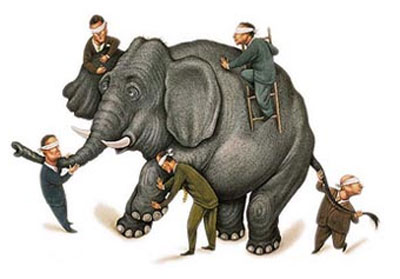
reminded me of the famous Indian legend and poem about the nine blind men and

the elephant.  Similarly many practitioners in the biotech sector seemed

to have a partial understanding of strategy based on their individual

experiences.

Earning a return on investment in biotech need not involve taking an innovation all the way through the development process to a physical product or delivered service. Often financial returns can be earned at earlier points in the value chain – for example a patent (an idea with intellectual property protection) may be licensed, or a drug that is still in clinical development may be licensed or sold, thereby earning a financial return for its owners.

Over a series of blog posts I am going to talk about how biotech firms “do” strategy – how the strategic issues that firms face shape their choice of business model, the strategic decisions and trade-offs that firms make and the implications of those choices.

Then over a further few posts I am going to suggest ways in which biotech firms can “do it better.” I’ll talk about organisational practices that support better investment strategy – the strategy that underpins getting a return to investors. I hope you’ll add your thoughts and comments as we go along, because the one thing that became obvious in my research was that no single biotech entrepreneur has all the answers. The answers are held across the community of entrepreneurs, and they have often been learned the hard way.

Upcoming posts will cover:

• The basics – defining investment strategy, business model and value chain

• The market for ideas vs product markets

• Common business models in the biotech sector (e.g. RIPCO, FIPCO, NRDO, FIPNET, VIPCO)

• How and why common business models are associated with certain types of technological innovation

• Strategic issues facing biotech start-ups and how biotech firms tend to do commercialisation strategy in this context

• Key strategic choices – what, when and how to commercialise

• What to commercialise – trade-offs and implications

• When to commercialise – trade-offs and implications

• How to commercialise – transaction mechanisms

• Organisational processes for improving investment strategy

• Amplifying value and reducing risk

Then we’ll see where we get to from there!

Janette Dixon

Looking for China money for your biotech venture?

<!—[if gte mso 9]>

Normal

0

false

false

false

MicrosoftInternetExplorer4

<![endif]—><!—[if gte mso 9]>

<![endif]—><!—[if !mso]>

<![endif]—><!—[if gte mso 10]>

<![endif]—>

While vacationing in the US during the Chinese New Year

early February, I attended a Bay Area event organized for VCs (venture

capitalists) and medical device entrepreneurs. I was a bit surprised by the

sentiment voiced by the panelists and the audience that “there is plenty of

venture money available in China”

and “given the tough funding environment in the US,

companies should look to China

for alternative sources of venture money”. “Aren’t the roads there paved with

gold?” a Chief Medical Officer for a Bay Area biotech startup jokingly asked

me. As an active healthcare VC in China in the past few years, I know

this view is far from accurate.

It is not hard to understand why investors and entrepreneurs

might view China

as a bountiful source of financing. At the end of 2010, China held over

$2.8 trillion of forex reserves. The Chinese government has played white knight

in an effort to help stabilize the Euro zone economy, by buying

euro-denominated Portuguese and Spanish debt. These facts have been widely

reported in the US press,

and I’m sure that US biotech entrepreneurs have also heard about the

hyper-active PE (private equity) and VC industries in China.

There is no comprehensive list of all the PE and VC funds with

a focus on China

who are actively investing. However, there are probably over a thousand of

these funds, and it is quite possible that more than half of them probably

raised fresh money over just the past two years. Statistics from ChinaVenture

suggest that such funds raised more than $12.3 billion in 2009, and over $30

billion in 2010 alone.

Moreover, the Chinese government’s 11th and 12th

five-year development plan spanning from 2006-2015 places a high priority on

biotech. As a result, dedicated central government funds have been allotted to

incentivize new drug development, and dozens of biotech parks have sprouted

around major cities to support biotech companies.

So is China

a good place for your biotech startup to look for money? Think again!

Over the past two years, I have come across a fair number of

entrepreneurs from North America and Europe,

with deals ranging from pre-clinical or phase I/II therapeutics to

prototype-stage medical devices. Many of these entrepreneurs had included some

sort of China-related story in their business plan. But most of them have

ultimately not been able to implement the Chinese dimension of their plan, even

after half a dozen trips to China

and many meetings with local investors and bio-parks. As a consequence, they

have left the country empty-handed — though after a series of eye-opening

experiences, and probably a sense of repletion after several elaborate banquets.

So the people I met at the Bay Area event are not so very

different from many bio-entrepreneurs who came to China with high hopes but major

misconceptions. Many of them appear to believe that: 1) there is plenty of VC

money available around China

for biotech startups; and 2) startups can get free funding from the government

and local bio-parks.

Unfortunately, I can tell you that if you are a starving

early stage biotech startup, chances are slim for you to get funded in China.

In next blog post, I’ll be explaining why.

(Karen Liu is a healthcare investor at a leading China based PE

and VC fund. The views and opinions expressed here are entirely personal and may

not represent those of her firm.)

<!—[if gte mso 9]>

Normal

0

false

false

false

MicrosoftInternetExplorer4

<![endif]—><!—[if gte mso 9]>

<![endif]—><!—[if !mso]>

<![endif]—><!—[if gte mso 10]>

<![endif]—>

Karen Liu

Technology Transfer in India

It has long been held that economic growth of a nation is closely dependent on its openness to generation and transfer of knowledge, which cannot be kept within the confines of an arbitrarily drawn national boundary. Thus protectionist policies that are often adopted to safeguard the interest of domestic players of a nation become an impediment to its growth and development potential.

India inherited a poorly defined and monopolistic domestic sector from its colonial past. However, Indian industry has been growing steadily since liberalization from its normal interactions with probable tech donors. It now has policies like automatic approval to all industries for foreign collaborations, so long as there is a decent lump sum payment (although there are regulatory ceilings on royalty payments). The result has been a blossoming of a few primarily Indian biopharmaceutical groups into multinational enterprises. Also, India has seen that projects with international collaborations have recorded minimal economic dispersion. This has enhanced the confidence of India, a nation that already has conspicuous human resources primed for research and development activity.

Still, India has not reached anywhere close to the biotech global top spots, despite its solid positioning in the low technology sectors, such as agriculture and dairy. Clearly something has gone amiss in this whole process. Either Indian corporations do not see a good market for hi-tech products, or there is no indigenous generation of high technology, or international groups offer only last-generation technology for collaborations. It must be said, however, that Indian research laboratories are close to global current trends on conceptual and technical terms. Obviously a lot of potential remains unharnessed, demands unmet and dreams unrealized.

Perhaps the problem in India is that elite researchers tend to not necessarily be technology oriented. I vividly remember an honest academic colleague of mine being at a total loss when asked what salable product he might deliver out of his research in plant response to stress – without that, he could not ask for grants from a biotechnology resource. He was simply not inclined to view the applicable aspect of scientific research.

Another colleague sold the funding agency on his claim of having generated value-added potatoes, but those potatoes have yet to reach the market. More recently, there was an initiative from the Department of Biotechnology, which was met with all kinds of apprehension and resistance from academic institutions of repute. Also, there is a trend where an influential group will try to quickly glorify its protégés through favors or by conferring recognition and unduly supporting grant proposals. Unfortunately the review for international proposals also has to pass through that same group, and the bias remains uncorrected.

India needs to chart its own independent priority in tech development, translation and transfer. Those writing the policy documents of India have to work in concert with the needs on the ground in agriculture, manufacturing, and healthcare, as much as on the global demand and supply situation. Being a populous country, it will be prudent to develop a model that also lifts the people. The biotech graduate has to have hands-on training not only in fundamental research but also in one of the biotechnological processes. We know this can work because when given the proper background, Indian researchers invariably do well when posted abroad.

Pramod Yadava