Key strategic choices – ‘what’ to develop

As I discussed in my last post, the key strategic issues facing biotech start-ups are capital constraint, regulatory burden and the need for complementary assets and credibility. Together, with project specific factors such as market opportunity and competition, they shape decisions about what, when, and how a firm plugs into the value chain. These decisions are captured in the firm’s business model. Over my next few posts I am going to explore the implications and trade-offs that surround each of these strategic decisions, beginning with what.

What describes the final product offering that a company expects to be marketed. In the pharmaceutical sector this vision for the product is described in the “target product profile,” which includes the desired therapeutic indications, dosage form, strength and route of administration. When embarking on a new product development project there may be many decisions that have to be made about exactly what form the innovation is going to take when it comes to market. For example, in the case of a product for relieving pain, what will need to differentiate between acute pain and chronic pain, the type of underlying disease to be targeted (e.g. cancer pain or lower back pain), the degree of pain (mild, moderate, severe) and the presentation of the product (e.g. tablet, transdermal patch or injection).

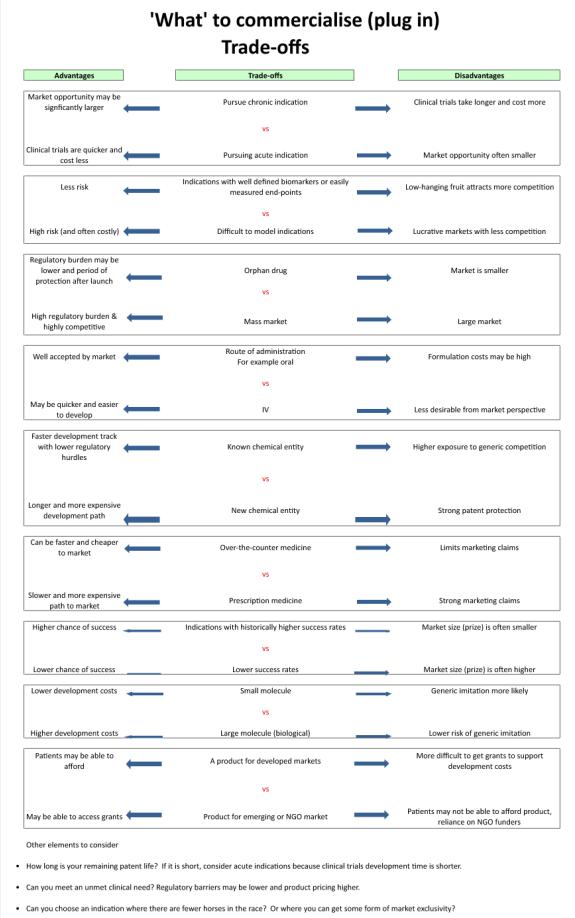
It is difficult to provide pre-emptive advice about what to bring to market, due to the vast range of unique development projects. However, in evaluating alternatives, there are often trade-offs to consider. The following table outlines typical trade-offs that drug development companies may have to face.
trade 2-thumb-650x1037-3650

Some of the factors to consider when deciding amongst this long list of trade-offs are the size of the market, the level of competition, regulatory barriers, pricing and reimbursement, and remaining patent life.

Time is an important driver of what choices from several perspectives. Firstly, what is the length of the firm’s intellectual property protection? (Patent protection usually expires 20 years after an initial patent filing.) The typical development time for a new drug is around 12 years, so it’s not hard to see that the shorter the remaining patent protection, the stronger the bias toward drugs that can be brought to market quickly. Factors such as the length of clinical trials for different indications or the availability of regulatory exclusivity become critical. Another consideration is how quickly you can get to market with a niche indication, allowing you to generate revenues for basic survival and for funding more potentially lucrative indications.

The choice of therapeutic area also brings different chances of success and is also typically associated with certain levels of costs and duration of clinical development. Figure 1 shows that anti-infective drugs are significantly more likely to pass phase I, II and III trials than cardiovascular, anti-cancer or nervous system drugs. However once drugs from these categories have been submitted for approval, they all have about 75-80% chance of making it to market.

Figure 1 Cumulative success rates to market by therapeutic area

Source: CMR International Institute for Regulatory ScienceCumulative Success Rates.jpg

Figure 2 shows that drugs for infectious diseases tend to be cheaper and faster to develop while central nervous system (CNS) drug development projects tend to be expensive and lengthy in duration.

Figure 2 Mean clinical study time vs cost for selected therapeutic groups

Source: DataEdge, Tufts Center for the Study of Drug Development

Mean Clinical Study Time.jpg

Clearly, a firm may have many options over what to develop and decisions made early in the life of the company will have major implications down the track.

But wait, there’s more ….. strategic decisions about ‘when’ and ‘how’ a firm will interact with its value chain are also key components of the business model. Coming up in my next post!

Janette Dixon

Leaving the bench: How life sciences grads can enter the business world

One aspect of my role here at MaRS is that I get many requests from graduate life sciences students who wish to make the leap into the business world. Having done so myself (albeit many moons ago) it is a pleasure to be of help.

What I’d like to share here is a condensed view of the advice and comments I usually provide.

Are you sure?

It takes a lot of time, effort and money to obtain a higher degree in life sciences. At the conclusion the graduate is expertly qualified to do one thing – deeply investigate biological phenomena. While there are some fields in the business world that are analogous (e.g. conducting applied research in a pharmaceutical or biotech firm), for the most part the skills required to succeed in business need to be added.

Therefore, before resetting the clock, it is worthwhile to consider what was it about the life sciences that fascinated you in the first place? Which aspects of research excite you? What are the perceived shortcomings of a research career?

If the negatives are primarily interpersonal or financial then it would likely be a better bet to switch labs rather than switch professions. Living from grant to grant is highly unsettling but as your publication record builds up funding will probably become more stable and abundant.

There are also some important points to consider about the practical realities of a business career before making the move:

  • You will be expected to be punctual, accountable and deliver results.
  • You will not have job security – there is no tenure in the private sector.
  • Your primary mission will often be to make your boss look good.
  • You will not be applauded for being smart, only for being effective.
  • You will need to work well in a team environment.
  • You will need to communicate clearly and concisely.
  • You will need to continuously develop your business and interpersonal skills.
  • You will not enjoy the same amount of freedom as you had in the lab.

Finding your specialty

If the spark has truly gone and you are certain that research is just not your bag then what can you do? Some examples of careers that post-grad/post-doc life scientists have successfully pursued include the following:

  • Technology transfer
  • Pharma/biotech R&D
  • Patent law
  • NPO/Government (e.g. research, health, education)
  • Pharma/medtech sales
  • Investment (analyst, VC)
  • Health news reporter
  • Entrepreneur

I would recommend that you consult the vast array of videos and articles on our Entrepreneur’s Toolkit to get an idea of what’s involved in some of the job functions listed above. Check out the websites of the companies involved and any trade discussion boards to build a more detailed picture.

Once you have an idea which sector is most appealing, I would recommend that you perform some primary market research. Contact individuals currently in the roles that you aspire to via their company websites and ask if they would be prepared to meet you for a coffee or have a 10 min phone conversation. Bear in mind that these folk are extremely busy and their time is at a premium. Make sure you know what questions you’ll be asking in advance and remember to follow up to thank them profusely afterwards.

Getting in

If all signs are positive (or acceptably so) then the next step is to find a way in. Having a higher degree in life sciences may show your prospective employer that you are bright and can work hard but you’ll need to do more than that to be considered for a role.

Experience has shown that one of the most effective ways to assess a potential employer and also get a job offer is to volunteer for a period as an intern. You’ll get to see the company from the inside and if you do a stellar job you stand the chance of being offered a position. This approach is much more effective in my opinion than sending out numerous resumes online via job sites.

Another approach with a high success rate is to network with former research colleagues who have successfully made the transition. These people know you and should be able to provide valuable advice.

Your experience matters

All I have provided here is a very superficial overview – it would be of great value to the community if you could share your experiences of making the switch (or your attempts to do so) as a comment. You are guaranteed an eager audience!

I would also recommend that you keep checking here for employment opportunities in the Discovery District and beyond.

Good luck!

Note: many thanks to John Buckingham and Caitlin McCabe for their help with this article.

John McCulloch

Five Day Filter

It’s time for our weekly roundup of biotech news around the world.

Michael Francisco

Four Types of “Premature Scaling” in Biotech

Earlier this week the Startup Genome project released a report on the DNA of internet startups. Essentially what attributes lead to success or failure. One of the things they found was that 74% of startups failed because of “premature scaling”. Sounds like an unfortunate medical condition. Its when internet startups build their companies too fast and spend too much money before they really know what they have – their product, customer, market, etc…

While reading it, and my Tech partner Fred Destin’s blog on it, I couldn’t help but think about the issue of premature scaling in life science startups. *Spending too much, growing too fast – not an uncommon characteristic in Biotech. It almost always leads to shareholder pain and a loss of invested capital.

Here are four types of premature scaling (or inappropriate scaling) I can think of in biotech, and we try to avoid them all:

1. Building a Big Science story too fast. This is the “Go big or go bust” strategy with a group of Nobel laureates: raise enormous amounts of capital to fund a novel discovery or research platform without enough evidence of target validation in a disease setting, confidence in chemical (or biological) tractability, progress on a lead program, etc… This generates big teams, big footprints, big stories – and massive burns. If the substance, and in particular the rapid progress on product development, doesn’t get in line quickly, a big gap in valuation emerges that can crush these investments. I can think of a few that are active right now but will leave names out to protect the innocent. The right way to build a Big Science story today involves scaling consistent with a science-led, capital efficient approach: build a sound platform with 15-20 FTEs on modest equity raises, find partners to help offset the growth and validation of that platform, and then grow into the Big Science story as R&D evolves. The wrong way to build these is through rapid scaling around a hype-led fundraising machine. More often than not, investors get burnt with these. Synta is a good rapid scaling example. They have raised and spent $350M, had at one time a team of 150+ FTEs or more, and built a big broad portfolio, but their investors have suffered considerably. Story is far from over, but at the 10-year point its looking tough for the early investors. Sometimes this model works, at least for investors. If the company can achieve escape velocity with enough hype and buzz in the market, they can get public or acquired early. Sirtris is a good example of a high escape velocity ‘big science’ deal that made it pubic and was acquired; its fair to say that many spectators wonder if GSK is regretting its $720M acquisition, but at the time the story had a ton of public relations momentum.

2. Building a big company when it’s really a project. Lots of venture money is wasted building “companies” when they are really just product development vehicles. I covered this theme under a prior blog around new liquidity theses. By stapling multiple programs together, building a big team especially on G&A, and running multiple studies at once, investors often think they’ve diversified their risk. Most of the time they’ve just raised the capital intensity of their deal such that one product bump and the whole thing gets revalued enormously. Big Pharma buys these plays for single programs typically and so if a company is lucky enough to have two winners, say a Phase 2 and preclinical program, they leave real value on the table. If you’ve got an interesting asset, then develop it. But there’s little reason to put the expensive trappings of a bigger company around it. Leverage a part-time group where possible; you probably don’t need a CFO or god forbid an HR person. Focus on lean product development. Stromedix and Zafgen are great examples in our portfolio.

3. Building too fast on back of a partnership. Biotechs often get seduced in premature scaling by the siren song of partnering: they do a big deal on their platform, and then expand their organization and footprint, and try to work on more projects – all increasing their net burn. In short, its often an illusion that the partnership actually brought non-dilutive runway extension to the company. Sadly, when the sugar daddy partner terminates the deal, the biotech is left way out of balance and has to RIF its staff. In the public markets, this has recently happened to Alnylam with Novartis and Targecept with AZ. Its much more painful for private companies with weaker cash positions. This strategy – of aggressively funding internal burn rather than buying runway – can work if the company is lucky enough to develop some interesting assets with the free cash from their partner. But there’s alot of luck involved (true of all of biotech, I guess). The alternative is to truly scale your organization to the partnership. Vitae has managed this reasonably well. It last raised equity in 2004, and has used its pair of deals with Boeringher to extend its runway while selectively advancing internal projects. Plexxikon was similarly successful; hadn’t raised equity for years before it was bought for >$800M by Daiichi.

4. Building out before a big outcome. Drug approval, for instance. In Big Pharma, having product to sell into the channel the day after approval is the goal for most blockbusters; in the event of a CRL rejection, they can eat the costs. But in cash-strapped biotech, this tends not to work. Small companies that build out aggressively before an approval more often than not get crushed. Vicuron a few years back. Adolor. ARCA. All hired sales reps prior to a pending approval, failed to get approval, and had to RIF large numbers of their employees. This is not only tragic for those sales folks, but it also exacts a huge tax on the capital intensity of these businesses (especially the small ones). Hubris and excessive optimism are the typical causes of this one, but sadly Boards still let this happen. Horizon Pharma *recently did it right – kept the company under 20 FTEs through approval of its new drug Duexa in April 2011. Its now public and working on the sales & marketing organization.

The counterpoint to premature scaling is what we at Atlas coined P/B/S. Its not Phosphate Buffered Saline. It’s Prove/Build/Scale. Thinking through small bets to prove a hypothesis, slightly more to test the programs, when to spend to grow a company, etc… Most of our seed investing is done to Prove concepts. Building requires partners (which is where we often exit). And scaling requires functioning capital markets so rarely happens today.

Premature scaling can kill companies and investments. Worth keeping that in mind for the next budget cycle.

Reposted with permission from the LifeSciVC blog.

Bruce Booth

Doing It Yourself

DIY house.jpg

Being a small company in the Brazilian biotech field and being a family business is really a challenge. With 30 years of history, we have a lot of good stories to tell regarding the challenges and curiosities of an innovative company in this sector. I remember when the CEO/founder of the company, Dr. Francisco Wykrota, together with his co-founding brother, Dr. Leonardo Wykrota, filed for financial support from the government via an agency called FINEP. The project aimed to promote an innovation establishing the manufacture of a material that was going to be used as a synthetic bone to reconstruct bone losses. A large number of patients needed this technology, almost 30 years ago. FINEP denied the funding because they did not think the project had enough technical reasons to justify the investment. The truth was that the technology was way ahead of the market. It was ahead of its time; the founders had the knowledge to do it but not the money.

That is how everything started. Without financial support from the government, venture capitalists, private equity, or angels, or anything at all, the two brothers launched the company with their own small resources. When they needed certain machines for their production line, they had to build them on their own. They created some pigs in the backyard of their house to use for clinical studies. Everything started very simple and without any external support. Just with a dream and their passion.

Step by step they developed their small, homemade production line using their own machines and a lot of creative ideas and tools. Soon they were able to reproduce the technology on a small scale, which gave them products to start selling. But before going to market there was a very important and very difficult step to go through: approval by the Brazilian Health Agency. The problem was that the agency (called ANS then, and ANVISA today) had never heard of a synthetic bone used for bone reconstruction, and thus struggled with how to regulate a product they did not have the references to understand.

Dr. Francisco found it necessary to help the ANS understand this technology and regulate its use. The result was that the product, called Osteosynt, was the first Bone Graft Substitute registered officially in Brazil. In other words, it became the reference. It took years of work. Then after all the manufacture and regulatory were done, Dr. Francisco took some samples on hand and traveled around the country, participating in symposiums, conferences, meetings and all possible events to show off this new and revolutionary technology.

However there was again another big challenge: the doctors in Brazil did not know about this technology yet! How would you use a new technology that you have never heard about? He succeeded in this educating them, and in my next post, I’ll talk more about it.

My take-home point is that you may fine yourself building a new technology with no support at all in the beginning. Or you might find that no one believes in your product, and will not invest. Or you might realize that the market or users are not ready for your solution. You might find that you need to do all this work without money, with just ideas, creativity, hard work and passion! But that is, after all, what entrepreneurs do, and that’s what these two entrepreneurs did here in Brazil.

Julio Vito Wykrota

Five Day Filter

This week’s Filter finds Merck jumping (late) into the VC and Twitterspheres and a round-up of agbiotech news from the Southern hemisphere. As always, we welcome your comments and questions.

Michael Francisco

Fast start, not short course

Social networking website LinkedIn went public in May and the share price more than doubled on the first day of trading. By all accounts, it was a very successful IPO: LinkedIn raised over $350M in an offering that valued the company around $3B, and the existing and IPO investors could book a substantial, immediate return. In contrast to the hope of a mere resuscitation of IPOs in biotech sector, murmurs of another tech bubble ensued after the LinkedIn offering. Other tech IPOs in 2011, namely Zillow and Qihoo 360 Technology, also enjoyed extraordinary first trading days, appreciating 79% and 134%, respectively.

The extraordinary first day pop in LinkedIn’s share price elicited some criticism of the IPO underwriters. Did they deliberately under price the offering to reward preferred clients and, by doing so, essentially cheat LinkedIn out of millions of dollars? I doubt it, but based on historical data from RenaissanceCapital.com, a doubling of share price on the first day of trading is truly exceptional and harks back to the bubble years of 1999 and 2000. On average, IPOs appreciate around 10% on their first day of trading.

Fig 1(2)

Because IPO pricing is as much art as science, one might guess that IPOs for pre-revenue biotech companies, for which valuations are arguably more challenging than for revenue-generating IT companies, would be prone to such dramatic first day pops (or drops). Indeed, when I looked back at the 34 life sciences IPOs during the bubble years of 1998-2000, I found that the average first day pop was 45%, and that 8 of the 34 showed first day pops of 75% or more. The top of the pops during that period were:

Fig 2.jpg

Of course, one must not confuse a fast start with a short course. Remarkably, each of the life sciences companies with explosive historical IPOs listed above are still independent companies (note that Antigenics is now called Agenus) and all except Illumina are trading lower on a per share basis than the IPO offer price. I often remember this point when I read the impressive press releases announcing large, syndicated Series A rounds for private biotech companies.

Here again, the fast start does not mean a short course for private companies. Using the MedTRACK database, I ranked by size the 774 Series A financings in the US from July 2006 to July 2011 and looked at how the top 10% have fared. Not surprisingly, nearly two-thirds (46/74) of largest Series A round occurred before 2009, which shows how the economic downturn has impacted life sciences venture capital. More than two years have elapsed for those 46 companies and yet I counted only a handful of exits: 3 IPOs (Pacira, Sagent, and Zogenix) and two M&A exits (Calistoga and Rule-Based Medicines). Now, there have been other exits for companies of that vintage (e.g., Alnara, Trius, etc.) but their Series A rounds didn’t give them the “fast starts” I am referring to.

Do first day pops in the public markets or supersized Series A venture rounds tell us anything? Not much. They are little more than snapshots of investor expectations taken against a backdrop of macroeconomic conditions.

Considering the dramatic change in market sentiment over the last month, from a comparatively bullish first half of 2011 to a string of dramatic down days in August, it is clear that fortunes can change quickly. This is the challenge of the long course to building a successful business.

Adam Bristol

Academic Serendipity to Clinical, Commercial Success

forumula.jpg

I always say to my colleagues “Success has no formula, but failure does.” Often, biotech spin-offs yield more in experience than they do history. But I would like to share the story of a colleague of mine who went from a humble academic job in the microbiology department in a national university to a clinical success story. His lab in Tokyo is now providing cell-based immunotherapy via 6,000 transfusions a year, from all over Japan and from neighboring countries.

Hiroshi Terunuma started his career as a medical microbiologist in the Yamanashi University School of Medicine in the late ’90s, when he worked on HIV carriers in whom RNA transcriptome analysis was essential to understand the nature of the immune system. He had no other way to study the RNA transcriptome than to try a reproducible expansion of human immune cells, including T cells and NK cells, in the lab. He did years of basic work without even glimpsing the light at the end of the tunnel. But then he had a two-year tenure in Zambia for studying the immune systems of HIV patients, and even though he came back to Japan with additional expertise, still he and his colleagues had to burn the midnight oil to achieve a successful lab-expansion of the human immune cells. Finally, at the end of a decade of hard work, he got a breakthrough and patented it, though he found his invention was going to be more useful in treating cancer patients!

By then, the Lymphokine Activated Killer cells and Dentritic Cell based treatments had started as clinical applications in Japan, and his invention of being able to grow the Natural Killer Cells without feeder layers meant he had become an immunotherapist for cancer patients. Around this time, he was introduced to Tsutomu Kaneko, whose business expertise combined with the clinical and research expertise of Terunuma to produce a win-win for all involved. With this type of customized and autologous cell-based procedures being considered as clinical procedures as per the Japanese law, the two men produced the Autologous Immune Enhancement Therapy (AIET) for cancer using the patient’s own Natural Killer cells and with other immune cells such as T cells. Today, AIET has treated more than 10,000 patients and several Asian countries have started this treatment as part of the Terunuma team’s outreach via technology transfer. The patents are swelling; the company he started with Kaneko is debt free and earning a profit. Above all, though, the product is a worthy contribution to cancer patients.

I would summarize by saying the key elements for success were:

  • • The years of hard work in the bench to find the appropriate culture methodologies.
  • • Repositioning the invention to an application that was essential and in demand
  • • The availability of clinical data on autologous immune cell therapies for cancer
  • • A synergy-based partnership helped the scientists and clinicians contribute in areas alien to them.
  • • The “clinical procedure” recognition of the autologous immune cell treatment in Japan


Samuel JK Abraham

Five Day Filter

Yes, just in time for the weekend, the Filter combs the ’net for news of bioentrepreneurship around the world. Feel free to comment or ask a question below.

Michael Francisco

Indian documentation, part II

2.jpg

In a previous blog post I wrote about incorporation and the different activities related to ROC (Registrar of Companies) and preparing Memorandum of Association (MOA) and Articles of Association (AOA) for the proposed company. MOA and AOA should be filled in the applicant’s handwriting, and the applicant must be one of the directors or registered company secretary. The applicant must, in the presence of a witness, mention their full name, their father’s name, occupation, residential address, number of shares subscribed for, etc.

If you’re a foreigner, your approved document for proof of identity and residency is your passport. For a few countries, prior authorization of the photocopy of passport by the Consulate or Embassy is mandatory. For Indians, there are many options of identity and address-related documents for submission. Three passport size photographs of all the directors or shareholders are required. Get MOA and AOA stamped by paying a stamp duty, which depends on the certified share capital of the proposed company. The price of stamp duty differs from state to state in India. The authorised and paid-up capital should be mentioned in the AOA.

It is mandatory to obtain Director’s Identification Number (DIN) by filling Form DIN-1 and getting digital signatures for two directors (this is required for filing documents with ROC). A temporary DIN is instantly issued, which must then be printed, signed and sent to the Ministry of Corporate Affairs for its consent along with the identity and address proof. Digital signature is mandatory for completion of company registration system under MCA 21.

You’ll need what’s called Form No. 1 printed on “non-legal stamp paper” (that costs less than a dollar) and signed by one of the company directors or attorneys or advocates, etc., mentioning that all the obligations of the Companies Act have been observed. Form No. 18 should be authorised and signed by one of the company directors, notifying the registered company address to ROC. Form No. 29 is not required if you are registering a private limited company. All directors should submit filled-in Form No.29 to operate as directors in the public limited company, though. Form No. 32 contains the details of the proposed board of directors from the date of company incorporation and should be signed by one of the acting directors.

In a few states (Karnataka, Maharashtra, Andhra Pradesh, New Delhi and others), the above forms are available online in the Ministry of Company Affairs website, namely e-form 1, e-form 18 and e-form 32. Along with above documents, submit the original “Company name allotment certificate” and power of attorney (or board resolution) signed by all the MOA subscribers certifying one of the subscribers to operate on their behalf for the purpose of registration and to acknowledge the certificate of incorporation. There are other supplementary steps for registering and starting operations of a public limited company in India. It is best to have a company secretary or legal advisor to coordinate ROC activities and draft guidelines to avoid problems in the future. Private companies can immediately begin operations after incorporation. A certificate of incorporation given by the Registrar in respect of any company shall be conclusive evidence that all the requirements of this Act have been compiled, and that the company is duly registered under the Companies Act.

To start company operations, you need a company seal (or common seal) to deliver share certificates and to issue letters. Open a current account of company in any of the nationalised banks. Banks require copies of the company name allotment certificate, name incorporation certificate, proof of registered office address, passport size photographs of directors (who will operate the account) and an initial deposit in Indian currency. If directors are Indian residents, then their residential address proof, permanent account number (PAN) card and photographs are required. Once the bank account is operational, apply for Company PAN and tax account number (TAN) from a certified franchise or agent of income tax department, namely National Securities Depository Limited (NSDL) and Unit Trust of India (UTI) Investors Services Limited.

Submit your company registration certificate along with the identity and residence proof to get PAN application Form No. 49A and TAN Application Form No. 49B from IT PAN Service Centers or TIN Facilitation Centers. PAN is important to credit tax under Income Tax Act, 1961 and TAN for submitting tax deducted or gathered at source (TDS). Enrol with the Office of Inspector, Shops & Establishment Act (State or Corporations or Municipal) certificate for the registered company address. The office board must have company name and address in two languages, namely the state’s official language (compulsory) and in English (optional). Under this procedure, a proclamation consisted of names of company, employer, manager and company address must be delivered to the local shop inspector with the pertinent fees.

Depending on the type of business and services, each company has to apply and obtain Value-Added Tax (VAT) and Commercial Sales Tax (CST) codes at the Commercial Tax Office (in the respective states). Fill out VAT Form No.101 and submit attested copy of MOA and AOA, residence proof, company address proof, one passport-sized photograph of applicant, PAN card and payment of fees in Form No. 210. Register for professional tax (PT) within 3 months of the company’s operation. If your company’s business involves manufacturing of goods and the disposal of clinical or toxic wastes, then obtain clearance from the Environment and Pollution Board.

The company registration process looks lengthy, but you can complete it within two to three weeks. Good luck and enjoy business in India. Write to me if you have specific questions or need any other help in setting up company in India. You can reach me here: pgbagali@geneflux.net.my

Prashanth Bagali