
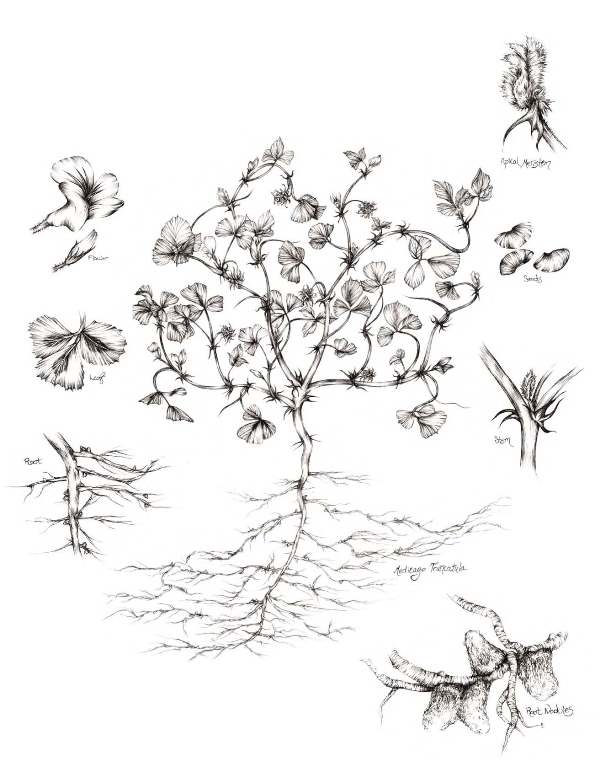
Image art by Bretta Watterson.
Legumes have the unusual ability to make their own fertilizer. They do this by associating with nitrogen-fixing bacteria, which take nitrogen from the air and convert it to ammonia that can be used by the plant to make proteins, nucleic acids and other essential molecules. Understanding the biology underlying the association between legumes and their symbionts could enable these concepts to be adopted in other types of crops as well. In a paper recently published in Nature Biotechnology, Joshua Coon and colleagues report the proteomic profile of the organs of a model legume, Medicago truncatula, and its collaborative partner, Sinorhizobium meliloti. Analyzing the proteomic atlas they generated together with transcriptome and genomic data, the researchers show how this resource can be used to discover new biological insights surrounding nitrogen fixation that may one day be useful for future crop engineering efforts.

