Tag Archives: innovation
Why building a start-up is probably your most sensible career path
Your PhD has given you the perfect tool set to start a high-tech company, and it’s nothing to do with your technical skill, says Mark Hammond.
In stark contrast to the proliferation of web based start-ups led by young founders, science based start-ups have typically remained the domain of seasoned professors, spinning out breakthrough technology built on years of research. This is changing rapidly, and it’s now more viable than ever to start a science based company straight out of a PhD. In fact, it might just be one of the most sensible career paths that you can take.
Entrepreneurship: You’ve got the edge to found
Young scientists have substantial advantages over others when it comes to founding a start-up.
Guest contributor Leonie Mueck
Eoin Hyde has been running from meeting to meeting. His start-up, Innersight, is in a critical phase and he has to convince investors to give him and his co-founder enough funds to get it off the ground. Even with his hectic schedule, he’s full of energy.
“Everything is happening very fast,” he says. Until just a few months ago, Hyde had been working as a postdoc at King’s College London, following a PhD in computational biology at the University of Oxford. He enjoyed his research, but when a former colleague approached him with the request to co-found Innersight, a medical imaging company that constructs 3D images from patients’ scans to help doctors during minimally invasive surgery, he didn’t think twice. “I had been playing with the idea to found a start-up for a long time,” he explains.
Hyde belongs to a minority. Not many science PhDs choose to found companies, at least not in the UK. According to the UK GRAD programme, only 2% of UK-based physical science and engineering PhD graduates are self-employed; it is unknown how many of those have the goal to found fast-growing technology start-ups with global reach. Alex Crompton, programme director at Entrepreneur First, finds these low numbers regretful because in his opinion, science PhD graduates are perfect founders. Continue reading
Aerospace engineers win global innovation challenge, virtually
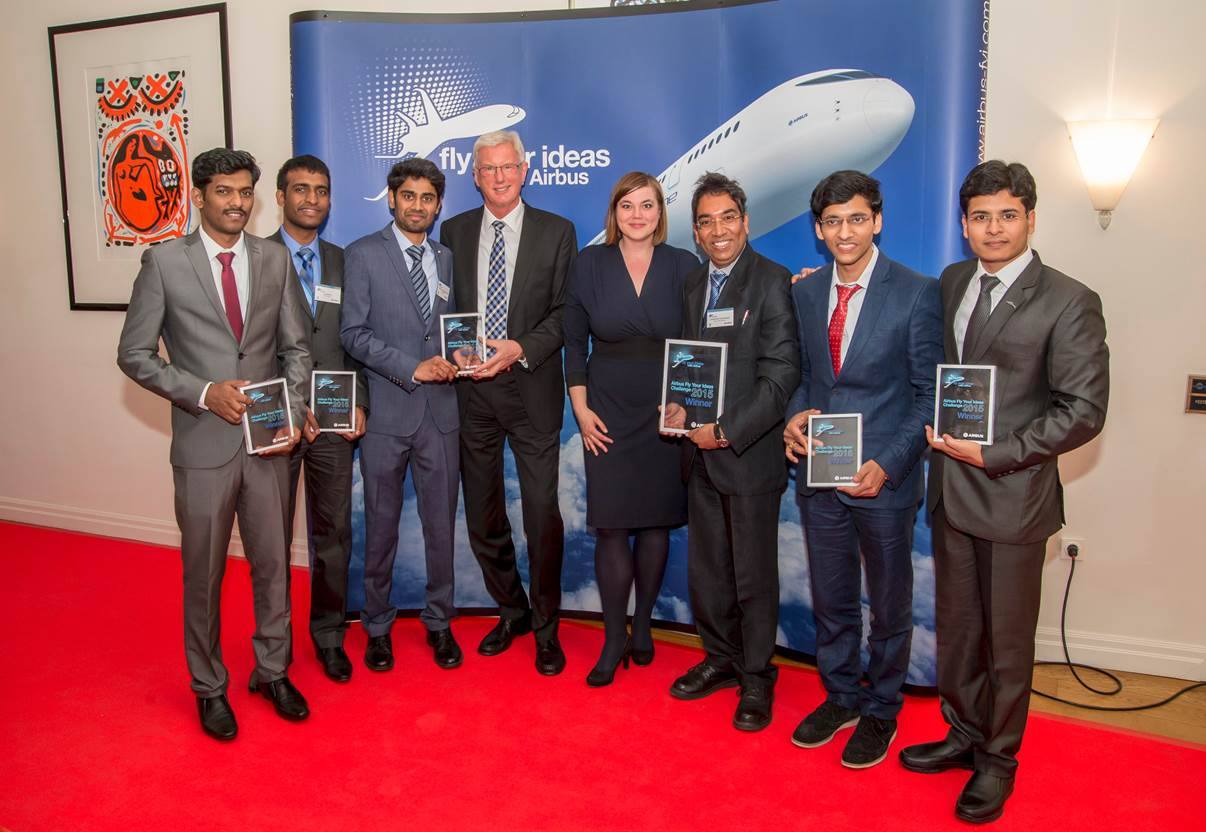
A virtually connected team of Indian aerospace engineers — based in India, USA, UK and The Netherlands — have emerged champions in a global biennial innovation challenge organised by UNESCO and the passenger aircraft manufacturing company Airbus.
Interestingly, members of the team, which aptly calls itself MultiFun, met in person for the first time only for the final round of the event last week (May, 2015). Their winning entry for the ‘Fly Your Ideas (FYI)’ competition held in Hamburg, Germany was a “hybrid battery-piezoelectric composite structure for next generation aircraft”. Simply put, they designed aircraft wings dressed in a “composite skin that harvests energy from natural vibrations” or flex in the wings. MultiFun bagged €30,000 as prize money along with the coveted trophy.
“Piezoelectric fibres gather electrical charges from even the smallest movements during flight, storing the energy generated in battery panels integrated in the fuselage and using it to power auxiliary in-flight systems, such as lighting and entertainment systems. This reduces the energy footprint of aircraft during flight and could even replace the entire power source for ground operations,” the jury said calling MultiFun’s entry a ‘path breaking’ innovation.
The idea was sprouted in the Department of Aerospace Engineering, Indian Institute of Science (IISc), Bangalore. The chief mentor for the project was Dineshkumar Harursampath, lab head of the Nonlinear Multifunctional Composites — Analysis & Design Laboratory at IISc. Harusampath got this globally-placed team of IISc alumni and current IISc students together through video-conferencing and virtual platforms. Team leader, Sathiskumar A. Ponnusami, a doctoral student in TU Delft, and Dhamotharan Veerasamy, a doctoral student in City University London, are IISc Masters alumni. Shashank Agrawal and Ajith Moses are current doctoral students at NMCAD Lab. And the youngest, Mohit Gupta, a Masters student at Georgia Tech, Atlanta, was an intern at NMCAD Lab a year ago.
The Indian team’s entry was shortlisted in the top five from among 518 teams representing 104 countries. FYI is designed to identify and encourage the next generation of innovators and uncover futuristic and unconventional yet promising solutions for the evolution of flight.
Team leader Sathiskumar says the “long umbilical cords” of IISc inspired them to design and develop multifunctional materials for next generation aerospace applications. “The lab provides an environment conducive for out-of-the-box thinking and uninhibited multimedia communication without space-time limitations amongst team members,” he said in a release. “Only half the time was spent on technical issues. The rest was inspirational yet unplanned chatting leading to team bonding, true to the name MultiFun!”
The team was able to work 24 hours a day by interacting across physical boundaries from four different locations around the world and managed to present the most disruptive idea for the future of aviation at the competition. “… the winning idea is all about good vibrations,” the jury noted.
Indeed a brilliant example of virtual networking for science and innovation.
Windback Wednesday: Entrepreneurship
Scientists are full of ideas, constantly creating wonderful research, but what can you do when one of these ideas could make you some money? In this Windback Wednesday series we’re digging up some articles from Nature Careers and the Naturejobs blog on entrepreneurship
The word entrepreneur comes from the 13th century french verb entreprendre, which literally translates to “to do something” or “to undertake”. By the 16th century, the word entrepreneur had developed a meaning of its own: someone who undertakes a business venture. It’s distinguishing features, according to Richard Cantillon (an 18th century economist), are an understanding of risk and being prepared to do business without guaranteed profits. Sounds scary, but it doesn’t need to be.
In a recent interview with Naturejobs (podcast to follow soon!), Steve Blank, a Silicon Valley entrepreneur, described entrepreneurship as a cross between science and art:
“Artists have something inside of them that they want to bring to fruition, and actually see tangible results of: it’s not just thinking about music or listening to music, they want to make music. Making a start-up and making something commercial is exactly that same feeling, and if you don’t have that passion for it, you shouldn’t get engaged. But if you do have that passion for it, you will figure out how to split up some time, take 6 months off or take a sabbatical…. [and] you will find, once in your life, you will experience what it takes to actually do a start-up. But this isn’t a job, this is a passion.”
On that much happier note, we’re going to start this month’s series on entrepreneurship with Neil Savvage’s article on Innovation: Brushing up on business. As well as case-studies, this article gives some insight into practical talks and training courses scientists can do to brush up on their business skills.
Throughout this month, we’ll also be looking at how to find some venture capital to fund ideas, how to become a bio-entrepreneur and how women can find a way in to the entrepreneurial world.
But what we’d like to know is: what does the word entrepreneur mean to you?
Harvard “Innovation Lab” opens
A Globe staff editorial ($) congratulates Harvard on the opening of its Innovation Lab in the old public television studieo in Allston.
The ribbon-cutting at the site last week marked a milestone in Harvard’s long-awaited expansion across the Charles River into Allston. The university should infuse the rest of its plans for the neighborhood with the same upbeat energy.
But, the paper reminds the school that some of its most innovative students — or at least the innovative students who made a lot of money and became household names — fled Harvard for the west coast.
A little background from the Crimson:
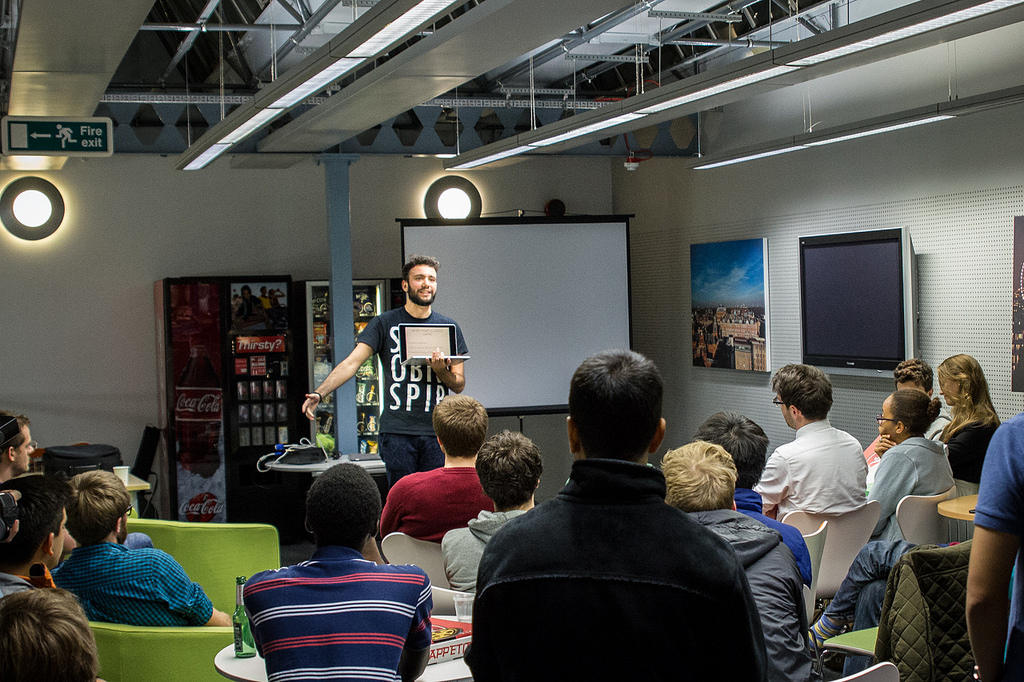
The i-lab sits on the first floor of Batten Hall on 125 Western Ave. and is equipped with a coffee shop and a 24/7 public meeting space. Local artwork hangs from the walls and ceiling, pillars double as white boards, and bright orange chairs swivel to create what Jones called a “flexible space.”
“Great ideas and great thinking don’t always happen at a desk,” Jones said. “They can happen in unconventional places because your mind starts to think in more unconventional ways.”
While the facility is designed to provide resources for start-ups, it is also a start-up of sorts itself.
The i-lab is the first realized step in a series of measures the University is taking to develop a technological hub in Allston, similar to MIT’s Kendall Square.
Though the i-lab is the first part of this plan to come to fruition, it is not the centerpiece of Harvard’s plan.
Harvard broke ground on the Allston Science Complex in 2009, a project with an estimated $1 billion price tag that was meant to be a crown jewel of Harvard’s interdisciplinary science facilities. But due to financial constraints, University President Drew G. Faust halted construction on the site.
The lab has a blog, which reported on an event called the “student scramble:
Warning — Don’t get excited about “today’s” events. The home page calendar lists next week’s events as happening on “Friday,” although the actual dates are correct. So
don’t rush over for the health care innovations event tonight. It’s on Monday.
Harvard Healthcare Innovation Group Opening Mixer
Mon, November 28, 6:30pm – 8:00pm
Description
Come meet Harvard students from across the school interested in healthcare innovation at the new Harvard Innovation Lab. Register here: https://www.eventbrite.com/event/2508216142