Dan Cressey, a reporter at Nature, speaks about getting a job as a science journalist at the Naturejobs Career Expo, London, 2016.
https://www.youtube.com/watch?v=iilmmDHxgPY

https://www.youtube.com/watch?v=iilmmDHxgPY
Guest contributor Catherine Seed

Left to right: Robert Dawson, Catherine Ball, Anke Sparmann and Belinda Quick{credit}Image credit: Catherine Seed{/credit}
Science communication is rapidly becoming a core requirement for scientists, and has long been a highly sought-after career in its own right.
There is a huge breadth and diversity in the field of science communication, agreed the panel members, yet the use of ‘science communication’ as an umbrella term often obscures this variety. Panellists agreed that the key to developing a successful science communication career is in finding how you prefer to communicate, and determining which avenues of communication match your style. With options ranging from news reporting to working for academic institutions or societies, or in simply starting your own blog, the options are countless. The process, they said, requires much experimentation; test different forms of communication to discover what works best for you.
The objectives of organisations shape the form of communication that they use, said Robert Dawson, head of news at the BBSRC. He stressed the importance of familiarising yourself with different media outlets, universities, research institutions, and companies and their communication style. In his own role, he communicates to scientists, journalists and other members of the media. “Science PR is about balancing the need to encourage the public to be enthusiastic about your organisation and about science, with the need to produce accurate and balanced coverage,” he said. Continue reading
Guest contributor Gaia Donati.

Dream jobs might not always be what you expect.
Planning a career path is a bit like committing to a relationship – you go through phases. First comes the infatuation, leading you to enthusiastically catch any opportunity to establish contacts and gain experience in your chosen sector. As you discover previously unsuspected facets of your ‘dream job’, a few doubts arise: you may find out that the competition is fiercer than you expected, that permanent positions are scarce or that it will take years for you to earn a decent salary. All of a sudden you question your choice altogether, and you are left with a menacingly dark cloud over your head.
Having defended my PhD thesis in experimental quantum optics at the end of July, the idea of my ‘dream career path’ must now become real – it’s time to find that job. I decided I would look into a career in science publishing and journalism, but as I moved the first steps in this direction I found myself surrounded by doubts and unknowns: do I wish to leave academia? What if I keep hopping from one internship to another?
After a few years in the laboratory and a stint at cutting-edge research for my PhD project, I ruled out the postdoc option. My future occupation should combine my love for science with my passion for communicating scientific advances to wider audiences; as a journalist, Continue reading

Following the success of the Boston Naturejobs Career Expo journalism competition (you can read all the articles from the competition in the #NJCEBoston category), we have decided to repeat it for the London Expo, which takes place on 19th September 2014 at the Business Design Centre in Islington.
We are looking for five budding science writers to help us with our coverage of the Naturejobs Career Expo conference sessions and workshops. The conference will explore career paths in industry, academia and science communication, entrepreneurship, structuring a CV and transferable skills, amongst other things. The five winners will have the opportunity to attend the Expo and write up at least two of the sessions or workshops for our readers, sharing the advice and expertise of the speakers with those who cannot attend in person. Winners will work closely with our editors, and their articles will be published on the Naturejobs blog.
Contributor Saheli Sadanand
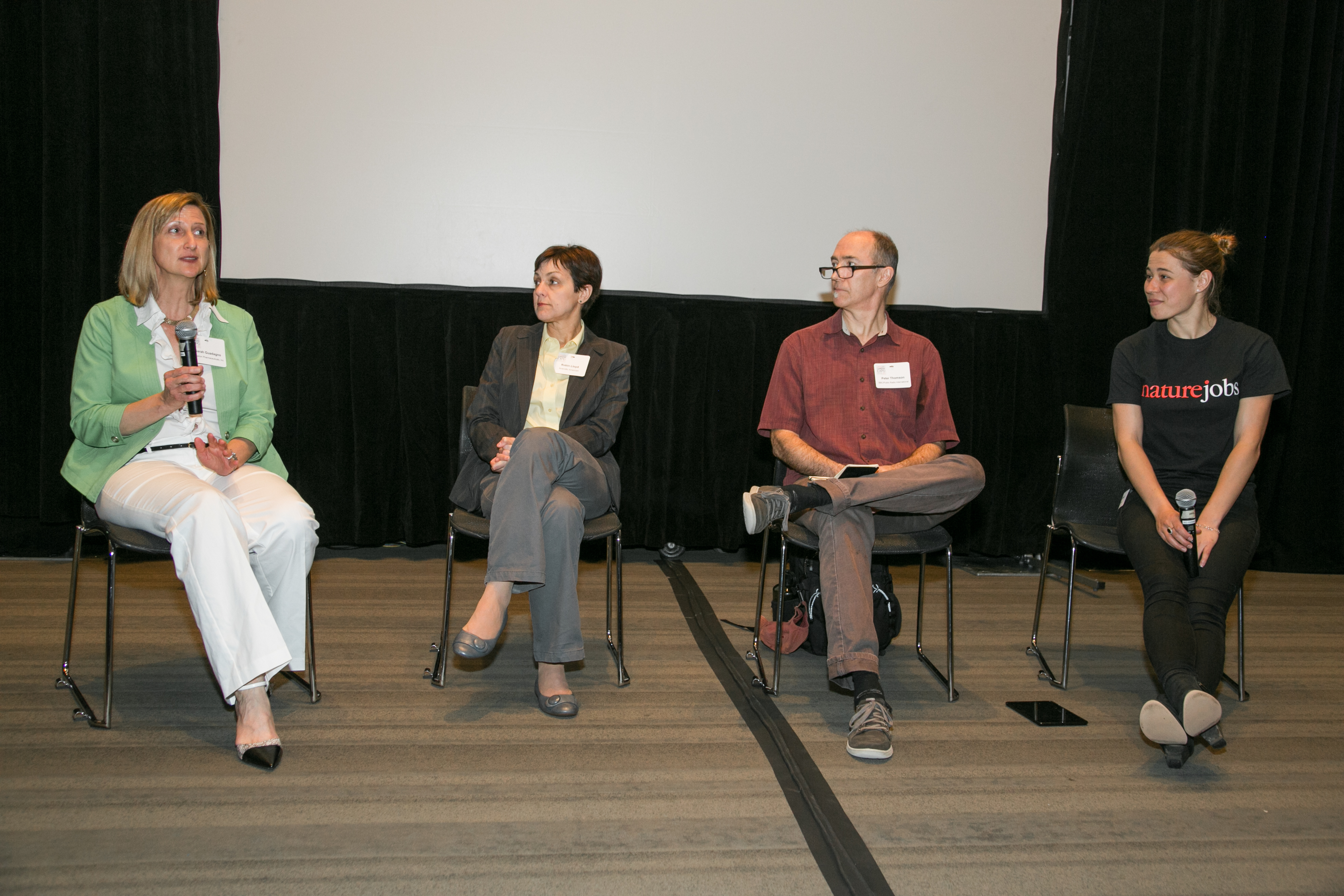
Sarah Guadagno, Robin Lloyd, Peter Thomson, Julie Gould
What is science communication? Turns out that it can be a number of things, as revealed by an afternoon panel at the Naturejobs Career Expo. Peter Thomson, Robin Lloyd and Sarah Guadagno — all of whom have made careers in different forms of science communications – described the paths that brought them to their current positions, and held forth on the challenges and rewarding features of their work.
Peter Thomson is the founding producer of “Living on Earth,” an award-winning environmental news program that has aired on the US public radio network (NPR) since 1991. He now serves as the environment editor for the Public Radio International program, “The World.” “There is something about the human voice that is so elemental. It’s the way we’ve always told stories,” Mr. Thomson said in describing the appeal of radio communication. “Radio is the most intimate medium.” Mr. Thomson pointed out that environment reporting involves more than just a science component; he and his team of journalists must address other perspectives in their pieces.
Robin Lloyd came to her position as online news editor for Scientific American via a circuitous route. She got her Ph.D. in sociology at the University of California, Santa Barbara and after a few years in a tenure-track position, she realised research was not her passion. She then worked in a variety of different jobs (including a stint as a barista!) before becoming a locum editor at Scientific American. Her appointment ultimately evolved into a permanent position at the journal. Her job, as she puts it, is “to take the material that comes in from the writer and turn it into something compelling that the audience really wants to read.” In addition to planning and editing stories for publication, she manages the Scientific American home page. She emphasised that her job involves more than just presenting new and trendy scientific discoveries. Continue reading

Major General Ibrahim Abdul Atti, the inventor behind the new device, told journalists that his invention is “20 years ahead of anything produced in the West.”
The Egyptian army’s claim to have invented a device that can detect and cure hepatitis C and AIDS seemed incredulous to many of us when it was first announced in a large press conference, but with every media report it became more absurd and ridiculous.
In a matter of days, it quickly spiralled to become a device (or two) that can use electromagnetic waves to remotely detect, treat and cure HCV and HIV, along with cancer, diabetes, AIDS and any other bacterial or viral infection. These claims were fueled by the person claiming to have invented the device, members of his team, unknown clinical doctors and a host of eager journalists and talk show hosts.
I have discussed the false science behind this device, and the reason why almost everyone in the science community is skeptical about it, in a previous blogpost. There’s absolutely no way this research paper can be taken seriously or be treated as science in the first place due to a host of unforgivable errors.
But maybe this whole debacle is a good chance to look at some of the underlying problems that extend across the Middle East, and not just Egypt, that led to this embarrassing situation:
1) We have a serious problem with media in general, and science journalism in particular. As outrageous as the claim was, none of the journalists who reported it have questioned it. They simply took the story and ran with it, and with every news report the claims became more outrageous. Instead of acting as watchdogs and pursuing their role as searchers for truth, the media outlets chose to be a mouthpiece for the authorities. This could be for various reasons, from political gains of private newspaper owners to lazy journalists willing to take anything they are fed – but whatever the reason, we are left with a disaster, and the public are the losers in this.
Even worse, this points out to the glaring lack of a science editor in these publications, someone with enough scientific information to raise a dozen warning flags before such a story is published. While politics and sports sell most in newspapers, science cannot be ignored, especially with the large number of science-related problems that the region is facing from threats to water and energy security to poor education and a degrading environment.
2) The whole issue points to the most glaring problem: the lack of critical thinking. It is a problem with our school education system, with our universities and with the general upbringing of most people. Children are discouraged from questioning or from analytically thinking and analyzing what they are taught. This very often translates, in adulthood, into a failure to question such “discoveries” – no matter how bizarre the premises is, as long as it is endorsed by the government and media.
The public is desperate for good news, especially in a country in turmoil like Egypt. However, the claims here were too outrageous for anyone to believe – and the least bit of critical thinking and a little research would have quickly shown this to be bogus. But the lack of a culture that supports and promotes either meant this was silently accepted and hailed with much ado about nothing.
3) There is a glaring problem of abuse of public health for the sake of fleeting political gains. Regardless of who is in power, giving false hope to millions of people in danger of death for the sake of some extra votes in an election is a disaster. Health and science should not be political tools, they are basic human rights and should be enshrined as such. The way this whole facade was presented was, obviously, made for political gains. Citizens should be protected from such abuse, where any entity that advertises such false health hopes is harshly punished.
4) Science has no “champion” in Egypt. There is no one to stand up to such claims and call them out as bogus. The few voices who did, such as the Egyptian president’s science advisor and planetary scientist Essam Heggy, were clawed to pieces by the media and politicians who said he was “tarnishing Egypt’s and the army’s international image.”
There is a need in Egypt and in the rest of the Arab world for an independent science body – such as the Royal Society in the UK for example – that can act as a watchdog and advisory to protect the public from such false claims in the name of science. When a handful of us are fighting to strengthen the role of science in society in the Arab world, such claims can wreck what took us years to build in a matter of days, and shake the public’s faith in science.
This entity would protect both the public, and their understanding of science. It would be vocal in fighting such claims and can help the media produce better coverage of science – protecting the public, protecting science, and advising the government on science-related issues independently.