Metaphor and message

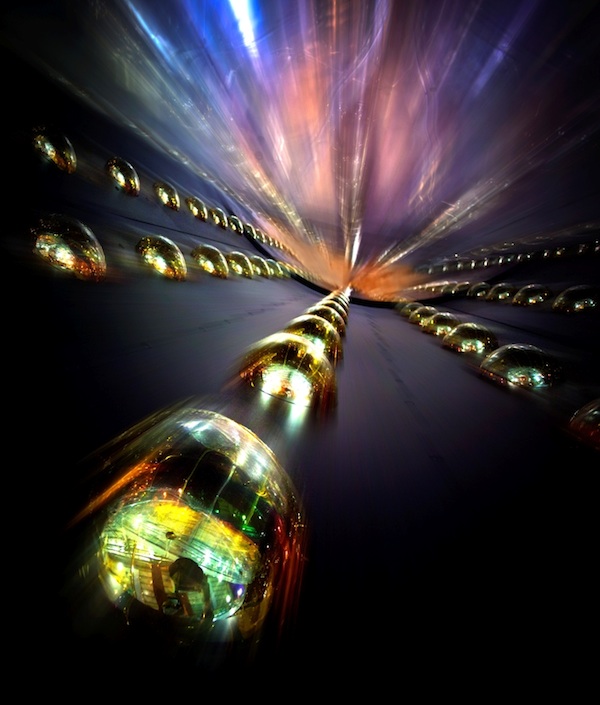
On the trail of the 'ghostly neutrino': the Daya Bay Neutrino Experiment near Hong Kong.

On the trail of the ‘ghostly neutrino’: the Daya Bay Neutrino Experiment near Hong Kong.{credit}Courtesy of Roy Kaltschmidt{/credit}

In this week’s Spring Books special — 6 reviews, 10 books, immeasurable reading pleasure — historian of genetics Nathaniel Comfort assesses a trio of new works on genomics, led by John Parrington’s The Deeper Genome. Comfort is dismayed by the outworn terminology we keep trotting out to describe our messy, dynamic, ‘junk’-ridden inner Universe. What’s needed, he asserts, is fresh, accurate imagery, nippy enough to keep up with the evolving science.

The power of metaphor in science is itself a trope in science writing. Scientists conveying the compulsive thrills of their work to the public and the generalist are ever reaching for the bon mot that expresses the essence of a phenomenon more truly understood through mathematical or chemical formulae. It’s a tough call, and on some level an impossible one. The most a communicator can light upon is often an organising idea — imperfect but functional, and with enough cultural resonance to allow intuitive understanding.

Hence the elegant Universe, ghostly neutrinos, dark energy, selfish genes. Do these mask, or reveal? Educate, or (to coin a simile) spread misinformation like the ripples from a thrown stone?

Science communicators ponder these issues as a matter of course. Ann Finkbeiner, a frequent contributor to Nature’s Books & Arts pages, is running a sporadic series on the issue (grappling, for instance, with the likes of “tidal locking”) in The Last Word on Nothing. Prolific writer and former Nature editor Philip Ball has written that we should “heed the warning of pioneering cyberneticists Arturo Rosenblueth and Norbert Wiener that ‘the price of metaphor is eternal vigilance’”. And exoplaneteer Caleb Scharf concedes that while some readers might be flummoxed by rococo images such as a “collapsing soufflé” to describe intergalactic gas, the risk must be taken.

Yet the challenge remains: science is quantitative, complicated, often beyond the reach of human experience. As Nobellist, chemist and poet Roald Hoffman (Q&A’d here) notes, “There is an interesting dance here, in that data (observations, equations, structural formulas, spectra) are useless without the narrative, theoretical framework to make a story out of them.” And however inadequate it can prove, metaphor is knitted into mentation: we seem to be pattern-matchers.

The known is a springboard to the unknown. This is how we learn. We need the familiar — and sometimes, if it serves, even the anthropomorphic — to begin to comprehend our wild cosmos. As Scharf notes, “what are we to do, just shrug and separate ourselves from the entire natural world – them and us?” Through metaphor we ally ourselves to the Universe, docking in with a linguistic click.

Order a free pdf of Spring Books here. And listen in as Kerri Smith and I talk about Spring Books on Nature Podcast. 


For Nature’s full coverage of science in culture, visit www.nature.com/news/booksandarts.

Much ado about science

The Chandos portrait, possibly of Shakespeare,

The Chandos portrait, possibly of Shakespeare, 1600-1610. {credit}National Portrait Gallery, London{/credit}

As the anniversary of Shakespeare’s birth rolls round again, it’s salutary to recall just how long the hunt for science in the bard’s work has gone on. In 1917, for instance, Herbert Warren, reviewing Shakespeare’s England, mentions the bard’s “world-embracing interest” as encompassing zoology and medicine. And the playwright’s lifetime (1564-1616) certainly coincided with a panoply of key scientific events and figures.

There were celestial dramas, from the Stella Nova spotted by Tycho Brahe in 1572 to Kepler’s sighting of Halley’s comet in 1607. There were starry contemporaries such as Galileo, who shared Shakespeare’s birthday. Meanwhile, the mindblowing findings of Copernicus on astronomy (De revolutionibus) and Vesalius on human anatomy (De humani corporus fabrica), both published in 1543, were ticking away like scientific timebombs.

And while England came late to Europe’s scientific renaissance, English luminaries such as mathematician-astronomers John Dee, Thomas Digges and Thomas Harriot held their own, as historian Jennifer Rampling revealed in her masterful summation of Tudor science last year. (Harriot, for instance, made telescope-aided drawings of the Moon’s surface four months before Galileo.) London was also, Rampling showed, a hotbed for the invention of everything from prototype wetsuits to navigational aids.

Thomas Harriot,1602.

Portrait of Thomas Harriot,1602. {credit}Trinity College, University of Oxford.{/credit}

So how are those tumultuous developments reflected in the plays? London’s bustling commercial reality is there. And as Philip Ball among others has shown, Dee — drenched in the occult as well as natural philosophy — is often held up as the model for Prospero, The Tempest’s island-dominating sorcerer. But does astronomy get a look-in?

In his excellent The Science of Shakespeare, science journalist Dan Falk rounds up the best research and speculation in this area. For instance: in Act 2 of Hamlet (1603), the Dane exclaims to Rosencranz and Guildenstern: “O God, I could be bounded in a nutshell and count myself a king of infinite space”. The infinitude of space was then still a fringe speculation. Yet intriguingly Digges, whose family Shakespeare knew, had created a diagram showing just that for his 1576 translation of Book 1 of Copernicus’s magnum opus. Meanwhile, Tycho — the other Dane — had two relatives named Rosencranz and Guildenstern.

Thomas Digges with a telescope.

Thomas Digges with a telescope.

However, as Falk is at pains to show, these echoes and intimations have yet to hang together cohesively, not least because of the paucity of information about the man from Stratford. What is clear is that Shakespeare wrote at the cusp of the scientific revolution: the medieval worldview still swirls through the plays, but mingled with acute observations of flowering plants, the subjective passage of time and, perhaps, the celestial conundrums of his era.

That rich, strange mix pervades the exhortation that opens Henry VI Part I: “Comets, importing change of times and states,/Brandish your crystal tresses in the sky.” Perhaps this is what is most scientific in Shakespeare: the mirror he, as brilliant observer, holds up to nature and the human mind.


For Nature’s full coverage of science in culture, visit www.nature.com/news/booksandarts.

Hubble and the cosmic sublime in poetry

The Bug Nebula (NGC 6302).

The Butterfly Nebula (NGC 6302).{credit}NASA, ESA and A.Zijlstra (UMIST, Manchester, UK){/credit}

Twenty-five years ago, NASA’s Hubble Space Telescope began to lay bare the depths of space — from the evolution of galaxies to the age of the Universe. Beyond its contribution to science, Hubble’s dazzling images of galaxies, stellar nurseries and planetary moons have mesmerised a generation.

The orbiting scope has inspired in other ways. Pulitzer-Prize winning poet Tracy K. Smith wrote her collection Life on Mars (2011) partly in homage to a Hubble engineer — her father. (See our profile here.) 

I asked Smith for her thoughts about Hubble now, and she noted that they centre on

how radically our sense of where we are and what we belong to has changed as a result of those marvellous images. They seem to straddle the real and the impossible so perfectly, hinting as they do at an order that is almost decipherable — almost visible — but that must, after a certain point, be taken for what it is: vast, mysterious, so large and ongoing as to be eternally beyond us. Perhaps that is why, at least for a writer like myself, they activate such powerful regions of the imagination.

Poet Tracy K. Smith

Tracy K. Smith{credit}T. RUISINGER/ROLEX/RSA{/credit}

Observational leaps have fired up poets for centuries. As scientists from the seventeenth century on harnessed ever more sophisticated optics to probe the heavens (see Philip Ball’s review of Galileo’s Telescope; 2015), transformative insights from their findings began to seep into culture, bolstered by populist works. Bernard le Bovier de Fontenelle’s 1686 Conversations on the Plurality of Worlds, for instance, championed the Copernican system, framing Earth as just one world in a crowded Universe and even playing with the idea of extraterrestrial life. By the eighteenth century, Newton’s revelation of a dynamic Universe had spurred poets such as Alexander Pope, Edward Young and James Thomson to play with the idea of the ‘cosmic sublime’.

Anna Barbauld, stipple engraving by John Chapman, 1798.

Anna Barbauld, by John Chapman, 1798.{credit}National Portrait Gallery, London{/credit}

Anna Barbauld’s 1772 nocturne A Summer Evening’s Meditation is a tour de force. Barbauld, assistant to the chemist Joseph Priestley and a champion of Enlightenment values, used science as a poetic springboard into speculation about the great beyond. “This dead of midnight is the noon of thought,/And wisdom mounts her zenith with the stars”, she writes, and imagines seeing

…solitary Mars; from the vast orb
Of Jupiter, whose huge gigantic bulk
Dances in ether like the lightest leaf;
To the dim verge, the suburbs of the system,
Where chearless Saturn ‘midst her watry moons
Girt with a lucid zone, majestic sits….

She ventures even into the interstellar, “the trackless deeps of space,/Where, burning round, ten thousand suns appear” — and on to regions “Where embryo systems and unkindled suns/Sleep in the womb of chaos”. 

R136 and young stellar grouping.

30 Doradus in the Large Magellanic Cloud.{credit}NASA, ESA, and F. Paresce (INAF-IASF, Bologna, Italy), R. O’Connell (University of Virginia, Charlottesville), the Wide Field Camera 3 Science Oversight Committee, and the Hubble Heritage Team (STScI/AURA){/credit}

Almost a decade later, William Herschel spotted Uranus in the “suburbs”, a discovery celebrated by poet and inventor Erasmus Darwin and used by the young John Keats as a symbol of Romantic wonder itself,  in his 1816 sonnet On First Looking Into Chapman’s Homer: “Then felt I like some watcher of the skies/When a new planet swims into his ken”.

Trawling the skies 200 years on, the atmospheres of exoplanets are just one of the phenomena probed by Hubble among the million images gleaned on its 4.8-billion-kilometre journey. A latterday starry messenger, it is still offering up visions that seem to “straddle the real and the impossible”. As Smith recalls in “My God, It’s Full of Stars” from Life on Mars, her father “spent whole seasons/Bowing before the oracle-eye, hungry for what it would find”:

The first few pictures came back blurred, and I felt ashamed
For all the cheerful engineers, my father and his tribe. The second time,
The optics jibed. We saw to the edge of all there is —

 So brutal and alive it seemed to comprehend us back.


See the Nature special on Hubble’s 25th anniversary here. For Nature’s full coverage of science in culture, visit www.nature.com/news/booksandarts.

A reef dive at London’s Natural History Museum

Posted on behalf of Marian Turner

Aquarium at London's Natural History Museum, housing a coral reef.

The coral reef in an aquarium at London’s Natural History Museum.{credit}Natural History Museum, London{/credit}

Covering less than 1% of the ocean’s floor, coral reefs house around 25% of the ocean’s biodiversity. This diversity, and the ‘services’ reefs provide, are celebrated in the Natural History Museum of London’s exhibition Coral Reefs: Secret Cities of the Sea, which opened on 27 March.

The NHM’s collection contains some 100,000 reef specimens dating back to Captain James Cook’s explorations of the Pacific in the eighteenth century. Around 200 are on display, ranging from a spectacular Turbinaria coral that fans out a metre wide to a pickled cuttlefish and a taxidermied giant grouper.

The start of the exhibition is surprisingly sombre. The coral skeletons on display lack the stunning colours of live corals, which come from their symbiotic photosynthetic algae. But these pale scaffoldings also reveal the stark beauty and magnificent diversity of coral forms and clarify their amusing common names: the potato chip, birdsnest and brain corals sit alongside their staghorn, bladed fire and organ pipe cousins.

The exhibition is littered with interconnecting plywood hexagons, mimicking the basic unit of a coral polyp. Displays describe how reefs are home to a vast array of organisms, support the livelihoods of some 500 million people through fisheries and tourism, and provide coastal defences and pharmaceutical lead compounds.

Large-sea-fan,-Gorgonia-sp-©-NHM,-LondonLOWRES

Large Gorgonian sea fan coral skeleton.

A “virtual dive”, with 180° panels and a joystick, lets viewers drift through panoramas from several reefs such as around Heron Island in the Great Barrier Reef, zooming in to see individual animals and out to get a sense of the whole. The images come from the Catlin Seaview Survey, a project sponsored by insurance company (and exhibition partner) Catlin Group Limited that aims to provide a visual snapshot of the world’s reefs. The survey team, which has partnered with marine biologists from the University of Queensland and Google to make the images public, hopes the records will be used to monitor change from coral loss to species invasion, and to help in choosing sites to study in more detail. “We need this baseline to understand the vulnerability of reefs and make management decisions,” says project chief scientist Ove Hoegh-Guldberg.

Around half of the world’s reefs have already been lost to human-driven damage, from agricultural runoff to the coral souvenir trade. Climate change is also upsetting the delicate relationships between corals, their algae and other reef denizens. The exhibition touches on these issues, but without the sense of urgency that Hoegh-Guldberg conveys.

The need for action on protecting coral reefs was driven home at the end of the exhibition when I came face to face with a living reef. Darting fish caught my eye first, then the waving fronds of the corals and anemones. As I got closer, almost everything appeared to be moving.

Taxidermied giant grouper (Epinephelus lanceolatus)

Taxidermied giant grouper (Epinephelus lanceolatus){credit}Natural History Museum, London{/credit}

The 4-tonne aquarium was created in collaboration with London’s Horniman Museum, whose holdings range across natural history and anthropology. Their Project Coral team are attempting to mimic the just-right combination of environmental cues under which corals spawn, in the hope of testing how changing oceans might affect coral reproduction.

The aquarium, complete with some ‘little Nemo’ clownfish, is sure to be a crowd pleaser. I hope it will raise the alarm that it is up to us to prevent more of these glorious landscapes of colour and activity from ending up as ghostly museum displays.

Coral Reefs: Secret Cities of the Sea runs at London’s Natural History Museum through 13 September.


For Nature’s full coverage of science in culture, visit www.nature.com/news/booksandarts.