Lunar balloonist

3Q: Luke Jerram

Artist's impression of Museum of the Moon as it will look in a park setting.

Artist’s impression of Museum of the Moon as it will look on its travels.{credit}Luke Jerram{/credit}

Multi-media artist and researcher Luke Jerram experiments with sound, movement and materials in a dazzling array of installations. He has created monumental blown-glass sculptures of bacteria and viruses (Glass Microbiology), the acoustic wind pavilion Aeolus, and Retinal Memory Volume, an interactive sculpture using the mechanisms of eyesight. Here Jerram talks about his new Museum of the Moon, a vast globe that will premier at the Bristol International Balloon Fiesta in August.

How did you make Museum of the Moon and what will it involve?

It is a balloon 7 metres across, made of urethane-coated ripstop material, lit from the inside. The surface is printed with an image of the Moon’s surface taken by a NASA satellite carrying the Lunar Reconnaisance Orbiter Camera, and created by the US Geological Survey’s Astrogeology Science Center. Each centimetre on the balloon represents 5 kilometres on the lunar surface. During the Bristol balloon festival it will be presented as part of their ‘night glow’, allowing the public to bathe in moonlight and listen to a Moon-inspired surround-sound composition by award-winning composer Dan Jones. The artwork will tour for several days; it will float through darkened streets and also be suspended a metre and a half above a local swimming pool, allowing people to swim out to view it close up. As it tours, astrophysicists from the University of Bristol will offer lectures. The balloon will then travel for up to 10 years around the world, collecting people’s ways of thinking about the Moon — from mythology to science — via questionnaires, online, on paper and on video. It’s likely to be interpreted differently in every country we go to; for example, in the United States people may think about the Apollo mission, while in China the Moon is very much celebrated during their Mid-Autumn Festival.

The lunar balloon under construction.

The lunar balloon under construction.{credit}Luke Jerram, with the kind support of Cameron Balloons. {/credit}

Why focus on the Moon?

Over millennia, the Moon has acted as a sort of cultural mirror, used as the basis for a calendar or for night-time navigation, and has been worshipped as a deity. Once it was the only night-time source of light. Now, many people see it surrounded by skyscrapers. Through this project I hope to restore a sense of wonder, to help people to ask questions and hopefully to reconnect with the night sky. I’m also fascinated in the latest lunar science. Recent space missions have detected water ice at the Moon’s poles, and the Moon is being considered as a staging post for a future mission to Mars. It was only in 1959 that the Soviet Union’s Luna 3 probe photographed the far side of the Moon, which looks completely different from the side we see: there are no dark patches, for instance. So the Museum of the Moon will be the first time most members of the public will see the far side. Here in Bristol we have the second highest tidal range in Europe: there is a 13-metre gap between high and low tide. So I think about the Moon’s influence every time I cycle to work over the River Severn each day.

Luke Jerram with blown-glass swine flu virus from his Glass Microbiology series.

Luke Jerram with blown-glass swine flu virus from his Glass Microbiology series.{credit}Luke Jerram{/credit}

Are there personal reasons for your choosing this project?

My colour-blindness has given me an interest in perception. There are a number of optical oddities linked to the Moon — for instance, the illusion that it seems larger when closer to the horizon. And when you see a close-up of the lunar surface, you realise it is very dark and grey, yet it can appear incredibly bright in the night sky due to the Gelb effect. I am fascinated by how things work. I nearly studied engineering, and still use maths and engineering as a part of my arts practice, to solve problems and design artworks. Both scientists and artists can ask similar questions, and interrogate, question and explore phenomena in different ways, which lead to very different sets of answers. I’m also fascinated by the communication of science, and am often asked by scientists to help them disseminate their research through art, and achieve that balance between accuracy, accessibility and inspiration.

Interview by Elena Bozhkova, a freelance journalist in London. She tweets at @elena_bozhkova.

The Bristol International Balloon Fiesta runs from 11 to 14 August at Ashton Court Estate, Bristol, UK. Museum of the Moon  is scheduled to tour UK festivals Lakes Alive (Kendal), the Norwich & Norfolk Festival, Brighton Festival and Greenwich+Docklands Festival, as well as Lieux Publics, Marseilles, France, and OORtredens Festival, Belgium.


For Nature’s full coverage of science in culture, visit www.nature.com/news/booksandarts.
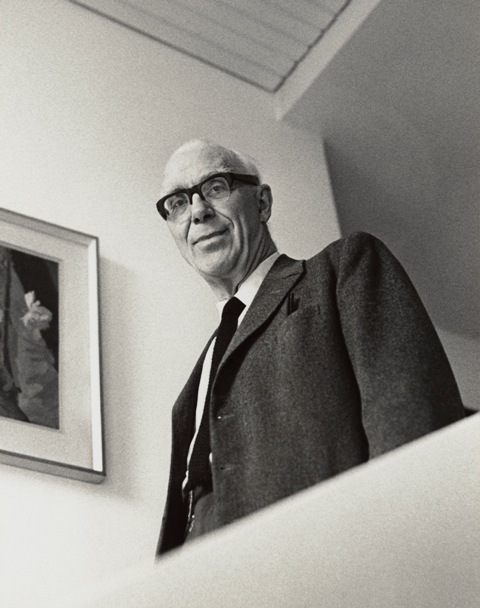
Master builder: Ove Arup

Posted on behalf of Jo Baker

Ove Arup by Godfrey Argent, 1969.

Ove Arup by Godfrey Argent, 1969.{credit}© National Portrait Gallery, London. Engineering the World: Ove Arup and the Philosophy of Total Design, the V&A Engineering Season.{/credit}

He was the structural innovator behind Sydney Opera House, founded the world’s leading engineering consultancy, and pioneered the philosophy of “total design” — the equal partnership of engineers, architects and designers in construction. Anglo-Danish engineer Ove Arup (1895-1988) is now celebrated in this first retrospective of his work, Engineering the World, at London’s Victoria and Albert (V&A) Museum, part of its Engineering Season.

On show are 150 never-before-exhibited sketches, technical drawings, architectural models, photographs, calculations and manifestos from a century of work by Arup and his colleagues at his eponymous consultancy, whose forerunner he set up in 1938. The compact show (funded by Arup) is squeezed into a room-sized cage of red steel beams copied from those of the Pompidou Centre in Paris, which Arup co-designed with architects Richard Rogers and Renzo Piano in the mid-1970s. The explanatory panels are worth scrutiny: they reveal Arup’s interest in science and early computing, his playful character and his enthusiasm for training the next generation of engineers.

Born in Newcastle, UK, Arup became interested in philosophy and engineering while at school in Denmark. He studied both disciplines at university in Copenhagen, graduating in 1922 with a specialism in reinforced concrete. Equally passionate about the arts, he was influenced by the Modernist movement — which promoted the idea that science and technology could improve society — and its luminaries, such as architects Le Corbusier (Charles-Edouard Jeanneret) and Walter Gropius, who founded the Bauhaus group.

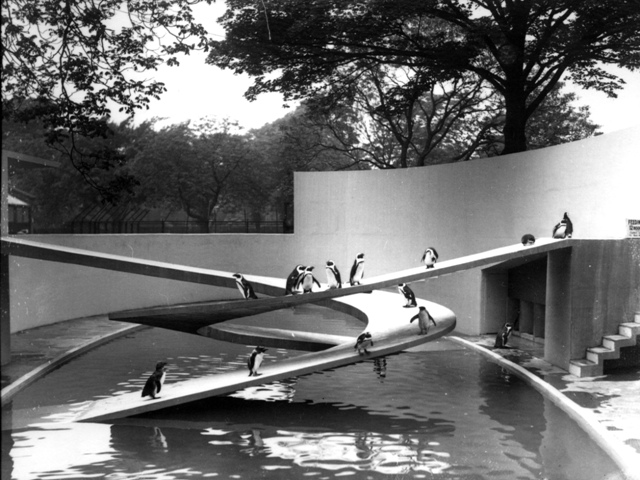
Penguin Pool, London Zoo, London, 1934.

Penguin Pool, London Zoo, London, 1934.{credit}© ZSL. Engineering the World: Ove Arup and the Philosophy of Total Design, the V&A Engineering Season.{/credit}

One of Arup’s early projects was the 1934 Penguin Pool at London Zoo. After studying penguin behaviour, he designed its thin gravity-defying spiral of interlocking ramps in concrete while working as a structural consultant for Berthold Lubetkin’s radical Tecton architectural partnership in London. The ramps’ curves were based on complex mathematics, and Arup’s calculations and notes are on display.

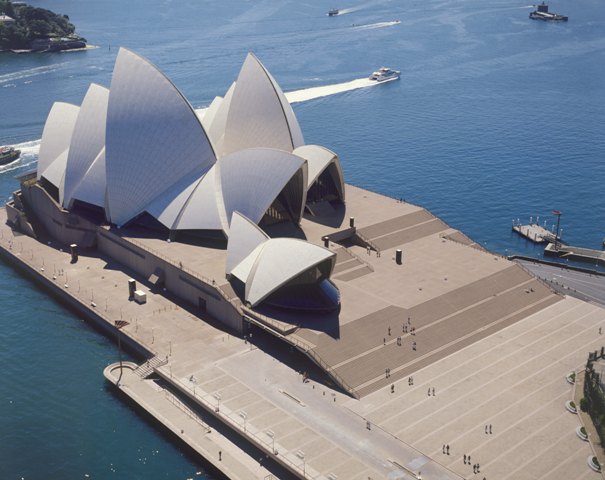
Sydney Opera House.

Sydney Opera House.{credit}© David Messent. Engineering the World: Ove Arup and the Philosophy of Total Design at the V&A Engineering Season.{/credit}

Arup had a strong sense of civic duty and designed air-raid shelters during the Second World War. His concepts were grand and controversial — massive concrete basements large enough to host hundreds of cars and people. (The government preferred small shelters.) Arup also worked on the Mulberry harbours, prefabricated temporary ports deployed during the 1944 Allied invasion in Normandy. He was responsible for a small but crucial element: a shock-absorbing fender that permitted the ships to dock. Photographs and technical drawings are on show.

Sydney Opera House is perhaps Arup’s most famous post-war project, and drawings and models of its design and construction form a focus of the exhibition. Faced with a freeform sketch of a collection of ‘sails’ by its Danish architect, Jørn Utzon, Arup pioneered the use of computers to solve the problem of how to build it from precast concrete. At the time most engineers still used slide rules and tables of logarithms. By renting a Ferranti Pegasus computer by the hour from the University of Southampton and writing their own software, Arup and his colleagues saved 10 years of manual calculations.

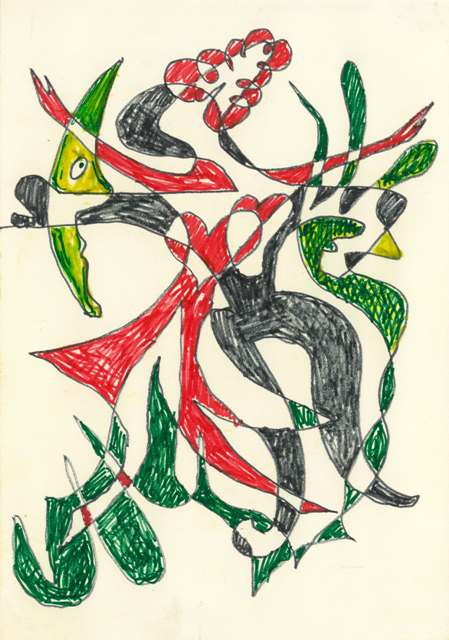
A doodle by Ove Arup.

A doodle by Ove Arup.{credit}© Private collection.{/credit}

The exhibition includes a wooden conceptual model explaining the solution he eventually conceived in 1961: sections cut from a sphere. A 2-metre-long wooden replica of the opera house used in wind tunnel tests is on show, along with charts illustrating airflow around it. When Utzon dropped out midway through the project, Arup took the construction to completion in 1973.

Arup eventually turned from engineering to shaping a new generation of engineers. In the 1970s and 80s successors emerged, including Peter Rice, Ted Happold and Mike Glover, who worked with architects including Piano, Rogers and Norman Foster on projects such as the Menil Collection gallery in Houston. A tilting model of the gallery — known for its naturally lit spaces — reveals how sun and shadows fall on the building through the day and year.

Engineering the World concludes with a look at the company today. Arup’s philosophy is still shared by its 12,000 employees in more than 90 offices around the world. A glass panel full of bubbling green liquid turns out to be a living façade where algae in an aerated soup of nutrients generate heat and biofuel. A section of wooden wall is part of a ‘wikihouse’ – a collaborative unfolding design for a home.

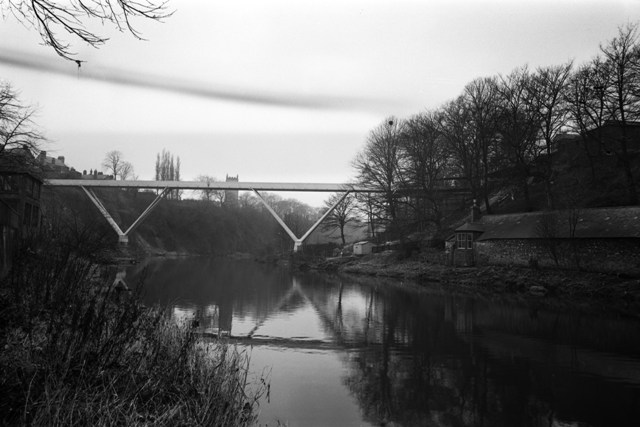
Arup’s ashes were scattered over a footbridge he designed: Durham’s Kingsgate, opened in 1963 and one of his favourites. He built it by rotating two halves into place — fittingly, for one whose creativity linked engineering and design.

View of Kingsgate Bridge, Durham, 1963.

View of Kingsgate Bridge, Durham, 1963.{credit}Reproduced by permission of Durham University Library. Engineering the World: Ove Arup and the Philosophy of Total Design at the V&A Engineering Season. {/credit}

Jo Baker is senior Comment editor at Nature.

Engineering the World: Ove Arup and the Philosophy of Total Design runs at the Victoria and Albert Museum, Cromwell Road, London, through 6 November. The V&A Engineering Season features displays, digital initiatives and a newly commissioned installation, Elytra Filament Pavilion, by experimental engineer Achim Menges with Moritz Dorstelmann, structural engineer Jan Knippers and climate-responsive engineer Thomas Auer. Inspired by filament structures of flying beetles’ forewing shells, the pavilion’s canopy is created from robotically fabricated carbon-fibre cells. Sensors in the canopy will capture anonymous data from the behaviour of visitors, allowing it to evolve.


For Nature’s full coverage of science in culture, visit www.nature.com/news/booksandarts.