Posted on behalf of Ewen Callaway
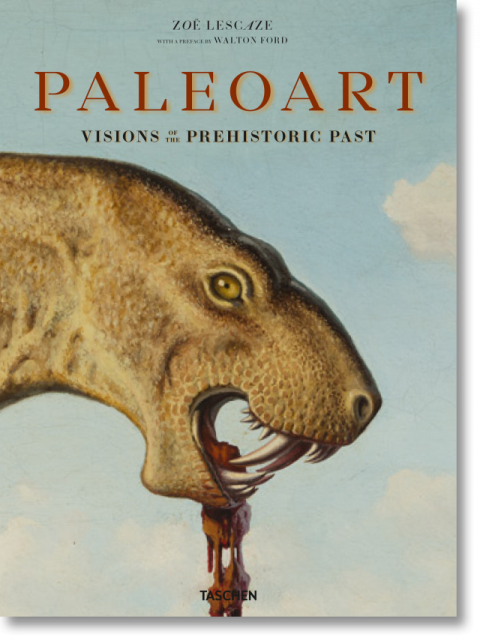 The term ‘paleoart’ might make many people think of fading ochre sketches of aurochs and other fearsome Ice Age animals in caves such as Lascaux, in southwestern France. That, however, is Palaeolithic art. Paleoart – graphic depictions of long-gone creatures and environments – is an oft-overlooked genre with roots in the early eighteenth century, when the study of extinct animal fossils took off, and both scientists and the public began to imagine a deep past.
In her striking new coffee-table book, Paleoart, writer and art critic Zoë Lescaze surveys images dating back to the nineteenth century. She ponders why mention of the genre still draws blank looks, concluding that it exists in a netherworld between fine art and natural history illustration, drawing inspiration from both but never fully belonging to either. This outsider status — and the fact that most of the details of its subject matter must be imagined (fossils have only recently begun to reveal the putative colouration of extinct animals) — freed paleoartists. They embraced the aesthetic of their eras, from Impressionism to Art Nouveau, and indulged their own idiosyncrasies, as the following illustrations reveal.

Duria Antiquior by Henry Thomas De la Beche (watercolour).{credit}Wikimedia Commons{/credit}
Ca. 1830
English geologist Henry Thomas De la Beche is credited with creating the first known depiction of the prehistoric world, Duria Antiquior. The original watercolour was inspired by fossils discovered on the Dorset coast near Lyme Regis, bolstered by a healthy dose of imagination. De la Beche sold lithographs of the work to help his friend, leading fossil hunter Mary Anning, support her family. (Anning was rarely credited by geologists and struggled financially.)

The Primitive World by Adolphe François Pannemaker (coloured engraving). The image served as the frontispiece for W. F. A. Zimmerman’s Le monde avant la création de l’homme (1857). {credit}Courtesy of Taschen{/credit}
1857
Although early paleoart was inspired by fossils, graphically it had much in common with illustrations of dragons that marked unknown territories in maps (as in, “Here be dragons”). Belgian engraver Adolphe François Pannemaker’s coloured engraving The Primitive World imagines a cataclysmic ancient realm of murky volcanism and nature at war.

Model-Room at the Crystal Palace by Philip Henry Delamotte.{credit}Courtesy of Taschen{/credit}
1853
Crystal Palace, a park and neighbourhood in southeast London, is famous for its ersatz concrete figures of dinosaurs and other extinct animals, such as the giant ground sloth Megatherium. On the day the attraction opened in June 1854, some 40,000 people arrived, and it was still drawing 2 million a year throughout the nineteenth century. What’s less known is the sculptures’ role in a major cultural and scientific battle. Their creation was overseen by Richard Owen, founder of London’s Natural History Museum and an opponent of evolutionary theory. Specifically, Owen sought to discredit the idea that animals became more complex over time, and instructed the sculptor Benjamin Hawkins to make the concrete beasts more closely resemble modern creatures such as lizards. This illustration, by artist and photographer Philip Henry Delamotte, depicts the ramshackle model room at Crystal Palace where Hawkins prepared his soon-to-be world-famous propaganda.

Laelaps by Charles R. Knight.{credit}Courtesy of American Museum of Natural History, New York{/credit}
1897
American palaeontology of the late nineteenth century was dominated by Othniel Charles Marsh and Edward Drinker Cope, whose 25-year feud over access to palaeontology sites and the glory accompanying new finds came to be known as the Bone Wars. Artist Charles R. Knight’s Laelaps, which portrays a death duel between two dinosaurs of a genus now known as Dryptosaurus, is widely believed to be a not-so-subtle reference to Cope and Marsh’s mutual enmity.

Study for the Age of Reptiles by Rudolph Zallinger (tempera).{credit}Courtesy of the Peabody Museum of Natural History, Yale University, New Haven{/credit}
1943
The Age of Reptiles, a fresco in the Great Hall of Yale’s Peabody Museum of Natural History in New Haven, Connecticut, is paleoart’s poor-man’s version of Michelangelo’s Sistine Chapel paintings. Rudolph F. Zallinger spent four years painting the mural, which was completed in 1947, after the Second World War. Lescaze speculates that the dark mood of those times may have seeped into that final work, in comparison with the vivid 3-metre-long study Zallinger had completed in 1943, shown here. The depiction of a Tyrannosaurus rex in the finished piece, she writes, “is like a case of plastic surgery gone wrong: the dinosaur’s skin is pulled taut to the point of losing its expressiveness and realism”. Zallinger was back on form in 1953, when he completed the 18-metre Age of Mammals mural for the museum.

Tyrannosaurus and Edmontosaurus by Ely Kish (oil).{credit}Eleanor Kish, © Canadian Museum of Nature{/credit}
1976
Ely Kish, an American-born artist who died in 2014, worked at a time when scientists were documenting human-caused destruction such as climate change, biodiversity loss and marine pollution. Mass extinctions, death and violence were a regular theme in her dynamic, dramatic oil paintings, such as Tyrannosaurus and Edmontosaurus.
Ewen Callaway is a senior reporter for Nature based in London. He tweets at @ewencallaway. Paleoart is published by Taschen (2017).
For Nature’s full coverage of science in culture, visit www.nature.com/news/booksandarts.