Raising Horizons: women in science reframed

Posted on behalf of Elizabeth Gibney
Mary Anning

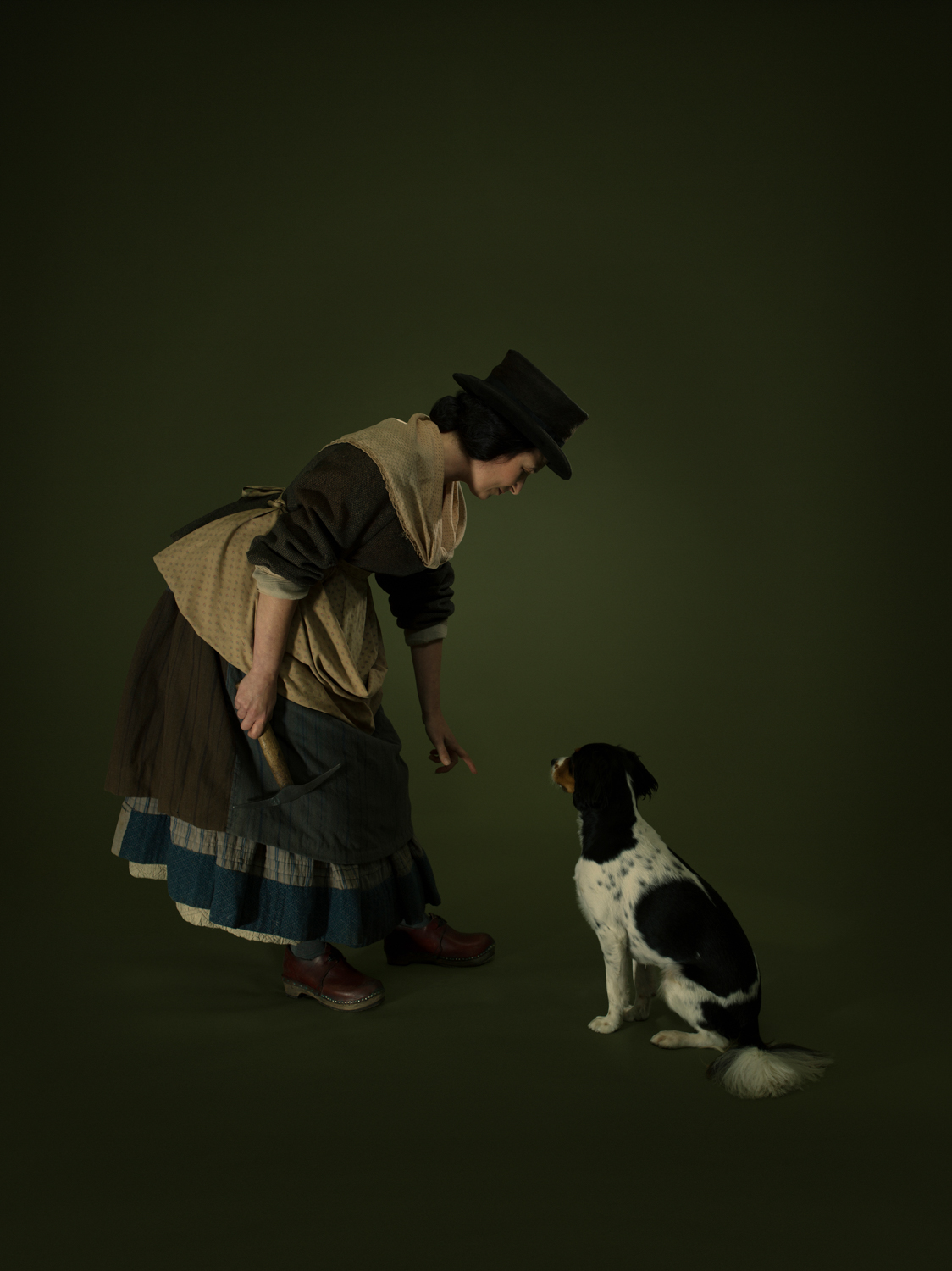
Victorian fossil hunter Mary Anning, posed by earth sciences curator Lorna Steel.{credit}Leonora Saunders{/credit}

Women in geoscience today can be struck by the paucity of their predecessors in the scientific record. This month, an exhibition helps to redress the balance: portraits celebrating 200 years of pioneering work by women archaeologists, palaeontologists and geologists, on display at London’s Geological Society library.

Raising Horizons — created by photographer Leonora Saunders and science outreach group TrowelBlazers — celebrates 14 women scientists, from fossil-hunter Mary Anning (1799-1847) to underwater archaeologist Honor Frost (1917-2010). The twist is that the portraits are photographs in which present-day scientific counterparts enact these historical luminaries. Thus Lorna Steel, senior curator in earth sciences at London’s Natural History Museum, is dressed as Anning out collecting with her dog Tray, and maritime archaeologist Rachel Bynoe is shown as Frost emerging dripping after a ‘wreck dive’ in the Mediterranean.

Underwater archaeology pioneer Honor Frost, portrayed by scientific counterpart Rachel Bynoe.

Underwater archaeology pioneer Honor Frost, portrayed by scientific counterpart Rachel Bynoe.{credit}Leonora Saunders{/credit}

Saunders, known for her work on gender and equality, has shot these portrayals of glass-ceiling smashers and adventurous field scientists in rich hues and with deep-green backdrops. They evoke oil paintings — an honour accorded to few of these formidable professionals during their lifetimes.

Most are portrayed at work. Geologist Catherine Raisin (1855-1945), modelled by pioneering geoconservationist Cynthia Burek, scrutinises a geological map. Archaeologist Shahina Farid — who was field director at Turkey’s Neolithic site Çatalhöyük for 17 years — appears as renowned archaeologist of Neolithic culture Kathleen Kenyon (1906-1978), pausing for breath at the excavation of Great Zimbabwe in the 1930s.

Archaeologist Shahina Farid - former field director at Turkey's Çatalhöyük site - as Kathleen Kenyon, who helped to excavate Great Zimbabwe.

Archaeologist Shahina Farid – former field director at Turkey’s Çatalhöyük site – as Kathleen Kenyon, who helped to excavate Great Zimbabwe.{credit}Leonora Saunders {/credit}

With Saunders, the four TrowelBlazers scientists — archaeologists Suzanne Pilaar Birch and Rebecca Wragg Sykes, bioarchaeologist Brenna Hassett and palaeobiologist Victoria Herridge — dug into archives for each portrayal. Period artefacts, such as the 1930s field camera Farid is holding, were used in some of the photos. The period class system is also on show. Geologist Charlotte Murchison (1788-1869), portrayed by earth scientist Natasha Stephen, wears a glamorous evening gown; Murchison’s contemporary, the working-class Anning, a simple dress and clogs.

“There are so many other people I could have chosen,” says Wragg Sykes, who selected subjects from almost 150 biographies accumulated by Trowelblazers. Although many of the women featured in the press, their names rarely made it into scientific publications, says Amara Thornton, the social historian of archaeology who portrays Margaret Murray (1863-1963), Britain’s first female archaeology lecturer.

Mary Leakey, the archaeologist who found the famous “Zinjanthropus” fossil, portrayed by specialist in Neanderthals Ella Al-Shamahi.

Mary Leakey, the archaeologist who found the famous “Zinjanthropus” fossil, portrayed by specialist in Neanderthals Ella Al-Shamahi.{credit}Leonora Saunders{/credit}

A highlight is Dorothy Garrod (1892-1968), an archaeologist who led digs at the prehistoric Mount Carmel site in Palestine and discovered an important Neanderthal skull at Gibraltar in the 1920s. Archaeologist Nicky Milner captures Garrod in intense concentration, examining a stone tool.

The exhibition does a fine job of emphasising just how long women have made key advances in these arduous fields. Like the Bearded Lady Project — which also celebrates female earth scientists — Raising Horizons indicates that the Indiana Jones stereotype could be on the wane. And the success of the Academy Award-nominated film Hidden Figures – about African-American female mathematicians whose calculations were crucial to the space race – shows a public appetite for such stories.

Social historian of archaeology Amara Thornton as archaeologist Margaret Murray, shown in the process of unwrapping a mummy.

Social historian of archaeology Amara Thornton as archaeologist Margaret Murray, shown in the process of unwrapping a mummy.{credit}Leonora Saunders{/credit}

The lives of many of Raising Horizons’ subjects are intertwined, as the women taught, mentored or worked alongside each other. A large part of Trowelblazers is about encouraging such networks today, says Wragg Sykes. Judging from the lively launch event – which, refreshingly, buzzed with children and babies, as well as women and men – they seem to be succeeding.

The scientists in these portraits are a diverse group representing generally white, wealthy historical predecessors. In terms of inspiring a new generation of trowel-wielding women, diversity in role models is essential, says Wragg Sykes. As the Trowelblazers put it, “If you can’t see it, you can’t be it”.

Geologist Catherine Raisin scrutinising a geological map, posed by geoconservationist Cynthia Burek.

Geologist Catherine Raisin scrutinising a geological map, posed by geoconservationist Cynthia Burek.{credit}Leonora Saunders{/credit}

Saunders says the photos were designed with the learned society setting in mind. Mounted high around the rail of the library, the intent is literally to ‘raise horizons’, slipping these scientists’ legacies back into positions in history they should already hold. But these images are so absorbing that I’d also hope to see them in larger formats when the exhibition tours Britain, and at eye level. That way young women contemplating the life scientific can ‘meet’ these inspiring researchers face to face.

Elizabeth Gibney is a reporter on physics for Nature based in London. She tweets at @LizzieGibney. Raising Horizons will run at The Geological Society, London, until 28 February. It will then set off on a UK tour, to include the University Women’s Club, London, the Lyme Regis Fossil Festival and the Women of the World festival in Chester.


For Nature’s full coverage of science in culture, visit www.nature.com/news/booksandarts.
From tin men to Terminator: Robots reviewed

Posted on behalf of Celeste Biever

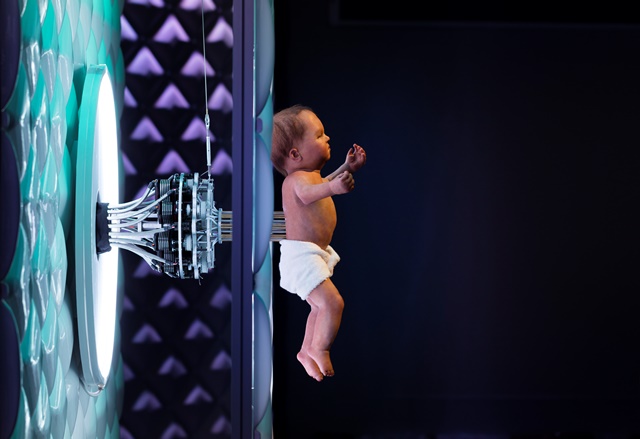
Animatronic baby, John Nolan Studio

Animatronic baby, John Nolan Studio.{credit}Plastiques Photography, courtesy of the Science Museum{/credit}

The baby’s skin looks soft and its hair downy as it blinks and stretches out its arms. Then I spot the plug and mass of wires protruding from its back.

Brainchild of London-based John Nolan Studio, the animatronic infant is a fitting start to the blockbuster Robots exhibition at London’s Science Museum. Its impressively comprehensive array of automatons is a reminder both of machine-like qualities in people, and of the challenges of imitating humans in mechanical form.

Historical automata crowd the first section, ‘Marvel’. A small, hand-carved mechanical monk from the 1560s was crafted to walk and beat its breast in contrition. Is this really a robot? Yes, says chief curator Ben Russell, who has long pondered this question: “A robot is a machine that looks life-like or behaves in life-like ways.” This summary proved a tough but useful curatorial filter, he says.

Clockwork 'Silver Swan', John Joseph Merlin, 1773.

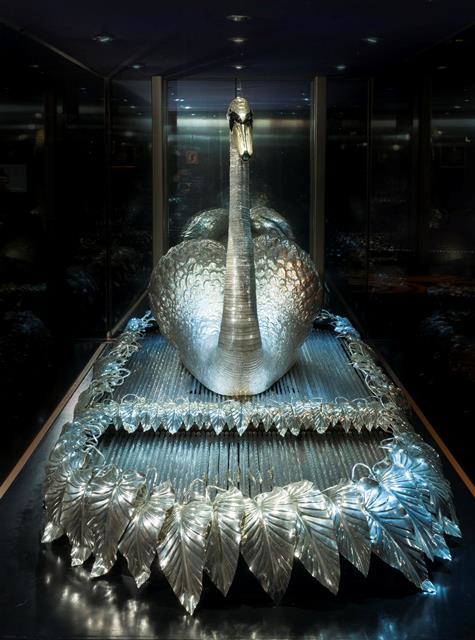
Clockwork ‘Silver Swan’, John Joseph Merlin, 1773.{credit}The Board of Trustees of the Science Museum{/credit}

Another highlight here is the Silver Swan, a life-sized clockwork bird on a glass pool crafted in 1773 by Belgian inventor and instrument-maker John Joseph Merlin, whose work inspired Charles Babbage. (The automaton is on loan from the Bowes Museum in county Durham, northern England.) In his 1869 travelogue The Innocents Abroad, American writer Mark Twain noted the avian wonder ‘swimming’ as “comfortably and unconcernedly as if he had been born in a morass instead of a jeweller’s shop”. The lifelike movements of its serpentine neck still impress – but visitors beware: to preserve the delicate machine, it will only play at certain times.

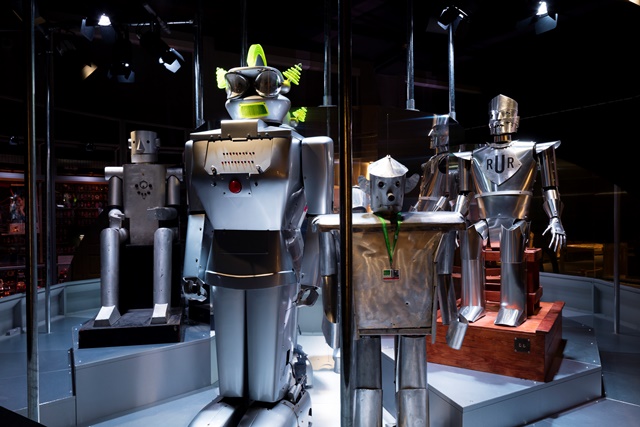
Classic twentieth-century robots Sitting Robot, Cygan, George and Eric (left to right).

Classic twentieth-century robots Sitting Robot, Cygan, George and Eric (left to right).{credit}Plastiques Photography, courtesy of the Science Museum.{/credit}

A clutch of robots classiques includes an impressive collection of dumb but engaging tin-giants dating back to the 1920s. Eric is arguably the star. The replica we see was commissioned for the exhibition and paid for by a Kickstarter campaign. Amateur engineer William Richards and mechanic Alan Reffell built the original Eric in 1928 for the annual Society of Model Engineers exhibition in London, where it a gave a speech as a stand-in for the Duke of York. Its feet bolted to a 12-volt electric motor, Eric could also stand, sit down and move its arms.

As I gaze at a Terminator from 2009 film Terminator Salvation, I’m reminded of how popular culture, as well as science and engineering, shaped the modern concept of a robot. The intimidating android “had to be there”, says Russell. “This is what people think a robot is like.”  Another delight for aficionados is a 1923 first-edition copy of Czech writer Karel Čapek’s play R.U.R. (Rossum’s Universal Robots), which coined the word ‘robot’.

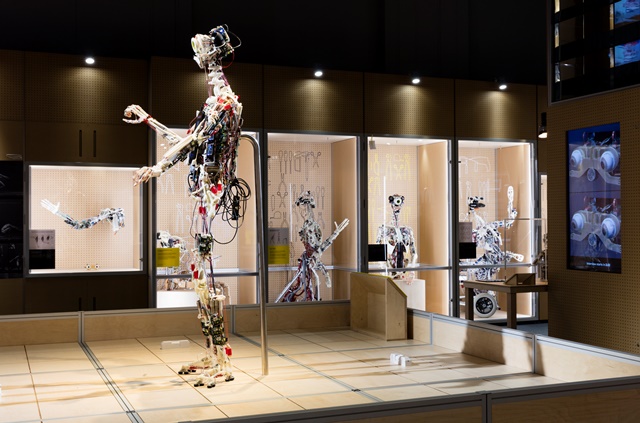
ECCEROBOT, Rob Knight and Owen Holland, 2004-2011.

ECCEROBOT, Rob Knight and Owen Holland, 2004-2011.{credit}Plastiques Photography, courtesy of the Science Museum.{/credit}

It’s one thing to dream, quite another to construct. The reality check is a gaggle of bots from a range of top labs — experiments shedding light on what it means to be human. Here are multiple versions of the life-sized ECCEROBOT (Embodied Cognition in a Compliantly Engineered Robot), each a skeletal display of tendons and bones. Built by robotics engineer Rob Knight, cognitive roboticist Owen Holland and the ECCEROBOT Consortium between 2004 and 2011, the series explores embodied cognition: how the structure of the human body shapes the evolution of intelligence and consciousness.

Juxtaposing several attempts at creating bipeds, this section also showcases the joy of tinkering. Honda’s well-resourced P2, unveiled in 1996, was the first full-bodied robot to walk on two legs. It stands next to the Shadow Biped — a pair of legs snaked through with wires and gauges, developed by inventor Richard Greenhill and other members of the Shadow Robot Project Group in a London attic from 1987 to 1997. (It managed a few wobbling steps.) The group evolved into the Shadow Robot Company, makers of the dexterous robotic hand on display.

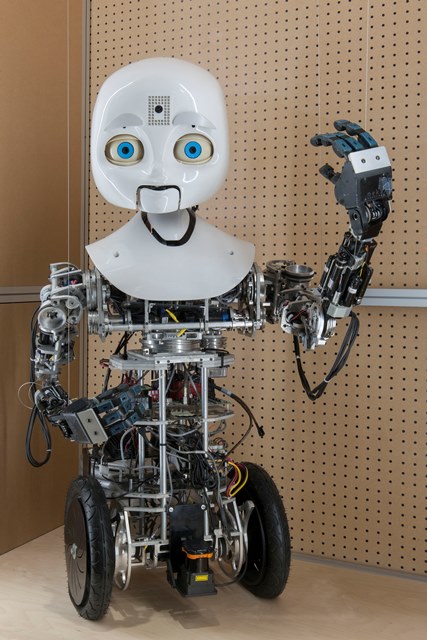
Nexi, Cynthia Breazeal, 2008.

Nexi, Cynthia Breazeal, 2008.{credit}The Board of Trustees of the Science Museum.{/credit}

The show’s research chops are also evident in the inclusion of Cog, the Massachusetts Institute of Technology project led by robotics pioneer Rodney Brooks that ended in 2003. The exhibit only features Cog’s head – a mess of wires and metal. While it’s not visually arresting, I was thrilled to see Cog: it was built to address the fascinating, once radical, question of whether human level intelligence could emerge from physical interactions with the environment, without any higher-level programming.

The emerging field of human-robot interaction gets a look-in with Inkha, built by Matthew Walker and Peter Longyear at King’s College London. A pair of bulbous eyes and rubbery lips attached to a metal frame, it served as a receptionist at King’s between 2003 and 2014. And the freakish, blue-eyed Nexi was built in 2008 by human-robot interaction pioneer Cynthia Breazeal of MIT. Through its ability to carefully control movements such as face-touching, Nexi was used to study the role of non-verbal communication.

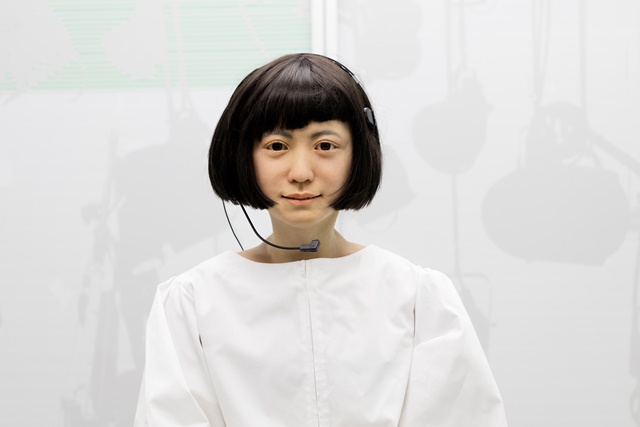
Robot child Kodomoroid, Hiroshi Ishiguro Laboratories.

Robot child Kodomoroid, Hiroshi Ishiguro Laboratories.{credit}Plastiques Photography, courtesy of the Science Museum.{/credit}

Today, of course, robots have escaped the lab, showing up in factories, homes and even clinics.  As I trek through the last room, a corridor lined with a range of humanoids already out in the real world, I ponder how robots will evolve next. Will they become ever more realistic, like the alarmingly life-like robot child Kodomoroid? Its creators at Hiroshi Ishiguro Laboratories in Japan have used such ‘geminoids’ — android ‘twins’ of real individuals — to monitor reactions when compared with the human originals. Robo-toddler Kaspar, by contrast, makes a virtue of robotic limitations. Its creators at the University of Hertfordshire are examining how children with autism,  who can be overwhelmed by diverse facial expressions, react to Kaspar’s much simpler, carefully controlled mannerisms.

This is a timely show, in a society now grappling with the implications of the robot invasion, enabled by speedily evolving, hyper-sophisticated machines. It does a beautiful job of demonstrating robotics’ embarrassment of riches and how humanity got here, powered at first by belief, then dreams and most recently hardcore research and engineering. The question that scientists, engineers, consumers and industry now have to answer is: where do we point this formidable engine?

Celeste Biever is Nature’s chief news and features editor. She tweets at @celestebiever.

Robots runs at London’s Science Museum from 8 February to 3 September.


For Nature’s full coverage of science in culture, visit www.nature.com/news/booksandarts.
Waltzing for science

Posted on behalf of Quirin Schiermeier

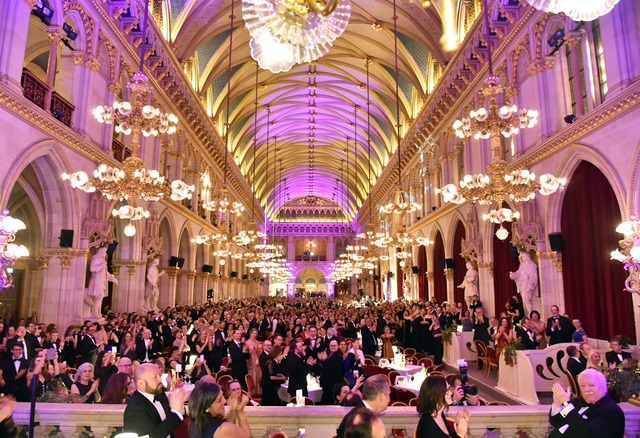
The Vienna Science Ball 2017, in the city's Town Hall.

The Vienna Ball of Sciences 2017, in the City Hall.{credit}©PID/Christian Jobst{/credit}

Around midnight on 28 January, hundreds of couples lined up in the splendid ballroom of the Vienna City Hall for the quadrilles — and the Vienna Ball of Sciences became tangibly interdisciplinary. Students, scientists and scholars of myriad fields whose paths would scarcely cross in daily academic life moved gracefully to the waltzes of the younger Johann Strauss. Laughter filled the air as rows of elegantly clad dancers performed (in reasonably perfect composure) the bows and figures of the traditional courtly dance.

Balls are the very hallmark of Vienna’s social life and an essential part of its cultural identity. Some 450 take place during January and February. Many trades and professions – from hunters to physicians – proudly hold their own in splendid venues such as the Hofburg, Vienna’s imperial palace. However, the city’s growing and increasingly international research community, currently numbering about 220,000 people, had long been standing aloof from the parallel world of its ball society.

That changed in 2015 when Oliver Lehmann and Alexander Van der Bellen launched an annual Vienna science ball. “We wanted to set a counterpoint to ultra-conservative student corps and the academic ball they organize,” says Van der Bellen, the former Green politician and economist who last week took office as Austria’s new president. “Vienna’s liberal science community absolutely deserves a wonderful ball of their own, we thought.”

Promoting diversity

Lehmann, a public relation expert with the Institute of Science and Technology (IST Austria) in Klosterneuburg near Vienna, says that Vienna’s balls tend to be high-level political affairs that have in the past drawn violent protests from some on the extreme left, who deem them elitist. But the science ball promotes diversity, reaching out to students and researchers from all academic disciplines and institutions. Like Berlin’s Falling Walls conference, held every November to commemorate the divided German city’s 1989 reunification, it is a clever attempt to associate a big city’s science base with its most distinguished cultural characteristics.

And the sold-out event was ample proof that the organizers had hit a nerve. The 3,000-strong crowd happily waltzed, tangoed and foxtrotted the night away in environs that subtly alluded to science. Light-emitting diodes illuminated dancers’ moves to stunning effect; tables were decorated with supposedly aphrodisiac plants (pomegranate, celery, orchids) selected by botanists at the University of Vienna’s department of pharmacognosy; and young artists with Vienna’s Academy of Fine Arts had covered the walls with expressive paintings.

Bundespräsident Van der Bellen, Bürgermeister Häupl und Stadtrat Mailath-Pokorny eröffnen den Ball der Wiener Wissenschaft

Austrian president Alexander Van der Bellen opens the Vienna science Ball. In the background are Oliver Lehmann of the Institute of Science and Technology (right), and Wolfgang Ortner, the conductor of the ball’s orchestra (left).{credit}©PID/Christian Jobst{/credit}

Those more inclined to test the laws of probability theory were offered a chance to do so at two roulette wheels. On large screens, researchers with the Ludwig Boltzmann Institute of Archaeological Prospection and Virtual Archaeology displayed the results of their geomagnetic prospection and ground-penetrating radar measurements of Stonehenge. And at the tables, animated discussions ranged over science and the arts. How often does it happen in academe that a pensive researcher on African cultural identity exchanges ideas with a tipsy quantum physicist about Arthur Schopenhauer’s philosophy of pessimism?

Computer scientist Thomas Henzinger, director of IST Austria and a member of the ball’s honorary committee, is not someone inclined to indulge in rambling sophism. He says he doesn’t even care much for ballroom entertainment, but he does agree that the ball raises Vienna’s profile as a cosmopolitan city of science. Vienna and Austria, he says, benefit a lot from the influx of talent from Eastern Europe and other countries. At the IST, launched in 2009, less than a fifth of 600 staff — and only 5% of postdocs — are Austrian, he says.

Isn’t a ball a bit jingoistic for such a global profession? “Nationalism is the very last thing I support,” Van der Bellen told me, speculating that Europe could soon become a haven for US scientists and intellectuals escaping the Trump administration. “I do appeal to all young scientists, here and around the world, to resist chauvinism and stand up for liberal values.”

As the scientists had a ball, anxiety about world politics became distant concerns — for a few hours. Some had travelled from as far as China to join the fun; many pledged to come again. Tickets for next year’s Science Ball go on sale on 15 November.

 Quirin Schiermeier is senior reporter for Nature in Munich. He tweets at @tomboy180463.


For Nature’s full coverage of science in culture, visit www.nature.com/news/booksandarts.