Posted on behalf of Martin Charter
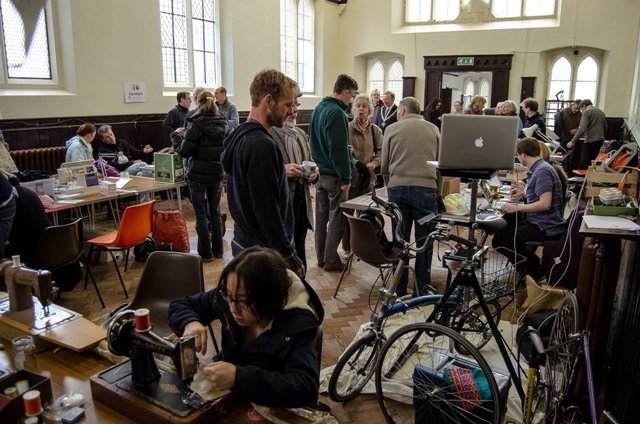
The Farnham Repair Cafe in Surrey, UK – one of over 1,000 community repair and recycling initiatives in the global Repair Cafe movement.{credit}Farnham Repair Cafe{/credit}
A few decades ago, a broken radio, fan or kettle generally triggered a trip to the repair shop. Now, it often means a journey to the dump. In Britain alone each year, over 2 million tonnes of waste electrical and electronic equipment are discarded; in Europe and the United States, repair services have been in decline for some decades. This ‘take, make and dispose’ approach sits uncomfortably with shifts towards closed-loop thinking and policy, such as the European Commission (EC) package on the circular economy, which emphasises repair, recycling and reuse.
For the past six years, a quiet repair revolution has been unfolding globally. Keen to drive local-level sustainability, Dutch journalist Martine Postma launched the Repair Café movement in Amsterdam, the Netherlands, in 2009. The next year, fired by its success, she set up the non-profit Repair Café Foundation to provide guidelines.
There are now 1,003 centres worldwide, with hundreds in Belgium, Germany and the Netherlands and 18 in Britain. Each is a community hub where local residents can bring in broken items and get them repaired for free, as well as network, learn skills, socialise and help others. Local expertise, tools, repair manuals and materials are all on hand. Melding education, social inclusivity, ‘sharing economy’ practices and sustainable action, the cafés have become nodes in the circular economy, teaching its principles from the bottom up.
In early 2014, The Centre for Sustainable Design ® (CfSD), which I head at the University for the Creative Arts (UCA) in Farnham, Surrey, completed the first survey into the circular economy aspects of Repair Cafés and Hackerspaces — places where the global community movements for repairing and ‘hacking’ (modifying) products come together to share knowledge and skills. The research results prompted CfSD to launch the Farnham Repair Café (FRC), a local non-profit organisation involving Transition Town Farnham (TTF), in February 2015. (This collaboration fuses CfSD’s experience in developing a range of innovative sustainability projects over two decades, and TTF’s local networks related to food and cycling. The Farnham Hoppers, for instance, cultivate hop plants for local brewers, while the largely volunteer-run Farnham Local Food project grows pesticide-free vegetables for sale to the community.)
The FRC offers a monthly ‘place and space’ for locals to “share in the repair”. To date, more than 500 people have participated, and over 120 items — vacuum cleaners, headphones, lamps, baby strollers and bicycles — have been repaired. That represents a diversion from landfill of near 450 kilograms of stuff, with an average repair rate within the 2.5-hour sessions of nearly 60%.
![graph-1[2]](https://blogs.nature.com/aviewfromthebridge/files/2016/03/graph-12.jpg "graph-1[2]")
{credit}The Centre for Sustainable Design ®, University for the Creative Arts, Farnham, Surrey. Graph from Scott Keiller and Martin Charter (2015) Repair Cafés: Implications for Product Developers and Designers.{/credit}
I am observing the emergence of a grassroots movement of makers, modifiers and fixers empowered by a new can-do attitude, social networking, massive access to online information and instructional videos. Beyond repair, recycling and upcycling, this sustainable community experiment shows the real ‘Big Society’ at work – people with technological skills wanting to give back to the community, and a technologically proficient, sharing community emerging.
Martin Charter is director of The Centre for Sustainable Design ®, UCA Farnham, and cofounder of the Farnham Repair Café, Surrey, UK.
Listen in to a podcast with Martin Charter and Product-Life Institute founder and director Walter Stahel here, and see a video on the Farnham Repair Café here. Nature‘s circular-economy special can be accessed here. For Nature’s full coverage of science in culture, visit www.nature.com/news/booksandarts.