The Colorado: elegy for an overused river

Posted on behalf of Monya Baker
The Colorado River

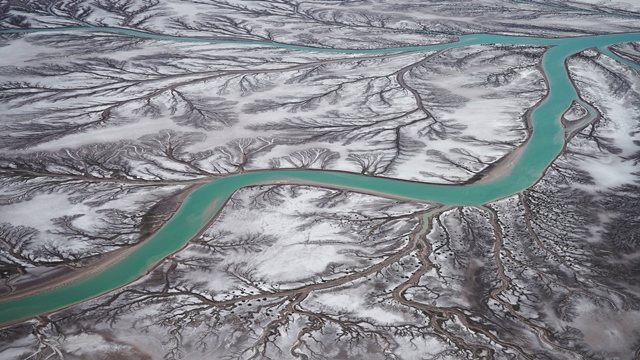
Tidal waters in the delta region of the Colorado River.{credit}Murat Eyuboglu{/credit}

The Colorado River in the US West proves the adage that you never step into the same river twice. Lined by a vast array of landscapes, communities and industries it has shaped, its waters run variously aqua, navy blue, muddy brown — or not at all. Over its 2,334 kilometres, it sustains some 40 million people, 2 million hectares of farmland and the Hoover Dam. It is also polluted, depleted, diverted.

Now this mighty waterway is celebrated in The Colorado — a music-based documentary that delivers a powerful environmental and social message. Produced by VisionIntoArt, the project brings together several composers including Paola Prestini and live performance ensemble Roomful of Teeth, among others. (See below for the trailer.)
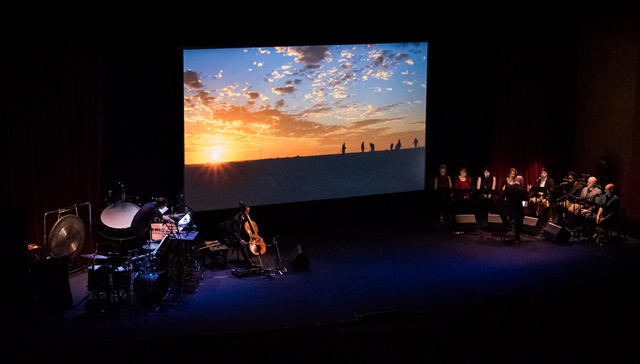
Glenn Kotche and Jeffrey Zeigler performing at the New York premiere of The Colorado.

Glenn Kotche and Jeffrey Zeigler performing at the New York premiere of The Colorado.{credit}Jill Steinberg{/credit}

At a pre-show talk on 22 April at Stanford University in Palo Alto, California, the project’s director Murat Eyuboglu noted that his inspiration was the story of the Salton Sea in California’s Colorado Desert. This huge inland lake was created by accident in 1905, when engineers’ plans for irrigation canals succumbed to the river’s might. Now saltier than the Pacific Ocean, the lake is filled with toxic sludge and hosts acres of deserted lakeshore development, yet is essential habitat for migrating seabirds. “I’ve never seen so much beauty and devastation cohabiting in one place,” said Eyuboglu. That sentiment holds for the film as well.

Eyuboglu’s interest in the Salton Sea led him to contact writer William deBuys, who has chronicled the natural histories of water in the region in books such as Salt Dreams (coauthored with Joan Myers). DeBuys signed on to advise Eyugoblu on the project, then became his co-scriptwriter and lyricist. Filmed over four years (and 20 trips into the river’s drainage basin), their documentary meanders from the artificially fertile fields of Imperial Valley to the artificially parched expanses in the Sonoran Desert as well as the Salton Sea.
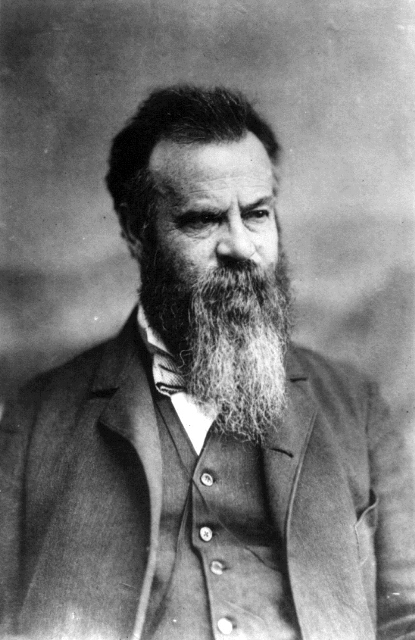
Geologist John Wesley Powell, the first to explore the Colorado River for scientific purposes.

Geologist John Wesley Powell, the first to explore the Colorado River for scientific purposes.

The work is divided into nine sections. Each begins with a narrative introduction by actor Mark Rylance, grounded in stories of people who explored, exploited or were exploited by water-fueled power. After the narration stops, we are steeped in stunning cinematography and archival footage.

The first to explore the Colorado for scientific purposes was noted geologist and Civil War veteran John Wesley Powell. (During that conflict Powell, who lost an arm in combat, would instruct his soldiers to watch out for fossils while digging trenches.) On his first, grueling three-month 1869 expedition, Powell recognized that the river had cut through millennia, pronouncing the region “a Book of Revelations in the rock-leaved Bible of geology” that he was determined to read. Mapping the basin, Powell made a coherent case that political units should follow the same boundaries, to balance the needs of those dwelling upstream and downstream at a time when land speculators carved property for their own benefit. That lost opportunity is repeatedly apparent in the film.

Another story is that of David Brower (1912-2000). Founder of environmental organisations including Friends of the Earth and first head of the Sierra Club, Brower successfully fought to stop a dam slated to flood the Dinosaur National Monument in Colorado and Utah. He proposed Glen Canyon as an alternative, despite never having seen it. After mapping Glen Canyon, he realised that burying its magnificent rock “cathedrals in the desert” and thousands of ancient indigenous sites under what is now Powell Lake would go down as the biggest US environmental mistake in history — and admitted his part in it. We see footage of the canyon being dynamited pre-dam, run backwards. Witnessing the canyon walls reform, we feel what has been lost.

In other sections, we see the tons of produce grown in Imperial Valley, irrigated by the river and harvested mainly by farm labourers from Latin America. Finally, we glimpse the nearly bone-dry delta of the Colorado in Mexico. With farms and industries each due a cut of “liquid property”, the water generally fails to reach the sea despite governmental efforts. The delta’s former fecundity is now relegated to the memories of octogenarians.

The Colorado is, for the most part, emotionally and intellectually rich — sometimes too much so. At one point, I missed a series of explanatory texts on screen because I was pondering the source of the sound accompanying them — it was, I eventually realized, the cellist striking his bow alternately on the instrument’s base and a plastic water bottle. Birdsong at the start of one segment is the call of the canyon wren, whose characteristic trill inspires a vocal piece later on. But I would not have recognized either fact without the pre-show talk.

The river is disappearing under the constant demands of civilization, yet is beautiful even in decline. The film closes with a Yuman poem, once description, now wish. “This is my water, my water… It shall flow forever.”

Monya Baker writes and edits for Nature from San Francisco, California. She tweets at Monya_science. The Colorado will travel to Washington DC in March 2018, as part of the Kennedy Center’s inaugural season of Direct Current, a celebration of contemporary culture. View a trailer for The Colorado here. A Nature Q&A with Paola Prestini can be found here.


For Nature’s full coverage of science in culture, visit www.nature.com/news/booksandarts.

The making of science

Posted on behalf of Jo Baker

Make-Shift-lock-up-1_eps fin4Scientists are makers. The specialized skills they hone in the lab over many years – from assembling robots and circuits to growing microbes and cells – mirror the practices of artisans such as seamstresses and potters. Chemists may melt, stretch and snap a glass tube to make a pipette. Jewellers rearrange silver atoms each time they warm the metal to anneal or soften it.

Bringing together makers of all stripes to innovate was the focus of MAKE:SHIFT, a two-day biennial conference this month in Manchester’s Museum of Science and Industry, home to Charles Babbage’s loom-inspired computing machines. Scientists and designers explored in talks, panel discussions and demonstrations how joint working can advance sustainability, healthcare and communities.

Across smart materials, biodesign, wearable electronics and more, the speakers showed how such collaborations have led them to think and work differently. They explored emerging trends, such as 3D printing and small-scale production. And they asked big questions, such as how the concepts of craft and making have become lost in today’s digital world of instant gratification, yet remain central to hatching new models and cultures of innovation. The following insights and individuals stood out.

Tools and workshops are increasingly accessible, linked and powerful. Fabrication labs or ‘fab labs’ – where members of the public and skilled experts recycle furniture or even edit genes – are proliferating. There are now 700 around the world. And 16 cities (including Barcelona, Boston in the US and Shenzhen) have signed up to become ‘fab cities’– aiming to produce locally 50% of what they consume by 2054. Online networking and exchanges of experience between make spaces is increasing, linking know-how in California with needs in Cape Town, for example.

Small-scale manufacturing is on the rise, aided by the Internet and cheaper production technologies such as 3D printers. Digital blueprints allow anyone with such means to construct furniture or even houses locally. Generic designs can be customized. Garment patterns that can be tweaked and knitted on demand avoid wastage. Customers increasingly care where their products come from, and value sustainability, social good and ethical work practices.

The nature of materials is being rethought. Bio-materials such as fungal webs (mycelium) can be used to ‘grow’ bricks, pots and even dresses on wood-chip, clay or textile frames. Amsterdam-based ecodesigner Maurizio Montalti of Officina Corpuscoli described how, after working with University of Utrecht microbiologists on scaling up these fungal creations, his studio began to look more like a lab. University College London materials scientist Mark Miodownik invoked a future devoid of roadworks if self-healing asphalt becomes reality.

Fungal Futures: a selection of mycorrhyzal materials by Maurizio Montalti for Officina Corpuscoli.

A selection of materials grown directly from fungi by Maurizio Montalti for Officina Corpuscoli.{credit}Fungal Futures © Maurizio Montalti-Officina Corpuscoli, 2016{/credit}

The Anthropocene offers new geologically inspired materials. ‘Fordite’, or ‘detroit agate’,  is made from fine layers of hardened car paint and can be cut and polished like semi-precious stone. We may one day dig up deposits of ‘bone marble’, retrieved from the metamorphosed skeletons of culled farm animals. The fashion industry is the second most polluting in the world, but sportswear company Adidas is scooping waste plastics out of the ocean to make its knitted footwear.

Crafts people are sensitive to people’s emotional responses to materials and objects. Yet few designers are included in research teams examining interactions between robots and humans, for example. Caroline Yan Zheng from London’s Royal College of Art is using soft robotics to make wall panels and accessories that swell or reshape in response to facial emotions. People tell her they find them comforting; one day they might be used to promote calm in hospitals.

Caroline Yan Zheng's soft robotic artefact prototype #4, exploring the performativity of kinetic silicone soft robotics.

Caroline Yan Zheng’s soft robotic artefact prototype #4, exploring the performativity of kinetic silicone.{credit}Caroline Yan Zheng, 2016{/credit}

Surgery is a craft – you don’t want your operation done by someone who has only read a book. Richard Arm from Nottingham Trent University brought in gorily realistic models of parts of the thoracic cavity that he has been making in silicone for surgeons to train on – complete with slimy finish, spurting arteries and the slash across the chest for you to dig your hand into. But introducing design innovations into the healthcare sector is difficult, Jeremy Myerson from the Royal College of Art noted; the sector is risk averse. His redesigned ambulance interior reduces the time it takes for paramedics to treat a patient’s wounds, by giving them better access to the patient and equipment. Yet, despite running it through ‘clinical trials’ successfully, it has yet to be taken up.

For making to drive innovation, many challenges need to be overcome. Craft has an old-fashioned hobbyist image, and many courses are closing as universities struggle to attract students. Yet jewellers and textile and industrial designers are open to new materials and technologies as never before, while few scientists are trained in metalworking or AutoCAD. And it is hard even to define what tacit skills and knowledge are.

Gravity Stool (detail) by Jólan van der Wiel, 2012. Photo

Jólan van der Wiel’s Gravity Stool (detail), created from magnetic plastic compounds, 2012.

That said, some technologies are overhyped. 3D printing remains expensive and impractical with many materials, such as porcelain. While printing is useful to make a detailed prototype, traditional processes like casting are often better for mass production. Also, the software needs to become more intuitive. Ann Marie Shillito of Edinburgh College of Art showed how she is using touch-sensitive ‘haptic’ computer design software to form organic shapes.

So how far can this model of local production be scaled? Ways must be found to promote collaboration between workshops, and optimize who makes what, where. And new business models are needed so that small-scale manufacturers can make a living; most workspaces depend on government grants. Nonetheless, MAKE:SHIFT was a heartening experience that highlighted what science and design have in common rather than, as is too often the case, what divides them. After all, even graphene (carbon that is 1 atomic layer thick) has been linked to traditional craft: the Japanese paper-cutting art of kirigami have been applied to graphene sheets to make stretchable electrodes, hinges and springs.

Jo Baker is senior Comment editor at Nature.


For Nature’s full coverage of science in culture, visit www.nature.com/news/booksandarts.

A world of change

Posted on behalf of Leslie Sage

311949

Bahama reefs from the ISS.{credit}© 2016 IMAX Corporation. Photo courtesy of NASA{/credit}

Watching the new IMAX 3D documentary film A Beautiful Planet, I was struck when astronaut Samantha Cristoforetti noted how contemplating the planet for months on end from the International Space Station (ISS) convinced her that it is a spacecraft. ‘Spacecraft Earth’ may be an old theme, but Cristoforetti spoke with passion about how humanity, as its crew, must look after the ship. The film, which showcases spectacular footage of Earth shot from the ISS, is intended in part to spur awareness of the negative influence we are having on the planet.

A Beautiful Planet — directed and written by Toni Myers, whose work includes 3D documentary film Hubble 3D (2010) — is a collaboration between NASA and IMAX. After three years of testing digital IMAX equipment on board, NASA astronauts trained in using the cameras — Kjell Lindgren, Terry Virts and Barry Wilmore, as well as former astronaut Scott Kelly — did the shoots over 15 months from the Cupola, a module of the ISS with seven windows. Cristoforetti, Kimiya Yui of the Japan Aerospace Exploration Agency and cosmonaut Anton Shkaplerov also contributed imagery.

Astronaut Samantha Cristoforetti in the ISS Cupola.

European Space Agency Astronaut Samantha Cristoforetti in the ISS Cupola.{credit}© 2016 IMAX Corporation. Photo courtesy of NASA{/credit}

I found the images stunning. The mass thunderstorms over Southeast Asia, with many lightning strikes per second, was extraordinary, as was the footage of the Atlantic Ocean around the Bahamas under a full Moon. The hundreds of plumes of smoke arising from ongoing slash-and-burn of the Amazonian rain forest were disturbing. Shots of nighttime North and South Korea were dramatic — the North almost completely dark, the South brightly spangled with light.

The film makes some serious points about climate change, such as the melting of the Greenland ice sheet and mass deforestation, without getting overly preachy. Yet it probably could have done with a little more preaching. One astronaut, for instance, noted that Earth provides everything we need to survive; the unstated subtext was that if we keep poisoning the air and water, it will no longer do so.

Lights at night over the Great Lakes region, US.

Nighttime shot of northeastern Canada, the US and beyond.{credit}© 2016 IMAX Corporation. Photo courtesy of NASA{/credit}

The actress Jennifer Lawrence narrates, her distinctive voice adding depth to what was, at times, a rather trite script. The 3D was the best I’ve ever seen, but I experienced some vertigo and nausea; anyone with balance problems should be prepared to close their eyes to rebalance.

Regaining equilibrium is ultimately what this film is about. I hope it convinces skeptics that protecting Earth is an urgent task.

Leslie Sage is senior physical sciences editor at Nature; his email is l.sage@us.nature.com.

A Beautiful Planet opens in IMAX cinemas on 29 April in the US, and 27 May in the UK.


For Nature’s full coverage of science in culture, visit www.nature.com/news/booksandarts.

Share the repair

Posted on behalf of Martin Charter

Farnham cafe fin 2

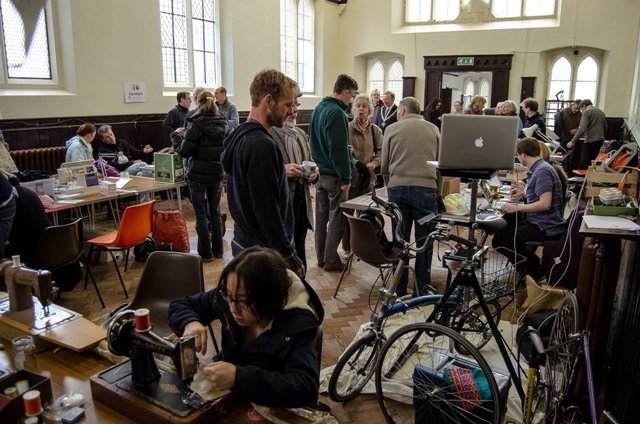
The Farnham Repair Cafe in Surrey, UK – one of over 1,000 community repair and recycling initiatives in the global Repair Cafe movement.{credit}Farnham Repair Cafe{/credit}

A few decades ago, a broken radio, fan or kettle generally triggered a trip to the repair shop. Now, it often means a journey to the dump. In Britain alone each year, over 2 million tonnes of waste electrical and electronic equipment are discarded; in Europe and the United States, repair services have been in decline for some decades. This ‘take, make and dispose’ approach sits uncomfortably with shifts towards closed-loop thinking and policy, such as the European Commission (EC) package on the circular economy, which emphasises repair, recycling and reuse.

For the past six years, a quiet repair revolution has been unfolding globally. Keen to drive local-level sustainability, Dutch journalist Martine Postma launched the Repair Café movement in Amsterdam, the Netherlands, in 2009. The next year, fired by its success, she set up the non-profit Repair Café Foundation to provide guidelines.

There are now 1,003 centres worldwide, with hundreds in Belgium, Germany and the Netherlands and 18 in Britain. Each is a community hub where local residents can bring in broken items and get them repaired for free, as well as network, learn skills, socialise and help others. Local expertise, tools, repair manuals and materials are all on hand. Melding education, social inclusivity, ‘sharing economy’ practices and sustainable action, the cafés have become nodes in the circular economy, teaching its principles from the bottom up.

In early 2014, The Centre for Sustainable Design ® (CfSD), which I head at the University for the Creative Arts (UCA) in Farnham, Surrey, completed the first survey into the circular economy aspects of Repair Cafés and Hackerspaces — places where the global community movements for repairing and ‘hacking’ (modifying) products come together to share knowledge and skills. The research results prompted CfSD to launch the Farnham Repair Café (FRC), a local non-profit organisation involving Transition Town Farnham (TTF), in February 2015. (This collaboration fuses CfSD’s experience in developing a range of innovative sustainability projects over two decades, and TTF’s local networks related to food and cycling. The Farnham Hoppers, for instance, cultivate hop plants for local brewers, while the largely volunteer-run Farnham Local Food project grows pesticide-free vegetables for sale to the community.)

The FRC offers a monthly ‘place and space’ for locals to “share in the repair”. To date, more than 500 people have participated, and over 120 items — vacuum cleaners, headphones, lamps, baby strollers and bicycles — have been repaired. That represents a diversion from landfill of near 450 kilograms of stuff, with an average repair rate within the 2.5-hour sessions of nearly 60%.

graph-1[2]

{credit}The Centre for Sustainable Design ®, University for the Creative Arts, Farnham, Surrey. Graph from Scott Keiller and Martin Charter (2015) Repair Cafés: Implications for Product Developers and Designers.{/credit}

At FRC we have also established a “creative zone” for upcycling – re-assembling product parts for a new intended purpose or for an improved function. Much of this channels into Farnham’s longheld identity as a locus for design and crafts: it was a pottery centre from the sixteenth century, and an art school (now subsumed into UCA) was established there in 1880. The café offers a chance to practise the haptic (hand-to-head) skills that are essential to craft — as well as to much science. FRC also aims to create a ‘sharing economy’, cooperating with local repair businesses by advertising their work, and encouraging them to get involved directly as volunteers.

I am observing the emergence of a grassroots movement of makers, modifiers and fixers empowered by a new can-do attitude, social networking, massive access to online information and instructional videos. Beyond repair, recycling and upcycling, this sustainable community experiment shows the real ‘Big Society’ at work – people with technological skills wanting to give back to the community, and a technologically proficient, sharing community emerging.

Martin Charter is director of The Centre for Sustainable Design ®, UCA Farnham, and cofounder of the Farnham Repair Café, Surrey, UK.

Listen in to a podcast with Martin Charter and Product-Life Institute founder and director Walter Stahel here, and see a video on the Farnham Repair Café here. Nature‘s circular-economy special can be accessed here. For Nature’s full coverage of science in culture, visit www.nature.com/news/booksandarts.