Illustrated books of 2017: the magnificent eight

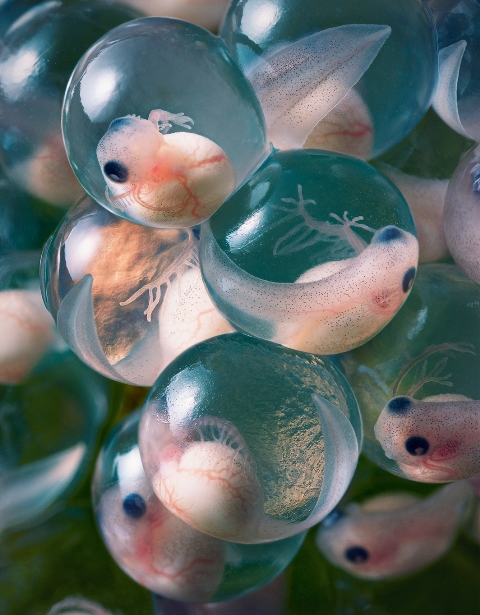
Yellow-eyed tree-frog eggs, from Endangered by Tim Flach, with text by Jonathan Baillie (Abrams).

Yellow-eyed tree-frog eggs, from Endangered by Tim Flach, with text by Jonathan Baillie (Abrams). {credit}© 2017 Tim Flach{/credit}

There’s something about a collection. We seem to harbour an urge to amass and sort as we build menageries, museums, taxonomies. And the illustrated book is a portable simulacrum, a paper cabinet of curiosities, curated for maximum aesthetic punch.

This year, my favourites include coffee-table tomes on the Solar System and early voyages from Europe to Latin America. The rest, as with those I prized most last year, focus on fauna — a reflection of the emphasis on animal intelligence, behaviour, extinction and resurrection in popular-science publishing. Our obsession with Animalia is unstoppable. In some important way, the thread has yet to snap between us and the humans who, 35,000 years ago, layered exquisite images of bison, lion and rhino on the walls of Chauvet cave.
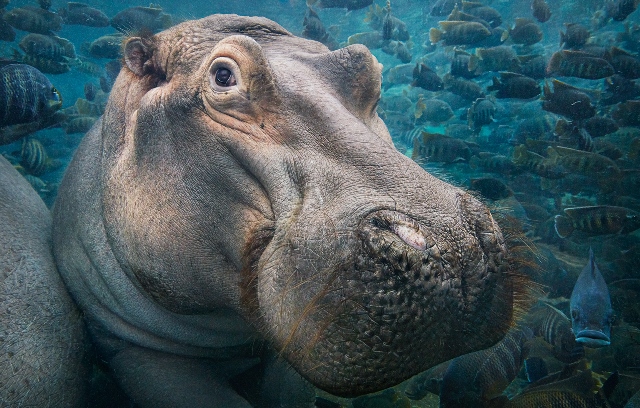
Hippopotamus underwater, from Endangered by Tim Flach, with text by Jonathan Baillie (Abrams).

Hippopotamus underwater, from Endangered by Tim Flach, with text by Jonathan Baillie (Abrams). {credit}© 2017 Tim Flach{/credit}

Among the eight illustrated books that leapt out at me, Endangered (Abrams) won the long jump. On the cover, a crowned sifaka lemur tightly clutches its knees, citrine eyes staring with alien intensity. Inside is a virtuosic gallery of species at the edge: the bulbous topography of a hippo’s face; Mexican free-tailed bats slicing up the sky; a long-range shot of a polar bear curled in snow, white on white. Complementing Tim Flach’s hyper-stylised images are commentary by Jonathan Baillie, the National Geographic Society’s chief scientist, and writer Sam Wells.
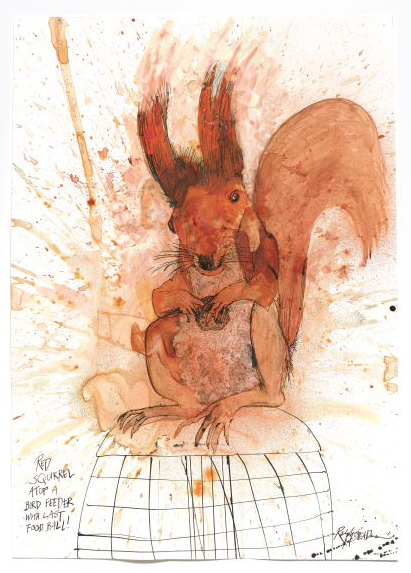
Red squirrel by Ralph Steadman in Critical Critters (Bloomsbury).

Red squirrel by Ralph Steadman in Critical Critters, by Steadman and Ceri Levy (Bloomsbury).{credit}Ralph Steadman and Ceri Levy{/credit}

Biodiversity loss has also gripped self-styled “gonzovationist” and illustrator Ralph Steadman for years, as his 2015 Nextinction showed. Now, in Critical Critters (Bloomsbury), Steadman (with Ceri Levy) pictures another bevy of beasts, exuberantly splatting his way from iconic megafauna such as tigers to dugongs, wombats and a red squirrel in burnt orange, ears aflame. The irrepressible Steadman includes the ‘grunting spiked turt’, a chameleon-like animal that should exist, but doesn’t.
Tortoise beetle, from Microsculpture: Portraits of Insects by Levon Biss (Abrams).

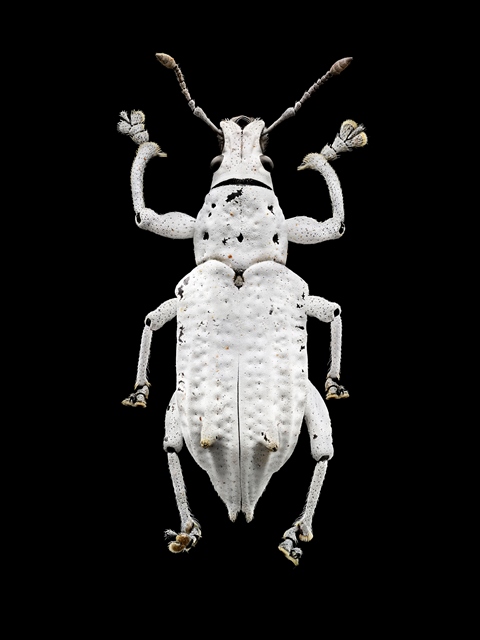
Short-nosed weevil, from Microsculpture: Portraits of Insects by Levon Biss (Abrams).{credit}© Levon Biss{/credit}

Insects that did exist, yet look impossible, feature in Levon Biss’s photographic feat Microsculpture (Abrams). Biss (whose work can also be seen in this film) imaged the world’s oldest insect collection at the Oxford University Museum of Natural History, including specimens bagged by Darwin and Alfred Russel Wallace. Each bravura photograph incorporates some 8,000 separate shots, from the ornate tortoise beetle — a rococo delight — to the ghostly short-nosed weevil.
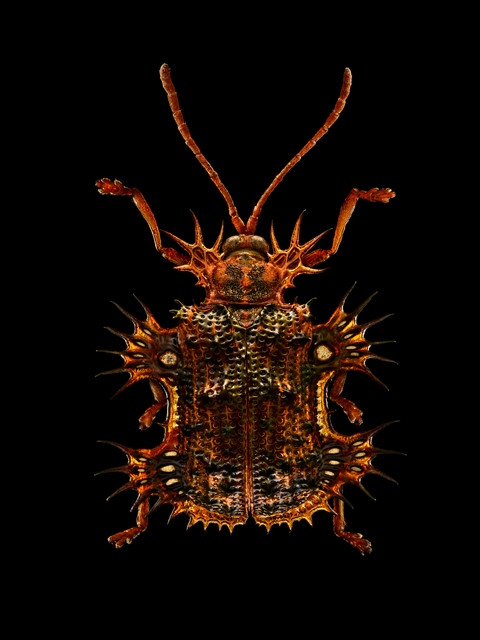
Tortoise beetle, from Microsculpture: Portraits of Insects by Levon Biss (Abrams).

Tortoise beetle, from Microsculpture: Portraits of Insects by Levon Biss (Abrams).{credit}© Levon Biss{/credit}

More entomological glory flutters in Mariposas Nocturnas (Princeton University Press), photographer Emmet Gowin’s hard-won homage to South American lepidoptera. From Brazil to Panama and over two decades, Gowin shot over 1,000 species of nocturnal moths alive. Arranged in typologies of 25, they form a morphologically varied, vividly hued patchwork. As Gowin writes, “By loving the minutiae, we find the whole.”
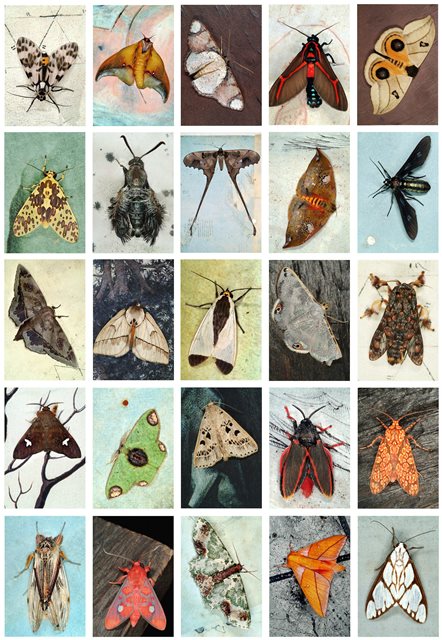
xxx

Index 31, taken in April 2010 in French Guiana, in Mariposas Nocturnas by Emmet Gowin (Princeton University Press){credit}Emmet Gowin{/credit}

Long before photography, engravers and printers battened upon beasts as evocative subjects for artworks and books — not just bestiaries and early natural-history tomes, but also allegories, illustrated tales and even playing cards. Animal (Bloomsbury) tells that story through powerful, often deeply strange works from the fifteenth to the twentieth centuries, deftly curated by editors Rémi Mathis and Valérie Seuer-Hermel from the National Library of France collection.
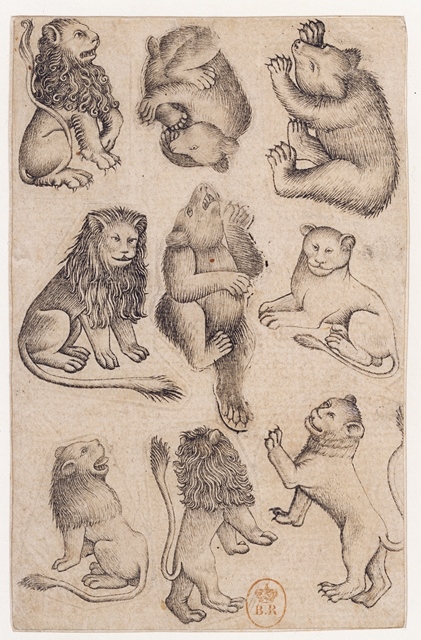
Cards with bear and lion symbols by the Master of the Playing Cards, Upper Rhine Valley, 1435-1445. In Animal, edited by

Cards with Bear and Lion Suit Symbols, by the Master of the Playing Cards,1435-1445, in Animal, edited by Rémi Mathis and Valérie Seuer-Hermel (Bloomsbury). Printed on copper plates, these cards were the first examples of engraving on metal seen in Europe.{credit}National Library of France{/credit}

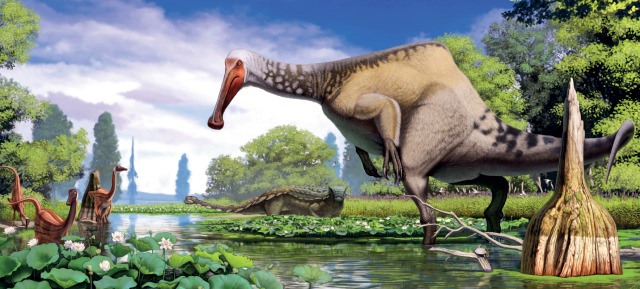
The cutting-edge imaging technologies of today feature in Dinosaur Art II (Titan Books), edited by artist Steve White. This follow-up to the 2012 Dinosaur Art features works of scientific precision and nuanced beauty by 10 top painters, modellers and digital artists. Among many standouts are Sergey Krasovskiy’s oil painting of the giant-jawed, tiny-limbed Pycnonemosaurus nevesi and a digital portrayal of the mysterious duck-billed Deinocheiris mirificus by Andrey Atuchin.
xxxx

The duck-billed dinosaur Deinocheiris mirificus (digital, 2014) by Andrey Atuchin, in Dinosaur Art II, edited by Steve White (Titan Books).{credit}Andrey Atuchin{/credit}

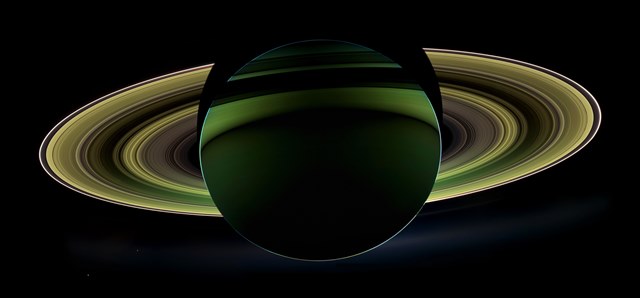
Zooming out from deep time to deep space, The Planets (Chronicle Books) by writer Nirmala Nataraj mines the NASA archives for a thrill-a-minute tour of our cosmic neighbourhood. It’s a handsome array, from the flow of dunes in Mars’s Nili Patera caldera, caught by the HIRISE camera on the Mars Reconnaisance Orbiter, to an opulently hued backlit view of Saturn captured by Cassini’s wide-angle camera.
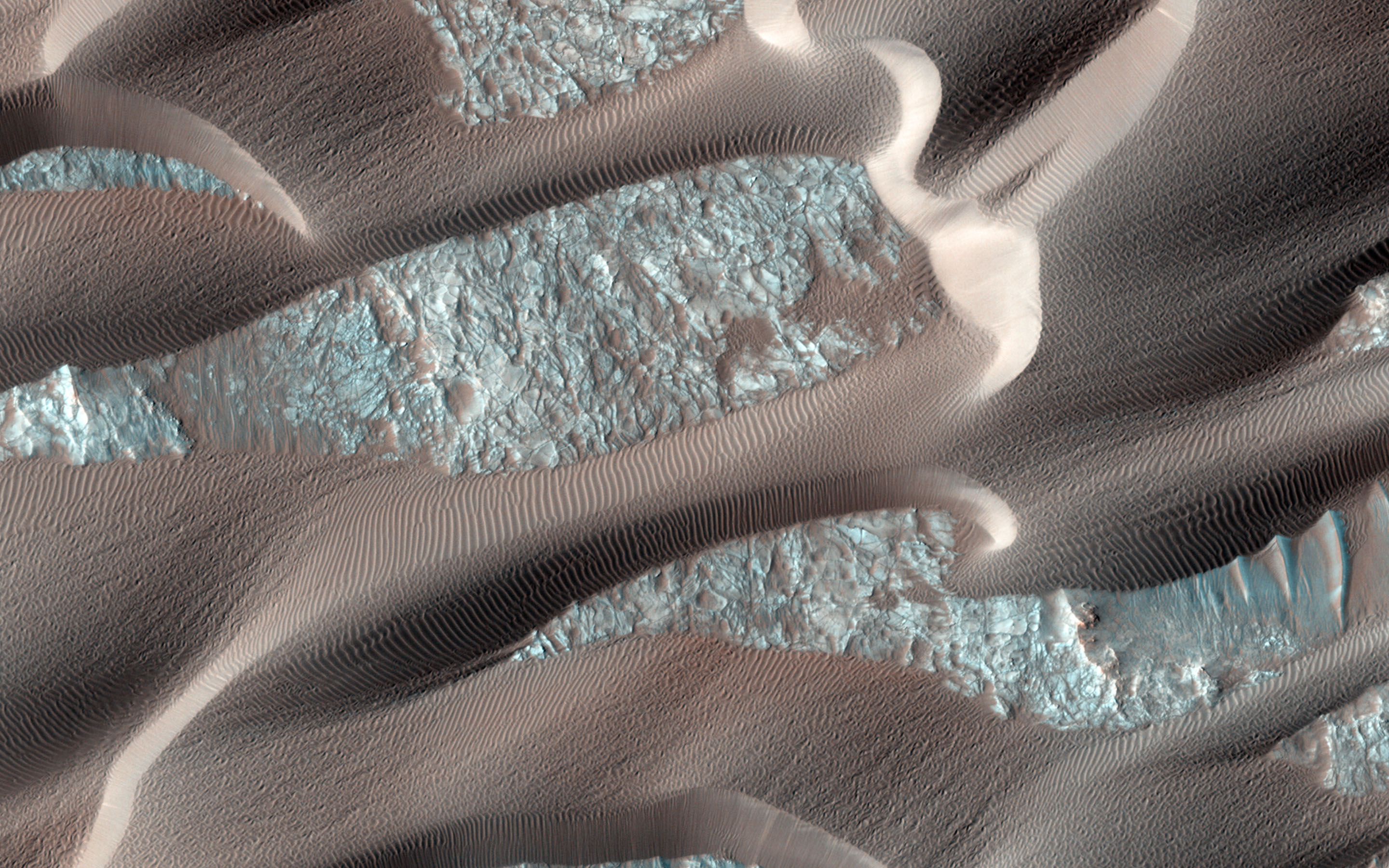
Dunes patterning Nili Patera caldera on Mars, caught by the HIRISE camera on the Mars Reconnaisance Orbiter. From The Planets (Chronicle Books) by Nirmala Nataraj.

Dunes patterning Nili Patera caldera on Mars, caught by the HIRISE camera on the Mars Reconnaisance Orbiter. From The Planets (Chronicle Books) by Nirmala Nataraj. {credit}NASA, JHUAPL, Carnegie Institution of Washington{/credit}
xxx

A back-lit view of Saturn, captured by Cassini’s camera. From The Planets (Chronicle Books) by Nirmala Nataraj. {credit}NASA, JPL-Caltech, SSI{/credit}

In mapping the Solar System, it’s easy to forget that swathes of Earth were uncharted five centuries ago, and indigenous Americans and Europeans had yet to meet. When they did, starting with Columbus’s 1492 voyage, a “vertiginous transformation” began, reminds historian Daniela Bleichmar in Visual Voyages (Yale University Press). It spelt immeasurable devastation for New World peoples even as their knowledge rewrote the Old World’s book of nature. As this fascinating, sensitively written book attests, this revolution, in turn, kickstarted a frenzy of printing and cartography to frame the barrage of botanical, zoological, anthropological and geographic data.
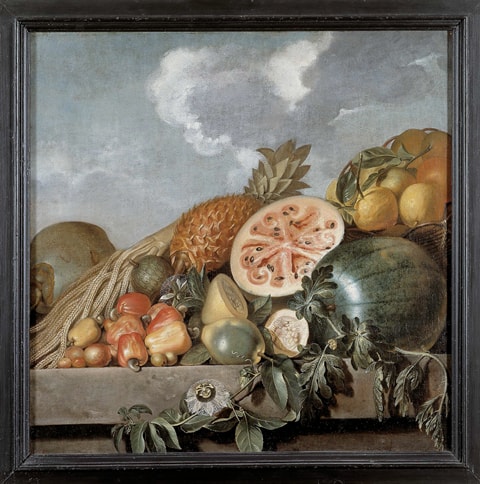
Fruits, Pineapple and Melon, 1640-50 (oil on canvas) by Albert Eckhout, in Visual Voyages by Daniela Bleichmar, Yale University Press.

Fruits, Pineapple and Melon, 1640-50 (oil on canvas) by Albert Eckhout, in Visual Voyages by Daniela Bleichmar, Yale University Press.{credit}National Museum of Denmark{/credit}

For Nature‘s full coverage of science and culture, see https://go.nature.com/2CMOwaL.
Rocket woman

xxxx

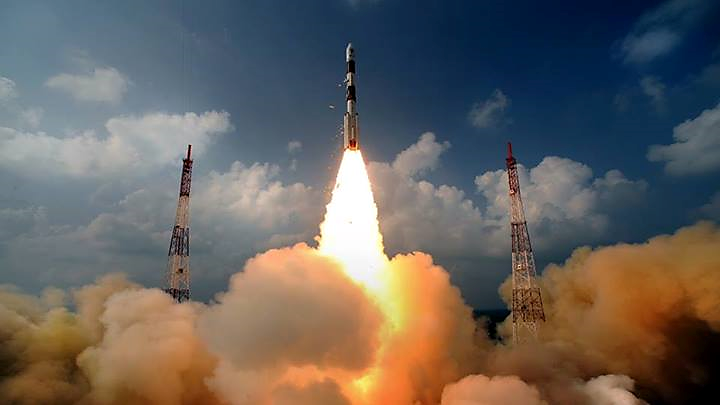
The Polar Satellite Launch Vehicle of the Indian Space Research Organisation, which carried the Mars Orbiter Mission satellite Mangalyaan. The payload included instruments developed by Dutta and her team.{credit}ISRO{/credit}

3Q: Moumita Dutta

A physicist at the Indian Space Research Organisation’s Space Applications Centre, Moumita Dutta was part of the team that put a probe into Mars orbit in 2014. The instruments they designed for the Mangalyaan are still beaming back data. Now India is gearing up for its third planetary mission in 2018 — Chandrayaan-2, a return to the Moon. As Dutta prepares to take part in the London Science Museum’s Illuminating India events, she talks about the lure of optics, the challenge of crafting super-light sensors, and the rise in Indian women entering space science.  

Tell me about your work with the Indian Space Research Organisation (ISRO).

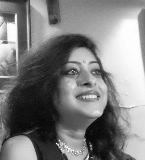
Moumitta Dutta.

Moumitta Dutta.

In my childhood I had dreamed about space, aliens, the Universe, the stars – particularly the aliens! But I didn’t think I would be involved in space science. I became interested in physics when I saw the magnificent colours coming out of a prism in an experiment at school. I ended up doing a master’s in applied physics, specialising in optics. Then one morning in 2004 I read in the local newspaper that India was preparing for its first lunar mission, and I thought ‘What a phenomenal thing’. From that moment on I wanted to join the ISRO. A year and a half later, I did, ending up working on two sensors that would fly on the Chandrayaan-1 project [India’s first lunar mission, which launched in 2008 and found evidence of water before losing contact with Earth.] My base is the Space Applications Centre in Ahmedabad, mainly working on optical sensors for studying Earth and for planetary missions. For India’s 2018 lunar mission, Chandrayaan-2, we will use advanced versions of the sensors flown in the last mission, carrying out a very detailed study of the lunar surface and mineralogical mapping. There will be an orbiter, a lander and a rover, with mounted instruments to carry out experiments on the surface.

Mangalyaan launched just 18 months from its conception, costing a relatively low US$75 million.  What challenges did you face in building its sensors? 

All the sensors were designed in India: a colour camera, an infrared spectrometer generating a thermal map of the Martian surface and a methane sensor. We had 15 months or so to develop them. The main challenge was to make them very compact, lightweight and low-power, because the mission was to be launched with minimum fuel. We fought for every gram. The sensors were all first of a kind, and to develop them quickly we had to use off-the-shelf — rather than space-qualified — components, then test each under extreme conditions. The team of almost 500 engineers working  across the centres on the mission worked day and night. I feel like people worked from their heart and no one cared about the clock. The mindset was that they were working for our country, and the mission had to be successful. When we received the first signal after the spacecraft was captured into Mars orbit, a wave of joy spread across the country. The project team members became the superstars of India, with people even holding their pictures on placards, like film stars. Eagerness about Indian space research has rocketed. Three years on, the orbiter still transmits data from all the sensors, which we are analysing today.

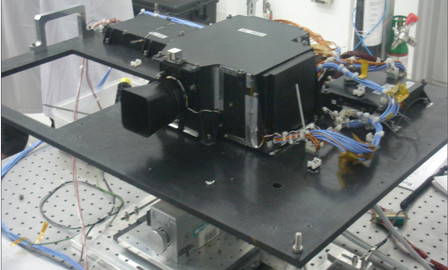
Methane sensor for Mars.

Methane sensor for Mangalyaan.{credit}Space Application Centre, ISRO{/credit}

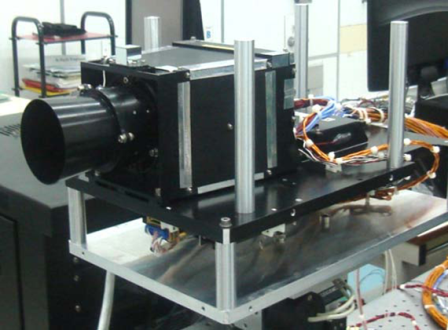
Mars colour camera.

Colour camera for Mangalyaan.{credit}Space Application Centre, ISRO{/credit}

Is space science in India welcoming women?

In the past few years we have seen a significant increase in the number of women joining Indian space science: right now, they constitute 20% or 25% of ISRO. The organisation is always ready to welcome women. As a government body, we get a minimum of six months’ maternity leave, for example, and women are given equal responsibilities. I feel like it’s not about whether someone is a man or woman, it is all about how they can handle the challenges. Now, whenever I give a talk and a small girl comes up to me and says, “I want to work for ISRO, I want to be an astronaut,” I feel wonderful. Women scientists of ISRO have also featured in the media, including Vogue India; and when our work is recognised, we represent the contributions of all the women involved.  That is the best part of it.

Interview by Elizabeth Gibney, a senior reporter for Nature based in London. This interview was edited for brevity and clarity.

Dutta will be appear in conversation with space scientist Maggie Aderin-Pocock at the London Science Museum’s Lates: Illuminating India on 29 November.


For Nature’s full coverage of science in culture, visit www.nature.com/news/booksandarts.

The artist as astronaut

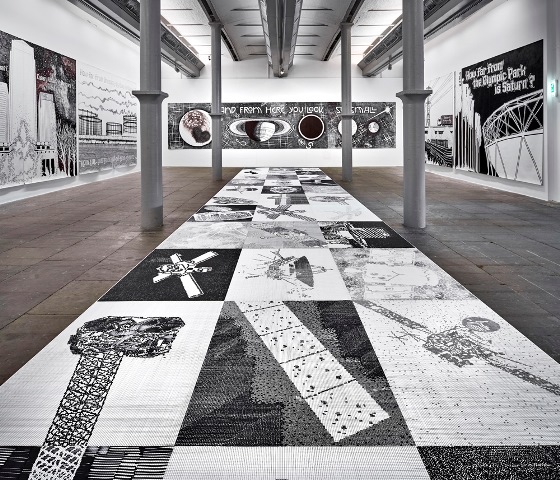
Probes is an inventory of space probes, which examines how the aesthetic of such craft has changed over time, as well as how functionality of design intersects with its cultural underpinnings. Mir views space probes as substitutes for human explorers, romantically searching for connection in the Solar System.

Artist Aleksandra Mir views space probes as substitutes for human explorers, romantically searching for connection in the Solar System. Her piece Probes (on floor) — part of her major work Space Tapestry — is an inventory of these craft, examining how their aesthetic has changed over time, as well as how the functionality of design intersects with its cultural underpinnings. {credit}Tate Liverpool{/credit}


3Q: Aleksandra Mir

 In 2014, Aleksandra Mir began a journey into the unknown. The London-based artist started talking with scientists and engineers about space — a realm in which she was a complete novice. The result of Mir’s dive into the cosmos is Space Tapestry, a vast wall hanging 3 by 200 metres, hand-drawn — in collaboration with 25 young artists — with fibre-tipped pens on synthetic canvas. Inspired in part by the eleventh-century depiction of Halley’s Comet on the Bayeux Tapestry, the work unfolds like a giant graphic novel to explore the unfathomable distances of space, the quest for extra-terrestrial life, and the impact of space technology on humans – from observing Earth to the politics of space. As the piece goes on show at Tate Liverpool, UK, Mir talks about her quest to get under the skin of science.

Why did you choose this format for Space Tapestry?

xxx

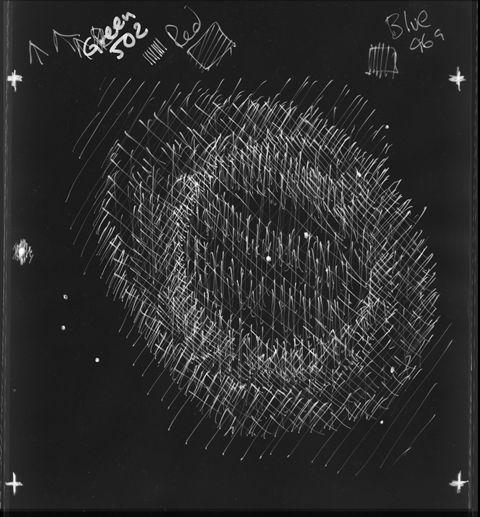
Mir’s work Ring Nebula emerged from conversations with Jayanne English, an astronomer involved in creating Hubble telescope images. To move beyond the “ice-cream” coloured swirls that Mir views as “trashy”, they experimented with capturing the same information in a black-and-white sketch in which the angle of cross-hatching represents different phenomena.{credit}Aleksandra Mir{/credit}

I wanted to create an immersive environment, almost like a stage set. And I wanted to introduce a new aesthetic. Whenever you see a science illustration you get what I call the “sleazy aesthetic”: supposed to convey fact but made to seduce with their slickness, intense colours and airbrushed surfaces. There are other ways of picturing phenomena that can be as realistic. And some phenomena beyond our technologies or perception can also be portrayed poetically. This is where art becomes relevant to science. My original inspiration for the project was the 1066 Bayeux Tapestry. It features a very early portrayal of Halley’s Comet: you have this little group of characters staring out in horror and fascination, and there’s this simple line drawing of the comet. What was interesting to me is that it doesn’t look anything like an actual comet, but conveys a tremendous amount of scientific information – it has a direction, a velocity and luminosity – which makes it valuable for contemporary scientists. So this became the key to my ‘tapestry’: images with validity for the science community, but also treated in a very poetic, freestyle, emotive and personal way.

You’ve explored many issues over your 25-year career. Why space, and why now?

Space has been a strand of my work for a very long time. My family watched the Moon landing in 1969 in Poland (which was then behind the Iron Curtain), and this left a powerful mark on me. My best-known work is First Woman on the Moon, the transformation of a beach in the Netherlands into a lunar surface in 1999, in response to the 30th anniversary of Apollo 11’s feat. The video of this event has been touring for 17 years now. And I recently realised that while the gist of the work is still valid – no woman has yet set foot on the Moon – I needed to catch up on the achievements of today’s space industry. I attended my first space conference in 2014 and was sold on a world that for me was like an alien planet. I had to learn a new language. I spoke to a lot of scientists about their daily lives. And once you start looking at that from my perspective as an artist and anthropologist, a natural philosophy and sort of magic embedded in these practices reveals itself. I was never interested in science fiction. Science has everything of interest to me. I think that the whole scientific project is a romantic project, the chasing for a connection, the yearning for depth, taking on a challenge, risking everything for a passion, the struggle.

xxxx

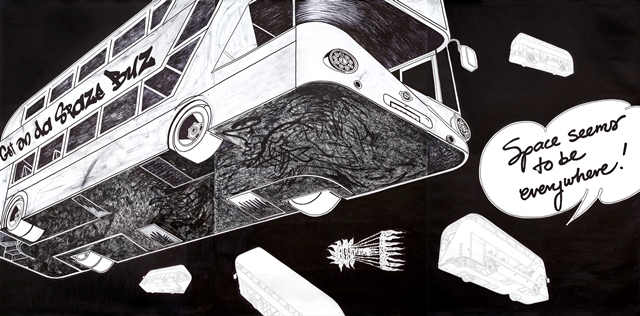
Get on Da Spaze Buz – a detail in Mir’s Space Tapestry: Earth Observation & Human Spaceflight.{credit}Modern Art Oxford{/credit}

What did you learn about scientists and science?

Working on the Space Tapestry project has given me access to some extraordinary scientists, locations and visuals. Among those I interviewed was Jan Woerner, director-general of the European Space Agency. Marek Kukula from the Royal Observatory Greenwich has been one of my main advisors, and molecular astrophysicist Clara-Sousa Silva has been a huge inspiration. I visited high-security sites such as Airbus Defence and Space in Stevenage, UK; and saw the network control centres at Inmarsat and the Satellite Applications Catapult, both depicted in my drawings. I was allowed to ask tons of naïve questions, be critical, playful and absurd at times, which has connected and educated me in a big way. I can now hold a conversation in this realm, and in 2015 I was invited as a speaker at the UK Space Conference myself.

Solar system

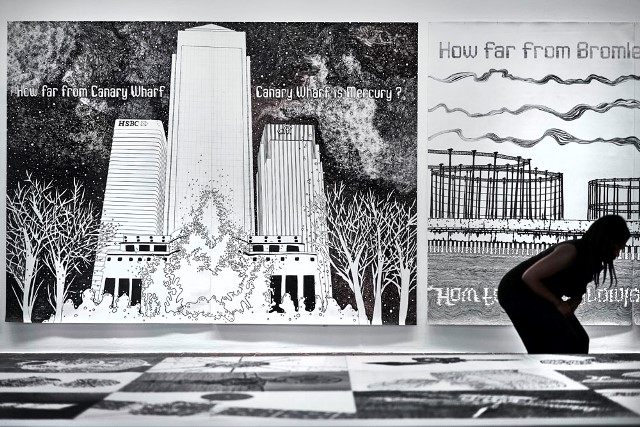
The Solar System series, part of Space Tapestry: Faraway Missions, aims to help viewers find more poetic and metaphorical ways to think about distances that are impossible for the human brain to grasp.{credit}Tate Liverpool{/credit}

There is a newfound dialogue with scientists who are reaching the understanding that they also have been working in isolation.  I have also realised that the sophistication of their projects, the enormous budgets and the long timespans can in no way ever be comparable to what I, as one artist, can do. So, if anything, I have gained a greater respect for science. One conversation I’ve had with scientists, though, is that you don’t always have to be heroic and successful to garner respect. To struggle, fail, be tired and dirty is part of our nature and a fundamental part of all human exploration. Artists know how to draw power from it and I think my project both humanizes and makes science more credible.

Mr's piece First Woman on the Moon (video, 1999).

Mir’s piece First Woman on the Moon (video, 1999).{credit}Aleksandra Mir{/credit}

Interview by Elizabeth Gibney, a reporter on physics for Nature based in London. She tweets at @lizziegibney.

This interview has been edited for length and clarity. 

Space Tapestry is on display in two parts: Faraway Missions will be at Tate Liverpool until 15 October; Earth Observation & Human Spaceflight will be on display at Modern Art Oxford until 12 November. An accompanying book forming part of the Space Tapestry project, We Can’t Stop Thinking About the Future, is also available, and includes 16 interviews with space professionals.


For Nature’s full coverage of science in culture, visit www.nature.com/news/booksandarts.

Snapping Earth for more than seven decades

Posted on behalf of Elizabeth Gibney

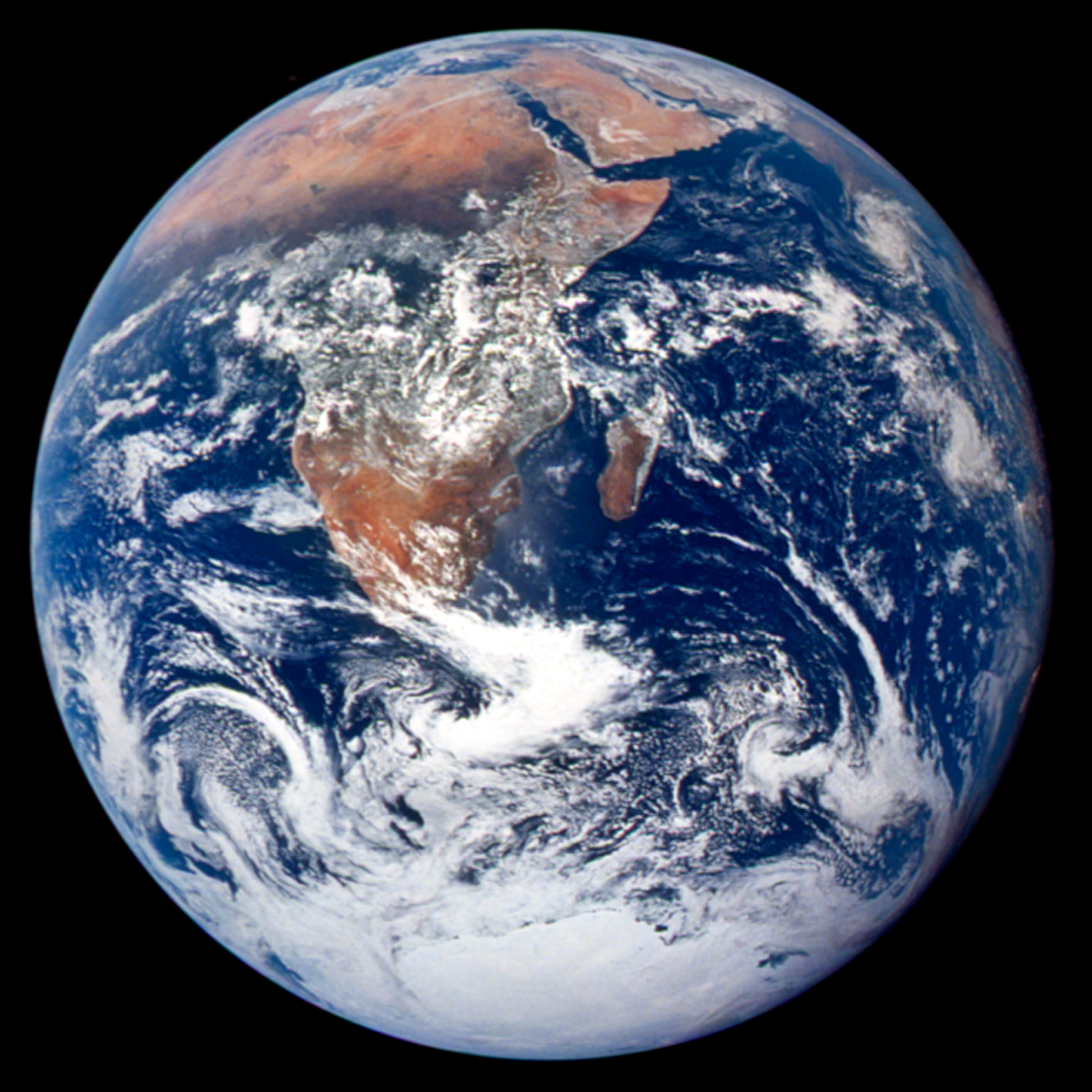
The 'Blue Marble' image of Earth by the Apollo 17 crew in 1972.

The ‘Blue Marble’ image of Earth captured by the Apollo 17 crew in 1972. {credit}NASA{/credit}

For centuries, the only way to ‘see’ Earth whole was through globes and maps; its grandeur was merely glimpsed in mountain vistas or across a stretch of ocean. That changed in the 1940s, when the first images of the planet were snapped from rockets probing the border of space, 100 kilometres up. The imaginable became the visible.

Since then, satellites and spacecraft have beamed down shots from ever greater distances and in growing detail. Now Nature Video has captured the most iconic of these in the film Portraits of a Planet: Earth from Space.

These images have massively boosted science and technology – from weather forecasting to monitoring natural disasters, forest cover and climate change. And they have had a subtler psychological impact. Revealing this majestic, finite, vulnerable entity framed in blackness has elicited deep responses feeding into policy and culture.

Going ballistic

The first images of Earth from space — from 1946 and 1947 — were black-and-white, grainy and remarkable partly for the fact that they happened at all. Both were taken by cameras retrofitted into the empty nosecone of V-2 rockets, long-range ballistic missiles the United States captured from Germany at the end of the Second World War.

In 1946, all that protected the film during the rocket’s crash landing was a steel cassette. When the photos were first projected onto a screen, “the scientists just went nuts”, recalled Fred Rulli, a member of the rocket’s recovery team, in an interview with Air and Space magazine. The following year’s project nudged the rocket further into space to 160 kilometres, bringing more detailed images clearly revealing Earth’s curvature.

Taken in March 1947, these pioneering NASA images of Earth were the first taken from an altitude of more than 100 kilometres. Cameras retrofitted into the empty nosecone of V-2 rockets were deployed to take the shots.

Taken in March 1947, these pioneering NASA images of Earth were taken from an altitude of 160 kilometres – then a record high. Cameras retrofitted into the empty nosecone of V-2 rockets were deployed to take the shots.{credit}Johns Hopkins Applied Physics Laboratory{/credit}

The cold-war space race soon pushed cameras to greater heights. In 1957, the Soviet Union launched its first satellite, Sputnik; the US quickly followed suit. Three years later, the newly formed NASA put TIROS 1, its first weather satellite, into orbit, which sent video back to Earth using dual television cameras. TIROS 1 proved that such images could provide be used to monitor cloud formation, one of the first indications of the potential scientific power of satellites.

In 1960, cameras aboard NASA's first weather satellite TIROS-1 captured Earth.

In 1960, cameras aboard NASA’s first weather satellite TIROS 1 shot Earth.{credit}NASA{/credit}

Human-crewed efforts began with the orbital missions of Yuri Gagarin in 1961 and John Glenn in 1962. But it was not until 24 December 1968 that Apollo 8 astronaut Bill Anders captured arguably the most iconic image of Earth. Later dubbed ‘Earthrise’, it was the first to show the planet from the perspective of another celestial body, as a luminous blue hemisphere rising above the Moon’s horizon. Anders had had to fight to get the long-lens camera on board, and deviated from the craft’s flight plan to get the snap (as he wrote in his obituary of Glenn earlier this year).

That awe-inspiring image was a shot across the bows of the cold war. It was also transformational for earthbound observers: the moniker ‘Spaceship Earth’ gained traction as people fully grasped the planet’s limits. Ultimately, ‘Earthrise’ supercharged the nascent environmental movement in the United States particularly, pioneered by environmentalists, scientists and thinkers such as Buckminster Fuller; and it proved a trigger for the US Earth Day, which launched in 1970.

That grassroots clamour, bolstered by works such as biologist Rachel Carson’s 1962 Silent Spring, had an influence on policy shifts at the federal level. The period from 1970 to 1973 saw the Environmental Protection Agency established and the US Clean Air Act, Clean Water Act and Endangered Species Act passed. Anders notes, “I wouldn’t say [Earthrise] was the only reason, but it certainly was an important reason motivating folks to take better care of our planet.”

'Earthrise' - possibly the most iconic portrait of Earth - was captured by astronaut Bill Anders from Apollo 8, the first crewed lunar mission.

‘Earthrise’ – possibly the most iconic portrait of the planet – was captured by astronaut Bill Anders from Apollo 8, the first crewed lunar mission, in 1968.{credit}NASA{/credit}

The spectacular ’Blue Marble’ (see opening image), shot by the crew of Apollo 17 in 1972, fuelled further activism; it has been recreated by NASA many times over. The photograph captured Earth with the Sun behind the camera illuminating most of the globe, and from a distance (45,000 kilometres from the planet) no one has managed since.

Inspired by the potential of such astounding images, the US Geological Survey and NASA launched the first satellite in the Landsat programme in 1972, to chart Earth’s terrain in detail. Landsat satellites have documented burning oil wells in the first Gulf War, the impact of Hurricane Katrina and deforestation in the Amazon. Landsat’s false-colour rendering of Alaska’s Malaspina glacier, taken with a thermal imaging camera, is mesmerizingly beautiful.

In 1991, Landsat satellites captured lit oil wells in Kuwait , which burned for 10 months.

Landsat satellite images of lit oil wells in Kuwait during the Gulf War, in 1991. They burned for 10 months.{credit}NASA{/credit}


This Landsat image, shot in 200, captures the majestic flow of Alaska's Malaspina Glacier. This false-colour composite was created using infrared, near infrared and green wavelengths.

Shot in 2000, this false-colour composite showing the majestic flow of Alaska’s Malaspina Glacier was created using infrared, near infrared and green wavelengths.{credit}NASA/USGS{/credit}

In recent years, a parade of Earth monitoring and robotic exploration craft have added countless images to the file. In 2012, over 312 orbits, the Suomi National Polar-orbiting Partnership satellite built up a night-side image of Earth and its lit-up cities in ‘The Black Marble’. In 2013, NASA’s Cassini craft turned around in the outer Solar System to capture Earth — a pinprick of light — through the rings and moons of backlit Saturn.

Composite image 'The Black Marble' was taken by Suomi NPP, a joint National Oceanic and Atmospheric Administration and NASA satellite, in 2012

Composite image ‘The Black Marble’ was taken by Suomi NPP, a joint National Oceanic and Atmospheric Administration and NASA satellite, in 2012.{credit}NASA{/credit}

Called ‘The Day the Earth Smiled’, that shot was taken from more than 1.2 billion kilometres away, making it a far cry from the images of our planet revealed some 70 years ago. But while the photographs have become ever more impressive, rarely are they as powerful as those first images of the ‘ground beneath our feet’ in its sublime entirety.

'The Day the Earth Smiled', taken by NASA's Cassini craft in 2013, shows Earth through Saturn's rings. The image spans some 650,000 kilometres and is a mosaic crafted from photographs taken over four hours.

‘The Day the Earth Smiled’, taken by NASA’s Cassini craft in 2013, shows Earth through Saturn’s rings. The image spans some 650,000 kilometres and is a mosaic crafted from photographs taken over four hours.{credit}NASA{/credit}

Elizabeth Gibney is a reporter on physics for Nature based in London. She tweets at @LizzieGibney. 


For Nature’s full coverage of science in culture, visit www.nature.com/news/booksandarts.

Tracking the propulsive power of science books

station-839208_960_720What makes a science tome so audacious, original and right that it kickstarts a life’s journey, propelling someone to the bench or field? Science writer Ann Finkbeiner (of The Last Word on Nothing) has written about that for A View from the Bridge. And when Academic Book Week fired up on 23 January, I started musing anew about encounters with remarkable books.

Academic Book Week celebrates “the diversity, innovation and influence of academic books” as forces shaping modern Britain. The popular vote went to economist John Maynard Keynes‘s 1936 The General Theory of Employment, Interest and Money. But despite the inclusion of works by Stephen Hawking, Richard Dawkins and James Watson in the ABW top 20, I saw a relative dearth of science in there. (No mention, for instance, of Charles Darwin’s On the Origin of Species or D’Arcy Thompson’s On Growth and Form.) Books that reveal the complexities of a culture to itself are essential. Books that unpick the complexities of nature seem as key.

So we asked readers to vote for their top science read – broadening the discussion by including any in the English language. Science writer David Quammen, for instance, cites David Hull’s 1988 Science as a Process and Horace Judson’s The Eighth Day of Creation (1979). Dawkins and Hawking are a noted presence, while Carl Sagan looms largest. Here’s a sampling:

12346789101112131415161718

A straw poll among colleagues yielded more rich pickings. US news editor Lauren Morello recalls reading The New York Times Guide to the Return of Halley’s Comet (1985) cover to cover at age seven, while James Gleick’s 1992 Genius: The Life and Science of Richard Feynman proved a beacon in high school. Podcast editor Kerri Smith extols Oliver Sacks‘s 1985 The Man Who Mistook His Wife for a Hat, “which made science feel like storytelling and was so much more pleasurable to read than the classic but quite dense pop science I had read before”. She notes further: “Maybe not a causal relationship, but I did a MSc in neuroscience a couple of years later.”

Nature reporters reported no less galvanising reads. Heidi Ledford recalls encountering Cosmos early on – and “how excited I felt whenever I picked it up”. As a teenager, Lizzie Gibney found that Hawking’s A Brief History of Time “really made me think science. The Time and Space of Uncle Albert had a huge influence too.” Ewen Callaway names thrilleresque 1995 The Hot Zone – Richard Preston’s non-fiction tome on viral haemorrhagic fever – as key. And Amy Maxmen opts for E.O. Wilson’s 1994 Naturalist, which she writes “made me get serious about bug collecting in high school, which resulted in a 10-year detour in science”.

What science classic pried open the door to your life in science? We’d love to know: answers either to the comments on A View from the Bridge, or to @naturenews with the hashtag #AcBookWeek.


For Nature’s full coverage of science in culture, visit www.nature.com/news/booksandarts.

Hidden Figures: the movie

Posted on behalf of Elizabeth Gibney

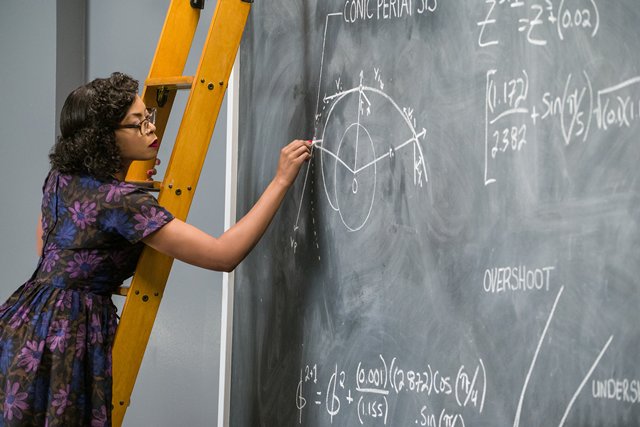
Taraji P. Henson as NASA ‘human computer’ Katherine Johnson. Over the course of her career, Johnson calculated the trajectories and launch windows for flights including the early missions of John Glenn and the Apollo 11 flight to the Moon, and did early work on the Mars mission.{credit}Courtesy of Twentieth Century Fox{/credit}

High-profile protests dominated the media during the civil rights era in 1960s America. At NASA, a quieter struggle was already underway. From the 1940s, African-American women had been chipping away at perceptions and making incursions into the early space programme — that otherwise very white, male world.

The stories of three of these scientific whizzes – Dorothy VaughanKatherine Johnson and Mary Jackson – are now told in Hidden Figures, a film directed by Theodore Melfi and based on a book of the same name by Margot Lee Shetterly (reviewed here for Nature by Alexandra Witze).

This sharp, witty triple biopic captures the focused frenzy of the United States’ space race with the Soviet Union, when NASA was trying to figure out how to achieve the remarkable feat of launching a man into orbit atop a rocket and returning him safely. That all-out effort meant opening the doors to the best people — which in turn created an opportunity for these pioneering African-American women to take on roles previously barred to them.

xxx

The Langley band of ‘human computers’ led by Dorothy Vaughan (played by Octavia Spencer).{credit}Courtesy of Twentieth Century Fox{/credit}

The movie recreates NASA’s Langley Research Center in Virginia, a state that in the early 1960s remained segregated. Vaughan, Johnson and Jackson are among Langley’s human “computers”: women hired to do the mathematics behind space flight, in the days just before the room-sized first IBM machine did it for them. This smart, passionate band, who made up the West Computing group, spend their days calculating launch and landing trajectories and air flow around capsules, armed only with pencils and reams of paper.

The trio were truly extraordinary. Vaughan, played by Academy Award-winner Octavia Spencer, is the matriarch. Although head of the computing group, she is not initially recognised as such for racist reasons. The film shows her initiative over the years in becoming an expert programmer of computing machines as the march of technology sees electronic counterparts to human computers emerge. Meanwhile Jackson, played with spirit by singer Janelle Monáe, wants to be an engineer. She struggles to reach ever-moving goalposts, including segregation laws that prevent her from attending the only school where she could get the necessary qualifications. Monáe’s vivacity earns her most of the film’s best lines.

xxx

Octavia Spencer as ‘human computer’ supervisor Dorothy Vaughan.{credit}Courtesy of Twentieth Century Fox{/credit}

The main focus in on Johnson, perhaps the most remarkable of the three. Her work stands at the very heart of US success in space. The film opens with her as a child prodigy, then zips past degrees in mathematics and French, and graduate school at West Virginia University — where she was one of the first black students to attend. At NASA she was soon picked to join the Space Task Force, who needed her talents in calculating the geometries of parabolic and, later, orbital flight. So indispensable was she that astronaut John Glenn asked for her to personally check the calculations of his trajectory by hand, ahead of the first US orbital flight in 1962.

Johnson is portrayed by Taraji P. Henson as quiet, tenacious and warm-hearted. The character could not be more different from Henson’s role as gangster Cookie Lyon in the music-industry television drama Empire. Johnson is a whizz with the chalk, often seen up a ladder scrawling calculations on a giant blackboard. She carves out her own position in the team, and in colourful outfits and heels offers a human face as often the only woman in a sea of white-shirted, pencil-tied men. (Among many excellent supporting actors, such as The Big Bang Theory’s Jim Parsons, Kevin Costner as a fictional amalgamation of several real NASA leaders deserves special mention. Gum-chewing and hard-nosed, he insists on referring to his team as “gentlemen” despite Johnson’s presence; but his desire to reach the heavens is what gives her her chance.)

xxx

Janelle Monáe as Mary Jackson, who later became a NASA engineer.{credit}Courtesy of Twentieth Century Fox{/credit}

Hidden Figures succeeds in revealing the institutionalised racism faced by the women and their families. Bathrooms, drinking fountains, schools, libraries — all were segregated. One of the best exchanges is between Vaughan and computing pool supervisor Vivian Mitchell (Kirsten Dunst), who insists, “I have nothing against y’all”. To this, Vaughan kindly replies: “I know you probably believe that.” And the women’s status as invisible engines driving the space programme contrasts clearly with the pomp surrounding the astronauts, who as the faces of NASA seem constantly showered with red, white and blue confetti.

Yet the upbeat film can sometimes come across as sanitised. There are no real baddies: even the racist characters, flawed with conscious or unconscious bias, seem ultimately good. A touch more anger wouldn’t have detracted from the enjoyable feel-goodness, epitomised by a bouncing soundtrack  by co-producer Pharrell Williams (composer of mega-hit Happy).

On another level, this may be an effort to avoid the film being solely about race. Rather, it is about women and their love of science. Vaughan, Johnson and Jackson had families to support and could not risk everything in the political fight for equality. In chasing their passions, these three chose to foment change from the inside. Hidden Figures fleshes its characters out into real human beings, and tells their cracking story with grace.

Elizabeth Gibney is a reporter on physics for Nature based in London. She tweets at @LizzieGibney. Hidden Figures’ US premiere is 25 December 2016; general release is on 6 January. The film’s UK premiere is 10 February 2017; general release is on 17 February.  


For Nature’s full coverage of science in culture, visit www.nature.com/news/booksandarts.

Top 20 books: a year that made waves

beach-1836366_960_720This was a year that made waves — some so steep that I found myself reaching for a psychological surfboard. I skimmed along the discovery of gravitational waves (featured in Janna Levin’s Black Hole Blues and Other Songs of Outer Space), and rode the CRISPR tsunami. The political turbulence stateside, in Britain and beyond had me scrabbling for balance — and historical precedents. Yet amid all the Sturm und Drang, it has been a terrific year for science and culture.

In Nature’s first sci-fi special, we celebrated two anniversaries that stand as reminders of profound — and much-needed — humanistic vision. One was the 150th of the birth of H.G. Wells, ‘Shakespeare of science fiction’, prolific author and frequent Nature contributor; the other, the 50th of Gene Roddenberry’s pioneering franchise Star Trek. And as ever I was able to trace bright currents in the bookish deeps.

Oncologist and writer Siddhartha Mukherjee plunged into the genetics riptide with The Gene — fortuitously, in a year when Richard Dawkins’s name-making classic The Selfish Gene hit 40 and a pod of genome-editing studies surfaced. There was a glut of big physics, notably Roger Penrose’s trenchant Fashion, Faith, and Fantasy in the New Physics of the Universe. And forests, earthquakes, biomechanics and military technology were all ‘trending’. But in trawling hundreds of books for my top 20, one of the more astonishing confluences was in the history of women in science — specifically, the ‘computers’ or number-crunchers behind key astronomical discoveries and space missions. (I’ve cheated here by counting three books on this phenomenon as one — as they are both important self-contained stories and part of a great historical trajectory.) The rest are pretty wonderful too. Enjoy.

The Glass Universe: How the Ladies of the Harvard Observatory Took the Measure of the Stars, Dava Sobel. Viking. The science writer traces the stories of pioneering women ‘computers’ who, from the late nineteenth century, made astronomical history at Harvard College Observatory. (Reviewed here.) 
Hidden Figures:
The American Dream and the Untold Story of the Black Women Mathematicians Who Helped Win the Space Race, Margot Lee Shetterly. William Morrow. A historian extols the brilliant African-American women mathematicians at NASA’s Langley Research Center who helped propel postwar America to the Moon and beyond. (Reviewed here.)
Rise of the Rocket Girls: The Women Who Propelled Us, from Missiles to the Moon to Mars, Nathalia Holt. Little, Brown. The HIV researcher on the women at NASA’s Jet Propulsion Lab who from the 1940s number-crunched in near-secrecy to launch missiles and the first US satellite. (Reviewed here.)

Lab Girl, Hope Jahren. Knopf. A palaeobiologist reveals the joy (and strangeness) of field and lab life through the lens of a woman in science. (Reviewed here.)

Half-Earth: Our Planet’s Fight for Life, Edward O. Wilson. Liveright. The eminent biologist issues a compelling call to commit half the planet to the rest of nature. (Reviewed here.)

Reality Is Not What It Seems, Carlo Rovelli. Allen Lane. The theoretical physicist invites us to gaze through a window at a world where space is granular and time does not exist. (Reviewed here.)

The Serengeti Rules: The Quest to Discover How Life Works and Why It Matters, Sean B. Carroll. Princeton University Press. An evolutionary biologist distils a vast body of biological research into six rules of regulation for the restoration of ecosystems and management of the biosphere. (Reviewed here.)

The Shock of the Anthropocene: The Earth, History and Us, Christophe Bonneuil and Jean-Baptiste Fressoz, trans. David Fernbach. Verso. Two historians dig into technological history, economics and climate science to reveal the role of imperialist ideology in today’s planetary crises. (Reviewed here.)

Serendipity: An Ecologist’s Quest to Understand Nature, James A. Estes. University of California Press. An innovative ecologist unpacks his life’s work tracing the top-down control of ecosystems by sea otters as apex predators. (Reviewed here.)

The Life Project: The Extraordinary Story of Our Ordinary Lives, Helen Pearson. Allen Lane. The Nature editor unravels the 70-year history of the British cohort studies and the crucial insights they offer on socioeconomic inequities. (Reviewed here.)

White Trash: The 400-Year Untold History of Class in America, Nancy Isenberg. Viking.  A historian delivers a searing indictment of the US political forces that persistently marginalise poor whites. (Reviewed here.)

Imbeciles: The Supreme Court, American Eugenics, and the Sterilization of Carrie Buck, Adam Cohen. Penguin. The award-winning writer revisits Buck vs Bell, the notorious 1920s case highlighting the dark history of US eugenics. (Reviewed here.)

Weapons of Math Destruction, Cathy O’Neil. Crown. A data scientist and former Wall Street quant uncovers the biases in the algorithmic overlords that micromanage the US economy. (Reviewed here.)

Bellevue: Three Centuries of Medicine and Mayhem at America’s Most Storied Hospital, David Oshinsky. Doubleday. The historian surveys the key advances and bold open-door policy that have made the New York public hospital a medical beacon. (Reviewed here.)

The Cyber Effect, Mary Aiken. John Murray. A forensic cyberpsychologist examines the mental lures built into sociotechnology and their impact on individuals and society. (Reviewed here.)

The Most Wanted Man in China: My Journey from Scientist to Enemy of the State, Fang Lizhi, trans. Perry Link. Henry Holt. The late astrophysicist and dissident on the scientific passion and quest for freedom of expression that drove his extraordinary life. (Reviewed here.)

Marconi: The Man Who Networked the World, Marc Raboy. Oxford University Press.  The communications scholar investigates the complexities of a giant of technology devoted to both science and fascism. (Reviewed here.)

How Not to Network a Nation: The Uneasy History of the Soviet Internet, Benjamin Peters. MIT Press. A communications specialist plumbs the messy and engrossing history of a Soviet technological failure on the grand scale. (Reviewed here.)

The Great Departure: Mass Migration from Eastern Europe and the Making of the Free World, Tara Zahra. W.W. Norton. An accomplished historian busts myths and adds nuance to the story of the 58 million Europeans who poured into the Americas from 1846 to 1940. (Reviewed here.)

Fine Lines: Vladimir Nabokov’s Scientific Art, edited by Stephen H. Blackwell and Kurt Johnson. Yale University Press. In this collection, a Russian scholar and entomologist trace the novelist’s significant contribution to lepidoptery and how that played out through his fiction. (Reviewed here.)

Bone Rooms: From Scientific Racism to Human Prehistory in Museums, Samuel J. Redman. Harvard University Press. A historian harks back to the nineteenth-century ‘skull wars’ and after, which packed US museums with human remains and fired ethical debates that still burn. (Reviewed here.)

The Euro: How a Common Currency Threatens the Future of Europe, Joseph E. Stiglitz. W.W. Norton. The Nobel laureate and economist analyses the failures of eurozone policymakers and the shape radical reform might take. (Reviewed here.)

Listen to my Nature Podcast interview on the top 20 books with Scientific American’s Steve Mirsky here.


For Nature’s full coverage of science in culture, visit www.nature.com/news/booksandarts.

Show home for the Red Planet

Posted on behalf of Elizabeth Gibney

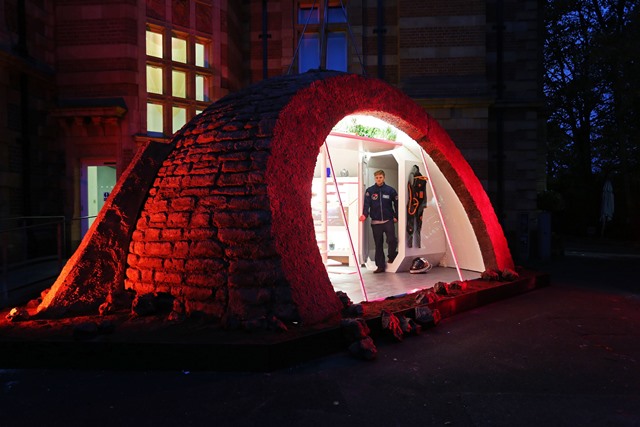
Mars show home at the Royal Observatory Greenwich, London.

The National Geographic Mars show home at the Royal Observatory Greenwich, London. The habitat is the work of Wild Creations in consultation with observatory astronomers and Stephen Petranek, author of How We’ll Live on Mars.{credit}National Geographic mini-series MARS runs through 19 December{/credit}

A big red igloo with a towering antenna seems a little overblown for a London show home. And so it proves. The object squatting outside the Royal Observatory Greenwich is actually a life-sized mock-up of a Mars habitat, billed as the imaginary dwelling of a second wave of settlers from Earth. That is, those who might live on the Red Planet in their thousands by around 2037, if the ambitious plans of space entrepreneurs such as SpaceX’s Elon Musk bear fruit.

The mock-up, in London this week to 16 November, promotes the National Geographic channel docudrama MARS, by director Ron Howard and Brian Grazer. Launched on 13 November, the mini-series charts the 2033 journey of a fictional first crewed mission to Mars by a blissfully collaborative International Mars Science Foundation, and subsequent attempts to establish a settlement.

As Earth’s second-nearest neighbour after Venus, Mars is widely seen as the best candidate planet for human colonization. But it lacks Earth’s thick atmosphere and global magnetic field, and is extremely inhospitable in myriad other ways. Colonists would need to be protected from temperatures that plummet to -70 degrees Celsius at night at the equator, as well as the high-energy cosmic particles and ultra-violet solar radiation that pummel the planet’s surface.

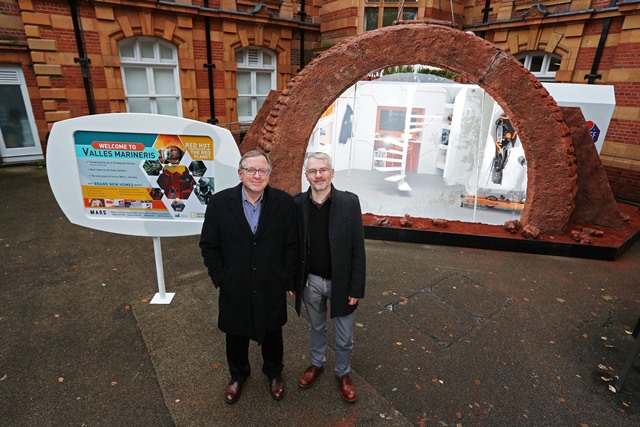
Author Stephen Petranek with Marek Kukula, the Royal Observatory Greenwich public astronomer.

Author Stephen Petranek with Marek Kukula, the Royal Observatory Greenwich public astronomer.{credit}National Geographic mini-series MARS runs through 19 December{/credit}

The Martian igloo, the work of display and model-making company Wild Creations, is a fun way of exploring what constraints the environment would put on design. The walls are a whopping 60 centimetres thick — just an eighth of the almost 5-metre depth they would need to be capable of protecting colonists from the radiation, said Stephen Petranek at the show-home opening. His book How We’ll Live on Mars inspired the series, and he consulted on the show home alongside the observatory’s public astronomer Marek Kukula. Moreover, Petranek notes, it would need to be built of bricks made by microwaving a mixture of polymer granules with Mars’ clay mineral-based soil. And an igloo is just one possible design. The same bricks could easily make bigger structures, even a large Gothic cathedral, he says. Or homes on the Red Planet could be built in the natural underground hollows that once housed lava, or in the side of craters.

Daily life for the 10,000 people Petranek imagines might some day dwell in this kind of shelter does not look appealing. Accessed via an ‘airlock’ stuck into the igloo wall, the dome’s interior is claustrophobically small — just a few paces across. Features would have to include an exercise machine to combat muscle wastage in the low-gravity environment, and an indoor farm. The small potted plants I spot on a mezzanine near the building’s ceiling hardly look substantial enough to sustain a hungry Martian for more than a few weeks — in contrast to the heaps of potatoes ingeniously grown by fictional astronaut Mark Watney (Matt Damon) in Ridley Scott’s 2015 film The Martian. Settlers would also need access to water, which (assuming it is there) may only exist in liquid form dozens of metres down in the planet’s concrete-hard ground.  

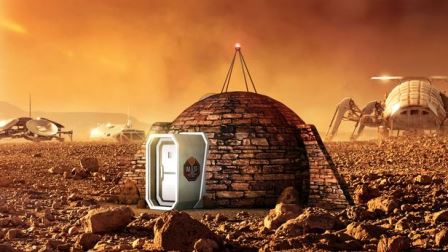
Artist's depiction of the show home in situ.

Artist’s depiction of the show home in situ.{credit}National Geographic{/credit}

The message here seems to be about thinking big to encourage ambition, as with the MARS mini-series. That uses an innovative format: the drama unfolds amid “flashbacks” to interviews with actual scientists and space pioneers, such as Musk. These highlight how real progress often initially involves failure, but  also serve to make the dramatised scenes seem even more fictional.

Petranek notes that plans such as Musk’s are “much more realistic than people give them credit for”. And whether or not they succeed, SpaceX is driving all space exploration in the direction of human missions to Mars, he argues. But for now, most planetary scientists still see living there as science fiction, and that’s not just because of unfeasible costs or optimistic technology projections.

Many researchers don’t actually want to send people to the Red Planet yet. It could well have harboured life billions of years ago, and finding that would tell us that life on Earth was not a one-off fluke. NASA, the European Space Agency (ESA) and the China National Space Administration all plan to put rovers on Mars in the 2020s to scour it for ancient life. But while rovers can be carefully sterilised to prevent contamination, sending humans would almost certainly contaminate the planet, and could mean we never find out. From that perspective at least, there is no hurry.

Elizabeth Gibney is a reporter on physics for Nature based in London. She tweets at @LizzieGibney. Listen in to her Nature Podcast talk with Andrew Coates, the planetary scientist working on the ESA’s first Mars rover. 

MARS runs through 19 December on the National Geographic channel. 


For Nature’s full coverage of science in culture, visit www.nature.com/news/booksandarts.


Breaking barriers: the US space programme’s black women mathematicians

Posted on behalf of Alexandra Witze

Mathematician Katherine Johnson at NASA's Langley Research Center, where she worked as a "computer" from 1953 to 1986.

Katherine Johnson at NASA’s Langley Research Center, where she worked as a “computer” and mathematician from 1953 to 1986. Her illustrious career included calculating Apollo 11’s trajectory on its flight to the Moon. {credit}NASA{/credit}

Some of the most intriguing stories in the history of US science have emerged over the past few years. It’s about time. These books centre on something long under wraps: the centrally important roles women played starting some 70 years ago in the great technological transition that gripped the twentieth century. Denise Kiernan’s The Girls of Atomic City (Touchstone, 2013) chronicled the contributions of the women who worked at the secret atomic-bomb laboratory in Oak Ridge, Tennessee, during the Second World War. Rise of the Rocket Girls by Nathalia Holt (reviewed here) depicted the mathematicians or “human computers” who crunched numbers at the Jet Propulsion Laboratory in southern California from the 1940s. In this catalogue, Margot Lee Shetterly’s Hidden Figures is more than just another entry.

Shetterly’s book is an exploration of the groundbreaking achievements and shocking discrimination experienced by a group of talented mathematicians in all aspects of their professional and personal lives. These African-American women — Dorothy Vaughan, Katherine Johnson, Mary Jackson and Christine Darden among them — began working from the early 1940s at the Langley Research Center in Hampton, Virginia, then the nation’s premier aeronautical laboratory. That wartime breakthrough was to propel many of them into long and successful careers at the heart of the space race. (A feature film based on the book and starring Taraji P. Henson will be released in January.)

Christine Darden in the control room of Langley's Unitary Plan Wind Tunnel in 1975. Darden became an expert on sonic booms and supersonic flights.

Christine Darden in the control room of Langley’s Unitary Plan Wind Tunnel in 1975. Darden became an expert on sonic booms and supersonic flights.{credit}NASA{/credit}

These stellar scientists broke major political and social barriers. Virginia in the American South was a segregated state. Beginning after the Civil War and lasting until the civil-rights era of the 1960s, “Jim Crow” laws enforced a rigid racial hierarchy. Shops, restaurants, public transportation — all viciously discriminated against African-Americans in matters as basic as where to use the toilet.

The mathematicians whose experience Shetterly unveils came of age in this reality. Members of a thriving African-American middle class, they went to universities such as Howard in Washington DC — historically black institutions where they were taught by eminent faculty trained at universities such as Harvard, who could not secure a position there because of their race. These accomplished young women became teachers, then generally the sole career option for educated black women. (Postgraduate education was not even possible in some states; rather than admit African-American students to its state university for graduate studies, between 1936 and 1950 Virginia paid them “scholarships” to attend graduate school elsewhere.)

Top flight

But after America entered the war in 1941, new professional opportunities opened. Langley, where engineers designed and tested technological advances that permitted US planes to fly higher and faster, needed an awful lot of number-crunchers to calculate, say, the ideal air flow over an aeroplane wing. That crushing demand opened the gates to women. Female computers began working through calculations that kept Boeing’s B-29 Superfortress bomber  aloft and the North American Aviation P-51 Mustang fighter manoeuvering through the skies.

Even here, however, segregation persisted. Vaughan and her colleagues were placed in Langley’s ‘West Computing’ unit. White women computed on the east side. At the back of the Langley cafeteria, a white cardboard sign labeled COLORED COMPUTERS directed the West mathematicians to sit together at lunch rather than mingle. Eventually, “tiny firebrand” Miriam Mann stole the sign, and the table was left unlabelled.

Margot Lee Shetterly.

Margot Lee Shetterly.{credit}Aran Shetterly{/credit}

Shetterly, who grew up in Hampton, illuminates this remarkable group’s professional careers and personal travails. Simply getting housing as a black woman was fraught with difficulty in these decades. It was only by harnessing the strong social networks of the African-American middle class that these mathematicians finally got a toehold in the American dream. Shared work experiences bound the group outside Langley: Vaughan and Mann brought their families together for local activities including a phenomenal performance in Hampton by iconic African-American singer Marian Anderson.

Postwar, the future was unclear, Shetterly shows. Would women be pushed out of the workforce? The Soviet Union’s launch of Sputnik in 1957 changed all that. In 1958, the Langley lab became part of the newly formed NASA and the centre of Project Mercury, the programme for crewed space travel. The West computers scattered to other divisions to begin work on the complex calculations of getting spacecraft into orbit.

HiddenFigures_HC HiResIn 1959 Johnson and her colleague Ted Skopinski first calculated the mathematics of firing a capsule into ballistic flight. The equations described the flight of a spacecraft, from the angle of launch, to point of re-entry, to the effect of Earth’s rotation. Their work underlay the successful 1961 suborbital flight of astronaut Alan Shepard. The following year, when John Glenn was about to make the first US orbital flight, he personally requested Johnson to double-check, by hand, the calculations of his trajectory. Johnson went on to an illustrious career in the US space programme. Her mathematics dictated the trajectory of the Apollo 11 flight to the moon, Neil Armstrong and Buzz Aldrin’s descent to the surface, and their tricky rendezvous with the command module in lunar orbit in order to make it safely home. Later, she worked on the space shuttle programme. In November 2015, she received the Presidential Medal of Freedom, the nation’s highest civilian honor, from President Barack Obama.

Vaughan, who in the 1950s had served as Langley’s first black supervisor, forged a successful career in computer programming. Jackson achieved the rank of engineer, then turned her attention to helping other women and minorities into high-level positions. Darden, one of the next generation to benefit from the barriers broken by this group, became a world expert on sonic booms and supersonic flight.

Hidden Figures is not the definitive history of women in the space programme, nor of women at Langley. It does not need to be. It lies at the intersection of the greatest scientific advances and the greatest civil-rights battles in US history.

Alexandra Witze is a correspondent for Nature based in Boulder, Colorado. Her email is witzescience@gmail.com and she tweets at @alexwitze.


For Nature’s full coverage of science in culture, visit www.nature.com/news/booksandarts.

The Hubble ‘space opera’

3Q: Paola Prestini

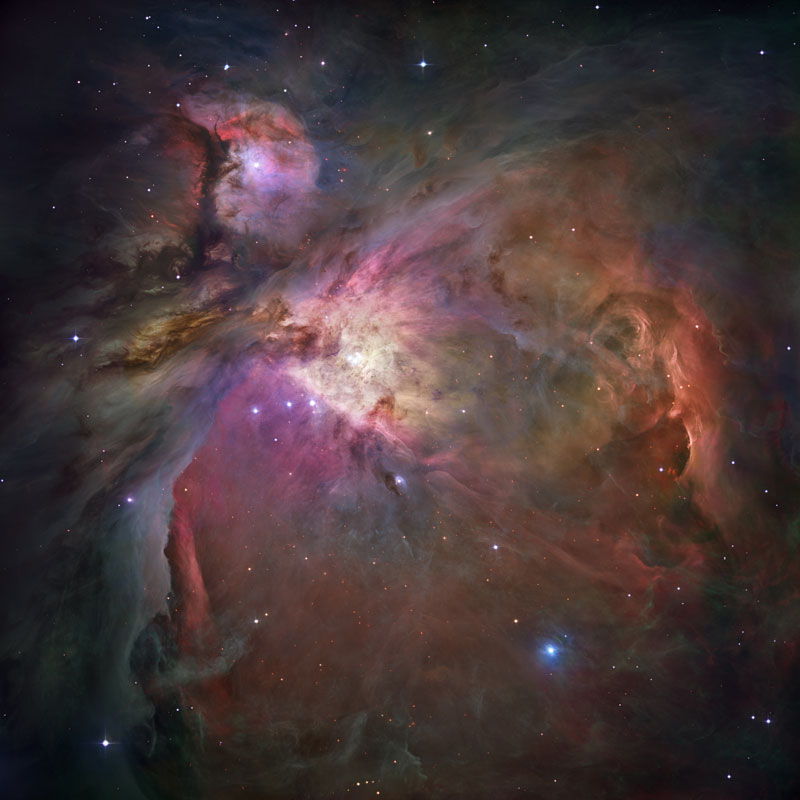
Hubble image of the Orion Nebula, at 1,500 light-years away, the nearest star-forming region to Earth. The bright glow at upper left is from M43, a small region being shaped by a massive, young star's ultraviolet light.

Hubble image of the Orion Nebula, the nearest star-forming region to Earth.{credit}NASA, ESA, M. Robberto (Space Telescope Science Institute/ESA) and the Hubble Space Telescope Orion Treasury Project Team.{/credit}

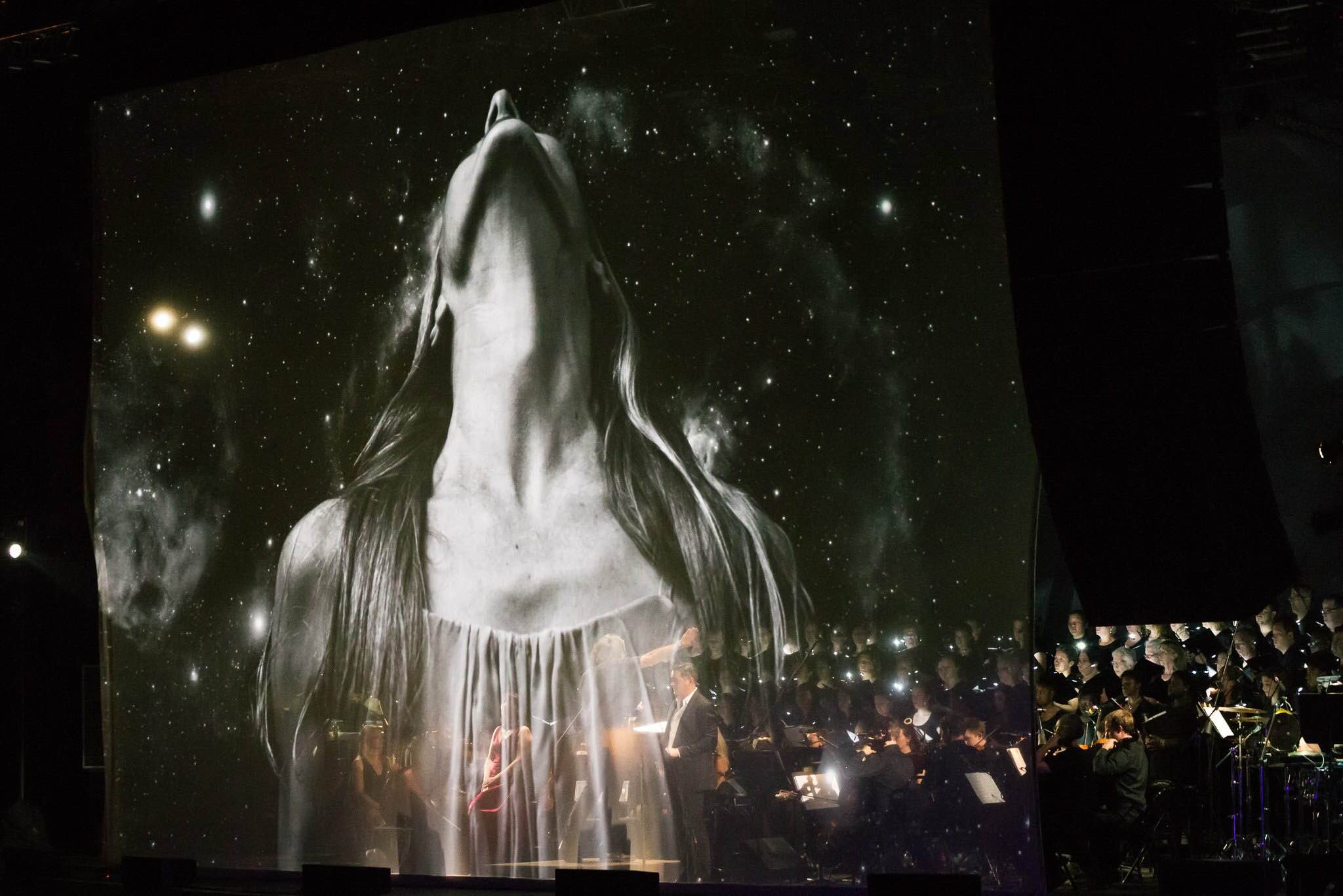
In 2012, composer Paola Prestini began collaborating with astrophysicist Mario Livio — who worked at the Hubble Space Telescope’s operations centre from 1991 to 2015 — on a “space opera” celebrating the instrument’s 25th anniversary. The result, The Hubble Cantata, debuted on the telescope’s 26th. Performed on 6 August at the BRIC Celebrate Brooklyn! festival in New York City’s Prospect Park, it is a multidimensional paean to the ‘eye in the sky’, meshing Livio’s narration with performances by Norwegian orchestra 1B1, a 100-strong chorus and Metropolitan opera stars Jessica Rivera and Nathan Gunn, and a climax featuring a 3D virtual-reality (VR) experience incorporating Hubble images that allows viewers to drift through the Orion Nebula. Here Prestini talks about the joys and challenges of putting together a highly collaborative meld of science and art.

What inspired this project?

About four years ago, I was asked by the nonprofit Bay Chamber Concerts — who were in touch with Matt Mountain, then-head of Hubble operations centre the Space Telescope Science Institute — to create a piece commemorating the telescope’s legacy and anniversary. I began to read what Mario Livio had written on his blog, and after meeting, we began to pull together a loose narrative. With the librettist Royce Vavrek, I realised that Mario could become the inspiration for the opera’s main character. What emerged from our collaboration with Mario was a cantata drawing connections between human loss, love and sorrow, and the life cycle of a star. We decided that Mario would narrate and be the voice of the lead character, an astrophysicist who had lost his wife; there would be an adult choir, children’s choir and orchestra. No Hubble images would be used until the ending, which would culminate in a VR work exploring the beauty and depth of Hubble images. I began to record Livio, and that was the launch of the cooperation.

Of the performance

Dancer Wendy Whelan projected on a scrim at the debut performance of The Hubble Cantata; singers Jessica Rivera and Nathan Gunn can be seen behind.{credit}Sasha Arutyunova{/credit}

How does your composition incorporate science?

Both in its premise, of course, and in the technological underpinnings that have gone into creating it. I worked with sound designer Terence Caulkins from engineering firm Arup to create the 3D soundscape. To present the experience outdoors, in particular for the VR experience, we needed to create an immersive experience that gives the impression sounds are moving around and through the audience space. We mixed the music in a spatialized sound format called Ambisonics, which can be used for various loudspeaker layouts. For example, in its Soundlab Arup has a sphere of loudspeakers that allows you to place sounds around, above and below listeners to enhance the VR effect. Ambisonic sound can also be mixed down to “binaural”, which is a 360-degree sound format for headphones. (This is what people downloading our free app, Fistful of Stars, will hear.) For the performance, we designed a concentric eight-point loudspeaker system surrounding the audience. The electronic narration sequences include Mario speaking about everything from baryonic matter to extra-solar life. Filmmaker Eliza McNitt created the virtual-reality film in collaboration with the Endless Collective. This is a five-minute VR video that gives a 360-degree tour through space, comprising CGI-animated Hubble imagery of the Orion Nebula. We found a company to sponsor cardboard virtual-reality glasses for audience members.

What is it like for you as an artist to work with scientists?

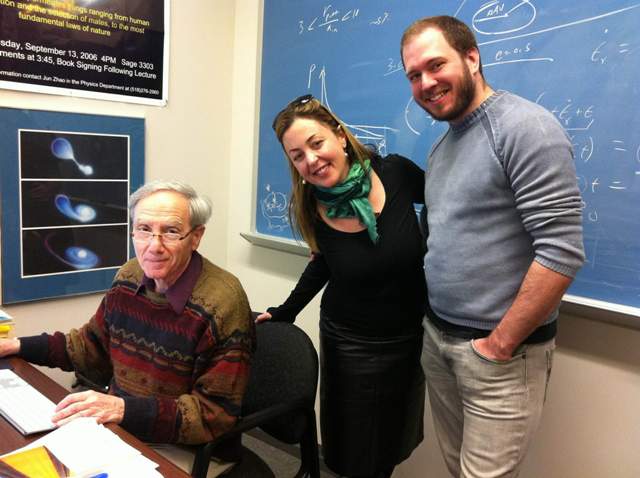
Astrophysicist Mario Livio, composer Paola Prestini and librettist Royce Vavrek (L to R).

Astrophysicist Mario Livio, composer Paola Prestini and librettist Royce Vavrek (L to R).{credit}Jill Steinberg{/credit}

It’s great fun. It’s fascinating to think about our creative processes and how different they are. Mario has worked with the Baltimore Symphony as a narrator for performances, but never really deeply in a music collaborative process before this one. There’s a great deal of learning going on for all of us. He needed to trust that we were going to bring these massive concepts to fruition, so there was a lot of back and forth. He is able to explain super-complex concepts, such as dark matter, to musicians; setting these texts as simple narrations was important to me so that they could be clearly understood. Hubble’s legacy and what it has done for our understanding of the Universe is at the core of our drive to give it a musical life. The loss of communication between loved ones in the cantata storyline is echoed by the expansion of the Universe “at the rate of our imagination” (something Mario often says). Yet as the fictional astrophysicist’s understanding of the Universe deepens, he reconstructs his wife’s story and understands her better. Woven together, those twin threads in the piece — the rarity of life in the grand cosmic scene, and Hubble’s revelation of that scene — connect human and cosmic scenarios, revealing realities that may exist at vastly different scales, but that are each vastly important.

Interview by Jeff Tollefson, a reporter for Nature based in Washington DC. He tweets at @jefftollef.

Paola Prestini is currently in conversation with several producers in the United States and overseas about presenting The Hubble Cantata again. The piece will be released as a recording by VIA Records and as a short film by an as-yet unnanounced distributor.


For Nature’s full coverage of science in culture, visit www.nature.com/news/booksandarts.