Illustrated books of 2017: the magnificent eight

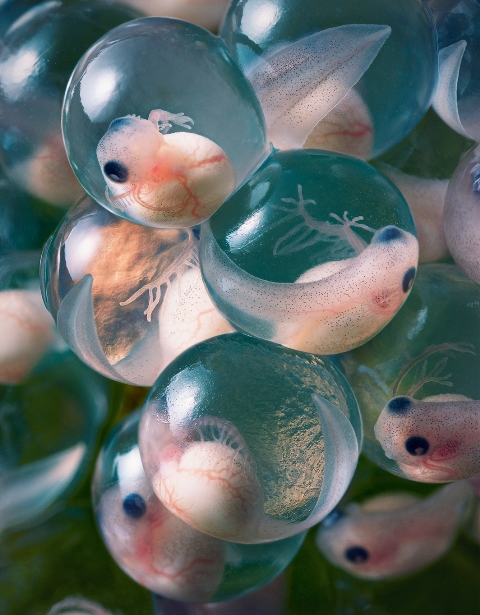
Yellow-eyed tree-frog eggs, from Endangered by Tim Flach, with text by Jonathan Baillie (Abrams).

Yellow-eyed tree-frog eggs, from Endangered by Tim Flach, with text by Jonathan Baillie (Abrams). {credit}© 2017 Tim Flach{/credit}

There’s something about a collection. We seem to harbour an urge to amass and sort as we build menageries, museums, taxonomies. And the illustrated book is a portable simulacrum, a paper cabinet of curiosities, curated for maximum aesthetic punch.

This year, my favourites include coffee-table tomes on the Solar System and early voyages from Europe to Latin America. The rest, as with those I prized most last year, focus on fauna — a reflection of the emphasis on animal intelligence, behaviour, extinction and resurrection in popular-science publishing. Our obsession with Animalia is unstoppable. In some important way, the thread has yet to snap between us and the humans who, 35,000 years ago, layered exquisite images of bison, lion and rhino on the walls of Chauvet cave.
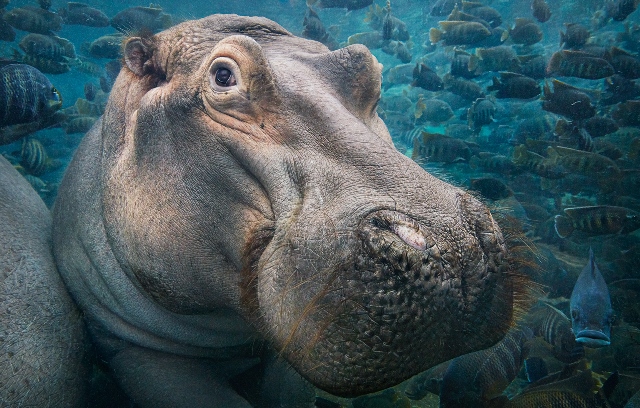
Hippopotamus underwater, from Endangered by Tim Flach, with text by Jonathan Baillie (Abrams).

Hippopotamus underwater, from Endangered by Tim Flach, with text by Jonathan Baillie (Abrams). {credit}© 2017 Tim Flach{/credit}

Among the eight illustrated books that leapt out at me, Endangered (Abrams) won the long jump. On the cover, a crowned sifaka lemur tightly clutches its knees, citrine eyes staring with alien intensity. Inside is a virtuosic gallery of species at the edge: the bulbous topography of a hippo’s face; Mexican free-tailed bats slicing up the sky; a long-range shot of a polar bear curled in snow, white on white. Complementing Tim Flach’s hyper-stylised images are commentary by Jonathan Baillie, the National Geographic Society’s chief scientist, and writer Sam Wells.
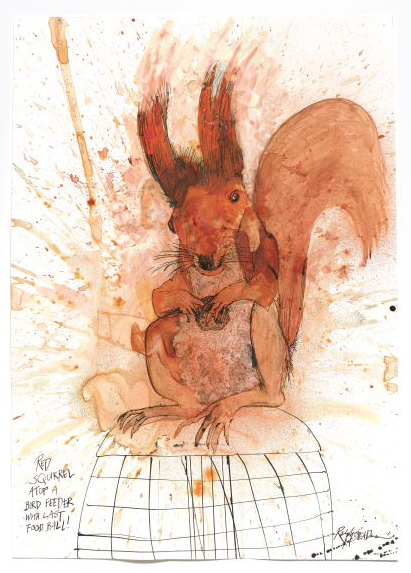
Red squirrel by Ralph Steadman in Critical Critters (Bloomsbury).

Red squirrel by Ralph Steadman in Critical Critters, by Steadman and Ceri Levy (Bloomsbury).{credit}Ralph Steadman and Ceri Levy{/credit}

Biodiversity loss has also gripped self-styled “gonzovationist” and illustrator Ralph Steadman for years, as his 2015 Nextinction showed. Now, in Critical Critters (Bloomsbury), Steadman (with Ceri Levy) pictures another bevy of beasts, exuberantly splatting his way from iconic megafauna such as tigers to dugongs, wombats and a red squirrel in burnt orange, ears aflame. The irrepressible Steadman includes the ‘grunting spiked turt’, a chameleon-like animal that should exist, but doesn’t.
Tortoise beetle, from Microsculpture: Portraits of Insects by Levon Biss (Abrams).

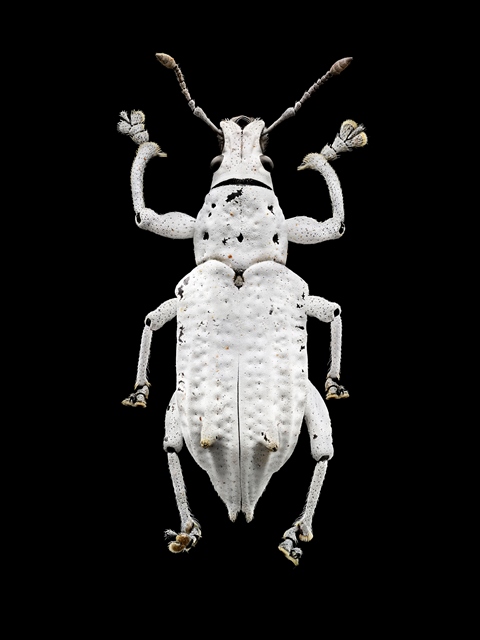
Short-nosed weevil, from Microsculpture: Portraits of Insects by Levon Biss (Abrams).{credit}© Levon Biss{/credit}

Insects that did exist, yet look impossible, feature in Levon Biss’s photographic feat Microsculpture (Abrams). Biss (whose work can also be seen in this film) imaged the world’s oldest insect collection at the Oxford University Museum of Natural History, including specimens bagged by Darwin and Alfred Russel Wallace. Each bravura photograph incorporates some 8,000 separate shots, from the ornate tortoise beetle — a rococo delight — to the ghostly short-nosed weevil.
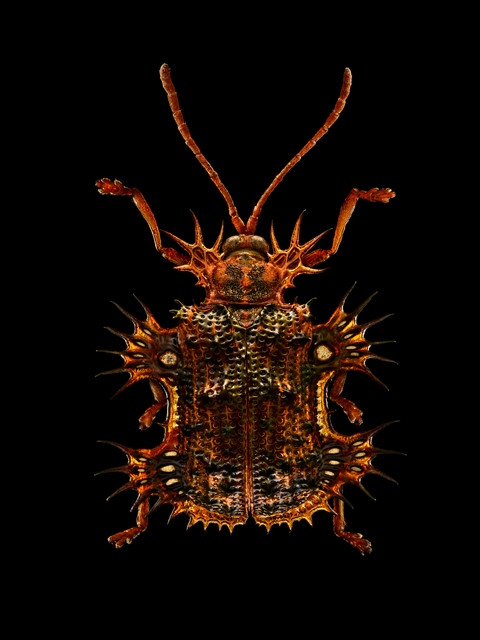
Tortoise beetle, from Microsculpture: Portraits of Insects by Levon Biss (Abrams).

Tortoise beetle, from Microsculpture: Portraits of Insects by Levon Biss (Abrams).{credit}© Levon Biss{/credit}

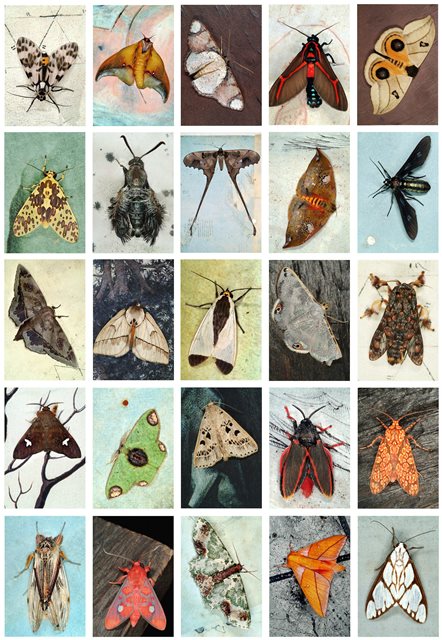
More entomological glory flutters in Mariposas Nocturnas (Princeton University Press), photographer Emmet Gowin’s hard-won homage to South American lepidoptera. From Brazil to Panama and over two decades, Gowin shot over 1,000 species of nocturnal moths alive. Arranged in typologies of 25, they form a morphologically varied, vividly hued patchwork. As Gowin writes, “By loving the minutiae, we find the whole.”
xxx

Index 31, taken in April 2010 in French Guiana, in Mariposas Nocturnas by Emmet Gowin (Princeton University Press){credit}Emmet Gowin{/credit}

Long before photography, engravers and printers battened upon beasts as evocative subjects for artworks and books — not just bestiaries and early natural-history tomes, but also allegories, illustrated tales and even playing cards. Animal (Bloomsbury) tells that story through powerful, often deeply strange works from the fifteenth to the twentieth centuries, deftly curated by editors Rémi Mathis and Valérie Seuer-Hermel from the National Library of France collection.
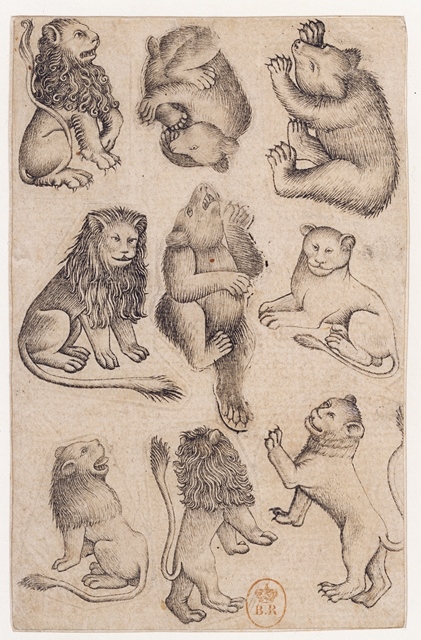
Cards with bear and lion symbols by the Master of the Playing Cards, Upper Rhine Valley, 1435-1445. In Animal, edited by

Cards with Bear and Lion Suit Symbols, by the Master of the Playing Cards,1435-1445, in Animal, edited by Rémi Mathis and Valérie Seuer-Hermel (Bloomsbury). Printed on copper plates, these cards were the first examples of engraving on metal seen in Europe.{credit}National Library of France{/credit}

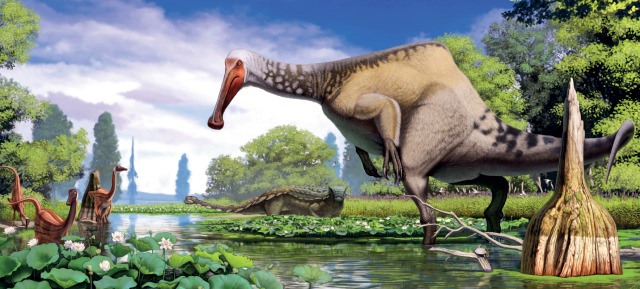
The cutting-edge imaging technologies of today feature in Dinosaur Art II (Titan Books), edited by artist Steve White. This follow-up to the 2012 Dinosaur Art features works of scientific precision and nuanced beauty by 10 top painters, modellers and digital artists. Among many standouts are Sergey Krasovskiy’s oil painting of the giant-jawed, tiny-limbed Pycnonemosaurus nevesi and a digital portrayal of the mysterious duck-billed Deinocheiris mirificus by Andrey Atuchin.
xxxx

The duck-billed dinosaur Deinocheiris mirificus (digital, 2014) by Andrey Atuchin, in Dinosaur Art II, edited by Steve White (Titan Books).{credit}Andrey Atuchin{/credit}

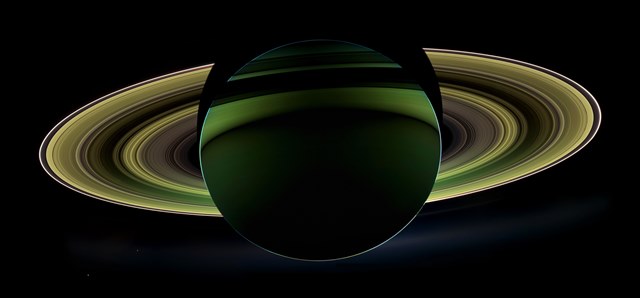
Zooming out from deep time to deep space, The Planets (Chronicle Books) by writer Nirmala Nataraj mines the NASA archives for a thrill-a-minute tour of our cosmic neighbourhood. It’s a handsome array, from the flow of dunes in Mars’s Nili Patera caldera, caught by the HIRISE camera on the Mars Reconnaisance Orbiter, to an opulently hued backlit view of Saturn captured by Cassini’s wide-angle camera.

Dunes patterning Nili Patera caldera on Mars, caught by the HIRISE camera on the Mars Reconnaisance Orbiter. From The Planets (Chronicle Books) by Nirmala Nataraj.

Dunes patterning Nili Patera caldera on Mars, caught by the HIRISE camera on the Mars Reconnaisance Orbiter. From The Planets (Chronicle Books) by Nirmala Nataraj. {credit}NASA, JHUAPL, Carnegie Institution of Washington{/credit}
xxx

A back-lit view of Saturn, captured by Cassini’s camera. From The Planets (Chronicle Books) by Nirmala Nataraj. {credit}NASA, JPL-Caltech, SSI{/credit}

In mapping the Solar System, it’s easy to forget that swathes of Earth were uncharted five centuries ago, and indigenous Americans and Europeans had yet to meet. When they did, starting with Columbus’s 1492 voyage, a “vertiginous transformation” began, reminds historian Daniela Bleichmar in Visual Voyages (Yale University Press). It spelt immeasurable devastation for New World peoples even as their knowledge rewrote the Old World’s book of nature. As this fascinating, sensitively written book attests, this revolution, in turn, kickstarted a frenzy of printing and cartography to frame the barrage of botanical, zoological, anthropological and geographic data.
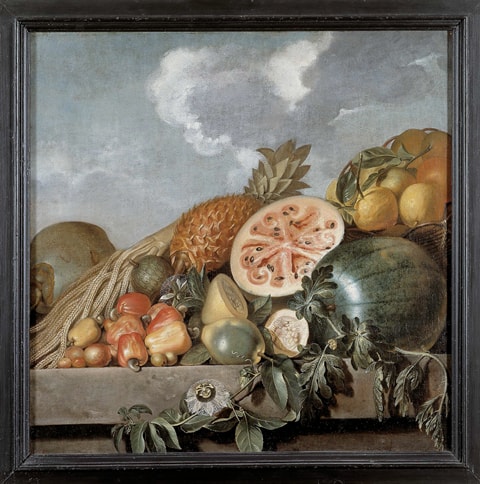
Fruits, Pineapple and Melon, 1640-50 (oil on canvas) by Albert Eckhout, in Visual Voyages by Daniela Bleichmar, Yale University Press.

Fruits, Pineapple and Melon, 1640-50 (oil on canvas) by Albert Eckhout, in Visual Voyages by Daniela Bleichmar, Yale University Press.{credit}National Museum of Denmark{/credit}

For Nature‘s full coverage of science and culture, see https://go.nature.com/2CMOwaL.
Show home for the Red Planet

Posted on behalf of Elizabeth Gibney

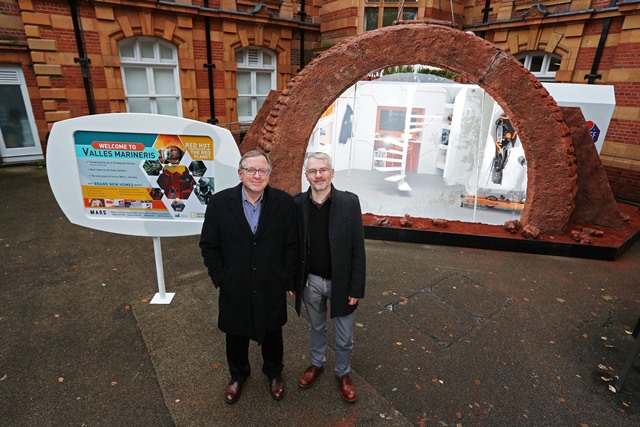
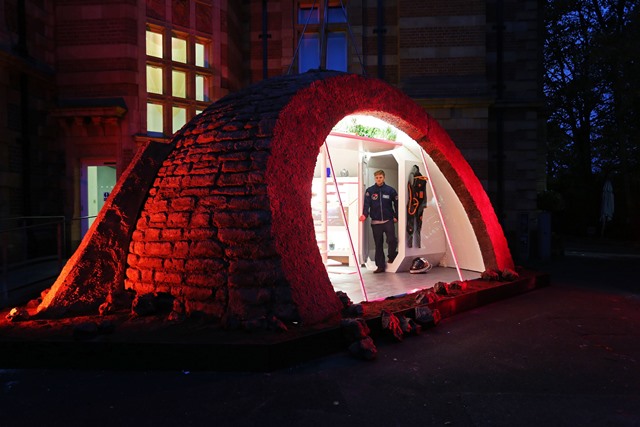
Mars show home at the Royal Observatory Greenwich, London.

The National Geographic Mars show home at the Royal Observatory Greenwich, London. The habitat is the work of Wild Creations in consultation with observatory astronomers and Stephen Petranek, author of How We’ll Live on Mars.{credit}National Geographic mini-series MARS runs through 19 December{/credit}

A big red igloo with a towering antenna seems a little overblown for a London show home. And so it proves. The object squatting outside the Royal Observatory Greenwich is actually a life-sized mock-up of a Mars habitat, billed as the imaginary dwelling of a second wave of settlers from Earth. That is, those who might live on the Red Planet in their thousands by around 2037, if the ambitious plans of space entrepreneurs such as SpaceX’s Elon Musk bear fruit.

The mock-up, in London this week to 16 November, promotes the National Geographic channel docudrama MARS, by director Ron Howard and Brian Grazer. Launched on 13 November, the mini-series charts the 2033 journey of a fictional first crewed mission to Mars by a blissfully collaborative International Mars Science Foundation, and subsequent attempts to establish a settlement.

As Earth’s second-nearest neighbour after Venus, Mars is widely seen as the best candidate planet for human colonization. But it lacks Earth’s thick atmosphere and global magnetic field, and is extremely inhospitable in myriad other ways. Colonists would need to be protected from temperatures that plummet to -70 degrees Celsius at night at the equator, as well as the high-energy cosmic particles and ultra-violet solar radiation that pummel the planet’s surface.

Author Stephen Petranek with Marek Kukula, the Royal Observatory Greenwich public astronomer.

Author Stephen Petranek with Marek Kukula, the Royal Observatory Greenwich public astronomer.{credit}National Geographic mini-series MARS runs through 19 December{/credit}

The Martian igloo, the work of display and model-making company Wild Creations, is a fun way of exploring what constraints the environment would put on design. The walls are a whopping 60 centimetres thick — just an eighth of the almost 5-metre depth they would need to be capable of protecting colonists from the radiation, said Stephen Petranek at the show-home opening. His book How We’ll Live on Mars inspired the series, and he consulted on the show home alongside the observatory’s public astronomer Marek Kukula. Moreover, Petranek notes, it would need to be built of bricks made by microwaving a mixture of polymer granules with Mars’ clay mineral-based soil. And an igloo is just one possible design. The same bricks could easily make bigger structures, even a large Gothic cathedral, he says. Or homes on the Red Planet could be built in the natural underground hollows that once housed lava, or in the side of craters.

Daily life for the 10,000 people Petranek imagines might some day dwell in this kind of shelter does not look appealing. Accessed via an ‘airlock’ stuck into the igloo wall, the dome’s interior is claustrophobically small — just a few paces across. Features would have to include an exercise machine to combat muscle wastage in the low-gravity environment, and an indoor farm. The small potted plants I spot on a mezzanine near the building’s ceiling hardly look substantial enough to sustain a hungry Martian for more than a few weeks — in contrast to the heaps of potatoes ingeniously grown by fictional astronaut Mark Watney (Matt Damon) in Ridley Scott’s 2015 film The Martian. Settlers would also need access to water, which (assuming it is there) may only exist in liquid form dozens of metres down in the planet’s concrete-hard ground.  

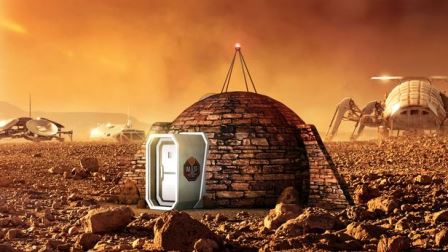
Artist's depiction of the show home in situ.

Artist’s depiction of the show home in situ.{credit}National Geographic{/credit}

The message here seems to be about thinking big to encourage ambition, as with the MARS mini-series. That uses an innovative format: the drama unfolds amid “flashbacks” to interviews with actual scientists and space pioneers, such as Musk. These highlight how real progress often initially involves failure, but  also serve to make the dramatised scenes seem even more fictional.

Petranek notes that plans such as Musk’s are “much more realistic than people give them credit for”. And whether or not they succeed, SpaceX is driving all space exploration in the direction of human missions to Mars, he argues. But for now, most planetary scientists still see living there as science fiction, and that’s not just because of unfeasible costs or optimistic technology projections.

Many researchers don’t actually want to send people to the Red Planet yet. It could well have harboured life billions of years ago, and finding that would tell us that life on Earth was not a one-off fluke. NASA, the European Space Agency (ESA) and the China National Space Administration all plan to put rovers on Mars in the 2020s to scour it for ancient life. But while rovers can be carefully sterilised to prevent contamination, sending humans would almost certainly contaminate the planet, and could mean we never find out. From that perspective at least, there is no hurry.

Elizabeth Gibney is a reporter on physics for Nature based in London. She tweets at @LizzieGibney. Listen in to her Nature Podcast talk with Andrew Coates, the planetary scientist working on the ESA’s first Mars rover. 

MARS runs through 19 December on the National Geographic channel. 


For Nature’s full coverage of science in culture, visit www.nature.com/news/booksandarts.


The warp and weft of wearable electronics

Zhang 1

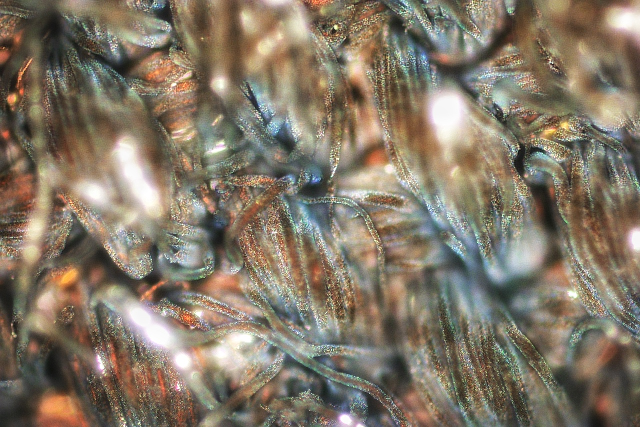
Optical microscope image of a battery electrode made of metallic textiles and active materials. {credit}Dongrui Wang{/credit}


3Q: Zijian Zheng

One of today’s challenges for materials scientists is wearable electronics — smart materials that monitor ailments, harvest energy, track performance or communicate. These remain expensive and hard to produce in bulk, and are often unattractive. Polymer scientist Zijian Zheng takes inspiration from his designer and business colleagues at Hong Kong Polytechnic University’s Institute of Textiles and Clothing. His solution: lightweight electronic yarns that can be made into textiles by adapting existing production processes.

 How do you create wearable electronics?

People need to feel like they’re not wearing electronics, so the materials must be lightweight and flexible. They must also be high-performance, as devices have to charge rapidly, last for a long time and be sweat-proof. Applying all these criteria, we create electronic textiles in which the fabrics themselves form the sensors and devices – from light-emitting diodes, photovoltaics, organic transistors and supercapacitors to batteries. We can make a supercapacitor using conductive yarn, made by coating cotton with nickel, and penetrating it with a form of graphene oxide. If you put a pair of these strands together in parallel, and fill the space between with an electrolyte gel, you can make it work as a supercapacitor storing energy as positively and negatively charged ions collect at the different wires. You could use that to power other devices, such as sensors, or store energy generated from photovoltaics. We’re working on making lithium batteries using the same principles.

Polymer scientist Zijian Zheng.

Polymer scientist Zijian Zheng.

What are your biggest challenges?

When integrating different materials together in an electronic textile, the interfaces create the biggest problems. You can get mismatches between mechanical and thermal expansion properties, and in a flexible system the weakest points are where the device twists or bends. In my group we focus on using polymers to address these issues. For example, we make new polymers that add texture to the surface of textiles, allowing them to be coated in copper at low temperatures for durability. To ensure scalability, our goal is to make textiles that can be integrated with the technology the clothing industry has used for the past 200 years. Our composite yarns can be used in sewing machines, and complicated patterns can be created from them using machine embroidery. From there, you start to add active materials to make devices in ways that are compatible with textile processing. For example, we’re now making photovoltaic cells printable via textile colour-printing technology and encapsulating them with textile-finishing technology. And we are set to make a radio-frequency identification tagging device within a garment, powered by a supercapacitor. We’ve designed it to hide the supercapacitor as an embroidered pattern, like camouflage. We also have a student working with local textile company EPRO Development, trying to put the metallic, conducting textile into real production. Devices will come a bit later as they are ten times more complex to make. Cost is a challenge too: the textile industry cares about every penny. In introducing functional elements into garments such as a breathable section, you might only be allowed to increase production costs by around 10 cents.

Zhang 2

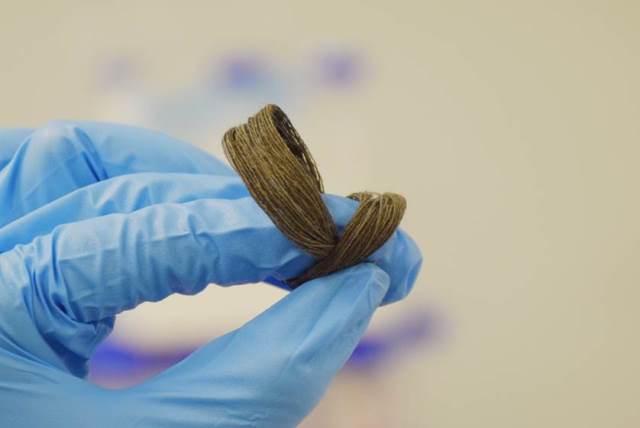
One hank of copper-coated cotton yarns used for making wearable devices and circuits.{credit}Ka-chi Yan{/credit}

How do the different disciplinary strands in your institute work together?

My institute covers the whole chain of production for textiles and clothing – with materials science and chemistry groups sitting alongside business and design. So we have three streams of students and teaching is totally different for each. The major challenge when I lecture is how to deliver my engineering or scientific-based content to a bunch of artists. We tend to give them an overview to help them understand first, with lots of examples, before we come down into the fundamentals. It’s very different from the physical science students, where we take them through a logical sequence from beginning to end. The artists ask so many questions. Generally they want to know if they can do something with a material, and don’t care about why it functions. They seldom ask “Why does this electron go through there?”

Interview by Elizabeth Gibney, a reporter on physics for Nature based in London. She tweets at @LizzieGibney.


For Nature’s full coverage of science in culture, visit www.nature.com/news/booksandarts.