Machines moved by mind

3Q: José Millán

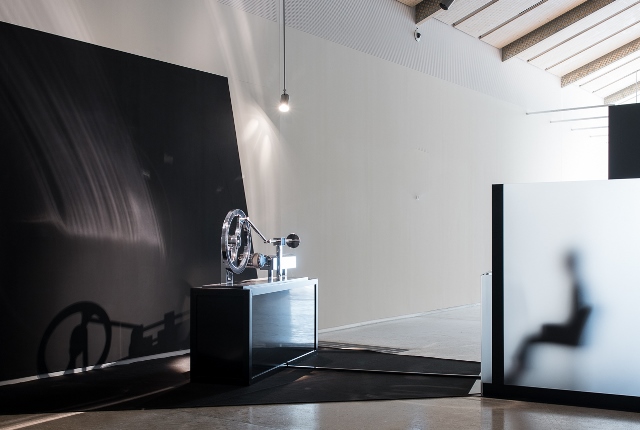
A 'mental worker' (behind screen at right) with Machine 1 at the exhibition Mental Work.

A visitor (behind screen at right) driving Machine 1 using the force of their own thoughts, at the exhibition Mental Work.{credit}© Photography Adrien Baraka / Mental Work{/credit}

At Mental Work, an exhibition at the Swiss Federal Institute of Technology Lausanne ArtLab (EPFL), visitors can drive simple machines using the force of their own thoughts. Probing the rapidly changing relationship between humans and technology, these artworks will also generate vast amounts of data that will be shared with researchers around the world. The show is a collaboration between experimental philosopher Jonathan Keats and EPFL neuroengineer José Millán, who develops brain-machine interfaces (BMIs) to help people with paralysis. Here, Millán talks pistons, probability and the debate over who or what is in control.

What will visitors experience at the show?

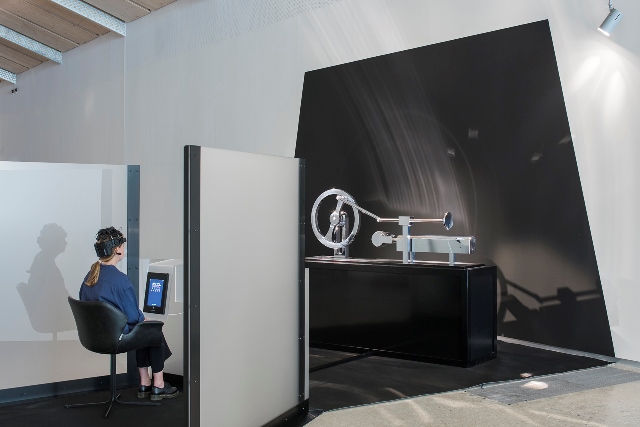
Some will be active participants in three experiments; others will watch them work. The participants, or ‘mental workers’, wear an EEG helmet studded with 19 dry electrodes — which continuously pick up electrical activity in their brains. In the first experiment they sit in front of a 2-metre-long construction (Machine 1) comprising a piston, fly-wheel and horizontal shaft. Using mental imagery, they try to move the piston onto the fly wheel; this starts the wheel turning, driving the shaft through a bolt. The brain-machine interface or BMI that makes this possible is an algorithm that has to be trained to ‘read’ the mind of each driver. The driver instigates the training by making a binary movement of the hand or foot, such as clenching and opening a fist, while simultaneously imagining the piston moving or stopping. The algorithm learns the stop-go instructions from patterns of the data from the electrodes, and converts them into commands for the piston. Because the data are always noisy and variable, the command is based on probability; but we program the piston motor to generate movement only when the probability is high — usually in the 70-90% range.
xxx

Another view of a ‘mental worker’ with Machine 1.{credit}© Photography Adrien Baraka / Mental Work{/credit}

What happens in the other two experiments?

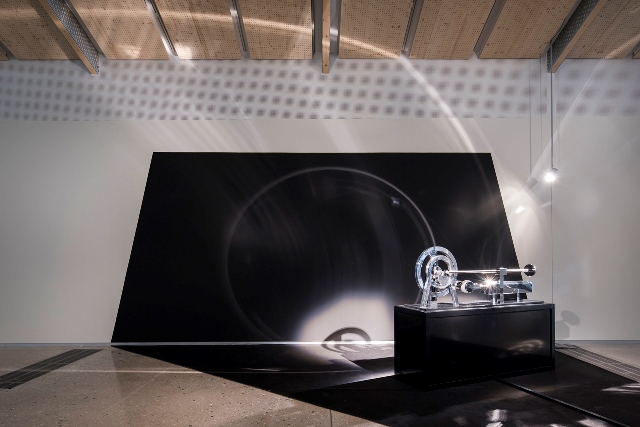
They are more complex, and so are the machines. Participants take the role of either ‘driver’ or ‘supervisor’. Supervisors may change the level of probability through their own mental imagery, so the driver has a harder or easier (but messier) job of getting the machine to work. Or the supervisors may use their mental imagery to instruct the BMI to stop using mental imagery altogether, and switch to a different algorithm that use patterns of alpha waves — the brain-wide oscillations generated when the brain is at rest — to drive movement. In this case, the supervisor also uses mental imagery to instruct the driver to relax and ‘empty’ his or her brain. This is the part I am terrified about! We can get this to work in the lab, but it gets so complicated we don’t know what will happen when it is tested in more open conditions. We’ll also distribute a questionnaire asking participants whether they felt they were controlling the machines or if the machines were controlling them.
 

xxx

Machine 2, where ‘drivers’ have their threshold adjusted using a brain-machine interface or BMI.{credit}© Photography Adrien Baraka / Mental Work{/credit}

What do you want to emerge from the exhibition?

We are entering a cognitive revolution in which we will increasingly use many different new technologies to tap into or extend the capabilities of our brains. I hope that Mental Work will help generate a societal debate about this. Could brain power be used to carry out real work in the real world? What would that mean for employment? Will machines take control of our minds, or will our minds always have the control of machines? Personally, I am optimistic – I think the future is up to us. But the debate needs to start now. I hope visitors to this show will also enjoy the aesthetics of these artistic machines. Meanwhile, the data will be very valuable scientifically. We will capture and share it with the BMI research community, which is constantly trying to improve interfaces, for example by increasing the probability that brain signals are correctly read. Our experience suggests that many participants improve their performance as they move from one machine to another, and I expect that the research community will also be able to develop better machine-learning techniques for BMI users. At the end of the day what I really want is help BMI users, particularly  people with paralysis, to generate brain signals that are more stable and easier to decode.

Interview by Alison Abbott, senior European correspondent for Nature. She tweets at @alison_c_abbott

 This interview has been edited for length and clarity.

Mental Work runs from 27 October – 31 January 2018. The first two weeks are open for registered participants only, so any visitors wishing to participate as ‘mental workers’ must first sign up on the website mentalwork.net. The show opens to the general public on 13 November. It will subsequently move on to swissnex San Francisco in California. 


For Nature’s full coverage of science in culture, visit www.nature.com/news/booksandarts.
The Colorado: elegy for an overused river

Posted on behalf of Monya Baker

The Colorado River

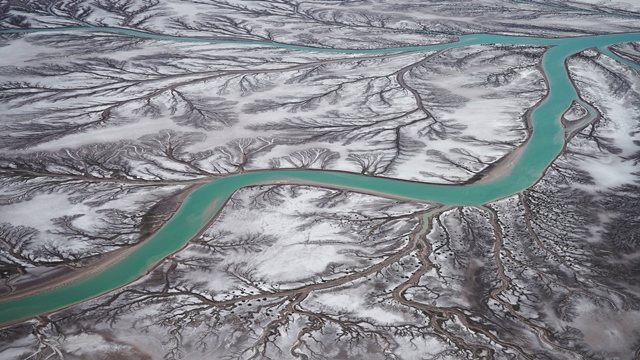
Tidal waters in the delta region of the Colorado River.{credit}Murat Eyuboglu{/credit}

The Colorado River in the US West proves the adage that you never step into the same river twice. Lined by a vast array of landscapes, communities and industries it has shaped, its waters run variously aqua, navy blue, muddy brown — or not at all. Over its 2,334 kilometres, it sustains some 40 million people, 2 million hectares of farmland and the Hoover Dam. It is also polluted, depleted, diverted.

Now this mighty waterway is celebrated in The Colorado — a music-based documentary that delivers a powerful environmental and social message. Produced by VisionIntoArt, the project brings together several composers including Paola Prestini and live performance ensemble Roomful of Teeth, among others. (See below for the trailer.)

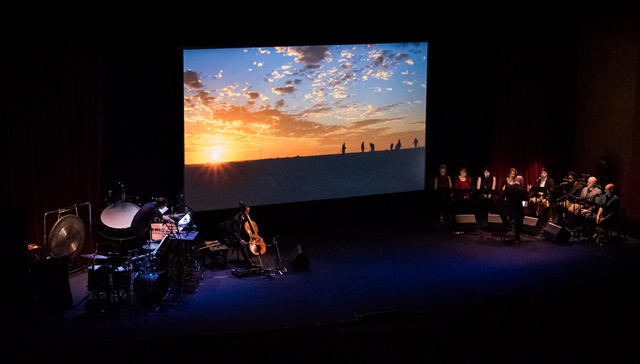
Glenn Kotche and Jeffrey Zeigler performing at the New York premiere of The Colorado.

Glenn Kotche and Jeffrey Zeigler performing at the New York premiere of The Colorado.{credit}Jill Steinberg{/credit}

At a pre-show talk on 22 April at Stanford University in Palo Alto, California, the project’s director Murat Eyuboglu noted that his inspiration was the story of the Salton Sea in California’s Colorado Desert. This huge inland lake was created by accident in 1905, when engineers’ plans for irrigation canals succumbed to the river’s might. Now saltier than the Pacific Ocean, the lake is filled with toxic sludge and hosts acres of deserted lakeshore development, yet is essential habitat for migrating seabirds. “I’ve never seen so much beauty and devastation cohabiting in one place,” said Eyuboglu. That sentiment holds for the film as well.

Eyuboglu’s interest in the Salton Sea led him to contact writer William deBuys, who has chronicled the natural histories of water in the region in books such as Salt Dreams (coauthored with Joan Myers). DeBuys signed on to advise Eyugoblu on the project, then became his co-scriptwriter and lyricist. Filmed over four years (and 20 trips into the river’s drainage basin), their documentary meanders from the artificially fertile fields of Imperial Valley to the artificially parched expanses in the Sonoran Desert as well as the Salton Sea.

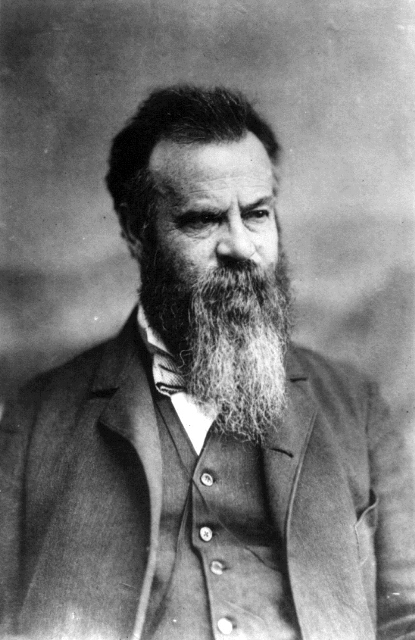
Geologist John Wesley Powell, the first to explore the Colorado River for scientific purposes.

Geologist John Wesley Powell, the first to explore the Colorado River for scientific purposes.

The work is divided into nine sections. Each begins with a narrative introduction by actor Mark Rylance, grounded in stories of people who explored, exploited or were exploited by water-fueled power. After the narration stops, we are steeped in stunning cinematography and archival footage.

The first to explore the Colorado for scientific purposes was noted geologist and Civil War veteran John Wesley Powell. (During that conflict Powell, who lost an arm in combat, would instruct his soldiers to watch out for fossils while digging trenches.) On his first, grueling three-month 1869 expedition, Powell recognized that the river had cut through millennia, pronouncing the region “a Book of Revelations in the rock-leaved Bible of geology” that he was determined to read. Mapping the basin, Powell made a coherent case that political units should follow the same boundaries, to balance the needs of those dwelling upstream and downstream at a time when land speculators carved property for their own benefit. That lost opportunity is repeatedly apparent in the film.

Another story is that of David Brower (1912-2000). Founder of environmental organisations including Friends of the Earth and first head of the Sierra Club, Brower successfully fought to stop a dam slated to flood the Dinosaur National Monument in Colorado and Utah. He proposed Glen Canyon as an alternative, despite never having seen it. After mapping Glen Canyon, he realised that burying its magnificent rock “cathedrals in the desert” and thousands of ancient indigenous sites under what is now Powell Lake would go down as the biggest US environmental mistake in history — and admitted his part in it. We see footage of the canyon being dynamited pre-dam, run backwards. Witnessing the canyon walls reform, we feel what has been lost.

In other sections, we see the tons of produce grown in Imperial Valley, irrigated by the river and harvested mainly by farm labourers from Latin America. Finally, we glimpse the nearly bone-dry delta of the Colorado in Mexico. With farms and industries each due a cut of “liquid property”, the water generally fails to reach the sea despite governmental efforts. The delta’s former fecundity is now relegated to the memories of octogenarians.

The Colorado is, for the most part, emotionally and intellectually rich — sometimes too much so. At one point, I missed a series of explanatory texts on screen because I was pondering the source of the sound accompanying them — it was, I eventually realized, the cellist striking his bow alternately on the instrument’s base and a plastic water bottle. Birdsong at the start of one segment is the call of the canyon wren, whose characteristic trill inspires a vocal piece later on. But I would not have recognized either fact without the pre-show talk.

The river is disappearing under the constant demands of civilization, yet is beautiful even in decline. The film closes with a Yuman poem, once description, now wish. “This is my water, my water… It shall flow forever.”

Monya Baker writes and edits for Nature from San Francisco, California. She tweets at Monya_science. The Colorado will travel to Washington DC in March 2018, as part of the Kennedy Center’s inaugural season of Direct Current, a celebration of contemporary culture. View a trailer for The Colorado here. A Nature Q&A with Paola Prestini can be found here.


For Nature’s full coverage of science in culture, visit www.nature.com/news/booksandarts.
Show home for the Red Planet

Posted on behalf of Elizabeth Gibney

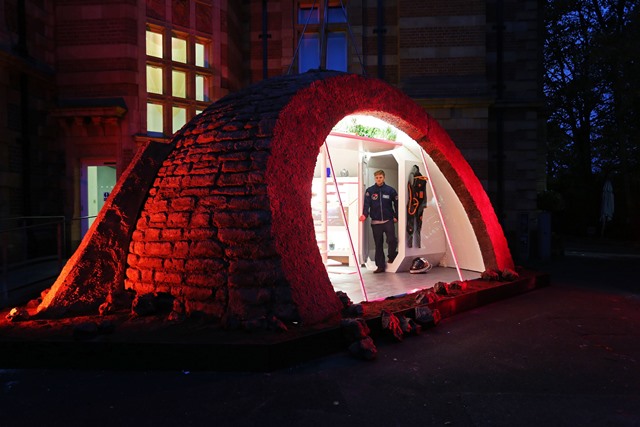
Mars show home at the Royal Observatory Greenwich, London.

The National Geographic Mars show home at the Royal Observatory Greenwich, London. The habitat is the work of Wild Creations in consultation with observatory astronomers and Stephen Petranek, author of How We’ll Live on Mars.{credit}National Geographic mini-series MARS runs through 19 December{/credit}

A big red igloo with a towering antenna seems a little overblown for a London show home. And so it proves. The object squatting outside the Royal Observatory Greenwich is actually a life-sized mock-up of a Mars habitat, billed as the imaginary dwelling of a second wave of settlers from Earth. That is, those who might live on the Red Planet in their thousands by around 2037, if the ambitious plans of space entrepreneurs such as SpaceX’s Elon Musk bear fruit.

The mock-up, in London this week to 16 November, promotes the National Geographic channel docudrama MARS, by director Ron Howard and Brian Grazer. Launched on 13 November, the mini-series charts the 2033 journey of a fictional first crewed mission to Mars by a blissfully collaborative International Mars Science Foundation, and subsequent attempts to establish a settlement.

As Earth’s second-nearest neighbour after Venus, Mars is widely seen as the best candidate planet for human colonization. But it lacks Earth’s thick atmosphere and global magnetic field, and is extremely inhospitable in myriad other ways. Colonists would need to be protected from temperatures that plummet to -70 degrees Celsius at night at the equator, as well as the high-energy cosmic particles and ultra-violet solar radiation that pummel the planet’s surface.

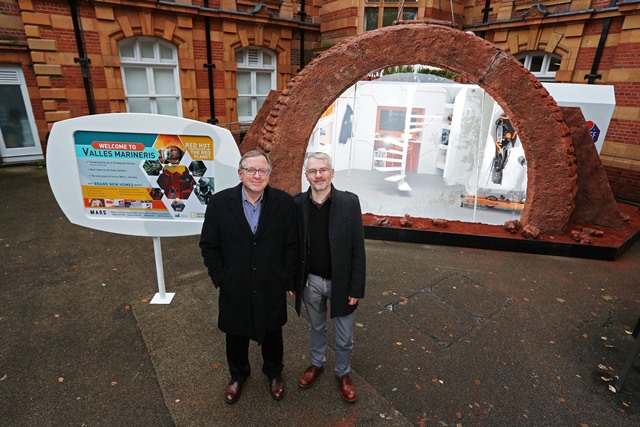
Author Stephen Petranek with Marek Kukula, the Royal Observatory Greenwich public astronomer.

Author Stephen Petranek with Marek Kukula, the Royal Observatory Greenwich public astronomer.{credit}National Geographic mini-series MARS runs through 19 December{/credit}

The Martian igloo, the work of display and model-making company Wild Creations, is a fun way of exploring what constraints the environment would put on design. The walls are a whopping 60 centimetres thick — just an eighth of the almost 5-metre depth they would need to be capable of protecting colonists from the radiation, said Stephen Petranek at the show-home opening. His book How We’ll Live on Mars inspired the series, and he consulted on the show home alongside the observatory’s public astronomer Marek Kukula. Moreover, Petranek notes, it would need to be built of bricks made by microwaving a mixture of polymer granules with Mars’ clay mineral-based soil. And an igloo is just one possible design. The same bricks could easily make bigger structures, even a large Gothic cathedral, he says. Or homes on the Red Planet could be built in the natural underground hollows that once housed lava, or in the side of craters.

Daily life for the 10,000 people Petranek imagines might some day dwell in this kind of shelter does not look appealing. Accessed via an ‘airlock’ stuck into the igloo wall, the dome’s interior is claustrophobically small — just a few paces across. Features would have to include an exercise machine to combat muscle wastage in the low-gravity environment, and an indoor farm. The small potted plants I spot on a mezzanine near the building’s ceiling hardly look substantial enough to sustain a hungry Martian for more than a few weeks — in contrast to the heaps of potatoes ingeniously grown by fictional astronaut Mark Watney (Matt Damon) in Ridley Scott’s 2015 film The Martian. Settlers would also need access to water, which (assuming it is there) may only exist in liquid form dozens of metres down in the planet’s concrete-hard ground.  

Artist's depiction of the show home in situ.

Artist’s depiction of the show home in situ.{credit}National Geographic{/credit}

The message here seems to be about thinking big to encourage ambition, as with the MARS mini-series. That uses an innovative format: the drama unfolds amid “flashbacks” to interviews with actual scientists and space pioneers, such as Musk. These highlight how real progress often initially involves failure, but  also serve to make the dramatised scenes seem even more fictional.

Petranek notes that plans such as Musk’s are “much more realistic than people give them credit for”. And whether or not they succeed, SpaceX is driving all space exploration in the direction of human missions to Mars, he argues. But for now, most planetary scientists still see living there as science fiction, and that’s not just because of unfeasible costs or optimistic technology projections.

Many researchers don’t actually want to send people to the Red Planet yet. It could well have harboured life billions of years ago, and finding that would tell us that life on Earth was not a one-off fluke. NASA, the European Space Agency (ESA) and the China National Space Administration all plan to put rovers on Mars in the 2020s to scour it for ancient life. But while rovers can be carefully sterilised to prevent contamination, sending humans would almost certainly contaminate the planet, and could mean we never find out. From that perspective at least, there is no hurry.

Elizabeth Gibney is a reporter on physics for Nature based in London. She tweets at @LizzieGibney. Listen in to her Nature Podcast talk with Andrew Coates, the planetary scientist working on the ESA’s first Mars rover. 

MARS runs through 19 December on the National Geographic channel. 


For Nature’s full coverage of science in culture, visit www.nature.com/news/booksandarts.
 

The warp and weft of wearable electronics

Zhang 1

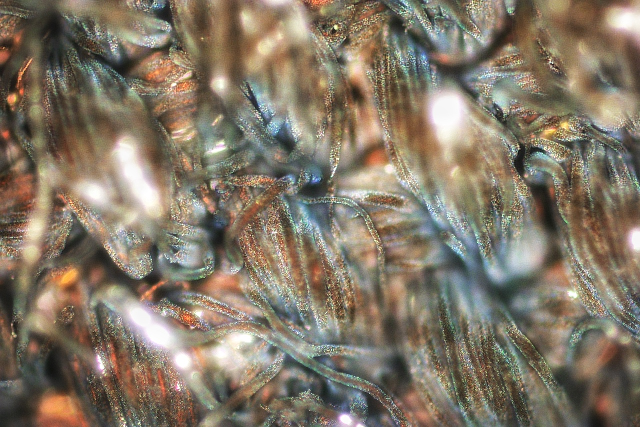
Optical microscope image of a battery electrode made of metallic textiles and active materials. {credit}Dongrui Wang{/credit}


3Q: Zijian Zheng

One of today’s challenges for materials scientists is wearable electronics — smart materials that monitor ailments, harvest energy, track performance or communicate. These remain expensive and hard to produce in bulk, and are often unattractive. Polymer scientist Zijian Zheng takes inspiration from his designer and business colleagues at Hong Kong Polytechnic University’s Institute of Textiles and Clothing. His solution: lightweight electronic yarns that can be made into textiles by adapting existing production processes.

 How do you create wearable electronics?

People need to feel like they’re not wearing electronics, so the materials must be lightweight and flexible. They must also be high-performance, as devices have to charge rapidly, last for a long time and be sweat-proof. Applying all these criteria, we create electronic textiles in which the fabrics themselves form the sensors and devices – from light-emitting diodes, photovoltaics, organic transistors and supercapacitors to batteries. We can make a supercapacitor using conductive yarn, made by coating cotton with nickel, and penetrating it with a form of graphene oxide. If you put a pair of these strands together in parallel, and fill the space between with an electrolyte gel, you can make it work as a supercapacitor storing energy as positively and negatively charged ions collect at the different wires. You could use that to power other devices, such as sensors, or store energy generated from photovoltaics. We’re working on making lithium batteries using the same principles.

Polymer scientist Zijian Zheng.

Polymer scientist Zijian Zheng.

What are your biggest challenges?

When integrating different materials together in an electronic textile, the interfaces create the biggest problems. You can get mismatches between mechanical and thermal expansion properties, and in a flexible system the weakest points are where the device twists or bends. In my group we focus on using polymers to address these issues. For example, we make new polymers that add texture to the surface of textiles, allowing them to be coated in copper at low temperatures for durability. To ensure scalability, our goal is to make textiles that can be integrated with the technology the clothing industry has used for the past 200 years. Our composite yarns can be used in sewing machines, and complicated patterns can be created from them using machine embroidery. From there, you start to add active materials to make devices in ways that are compatible with textile processing. For example, we’re now making photovoltaic cells printable via textile colour-printing technology and encapsulating them with textile-finishing technology. And we are set to make a radio-frequency identification tagging device within a garment, powered by a supercapacitor. We’ve designed it to hide the supercapacitor as an embroidered pattern, like camouflage. We also have a student working with local textile company EPRO Development, trying to put the metallic, conducting textile into real production. Devices will come a bit later as they are ten times more complex to make. Cost is a challenge too: the textile industry cares about every penny. In introducing functional elements into garments such as a breathable section, you might only be allowed to increase production costs by around 10 cents.

Zhang 2

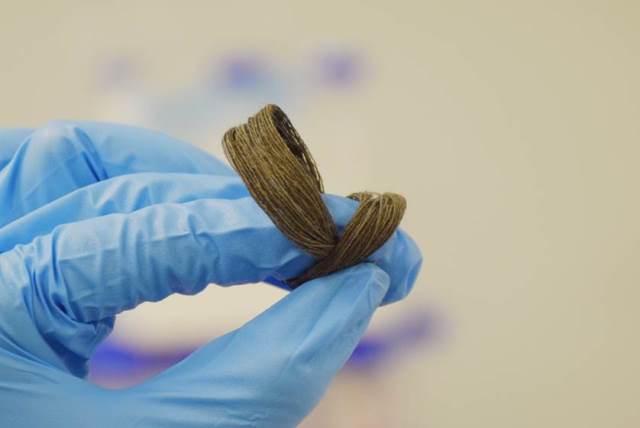
One hank of copper-coated cotton yarns used for making wearable devices and circuits.{credit}Ka-chi Yan{/credit}

How do the different disciplinary strands in your institute work together?

My institute covers the whole chain of production for textiles and clothing – with materials science and chemistry groups sitting alongside business and design. So we have three streams of students and teaching is totally different for each. The major challenge when I lecture is how to deliver my engineering or scientific-based content to a bunch of artists. We tend to give them an overview to help them understand first, with lots of examples, before we come down into the fundamentals. It’s very different from the physical science students, where we take them through a logical sequence from beginning to end. The artists ask so many questions. Generally they want to know if they can do something with a material, and don’t care about why it functions. They seldom ask “Why does this electron go through there?”

Interview by Elizabeth Gibney, a reporter on physics for Nature based in London. She tweets at @LizzieGibney.


For Nature’s full coverage of science in culture, visit www.nature.com/news/booksandarts.
The art of engineering: 9 Evenings revisited

Composer John Cage's xxxx at 9 Evenings, October 1966.

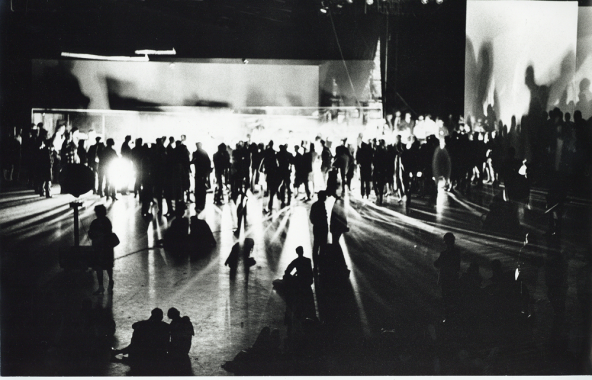
John Cage, Variations VII, 9 Evenings: Theatre & Engineering, October 1966.{credit}Adelaide de Menil{/credit}

I’m gazing at a stage draped in white when a giant zipper suddenly appears, projected onto one wall. As it works its way noisily around, more projections — live-streamed or pre-recorded moving images of buildings, blurred pedestrians, discarded clothing and simmering water — judder on crumpled backdrops. An apparently random urban soundtrack lulls and roars in the background. In the foreground, performers skip rope and cut hair; one solemnly rips up, boils and eats her shirt. It’s quite an evening.

Robert Whitman at performance of Side Effects, October 2016.

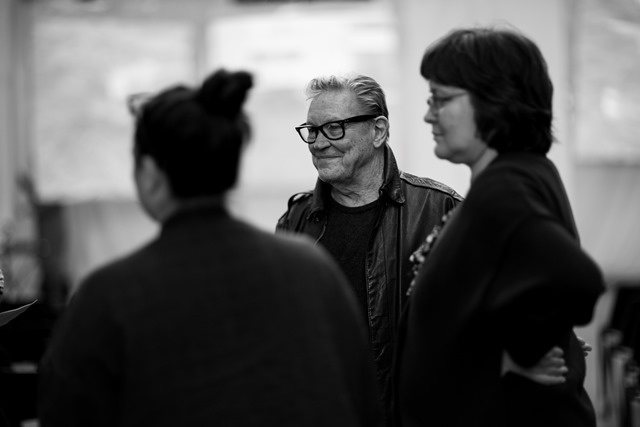
Robert Whitman (centre) at performance of Side Effects, October 2016.{credit}Christopher Fernandez{/credit}

The artist behind this indeterminate, playful, technologically rich and vaguely disturbing piece, Side Effects (commissioned by Arts Catalyst) is Robert Whitman. The evening is an homage to 9 Evenings: Theatre & Engineering, a legendary series of performances that, 50 years ago, galvanised New York with an unprecedented mix of cutting-edge technologies and avant-garde art. Whitman was one of 10 artists — among them multi-media maverick Robert Rauschenberg, composer John Cage and choreographer Lucinda Childs — who collaborated one-to-one with 30 engineers, most from research powerhouse Bell Labs and including, notably, the visionary electrical engineer Billy Klüver. Klüver was adamant about involving technologists rather than scientists, feeling that technology is essentially about “the material and the physicality”. It was a moment that paved the way to crossover disciplines such as digital art.

There was a utopian edge to technology then, as America literally reached for the Moon. For artists seeking new media, high-tech expertise enabled fresh explorations in sound and vision. For the engineers, artists expanded what Klüver (already a veteran of collaborations with Jean Tinguely, Andy Warhol, Rauschenberg and Cage) saw as constrained horizons. Whitman, whom I caught up with after the performance of Side Effects, recalled that the 9 Evenings teams included a lot of “arranged marriages”, but worked if goals and enthusiasms chimed.

Billy Kluver in 1965.

Billy Klüver with Robert Rauschenberg’s work Oracle in 1965.{credit}New York Times, courtesy of E.A.T.{/credit}

By that time (October 1966), Whitman had been creating immersive pieces for some years, combining film, performers and ‘shape-changing’ props such as plastic sheeting. His 1960 The American Moon, for instance, had a hallucinatory quality and a sense of “slow time”, according to fellow experimentalist Claes Oldenburg. 9 Evenings offered a chance to push the boundaries in a bold venue.

That was the 69th Regiment Armory, a hangar-like midtown Manhattan edifice where, over 50 years before, another exhibition had exploded America’s cultural complacency with artworks such as Marcel Duchamp’s Nude Descending a Staircase. For 9 Evenings, some 1,500 people a night filed into its reverberating spaces.

Signal splitters, Geiger counters

Whitman’s contribution Two Holes of Water – 3 featured input from a number of engineers, including cellular telephony researcher Robby Robinson. The piece involved 23 performers, seven plastic-wrapped cars equipped with film projectors, one of the first fibre-optic miniature video cameras, film shot using an optical device with parallel mirrors, and a signal splitter that allowed a performer’s front and back view to be superimposed. A projected live image of water being poured into a glass on the Armory floor and documentary footage of Alaskan flora and fauna also featured.

Equally bravura was Cage’s composition Variations VII (pictured above), which harnessed live feeds from numerous sound sources. As Cage ‘played’ several transistor radios, 10 telephone lines picked up ambient noises from locations round the city, including the 14th Street Con Edison electric power station and the press room of the New York Times. Signals from two Geiger counters were converted into sounds; six contact microphones amplified noises generated by performers handling devices such as juicers, while data from electrodes on the forehead of another were converted into sound waves.

Robert Whitman in the 1970s.

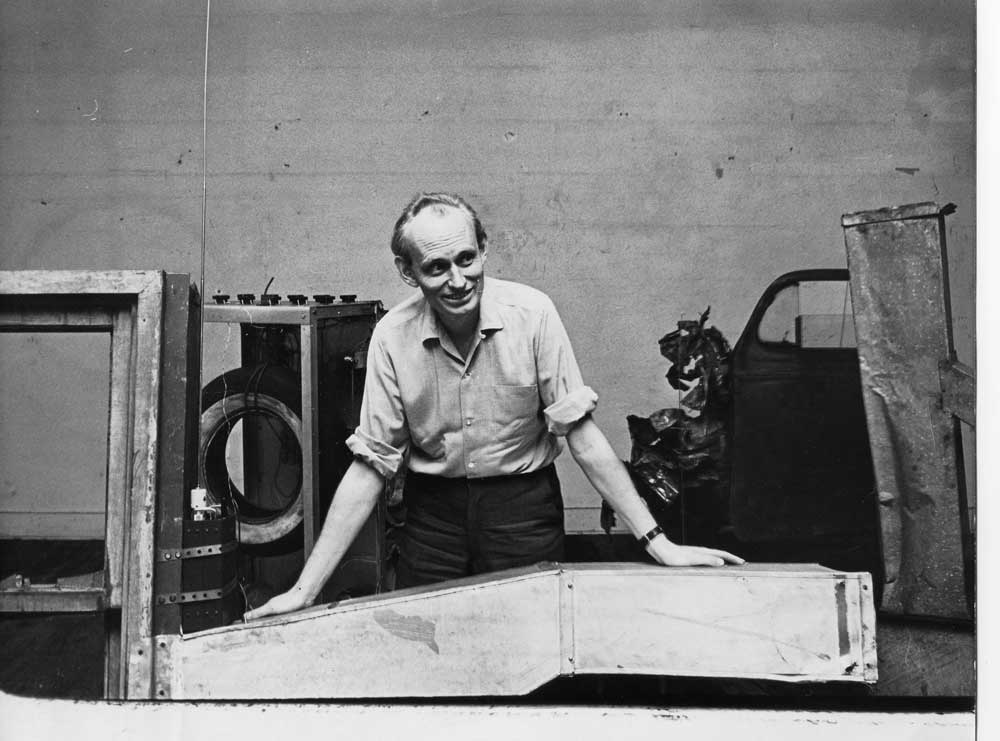
Robert Whitman in the late 1960s.{credit}A&T archives, courtesy Los Angeles County Museum of Art{/credit}

Some critics tore into the event, as technology historian Patrick McCray has noted. Whitman, Rauschenberg, Klüver and fellow engineer Fred Waldhauer, however, had already forged ahead with another venture. The non-profit foundation Experiments in Art and Technology (E.A.T.) took the cross-fertilisation further. By 1969, E.A.T. comprised 2,000 artists and as many technologists, riding the wave of innovation in electronics and communications. Their Projects Outside Art series, for instance, featured Telex: Q&A, which linked public spaces in India, Japan, New York and Sweden to encourage citizens of each to question future possibilities.

Meanwhile, a programme with aims similar to E.A.T.’s had sprung up at the Los Angeles County Museum of Art (LACMA). Art and Technology, the brainchild of curator Maurice Tuchman, boasted star physicist Richard Feynman as consultant. Whitman was also involved. So began his immensely fruitful teamwork with optical scientist John Forkner, then at Philco-Ford, the company that built the equipment at NASA’s Johnson Space Center mission control.

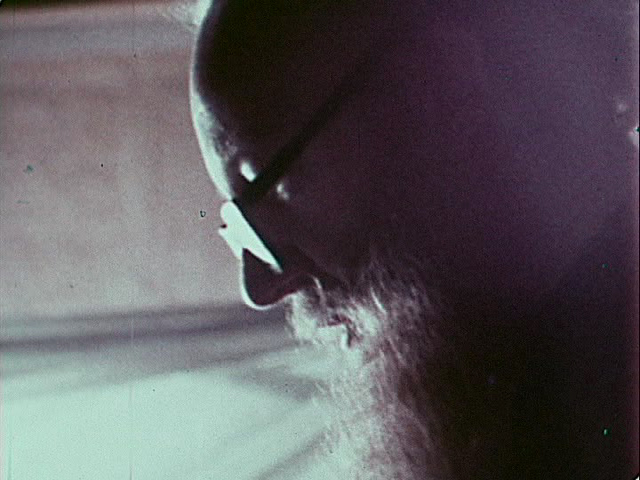
Optics scientist John Forkner.

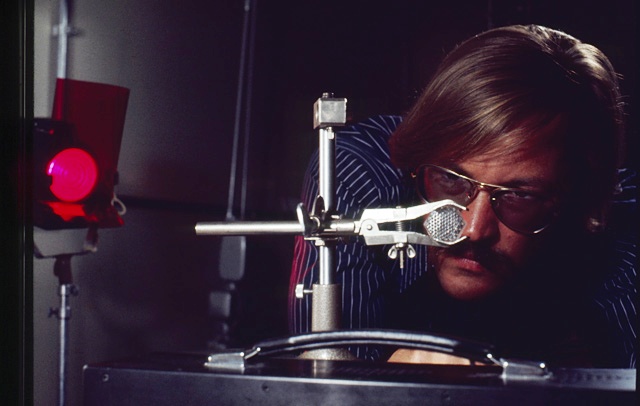
Optical scientist John Forkner.{credit}A&T archives, courtesy Los Angeles County Museum of Art{/credit}

“This public-relations official introduced me to a guy with a long beard. I was lucky,” says Whitman. “John was a natural genius in optics and very interested in music and art. I remember that at one point I was sitting in a car with Feynman and he said, ‘Where’d you find him? He’s terrific.’”

Over 18 months, Whitman and Forkner created a spectacular installation for LACMA at the US Pavilion at Expo ’70 in Osaka, Japan. Tuchman described the work as an “optical tour de force” incorporating 1,000 corner-shaped mirrors reflecting the viewer’s multiplied image to them, as well as pulsating mylar mirrors and “eerily bright three-dimensional objects (a pear, drill, goldfish bowl with live fish, a knife, a clock, ferns, etc.).”

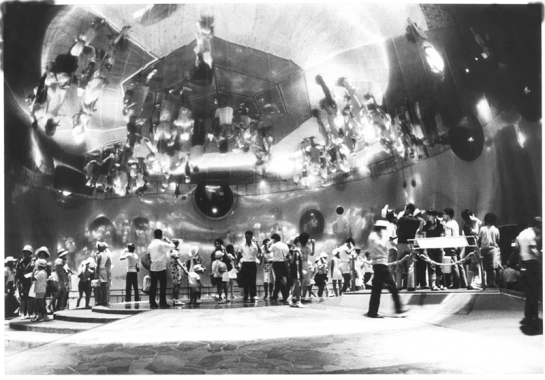
E.A.T. was equally busy at Expo ’70: the Pepsi Pavilion was a focus for several of its cutting-edge collaborations. A major element was a spherical mirror over 27 metres in diameter that created real images of visitors, hanging in space above their heads. Whitman contributed here too, along with physicist Elsa Garmire, while artist Fujiko Nakaya worked with physicist Tom Mee to create the evocative fog sculpture capping the structure. It was clear that by this time, as McCray puts it, artists and engineers between them had “rewired modern art”.

Mirror dome room at the Pepsi Pavilion at Expo '70 in Osaka.

Mirror dome room at the Pepsi Pavilion at Expo ’70 in Osaka.{credit}Shunk-Kender{/credit}

Whitman is now 81, and busy. Many other movers and shakers behind 9 Evenings and E.A.T. are gone. As for E.A.T. itself, it has effectively ended as an entity, but “exists as an idea,” notes its director Julie Martin (Klüver’s widow). Klüver himself, in a 1999 interview with Hans Ulrich Obrist, said, “once everybody understands the idea of artists and engineers working together, there is no reason for E.A.T. to exist”.

I asked Whitman what he thought about 9 Evenings now. “Looking back is what I call ‘dead guy stuff’. You need to get onto the next thing. As for the future, it’d be fun to be around.” There is something there of the unquenchably optimistic technophile, always looking for the next innovation. Yet just for a moment, he did look back. “I didn’t know it at the time, but for me it all started with Emmett Kelly,” he told me. On a childhood visit to the circus in the 1940s, Whitman had been galvanised by the iconic American clown, who had a routine where he swept up the spotlight with a broom. “I was staring at everyone around me, wondering why they weren’t seeing this miracle. It set me on my way.”

I thought of the spotlit zipper in Side Effects, and began too to see how an early bent towards flux and illumination led him to performance, advanced technology and the intensive mix of both that was 9 Evenings. And beyond.

Arts Catalyst’s 9 Evenings: Theatre and Engineering Revisited 1966/2016 continues to 29 October.

Archival information on 9 Evenings and E.A.T. can be accessed at the Daniel Langlois Foundation Collection. Maurice Tuchman’s report on LACMA can be accessed here. My thanks to Robert Whitman, Julie Martin and Patrick McCray for additional information. McCray is currently writing a book (tentatively entitled Art Rewired: Engineering a New Creative Culture) on the art-technology nexus in that era. His Leaping Robot blog meanwhile offers much fascinating detail on 9 Evenings, E.A.T. and more.

Smoke on the water

Posted on behalf of Rich Monastersky

41818dc4-5a71-11e6-8ecd-005056b70bb8

{credit}© 2016 Lionsgate{/credit}

Nobody loves disasters more than movie producers. If threats in real life matched their frequency on screen, we should be in a constant state of panic over the risks of alien invasions, zombie viruses and asteroid impacts. Given the film industry’s appetite for catastrophes, it is no surprise that it has finally focused on the greatest environmental disaster in US history: the 2010 oil spill in the Gulf of Mexico that began with explosions that killed 11 people and sank the Deepwater Horizon drilling rig.

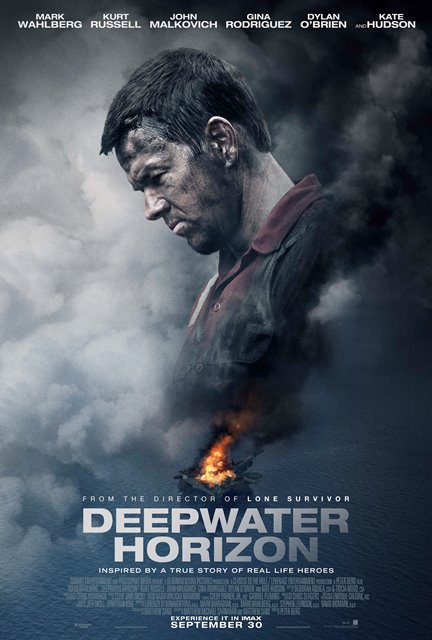
Peter Berg’s film, Deepwater Horizon, is filled with Hollywood heavyweights. Mark Wahlberg plays an everyman electrician who finds his inner hero during the disaster. Kurt Russell portrays the grizzled rig chief who steps up while everything is collapsing, and John Malkovich is the company man chasing profit at the expense of prudence. But the real star is the rig itself. Berg provides a rare look at life on board one of the most sophisticated drilling platforms on the planet. For that reason alone, the film is worth watching, despite the unnecessary liberties it takes with several key facts.

Deepwater Horizon was a US$560-million marvel of engineering, with a gleaming steel deck bigger than a football field perched on four immense floating legs. In 2009, the vessel had distinguished itself by drilling the deepest oil well to date. Owned by the company Transocean, Deepwater Horizon was leased to BP at the time of the disaster and was finishing drilling operations on the Macondo oil well, which reached 18,360 feet (5,596 metres) below sea level.

Fire boat response crews battle the blazing remnants of the offshore oil rig Deepwater Horizon. A Coast Guard MH-65C dolphin rescue helicopter and crew document the fire while searching for survivors. Multiple Coast Guard helicopters, planes and cutters responded to rescue the Deepwater Horizon's 126 person crew.

Firefighters try to extinguish blazes on the Deepwater Horizon drilling rig in the aftermath of explosions that killed 11 people. {credit}US Coast Guard{/credit}

The movie’s producers spared no expense on their star. Production designer Chris Seagers and his crew of 85 welders worked for eight months to build an 85% scale replica of the Deepwater Horizon, which helped to drive the cost of the movie to an estimated value well over $100 million.

To most of the public, the name Deepwater Horizon brings to mind the 4.9 million barrels of oil that spewed into the Gulf over 87 days after the catastrophic blowout. For the filmmakers, the spill is literally an afterthought — a few words that scroll on screen at the movie’s end. The drama concentrates instead on the first few hours of the disaster, when the crew was racing to finish its work on the long-delayed oil well.

Berg’s movie brings to life an industry that touches everybody but is seen by few. Oil and gas operations on land and offshore bore the holes that provide more than half the energy used across the globe. And yet the industry is overlooked, even shunned, in a society where most of us prefer not to dwell too much on the potentially disturbing origins of our gasoline, steak and smartphones.

Well from hell

Deepwater Horizon puts faces on the drillers, electricians, crane operators, toolpushers and mud engineers who were among the 126 people on board at the time of the explosion. That day began tensely: the crew was behind schedule in finishing up operations on the “well from hell”. Deepwater Horizon’s assigned task was to drill the hole and then seal the walls of the Macondo well with steel casing and concrete. On 20 April, the crew had finished pumping concrete to the bottom of the hole and was testing the seal job. After that, Deepwater Horizon would depart and a smaller production rig would move in to extract the oil and gas.

To the credit of Berg and the screenwriters, the movie accurately portrays many details of the critical testing phase, during which the first signs of problems arise. But in the interest of creating an engaging narrative, the filmmakers turn these pivotal scenes into a cartoonish contest of good versus evil. BP employees — particularly Malkovich’s character, Donald Vidrine — come across as primarily responsible for the disaster, while the Transocean crew members are the heroes more focused on safety.*

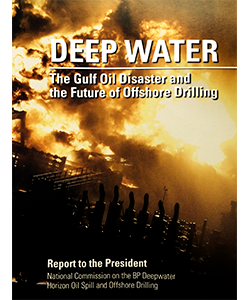
deepwater-cover-250That stark contrast in the way the movie treats BP and Transocean does not match the conclusions of several investigative panels, which found that representatives of both companies on the rig failed to heed important warning signs that immense pressure was building up in the well. The report to President Obama from the National Commission on the BP Deepwater Horizon Oil Spill and Offshore Drilling found plenty of blame to go around, including government regulations and the company Halliburton, which had previously identified problems in the type of cement slurry it used in the Macondo well on the morning of the blowout.

The movie also neglects to mention that Transocean did not tell the Deepwater Horizon crew about a similar pressure problem that had almost turned disastrous at one of its wells in the North Sea in late 2009 — a point raised by the National Commission in its report.  And Transocean did not identify problems with a crucial safety device, called a blowout preventer, according to an investigation by the US Chemical Safety Board, which issued its report this year. The blowout preventer is a 400-tonne apparatus that sits on the seafloor and is designed to seal the well if the pressure inside rises to uncontrollable levels. But the crew on Deepwater Horizon did not act quickly enough when evidence of trouble first appeared and the blowout preventer failed in the crucial moment.

In the end, though, blame is not central to the movie. It is more concerned with the heroic actions of many members of the crew, including some of those who perished, which saved most of the lives on the Deepwater Horizon. Although the film alters some facts here, too, it captures the central truth that some ordinary people stepped forward in the darkest hour and committed acts of extreme bravery.

*The US government indicted Vidrine and Robert Kaluza, another BP employee on the rig at the time of the explosion, on charges of involuntary manslaughter but later dropped the charges. Vidrine pleaded guilty last December to a misdemeanor pollution charge and was sentenced to 10 months of probation, a $50,000 fine and community service. Kaluza was charged with the same offence but took the case to trial and won in February.

Rich Monastersky is news features editor at Nature, based in Washington DC. He tweets at @RichMonastersky.


For Nature’s full coverage of science in culture, visit www.nature.com/news/booksandarts.
Master builder: Ove Arup

Posted on behalf of Jo Baker

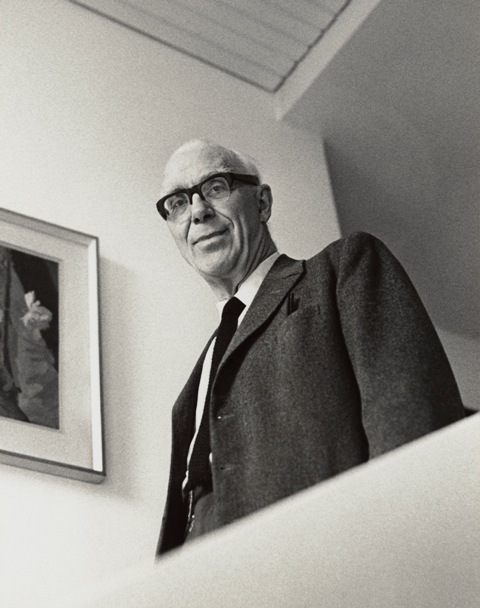
Ove Arup by Godfrey Argent, 1969.

Ove Arup by Godfrey Argent, 1969.{credit}© National Portrait Gallery, London. Engineering the World: Ove Arup and the Philosophy of Total Design, the V&A Engineering Season.{/credit}

He was the structural innovator behind Sydney Opera House, founded the world’s leading engineering consultancy, and pioneered the philosophy of “total design” — the equal partnership of engineers, architects and designers in construction. Anglo-Danish engineer Ove Arup (1895-1988) is now celebrated in this first retrospective of his work, Engineering the World, at London’s Victoria and Albert (V&A) Museum, part of its Engineering Season.

On show are 150 never-before-exhibited sketches, technical drawings, architectural models, photographs, calculations and manifestos from a century of work by Arup and his colleagues at his eponymous consultancy, whose forerunner he set up in 1938. The compact show (funded by Arup) is squeezed into a room-sized cage of red steel beams copied from those of the Pompidou Centre in Paris, which Arup co-designed with architects Richard Rogers and Renzo Piano in the mid-1970s. The explanatory panels are worth scrutiny: they reveal Arup’s interest in science and early computing, his playful character and his enthusiasm for training the next generation of engineers.

Born in Newcastle, UK, Arup became interested in philosophy and engineering while at school in Denmark. He studied both disciplines at university in Copenhagen, graduating in 1922 with a specialism in reinforced concrete. Equally passionate about the arts, he was influenced by the Modernist movement — which promoted the idea that science and technology could improve society — and its luminaries, such as architects Le Corbusier (Charles-Edouard Jeanneret) and Walter Gropius, who founded the Bauhaus group.

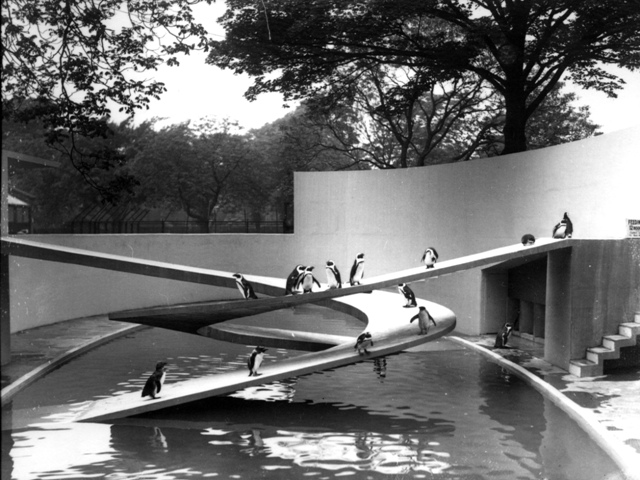
Penguin Pool, London Zoo, London, 1934.

Penguin Pool, London Zoo, London, 1934.{credit}© ZSL. Engineering the World: Ove Arup and the Philosophy of Total Design, the V&A Engineering Season.{/credit}

One of Arup’s early projects was the 1934 Penguin Pool at London Zoo. After studying penguin behaviour, he designed its thin gravity-defying spiral of interlocking ramps in concrete while working as a structural consultant for Berthold Lubetkin’s radical Tecton architectural partnership in London. The ramps’ curves were based on complex mathematics, and Arup’s calculations and notes are on display.

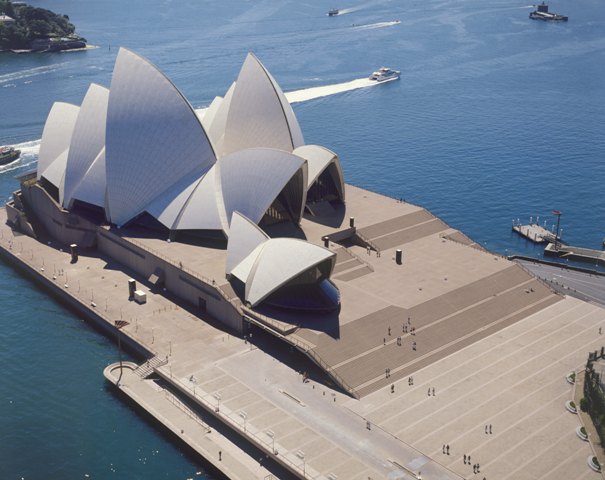
Sydney Opera House.

Sydney Opera House.{credit}© David Messent. Engineering the World: Ove Arup and the Philosophy of Total Design at the V&A Engineering Season.{/credit}

Arup had a strong sense of civic duty and designed air-raid shelters during the Second World War. His concepts were grand and controversial — massive concrete basements large enough to host hundreds of cars and people. (The government preferred small shelters.) Arup also worked on the Mulberry harbours, prefabricated temporary ports deployed during the 1944 Allied invasion in Normandy. He was responsible for a small but crucial element: a shock-absorbing fender that permitted the ships to dock. Photographs and technical drawings are on show.

Sydney Opera House is perhaps Arup’s most famous post-war project, and drawings and models of its design and construction form a focus of the exhibition. Faced with a freeform sketch of a collection of ‘sails’ by its Danish architect, Jørn Utzon, Arup pioneered the use of computers to solve the problem of how to build it from precast concrete. At the time most engineers still used slide rules and tables of logarithms. By renting a Ferranti Pegasus computer by the hour from the University of Southampton and writing their own software, Arup and his colleagues saved 10 years of manual calculations.

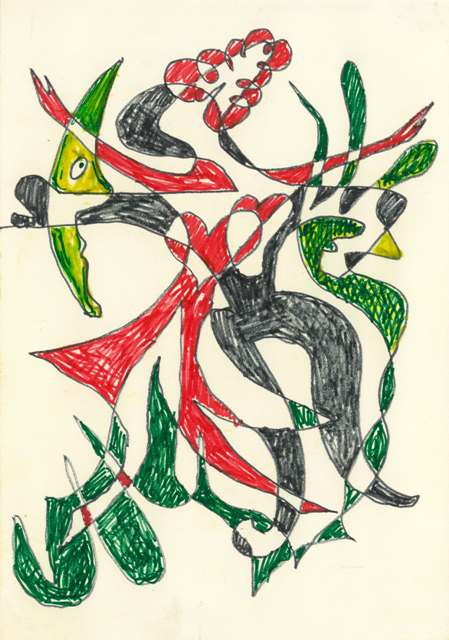
A doodle by Ove Arup.

A doodle by Ove Arup.{credit}© Private collection.{/credit}

The exhibition includes a wooden conceptual model explaining the solution he eventually conceived in 1961: sections cut from a sphere. A 2-metre-long wooden replica of the opera house used in wind tunnel tests is on show, along with charts illustrating airflow around it. When Utzon dropped out midway through the project, Arup took the construction to completion in 1973.

Arup eventually turned from engineering to shaping a new generation of engineers. In the 1970s and 80s successors emerged, including Peter Rice, Ted Happold and Mike Glover, who worked with architects including Piano, Rogers and Norman Foster on projects such as the Menil Collection gallery in Houston. A tilting model of the gallery — known for its naturally lit spaces — reveals how sun and shadows fall on the building through the day and year.

Engineering the World concludes with a look at the company today. Arup’s philosophy is still shared by its 12,000 employees in more than 90 offices around the world. A glass panel full of bubbling green liquid turns out to be a living façade where algae in an aerated soup of nutrients generate heat and biofuel. A section of wooden wall is part of a ‘wikihouse’ – a collaborative unfolding design for a home.

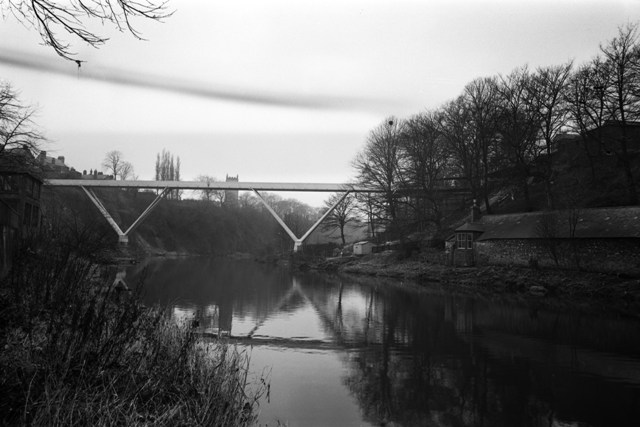
Arup’s ashes were scattered over a footbridge he designed: Durham’s Kingsgate, opened in 1963 and one of his favourites. He built it by rotating two halves into place — fittingly, for one whose creativity linked engineering and design.

View of Kingsgate Bridge, Durham, 1963.

View of Kingsgate Bridge, Durham, 1963.{credit}Reproduced by permission of Durham University Library. Engineering the World: Ove Arup and the Philosophy of Total Design at the V&A Engineering Season. {/credit}

Jo Baker is senior Comment editor at Nature.

Engineering the World: Ove Arup and the Philosophy of Total Design runs at the Victoria and Albert Museum, Cromwell Road, London, through 6 November. The V&A Engineering Season features displays, digital initiatives and a newly commissioned installation, Elytra Filament Pavilion, by experimental engineer Achim Menges with Moritz Dorstelmann, structural engineer Jan Knippers and climate-responsive engineer Thomas Auer. Inspired by filament structures of flying beetles’ forewing shells, the pavilion’s canopy is created from robotically fabricated carbon-fibre cells. Sensors in the canopy will capture anonymous data from the behaviour of visitors, allowing it to evolve.


For Nature’s full coverage of science in culture, visit www.nature.com/news/booksandarts.

Industrial optimist: Moholy-Nagy revisited

Posted on behalf of Jeff Tollefson

László Moholy-Nagy Dual Form with Chromium Rods, 1946 (Plexiglas and chrome-plated brass)

László Moholy-Nagy, Dual Form with Chromium Rods, 1946 (Plexiglas and chrome-plated brass).{credit}Solomon R. Guggenheim Museum, New York, Solomon R. Guggenheim Founding Collection 48.1149 © 2016 Hattula Moholy-Nagy/VG Bild-Kunst, Bonn/Artists Rights Society, New York. Photo: David Heald © Solomon R. Guggenheim Foundation{/credit}

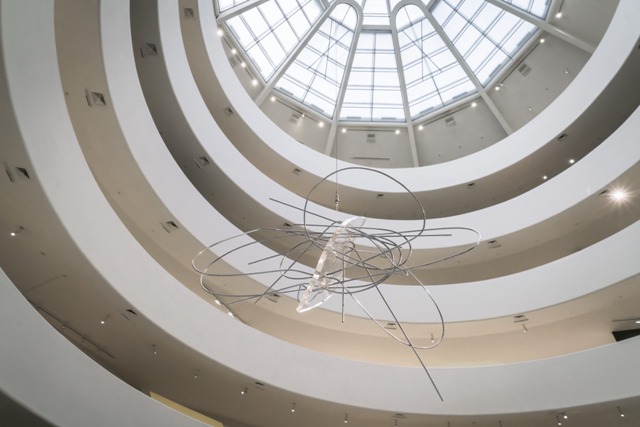
I’m standing in the spiraling rotunda of New York’s Guggenheim Museum, and over me dangles a chaotic mess held together by translucent Plexiglas. In the shadow the sculpture casts on the wall, the shapes converge in a pleasing negative blending intention and happenstance – impossible to predict, yet clearly part of a plan. On evidence, this is an artist thinking experimentally, and in multiple dimensions.

The industrial designer, artist and photographer Lázló Moholy-Nagy (1895-1946) was certainly that. As the Guggenheim’s retrospective Moholy-Nagy: Future Present shows, the Hungarian pioneer of the Bauhaus and beyond worked in a dazzling array of media: film, photography, painting, sculpture, graphic design and typography. But behind the restless eclecticism, he adhered to the unifying theory (with the Constructivists) that art is integral to social transformation and must embrace new technologies. At a time of vast industrial expansion, he declaimed himself as “[n]ot against technological progress, but with it”, championing novel industrial materials — from Formica and aluminium to the Plexiglas in Dual Form with Chromium Rods (1946) in the rotunda. Drawn towards the airy, the transparent and the brilliantly coloured, he was also in love with light and movement: like contemporary Alexander Calder, he engineered moving parts and even electric motors into kinetic sculptures.

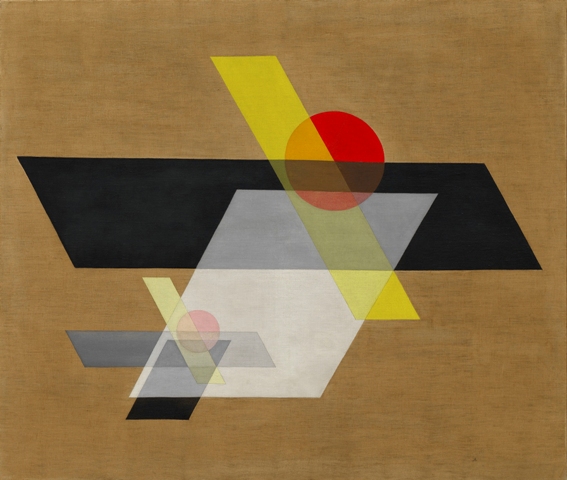
László Moholy-Nagy A II (Construction A II), 1924 Oil and graphite on canvas

László Moholy-Nagy, A II (Construction A II), 1924 (oil and graphite on canvas).
{credit}Solomon R. Guggenheim Museum, New York, Solomon R. Guggenheim Founding Collection 43.900 © 2016 Hattula Moholy-Nagy/VG Bild-Kunst, Bonn/Artists Rights Society, New York{/credit}

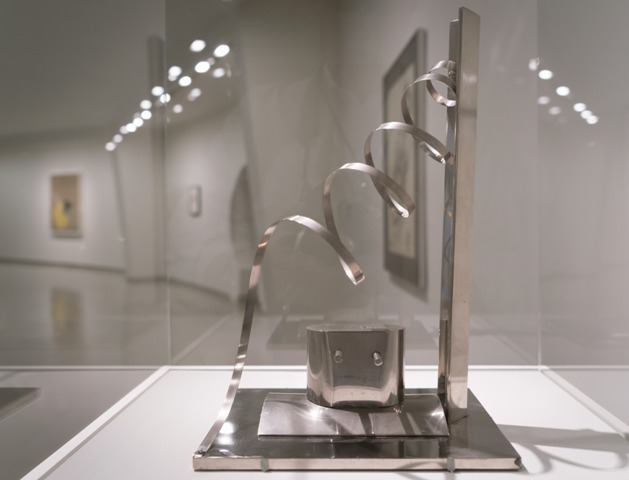
The exhibition takes a roughly chronological approach. Moholy-Nagy’s career began in earnest after he was injured in the First World War trenches. Much of the wall space is dedicated to earlier works such as the 1924 A II (Construction A II), an oil-and-graphite canvas in the Constructivist mode, that plays with colour intensity and transparency in rhombi and circles. Small abstract sculptures such as the welded, plated Nickel Sculpture with Spiral (1921) have a machined appearance. Its metal spiral inadvertently echoes the Guggenheim’s internal architecture, reflected on its glass case.

László Moholy-Nagy Nickel Sculpture with Spiral, 1921 (nickel-plated iron, welded)

László Moholy-Nagy, Nickel Sculpture with Spiral, 1921 (nickel-plated iron, welded).
{credit}The Museum of Modern Art, New York, Gift of Mrs. Sibyl Moholy-Nagy 1956 © 2016 Hattula Moholy-Nagy/VG Bild-Kunst, Bonn/Artists Rights Society, New York. Photo: David Heald © Solomon R. Guggenheim Foundation{/credit}

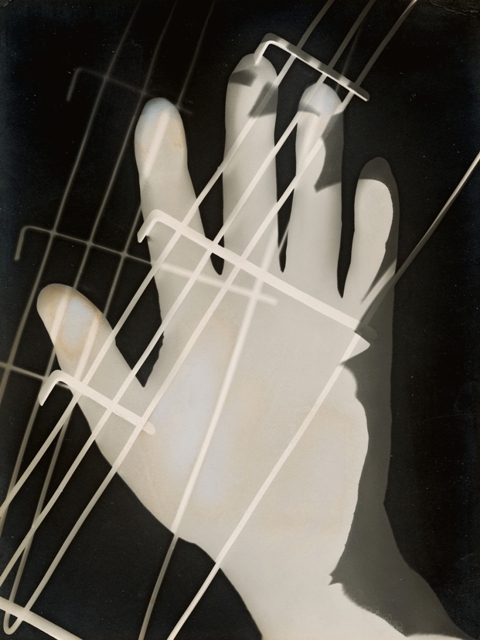
Deeper into the show we encounter Moholy-Nagy’s innovative photographic abstractions, which he called photograms. Developed directly on light-sensitive paper, these images (such as the 1926 Photogram) allowed the capture of objects in outline and even a playful profile of his own head. Other works reveal the artist’s intent to  harness the laws of physics. Space III (1940) is an abstract, multi-dimensional work composed of a Plexiglas sheet suspended in front of a white panel. The sheet is delicately etched and pigmented on both sides around an untouched circle, so that light both flows through and casts shadows on the panel. “Light does then what I could not do,” he wrote. “A sparkling, vibrating color effect through the addition of the shadows produce mixtures as no one could on the palette.”

Such materials and artistic approaches are ubiquitous now. But context and intention are critical to this show. There were moments when I felt as if I was in a history museum dedicated to the co-evolution of technology, industry and humanity. Clearly Moholy-Nagy was conscious of his place in time, and his role as interpreter of both past and present. He also sometimes felt he was speaking to the future. “I often had the feeling, when pasting my collages and painting my ‘abstract’ pictures, that I was throwing a message, sealed in a bottle, into the sea,” he wrote in 1944. “It might take decades for someone to find and read it.” Gradually I found myself seeing the avant-garde in the work by focusing on details and juxtaposition.

László Moholy-Nagy, Photogram, 1926 (gelatin silver photogram)

László Moholy-Nagy, Photogram, 1926 (gelatin silver photogram){credit}Los Angeles County Museum of Art, Ralph M. Parsons Fund © 2016 Hattula Moholy-Nagy/VG Bild-Kunst, Bonn/Artists Rights Society (ARS), New York Photo: © Museum Associates/LACMA{/credit}

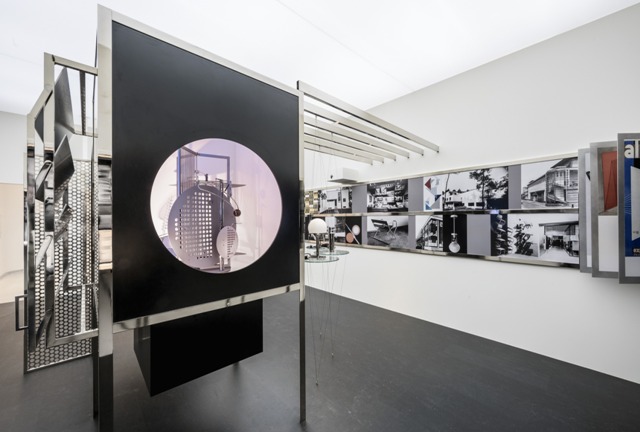
The Room of the Present offers a full realization of the artists’ vision, meshing space, light and an industrial aesthetic. An exhibition space within an exhibition space, it was never built in his lifetime, but constructed in 2009 based on architectural drawings, some of which are on display. Images of dancers and race cars jostle with those of laboratories and industrial facilities. Soviet filmmaker Sergei Eisenstein’s 1925 silent Battleship Potemkin is on view, but pride of place is given to a replica of Moholy-Nagy’s famous mixed-media kinetic sculpture Light Prop for an Electric Stage (1923-30). Attached to an electric motor and a simple gear box at the base, the collection of discs, springs and rods pivot, twirl and twist as the sculpture turns, casting colours and shadows onto the back of the box.

Moholy-Nagy left Nazi Germany in 1934, landing in Amsterdam, then London and eventually Chicago. There, in 1937, he founded the New Bauhaus, now known as the Institute of Design, at the Illinois Institute of Technology. He called his institute a “laboratory for a new education”, where art, industry and intellectual curiosity could come together to solve human problems, large and small. “If the unity of art can be established with all the subject matters taught and exercised, then a real reconstruction of this world could be hoped for — more balanced and less dangerous,” he wrote at the height of the Second World War, in 1943. Thanks to a little luck, and immigration, he survived both wars and remained an optimist to the end, dying from leukaeumia in 1946.

László Moholy-Nagy, Room of the Present, constructed 2009 (mixed media).

László Moholy-Nagy, Room of the Present, constructed 2009 (mixed media), with Light Prop for an Electric Stage, 1930 (exhibition replica, 2006; metal, plastics, glass, paint, and wood, with electric motor).{credit}Van Abbemuseum, Eindhoven. © 2016 Hattula Moholy-Nagy/VG Bild-Kunst, Bonn/Artists Rights Society, New York. Photo: David Heald © Solomon R. Guggenheim Foundation{/credit}

Among the last pieces on display at the Guggenheim are Nuclear I (1945) and Nuclear II (1946). A response to the bombings of Hiroshima and Nagasaki in 1945, the colourful globes in both paintings recall nuclear fireballs, frozen in a perpetual state of expansion. Inside are mosaic-like collections of abstract shapes, with faint hints of smoke and mushroom clouds.

 The bombings were a low point for the role of science in human affairs, but Moholy-Nagy interpreted the horror in his own way — with a chromatic intensity that speaks of hope amid destruction. In these and so many other works in this stunning exhibition, Moholy-Nagy’s belief in human resilience, as well as his sheer joy in experimenting with ideas, materials and light, shine through.

Jeff Tollefson is a reporter for Nature based in Washington DC. He tweets at @jefftollef. Moholy-Nagy: Future Present runs at the Guggenheim Museum at 1071 Fifth Avenue in New York through 27 September.


For Nature’s full coverage of science in culture, visit www.nature.com/news/booksandarts.
The top 20: a year of reading immersively


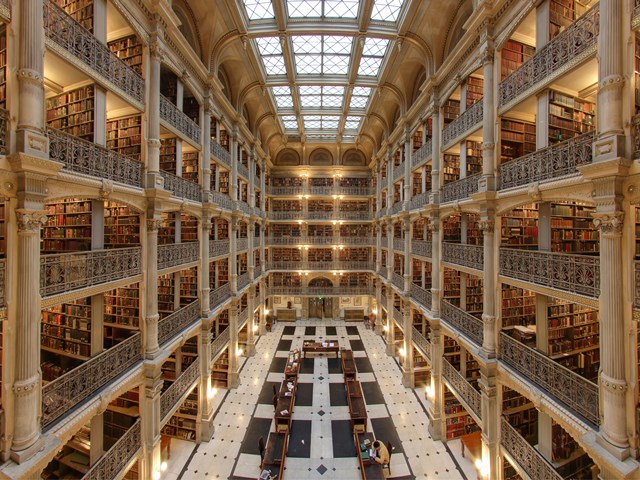
George Peabody Library, Baltimore, Maryland.

George Peabody Library, Baltimore, Maryland.{credit}Matthew Petroff{/credit}

It has been quite a year. We found ourselves saturated with light and knee-deep in soil — even diving down the rabbit hole with Alice to explore Lewis Carroll’s legacy for logic. There were discoveries (the pockmarked beauty of Pluto) and rediscoveries (the taxonomic reinstatement of Brontosaurus).

Meanwhile, in my parallel biblio-Universe, hundreds of science, social-science and science-history books hove into view. As I read, relished, reviewed and commissioned, I too made discoveries. Fascinating patterns emerged — ripples from shifts in science, society, culture. Robots held pole position, as authors grappled with the deep implications of twenty-first-century mechanisation and AI. There was a burst of books on the soup-to-nuts story of the cosmos, and an astonishing irruption of butterfly studies. Bedbugs had a moment (in Richard Jones’s House Guests, House Pests, reviewed here, and Brooke Borel’s Infested), as did pigs (in offerings such as Barry Estabrook’s Pig Tales, reviewed here).

As always, pulling ‘the best’ out of this flood has been tough. The 20 that stood out for me have an original grain — not going with the flow but creating whorls of their own. Several are biographies themselves representing a life’s work for their authors. Death, rainforests, seashells, Alexander Humboldt and DNA get a look-in. In no particular order, here goes.

The Invention of Nature: Alexander Humboldt’s New World, Andrea Wulf. Knopf. The accomplished historian delivers an inspired biography of the German polymath, explorer, prescient proto-environmentalist and discoverer of climate zones. (Reviewed here.)

Life’s Greatest Secret: The Race to Crack the Genetic Code, Matthew Cobb. Profile. A zoologist reframes the double-helix story, interweaving findings across physics, chemistry and biology with the lives of the luminaries involved. (Reviewed here.)

On the Edge: The State and Fate of the World’s Tropical Rainforests, Claude Martin. Greystone. The seasoned conservationist traces decades of rainforest losses to map future strategies for sustainable management in a key report to the Club of Rome. (Reviewed here.)

Our Kids: The American Dream in Crisis, Robert D. Putnam. Simon and Schuster. The astute political scientist and author of Bowling Alone (2000) exposes the insidious erosion of US social mobility that is disenfranchising a generation. (Reviewed here.)

Spirals in Time: The Secret Life and Curious Afterlife of Seashells, Helen Scales. Bloomsbury Sigma. A marine biologist tours the exquisite morphology and multidimensional functionality of that architectural marvel, a mollusc’s shell. (Reviewed here.)

Pure Intelligence: The Life of William Hyde Wollaston, Melvyn C. Usselman. University of Chicago Press. A meticulous, engrossing biography of the Enlightenment polymath — discoverer of cystine and palladium — by the late chemist. (Reviewed here.)

Weatherland: Writers and Artists Under English Skies, Alexandra Harris. Thames & Hudson. A cultural historian traces the weather fronts moving through English literature and art, from Shakespeare’s storms to Turner’s meteorological sublime. (Reviewed here.)

Birth of a Theorem: A Mathematical Adventure, Cédric Villani. Bodley Head/Faber and Faber. The flamboyant French recipient of the 2010 Fields Medal parts the curtains on the “strange alternate universe” of a mathematician’s life. (Reviewed here.)

The Black Mirror: Looking at Life Through Death, Raymond Tallis. Yale University Press. The former geriatric specialist uses his future corpse as the philosophical focus for a layered journey through his sensory and emotional life. (Reviewed here.)

Alfred Wegener: Science, Exploration, and the Theory of Continental Drift, Mott T. Greene. Johns Hopkins University Press. The science historian brilliantly biographises the physicist, meteorologist and explorer who discovered the precursor to plate tectonics. (Reviewed here.)

Concrete Revolution: Large Dams, Cold War Geopolitics, and the US Bureau of Reclamation, Christopher Sneddon. University of Chicago Press. A geographer surveys the US hegemony in twentieth-century dam engineering that has spawned a mixed global legacy. (Reviewed here.)

The Brain: The Story of You, David Eagleman. Pantheon. The virtuosic neuroscientist skips into the skull for a cutting-edge tour of how meat can generate self. (Reviewed here.)

The Reproach of Hunger: Food, Justice and Money in the 21st Century, David Rieff. Verso. The veteran development observer reveals how philanthrocapitalists and aid agencies are failing to crack the deep political problem of poverty and hunger. (Reviewed here.)

The Invention of Science: A New History of the Scientific Revolution, David Wootton. Allen Lane. A robust, expertly synthesised revisionist retelling of the scientific revolution by a commanding historical mind. (Reviewed here.)

Applied Minds: How Engineers Think, Guru Madhavan. W.W. Norton. A bioengineer lifts the lid on the rigorous, solution-oriented, constraints-savvy mindset of the made world’s hidden heroes. (Reviewed here.)

Why Are We Waiting?: The Logic, Urgency, and Promise of Tackling Climate Change, Nicholas Stern. MIT Press. The towering economist examines the hellish complexities of climate change and the potential of future innovation to tackle them. (Reviewed here.)

The Vital Question: Why Is Life the Way It Is?, Nick Lane. Profile. The evolutionary biochemist analyses the “improbable” moment, 1.5 billion years ago, when an endosymbiosis event created the cellular forebear of complex life. (Reviewed here.)

Plant Behaviour and Intelligence, Anthony Trewavas. Oxford University Press. The plant physiologist draws on 50 years of research for a rollicking exploration of botanic behaviours. (Reviewed here.)

Sharing Cities: A Case for Truly Smart and Sustainable Cities, Duncan McLaren and Julian Agyeman. MIT Press. Two urban sustainability thinkers propose a paradigm for collaboration and inclusivity in cities that far outpaces the commercial sharing-economy model. (Reviewed here.)

Scientific Babel: The Language of Science from the Fall of Latin to the Rise of English, Michael Gordin. Profile/University of Chicago Press. A linguist and historian deftly analyses the irresistible rise of English as the scientific lingua franca. (Reviewed here.)


For Nature’s full coverage of science in culture, visit www.nature.com/news/booksandarts.

Five books for the COP negotiator

city-cars-traffic-eiffel-tower 3George Orwell, author of dystopian classics Nineteen Eighty-Four and Animal Farm, was a political animal par excellence. He understood how the language of politics could give “an appearance of solidity to pure wind”, as he put it in his 1946 essay Politics and the English Language. Those words should blast right through the miasmas forming over Paris as COP21 enters its second week.

Happily, 65 years after Orwell’s death, there is no shortage of miasma-busters out there, and I’ve assembled five books to prove it. But first, a closer look at the fog itself.

After decades of COP-watching, I remain as astonished by the halting nature of progress as I am by the number of spanners in their works. National politics and regional-bloc agendas are only some of the impedimenta. There are now, increasingly, external pressures such as corporate lobbying and well-meaning but often disruptive parallel actions by billionaire philanthropists. The whole looks, and often is, a hopelessly unwieldy form of decision-by-committee.

More, the COPs have accreted a culture that, like many variants of the UN model, might leave an ethnographer bemused. There are, for instance, the agreement rollouts that are vague, stretch decades into the future, or both. Climate policy analyst Oliver Geden has called the tendency “kicking the can down the road” — the “modus operandi of UN climate policy”. That pattern also popped up in Indian prime minister Narendra Modi’s announcement last week of a solar alliance involving 120 countries, including France.  India’s big date is 2030, by which time it plans to draw 40% of its energy needs from renewables — even as it formulates equally ambitious plans for its coal. France, meanwhile, currently gets 75% of its energy from nuclear, and that is only due to be reduced by 2025. Ambitious transitions, or a prime example of Orwellian doublethink (and can-kicking)?

French climate-change ambassador Laurence Tubiana, however, dubbed the solar alliance “a true game-changer”. That brings me to another staple of COP culture: hyperbole, deployed to give a sense of dynamism to the often seemingly imperceptible advance of climate decision-making. Yet a clear critique of proposed solutions is as important as sticking to the science on climate change: the facts are alarming enough.

Despite all, solutions need to emerge from the psychological push and pull of the negotiating room. On to the books that in my view could move mountains, or indeed miasmas.

Guru Madhavan’s Applied Minds: How Engineers Think (W.W. Norton, 2015) is by and about the pragmatic tribe who craft the made world (reviewed here). If it seems whimsical to imagine an engineer’s experience might translate to the delicate calibrations and manoeuvrings of negotiation, read on. Their mindset, as Madhavan shows, is focused totally on solutions. Trained in ‘modular systems thinking’, engineers handle complexity by considering the components, the interdependencies and the totality of problems. Engineers are, moreover, deft operators under constraints such as time, finance, physics and human behaviour. Finally, they have a nuanced grasp of tradeoffs and can weed out weak from strong goals. To me, pragmatic, time-sensitive grappling with multidimensional problems doesn’t seem alien in the context of the COPs, which are, after all, attempts to construct a framework. And in a broader sense, systems-thinking seems key to achieving sustainability in an inherited cascade of environmental problems.

History, by deepening our understanding of how today’s looming issues have evolved, can give some insight into solutions. Janet Biehl’s Ecology or Catastrophe: The Life of Murray Bookchin (Oxford University Press, 2015), reviewed here, reminds how 50 years ago, important thinking on climate change was already very much out there. Bookchin, an independent radical ecologist, revealed a rare grasp of the global scale of environmental problems in books such as the 1965 Crisis in Our Cities, in which he wrote: “Theoretically, after several centuries of fossil-fuel combustion, the increased heat of the atmosphere could even melt the polar ice caps”. Bookchin’s solutions to the crisis were as prescient, not least in integrating social with environmental elements. Working from a vision of urban ecotopias, he inspired and championed community-centred, solar-powered, closed-loop food production as early as the 1970s.

David Rieff’s The Reproach of Hunger (Simon and Schuster, 2015), reviewed here, is about the global food crisis, a challenge intimately linked with climate change and like it, human-driven. Rieff, a veteran writer on aid and development issues, spent six years researching this study, and it shows. It is perhaps most acute, and balanced, on why the current melee of international policy bodies, the private sector, “philanthrocapitalists” and technophiles is failing to find viable solutions to hunger. Rieff points to the greater context: a globalised, neoliberal economic system which — as others such as economist Joseph Stiglitz have pointed out — drives the inequities behind global problems, not least the wealth of a tiny minority. I commend this book to my hypothetical negotiator as a salient reminder of the politics infusing global challenges.

In Climate Shock: The Economic Consequences of a Hotter Planet (Princeton University Press, 2015), reviewed here, economists Gernot Wagner and Martin Weitzman deliver a stinging slap to the reluctant or somnolent negotiator. They creatively reframe climate change as a risk management issue — asking why, if there is a 10% chance that climate change will lead to catastrophe, we are not girding ourselves through ‘insurance’, such as pushing industry and policymakers to get on with the transition. They marshall excellent evidence to show that the longer the world waits to act, the likelier it will be that extreme events will happen. A welcome reminder that we must avoid becoming lobsters dawdling at the bottom of a slowly boiling pot.

And finally, a primer on what is at the bottom of all the horror and hoopla — fossil fuels. Two years ago I extolled The Burning Question by Mike Berners-Lee and Duncan Clark (Profile Books, 2013). It is even more relevant now. They lay out the maths, showing that we have “five times as much oil and coal and gas on the books as climate scientists think it is safe to burn”. Yet we are planning to burn it, because fossil-fuel companies treat underground reserves as an existing asset. If the stuff stayed in the ground, they note, it would be goodbye to trillions — but a real commitment to carbon curbing. At a COP partly sponsored by oil interests, my putative negotiator might want to mull over the real costs of a carbon economy.

We refer to the COPs as ‘talks’, and the negotiations themselves do proceed in a soup of arcane UN-speak. Outside those established constraints, the players in this global endeavour need to think deeply about language. It is a shaper of reality. As Orwell noted, the use of a hackneyed phrase “anaesthetizes a portion of one’s brain”. By contrast, lucid and original language and the independent thinking it fosters — as seen in these five exemplary books — are a “necessary first step towards political regeneration” and some dispelling of the murk.


For Nature’s full coverage of science in culture, visit www.nature.com/news/booksandarts.