The deck stacked against women in science

Posted on behalf of Nicola Jones
xxx

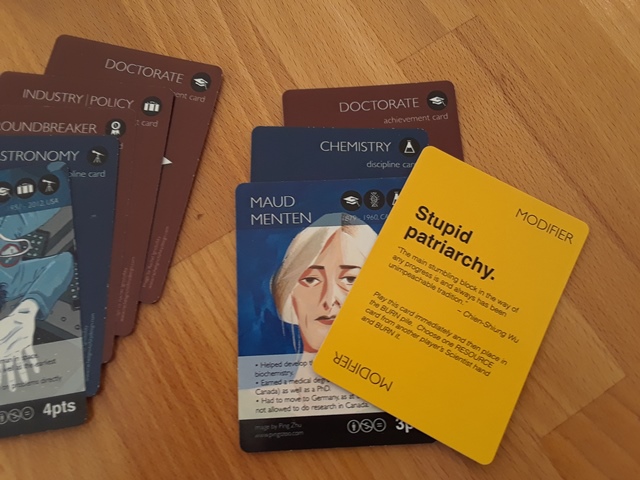
The card deck featuring women in science and engineering.{credit}Nicola Jones{/credit}

The player on my left has the biochemist Maud Menten’s career well on track. Suddenly another player slaps a “stupid patriarchy” card on Menten’s head, and she has to earn her doctorate all over again. So goes a novel card game devoted to women in science and engineering, designed to highlight these unsung researchers and the barriers and boons that women in these fields experience.
Alice Ball, the chemistry student who

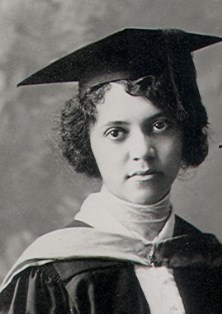
Alice Ball, the chemist who isolated an early effective treatment for leprosy.{credit}University of Hawaii{/credit}

Menten (1879-1960) was one of the first women in Canada to earn a medical degree atop her PhD. But at the time women weren’t allowed to do research at Canadian universities; she had to conduct her famous work on enzyme kinetics in the United States and Germany. Menten is one of 21 pioneering women scientists, mostly from North America, featured in the game — the latest in a series that began in 2000 with a biodiversity game called Phylo. The card deck was developed by an innovative science outreach programme at Vancouver’s University of British Columbia (UBC), in collaboration with Westcoast Women in Engineering, Science and Technology (WWEST) at Burnaby’s Simon Fraser University (SFU). Players complete researchers’ careers by collecting cards for achievements such as degrees, and try to avoid setbacks — such as the “tokenism” card, which wipes a scientist in play off the table.

“These are my favourites,” says computer engineer and WWEST chair Lesley Shannon, pointing to Alice Ball and Hedy Lamarr. Ball (1892-1916), the first woman and African-American Masters graduate from the University of Hawaii, developed a critical leprosy treatment. After her early death, university president Arthur Dean took credit for her work. Hollywood star Lamarr (1914-2000) co-invented frequency technologies used in WiFi and beyond.
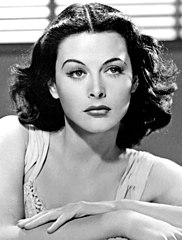
Hollywood star and xxx Hedy Lamarr.

Hollywood star Hedy Lamarr co-invented key frequency technologies.{credit}MGM{/credit}

Shannon and I put the game through its paces with three researchers from SFU: applied ecologist Anne Salomon, glaciologist Gwenn Flowers and physicist Sarah Johnson. We try to figure out the best strategies and which cards to play: scientists with more complex careers are worth more points. Completing the challenging career of a woman of colour nets a bonus point. Modifier cards can help as well as hinder progress: “mentors are awesome”, for example, gives a player a boost via an extra card.

The discussion provoked by the game is as interesting as the action. Sighs of recognition greet the setback card “ways of the Queen Bee”, which marks how women scientists sometimes undermine female colleagues. “I’ve been there,” says Shannon. Johnson counters: “I haven’t experienced this — perhaps because I haven’t had many female colleagues.”

Some have positive stories to tell: Salomon recalls one senior female mentor who offered to review her grant requests, in the name of building up a “good old girls’ club”. Since, she has tried to pay that idea forwards, helping more women to be invited onto panels or keynote lectures, get funding and publish. “We retain the rigour of peer review,” she says, “but that back door works to even the balance.”

Although women have, since the 1990s, earned about half of US science and engineering undergraduate degrees, as of a 2011 study they still held fewer than 25% of STEM jobs, were paid 86 cents on the dollar, and were seriously under-represented in degrees for fields like engineering. A recent study in Science showed that girls tend to think less of their intellectual abilities as early as age six. When 96 children were told a story about a “really, really smart” adult and asked to pick a face to match the story, for example, 5-year-old boys and girls both picked someone of their own gender about 70% of the time. But among 6- and 7-year-old girls, this percentage dropped to about half. More role models are among the many fixes proposed to shift the entrenched bias.

xxx

{credit}Nicola Jones{/credit}

WWEST’s mission is to help reverse such trends, in part by funding outreach projects. So when David Ng — who handles educational outreach for UBC’s Michael Smith Laboratories — approached them with the idea for the game in 2015, it was a good fit. Ng’s initiatives have included literary science magazine Science Creative Quarterly and other card sets (such as Phylo).

The games are crowd-sourced; anyone can invent one, or contribute to one, and the sets are available to download for free. If you play it, you start to get at least an inkling of the challenges around gender equity,” says Ng. “This is just a starter deck. Hopefully people will add to it.”

While aimed at pre-teens, when Shannon says many girls begin to turn away from science, the appeal of the women-in-science game is broader. Some of the harsher modifier cards (such as one that reads “mistaken for a janitor”) could, note Shannon and Ng, be removed from the game for more-impressionable age groups.

Mid-game, Johnson looks at the cards on the table and comments: “They’re all overachievers”. These women, she notes, had to be smarter and work harder to get the same recognition as male scientists — echoing her own undergraduate experience. “All of the female physics majors I knew were A students. This was not true of the men,” she says. That’s just one thing this worthy game aims to reverse.

Nicola Jones is a freelance science writer and editor living in Pemberton, British Columbia.

Download the game at https://www.sfu.ca/wwest/projects/phylo-card-deck.html

For more on science and culture, see: https://go.nature.com/2CMOwaL
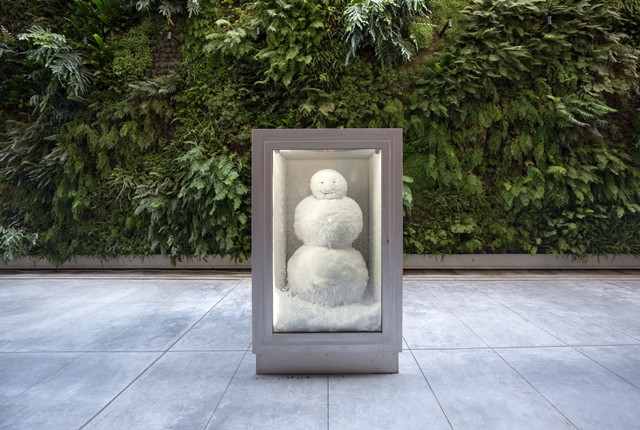
 

The 30-year-old snowman

Snowman, 1987/2016 (multimedia), by Peter Fischli and David Weiss.

Snowman, 1987/2016 (multimedia), by Peter Fischli and David Weiss.{credit}Peter Fischli and David Weiss © the artists, courtesy Matthew Marks Gallery; photo: Mary Ellen Hawkins, courtesy SFMOMA{/credit}


Posted on behalf of Michael White

It stands there trapped in a frosty cage: a 30-year-old snowman in a state of bliss, its currant-shaped eyes peering out over a lopsided grin in a face dotted with frozen florets.

The glass-fronted aluminum cooler currently sits at the San Francisco Museum of Modern Art. Above the sculpture, entitled simply Snowman, the understorey citizens of a redwood forest sway in the United States’ largest living wall. The tensions are inescapable: snow, a natural process, in a totemic form, in a machined box, surviving on electricity, juxtaposed against an artificial ecosystem. The installation is a brilliant encapsulation of our mixed-up global environment now — from polar melt to green cities.

Snowman was constructed in 1987 by Swiss artistic duo Peter Fischli and David Weiss for the Römerbrücke power plant in Saarbrücken, Germany. Toying with the idea that human enterprise could prolong an inherently transient existence, they crafted a technically fascinating sculpture. Its scaffolding is, as Fischli puts it, a “skinny snowman” constructed from copper. Under controlled humidity and temperature, the snowman grows and shrinks and alters itself – one day the eyes narrower, the next a different twist to the smile. The snow also alters the chamber’s microclimate; technicians adjust the dials to prevent a runaway snowman.

It’s not all fun and games and engineering. The snowman’s remarkable longevity and technical underpinnings provoke reflections on our climate, and the possibility that we too may be forced to control our own environment.

What of the Paris Agreement’s ambitious goal of keeping global warming to no more than 1.5 ⁰C? Doing so, without geoengineering, looks almost impossibly optimistic. With geoengineering, we will become the snowman, our climatic stability reliant on fiddling with dials. Only this time the outcome is uncertain and fraught with ethical dilemmas, ranging from disrupted monsoons to a rain of metallic nanoparticles.

Snowman would perish without electricity, as its intentionally obvious, preposterously long power cord reminds. Yet its built-in grin fizzes with joy. There is, after all, always the next installation. What of our own shrinking cryosphere, much of which is in rapid retreat? Technically, we can probably prevent the loss of the biggest chunks of ice, such as the Greenland and West Antarctic Ice Sheets. But I doubt that we’ll be feeling blissed-out about it.

Michael White is senior editor in physical sciences at Nature. He tweets at @MWClimateSci.

Snowman by Peter Fischli and David Weiss is on view at the San Francisco Museum of Modern Art through March 2018.


For Nature’s full coverage of science in culture, visit www.nature.com/news/booksandarts.

Maths and murals: Leiden’s wall formulae

Posted on behalf of Quirin Schiermeier

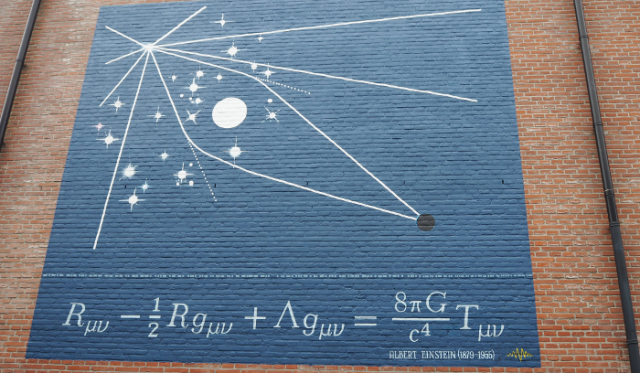
One of Einstein's field equations - part of the Leiden wall formulae project.

One of Einstein’s field equations – part of the Leiden wall formulae project.{credit}Ivo van Vulpen and Sense Jan van der Molen. Photograph by Hielco Kuipers.{/credit}

Albert Einstein’s field equations from his theory of general relativity combine wonderful scientific intuition with the honed concision of poetry. Yet relatively few of the culturally inclined marvel at the shape of a mathematical equation in the way they might at a line from Shakespeare. Now, however, the Dutch university town of Leiden is giving its citizens a chance to try, through iconic formulae by physicists and astronomers painted on walls throughout the city.

The formulae join 100-plus murals of poems, painted by artists over more than two decades as a way of highlighting Leiden’s long connection with the arts, not least as Rembrandt’s birthplace. These celebratory artworks, some in delicate Japanese calligraphy, have become part of an urban aesthetic. But the city is also a crucible for discoveries such as superconductivity, by Heike Kamerlingh Onnes, in 1911.

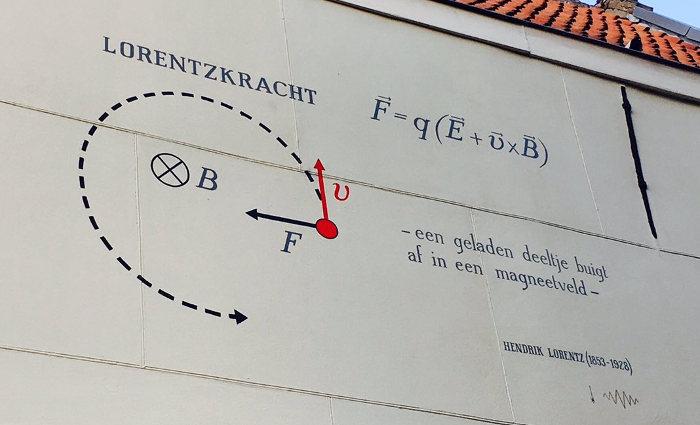
lorentzkracht

The Lorentz force formula.{credit}Ivo van Vulpen and Sense Jan van der Molen. Photograph by Hielco Kuipers.{/credit}

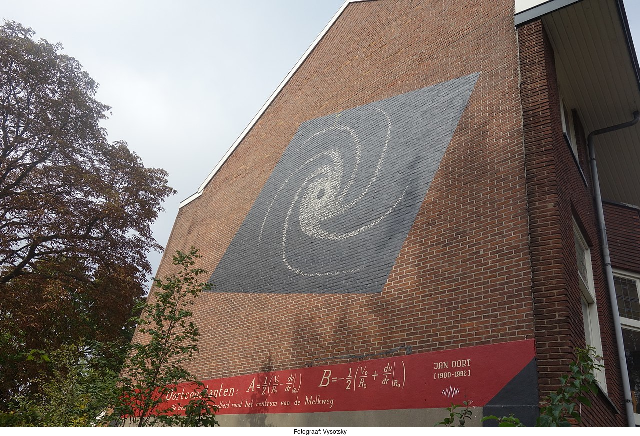
The idea of ‘wall formulae’ arose a few years ago, when physicists Ivo van Vulpen and Sense Jan van der Molen convinced municipal authorities (and house-owners) to embrace the scheme as a way of celebrating science in the city. Dutch artists Jan Willem Bruins and Ben Walenkamp were first in, painting Willebrord Snellius’s law of refraction (Snell’s law), Hendrik Lorentz’s force formula, and Einstein’s field equations. These were unveiled in 2016. Three more – the Oort constants, the Lorentz contraction and electron spin (discovered by Lorentz’s students Samuel Goudsmit and George Uhlenbeck) – are officially unveiled today.

Oort constants.

Oort constants.{credit}Ivo van Vulpen and Sense Jan van der Molen. Photograph by Hielco Kuipers.{/credit}

Van der Molen notes that the equations, like poems, distil realities and are “beautiful to behold and inspiring”. To help convey their meaning to non-mathematicians, the artists add a simple graphical representation of the physical phenomenon described. Thus the Lorentz contraction, which expresses how objects shrink to an observer travelling near speed of light, is illustrated by a circle and a series of ‘squeezed’ ellipses. The Oort constants, which refer to the angular velocity of the Sun around the centre of the Milky Way, are symbolized by a spiral galaxy (with a dot showing the Sun’s position). And to picture Einstein’s field equations – which describe how space is deformed by big objects – we see a ray of starlight’s curved path around a heavy mass, known as gravitational lensing.

By inviting comparison between these and more familiar lines of beauty, Leiden is leading the way in inspiring its citizens about physics and maths on the hoof.

Quirin Schiermeier is a senior reporter for Nature based in Munich.

 The Leiden wall formulae feature on city-centre buildings including the Boerhaave science history museum. Tourists can visit the sites on a leisurely 90-minute walk. Guided tours and an app for smartphones, developed by Leiden physics students involved in a science communication project, will be available by the start of 2018.


For Nature’s full coverage of science in culture, visit www.nature.com/news/booksandarts.

The impossibility of being known

Posted on behalf of Elizabeth Gibney

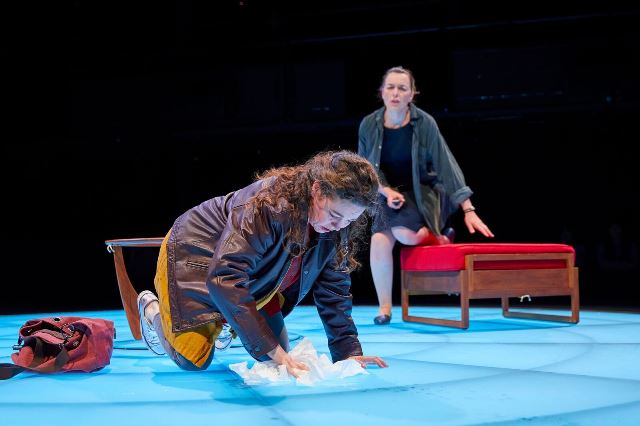
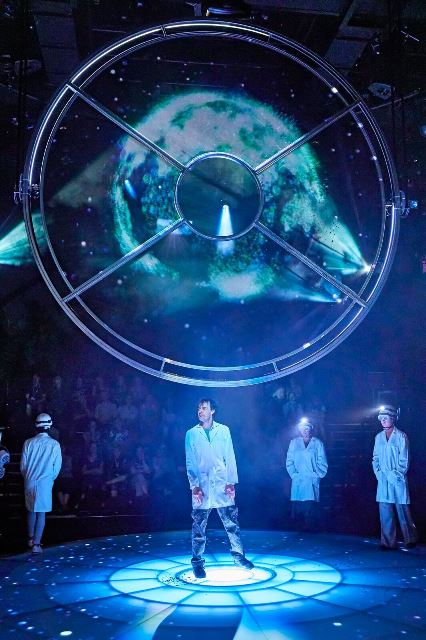
Scene from Heisenberg: the Uncertainty Principle

A model relationship: Anne-Marie Duff and Kenneth Cranham

Like Copenhagen, Michael Frayn’s 1990s blockbuster, Heisenberg: the Uncertainty Principle is a play that takes as its muse a notion at the heart of quantum physics: that it is impossible to know both the exact position and momentum of a particle at once.  Where Frayn imagined physicists’ rarefied debates, playwright Simon Stephens uses the idea to probe the messy world of relationships.

The one-act work revolves around 42-year-old Georgie (Anne-Marie Duff), a fabulist, and Alex (Kenneth Cranham), a 75-year-old butcher, who meet in a station. The pair forges an unlikely affair that sees them baring their souls over a period of six weeks.

Stephens exploits the uncertainty principle to explore what he sees as a quirk of human interaction. To predict someone’s movements is to not pay attention to them properly, and knowing someone really well makes it more likely that they will surprise you, he said in interviews ahead of the opening. When Stephens learned of the principle though his son’s love of science, it struck him, he says, “that all life is contained within it”.

Georgie name checks Werner Heisenberg as she lays out the principle to Alex to help explain why she is estranged from her son (the only time the theory, or indeed science, is actually mentioned). The urge to find him drives the story forward. There are further parallels: one interpretation of the principle, for example, is that uncertainty in a particle’s momentum comes from the physical process of measuring its position. Similarly, only by learning about each other do Georgie and Alex change the course of their lives. What in other hands could be somewhat contrived is made enjoyable by stellar performances, thoughtful direction by Marianne Elliot and clever staging and music.

Both characters prove surprising in different ways. Georgie is blunt and quixotic. Duff plays the effervescent role masterfully. Alex’s change of tack is much more subtle. He is at first a grumpy man of a certain age – inured to life and happy to be alone. Cranham movingly shows how breaking through the façade can reveal a complex and raw person, with an boyish zest for life.

Though the script is witty and at times insightful, it doesn’t always ring true. For me, the age gap was perpetually jarring. But it’s almost as if the combination is not supposed to be real. Indeed the play has the feel of a textbook problem: a stripped-back model that asks the audience to imagine an unlikely paring of two people, like particles in a box. The feeling is enhanced by the stark set. Designer Bunny Christie has events take place in a minimalist white space that morphs before our eyes as scenes change.

The uncertainty principle is one of only a few ideas in quantum mechanics that is both intuitive and easy to describe, and the play’s reference to it is thankfully not overcooked. The analogies Stephens draws between life and physics aren’t perfect, but as device for exploring interaction – and a way to remind theatre-goers that science can resonate with human experience and creativity – it works.

Elizabeth Gibney is a senior reporter for Nature based in London. She tweets at @lizziegibney.

Heisenberg: The Uncertainty Principle is on at the Wyndham’s Theatre, London, until 6 January 2018.


For Nature’s full coverage of science in culture, visit www.nature.com/news/booksandarts.

When physics and family collide

Posted on behalf of Elizabeth Gibney

NTGDS_Mosquitoes_Twitter_1024x512TT_Photography (Olivia Williams and Olivia Colman) by David Stewart. Design by National TheatLucy Kirkwood’s new play Mosquitoes is such a sparkling showcase for physics that it might as well have been commissioned by CERN, Europe’s particle physics laboratory. But this tragicomedy is most successful in its portrayal of heartbreak, trust and the tug of family ties.

The science begins with the play’s name, a reference to a phenomenon at the heart of CERN’s Large Hadron Collider (LHC): that incredible things emerge when particles collide with the force of just two mosquitoes. The action takes place during the LHC’s startup in 2008. Women scientists from two generations feature — condensed-matter physicist Karen (Amanda Boxer) and her daughter, particle physicist Alice (Olivia Williams). There is even a humanised boson called, naturally, The Boson. Played by Paul Hilton, the personified particle segues into grand monologues about the creation and demise of the Universe, set to spectacles of light and sound in Rufus Norris’s slick, minimalist production. (The ghostly character doubles up as Alice’s missing husband, who is as elusive as the long-searched-for Higgs.) But it is the very human story enacted by Williams and Olivia Colman, as Alice’s disgruntled, underachieving sister Jenny, that completely steals the show.

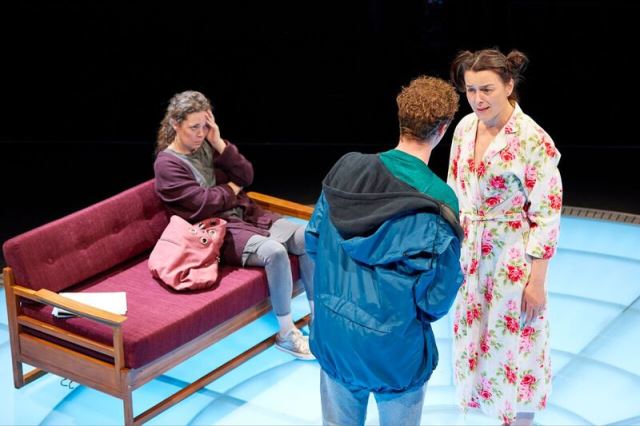
Olivia Williams (on bench) and Olivia Colman as Alice and Jenny.{credit}BrinkhoffMogenburg{/credit}

A tragedy prompts Jenny and their mother Karen, who is coping with the early stages of dementia, to visit Alice just as she is about to embark on the most exciting years of her career at the LHC. During their stay, Alice’s orderly life is jolted by events unfolding around her guests and her socially awkward teenage son Luke (Joseph Quinn). Each faces a personal issue — guilt, loss of control, work or teenage angst — that can stop them from seeing the bigger picture.

Colman is electric as Jenny. Witheringly witty, she’s also boozy and reckless, a fan of horoscopes and holidays “somewhere hot that serves English food”. Williams has less to work with but is excellent as even-tempered Alice, who struggles to understand her son and gently patronises her frequently deluded sister. Their relationship is very believable, not least in drawing on each other’s diverse qualities at times of need; it steadies the whirlwind of ideas Kirkwood plays with, from mental health to cosmology. The pacy dialogue meanwhile zings with humour.

xxx

Paul Hilton (centre) as The Boson.{credit}Brinkhoff Mogenburg{/credit}

Science here is most successful as a backdrop. The play perfectly captures the fervid atmosphere of the LHC’s switch-on day, with physicists jumping for joy at screens that seem, to an outsider, to show nothing. Boxer is effervescent as Karen, describing the highs and lows of her scientific work – for which, she often reminds her daughters, she should have won a Nobel. (Kirkwood also neatly skewers journalists who sought to ham up the possibility of the LHC causing Earth to be sucked into a black hole.) Jenny meanwhile becomes an anti-science mouthpiece, at one point masterfully comparing the quest for the Higgs boson to complete the Standard Model to the claim “my marriage isn’t working because we don’t have a cappuccino machine”. Her views are generally so ludicrous that such comments come off as praise.

The science setpieces are eerie and gripping — notably The Boson’s description of the Universe’s first 300,000 years as a real “pea-souper” while twinkling visuals appear on a screen above. But the relevance of these moments to the rest isn’t entirely clear. Are they meant to highlight the importance of Alice’s work? Are they a counterweight to the minutiae of human stories?

A more successful theme is the link between power and trust. Though the play celebrates the triumph of reason over pseudoscience, it also subtly makes the point that scientific pronouncements are taken on trust by everyone except those who directly work on them. Mosquitoes equates science with power, and shows that working in the two sisters. Jenny feels left behind by her scientific family, and that relates to her reactionary attitude and mistrust of doctors who tell her that vaccines and ultrasounds are safe. Meanwhile, the harder Alice’s life gets, the more she leans on superstition, faith and the blind acceptance of family.

Colman, Paul Quinn and Williams.

Colman, Paul Quinn (as Luke) and Williams.{credit}Brinkhoff Mogenburg{/credit}

Kirkwood’s decision to intertwine this intense relationship and each character’s personal struggles with a barrage of science makes for a slightly disjointed but profoundly emotional, immersive and compelling experience. I was irked only by the fact that the play does little to dispel the myth that science is only for the select few. (In a great comic line, Luke’s would-be girlfriend earnestly proclaims that, as she’s not clever enough to become a scientist, she’ll probably just be a doctor or lawyer. It’s a joke that’s close to the bone.) The audience is unlikely to leave Mosquitoes with a radically better understanding of cosmic mysteries, but they will be stung by its insights into the power of family relationships long after the curtains close.

Elizabeth Gibney is a senior reporter on physics for Nature based in London. She tweets at @LizzieGibney. 

Mosquitoes is on at the National Theatre, London, until 28 September.


For Nature’s full coverage of science in culture, visit www.nature.com/news/booksandarts.

Revisiting Feynman on physical law

Posted on behalf of Andrea Taroni

9780262533416

Physics, along with jurisprudence, is principally known for its laws. And physical laws are amazing: they can predict almost anything, from the effects of gravity to why the Sun shines. Explaining them is surprisingly hard, however. Anybody first encountering them in the classroom, typically as mathematical formulae applied to abstract problems, can attest to that. The result is countless hours spent by teachers, educators and popularisers of science devising ways to make physics (and its laws) ‘more interesting’.

Richard Feynman’s The Character of Physical Law – published in 1965 and now newly reissued by MIT with a foreword by Frank Wilczek – stands out as an early example of a successful attempt towards this end. The book is based on a series of lectures the iconic physicist had delivered the previous year at Cornell University. But it’s a layered work, and clearly shows Feynman also drawing from another set of lectures, delivered at the California Institute of Technology from 1961 and 1963. Those would go on to become his most famous work: The Feynman Lectures in Physics (reviewed here).

However, whereas The Feynman Lectures were an attempt to reinvigorate the pedagogical approach to ‘freshman’ physics, The Character of Physical Law is, in Wilczek’s words, far more than an exposition of facts and ideas. It is also a character study of Feynman himself.

By physical law, Feynman is quick to explain that he means “the rhythm and pattern of phenomena of nature which is not apparent to the eye, but only to the eye of analysis”. In other words, the very phenomena we uncover through painstaking empirical observation, and tend to ultimately write down as mathematical equations. But the topic of the lectures is broader still. They focus on the characteristics common to all the laws: “that is another level, if you will, a higher generality over the laws themselves”.

The big picture

What is really striking about The Character of Physical Law is Feynman’s ease in covering broad areas of physics — for instance, the law of gravitation, the relationship between physics and mathematics, the role of symmetry in physical laws. But crucially, he is equally adept at discussing the history of these topics and their relevance to everyday life, and lucidly articulating the reasons why one might be curious about them. It is this combination of skills that allows him to avoid excessive abstraction and philosophising, a common pitfall when looking at the big picture of things.

For instance, Feynman kicks off by discussing the law of gravitation. In plain words, this describes how a particle is attracted to every other particle through a force directly proportional to the product of their masses, and inversely proportional to their distance. Though acknowledging that it is a discovery of the Enlightenment, he argues that by “describing its history and methods, the character of its discovery, its quality”, he recontextualises it for the present.

In the space of a few pages, the reader learns the way mathematician and astronomer Johannes Kepler established how the planets orbit around the sun. And they are provided with a clear description of the Newtonian mechanics that explain what makes them go around — including, of course, a brief explanation that, eventually, even Newton’s laws are found wanting and Einstein’s relativity takes over. At the next level of generality, Feynman also considers other instances in which inverse-square laws appear in nature — for example, to describe the interaction between electrical charges. The reader is invited to think deeper as each layer of description is peeled away, while at the same time keeping in mind the common threads that bind them together. Yet Feynman isn’t afraid to admit when even the boundaries of his knowledge are reached: “instead of having the ability to tell you what the law of physics is, I have to talk about the things that are in common to the various laws; we do not understand the connection between them”.

This approach certainly demonstrates an unusual depth of physics understanding. It also reveals Feynman’s humanity. Feynman was of course famously charming and charismatic — and, arguably, flawed, perhaps propagating the myth of his stage persona a little too enthusiastically. But ultimately he was, in my view, a man driven by a playful, down-to-earth spirit of curiosity, not the dry and abstract reasoning of a detached academic.

Rules of the game

As Wilczek notes in the foreword, a lot has happened in physics since 1965; yet The Character of Physical Law holds up extremely well today. My favourite chapter is the one on symmetry in physics. Feynman starts off by noting that symmetry appears to fascinate the human mind, if only for aesthetic reasons. But he chooses to emphasise the symmetry within the laws of physics themselves. Certain laws can be symmetric with respect to time and space, for example, but not necessarily under changes of scale. The implications of these symmetries are more obvious in some cases than others. But the key point is that by focusing on these underlying rules of the game, one gains an appreciation for the character of the physical laws they apply to.

To underline that, he masterfully explicates the far-reaching implications of charge-parity violation in the weak nuclear force. In his own words, “it is as if 99.99% of nature is indistinguishable right from left, but that there is one little piece which is completely different”. This ultimately explains the preponderance of right-handed molecules, such as proteins, that play a central role in the biochemistry of life. Feynman’s genius as a communicator lies in his ability to explain this connection in a manner that is accessible, fascinating and accurate in equal part.

Ultimately, I wouldn’t go quite as far as Wilczek by describing The Character of the Physical Law as the single best introduction to modern physics. Somehow, I suspect there is a reason why the more incremental approach espoused in The Feynman Lectures in Physics has gained traction with a wider readership over the years. But for the interested reader looking for more, this book offers enlightenment to those exploring its facets.

Andrea Taroni is chief editor of Nature Physics. He tweets at @TaroniAndrea. 


For Nature’s full coverage of science in culture, visit www.nature.com/news/booksandarts.

The art of engineering: 9 Evenings revisited

Composer John Cage's xxxx at 9 Evenings, October 1966.

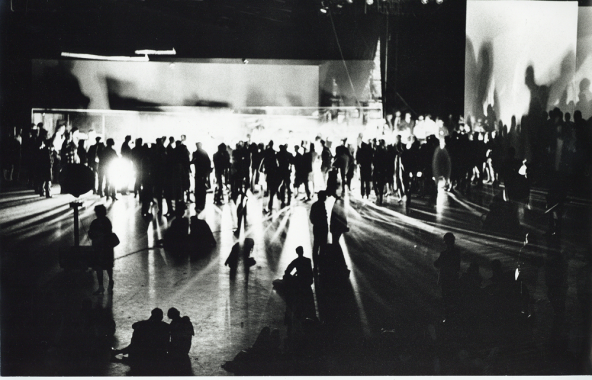
John Cage, Variations VII, 9 Evenings: Theatre & Engineering, October 1966.{credit}Adelaide de Menil{/credit}

I’m gazing at a stage draped in white when a giant zipper suddenly appears, projected onto one wall. As it works its way noisily around, more projections — live-streamed or pre-recorded moving images of buildings, blurred pedestrians, discarded clothing and simmering water — judder on crumpled backdrops. An apparently random urban soundtrack lulls and roars in the background. In the foreground, performers skip rope and cut hair; one solemnly rips up, boils and eats her shirt. It’s quite an evening.

Robert Whitman at performance of Side Effects, October 2016.

Robert Whitman (centre) at performance of Side Effects, October 2016.{credit}Christopher Fernandez{/credit}

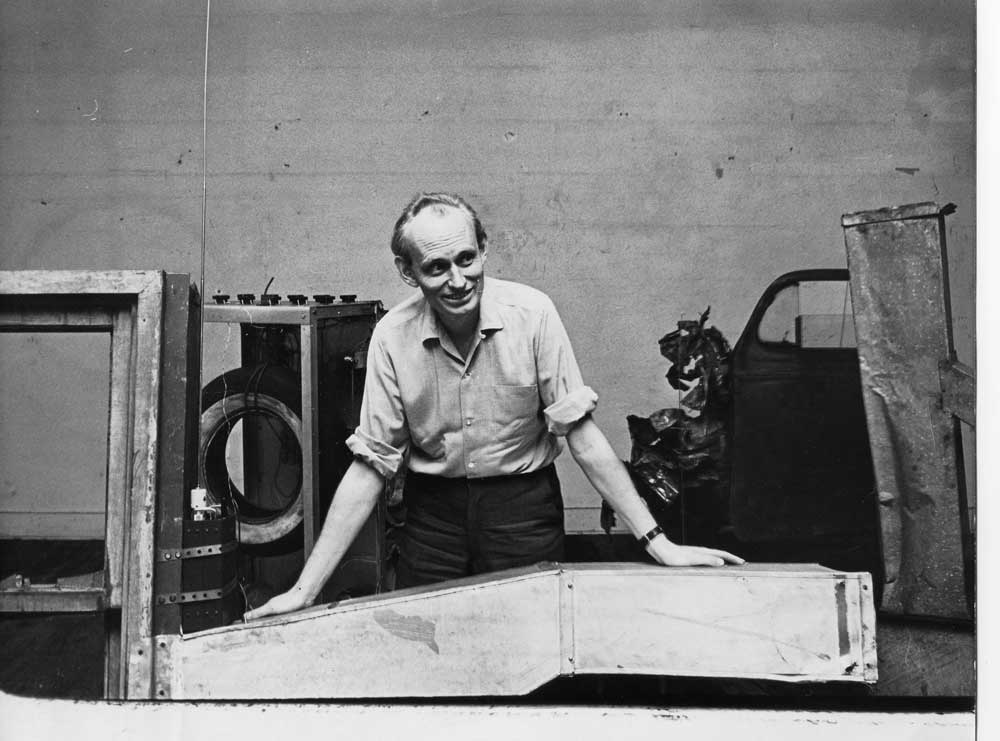
The artist behind this indeterminate, playful, technologically rich and vaguely disturbing piece, Side Effects (commissioned by Arts Catalyst) is Robert Whitman. The evening is an homage to 9 Evenings: Theatre & Engineering, a legendary series of performances that, 50 years ago, galvanised New York with an unprecedented mix of cutting-edge technologies and avant-garde art. Whitman was one of 10 artists — among them multi-media maverick Robert Rauschenberg, composer John Cage and choreographer Lucinda Childs — who collaborated one-to-one with 30 engineers, most from research powerhouse Bell Labs and including, notably, the visionary electrical engineer Billy Klüver. Klüver was adamant about involving technologists rather than scientists, feeling that technology is essentially about “the material and the physicality”. It was a moment that paved the way to crossover disciplines such as digital art.

There was a utopian edge to technology then, as America literally reached for the Moon. For artists seeking new media, high-tech expertise enabled fresh explorations in sound and vision. For the engineers, artists expanded what Klüver (already a veteran of collaborations with Jean Tinguely, Andy Warhol, Rauschenberg and Cage) saw as constrained horizons. Whitman, whom I caught up with after the performance of Side Effects, recalled that the 9 Evenings teams included a lot of “arranged marriages”, but worked if goals and enthusiasms chimed.

Billy Kluver in 1965.

Billy Klüver with Robert Rauschenberg’s work Oracle in 1965.{credit}New York Times, courtesy of E.A.T.{/credit}

By that time (October 1966), Whitman had been creating immersive pieces for some years, combining film, performers and ‘shape-changing’ props such as plastic sheeting. His 1960 The American Moon, for instance, had a hallucinatory quality and a sense of “slow time”, according to fellow experimentalist Claes Oldenburg. 9 Evenings offered a chance to push the boundaries in a bold venue.

That was the 69th Regiment Armory, a hangar-like midtown Manhattan edifice where, over 50 years before, another exhibition had exploded America’s cultural complacency with artworks such as Marcel Duchamp’s Nude Descending a Staircase. For 9 Evenings, some 1,500 people a night filed into its reverberating spaces.

Signal splitters, Geiger counters

Whitman’s contribution Two Holes of Water – 3 featured input from a number of engineers, including cellular telephony researcher Robby Robinson. The piece involved 23 performers, seven plastic-wrapped cars equipped with film projectors, one of the first fibre-optic miniature video cameras, film shot using an optical device with parallel mirrors, and a signal splitter that allowed a performer’s front and back view to be superimposed. A projected live image of water being poured into a glass on the Armory floor and documentary footage of Alaskan flora and fauna also featured.

Equally bravura was Cage’s composition Variations VII (pictured above), which harnessed live feeds from numerous sound sources. As Cage ‘played’ several transistor radios, 10 telephone lines picked up ambient noises from locations round the city, including the 14th Street Con Edison electric power station and the press room of the New York Times. Signals from two Geiger counters were converted into sounds; six contact microphones amplified noises generated by performers handling devices such as juicers, while data from electrodes on the forehead of another were converted into sound waves.

Robert Whitman in the 1970s.

Robert Whitman in the late 1960s.{credit}A&T archives, courtesy Los Angeles County Museum of Art{/credit}

Some critics tore into the event, as technology historian Patrick McCray has noted. Whitman, Rauschenberg, Klüver and fellow engineer Fred Waldhauer, however, had already forged ahead with another venture. The non-profit foundation Experiments in Art and Technology (E.A.T.) took the cross-fertilisation further. By 1969, E.A.T. comprised 2,000 artists and as many technologists, riding the wave of innovation in electronics and communications. Their Projects Outside Art series, for instance, featured Telex: Q&A, which linked public spaces in India, Japan, New York and Sweden to encourage citizens of each to question future possibilities.

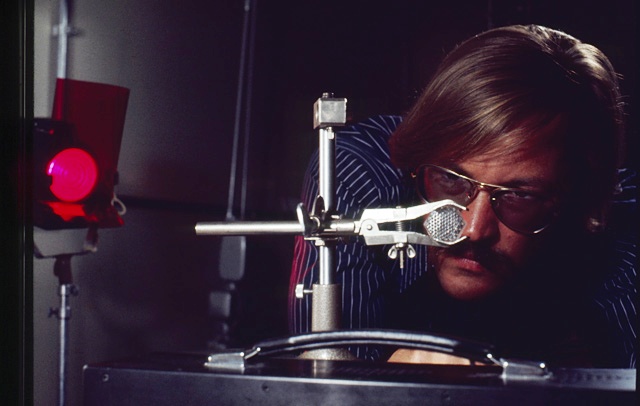
Meanwhile, a programme with aims similar to E.A.T.’s had sprung up at the Los Angeles County Museum of Art (LACMA). Art and Technology, the brainchild of curator Maurice Tuchman, boasted star physicist Richard Feynman as consultant. Whitman was also involved. So began his immensely fruitful teamwork with optical scientist John Forkner, then at Philco-Ford, the company that built the equipment at NASA’s Johnson Space Center mission control.

Optics scientist John Forkner.

Optical scientist John Forkner.{credit}A&T archives, courtesy Los Angeles County Museum of Art{/credit}

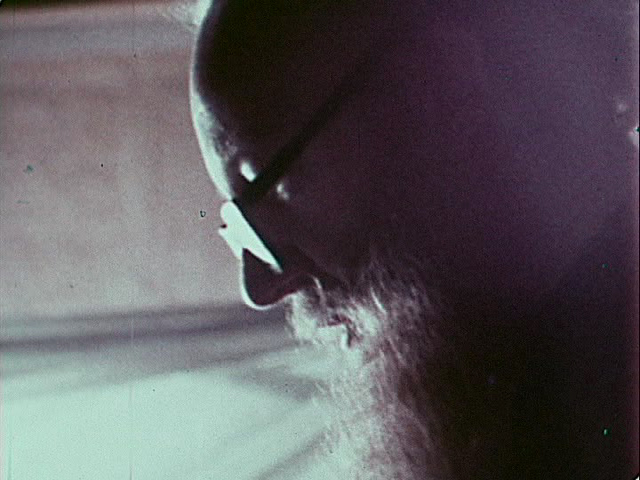
“This public-relations official introduced me to a guy with a long beard. I was lucky,” says Whitman. “John was a natural genius in optics and very interested in music and art. I remember that at one point I was sitting in a car with Feynman and he said, ‘Where’d you find him? He’s terrific.’”

Over 18 months, Whitman and Forkner created a spectacular installation for LACMA at the US Pavilion at Expo ’70 in Osaka, Japan. Tuchman described the work as an “optical tour de force” incorporating 1,000 corner-shaped mirrors reflecting the viewer’s multiplied image to them, as well as pulsating mylar mirrors and “eerily bright three-dimensional objects (a pear, drill, goldfish bowl with live fish, a knife, a clock, ferns, etc.).”

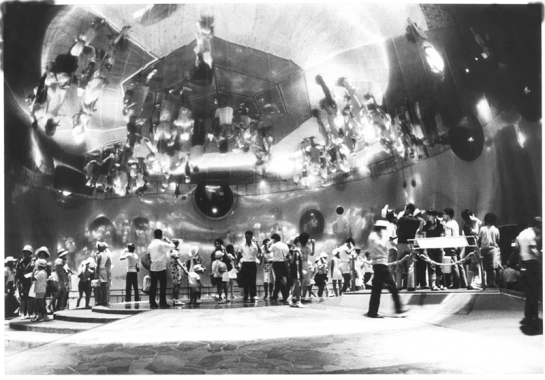
E.A.T. was equally busy at Expo ’70: the Pepsi Pavilion was a focus for several of its cutting-edge collaborations. A major element was a spherical mirror over 27 metres in diameter that created real images of visitors, hanging in space above their heads. Whitman contributed here too, along with physicist Elsa Garmire, while artist Fujiko Nakaya worked with physicist Tom Mee to create the evocative fog sculpture capping the structure. It was clear that by this time, as McCray puts it, artists and engineers between them had “rewired modern art”.

Mirror dome room at the Pepsi Pavilion at Expo '70 in Osaka.

Mirror dome room at the Pepsi Pavilion at Expo ’70 in Osaka.{credit}Shunk-Kender{/credit}

Whitman is now 81, and busy. Many other movers and shakers behind 9 Evenings and E.A.T. are gone. As for E.A.T. itself, it has effectively ended as an entity, but “exists as an idea,” notes its director Julie Martin (Klüver’s widow). Klüver himself, in a 1999 interview with Hans Ulrich Obrist, said, “once everybody understands the idea of artists and engineers working together, there is no reason for E.A.T. to exist”.

I asked Whitman what he thought about 9 Evenings now. “Looking back is what I call ‘dead guy stuff’. You need to get onto the next thing. As for the future, it’d be fun to be around.” There is something there of the unquenchably optimistic technophile, always looking for the next innovation. Yet just for a moment, he did look back. “I didn’t know it at the time, but for me it all started with Emmett Kelly,” he told me. On a childhood visit to the circus in the 1940s, Whitman had been galvanised by the iconic American clown, who had a routine where he swept up the spotlight with a broom. “I was staring at everyone around me, wondering why they weren’t seeing this miracle. It set me on my way.”

I thought of the spotlit zipper in Side Effects, and began too to see how an early bent towards flux and illumination led him to performance, advanced technology and the intensive mix of both that was 9 Evenings. And beyond.

Arts Catalyst’s 9 Evenings: Theatre and Engineering Revisited 1966/2016 continues to 29 October.

Archival information on 9 Evenings and E.A.T. can be accessed at the Daniel Langlois Foundation Collection. Maurice Tuchman’s report on LACMA can be accessed here. My thanks to Robert Whitman, Julie Martin and Patrick McCray for additional information. McCray is currently writing a book (tentatively entitled Art Rewired: Engineering a New Creative Culture) on the art-technology nexus in that era. His Leaping Robot blog meanwhile offers much fascinating detail on 9 Evenings, E.A.T. and more.

Industrial optimist: Moholy-Nagy revisited

Posted on behalf of Jeff Tollefson

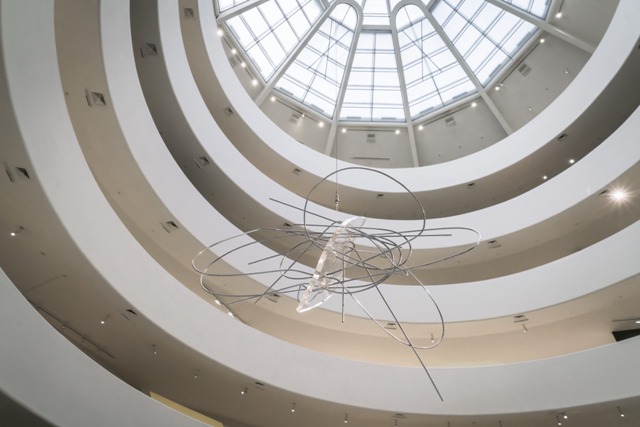
László Moholy-Nagy Dual Form with Chromium Rods, 1946 (Plexiglas and chrome-plated brass)

László Moholy-Nagy, Dual Form with Chromium Rods, 1946 (Plexiglas and chrome-plated brass).{credit}Solomon R. Guggenheim Museum, New York, Solomon R. Guggenheim Founding Collection 48.1149 © 2016 Hattula Moholy-Nagy/VG Bild-Kunst, Bonn/Artists Rights Society, New York. Photo: David Heald © Solomon R. Guggenheim Foundation{/credit}

I’m standing in the spiraling rotunda of New York’s Guggenheim Museum, and over me dangles a chaotic mess held together by translucent Plexiglas. In the shadow the sculpture casts on the wall, the shapes converge in a pleasing negative blending intention and happenstance – impossible to predict, yet clearly part of a plan. On evidence, this is an artist thinking experimentally, and in multiple dimensions.

The industrial designer, artist and photographer Lázló Moholy-Nagy (1895-1946) was certainly that. As the Guggenheim’s retrospective Moholy-Nagy: Future Present shows, the Hungarian pioneer of the Bauhaus and beyond worked in a dazzling array of media: film, photography, painting, sculpture, graphic design and typography. But behind the restless eclecticism, he adhered to the unifying theory (with the Constructivists) that art is integral to social transformation and must embrace new technologies. At a time of vast industrial expansion, he declaimed himself as “[n]ot against technological progress, but with it”, championing novel industrial materials — from Formica and aluminium to the Plexiglas in Dual Form with Chromium Rods (1946) in the rotunda. Drawn towards the airy, the transparent and the brilliantly coloured, he was also in love with light and movement: like contemporary Alexander Calder, he engineered moving parts and even electric motors into kinetic sculptures.

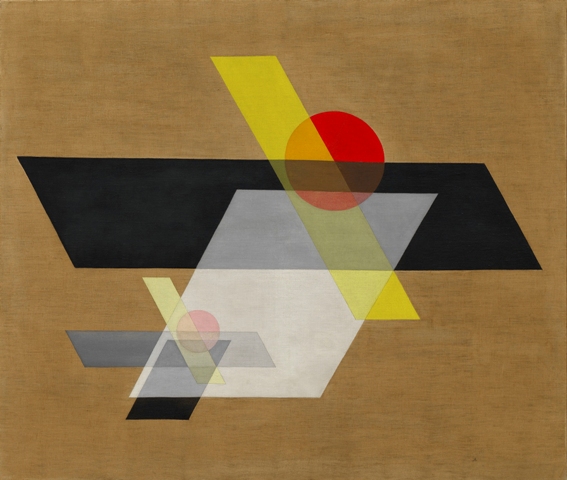
László Moholy-Nagy A II (Construction A II), 1924 Oil and graphite on canvas

László Moholy-Nagy, A II (Construction A II), 1924 (oil and graphite on canvas).
{credit}Solomon R. Guggenheim Museum, New York, Solomon R. Guggenheim Founding Collection 43.900 © 2016 Hattula Moholy-Nagy/VG Bild-Kunst, Bonn/Artists Rights Society, New York{/credit}

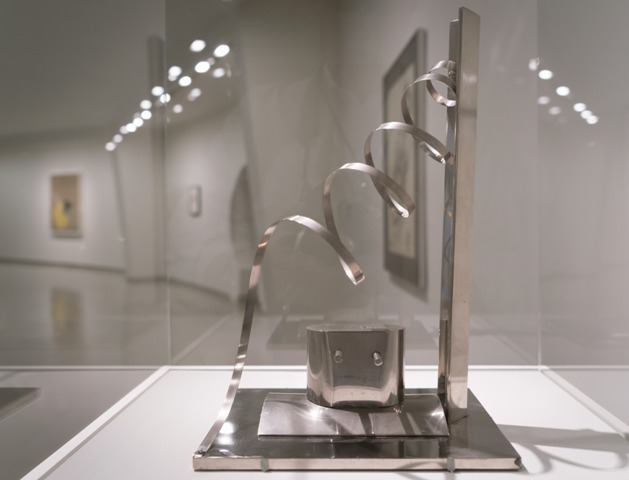
The exhibition takes a roughly chronological approach. Moholy-Nagy’s career began in earnest after he was injured in the First World War trenches. Much of the wall space is dedicated to earlier works such as the 1924 A II (Construction A II), an oil-and-graphite canvas in the Constructivist mode, that plays with colour intensity and transparency in rhombi and circles. Small abstract sculptures such as the welded, plated Nickel Sculpture with Spiral (1921) have a machined appearance. Its metal spiral inadvertently echoes the Guggenheim’s internal architecture, reflected on its glass case.

László Moholy-Nagy Nickel Sculpture with Spiral, 1921 (nickel-plated iron, welded)

László Moholy-Nagy, Nickel Sculpture with Spiral, 1921 (nickel-plated iron, welded).
{credit}The Museum of Modern Art, New York, Gift of Mrs. Sibyl Moholy-Nagy 1956 © 2016 Hattula Moholy-Nagy/VG Bild-Kunst, Bonn/Artists Rights Society, New York. Photo: David Heald © Solomon R. Guggenheim Foundation{/credit}

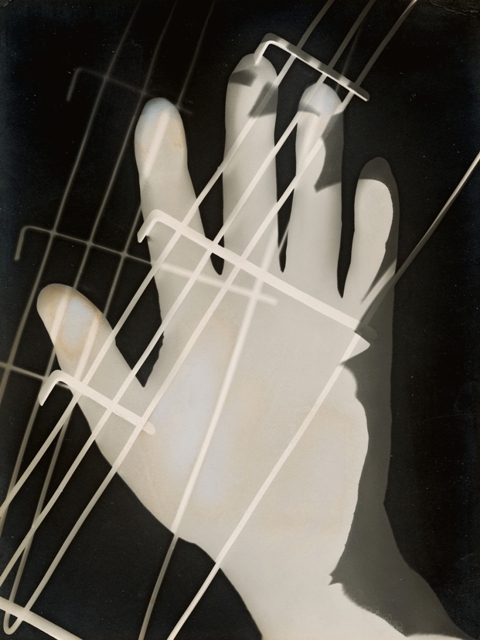
Deeper into the show we encounter Moholy-Nagy’s innovative photographic abstractions, which he called photograms. Developed directly on light-sensitive paper, these images (such as the 1926 Photogram) allowed the capture of objects in outline and even a playful profile of his own head. Other works reveal the artist’s intent to  harness the laws of physics. Space III (1940) is an abstract, multi-dimensional work composed of a Plexiglas sheet suspended in front of a white panel. The sheet is delicately etched and pigmented on both sides around an untouched circle, so that light both flows through and casts shadows on the panel. “Light does then what I could not do,” he wrote. “A sparkling, vibrating color effect through the addition of the shadows produce mixtures as no one could on the palette.”

Such materials and artistic approaches are ubiquitous now. But context and intention are critical to this show. There were moments when I felt as if I was in a history museum dedicated to the co-evolution of technology, industry and humanity. Clearly Moholy-Nagy was conscious of his place in time, and his role as interpreter of both past and present. He also sometimes felt he was speaking to the future. “I often had the feeling, when pasting my collages and painting my ‘abstract’ pictures, that I was throwing a message, sealed in a bottle, into the sea,” he wrote in 1944. “It might take decades for someone to find and read it.” Gradually I found myself seeing the avant-garde in the work by focusing on details and juxtaposition.

László Moholy-Nagy, Photogram, 1926 (gelatin silver photogram)

László Moholy-Nagy, Photogram, 1926 (gelatin silver photogram){credit}Los Angeles County Museum of Art, Ralph M. Parsons Fund © 2016 Hattula Moholy-Nagy/VG Bild-Kunst, Bonn/Artists Rights Society (ARS), New York Photo: © Museum Associates/LACMA{/credit}

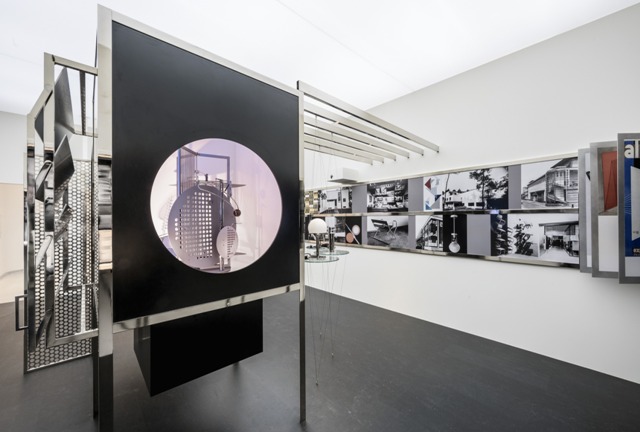
The Room of the Present offers a full realization of the artists’ vision, meshing space, light and an industrial aesthetic. An exhibition space within an exhibition space, it was never built in his lifetime, but constructed in 2009 based on architectural drawings, some of which are on display. Images of dancers and race cars jostle with those of laboratories and industrial facilities. Soviet filmmaker Sergei Eisenstein’s 1925 silent Battleship Potemkin is on view, but pride of place is given to a replica of Moholy-Nagy’s famous mixed-media kinetic sculpture Light Prop for an Electric Stage (1923-30). Attached to an electric motor and a simple gear box at the base, the collection of discs, springs and rods pivot, twirl and twist as the sculpture turns, casting colours and shadows onto the back of the box.

Moholy-Nagy left Nazi Germany in 1934, landing in Amsterdam, then London and eventually Chicago. There, in 1937, he founded the New Bauhaus, now known as the Institute of Design, at the Illinois Institute of Technology. He called his institute a “laboratory for a new education”, where art, industry and intellectual curiosity could come together to solve human problems, large and small. “If the unity of art can be established with all the subject matters taught and exercised, then a real reconstruction of this world could be hoped for — more balanced and less dangerous,” he wrote at the height of the Second World War, in 1943. Thanks to a little luck, and immigration, he survived both wars and remained an optimist to the end, dying from leukaeumia in 1946.

László Moholy-Nagy, Room of the Present, constructed 2009 (mixed media).

László Moholy-Nagy, Room of the Present, constructed 2009 (mixed media), with Light Prop for an Electric Stage, 1930 (exhibition replica, 2006; metal, plastics, glass, paint, and wood, with electric motor).{credit}Van Abbemuseum, Eindhoven. © 2016 Hattula Moholy-Nagy/VG Bild-Kunst, Bonn/Artists Rights Society, New York. Photo: David Heald © Solomon R. Guggenheim Foundation{/credit}

Among the last pieces on display at the Guggenheim are Nuclear I (1945) and Nuclear II (1946). A response to the bombings of Hiroshima and Nagasaki in 1945, the colourful globes in both paintings recall nuclear fireballs, frozen in a perpetual state of expansion. Inside are mosaic-like collections of abstract shapes, with faint hints of smoke and mushroom clouds.

 The bombings were a low point for the role of science in human affairs, but Moholy-Nagy interpreted the horror in his own way — with a chromatic intensity that speaks of hope amid destruction. In these and so many other works in this stunning exhibition, Moholy-Nagy’s belief in human resilience, as well as his sheer joy in experimenting with ideas, materials and light, shine through.

Jeff Tollefson is a reporter for Nature based in Washington DC. He tweets at @jefftollef. Moholy-Nagy: Future Present runs at the Guggenheim Museum at 1071 Fifth Avenue in New York through 27 September.


For Nature’s full coverage of science in culture, visit www.nature.com/news/booksandarts.

Charlotte Brontë’s brushes with science

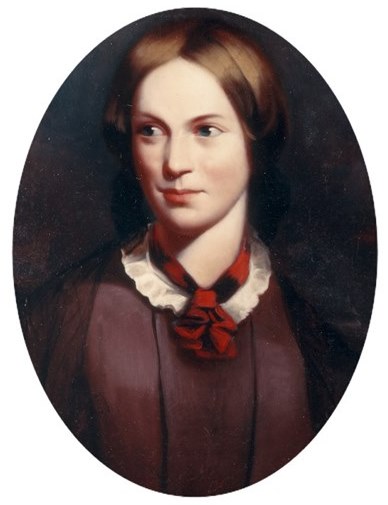
Portrait of Charlotte Bronte by J.H. Thompson, 1850s.

Portrait of Charlotte Brontë by J.H. Thompson, 1850s.{credit}© The Brontë Society{/credit}


I enter a room that is, in effect, a cabinet of curiosities. Glass-fronted cases reflecting shards of light are crammed with an odd array of objects — a pair of callipers, a Victorian stereoscope, wire-rimmed spectacles, daguerreotypes. A stuffed giraffe looms behind a desk. There is a faint savour of the natural history museum; the hint of a steampunk preoccupation with instrumentation. It seems an unlikely space for a meeting with one of English literature’s radical firebrands, but that is what this exhibition at Sir John Soane’s Museum London promises: an encounter with Charlotte Brontë.

Charlotte Brontë at the Soane marks the bicentenary of the novelist’s birth on 21 April. The exhibition — in nineteenth-century architect John Soane’s home, preserved as a museum — hinges on the Yorkshire novelist’s five trips to London between 1848 and 1853 to see her publisher George Smith. During these, the show’s curator Charlotte Cory told me, Brontë had several brushes with science — encounters with eminent specialists in physics and medicine, exposure to cutting-edge technologies. Yet this sharply observant writer left just a scatter of references to these experiences that leave us guessing in all sorts of ways.

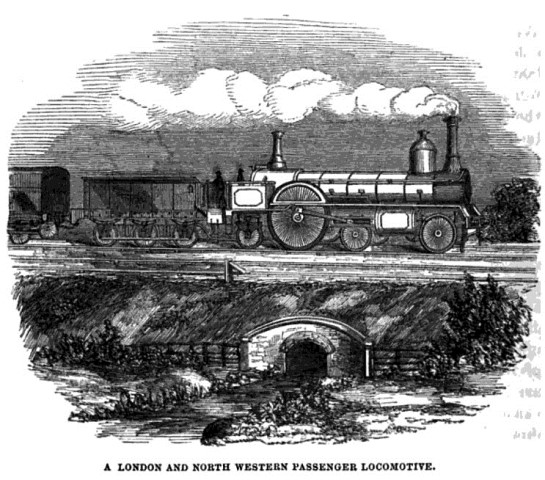
Bronte embraced travel on Britain's burgeoning rail system.

Bronte embraced travel on Britain’s burgeoning rail system.{credit}From Frederick S. Williams, Our Iron Roads, ca. 1852, via Wikimedia Commons{/credit}

Jane Eyre — pioneering ‘psychological’ novel, instant bestseller — had emerged in 1847 as the work of ‘Currer Bell’. The pseudonymous mask slipped the next year on Brontë’s first trip to the city, spurred by an impetuous decision to clear up a rumour that her novel and those of sisters Anne and Emily (‘Acton’ and ‘Ellis’) were all by the same author. Brontë’s need for speed led her to embrace one of the era’s great technological advances — rail travel. “The coming of the railways was absolutely key for her independence,” noted Cory, and Brontë’s letter about the trip hints at the thrill of how she and Anne walked to Keighley station from Haworth in a thunderstorm, “got to Leeds and whirled up by the Night train to London” in a matter of hours, where they revealed their identities to an astonished Smith.

Under Smith’s aegis, the shy provincial became an unwilling celebrity in the city she dubbed “Babylon”. She met (and was verbally mauled by) literary lion William Makepeace Thackeray, and visited social theorist Harriet Martineau. Beyond the salon, London pulsed with scientific, medical and industrial innovation: the Industrial Revolution was in full spate. The Great Exhibition of 1851, coinciding with Brontë’s fourth visit to the city, was vivid proof.

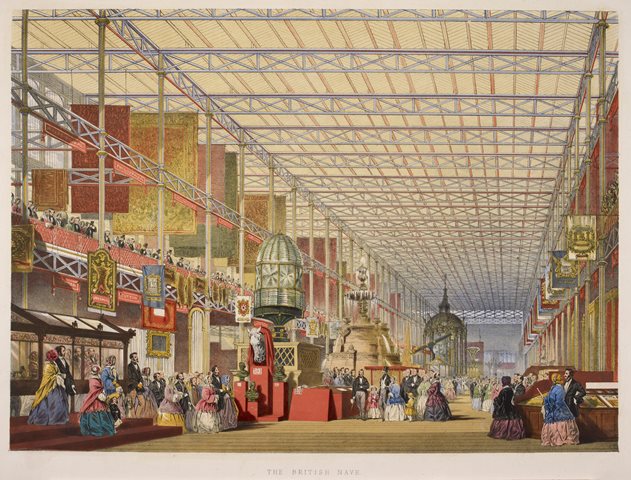
The 'British Nave' at the Great Exhibition, 1851.

The ‘British Nave’ at the Great Exhibition, 1851.{credit}From Dickinson’s Comprehensive Pictures of the Great Exhibition of 1851, from the originals painted for Prince Albert, by Messrs. Nash, Haghe and Roberts.{/credit}

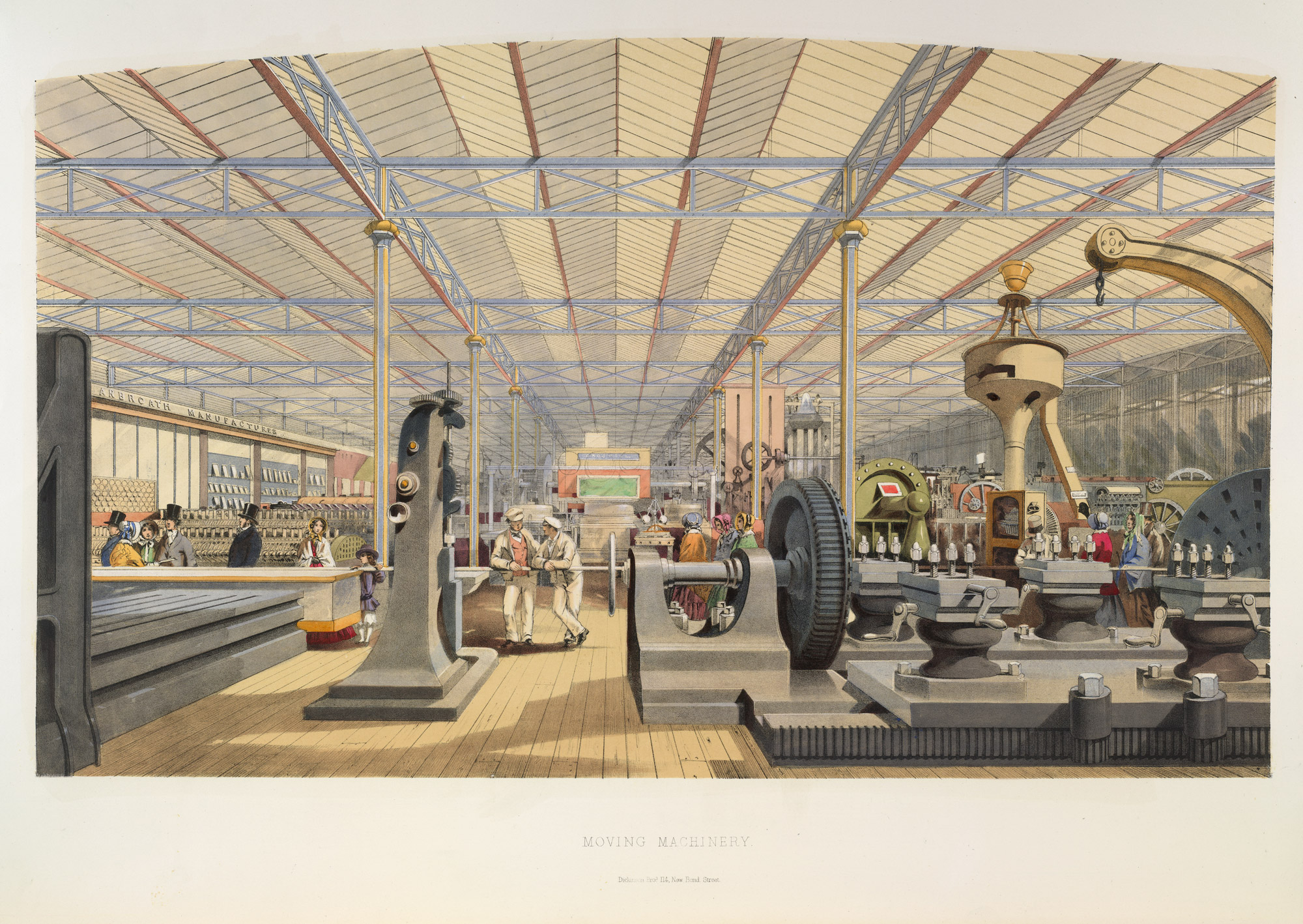
Housed in the vast glass-and-iron Crystal Palace at Hyde Park and masterminded by top technophile Prince Albert, it featured 100,000 objects, from hydraulic presses, steam hammers, barometers and electric telegraphs to velocipedes, microscopes, surgical instruments, ‘tangible’ ink for the visually impaired and kilometres of textiles.

The display of moving machinery at the Great Exhibition.

The display of moving machinery at the Great Exhibition.{credit}From Dickinson’s Comprehensive Pictures of the Great Exhibition of 1851, from the originals painted for Prince Albert, by Messrs. Nash, Haghe and Roberts{/credit}

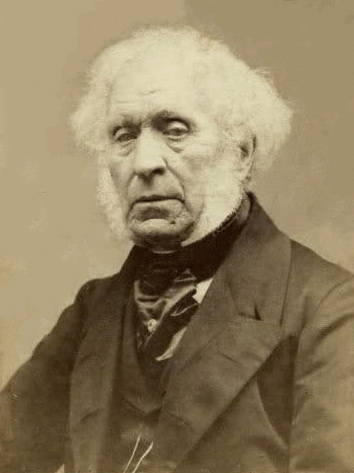
The 6 million visitors generated enough surplus funds to seed the Science Museum, Natural History Museum and design treasurehouse the Victoria and Albert Museum. This was a show not just for gawkers, but for anyone with an interest in scientific endeavour and invention. It drew in Charles Darwin; photographer, mathematician and author Lewis Carroll; and eminent physicist David Brewster who, Cory told me, squired Brontë on one of her visits.

Physicist and experimental-optics pioneer David Brewster in the 1850s.

Physicist and experimental-optics pioneer David Brewster in the 1850s.{credit}Wikimedia Commons{/credit}

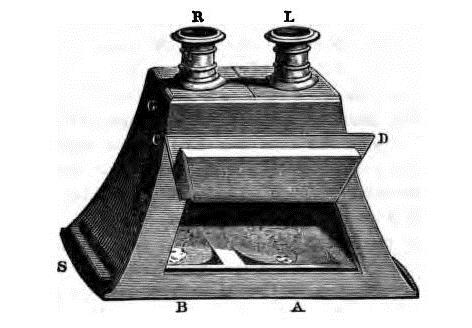
Brewster was a leading light in experimental optics. His advanced ‘lenticular’ stereoscope, replacing mirrors with prisms, is displayed at the Soane. He also explored polarised light, invented the kaleidoscope, and created a precursor of the Fresnel lens. Brewster and Brontë seem to have got along, as she noted in a letter to a friend:

Sir David Brewster came to take us to the Crystal Palace — I had rather dreaded this, for Sir David is a man of the profoundest science and I feared it would be impossible to understand his explanations of the mechanisms &c. indeed I hardly knew how to ask him questions — I was spared all trouble — without being questioned — he gave information in the kindest and simplest manner…

But in another letter about the exhibition, Brontë is more pungent:

… after all, its wonders appeal too exclusively to the eye, and rarely touch the heart or head. I make an exception to the last assertion, in favour of those who possess a large range of scientific knowledge. Once I went with Sir David Brewster, and perceived that he looked on objects with other eyes than mine.

The phrase “with other eyes” is provocative. Was Brewster gripped by technological aspects of the show that failed to dazzle Brontë? Interest is, after all, in the eye of the beholder, and an expert in the mechanics of light and vision might perceive the same object very differently from an artistic adept of the ‘inward eye’. Despite her poor vision (hence the spectacles at the Soane), Brontë had planned a career in art, but transmuted that visual and emotional precision into “deep, significant reality” on the page, as science writer George Henry Lewes wrote of Jane Eyre.

Brewster's lenticular stereoscope.

Brewster’s lenticular stereoscope.{credit}From Brewster’s The Stereoscope: Its History, Theory and Production, 1856{/credit}

About the objects of their gaze we can only theorise. Among the technologies on show was photography, and Brewster, who championed the calotype introduced by William Henry Fox Talbot, may well have steered Brontë towards a display. Yet here is another puzzle. At the time, every grandee from Queen Victoria to engineer Isambard Kingdom Brunel sought to be ‘shot’, but Brontë, as far as we know, was never photographed. Some suspect it was vanity, given Brontë biographer Elizabeth Gaskell’s unforgiving verbal snapshot: “reddish face; large mouth & many teeth gone; altogether plain”. I wonder, however, whether Brontë felt she had exposed enough of herself in her literary explorations of intuitive consciousness.

That fascination with internal realities extended to the medical. Brontë’s last novel Villette (1853) is permeated with references to illness, has a physician as a central character, and features a drug-fuelled walk through a nighttime carnival. The inspiration is clear. Anne, Emily and their substance-abusing brother Branwell had died from tuberculosis within nine months of each other several years before. Moreover, Brontë’s hypochondriac father Patrick, prey to contemporary fears of ‘nervous disorders’, obsessively read Thomas John Graham’s 1827 Modern Domestic Medicine, as Sally Shuttleworth shows in Charlotte Brontë and Victorian Psychology (1996). So Brontë’s portrayals of the pathological — from the fiery ‘madwoman’ Bertha in Jane Eyre to Villette’s frozen, tortured Lucy Snowe — are unsurprising. (Even Brontë’s descriptions of some of the animals she saw at London Zoo have a Bertha-esque feel, from a hyena emitting “a hideous peal of laughter” to a cobra with the “eyes and face of a fiend”).

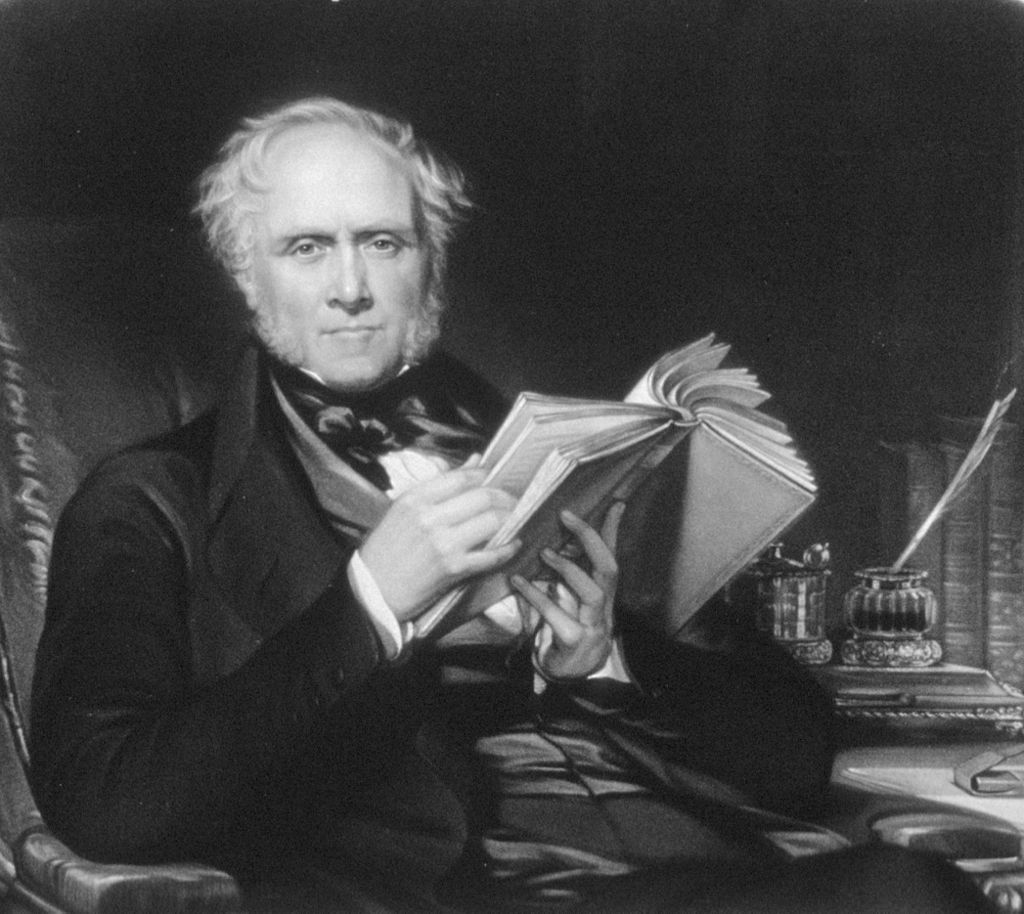
The physician John Forbes in 1852, by John Partridge (drawing).

The physician John Forbes in 1852, by John Partridge (drawing).{credit}US National Library of Medicine via Wikimedia Commons{/credit}

On her final trip to London in 1853 to check the proofs of Villette, Brontë sought to further probe extremes of human experience — “the real rather than the decorative side of Life”, as she saw it. She visited Newgate and Pentonville prisons and may have seen Bethlehem (Bedlam) Hospital with medical moderniser John Forbes, whom she had consulted years before about Anne’s health. George Smith related how in Newgate, Brontë responded compassionately to a prisoner who had allegedly killed her own child. But no letter from Brontë recording these visits has surfaced; and if she wrote none, it is an odd omission given her preoccupations, Cory noted.

Those preoccupations also led to a fascination with phrenology, the era’s pseudoscientific attempt to create a material theory of mind; the callipers in Cory’s show are the tool of the trade. On one London visit, Brontë had visited a practitioner anonymously with Smith to have her head ‘read’. The report is startling:

Temperament for the most part nervous… [The forehead] bears the stamp of deep thoughtfulness and comprehensive understanding. It is highly philosophical. It exhibits the presence of an intellect at once perspicacious and perspicuous…

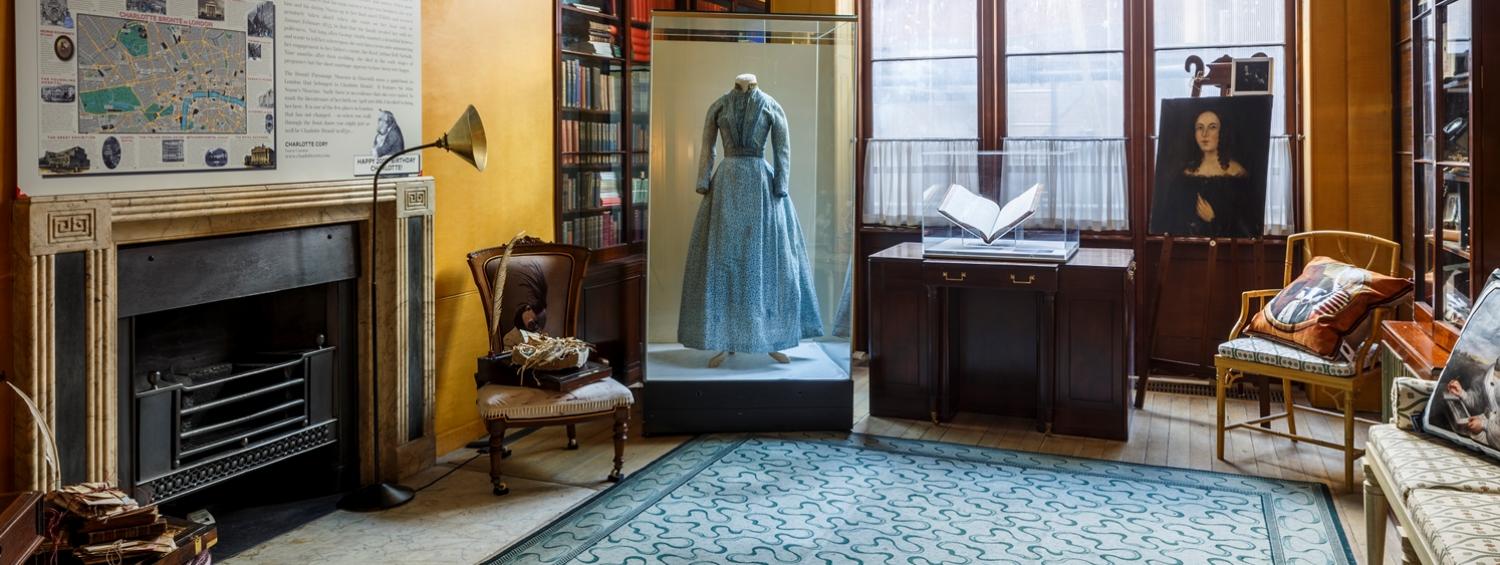
The exhibition, including the dress Bronte wore to a dinner given by Thackeray.

A view of the exhibition, showing the dress Bronte wore to a dinner given by Thackeray.{credit}Gareth Gardner/Sir John Soane’s Museum London{/credit}

Ultimately, like the exhibition (the author may never have visited the museum but, Cory declared, “ought to have”), we must speculate in trying to understand Brontë’s take on science. What did this brilliant but relatively unsystematic student of the mind, this writer preoccupied with interiority, think of the Victorian endeavour to unpeel the secrets of the Universe, from geological strata to ‘ghostly’ conundrums such as energy?

Says Shuttleworth: “She was a voracious reader of the periodicals of the time, which carried detailed accounts of new scientific and medical ideas and advances. In the pages of her novels one can track the language of the psychology of the era, transformed into a new mode of psychological presentation. Charlotte Brontë was a writer both of her time, and in advance of it.”

After Brontë’s death in 1855, the ‘invisible Universe’ of atoms and rays was gradually empirically revealed. That Brontë had trawled the unseen currents of the psyche and put her findings in books so revealing of human behaviour testifies to the power of another way of seeing.

Charlotte Brontë at the Soane is at Sir John Soane’s Museum London13 Lincoln’s Inn Fields, London, through 7 May.


For Nature’s full coverage of science in culture, visit www.nature.com/news/booksandarts.

A scintillating shortlist for the Royal Society prize

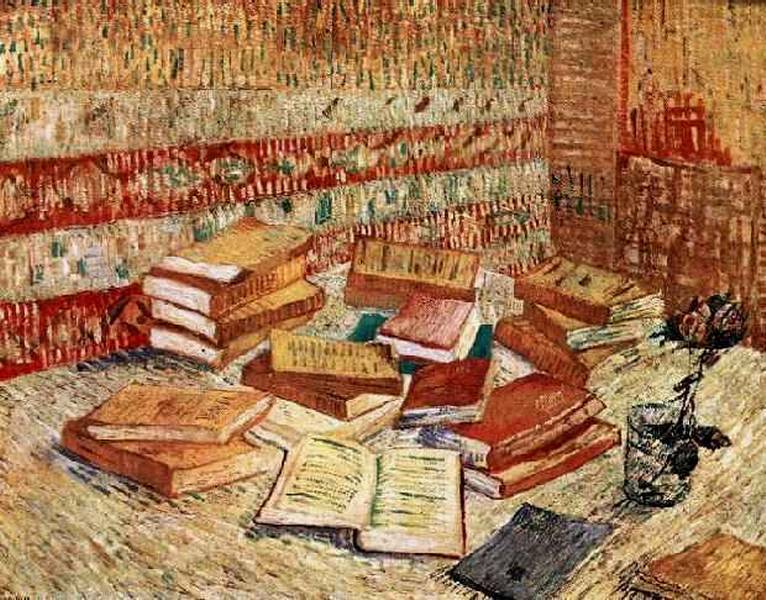
Libri_Vincent_van_Gogh

{credit}Still Life with French Novels and a Rose, Vincent Van Gogh (oil, 1887){/credit}

As the literati strive to predict the future of the book, one thing is clear in the here and now: the best of popular science writing is still all about clarity, rigour and brio. This year’s six-book shortlist for the Royal Society Winton Prize for Science Books bristles with that mix.

The Society’s annual prize, now worth £25,000, is awarded to the year’s “outstanding popular science books from around the world”. This half-dozen certainly delves into many worlds — the universe inside the skull, the cosmos of numbers, the subatomic, the gene, and the dynamic interplay between biology and quantum mechanics, and people and planet.

Meet the contenders (in alphabetical order of authors’ surnames).

The Man Who Couldn’t Stop by David Adam (Picador)

Seasoned science journalist (and Nature colleague) Adam’s searing study-cum-memoir, reviewed here, is a twin journey through his own knotted, traumatic experience of obsessive-compulsive disorder, and the evolving science surrounding it. A reflective eye on what Adam calls “our siege mentality”.

Alex Through the Looking-Glass: How Life Reflects Numbers and Numbers Reflect Life by Alex Bellos (Bloomsbury)

The erudite and engaging Bellos, a writer and speaker on mathematics, follows up his bestselling 2010 Alex’s Adventures in Numberland with this equally adroit interweaving of maths history, the peculiarities of day-to-day maths, and the mindscapes of mathematicians. (Why is 24 is better than 31 in the context of anti-dandruff shampoo? You’ll need to read the book.)

Smashing Physics: Inside the World’s Biggest Experiment by Jon Butterworth (Headline)

Butterworth, a particle physicist and CERN insider, here (writes my colleague Jo Baker) gives “a personal account of three years that shook his research field – from the switching on of the Large Hadron Collider at CERN in 2009 to the discovery of the Higgs boson in 2012. In a lucid treatment —  part memoir, part primer — he relates the ups, downs and minutiae of everyday life at the particle physics coalface and reflects on the public and political perceptions of science.”

Life’s Greatest Secret: The Story of the Race to Crack the Genetic Code by Matthew Cobb (Profile)
Zoologist Cobb masterfully recontextualises the 1953 discovery of the structure of DNA (reviewed here). One for the shelf bearing seminal early studies by James Watson and Horace Judson, Cobb’s treatment beautifully explicates the contributions of physics, biology and chemistry, and scientists from Oswald Avery to Rosalind Franklin.

Life on the Edge: The Coming of Age of Quantum Biology by Johnjoe Mcfadden and Jim Al-Khalili (Bantam Press)
Al-Khalili (a physicist) and McFadden (a molecular biologist) take on the vexed nexus of quantum weirdness and life itself in this exploration of an emergent field of scientific endeavour (reviewed here). From synthbio to quantum tunnelling inside enzymes, a trip into strange, and strangely compelling, realms of research.

Adventures in the Anthropocene: A Journey to the Heart of the Planet we Made by Gaia Vince (Chatto & Windus)
Writer, broadcaster and former Nature news editor Vince covered six continents over two years to craft this compilation (reviewed here). Bucking the trend to view the environmental challenges of the Anthropocene with terrified or jaundiced eye, she discovered innovators and pioneers working towards new models of adaptation and environmental ‘reverse engineering’. A grand survey of development endeavour through a science writer’s lens.

In looking through this list, it occurred to me anew how popular science writing remains one of the great exemplars of multidisciplinarity. It is the context to the findings — the history, the socioeconomic realities, the psychology of the players and their rivals, the leadup to discovery and the societal implications of its deployment — that reveals the real-world significance of the science.

Scientific storytelling is one of the great artforms of our age. Its roots may stretch back to Mary Somerville’s monumental On the Connexion of the Physical Sciences 181 years ago (reviewed here), but its heyday is now.

The judges of this year’s prize include chair Ian Stewart (mathematician and Royal Society Fellow), Guardian books editor Claire Armitstead, Channel 4 lead anchor Krishnan Guru-Murthy, electronics engineer Jo Shien Ng, science broadcaster and author Adam Rutherford, and novelist Sarah Waters. The winner will be announced at a Royal Society public event on 24 September, hosted by Brian Cox, Royal Society Professor for Public Engagement in Science.


For Nature’s full coverage of science in culture, visit www.nature.com/news/booksandarts.