Rare diseases and precision medicine on film

Posted on behalf of Brendan Maher

Bea Rienhoff with US President Barack Obama.

Bea Rienhoff with US President Barack Obama. {credit}Hugh Rienhoff{/credit}

When US President Barack Obama introduced his $215 million precision medicine initiative early this month, he showcased his politician’s penchant for sharing the inspiring personal stories of extraordinary citizens. One story that might be familiar to Nature readers was that of Hugh Rienhoff and his daughter Beatrice.

Now two documentary film makers, Allen Moore and Kori Feener, are raising funds via Kickstarter to tell Bea’s story — of “a violin-playing, theatre-performing tomboy with a disease so rare, no one else in the world has it” (see below). (For what it’s worth, Hugh prefers to call what Bea has a “condition” because he does not want her to feel limited by the negative connotation of the word “disease”). Feener adds, “We also want to focus on family advocacy.”

The funding drive finishes, fittingly, on International Rare Disease Day — 28 February.

Hugh, a trained clinical geneticist, embarked on a quest to identify the genetic cause of a puzzling array of symptoms affecting Bea, such as fingers and toes that won’t uncurl all the way and an inability to put on much muscle mass. After reading, consulting, cloning Bea’s genes in his basement and enlisting the help of a major genome sequencing firm, Hugh eventually identified the cause: a mutation in the gene that encodes transforming growth factor-β3 (TGF- β3), one of a family of signalling proteins involved in development and cell differentiation. He has since been working with a group of researchers to study Bea’s version of the gene in mice (Bea has one named Almond Joy in her bedroom), and he has been collecting examples of other people who share similar genetic variants. His hope is to best understand what lies in store for his daughter as she grows older. It is a profound example of what a parent might be able to do given the right tools, support and knowhow.

https://vimeo.com/115936139

Such stories have undeniable power. And resonance: much of Hugh’s diagnostic odyssey is familiar to parents who have bounced from doctor to doctor hoping to hear something other than “We just don’t know”.  Nicole Boice, inspired by these experiences, founded a rare-disease advocacy organization called Global Genes in Aliso Viejo, California, in 2008. “That sense of isolation is very common: the impact on the family on finances, dealing with insurance and finding someone who cares about this from a scientific perspective.”

Sharing the insights

Global Genes has a useful collection of documentaries and dramas recounting similar stories. It includes what many consider the prototype: Lorenzo’s Oil, George Miller’s 1992 film about Augusto and Michaela Odone’s quest to find a treatment for their son’s adrenoleukodystrophy, a fatty acid storage disorder that affects the nervous system. Tom Vaughan’s 2010 drama Extraordinary Measures tells the story of John and Aileen Crowley, who quit their jobs to found a biotech company in order to find a cure for the neuromuscular condition Pompe’s disease, which affects their two children. It’s inspiring — and fun, starring Harrison Ford as a brilliant but acerbic scientist. (Think Han Solo with a pipettor.)

The list also features recent documentaries showing how families and patients affected by rare diseases such as progeria, a rare disorder with symptoms that resemble accelerated aging (Life According to Sam), and the lysosomal storage disease Neiman-Pick Type C (Here.Us.Now.), are becoming more empowered, engaging with the science and taking their future into their hands.

International Rare Disease Day is a moment to raise awareness of under-the-radar conditions that don’t have huge support groups, research associations or lobbying arms. The White House initiative is slated to use genome sequencing on a cohort of 1 million Americans to further assess its value in delivering the right treatments, and it may ultimately enhance that awareness.

Although in Hugh’s eyes Bea will always be one of a kind, he knows there are others like her. Scientists have already uncovered at least three other individuals with mutations in the same gene, and they may help to provide guidance in keeping Bea healthy. “The truth of the matter is, there’s going to be a whole category of people: onesies and twosies and threesies of the genetics world. And that number of people will only grow.”


For Nature’s full coverage of science in culture, visit www.nature.com/news/booksandarts.


A book that changed my mind: The First Three Minutes

Posted on behalf of Ann Finkbeiner

Science writer Ann Finkbeiner

Science writer Ann Finkbeiner.

The young me thought science was something you did if you didn’t have the imagination to be an artist. I wanted to write fiction. But somehow I didn’t: I didn’t have any stories I thought were worth writing. The first clue about what might be wrong with me came when I read Steven Weinberg’s 1977 The First Three Minutes.

It’s about the beginnings of the Universe. I remember the beautiful storyline that started with the infant Universe expanding, hotter than hot, with matter and light as aspects of one thing, all forces being one force; and then ticked on through expansion’s consequences, the slow cooling, matter separating from light, and the four forces falling out of equilbrium, one by one. I’d never read a story that had such precision and inevitability, the logic like tipping dominoes. Does science have more stories like that? I thought. Had I been wrong about science all along?

It certainly does and I had. For instance: quantum theory, created step by painstaking step to explain the Universe’s most elementary and surest foundation, ended up with each step instead building to a cosmos built on fundamental uncertainty. Another instance: the tectonic plates, the continents and ocean floor, move laterally along the Earth’s surface. Until, that is, they reach the edge of the convection cell that cools and falls, and they fall with it, back into the mantle to warm, melt and rise again.

Science turns out to have the storylines every bit as compelling as those in myths and classical Greek plays. Those stories are worth writing, I thought, and maybe if I learned about science, I could write them; so I did, and I’ve been doing it ever since. But I didn’t remember until I recently looked at Weinberg’s book again that he was not just telling a good story. He was also explaining how and why to be a science writer.

 Here are three lovely examples. 

1.  “I cannot deny a feeling of unreality in writing about the first three minutes as if we really know what we’re talking about.”  

Other physicists/astrophysicists in this field, cosmology, say the same thing, and it’s more complicated than it sounds. The basis of the field is physics, about as non-waffly as science can be. But the subject is all-but-unobservable, or observable only indirectly and with large error bars. The message for the science writer is, the Universe operates on physics so you can believe these physicists know what they’re talking about. But believe what they say the way they believe it: not permanently, only for now and knowing it’ll change. 

2.  “I picture the reader as a smart old attorney who does not speak my language but who expects nonetheless to hear some convincing arguments before he makes up his mind.”  

All professions have their own jargon – journalism’s is especially annoying – but jargon is just a shortcut for the ideas. Write the ideas without the jargon and with a clear argument, Weinberg says, because the science writer’s audience is, whatever its education, fully capable of understanding the science and – importantly in a democracy – of making up its own mind. 

3. “The more the universe seems comprehensible, the more it also seems pointless.”  

That sentence is famous. In his 1990 Origins, science writer Alan Lightman asked cosmologists about it. Some said they didn’t see the need for the Universe to have a point. Some said what Weinberg went on to say: that scientists build instruments of detection and analysis, observe and experiment, create theories, all in hopes of comprehending the Universe because the Universe is beautiful and the comprehension itself has meaning. “The effort to understand the universe is one of the very few things that lifts human life a little above the level of farce,” Weinberg writes, “and gives it some of the grace of tragedy.” As a science writer I can’t help but feel a part of that. And what better story could you ask for? 

Steven Weinberg, The First Three Minutes: A Modern View of the Origin of the Universe. New York: Basic Books, Inc., 1977.

Ann Finkbeiner is a science writer based in Baltimore, Maryland, specializing primarily in physics. Her books include The Jasons (2006) and A Grand and Bold Thing (2010). Her blog is The Last Word on Nothing https://www.lastwordonnothing.com. 


For Nature’s full coverage of science in culture, visit
www.nature.com/news/booksandarts.



Wellcome changes: a trip round the Reading Room

The Reading Room at London's Wellcome Collection.

The Reading Room at London’s Wellcome Collection.{credit}Wellcome Collection{/credit}

It’s a rare room where one raking glance can take in a columnar dress in scarlet fake-fur, a 1920s ‘dental station’ and a tot partly sculpted from synthetic milk powder. But such is the new Reading Room at London’s Wellcome Collection, part of biomedical research funding giant the Wellcome Trust’s £17.5 million refit, and now open to the public.

“We see it as a creative bridge between the library and collection,” says senior media officer Tim Morley, “a kind of ‘This way here’ sign for the library, with a taste of  our public programmes.”

Henry Wellcome in 1885.

Henry Wellcome in 1885.{credit}Wellcome Collection{/credit}

An asymmetrical spiral staircase connects the airy room with other floors. Ten niches — themed Alchemy, Body, Breath, Face, Faith, Food, Lives, Mind, Pain and Travel — offer space to study some of the 1,000 books on offer, draw or play boardgames. In the communal middle, a digital autopsy station dares you to (virtually) unpeel the wrappings of several mummies. The seating and floor cushions are upholstered in pale green and red fabric with a fetching mid-century modern design from the Festival of Britain, based on insulin’s crystalline structure.

“People can delve deeper into the collection’s themes here, and really explore,” notes assistant media officer Holly Story. “There’s a playful element, and they can draw their own threads through and make their own links.”

The vast trove of scientific, cultural and medical objects amassed by Wisconsin-born pharmacologist-entrepreneur Henry Wellcome (1853-1936) and his successors range from the exquisite to the grotesque. Predictably, the 100 that made the cut are rich and strange indeed.

That blood-hued gown, a 2014 copy of the 1997 original by British designer Helen Storey and her embryologist sister Kate, depicts the closing of a neural tube in early embryonic development.  A scatter of charms and amulets (many from Oxford’s anthropological goldmine, the Pitt Rivers Museum) include dried moles’ feet, once thought to guard against toothache. A silver-plated “bronchitis kettle”, a facsimile of the fifteenth-century Alchemical Processes and Receipts, an anatomical wax moulange showing acne of the hand — it’s the classic embarrassment of riches.

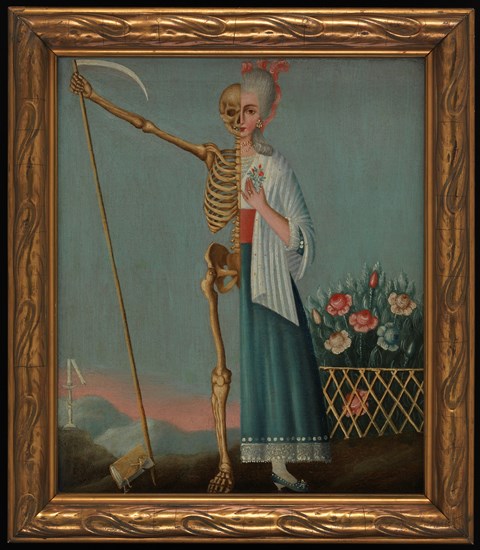
Life and Death (artist and date unknown).

Life and Death (artist and date unknown){credit}Wellcome Library{/credit}

As I contemplate this shining window-lined space with its phalanx of pendant lamps, I wonder how its design will drive use, and how the curatorial mix will enhance understanding of the ‘human wilderness’. Do luxe seating and designer lighting sit oddly with an invitation to don a straitjacket and contemplate anonymous paintings of flayed bodies?

But it’s precisely that tension between comfort and that zone beyond it that makes this space potent. As I leave, I gaze enchanted at a small vanitas oil on canvas. The eighteenth-century figure in the frame — half pompadoured woman, half skeleton — is an emblem of human mortality and a check to vanity. Yet there is something here of the very modern Frida Kahlo, whose self-portraits can be like dissections baring both her own medical trauma and the precarious human condition. Pure Wellcome — finding the universals under the skin.  

The Reading Room is part of Wellcome Collection at 183 Euston Road, London NW1 2BE (www.wellcomecollection.org). Wellcome show The Institute of Sexology runs through September; listen here to Geoff Marsh’s Nature Podcast Extra interview with co-curator Honor Beddard. 


For Nature’s full coverage of science in culture, visit www.nature.com/news/booksandarts.
Biophilia in the Anthropocene

Conservation scientist M. Sanjayan on the African plains.

Conservation scientist M. Sanjayan on the African plains.{credit}Passion Planet{/credit}

Are we all feeling a bit epochal? The Anthropocene — the brave new era of pervasive human impact on Earth systems — is due for scientific acceptance (or not) in 2016. Meanwhile, it is proving fertile ground for pop-sci, from Diane Ackerman’s The Human Age to Gaia Vince’s Adventures in the Anthropocene (reviewed here and here). Now the notion has floated far enough along the mainstream to reach TV with the five-part PBS series Earth: A New Wild, kicking off tonight.

The focus here is that rich, fraught edge environment where wild animals and humanity commingle or collide. M. Sanjayan presents. An ecologist who spent part of his childhood in Sierra Leone, he offers both scientific chops and an understanding of rural realities in developing countries.

Not least, the series shows development policy schemes in action — such as payments for ecosystem services, which enable poor communities in wilderness regions to steward the land and keep it wild. The programme is unusual in mixing such development paradigms with anthropocenic touches such as a lament for the catastrophically drained Aral Sea, or an industrial architect’s plans to reintroduce oysters round Manhattan.

Sanjayan is no magisterial David Attenborough. Yet he is engaged, sometimes eloquent — and endearingly thrilled, whether he’s gazing at infant giant pandas in a Chinese rewilding facility, or getting stuck in a metre of mud tracking tigers in Bangladesh.

With his crew, he racked up 45 shoots in 29 countries for the series — from Malawi to Mexico, Brazil and the United States, looking in turn at forests, encroached habitats, oceans, plains and freshwater. The gorgeous footage includes some from thermal cameras, which transform lions hunting at night in Africa’s Rift Valley into ghosts on the prowl.

Cherrypicked, not sanitised

While cherrypicked, Sanjayan’s encounters are not sanitised. In the forests of Ecuador’s biodiversity hotspot the Intangible Zone he meets a group of indigenous Waorani, whose knowledge of the Amazonian environment is encyclopaedic. Their shaman matter-of-factly relates how he and other members of the community killed several oil prospectors. Such scenes are interspersed with shots of wild boar tiptoeing to a waterhole and parrots nibbling nutrient-rich mud.

The Samburu of northern Kenya dig wells used by both wildlife and their herds.

The Samburu of northern Kenya dig wells used by both their herds, and wildlife.{credit}Courtesy of Ami Vitale{/credit}

The scattered communities of Waorani may not reflect the Amazon’s past. Sanjayan points to geometric earthworks in forest clearings, some dating to 2,000 years ago and so vast and numerous that they suggest a human population as high as 60,000. Terra preta soils left by ancient peoples, engineered from biochar and human waste, have left 10% of the Amazon highly fertile, indicating how such hordes might have subsisted.

The concept of Earth as sustainable smorgasbord is thematic. The ocean-forest ecosystem of Canada’s Great Bear Rainforest, where 5 million acres are off limits to logging, is a goldmine for wolves, salmon, bears, eagles and humans — all thanks to the great Pacific herring run. The fish leave billions of fertilised eggs washed up on the coasts, a pearly caviar relished by wildlife and harvested sustainably by the Heiltsuk, a First Nation people who sink pine trees into the water to snag the eggs. The forest is fed in turn when salmon eat the herring and swim up the creeks; half-eaten by bears, their remains rot down to fertilise the soil.

Such ‘ecosystem services’ are not all passive. Many plains species, Sanjayan shows, are active farmers. Zimbabwean biologist Alan Savory led a cull of over 40,000 elephants decades ago to regenerate the land. When the measure failed, Savory did a U-turn, and now posits that even larger herds are needed. Elephants, he notes, efficiently aerate, fertilise and seed the earth; the trick is keeping them tightly bunched and on the move via humans or predators.

Montana rancher Bryan Ulring, who has regenerated his acreage by changing his cattle's behaviour.

Montana rancher Bryan Ulring, who has regenerated his land by changing his cattle’s behaviour.{credit}Ami Vitale/The Nature Conservancy{/credit}

Like mobile ploughs and fertilising machines in one, the packed animals stir up the earth and deposit dung and urine, patch by patch. Testing the theory with cattle, Savory shows how grasses and even waterholes on his land have recovered. Thousands of kilometres away in Montana near Yellowstone National Park, rancher Bryan Ulring is successfully replicating the method, inspired by the harrying power of rewilded wolves. With the land regreened, rare birds such as the sage grouse are returning.

Such empirical evidence saves the series from becoming yet more ethological or anthropological eye candy, although quibbles remain — such as too much footage of baby pandas. However, in the growing body of popular science on the Anthropocene, Earth: A New Wild is a welcome fusion of conservation and development that reinserts the human into Eden. It gives the extraordinary people who live alongside iconic animals their due.

Take the man in the Sundarbans whose father was killed by a tiger. However grief-stricken, he makes his living in the mangroves and understands the tiger’s place in them: the forests would not exist without their ‘ecology of fear’. Nature is never complacent. We might learn that lesson from it.

Earth: A New Wild is produced by National Geographic Studios in association with Passion Planet, and directed by Nicholas Brown.


For Nature’s full coverage of science in culture, visit www.nature.com/news/booksandarts.
Carl Djerassi, 1923-2015

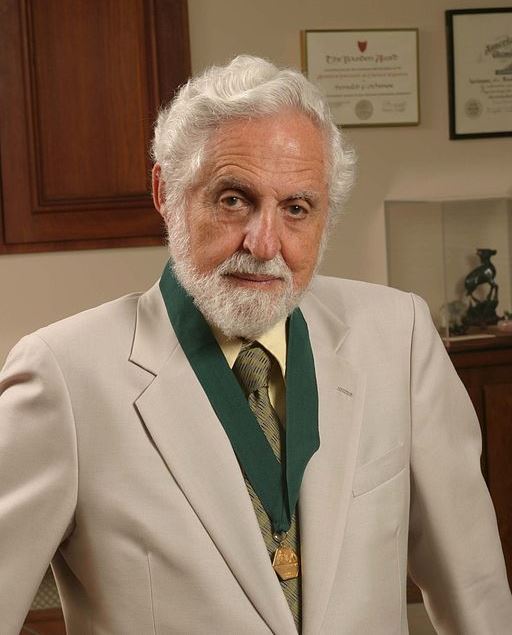
Carl Djerassi in 2004 with the American Institute of Chemists gold medal

Carl Djerassi in 2004 with the American Institute of Chemists gold medal{credit}Chemical Heritage Foundation{/credit}

Posted on behalf of Sara Abdulla 

Carl Djerassi — ‘father of the Pill’, novelist and playwright — who died last week aged 91, made more appearances in Nature’s Books and Arts pages than most epoch-making organic chemists.

Just three months ago, Alison Abbott reviewed the second volume of Djerassi’s autobiography, In Retrospect, a journey through his testy relationships and cultural experiments. She wrote, “Djerassi’s multifaceted life has been intense, high-octane and successful. The vigour of his prose suggests how much he has enjoyed it.”

Over the years, the section reviewed his plays and novels as they emerged. Of Oxygen, Djerassi’s didactic theatrical treatment of the priority scuffles over the discovery of the gas, Philip Ball noted that “it shows how little the squabblings of Priestley, Scheele and Lavoisier matter for chemistry today, and how arbitrary is any final attribution”. Jack Cohen gave a wry appraisal of Menachem’s Seed, Djerassi’s third piece of ‘science-in-fiction’, set among reproductive biologists. His fourth, NO, continued the science-of-sex theme, as well as the pedagogical approach.

By way of a few plugs for his first and best-remembered work of fiction, Cantor’s Dilemma, Djerassi even hymned a ‘lab-lit’ favourite of his own in Nature’s pages, commending The Struggles of Albert Woods, a chemistry novel by William Cooper. It is in this piece that we find his credo: “I felt that a clansman can best describe a scientist’s tribal culture and idiosyncratic behaviour”.


For Nature’s full coverage of science in culture, visit www.nature.com/news/booksandarts.