Lust and the Turing test

Posted on behalf of Christof Koch

ex-machina-poster

{credit}@ 2015 Universal Pictures{/credit}

By and large, we watch movies to be entertained, not to be provoked into deep thought. Occasionally, a film does both. This year’s Ex Machina is one such gem. It prompted me to reflect upon the evolution of the idea of machine sentience over the past three decades of science fiction on film.

I am a long-time student of the mind-body problem — how consciousness arises from the brain. There is a conundrum at the heart of this ancient dilemma, challenging both brain science and AI; and it is well captured by Ex Machina and two other SF movies. In essence, it lies in how we can ever be certain that a machine feels anything, is conscious.

Consider Ridley Scott’s dystopian classic Blade Runner (1982). The morally ambiguous ex-cop Rick Deckard (played by Harrison Ford) is tasked with “retiring” four replicants, bioengineered androids that escaped from an off-world colony and are hiding in a dark and oppressive Los Angeles of the near future. After killing three, Deckard is saved from a lethal fall by the last, Roy Batty (Rutger Hauer). As Batty’s life runs out (his model of android lasts just four years), he delivers his justly famous death soliloquy:

I’ve seen things you people wouldn’t believe. Attack ships on fire off the shoulder of Orion. I watched c­-beams glitter in the dark near the Tannhäuser Gate. All those moments will be lost in time … like tears in rain…. Time to die.

These words speak to the clarity and poignancy of Batty’s memories — whether real or synthetic, lived or implanted.

Deckard’s final act is a recognition of these creatures’ essential human-like nature: he leaves his life behind and flees with Rachael, a more advanced replicant who believes herself to be human. Deckard crosses a line, at least implicitly endorsing the belief that replicants have feelings of regret, of pity, possibly even of love. (The question of whether Deckard is himself a replicant remains one of the more tantalizing in movie history.)

Tried and tested

In that sense, Batty, Rachael and their companions pass the Turing test. Introduced by the mathematician Alan Turing in 1950 to answer the question “Can machines think?”, it replaces this metaphysically loaded query with a pragmatic imitation game. If an agent can’t be distinguished from a human being, the agent passes the test.

The Turing test remains alive and well in philosophy of mind and in the annual competition for the $25,000 Hugh Loebner prize — albeit less so in university computer science departments.

Blade Runner

{credit}Warner Brothers{/credit}

Consider a version of the test focused on the question “Can a machine be conscious?” That is, does it feel like something to be this artifact? My washing machine has no feelings, but an android might well have – such as pity over the impending death of a human pursuer or pride in its own accomplishments. How would we know?

How do we know that anybody else but us is conscious? By interacting with them — asking them, “Tell me about your feelings.” Variants of this are used with non-linguistic competent individuals, whether aphasic patients, infants, or monkeys or other animals.

So, if what a machine tells us sounds plausibly human, we may act as if it too were sentient. Going by Deckard’s action in saving his beloved from doom, Rachael has passed the Turing test.

Fast forward to the 2013 romantic SF comedy Her, directed by Spike Jonze. In it, the anodyne writer Theodore Twombly (Joaquin Phoenix) downloads a new applet, Samantha — essentially an advanced version of iPhone’s Siri. It is a plausible storyline for our digitized age: a lonely guy speaks incessantly to his smartphone, who answers in a seductive voice and knows everything about him, his emails, his likes and dislikes, even his dating history. They joke, have intimate discussions; he takes her everywhere. Samantha is the last thing he speaks to before he goes to sleep and the first upon awakening.

Her eschews any significant discussion of the extent to which a computer program can have conscious feelings. Twombly doesn’t worry about such philosophical speculations; he behaves like any lover. Indeed, his passion for Samantha, who ‘lives’ in the cloud, cools after she confesses that she is simultaneously interacting with 8,316 other customers and is in love with 641 of them.

All about Ava

Enter Ex Machina, directed by Alex Garland. This intelligent and thoughtful mix of psycho-drama and SF thriller centers on a strange ménage à trois. Ava is a beauty with a difference (a phenomenal performance by Alicia Vikander); Caleb is a nerdy young programmer (Domhnall Gleeson); Nathan is a beastly, brilliant inventor and immensely rich tech-entrepreneur (Oscar Isaac).

Caleb is selected by Nathan, a recluse, to spend a week at his live-in Arctic laboratory. He introduces Caleb to Ava, an advanced cyborg whose semi-transparent skull and body reveal inner workings, including a brain that is quasi-organic in some unspecified way. It’s a twist on Blade Runner: if Caleb interacts with Ava as he would with an alluring woman – while seeing clearly that she is not flesh and blood – that would testify to Ava’s ability to convince him she has real feelings. Ava and Caleb hit it off at first sight.

Unlike Her, Ex Machina soon becomes a game of smoke and mirrors.  Ava hints to Caleb that she doubts Nathan’s purely scientific motives; there are bizarre scenes such as Nathan doing a synchronized dance routine with a mute servant. Nathan’s lab becomes Bluebeard’s Castle, complete with locked rooms and heavy psychosexual undertones. Ex Machina’s ending, invoking the trope of the femme fatale, is logical, surprising and darker than Blade Runner’s.

All three films showcase how the psychology of desire can be exploited to forge a powerful empathic response in their protagonists, sweeping away doubts about the object of their longing having sentience. It’s a Turing test based on lust, each movie an excursion into human social psychology and the attendant gender power politics. Unfortunately, the movies don’t inform us whether or not Rachael, Samantha and Ava are conscious or not. Simply that the men in these movies behave as if they were.

Leaving all that aside, I have little doubt about the essential scientific veracity of these movies. Within this century, we will create artifacts that will behave to all intents and purposes as if they too shared the gift of conscious experience with us. They will pass the Turing test. Blessing or curse? Only time will tell.

Christof Koch is chief scientific officer of the Allen Institute for Brain Science in Seattle, Washingon.


For Nature’s Insight page on machine intelligence, see here. For Nature’s full coverage of science in culture, visit www.nature.com/news/booksandarts.


Science guns the engine

A Harley-Davidson.

A Harley-Davidson.{credit}Hartmann Linge, Wikimedia Commons.{/credit}

What is it about scientists and motorcycles? Is the idea of caning it helmet-free down the highway an antidote to the close analysis and hunched precision of the lab? Does the love of Harley-Davidsons on an open road somehow spring out of the exploratory dynamism of the scientific enterprise? Or is the boffin-bike nexus just down to the deep groove Easy Rider cut in our collective psyche?

It was Tim Radford’s stirring review of neuroscientist Oliver Sacks’s On the Move that kickstarted my thinking about the connection. In it, Sacks recounts his youthful immersion in 1960s America, notably the revved-up cultures of the East and West coasts. Here he took to motorcycles (and musclebuilding), as the cover photo of a young Sacks on a BMW in Greenwich Village — looking somehow both vulnerable and physically at ease — neatly reveals.

Sacks was then already a veteran of the road, and multiple biking accidents. As he tells in On the Move, he motored through several models as a London teenager — a BSA Bantam, a 250cc Norton, and finally a 600cc Norton Dominator. On this he managed both to ‘do the ton’ (hit 100 mph) and zip to Stratford-on-Avon to see the latest Shakespeare play. That restlessness, he notes, has also propelled him through his phenomenal career.

Francis Collins of the NIH on his Harley.

Francis Collins of the NIH on his Harley.{credit}K. Wolf/Nature{/credit}

So perhaps the link between driven scientist and big bike isn’t so hard to parse. Certainly, two eminent geneticists — Francis Collins, US National Institutes of Health director, and Paul Nurse, Royal Society president and Francis Crick Institute director — are devotees. (Collins’s is a Harley-Davidson Road King Classic, while Nurse famously bought a bigger Kawasaki when he won the 2001 Nobel Prize for Medicine or Physiology.) Experimental physicist Charles Falco owns over a dozen (and co-curated the New York Guggenheim’s blockbuster 1998 show,  The Art of the Motorcycle). And IBM’s lead architect for cloud solutions, Lysa Banks, is no stranger to sprockets and kickstands.

Aside from such exalted hobbyists, there are scientists who gun the engines on work time. Giovanni  Savino of Australia’s Monash University , for instance, has devoted his career to studying the physics of motorcycles. His unique interactive physics lab in Bologna’s historic Ducati motorcycle factory, Fisica in Moto, allows local high-school students to see physical principles in action.

Bikes have even infiltrated community healthcare. In April 2013, Nature reporter Ewen Callaway joined and filmed epidemiologists in northern Nigeria working on polio eradication under a programme run by the Nigerian government and the US Centers for Disease Control and Prevention.

One of the dirt bikes used by a polio-eradication team in northern Nigeria.

One of the dirt bikes used by a polio-eradication team in northern Nigeria.{credit}Ewen Callaway{/credit}

Using off-road motorbikes on the rough terrain, the team search for nomadic Fulani communities and check whether the children are vaccinated — mapping tens of thousands of settlements as they go.

Whether for escape or discovery — or both — the nexus of road and motorcycle seems to inhabit a key niche in scientists’ mental ecology. In a world where many opt for a desk toy or a run to spur original thinking, straddling a bike might look a little extreme. But as Sacks has wonderfully shown, it suits the supercharged mind.

Sample Nature Podcast’s Oliver Sacks special here.


For Nature’s full coverage of science in culture, visit www.nature.com/news/booksandarts.

More bang for your book

Posted on behalf of Daniel Cressey

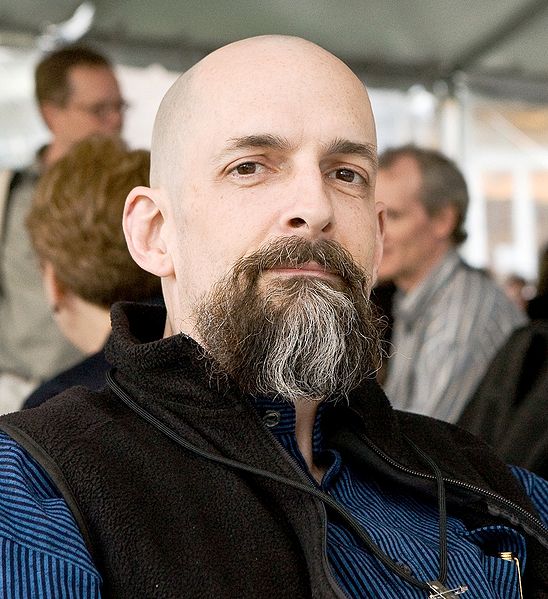
Neal Stephenson at the xxx convention, 2008.

Neal Stephenson at the Science Foo Camp, 2008.{credit}Bob Lee, cropped by Beyond My Ken{/credit}

Sci-fi writer Neal Stephenson has a rare gift for building page-turning novels out of unlikely scientific subject matter.

 The hero of Zodiac, an early work, is an environmental activist taking on a huge chemical corporation – perhaps trite today, but on point in 1988, when it was published. The Baroque Cycle trilogy, published in the early 2000s, dresses up the scientific revolution of Isaac Newton’s day as a knowing romp with echoes of Alexandre Dumas’s Three Musketeers: it manages to be both an excellent action movie and a good fictionalised history-of-science primer. Anathem (2008)  is a strange futuristic meditation on the dangers of ivory towerism and the assumption that knowledge can be divorced from its application, with a cross-country adventure, a giant train and a space battle thrown in.

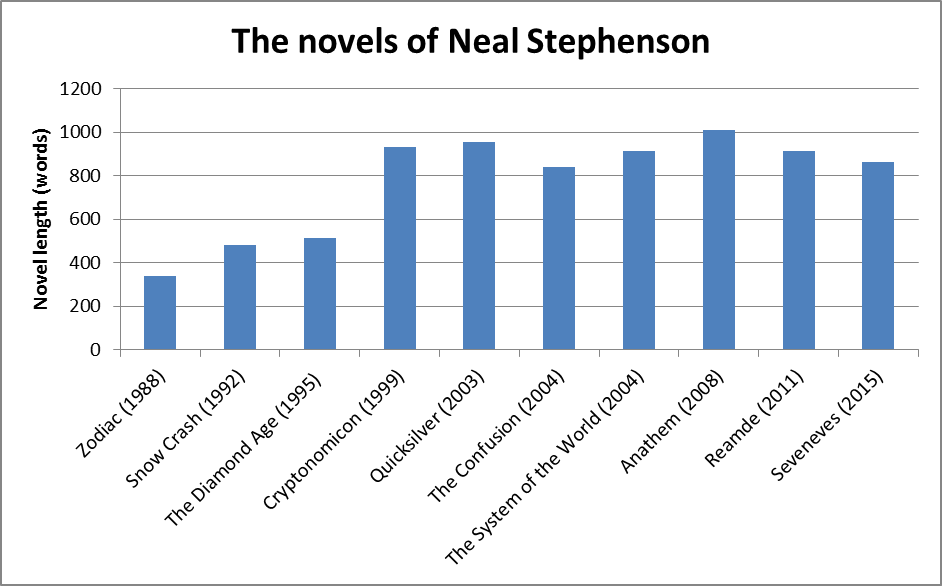
 But Stephenson’s latest book, Seveneves, reviewed by John Gilbey in this week’s issue, hinges on more conventional sci-fi subject matter. It follows an assortment of people selected to try to survive the total destruction of all life on Earth. (Wrist-wreckingly massive, it is by no means the longest Stephenson novel, as the chart below reveals.)

 New Picture.jpg

This “tale of straight-up global disaster”, Stephenson explains in the acknowledgements, is “an opportunity to showcase many of the more positive ideas that have emerged, over the last century, from the global community of people interested in space exploration”. Many of the “big hardware ideas”— which Stephenson noted in a Q&A as dear to his heart —   will be familiar to sci-fi fans, he admits.

Stephenson acknowledges that the premise stems from his time, around 2006, working for Blue Origin, the private spaceflight company owned by Amazon.com founder Jeff Bezos. (One major character in Seveneves is clearly inspired by Bezos, with perhaps a dash of Elon Musk.)

Stephenson has had a lot of irons in the fire recently. Along with this book, he was involved in an aborted attempt to make a realistic swordfighting video game, an innovation-fi anthology called Hieroglyph, and a multi-author series of stories set in the Middle Ages, The Mongoliad.  

That load has not hobbled his ability to research Seveneves, but I preferred his previous works, in which the characters drove the story. Stephenson’s 2011 globetrotting tale of terrorists and cybercriminals Reamde, for instance, was hugely fun, if lacking some of the grand thematic sweep of Anathem or Seveneves

For the scientifically inclined, the real delight of reading a Stephenson novel is the clear joy he takes in a scientific idea and its application. At his best, Stephenson is a chronicler of what we know and how we know it, and most importantly, what that means.

Daniel Cressey is a reporter for Nature in London. He tweets at @DPCressey.


For Nature’s full coverage of science in culture, visit www.nature.com/news/booksandarts.
 

Tracing the hum

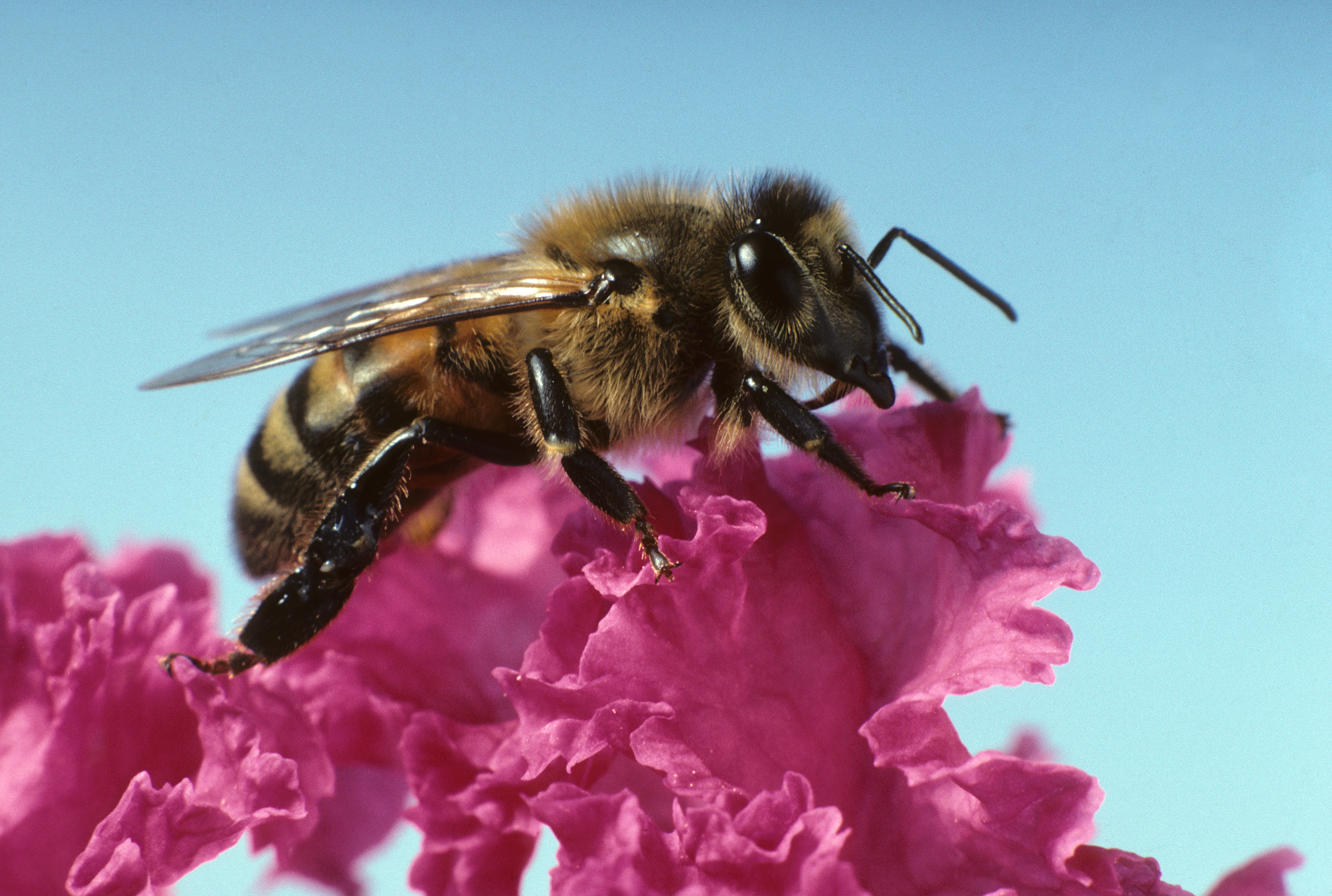
Rob Flynn USDA

{credit}Rob Flynn/USDA{/credit}

Consider the honeybee. Not as an automaton in a honey factory, but as a remarkable social insect and pollinator indissolubly tied to food security — and to the artistic imagination. So asks the poet John Burnside in his incisive essay on the bee in culture in this week’s Books and Arts.

Burnside points out how, as colony collapse disorder decimates hives worldwide, poets and artists are revealing anew the multifaceted relationship of the bee and us. The subtly beautiful limited-edition artbook Melissographia, a collaboration between Burnside and British multimedia artist Amy Shelton, for instance, interweaves poems, pollen maps, botanical samples and illustrations.

Detail of Amy Shelton’s Florilegium: Honey Flow. Spring, 2014.

Detail of Amy Shelton’s Florilegium: Honey Flow. Spring, 2014. {credit}John Melville{/credit}

Shelton notes on her website that she works in the “strong artistic tradition in England of ‘unseen landscapes’” by focusing on the beehive — “a locus of wildness fusing with human culture”. The lightbox installations of Shelton’s Florilegium: Honeyflow illuminate scores of nectar-rich wildflower specimens in the order they bloom through the bee season — in the process spotlighting the loss of 97% of Britain’s wildflower meadows in the past 75 years.

Shelton also runs Honeyscribe, an educational project offering children the chance to learn about our dependence on pollinators and the wonders of the hive. (One eight-year-old attendee, Shelton tells me, said of standing near the beehives that “it was like it was snowing bees. It was beautiful.”)

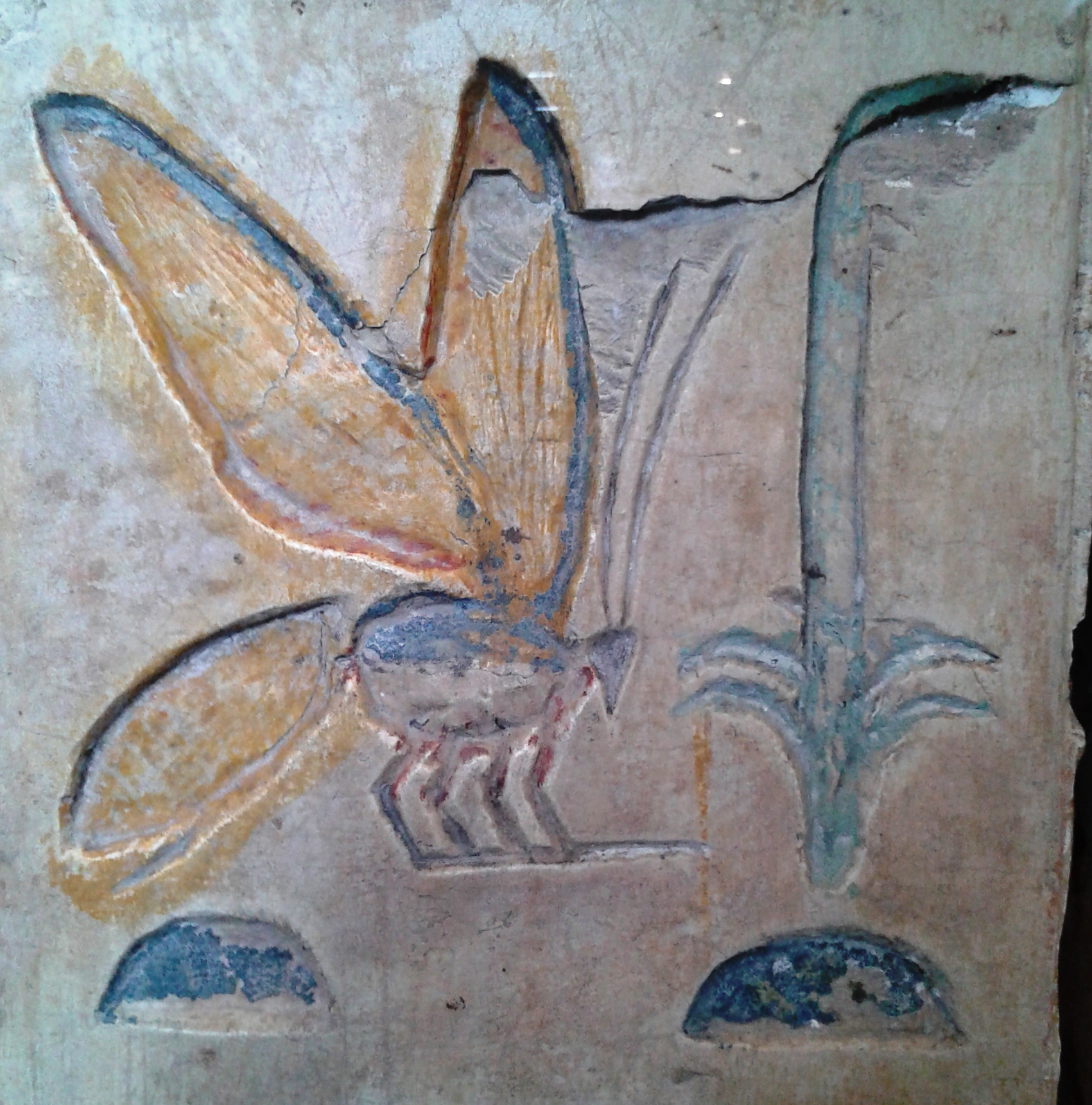
In ancient Egypt, honeyscribes monitored the harvests of the hives. But the bee, fierce as well as beneficent, was also symbolically tied to royalty. As the emblem of lower Egypt, the insect became part of the iconography of governance: that region’s crown, the deshret, sports a spring-like protuberance resembling a bee’s proboscis.

Epithet on limestone plaque from the temple of Ramesses II at Abydos, 13th century BC, in the British Museum, London. The bee symbolises lower Egypt.

Epithet on limestone plaque from the temple of Ramesses II at Abydos, 13th century BC (British Museum, London). The bee symbolises lower Egypt.{credit}Barbara Kiser{/credit}

The bee had meanwhile ascended to divine status in preclassical Aegean civilisations. Some islands seem to have buzzed with bee-goddess cults, as seventh-century BC finds from Crete and Rhodes hint.

Underneath these lofty goings-on, the honeybee remained knitted in to quotidian existence round the world, as Eva Crane (1912-2007) documented in classics such as the World History of Beekeeping and Honey Hunting (1999; reprinted 2011). (Crane, a quantum mathematician, directed the International Bee Research Association for 35 years and worked on apian science in more than 60 countries.)

Crane’s research points to the Aegean as a fountainhead of beekeeping. I recently had a visceral reminder of the region’s elemental and ongoing link to bees in Mani, one of the tattered ribbons of land that blow south from the Peloponnese. As I walked the flank of the rock-strewn Sangias range among wild orchids, scabious and euphorbia, the earth itself seemed to reverberate.  It was the hum of millions of honeybees at work round the wooden hives of village cooperatives. Apis mellifera, still only half-tamed, remains at home in this ferocious landscape.

Amy Shelton’s lightbox artworks, Florilegium: Honey Flow, can be seen at the Wellcome Kitchen, the Wellcome Collection’s new restaurant at 183 Euston Road, London NW1 2BE, UK.


For Nature’s full coverage of science in culture, visit www.nature.com/news/booksandarts.