Blade Runner 2049: a dystopian masterwork

Posted on behalf of Elizabeth Gibney
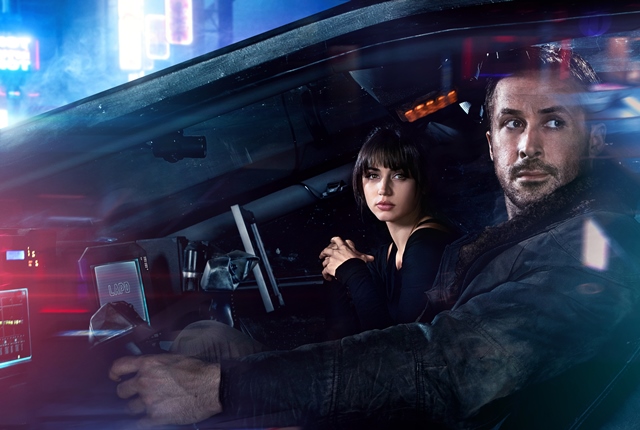
Ryan Gosling as K and Ana d x as Joi in Blade Runner 2049.

Ryan Gosling as K and Ana de Armas as Joi in Blade Runner 2049.{credit}Sony Pictures{/credit}

If director Denis Villeneuve was daunted by creating a sequel to the 1982 cult noir Blade Runner, it doesn’t show. The themes running through his Blade Runner 2049 feel more poignant than ever, the Los Angeles rain falls even harder, and it packs as much of a cinematic punch.

Villeneuve – fresh from his sci-fi success with Arrival in 2016 – has reimagined a world first brought to life by Ridley Scott. Thirty years on, the LA of Blade Runner 2049 is still grimy, bleak and sodden. Neon lights continue to flash and splutter, but now building-high advertisement holograms also shimmer alluringly. Replicants, as the bioengineered humanoids are known, remain enslaved.

The story centres on Officer K (Ryan Gosling), a blade runner — a cop tasked with ‘retiring’ replicants. In the original, loosely based on Philip K. Dick’s novel Do Androids Dream of Electric Sheep?, Harrison Ford plays Rick Deckard, a jaded predecessor of K, whose mission is to hunt down replicants escaped from off-world colonies. His interaction with them eventually prompts questions about the very premise of his job and his very identity. In 2049, replicants are now the bread and butter of the Earth-bound workforce, a new breed engineered by a new corporation. Under orders from his superior Lieutenant Joshi (a condescending but not entirely unsympathetic character, played by the excellent Robin Wright), K must find and terminate the older rogue models still hiding out.
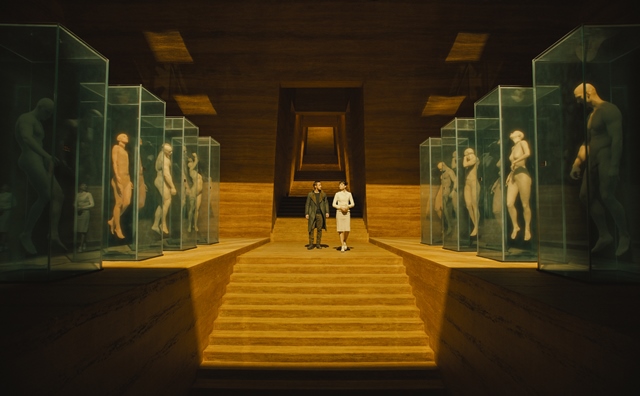
K and xxx (xxx)

K and Luv (Sylvia Hoeks) at the headquarters of the film’s hyper-ambitious bioengineering corporation.{credit}Sony Pictures{/credit}

Where Deckard was burnt-out and moody, K is a stoic and obedient, if lonely, worker – until an investigation brings about a discovery that leads him off course. Gosling does understated very well, shimmering with emotion that only begrudgingly breaks the surface. Ana de Armas is heart-breaking as his unconventional live-in companion; and Sylvia Hoeks makes for a terrifying foe. The dystopian world in which the film is based is rich with remarkable attention to detail. Fans will be thrilled to see Ford pop up for the finale as a grizzled, ageing Deckard.

The original Blade Runner brought to life Dick’s Voight-Kampf test, a form of Turing test designed to catch out androids by probing their biological response to questions that should trigger empathy, an idea that went on to inspire the wider sci-fi genre. In the wake of recent sci-fi successes such as Spike Jonze’s Her (2013), Alex Garland’s Ex-Machina (2014; reviewed here), HBO’s Westworld and the British series Humans, today’s viewers could be forgiven for becoming inured to shows that ask where artificial intelligence ends and humans begin. But Blade Runner 2049 manages to tread fresh ground. K’s modus operandi is a simple iris scan of replicants, but the film finds new ways to probe the question, through themes of morality and identity, and the roles of memory and soul.
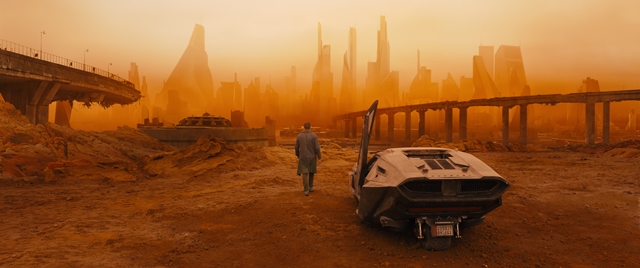
Environmental dystopia figures large in the film.

Environmental dystopia figures large in the film.{credit}Sony Pictures{/credit}

Blade Runner 2049 also burns with an environmental message far more glaring than in the 1982 film. The sequel takes the audience beyond LA to sneak a glimpse at a hellish wreck of a planet. Set in the aftermath of a nuclear war, the symptoms of a species sliding into oblivion are everywhere, with a haywire climate, city-sized rubbish dumps and a sea wall of epic proportions. As noted by Gosling in an interview with Wired: The power of science fiction, and what’s positive about it, is that you’re able to experience the worst-case scenario without actually having to live it.” Villeneuve has brought us a terrifyingly realistic version of civilisation’s possible future.

The film has garnered wide-spread acclaim, and deservedly so. Almost every scene is a visual masterpiece, teasing the viewers with shadows and tricks of the light, as well as breath-taking landscapes. Its haunting score pounds like an irregular heartbeat, reminiscent of the equally powerful soundtrack to 2001: A Space Odyssey. These go a long way to making the film as nail-biting as it is contemplative and spare. But Blade Runner 2049 is ultimately a work of art, and at a whopping 2 hours 43 minute run time, made for people who love cinema, not those after a cheap thrill.

Elizabeth Gibney is a senior reporter on physics for Nature based in London. She tweets at @lizziegibney.

Blade Runner 2049 is on general release.


For Nature’s full coverage of science in culture, visit www.nature.com/news/booksandarts.
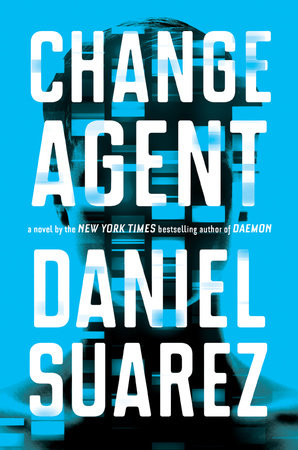
Change Agent: CRISPR-flavoured fiction

Posted on behalf of Sara Reardon

9781101984666It’s 2045, and the genetic editing system CRISPR has become a mainstay of society, producing everything from housecat-sized tigers to geopolitical intrigues. The United Nations has approved a sensible list of gene edits that can be legally used to eliminate specific genetic diseases from human embryos. This international concord works as well as one could expect from a sluggish bureaucracy trying to rein in a lucrative new enterprise. Before the treaty’s ink is dry, underground labs in Asia are offering “vanity edits” to parents willing to pay for smarter, healthier children. A single CRISPR snip to a gene that reduces the risk of heart disease might be routine and relatively cheap; altering the many genes that contribute to a complex feature like intelligence will cost much more. And that’s before you factor in the legal consequences if you get caught designing your perfect baby. As one illicit geneticist says, “all genetics is warfare”.

So begins Change Agent: a sci-fi thriller set in Southeast Asia with colourful and scientifically believable elements embellishing a fairly tired plot. Former software developer Daniel Suarez drew on still-cutting-edge research for his novel, one of the first to namecheck CRISPR as the catalyst for dystopia.

In Suarez’s imagined future, crime involving genetically modified humans has become so pervasive that international police organisation INTERPOL has devoted massive resources to dealing with it. But when detective Kenneth Durand finds himself hot on the heels of an organized crime ring in Singapore, he gets jabbed with a “change agent”. He awakens weeks later, shocked to find his body inexplicably transformed into that of the cartel’s ringleader, Marcus Demang Wyckes.

No one believes Durand’s explanation, least of all fellow INTERPOL agents who see him as the man whose face is on every wanted poster in Asia. After all, even the best scientists in 2045 believe it is impossible to genetically edit a living person. So Durand-as-Wyckes sets off alone to track down the real Wyckes and find a way to reverse-engineer his own body. That journey takes him through a landscape of sci-fi cliché – an underground nightclub of bio-enhancement enthusiasts, a shadowy Chinese trafficking ring with an invisible leader, intrusive augmented-reality ads.

Biotechnological flights of fancy

Yet Suarez has sprinkled the narrative with clever ideas inspired by current technologies. Singapore’s streets crawl with drug addicts, who tattoo molecular compounds onto their bodies so that dealers with 3-D printers can synthesize the drugs to deliver personalized highs. The Burmese government, which is waging genocide on its hill tribes, destroys their crops with gene drives — a controversial technology that can destroy populations by introducing genes that kill offspring. Nearly every other page is a glimpse into some biotechnological flight of fancy.

Suarez’s descriptions of the capacities and limitations of CRISPR, among other real-life technologies, are clear and mostly accurate, with minimal artistic licence. It’s the novel’s plot that — although fast-moving — fails to impress. As Durand flees his pursuers, he fights an unconvincing war with himself, as Wyckes’ grafted-on persona tries to drive him to violence. The enemies and allies that he picks up along the way are hackneyed and forgettable. This is especially true of the moustache-twirling Wyckes, whose denouement would be described as disappointing if we had cared about him in the first place. I won’t spoil everything, but suffice to say that Suarez wastes his most original idea in Wyckes’s bizarre engineered hitman, whose clever biochemical makeup repulses normal humans.

When we finally meet the CRISPRers, it’s in coastal Thailand (where else?). Potential parents sit through a parade of perfect children as if it’s a presentation for timeshare vacation condos. Predictably, the youngsters are a cover for the criminals’ more profitable product: children engineered with defective brains and enhanced muscles that make them disciplined workers and soldiers. Certainly people in 2045 must have read Brave New World. And meanwhile, readers will experience less shock than scepticism over how INTERPOL ever let crime get this bad right under their noses.

Perhaps that dulled reaction is what makes Change Agent most memorable. We have become so used to fictional explorations and academic treatises on engineering humans — from Mary Shelley’s Frankenstein to recent editorials in Nature — that the deranged possibilities presented by the technologies fail to thrill us any more. In an era stranger than fiction, sci-fi writers are increasingly hard-pressed to generate the requisite surprise, even as the scientific advances motor on.

Sara Reardon is a reporter for Nature working on biomedical research and policy, based in Washington DC. She tweets at @Sara_Reardon.


For Nature’s full coverage of science in culture, visit www.nature.com/news/booksandarts.

Science fiction: journey to the East

Cixin Liu

Cixin Liu.{credit}Li Yibo{/credit}

Posted on behalf of Iulia Georgescu

Last week’s Chinese Sci-Fi event at the London Literature festival was irresistible: I love science fiction and have a keen interest in the Far East. The star here was Cixin Liu, whose 2008 Hugo-awarded novel The Three-Body Problem is a huge best-seller in China and, since its English translation (Head of Zeus, 2015), beyond. (See Nature’s interview with its translator, sci-fi writer Ken Liu, here.) Liu’s fellow panellist was Xiaolu Guo, the award-winning, genre-defying Chinese novelist and filmmaker now living in Britain, whose works include the 2014 I Am China and 2012 UFO In Her Eyes.

Xiaolu Guo.

Xiaolu Guo.{credit}provided by Xiaolu Guo{/credit}

Both Cixin Liu and Guo had much to say. They agreed that sci-fi is a Western concept imported into China in the late 1970s and 80s. Post-Cultural Revolution China had the perfect climate for nurturing the genre, they said. First, there was a void in fantastic and speculative literature: much of Chinese literature in the twentieth century was focused on realism. Secondly, as science education was very poor at that time, sci-fi was a means of educating about science. The public fell upon it, eager to learn more about the latest discoveries.

Although Liu was heavily influenced by Western sci-fi writers, Chinese sci-fi has unique features. The difference, he seemed to think, lies in the Christian tradition imprinted on Western fiction. For instance, there is much discussion of whether the ethical implications of human cloning are perceived differently in China (see this Nature article). Liu averred that more than that, the idea of a doomsday, so dominant in Western thought, is less so in Chinese culture, which enshrines the concept of time flowing continuously and eternally.

imagesThat said, Liu’s The Three-Body Problem is about the end of the world — which is perhaps one of the reasons for its international popularity. (Japanese sci-fi is rich in apocalyptic scenarios too, for example in classics such as Kobo Abe’s Inter Ice Age 4, Sakyo Komatsu’s Japan Sinks, or the Neon Genesis Evangelion media franchise.)

Liu and Guo agreed that for them, the appeal of sci-fi lies in its departure from realism. Guo suggested that sci-fi is perhaps the only way for writers living in China to talk about political and social issues, as with Jingfang Hao‘s Hugo-winning novelette Folding Beijing (set in a future where three social classes inhabit Beijing in different spatial dimensions that only occasionally overlap). For Liu, sci-fi allows him to explore a bigger picture – humanity as a whole and its place in the Universe, as in the last book of his Three-Body trilogy, set in the very distant future.

The event made me realize anew how little of contemporary Asian literature has been translated into English. I hope that Liu’s popularity prompts publishers to more translations: I already have a long wish list.

Iulia Georgescu is senior editor, Nature Physics.


Access Natures science fiction special here; and Natures science-fiction column Futures (and Future Conditional blog) here. For Nature’s full coverage of science in culture, visit www.nature.com/news/booksandarts.

The rise and fall of the UFO

Posted on behalf of Daniel Cressey

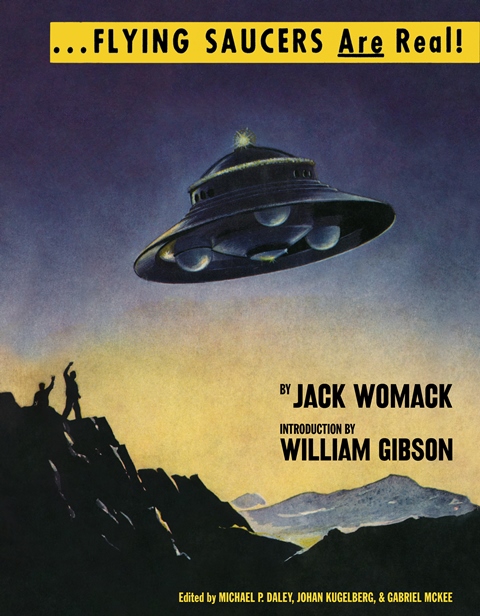
ARC028 - UFO - CoverIt seems amazing that anyone ever believed in them. In the mid-twentieth-century heyday of unidentified flying objects (UFOs), grainy pictures of flying saucers hovering in the sky were a staple even in  respectable magazines such as Time and Life. Volumes were written earnestly detailing the visits of aliens. This novel form of cold war paranoia seemed to seep into the collective psyche on both sides of the Atlantic.

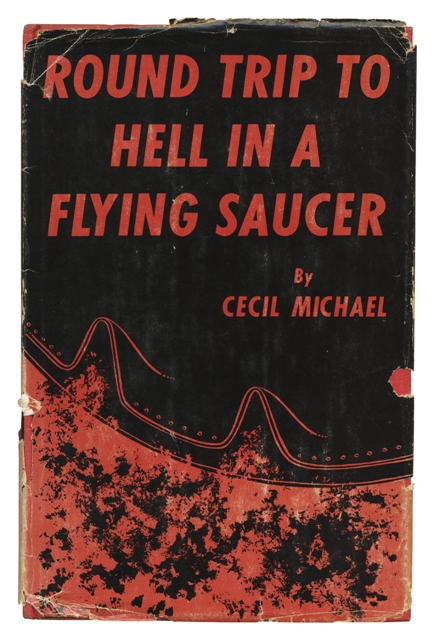
For believe they did. A sizeable section of the public ate up cheap books on saucers and devoured tales of visitors from beyond our planet, whether their intent was good or ill. Fortunately for anyone enamoured of American subcultures in all their garish glory, the speculative-fiction writer Jack Womack has amassed a huge collection of these books, from sex-obsessed adult novels to earnest pseudo-academic treatises. He reproduces many of these gems in his lavishly illustrated menagerie of the tracts, Flying Saucers Are Real.

ARC028 - UFO - MIichael, C - Round Trip To Hell In A Flying Saucer

A 1955 title.

They range from what Womack calls the “finest science fiction cover to ever appear on a non-science fiction book” (The Flying Saucers Are Real by Donald Keyhoe) to the mundane (Richard S. Shaver’s 1948 I Remember Lemuria).

While Womack is deeply invested in these books, he doesn’t spare them. UFO Photographs Around the World Vols 1 and 2, he notes, “offers the most complete compilation of lens flares, camera smudges, film imperfections, blurs and jiggled shots ever published”. Womack points out that British linguist Gavin Gibbons (author of The Coming of the Space Ships (1956) and They Rode In Space Ships (1957)), and others from the UK brought “a wide-eyed if not overly creative spirit to the field”. Gibbons rewrote other people’s UFO encounters, “managing to make their accounts far less interesting”.

This is no attempt to deconstruct the reasons behind the rise and fall of the UFO. Instead, Womack seems to be attempting to understand a bizarre lost cult by collecting the artefacts they left.

We learn of George Adamski, born in Poland in 1891, who ended up founding the “Royal Order of Tibet” in California (and co-writing the 1953 Flying Saucers Have Landed) before setting up an eatery. Adamski’s ‘close encounters’ include a man who claimed to be from Venus — evidenced by the fact that his “trousers were not like mine”. In Britain, Leonard G. Cramp’s 1966 UFOs and Anti-Gravity purported to lay bare the engineering of the flying saucer, complete with detailed blueprints, which he apparently thought revealed an anti-gravity system “similar to one of his own devising”.

Womack describes another book, Flying Saucer from Mars (1954), as written by “Cedric Allingham” — a hoax said to have been perpetrated by a now-deceased British astronomer and his friend. This friend apparently admitted pretending to be Allingham to give a talk to a flying saucer club, during which he wore a false moustache.

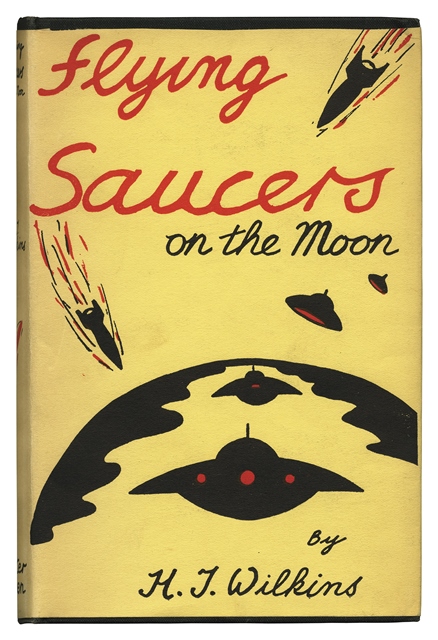
Harold T. Wilkins's 1954 text.

Harold T. Wilkins’s 1954 text.

Womack’s book can be as confusing to follow as the arguments of his UFO proponents. The typefaces switch to signal passages from source materials, and covers, photos and drawings abound. Following the huge numbers of authors mentioned and whether they are believers, hoaxers or fictional becomes something of a task. There is no clear logic to this collection of what science-fiction luminary William Gibson calls “testimonials to certain human needs” in the introduction.

Some of the notes accompanying the awesome images are brief and baffling. We read on page 10: “When John C. Sherwood was seventeen, Gray Barker published his book, Flying Saucers are Watching You (1967), a dry account of events during the 1966 Michigan Flap. Barker’s congratulation, post-publication, ‘Evidently the fans swallowed this one with a gulp.’” Who Sherwood and Barker are, and what the “Michigan Flap” was, we can only guess.

Womack’s collection is heading to Georgetown University Library in Washington DC, to be preserved among its special collections. It may stand as a monument to collective lunacy, a testament to how easily people can be led down the garden path, or simply a collection of egregious publishing mistakes. Whichever it is, Womack has preserved a record of something that felt very real to a great many people. These books began emerging, after all, around a decade after the filmmaker and theatre impresario Orson Welles inadvertently frightened an estimated 1.2 million US listeners during his famous 1938 radio broadcast of an adaption of H.G. Wells’s The War of the Worlds.

Today, the ubiquitous advanced cameras mean the lack of convincing photographs is more and more of a problem for believers. The evidence collected here is as ‘real’ as flying saucers will ever get.

Daniel Cressey is a senior reporter for Nature in London. He tweets at @dpcressey. Flying Saucers Are Real is the first book release of New York City publisher Anthology Editions, a partnership between Boo-Hooray Gallery and Anthology Recordings.


For Nature’s full coverage of science in culture, visit www.nature.com/news/booksandarts.

Star Trek puts its stamp on the future

hi res 2

{credit}© USPS 2016{/credit}

As Star Trek boldly sails into its second half-century, you might wonder what other impacts on science and culture this astonishing franchise could have. ‘Live long and prosper’, for instance — could the show hold clues to hyper-longevity? (Certainly ‘Bones’ McCoy managed to survive an incurable terminal illness, xenopolycythemia, during heated skirmishes on the asteroid-ship Yonada in an early series). Might the weird paradoxes the series harnessed to explain time travel ever transpire?

We can only wait. But in the meantime, on 2 September the US Postal Service issued a stunning set of Star Trek ‘Forever’ stamps — a time-bending product useable for posting a first-class, 1-ounce letter into perpetuity “regardless of star date”, they assure us.

hi res 6

{credit}© USPS 2016{/credit}

hi res 4

{credit}© USPS 2016{/credit}

Launched in June at a ceremony featuring a talk by Walter Koenig (the original series’ inimitable navigator Pavel Chekhov), the stamps’ designs feature motifs of the USS Enterprise, Starfleet insignia and a crew member in mid-transport. The stamp featuring the Enterprise inside the silhouette of a Vulcan salute is frankly awesome, and sure to fulfil (as Spock might say) “the needs of the many”.

They don’t promise delivery at warp speed, but these stamps are a beautiful reminder, if we needed another one, of our deep, enduring affinity with Gene Roddenberry’s brainchild.

Sidney Perkowitz’s essay on Star Trek’s 50-year impact is just part of Nature’s packed science-fiction special, a cornucopia of offerings including Shamini Bundell’s podcast segment on how the franchise is used to teach ethics in engineering and beyond.


For Nature’s full coverage of science in culture, visit www.nature.com/news/booksandarts.
CRISPR patent belongs to aliens

Mulder and Scully are back.

Mulder and Scully are back.{credit}THE X-FILES © 2016 Fox and its related entities. All rights reserved{/credit}

Posted on behalf of Sara Reardon

“Welcome back, you two,” says assistant FBI director to Fox Mulder and Dana Scully. He unlocks the door to Mulder’s old pencil-strewn office. The iconic I WANT TO BELIEVE poster lies crumpled on the floor.

We agree. After nearly 15 years, FOX rebooted the X-Files for a six-episode season that wrapped up last week. The technological advances of the past decade and a half, CRISPR included, gave the writers a raft of new ideas for its supernatural plots. DNA sequencing can be done in hours. People snap pictures of close encounters on their smartphones. Mulder’s ringtone, hilariously, is the X-Files theme song. Now the internet provides a platform for conspiracy theorists and the ill-informed to spread misinformation about the dangers of vaccines, genetically modified crops and gluten. (Spoilers aplenty to follow).

The new season takes full advantage. It opens with an internet personality who has become rich off his conspiracy theory videos. He wants Mulder and Scully to investigate a young woman who claims to have been injected with “alien DNA.” Scully, who was abducted in the show’s second season, finds similar DNA in her own cheek swab.

The scientific dialogue is laughable jargon jazz. But the concepts involve cutting-edge research. Alien DNA, for example, was floated in the first season in 1993, explains the series’ science advisor Anne Simon, a virologist at the University of Maryland. Back then, Mulder & Scully found a bacterium with six different letters in its DNA code rather than the usual four,

Since then, such DNA has actually been made. In 2014, researchers at Scripps Research Institute in La Jolla, California created the first cell that survived with two synthetic bases. These bases expand the number of possible DNA codes by orders of magnitude.

Other advances that the show predicted long ago have also become reality. In the second episode of the new series, the agents investigate a doctor, nicknamed ‘The Founder’, who purportedly studies children with rare genetic diseases – real conditions, cartoonishly amplified for the show. He’s been altering these babies’ DNA.

The title of the episode is Founders’ Mutation. This is a concept in evolutionary biology when an individual’s mutation spreads through all of its descendants, eventually creating a novel group of organisms. Explaining the idea, Scully gives a shoutout to a 2015 paper in Nature Communications, which suggests that most European men descended from just three men.

Indeed it is human genome editing that forms the season’s backbone: a concept that is far more scientifically plausible today than it was in 2001 — or even 2012. The CRISPR/Cas9 system, which makes precise snips in DNA, is revolutionizing agriculture, basic research, and medicine. Two groups of scientists, one at the Broad Institute in Boston and one at the University of California Berkeley, are battling over which owns the technology’s patent.

That patent, Simon jokes, should belong to the aliens.

Alien DNA is an antidote to the Spartan virus (which Simon and the writers invented for the show) that lives in us all, the story goes. Scully and a few other lucky people who have the alien DNA will presumably be able to survive the coming apocalypse. The Spartan virus was created by aliens and integrates into the human genome. For reasons yet to be revealed, a secretive cabal spread the virus through the smallpox vaccine over decades. It entered the germline and was passed on to children who never received the vaccine after 1972 when it stopped being administered.

The virus contains the code for CRISPR and the enzyme Cas9. It spreads through the body and snips at the gene for adenosine deaminase: an enzyme essential for immune function. When the virus is activated through ions spread in aeroplanes’ vapour trails– yes, the chemtrail conspiracy theory — the CRISPR system begins destroying immune systems. Soon, everyone, including Mulder, is dying of simple diseases.

Scully buys some time by making a vaccine from her alien DNA, which she believes encodes a way to inhibit Cas9. The season, as always, ends on a cliffhanger – hospitals overrun with dying people, panic in the streets and traffic stalled on bridges across the Potomac River. We have to wait for next season to find out the purpose of the alien DNA, Simon says.

As someone nearly as obsessed with CRISPR as Mulder is with alien encounters, it’s fun to see Scully and a new protégé geeking out over it and amusing when Scully dramatically intones, “I want you to do a PCR.” The genome-editing-as-bioweapon storyline is intriguing, but it’s unclear where it’s going to make judgement. And, as always, one must look past the made-for-TV compromises: the insta-vaccine for instance.

Simon doubts that the episode will fuel fears of CRISPR. “It’s just a tool,” she says. In fact, when director Chris Carter asked her to create a world-destroying technology, she took care to avoid stoking real fears. GMOs and common vaccines were right out. She settled on the smallpox vaccine because it hasn’t been routinely given since 1972. And relegating vaccination conspiracies to the same level as aliens and chemtrails might even be helpful.

She does hope that the entrance of CRISPR into popular culture will stimulate discussion of its many applications and ethical ramifications, primarily those involving editing humans. “I think we have to be careful about modifying the human germline because we don’t know what we’re doing,” Simon says. The public, not just those who wield the technology, should be crucial players in making such decisions.

For Nature’s full coverage of science in culture, visit www.nature.com/news/booksandarts.
The X-Files is on Channel 5, Mondays at 9pm.

Lust and the Turing test

Posted on behalf of Christof Koch

ex-machina-poster

{credit}@ 2015 Universal Pictures{/credit}

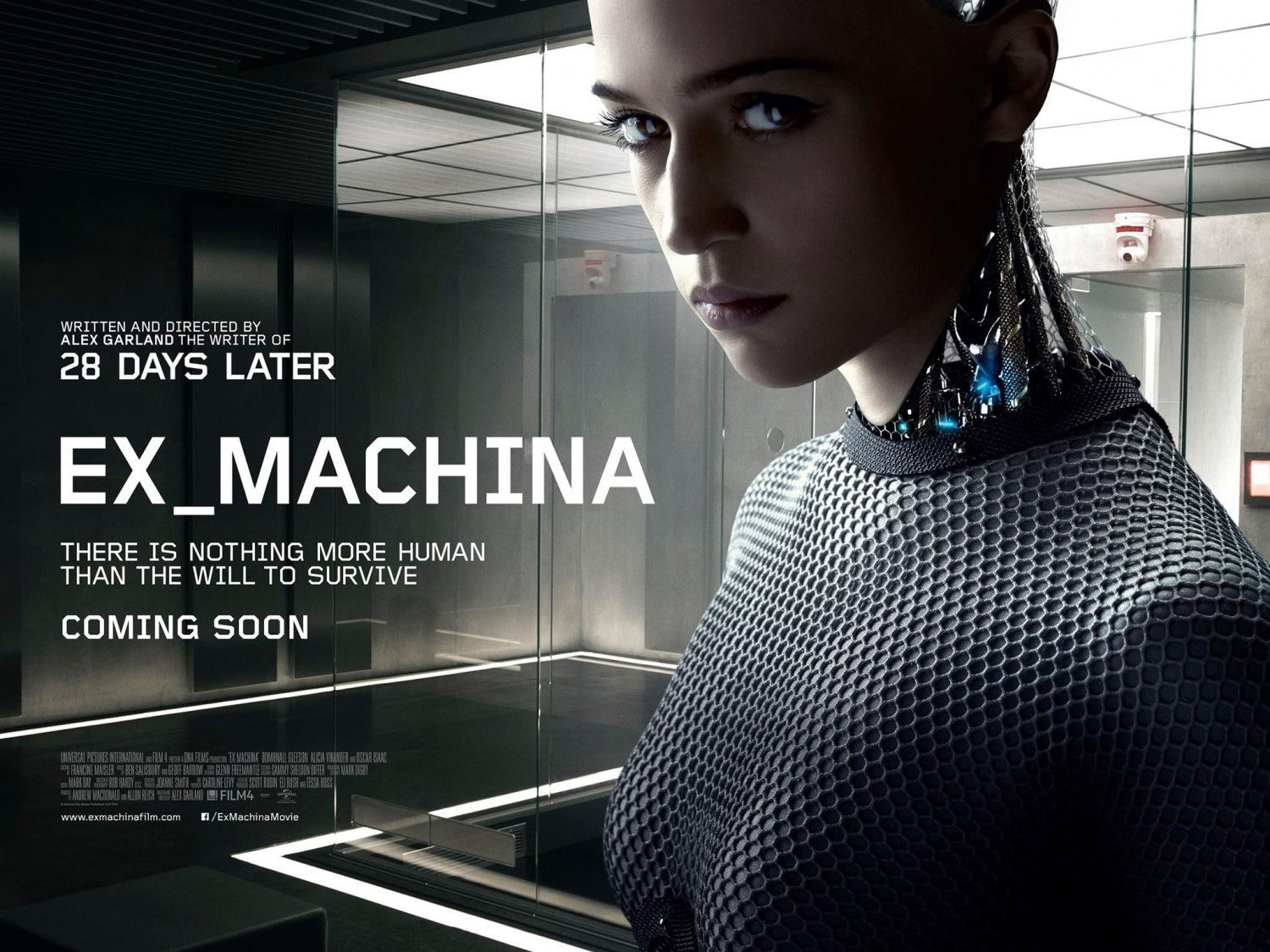
By and large, we watch movies to be entertained, not to be provoked into deep thought. Occasionally, a film does both. This year’s Ex Machina is one such gem. It prompted me to reflect upon the evolution of the idea of machine sentience over the past three decades of science fiction on film.

I am a long-time student of the mind-body problem — how consciousness arises from the brain. There is a conundrum at the heart of this ancient dilemma, challenging both brain science and AI; and it is well captured by Ex Machina and two other SF movies. In essence, it lies in how we can ever be certain that a machine feels anything, is conscious.

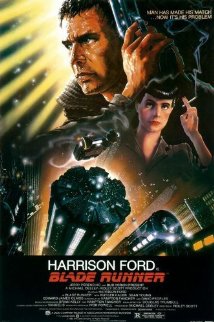
Consider Ridley Scott’s dystopian classic Blade Runner (1982). The morally ambiguous ex-cop Rick Deckard (played by Harrison Ford) is tasked with “retiring” four replicants, bioengineered androids that escaped from an off-world colony and are hiding in a dark and oppressive Los Angeles of the near future. After killing three, Deckard is saved from a lethal fall by the last, Roy Batty (Rutger Hauer). As Batty’s life runs out (his model of android lasts just four years), he delivers his justly famous death soliloquy:

I’ve seen things you people wouldn’t believe. Attack ships on fire off the shoulder of Orion. I watched c­-beams glitter in the dark near the Tannhäuser Gate. All those moments will be lost in time … like tears in rain…. Time to die.

These words speak to the clarity and poignancy of Batty’s memories — whether real or synthetic, lived or implanted.

Deckard’s final act is a recognition of these creatures’ essential human-like nature: he leaves his life behind and flees with Rachael, a more advanced replicant who believes herself to be human. Deckard crosses a line, at least implicitly endorsing the belief that replicants have feelings of regret, of pity, possibly even of love. (The question of whether Deckard is himself a replicant remains one of the more tantalizing in movie history.)

Tried and tested

In that sense, Batty, Rachael and their companions pass the Turing test. Introduced by the mathematician Alan Turing in 1950 to answer the question “Can machines think?”, it replaces this metaphysically loaded query with a pragmatic imitation game. If an agent can’t be distinguished from a human being, the agent passes the test.

The Turing test remains alive and well in philosophy of mind and in the annual competition for the $25,000 Hugh Loebner prize — albeit less so in university computer science departments.

Blade Runner

{credit}Warner Brothers{/credit}

Consider a version of the test focused on the question “Can a machine be conscious?” That is, does it feel like something to be this artifact? My washing machine has no feelings, but an android might well have – such as pity over the impending death of a human pursuer or pride in its own accomplishments. How would we know?

How do we know that anybody else but us is conscious? By interacting with them — asking them, “Tell me about your feelings.” Variants of this are used with non-linguistic competent individuals, whether aphasic patients, infants, or monkeys or other animals.

So, if what a machine tells us sounds plausibly human, we may act as if it too were sentient. Going by Deckard’s action in saving his beloved from doom, Rachael has passed the Turing test.

Fast forward to the 2013 romantic SF comedy Her, directed by Spike Jonze. In it, the anodyne writer Theodore Twombly (Joaquin Phoenix) downloads a new applet, Samantha — essentially an advanced version of iPhone’s Siri. It is a plausible storyline for our digitized age: a lonely guy speaks incessantly to his smartphone, who answers in a seductive voice and knows everything about him, his emails, his likes and dislikes, even his dating history. They joke, have intimate discussions; he takes her everywhere. Samantha is the last thing he speaks to before he goes to sleep and the first upon awakening.

Her eschews any significant discussion of the extent to which a computer program can have conscious feelings. Twombly doesn’t worry about such philosophical speculations; he behaves like any lover. Indeed, his passion for Samantha, who ‘lives’ in the cloud, cools after she confesses that she is simultaneously interacting with 8,316 other customers and is in love with 641 of them.

All about Ava

Enter Ex Machina, directed by Alex Garland. This intelligent and thoughtful mix of psycho-drama and SF thriller centers on a strange ménage à trois. Ava is a beauty with a difference (a phenomenal performance by Alicia Vikander); Caleb is a nerdy young programmer (Domhnall Gleeson); Nathan is a beastly, brilliant inventor and immensely rich tech-entrepreneur (Oscar Isaac).

Caleb is selected by Nathan, a recluse, to spend a week at his live-in Arctic laboratory. He introduces Caleb to Ava, an advanced cyborg whose semi-transparent skull and body reveal inner workings, including a brain that is quasi-organic in some unspecified way. It’s a twist on Blade Runner: if Caleb interacts with Ava as he would with an alluring woman – while seeing clearly that she is not flesh and blood – that would testify to Ava’s ability to convince him she has real feelings. Ava and Caleb hit it off at first sight.

Unlike Her, Ex Machina soon becomes a game of smoke and mirrors.  Ava hints to Caleb that she doubts Nathan’s purely scientific motives; there are bizarre scenes such as Nathan doing a synchronized dance routine with a mute servant. Nathan’s lab becomes Bluebeard’s Castle, complete with locked rooms and heavy psychosexual undertones. Ex Machina’s ending, invoking the trope of the femme fatale, is logical, surprising and darker than Blade Runner’s.

All three films showcase how the psychology of desire can be exploited to forge a powerful empathic response in their protagonists, sweeping away doubts about the object of their longing having sentience. It’s a Turing test based on lust, each movie an excursion into human social psychology and the attendant gender power politics. Unfortunately, the movies don’t inform us whether or not Rachael, Samantha and Ava are conscious or not. Simply that the men in these movies behave as if they were.

Leaving all that aside, I have little doubt about the essential scientific veracity of these movies. Within this century, we will create artifacts that will behave to all intents and purposes as if they too shared the gift of conscious experience with us. They will pass the Turing test. Blessing or curse? Only time will tell.

Christof Koch is chief scientific officer of the Allen Institute for Brain Science in Seattle, Washingon.


For Nature’s Insight page on machine intelligence, see here. For Nature’s full coverage of science in culture, visit www.nature.com/news/booksandarts.


More bang for your book

Posted on behalf of Daniel Cressey

Neal Stephenson at the xxx convention, 2008.

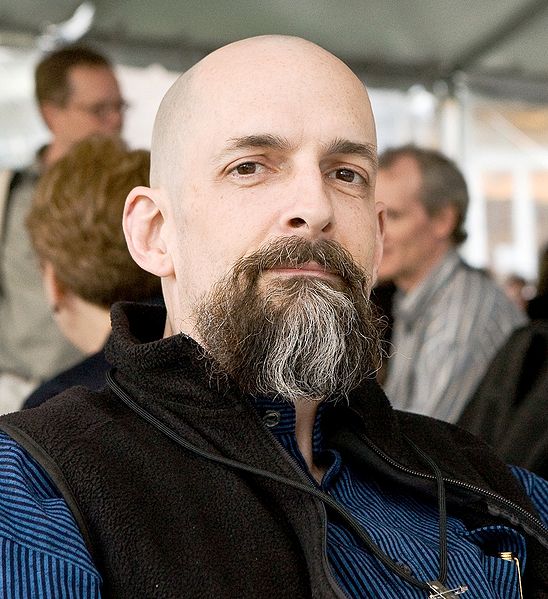
Neal Stephenson at the Science Foo Camp, 2008.{credit}Bob Lee, cropped by Beyond My Ken{/credit}

Sci-fi writer Neal Stephenson has a rare gift for building page-turning novels out of unlikely scientific subject matter.

 The hero of Zodiac, an early work, is an environmental activist taking on a huge chemical corporation – perhaps trite today, but on point in 1988, when it was published. The Baroque Cycle trilogy, published in the early 2000s, dresses up the scientific revolution of Isaac Newton’s day as a knowing romp with echoes of Alexandre Dumas’s Three Musketeers: it manages to be both an excellent action movie and a good fictionalised history-of-science primer. Anathem (2008)  is a strange futuristic meditation on the dangers of ivory towerism and the assumption that knowledge can be divorced from its application, with a cross-country adventure, a giant train and a space battle thrown in.

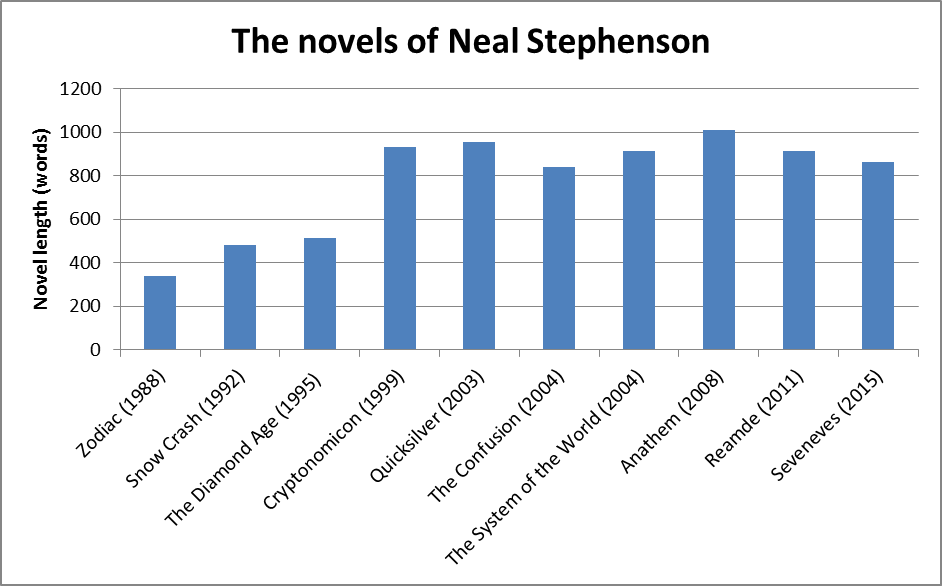
 But Stephenson’s latest book, Seveneves, reviewed by John Gilbey in this week’s issue, hinges on more conventional sci-fi subject matter. It follows an assortment of people selected to try to survive the total destruction of all life on Earth. (Wrist-wreckingly massive, it is by no means the longest Stephenson novel, as the chart below reveals.)

 New Picture.jpg

This “tale of straight-up global disaster”, Stephenson explains in the acknowledgements, is “an opportunity to showcase many of the more positive ideas that have emerged, over the last century, from the global community of people interested in space exploration”. Many of the “big hardware ideas”— which Stephenson noted in a Q&A as dear to his heart —   will be familiar to sci-fi fans, he admits.

Stephenson acknowledges that the premise stems from his time, around 2006, working for Blue Origin, the private spaceflight company owned by Amazon.com founder Jeff Bezos. (One major character in Seveneves is clearly inspired by Bezos, with perhaps a dash of Elon Musk.)

Stephenson has had a lot of irons in the fire recently. Along with this book, he was involved in an aborted attempt to make a realistic swordfighting video game, an innovation-fi anthology called Hieroglyph, and a multi-author series of stories set in the Middle Ages, The Mongoliad.  

That load has not hobbled his ability to research Seveneves, but I preferred his previous works, in which the characters drove the story. Stephenson’s 2011 globetrotting tale of terrorists and cybercriminals Reamde, for instance, was hugely fun, if lacking some of the grand thematic sweep of Anathem or Seveneves

For the scientifically inclined, the real delight of reading a Stephenson novel is the clear joy he takes in a scientific idea and its application. At his best, Stephenson is a chronicler of what we know and how we know it, and most importantly, what that means.

Daniel Cressey is a reporter for Nature in London. He tweets at @DPCressey.


For Nature’s full coverage of science in culture, visit www.nature.com/news/booksandarts.