The making of science

Posted on behalf of Jo Baker

Make-Shift-lock-up-1_eps fin4Scientists are makers. The specialized skills they hone in the lab over many years – from assembling robots and circuits to growing microbes and cells – mirror the practices of artisans such as seamstresses and potters. Chemists may melt, stretch and snap a glass tube to make a pipette. Jewellers rearrange silver atoms each time they warm the metal to anneal or soften it.

Bringing together makers of all stripes to innovate was the focus of MAKE:SHIFT, a two-day biennial conference this month in Manchester’s Museum of Science and Industry, home to Charles Babbage’s loom-inspired computing machines. Scientists and designers explored in talks, panel discussions and demonstrations how joint working can advance sustainability, healthcare and communities.

Across smart materials, biodesign, wearable electronics and more, the speakers showed how such collaborations have led them to think and work differently. They explored emerging trends, such as 3D printing and small-scale production. And they asked big questions, such as how the concepts of craft and making have become lost in today’s digital world of instant gratification, yet remain central to hatching new models and cultures of innovation. The following insights and individuals stood out.

Tools and workshops are increasingly accessible, linked and powerful. Fabrication labs or ‘fab labs’ – where members of the public and skilled experts recycle furniture or even edit genes – are proliferating. There are now 700 around the world. And 16 cities (including Barcelona, Boston in the US and Shenzhen) have signed up to become ‘fab cities’– aiming to produce locally 50% of what they consume by 2054. Online networking and exchanges of experience between make spaces is increasing, linking know-how in California with needs in Cape Town, for example.

Small-scale manufacturing is on the rise, aided by the Internet and cheaper production technologies such as 3D printers. Digital blueprints allow anyone with such means to construct furniture or even houses locally. Generic designs can be customized. Garment patterns that can be tweaked and knitted on demand avoid wastage. Customers increasingly care where their products come from, and value sustainability, social good and ethical work practices.

The nature of materials is being rethought. Bio-materials such as fungal webs (mycelium) can be used to ‘grow’ bricks, pots and even dresses on wood-chip, clay or textile frames. Amsterdam-based ecodesigner Maurizio Montalti of Officina Corpuscoli described how, after working with University of Utrecht microbiologists on scaling up these fungal creations, his studio began to look more like a lab. University College London materials scientist Mark Miodownik invoked a future devoid of roadworks if self-healing asphalt becomes reality.

Fungal Futures: a selection of mycorrhyzal materials by Maurizio Montalti for Officina Corpuscoli.

A selection of materials grown directly from fungi by Maurizio Montalti for Officina Corpuscoli.{credit}Fungal Futures © Maurizio Montalti-Officina Corpuscoli, 2016{/credit}

The Anthropocene offers new geologically inspired materials. ‘Fordite’, or ‘detroit agate’,  is made from fine layers of hardened car paint and can be cut and polished like semi-precious stone. We may one day dig up deposits of ‘bone marble’, retrieved from the metamorphosed skeletons of culled farm animals. The fashion industry is the second most polluting in the world, but sportswear company Adidas is scooping waste plastics out of the ocean to make its knitted footwear.

Crafts people are sensitive to people’s emotional responses to materials and objects. Yet few designers are included in research teams examining interactions between robots and humans, for example. Caroline Yan Zheng from London’s Royal College of Art is using soft robotics to make wall panels and accessories that swell or reshape in response to facial emotions. People tell her they find them comforting; one day they might be used to promote calm in hospitals.

Caroline Yan Zheng's soft robotic artefact prototype #4, exploring the performativity of kinetic silicone soft robotics.

Caroline Yan Zheng’s soft robotic artefact prototype #4, exploring the performativity of kinetic silicone.{credit}Caroline Yan Zheng, 2016{/credit}

Surgery is a craft – you don’t want your operation done by someone who has only read a book. Richard Arm from Nottingham Trent University brought in gorily realistic models of parts of the thoracic cavity that he has been making in silicone for surgeons to train on – complete with slimy finish, spurting arteries and the slash across the chest for you to dig your hand into. But introducing design innovations into the healthcare sector is difficult, Jeremy Myerson from the Royal College of Art noted; the sector is risk averse. His redesigned ambulance interior reduces the time it takes for paramedics to treat a patient’s wounds, by giving them better access to the patient and equipment. Yet, despite running it through ‘clinical trials’ successfully, it has yet to be taken up.

For making to drive innovation, many challenges need to be overcome. Craft has an old-fashioned hobbyist image, and many courses are closing as universities struggle to attract students. Yet jewellers and textile and industrial designers are open to new materials and technologies as never before, while few scientists are trained in metalworking or AutoCAD. And it is hard even to define what tacit skills and knowledge are.

Gravity Stool (detail) by Jólan van der Wiel, 2012. Photo

Jólan van der Wiel’s Gravity Stool (detail), created from magnetic plastic compounds, 2012.

That said, some technologies are overhyped. 3D printing remains expensive and impractical with many materials, such as porcelain. While printing is useful to make a detailed prototype, traditional processes like casting are often better for mass production. Also, the software needs to become more intuitive. Ann Marie Shillito of Edinburgh College of Art showed how she is using touch-sensitive ‘haptic’ computer design software to form organic shapes.

So how far can this model of local production be scaled? Ways must be found to promote collaboration between workshops, and optimize who makes what, where. And new business models are needed so that small-scale manufacturers can make a living; most workspaces depend on government grants. Nonetheless, MAKE:SHIFT was a heartening experience that highlighted what science and design have in common rather than, as is too often the case, what divides them. After all, even graphene (carbon that is 1 atomic layer thick) has been linked to traditional craft: the Japanese paper-cutting art of kirigami have been applied to graphene sheets to make stretchable electrodes, hinges and springs.

Jo Baker is senior Comment editor at Nature.


For Nature’s full coverage of science in culture, visit www.nature.com/news/booksandarts.

O brave new world of fantastic beasts

Posted on behalf of Stuart Pimm and his research group

Fantastic BeastsFrom the start, European visitors to the New World have celebrated its fantastic biodiversity. What looks like a scarlet macaw embellishes German cartographer Martin Waldseemüller’s 1507 world map, the first to name these lands “America”. Eighty years later the English artist John White, a governor during England’s first attempt at settling North Carolina, was painting fireflies, “which in the night [emit] a flame of fire” (a sight of pure magic on a warm summer’s evening).

And in the 1920s, magizoologist Newt Scamander — with portable menagerie in tow — visited New York with the entirely laudable aim of returning a thunderbird to its home in Arizona. Thus begins Fantastic Beasts and Where to Find Them, the David Yates-directed film based on J.K. Rowling’s book of the same name – one of the set texts her boy wizard, Harry Potter, must study at school.

With my research group, including graduate students Alexandra Sutton, Ryan Huang and Rubén Palacio, I had waited anxiously for this new treatment of Scamander’s classic work on the natural history, biogeography and conservation status of the world’s biodiversity invisible to muggles. (That’s you non-wizards.) We entered the seminar room (transformed to resemble a movie theatre), surrounded by young wizards in Hogwarts’ school uniforms. We had many questions in mind.

Would this hidden biodiversity be as diverse and unexpected as that encountered by the first European settlers in the Americas? How would species be distributed across different biomes? Rowling’s previous accounts of the fauna around Hogwarts have merely hinted at the range of possible species, obviously limited to the school’s location in Scotland. Northern, island ecosystems have few species, albeit a plethora of owls.

Here be dragons

Scamander’s ‘zoo’ fits into a single suitcase, which like Doctor Who’s Tardis is very much larger on the inside. And in we go, where we quickly learn of a wide variety of species mostly unknown to the muggle world. We expected dragons, of course. The theoretical ecologist Robert May and colleagues have discussed them in the pages of this journal and, indeed, predicted their resurgence with global warming (Nature 264, 16-17 (1976); Nature 520, 42-43 (2015).

There are many other species. We see the range of ecosystems occupied, extending beyond the Americas and ranging from frozen Arctic wastes to African savannahs. In the latter, we encounter what could be a horned relative of the gargantuan rhinoceros Paraceratherium, long thought to be extinct. Nor does Scamander neglect those world rulers, the arthropods: there are stag beetles as big as dogs. And a relative of the praying mantis, though it does not pray and, despite exhortations, cannot even be persuaded to smile. Australian fauna are also included, with an engaging duck-billed platypus relative that has a bowerbird’s propensity to collect things — in this case, shiny coins and jewellery.

Dan Fogler as Jacob, Eddie Redmayne as Newt Scamander and a beast called a Bowtruckle in Warner Bros. Pictures' fantasy adventure Fantastic Beasts and Where to Find Them.

Dan Fogler as Jacob, Eddie Redmayne as Newt Scamander and a beast called a Bowtruckle in Warner Bros. Pictures’ fantasy adventure Fantastic Beasts and Where to Find Them.{credit}© 2016 Warner Bros. Fantastic Beasts © JKR{/credit}

Following the presentation, I asked my students: What were the key management issues in the magical world? And how do they compare and contrast to those that muggles experience in their world?

Alexandra noted Scamander’s contradictions: “He’s often the conservationist and he advocates the education of fellow wizards about the value of these magical beasts in their world. But he’s also the collector, keeping wild animals as pets in an environment that’s not necessarily suited to them”. The tension here recalls the species-bagging of early naturalists such as the eccentric Lionel Walter Rothschild, whose vast collection is now held at London’s Natural History Museum.

Species in Scamander’s zoo escape and cause considerable physical damage to New York. It takes much magic to undo the damage, an option unavailable to muggle professionals facing invasive species. As Ryan put it, the movie is also a reminder that “with keeping animals captive comes the callousness by which people traffic in beasts”.

Much of this callousness is borne of our growing separation from the natural world. Rubén reflected: “Some species are mighty, and if not treated correctly, can be dangerous, but this comes from our ignorance. Scamander…understands and engages the animals.” Ryan agreed: “Even though there have been very few wolf attacks on humans, people still fear wolves. Scamander affirms that we humans are the most dangerous beasts of all. When we are scared, we lash out.”

And my view? It tallies with Scamander’s. He asks why “magical beasts, even those that are savage and untameable”, are protected. The answer? To “ensure that future generations enjoy their strange beauty…as we have been privileged to do”.

Stuart Pimm is professor of conservation at the Nicholas School of the Environment, Duke University, Durham, North Carolina, and directs the non-profit SavingSpecies, www.savingspecies.orgHe tweets at @StuartPimm.


For Nature’s full coverage of science in culture, visit www.nature.com/news/booksandarts.

Werner Herzog gets geological

Posted on behalf of Noah Baker

InfernoThe film Into the Inferno opens with a grand spectacle. The camera glides up and over tiny figures clustered on the peak of the volcanic island of Ambrym in Vanuatu in the South Pacific. Far below, an ominous lava lake splutters to a bombastic choral soundtrack. There is a sense of ritualistic grandeur here that sets the tone for what follows.

The documentary, created by legendary filmmaker Werner Herzog and Cambridge volcanologist Clive Oppenheimer, straddles the science and culture of volcanoes. It is strong on exploring the significance of volcanoes to humanity — their role in local mythologies, traditions and lifestyles, now and through the centuries. The film even suggests that our relationship with these geological giants stretches back to early hominids living in the shadows of volcanoes in East African rift valleys.

Like many Herzog films, Inferno goes off on tangents and strays into quirky side stories, hopping about among unusual locations. One moment we’re hearing from a volcanology station in North Korea, where Oppenheimer, in a rare international collaboration, has been working with local volcanologists for several years. The next we’re in the midst of an archaeological dig in Ethiopia, scientists scraping away at the soil in search of early hominid remains. The stories and locations do link back to volcanoes, but sometimes a little obliquely.

Oppenheimer occasionally brings insights into the science among the craters and cones, but his central quest remains cultural. And that yields a trove — not least the ‘cargo cult’ on the island of Tanna in Vanuatu. Its members worship a US serviceman called John Frum, who they claim lives in local volcano Yasur.

Noah Baker is senior editor in Nature’s multimedia team. Hear his Nature Podcast interview with Oppenheimer here.


For Nature’s full coverage of science in culture, visit www.nature.com/news/booksandarts.

Show home for the Red Planet

Posted on behalf of Elizabeth Gibney

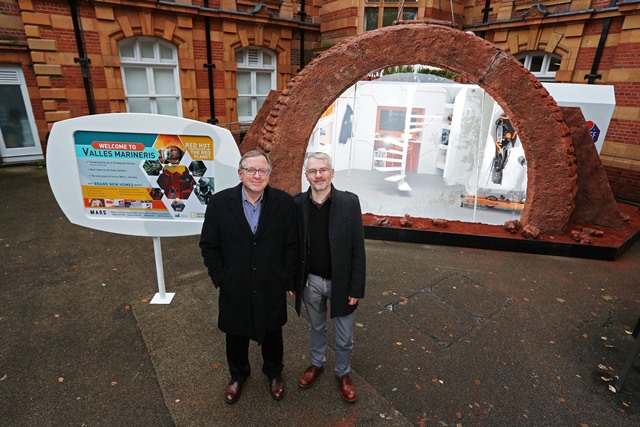
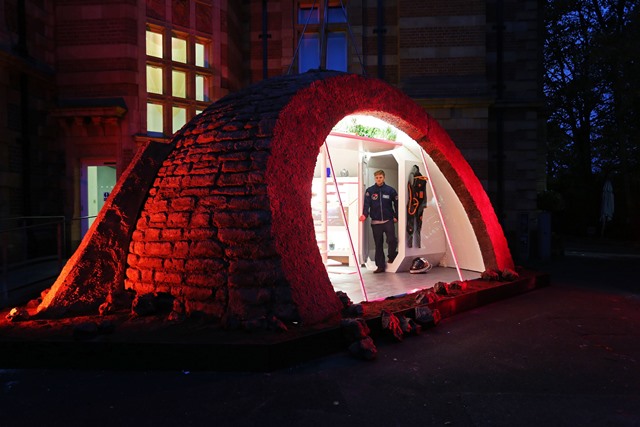
Mars show home at the Royal Observatory Greenwich, London.

The National Geographic Mars show home at the Royal Observatory Greenwich, London. The habitat is the work of Wild Creations in consultation with observatory astronomers and Stephen Petranek, author of How We’ll Live on Mars.{credit}National Geographic mini-series MARS runs through 19 December{/credit}

A big red igloo with a towering antenna seems a little overblown for a London show home. And so it proves. The object squatting outside the Royal Observatory Greenwich is actually a life-sized mock-up of a Mars habitat, billed as the imaginary dwelling of a second wave of settlers from Earth. That is, those who might live on the Red Planet in their thousands by around 2037, if the ambitious plans of space entrepreneurs such as SpaceX’s Elon Musk bear fruit.

The mock-up, in London this week to 16 November, promotes the National Geographic channel docudrama MARS, by director Ron Howard and Brian Grazer. Launched on 13 November, the mini-series charts the 2033 journey of a fictional first crewed mission to Mars by a blissfully collaborative International Mars Science Foundation, and subsequent attempts to establish a settlement.

As Earth’s second-nearest neighbour after Venus, Mars is widely seen as the best candidate planet for human colonization. But it lacks Earth’s thick atmosphere and global magnetic field, and is extremely inhospitable in myriad other ways. Colonists would need to be protected from temperatures that plummet to -70 degrees Celsius at night at the equator, as well as the high-energy cosmic particles and ultra-violet solar radiation that pummel the planet’s surface.

Author Stephen Petranek with Marek Kukula, the Royal Observatory Greenwich public astronomer.

Author Stephen Petranek with Marek Kukula, the Royal Observatory Greenwich public astronomer.{credit}National Geographic mini-series MARS runs through 19 December{/credit}

The Martian igloo, the work of display and model-making company Wild Creations, is a fun way of exploring what constraints the environment would put on design. The walls are a whopping 60 centimetres thick — just an eighth of the almost 5-metre depth they would need to be capable of protecting colonists from the radiation, said Stephen Petranek at the show-home opening. His book How We’ll Live on Mars inspired the series, and he consulted on the show home alongside the observatory’s public astronomer Marek Kukula. Moreover, Petranek notes, it would need to be built of bricks made by microwaving a mixture of polymer granules with Mars’ clay mineral-based soil. And an igloo is just one possible design. The same bricks could easily make bigger structures, even a large Gothic cathedral, he says. Or homes on the Red Planet could be built in the natural underground hollows that once housed lava, or in the side of craters.

Daily life for the 10,000 people Petranek imagines might some day dwell in this kind of shelter does not look appealing. Accessed via an ‘airlock’ stuck into the igloo wall, the dome’s interior is claustrophobically small — just a few paces across. Features would have to include an exercise machine to combat muscle wastage in the low-gravity environment, and an indoor farm. The small potted plants I spot on a mezzanine near the building’s ceiling hardly look substantial enough to sustain a hungry Martian for more than a few weeks — in contrast to the heaps of potatoes ingeniously grown by fictional astronaut Mark Watney (Matt Damon) in Ridley Scott’s 2015 film The Martian. Settlers would also need access to water, which (assuming it is there) may only exist in liquid form dozens of metres down in the planet’s concrete-hard ground.  

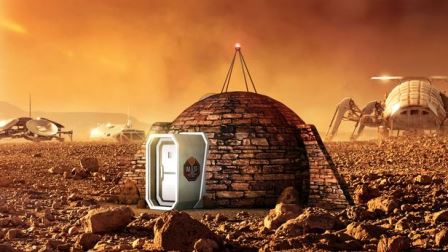
Artist's depiction of the show home in situ.

Artist’s depiction of the show home in situ.{credit}National Geographic{/credit}

The message here seems to be about thinking big to encourage ambition, as with the MARS mini-series. That uses an innovative format: the drama unfolds amid “flashbacks” to interviews with actual scientists and space pioneers, such as Musk. These highlight how real progress often initially involves failure, but  also serve to make the dramatised scenes seem even more fictional.

Petranek notes that plans such as Musk’s are “much more realistic than people give them credit for”. And whether or not they succeed, SpaceX is driving all space exploration in the direction of human missions to Mars, he argues. But for now, most planetary scientists still see living there as science fiction, and that’s not just because of unfeasible costs or optimistic technology projections.

Many researchers don’t actually want to send people to the Red Planet yet. It could well have harboured life billions of years ago, and finding that would tell us that life on Earth was not a one-off fluke. NASA, the European Space Agency (ESA) and the China National Space Administration all plan to put rovers on Mars in the 2020s to scour it for ancient life. But while rovers can be carefully sterilised to prevent contamination, sending humans would almost certainly contaminate the planet, and could mean we never find out. From that perspective at least, there is no hurry.

Elizabeth Gibney is a reporter on physics for Nature based in London. She tweets at @LizzieGibney. Listen in to her Nature Podcast talk with Andrew Coates, the planetary scientist working on the ESA’s first Mars rover. 

MARS runs through 19 December on the National Geographic channel. 


For Nature’s full coverage of science in culture, visit www.nature.com/news/booksandarts.
 

The warp and weft of wearable electronics

Zhang 1

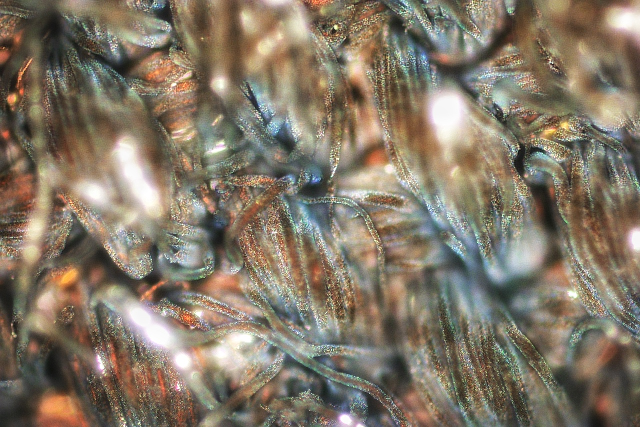
Optical microscope image of a battery electrode made of metallic textiles and active materials. {credit}Dongrui Wang{/credit}


3Q: Zijian Zheng

One of today’s challenges for materials scientists is wearable electronics — smart materials that monitor ailments, harvest energy, track performance or communicate. These remain expensive and hard to produce in bulk, and are often unattractive. Polymer scientist Zijian Zheng takes inspiration from his designer and business colleagues at Hong Kong Polytechnic University’s Institute of Textiles and Clothing. His solution: lightweight electronic yarns that can be made into textiles by adapting existing production processes.

 How do you create wearable electronics?

People need to feel like they’re not wearing electronics, so the materials must be lightweight and flexible. They must also be high-performance, as devices have to charge rapidly, last for a long time and be sweat-proof. Applying all these criteria, we create electronic textiles in which the fabrics themselves form the sensors and devices – from light-emitting diodes, photovoltaics, organic transistors and supercapacitors to batteries. We can make a supercapacitor using conductive yarn, made by coating cotton with nickel, and penetrating it with a form of graphene oxide. If you put a pair of these strands together in parallel, and fill the space between with an electrolyte gel, you can make it work as a supercapacitor storing energy as positively and negatively charged ions collect at the different wires. You could use that to power other devices, such as sensors, or store energy generated from photovoltaics. We’re working on making lithium batteries using the same principles.

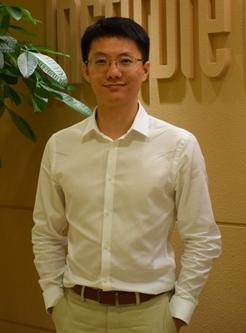
Polymer scientist Zijian Zheng.

Polymer scientist Zijian Zheng.

What are your biggest challenges?

When integrating different materials together in an electronic textile, the interfaces create the biggest problems. You can get mismatches between mechanical and thermal expansion properties, and in a flexible system the weakest points are where the device twists or bends. In my group we focus on using polymers to address these issues. For example, we make new polymers that add texture to the surface of textiles, allowing them to be coated in copper at low temperatures for durability. To ensure scalability, our goal is to make textiles that can be integrated with the technology the clothing industry has used for the past 200 years. Our composite yarns can be used in sewing machines, and complicated patterns can be created from them using machine embroidery. From there, you start to add active materials to make devices in ways that are compatible with textile processing. For example, we’re now making photovoltaic cells printable via textile colour-printing technology and encapsulating them with textile-finishing technology. And we are set to make a radio-frequency identification tagging device within a garment, powered by a supercapacitor. We’ve designed it to hide the supercapacitor as an embroidered pattern, like camouflage. We also have a student working with local textile company EPRO Development, trying to put the metallic, conducting textile into real production. Devices will come a bit later as they are ten times more complex to make. Cost is a challenge too: the textile industry cares about every penny. In introducing functional elements into garments such as a breathable section, you might only be allowed to increase production costs by around 10 cents.

Zhang 2

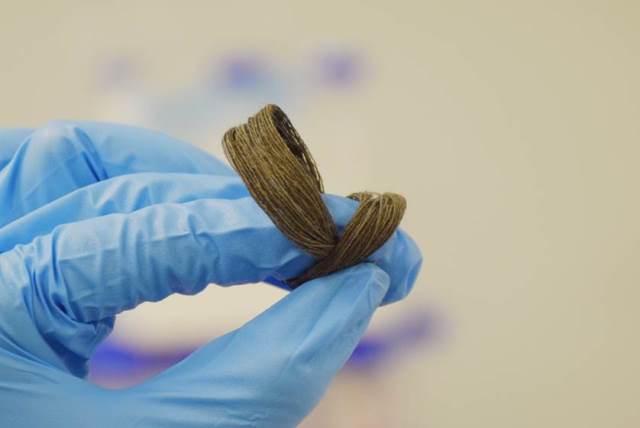
One hank of copper-coated cotton yarns used for making wearable devices and circuits.{credit}Ka-chi Yan{/credit}

How do the different disciplinary strands in your institute work together?

My institute covers the whole chain of production for textiles and clothing – with materials science and chemistry groups sitting alongside business and design. So we have three streams of students and teaching is totally different for each. The major challenge when I lecture is how to deliver my engineering or scientific-based content to a bunch of artists. We tend to give them an overview to help them understand first, with lots of examples, before we come down into the fundamentals. It’s very different from the physical science students, where we take them through a logical sequence from beginning to end. The artists ask so many questions. Generally they want to know if they can do something with a material, and don’t care about why it functions. They seldom ask “Why does this electron go through there?”

Interview by Elizabeth Gibney, a reporter on physics for Nature based in London. She tweets at @LizzieGibney.


For Nature’s full coverage of science in culture, visit www.nature.com/news/booksandarts.