The artist as astronaut

Probes is an inventory of space probes, which examines how the aesthetic of such craft has changed over time, as well as how functionality of design intersects with its cultural underpinnings. Mir views space probes as substitutes for human explorers, romantically searching for connection in the Solar System.

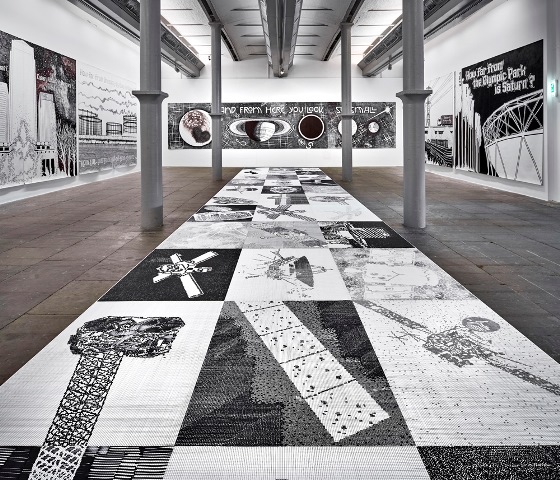
Artist Aleksandra Mir views space probes as substitutes for human explorers, romantically searching for connection in the Solar System. Her piece Probes (on floor) — part of her major work Space Tapestry — is an inventory of these craft, examining how their aesthetic has changed over time, as well as how the functionality of design intersects with its cultural underpinnings. {credit}Tate Liverpool{/credit}


3Q: Aleksandra Mir

 In 2014, Aleksandra Mir began a journey into the unknown. The London-based artist started talking with scientists and engineers about space — a realm in which she was a complete novice. The result of Mir’s dive into the cosmos is Space Tapestry, a vast wall hanging 3 by 200 metres, hand-drawn — in collaboration with 25 young artists — with fibre-tipped pens on synthetic canvas. Inspired in part by the eleventh-century depiction of Halley’s Comet on the Bayeux Tapestry, the work unfolds like a giant graphic novel to explore the unfathomable distances of space, the quest for extra-terrestrial life, and the impact of space technology on humans – from observing Earth to the politics of space. As the piece goes on show at Tate Liverpool, UK, Mir talks about her quest to get under the skin of science.

Why did you choose this format for Space Tapestry?
xxx

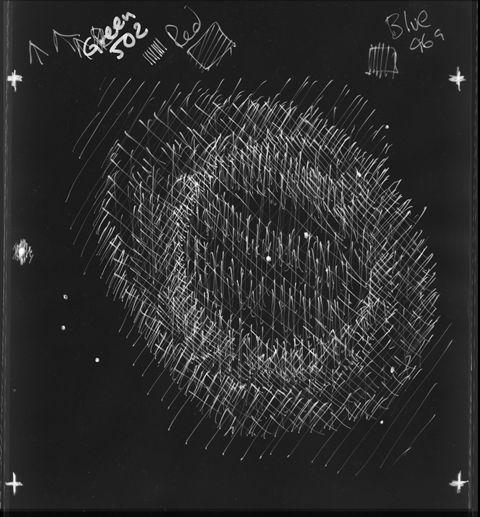
Mir’s work Ring Nebula emerged from conversations with Jayanne English, an astronomer involved in creating Hubble telescope images. To move beyond the “ice-cream” coloured swirls that Mir views as “trashy”, they experimented with capturing the same information in a black-and-white sketch in which the angle of cross-hatching represents different phenomena.{credit}Aleksandra Mir{/credit}

I wanted to create an immersive environment, almost like a stage set. And I wanted to introduce a new aesthetic. Whenever you see a science illustration you get what I call the “sleazy aesthetic”: supposed to convey fact but made to seduce with their slickness, intense colours and airbrushed surfaces. There are other ways of picturing phenomena that can be as realistic. And some phenomena beyond our technologies or perception can also be portrayed poetically. This is where art becomes relevant to science. My original inspiration for the project was the 1066 Bayeux Tapestry. It features a very early portrayal of Halley’s Comet: you have this little group of characters staring out in horror and fascination, and there’s this simple line drawing of the comet. What was interesting to me is that it doesn’t look anything like an actual comet, but conveys a tremendous amount of scientific information – it has a direction, a velocity and luminosity – which makes it valuable for contemporary scientists. So this became the key to my ‘tapestry’: images with validity for the science community, but also treated in a very poetic, freestyle, emotive and personal way.

You’ve explored many issues over your 25-year career. Why space, and why now?

Space has been a strand of my work for a very long time. My family watched the Moon landing in 1969 in Poland (which was then behind the Iron Curtain), and this left a powerful mark on me. My best-known work is First Woman on the Moon, the transformation of a beach in the Netherlands into a lunar surface in 1999, in response to the 30th anniversary of Apollo 11’s feat. The video of this event has been touring for 17 years now. And I recently realised that while the gist of the work is still valid – no woman has yet set foot on the Moon – I needed to catch up on the achievements of today’s space industry. I attended my first space conference in 2014 and was sold on a world that for me was like an alien planet. I had to learn a new language. I spoke to a lot of scientists about their daily lives. And once you start looking at that from my perspective as an artist and anthropologist, a natural philosophy and sort of magic embedded in these practices reveals itself. I was never interested in science fiction. Science has everything of interest to me. I think that the whole scientific project is a romantic project, the chasing for a connection, the yearning for depth, taking on a challenge, risking everything for a passion, the struggle.
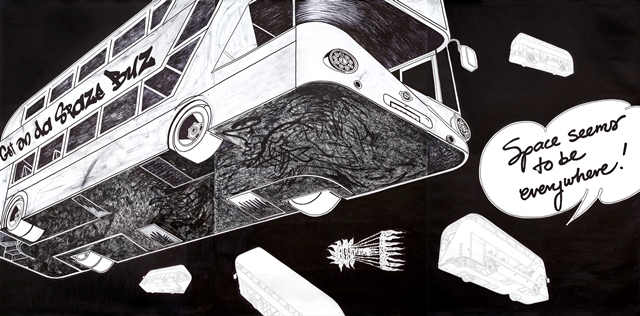
xxxx

Get on Da Spaze Buz – a detail in Mir’s Space Tapestry: Earth Observation & Human Spaceflight.{credit}Modern Art Oxford{/credit}

What did you learn about scientists and science?

Working on the Space Tapestry project has given me access to some extraordinary scientists, locations and visuals. Among those I interviewed was Jan Woerner, director-general of the European Space Agency. Marek Kukula from the Royal Observatory Greenwich has been one of my main advisors, and molecular astrophysicist Clara-Sousa Silva has been a huge inspiration. I visited high-security sites such as Airbus Defence and Space in Stevenage, UK; and saw the network control centres at Inmarsat and the Satellite Applications Catapult, both depicted in my drawings. I was allowed to ask tons of naïve questions, be critical, playful and absurd at times, which has connected and educated me in a big way. I can now hold a conversation in this realm, and in 2015 I was invited as a speaker at the UK Space Conference myself.
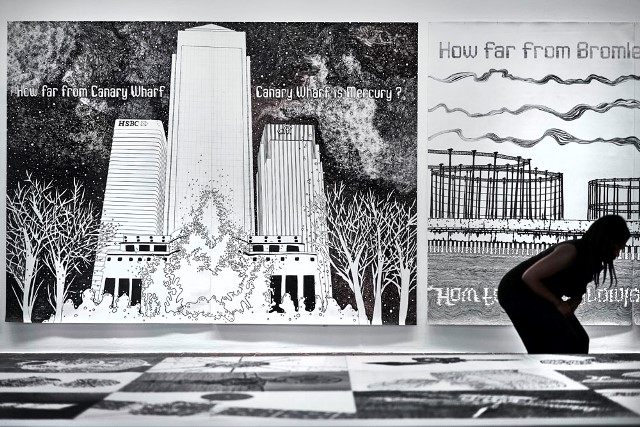
Solar system

The Solar System series, part of Space Tapestry: Faraway Missions, aims to help viewers find more poetic and metaphorical ways to think about distances that are impossible for the human brain to grasp.{credit}Tate Liverpool{/credit}

There is a newfound dialogue with scientists who are reaching the understanding that they also have been working in isolation.  I have also realised that the sophistication of their projects, the enormous budgets and the long timespans can in no way ever be comparable to what I, as one artist, can do. So, if anything, I have gained a greater respect for science. One conversation I’ve had with scientists, though, is that you don’t always have to be heroic and successful to garner respect. To struggle, fail, be tired and dirty is part of our nature and a fundamental part of all human exploration. Artists know how to draw power from it and I think my project both humanizes and makes science more credible.

Mr's piece First Woman on the Moon (video, 1999).

Mir’s piece First Woman on the Moon (video, 1999).{credit}Aleksandra Mir{/credit}

Interview by Elizabeth Gibney, a reporter on physics for Nature based in London. She tweets at @lizziegibney.

This interview has been edited for length and clarity. 

Space Tapestry is on display in two parts: Faraway Missions will be at Tate Liverpool until 15 October; Earth Observation & Human Spaceflight will be on display at Modern Art Oxford until 12 November. An accompanying book forming part of the Space Tapestry project, We Can’t Stop Thinking About the Future, is also available, and includes 16 interviews with space professionals.


For Nature’s full coverage of science in culture, visit www.nature.com/news/booksandarts.
Chasing Coral: beauty and destruction

Posted on behalf of Jeff Tollefson

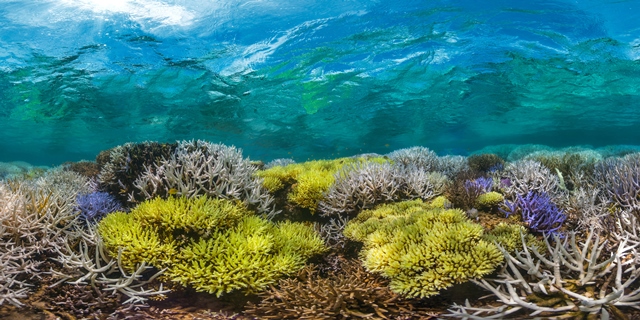
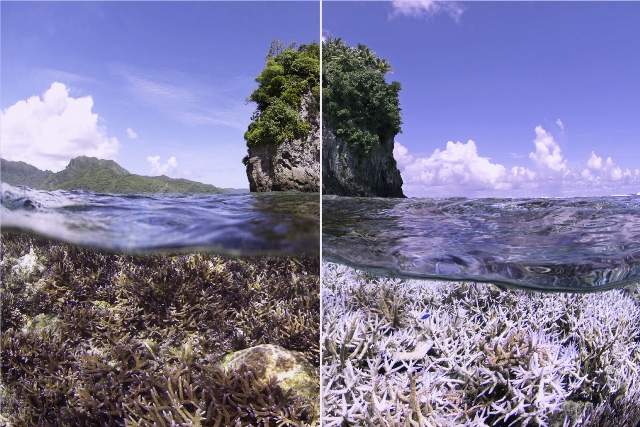
Images shot by the Chasing Coral crew graphically show the progress of the coral bleaching event in xx over xx days.

Images shot by the Chasing Coral crew graphically show the progress of the coral bleaching event that began in 2014.{credit}Chasing Coral, courtesy of Netflix{/credit}

First we take the plunge, off the boat and into the blue. Once the bubbles clear, wonders emerge. Guided by the camera, the eye is initially drawn to the obvious: turtles, rays, eels, jellies, fish. But the star of this show is a different kind of animal. The focus shifts, and we see a variety of fabulously intricate and colourful structures, some branched like trees, others spiny and globular. Each edifice in this marine metropolis was erected by corals — master builders now under unprecedented threat.

Director Jeff Orlowski begins his latest documentary, Chasing Coral, with this view of living abundance. Soon enough, we see death. Images of reefs left white and mostly lifeless give way to apocalyptic footage of dead corals, covered in algae and disintegrating in murky waters. Orlowski’s film, which launched on Netflix on 14 July, reveals the shocking reality of the global bleaching event that began in 2014, spurred by human-driven climate change and only now coming to an end.

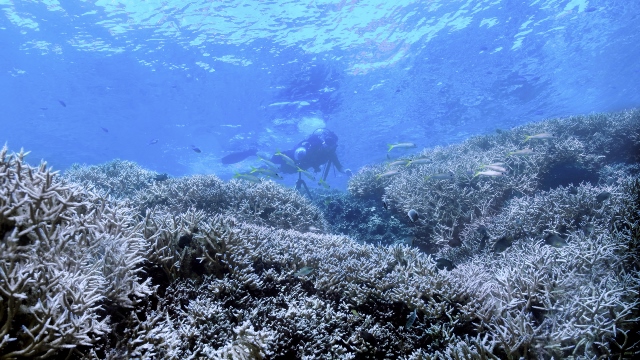
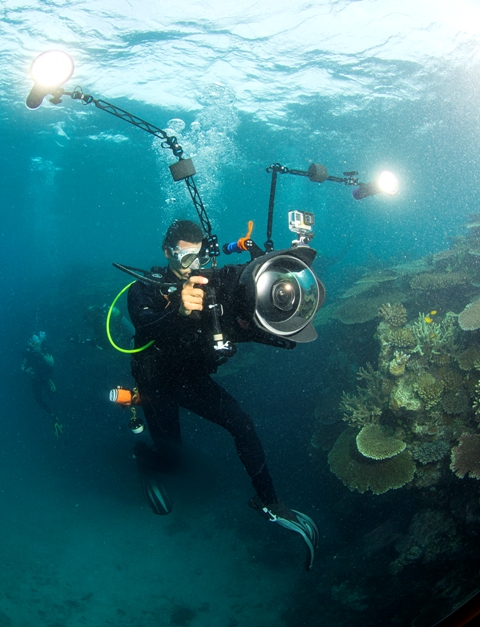
Jeff Orlowski filming corals on the Great Barrier Reef, Australia.

Jeff Orlowski filming corals on the Great Barrier Reef, Australia.{credit}Richard Vevers/Chasing Coral, courtesy of Netflix{/credit}

There are similarities between Chasing Coral and Chasing Ice, Orlowski’s 2012 documentary about melting glaciers, right down to the focus on time-lapse imagery to capture environmental degradation. But where Chasing Ice centres on James Balog, a National Geographic photographer who set up the Extreme Ice Survey to document ice shrinkage, Chasing Coral features, along with leading coral researchers, a curious collection of characters who embark on a technically daunting effort to document the transition from life to illness and death on a coral reef. The result is a fast-paced narrative arc that manages to carry a full-length film about global warming, the ultimate slow-boil.

Orlowski doesn’t hide anything. In fact, he becomes part of his own narrative through that of Richard Vevers, the man driving the project. A former advertising executive turned ocean activist and underwater photographer, Vevers relates how in 2010,  he decided to put his talents to better use: saving corals. After seeing Chasing Ice in 2013, he decided to contact Orlowski, who – in an intriguing meta-moment – makes an appearance in the film to talk about the genesis of the project.

A panoramic view of fluorescing and bleaching corals in New Caledonia in the southwest Pacific, in March 2016.

A panoramic view of fluorescing and bleaching corals in New Caledonia in the southwest Pacific, in March 2016.{credit}The Ocean Agency/XL Catlin Seaview Survey{/credit}

To its credit, Chasing Coral goes beyond personalities and crises and gets into the science – as well as the challenge of communicating that science and raising public awareness. “One of the biggest issues with the ocean is that it is completely ‘out of sight, out of mind’,” Vevers says. “And that is an advertising issue.”

The first step the crew faced was acquiring a high-quality camera capable of operating underwater remotely for weeks at a time. Enter View into the Blue, a company based in Boulder, Colorado, that adapted a high-resolution underwater camera – with its own wiper system to keep the domed-glass housing case clean –  for the project. Step two: figure out where to deploy the camera. Glaciers are easy to identify and visit, and nearly all of them are melting now. But setting up a time-lapse camera to capture the death of a coral reef due to warm ocean currents requires considerable planning and a measure of serendipity.

Mark Eakin, who heads the US National Oceanic and Atmospheric Administration’s Coral Reef Watch, provided forecasts and guidance on where to deploy. Vevers and the team figured out how to power the camera and retrieve data, but an initial deployment in Hawaii failed: the cameras lost their focus after the first shot. A second try on the southern Great Barrier Reef off Queensland, Australia, saw the warm waters (fortunately) failing to arrive.

A reef decimated by warm-water currents.

A bleached reef.{credit}Chasing Coral, courtesy of Netflix{/credit}

So the team ditched the automation altogether and moved north to Lizard Island, and on to New Caledonia. Here, they manually photographed dozens of sites each day for 40 days. It worked. At one location after another, we see a rapid decline from vibrant colour and biodiversity to whitening and death. At this point the film switches to the emotional journey of ‘coral nerd’ Zachary Rago. “I’m not even sad that we are leaving, because it’s so miserable here,” Rago says when the job is complete.

Basic science is interwoven throughout. Through coral researchers such as Ruth Gates and Ove Hoegh-Guldberg, we learn about the fascinating lives of corals, which operate as a collective to build and maintain an ecosystem that supports thousands of animals, from clown fish to sharks. We hear about the symbiotic relationship corals have developed with the algae living inside them, which provide their hosts with colour and energy through photosynthesis. And we see what happens when temperatures rise: the algae shut down and corals kick them out.

Chasing Coral also brings home the implications of decades of research. This latest global bleaching event, bolstered by a powerful El Niño in 2015-2016, is the third in recorded history; the first was in 1998. Research suggests that most of the world’s corals could perish within a few decades from rising temperature and ocean acidification without immediate action to halt greenhouse gas emissions.

The film mostly glosses over the scientific endeavour itself, however. After all, Vevers is the executive director of the XL Catlin Seaview Survey, a bonafide research initiative that launched in 2012 to catalogue the world’s corals (as Nature has reported here and here). But it’s a minor point. In the end, the film accomplishes its goals. Nobody knows precisely what an ecological collapse would mean for the oceans, but Chasing Coral makes it abundantly clear that it won’t be pretty. And perhaps that’s enough to inspire action.

Jeff Tollefson is a reporter for Nature based in New York. He tweets at @jefftollef. 


For Nature’s full coverage of science in culture, visit www.nature.com/news/booksandarts.
Double Shift: schooling Syria’s child refugees

xxx

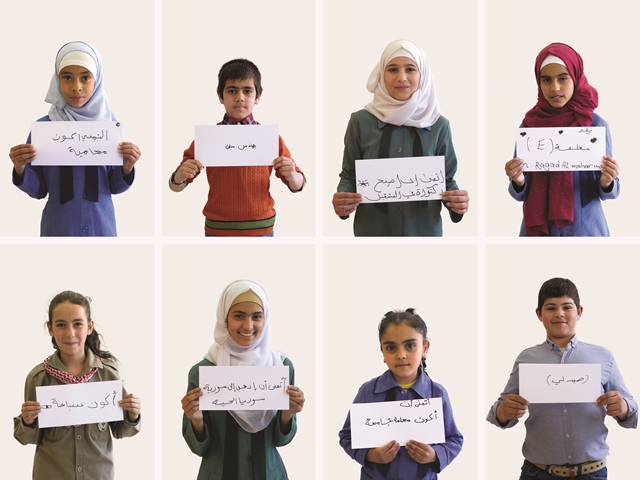
Jordanian and Syrian pupils in Al-Arqam school’s double-shift programme declare their ambitions, from doctor and ship’s engineer to teacher, swimmer and professor.{credit}Paula Ellguth, Marjam Fels{/credit}

Imagine this. You’re 12 years old. Half your family has been killed in conflict, and you find yourself in a country where every other word is a mystery. You’re desperate for stability — not least, school enrolment.

This is reality for many of the 8 million children who make up half the world’s refugees. Education is one of the biggest hurdles they face: only half have access to primary schooling. Potentially, they are a lost generation, at risk from abuse, trafficking and criminalisation, disenfranchised in ways and magnitudes unimaginable to many. A country’s loss of intellectual capital is tragic: how much more so, losing the intellectual future its children represent.

Now, a rich multimedia web documentary is revealing how Jordan — a nation hosting 657,000 registered Syrian refugees — is lighting a candle in the murk. Called Double Shift, the video, audio and text showcase the findings of an innovative social-science research project looking at how the “double shift” educational system, in which different groups are taught morning and evening, is working in the country. Already deployed for decades in Jordan and in other nations from Uganda to the United States, the system is being rolled out anew to accommodate children fleeing the war: Lebanon has adopted it, and Jordan, as Double Shift documents, is following suit to serve 160,000 school-aged Syrian refugees.

xxx

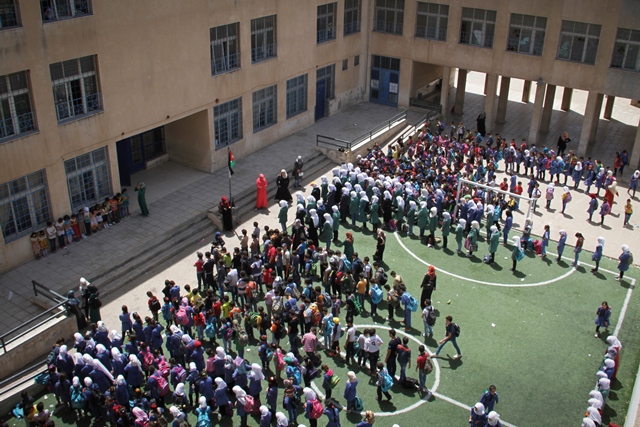
The noon switchover from the Jordanian to the Syrian cohort allows few close encounters. A football club and Saturday centre bridge the gap.{credit}Paula Ellguth, Marjam Fels{/credit}

Double Shift is a joint effort by the WZB Berlin Social Science Center and the European Bank for Reconstruction and Development. Its team of social scientists and visual designers used a variety of methods to capture data from Syrian refugee children in a Jordanian school, from “cultural probe” — giving students digital cameras to document their daily lives — to participatory workshops.

The findings reflect the day-to-day complexities child refugees cope with, notes Steffen Huck, director of WZB research unit Economics of Change. “Some showed the traumatic effects of the war in Syria,” he says. A questionnaire given to 88 Jordanian and Syrian students at Al-Arqam school in Sahab, southeast of Amman, is a case in point. It suggests overwhelming positivity about the school, with 90% reporting approval and more than half finding the classroom clean and safe. A subjective assessment hints at different insights.

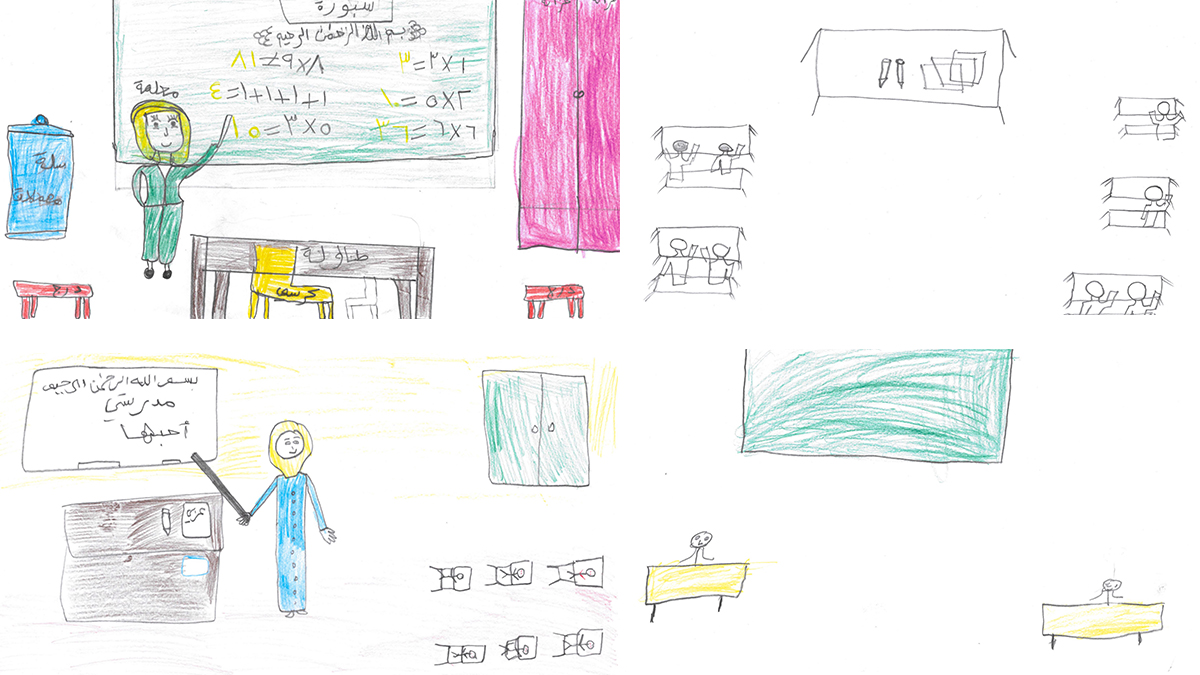
Each student was supplied with five colours and a pen and asked to draw their classroom. “The Jordanian children used significantly more colours than the Syrian,” Huck said. “They also painted in a larger portion of the sheet of paper.” Huck speculates that these differences could indicate relatively withdrawn psychological states among the Syrian children.

xxx

At Al-Arqam school, the differences in coverage and colour use between the Jordanian children’s drawings (left) and those of the Syrian child refugees were marked.{credit}Paula Ellguth, Marjam Fels{/credit}

Jordan’s public schools are already under strain, with teachers, classrooms, water, cooling and heating all in short supply. Class sizes can number 45. The pressures on both teachers and pupils are clear, and the separate shifts (Jordanian children in the morning, Syrian in the afternoon) risk entrenching difference. Yet as Double Shift documents, Al-Arqam is building bridges through a mixed soccer club and Saturday centre for study and play.

Meanwhile, Huck and colleagues have done the maths on another gain: US$167,552,165.00. That is their figure for the total net benefit to the country’s economy of enrolling 50,000 Syrian child refugees in Jordanian schools. As it happens, a new cohort of that size is poised to enter the educational system, thanks  to international funding and support from agencies such as UNICEF.

“As the Syrian civil war drags on with no end in sight,” Huck says, “Jordan’s efforts do not only set a humanitarian example but become more and more an investment in its own future.”

xxx

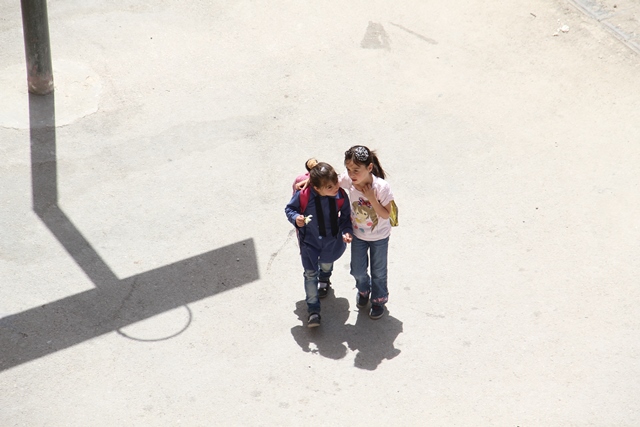
A rare meeting during the midday double-shift switchover.{credit}Paula Ellguth, Marjam Fels{/credit}

Double Shift offers a balanced examination of one school and the headteachers, parents and children who make up its community. It pans out, too, to the wider picture, where other factors come into focus.

Sarah Dryden-Peterson, who researches the nexus of education and social stability, has reported on serious issues with Lebanon’s double-shift programme on the non-profit Brookings Institute website. She reveals that Syrian children may be bullied, and that teachers may be exhausted and poorly trained to cope with their pupils’ psychological trauma. But solutions to fast-moving, critical situations often are partial or quasi-experimental.

If a ‘war child’ is to become an engineer, a surgeon, a pilot — as so many of the children interviewed by Double Shift passionately wish — it’s bedrock we need, not sand. As Dryden-Peterson has noted:

The average length of exile for refugees is 17 years. That’s the equivalent of a child’s whole shot at education, from birth to high school graduation… Syrian refugees do not need temporary education programs. They need access to a complete education.

Currently, debates over STEM teaching and anxieties over science in a politically chaotic world proliferate. Yet the fate of this traumatised, uprooted generation seems an afterthought to governments, who increasingly de-prioritize education in aid portfolios. Policymakers and pundits forget, perhaps, that it was refugees in flight from another appalling war who built American science and technology.


For Nature’s full coverage of science in culture, visit www.nature.com/news/booksandarts.