Suspended animation: Calder’s sculptural revolution

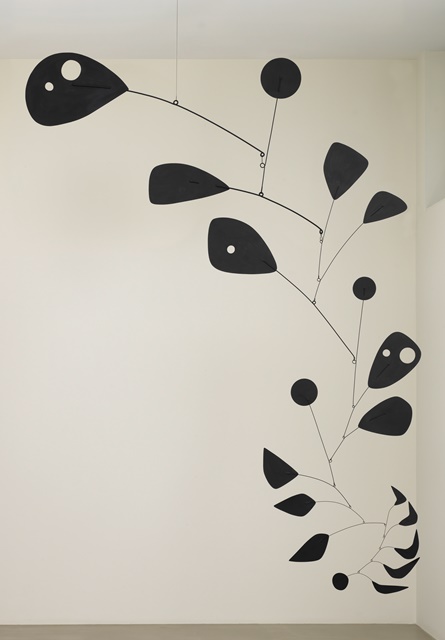
Alexander Calder's mobile Black Widow, c. 1948 (wire and painted metal), Instituto de Arquitetos do Brasil, São Paulo.

Black Widow, ca. 1948 (wire and painted metal), Instituto de Arquitetos do Brasil, São Paulo.{credit}© 2015 Calder Foundation, New York / DACS, London{/credit}

She hangs dark, immense and pocked with holes in a white room, a beast of many parts languidly revolving in the air. Part leaf, part lever, all magisterial grace, Black Widow is a quintessential Calder mobile — one of the signature inventions of the extraordinary twentieth-century artist-engineer.

This tremendous piece, three and a half metres long, is the finale to Alexander Calder: Performing Sculpture at London’s Tate Modern, a show that maps the evolution of Calder’s thought and practice on a route that is itself like the slow turn of a mobile. I spiralled through rooms mesmerised by manifestations of the propulsive, experimental drive of the man. Calder was not just a pioneer of kinetic sculpture and one of the first to use industrial materials other than pigments, such as steel. His early wire sculptures are scribbles in metal, yet miraculously evoke heft through mere line. And his fascination with sound and performance led to probings of chance and uncertainty that influenced avant-garde US composers such as Earle Brown and John Cage.
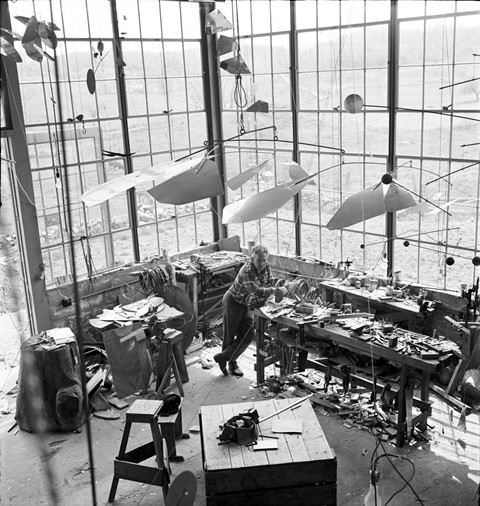
Alexander Calder in his Roxbury studio, 1941.

Alexander Calder in his studio in Roxbury, Connecticut, 1941.
{credit}Calder Foundation, New York / Art Resource, NY© ARS, NY and DACS, London 2014{/credit}

Astrophysics also exerted a singular pull on the artist. Fired by the sight, from shipboard, of a serendipitous equilibrium — a setting Sun and rising Moon on opposite horizons — Calder would declare years later that the “underlying sense of form in my work has been the system of the Universe”, the “idea of detached bodies floating in space, of different sizes and densities”. Calder was to investigate such momentous problems of motion and relationship in mobiles both wind-driven and motorised, such as A Universe (1934), in which two spheres go through different 40-minute cycles. (Einstein reportedly watched them from start to finish while viewing the piece in New York’s Museum of Modern Art.)

As the Tate show makes clear, Calder’s own balancing act — one foot in science, one in art — arose from both chance and deliberation. Born into a family of artists and sculptors, he decided at 17 to study descriptive geometry and applied kinetics at the Stevens Institute of Technology in New Jersey. He then pursued painting at New York’s seminal Art Students League in the early 1920s and, after experimenting with metal sculpture, set off in 1926 for the cultural crucible of Paris.

Here he began to explore the suggestion of movement in the fluidity of works in wire such as Hercules and the Lion (1928). The star of this period, however, is the Cirque Calder, a troupe of miniature acrobats and animals sculpted in wire, wood, cork, fabric and other materials and used for live-action shows that enthralled the likes of Joan Miró and Piet Mondrian. While the ingenious palette of materials may owe something to the Constructivism of Russian-born artist Naum Gabo, the wit and dogged study of the physics of moving objects are Calder’s own. A 45-minute film of him putting his performers through their paces, as fiercely concentrated as a four-year-old with a train set, is a major delight of this show.
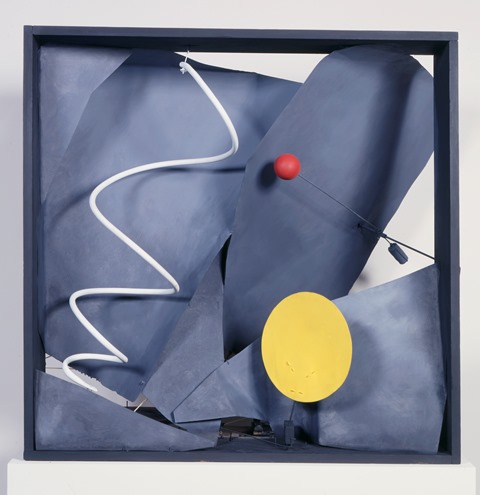
Black Frame, 1934.

Black Frame, 1934: one of Calder’s motorised sculptures. {credit}Calder Foundation, New York © 2015 Calder Foundation, New York / DACS, London{/credit}

And it’s one among many. We can, for instance, trace the gestation of Calder’s mobiles from his visit to Mondrian’s Paris studio in 1930, where he wondered why the Dutch painter didn’t set the cardboard rectangles he used to aid composition oscillating. Mondrian was dubious; Calder felt “like the baby being slapped to make its lungs start working”.
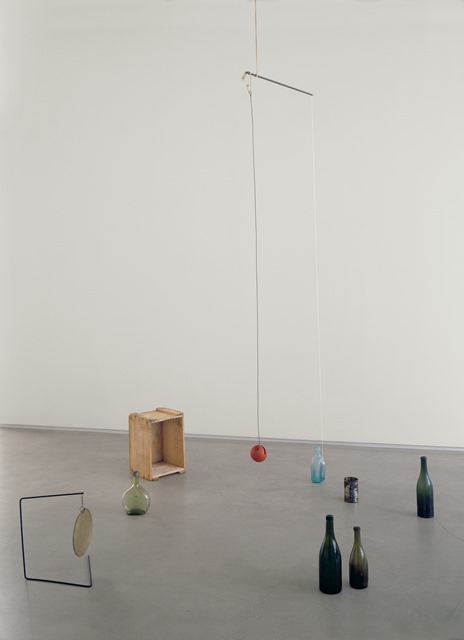
Small Sphere and Heavy Sphere 1932/33 (iron, wood, cord, thread, rod, paint, and impedimenta).

Small Sphere and Heavy Sphere 1932/33 (iron, wood, cord, thread, rod, paint, and impedimenta).{credit}Calder Foundation, Mary Calder Rower Bequest, 2011 © 2015 Calder Foundation, New York / DACS, London{/credit}

He began creating free-standing wire constructions hung with geometric forms in white, black and Mondrian-esque primaries, such as Small Feathers (1931). He played with mechanised motion in works like Black Frame (1934). And, distributing force through precise arrangements of levers and their fulcrums, he created suspended mobiles — suggesting orbiting planets, snowstorms, schools of fish, flotillas of cloud or, as some have noted, animated Mirós. He became an engineer of air, a definer of space.

Around the same time, Calder’s interest in the aural grew. The elements of his sculptures, he noted, were “weight, form, size, colour, motion and then you have noise”. Small Sphere and Heavy Sphere (1932/3) is an open-ended experiment in which two suspended coloured balls are arranged so that one hits a collection of bottles, a box, a can and a gong. Visitors would reorganise these to create randomised ‘compositions’.

Such investigations of ‘open form’ reached a new pitch in the 1940s. Calder fitted large mobiles such as Triple Gong (1948) with beaters and differently pitched brass gongs to create evocative music as they shifted in air, not unlike exquisitely calibrated windchimes. Later still, he collaborated with Earle Brown on Calder Piece, a “sonic animation” of Calder’s mobile Chef d’Orchestre, which by moving ‘conducts’ a percussion ensemble.

As the show reveals, Calder’s boldness in testing possibilities extended to other materials and contexts. Mercury Fountain, created for the Spanish Pavilion at the 1937 World’s Fair in Paris  is one; there were also theatrical sets, the Water Ballet, an ‘acoustical ceiling’ in Caracas — and more.
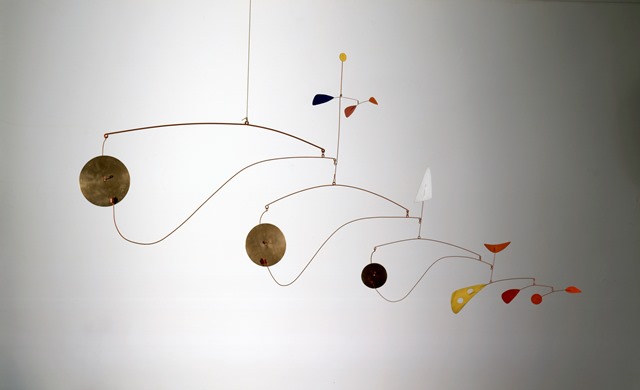
Triple Gong, ca. 1948 (brass, sheet metal, wire, paint).

Triple Gong, ca. 1948 (brass, sheet metal, wire, paint).{credit}Calder Foundation, New York © 2015 Calder Foundation, New York / DACS, London{/credit}

Scientifically inspired art of the twentieth century might seem the usual seepage of ideas across disciplinary boundaries. Painters such as the Dadaist Max Ernst and muralist Diego Rivera were deeply influenced by developments in mathematics and particle physics, for instance. Sculptors, however, did not just depict; they embodied. Calder shaped the stuff of physics into a biomorphic aesthetic to rival Barbara Hepworth’s. And like Hepworth and her insistent use of voids in solid form, he found a way to marry the immateriality of air with a significant tonnage of standing and hanging metal.

This reassessment of an artist who created 22,000 works over an unstoppable career was a journey of discovery for me. As a child of thoroughly modernist artists, I early on absorbed (and loved) many of Calder’s works. But I found myself entranced, and educated, all over again — and seething with questions. I’d give a hell of a lot to know, for instance, what was going through Einstein’s mind as he gazed at Calder’s A Universe.

Alexander Calder: Performing Sculpture runs at Tate Modern, London, through 3 April 2016. The quotes from Calder in this piece are from the show’s programme notes.


For Nature’s full coverage of science in culture, visit www.nature.com/news/booksandarts.
On reflection: the art and neuroscience of mirrors

Posted on behalf of Alison Abbott

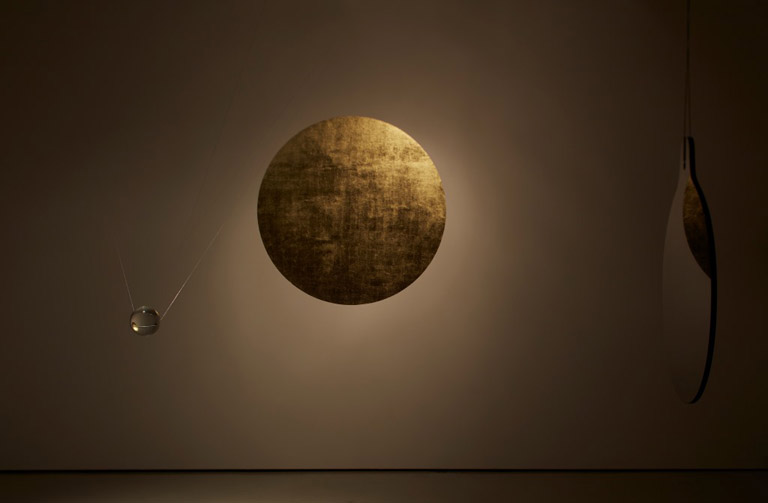
The installation Smoking Mirror by Otavio Schipper and Sergio Krakowski, 2015.

The installation Smoking Mirror by Otavio Schipper and Sergio Krakowski, 2015.{credit}Nick Ash{/credit}

Two linked exhibitions in Berlin – Mirror Images in Art and Medicine and Smoking Mirror – begin where Narcissus left off. The hero of Greek mythology wasted away gazing transfixed at his own beauty reflected on the surface of a dark pool. He left his name both to the narcissus (daffodil) that sprang up on the banks where he died, and to psychology.

The desire to see one’s own reflection more conveniently than kneeling at the waters’ edge on a sunny day  appears universal. Most of the world’s major cultures invented their own types of portable mirror over the millennia. The earliest so far found, in Anatolia, were made from polished obsidian, a naturally occurring volcanic glass, and date back 8,000 years. Later came mirrors made from polished metal, and around the first century AD, metal-coated glass.

Examples of mirror-based objects – like the extraordinary non-reversing mirror invented by US mathematician Andrew Hicks in 2010 – are on display in Mirror Images at the Museum of Medical History at the Charité. But at its most provoking, the exhibition explores the psychological and neuroscientific power of reflections. It departs from the relatively simplistic notion of narcissism – an unhealthy concern with one’s self – to examine deeper and altogether more fascinating concepts of ‘self’.  How do we perceive the boundary between the outer limits of our body and the environment in which our bodies move? Is our perception of our individual ‘self’ constant or manipulable?

These concepts have both medical and philosophical significance. In the past half-century, artists have been doing their own explorations of what self means, exploiting video technology to capture ‘reflections’ more permanently than mirrors can. Mirror Images shows, as few similar ventures have been able to do, how art and science really do sometimes converge on important questions in a meaningful way.

'Maintenance III (Self Portrait)' by William Anastasi (1967).

‘Maintenance III (Self Portrait)’ by William Anastasi (1967). {credit}© William Anastasi{/credit}

The exhibition showcases several mirror-containing instruments that transformed medicine in the nineteenth and early twentieth centuries. Among them is an exquisite 1851 ophthalmoscope in its original wood, velvet and silk case. Invented by pioneering physicist and physiologist Herrmann von Helmholtz, the instrument was the first to allow light to be shone directly into any part of the body that is sealed from the environment by a membrane, and it gave physicians their first view inside a functioning eye. This was long before photography became common, so physicians had to draw what they saw there. A sample watercolour alongside the ophthalmoscope shows how impressive their artistic skills could be.

The exhibition also showcases the healing potential of reflections. A series of photographs on display, taken of herself in different locations during paralysing panic attacks, helped artist Sabina Grasso to cure her psychological disorder. She says the cure resulted from being able to contemplate from a distance the images of her own captured body.

A version of neuroscientist Vilayanur Ramachandran’s famous mirror box is available for visitors to test its illusory powers on their own bodies. Ramachandran  developed the deceptively simple device in the 1990s to help amputees who feel phantom pain from their missing limb. The pain may occur because the brain responds as if the limb were not missing, but in spasm. The patient places his or her remaining limb in front of a vertical mirror so that its reflection appears as if it could be the missing limb. The brain registers the spasm-free movements and, in some cases, stops sending the painful signals.

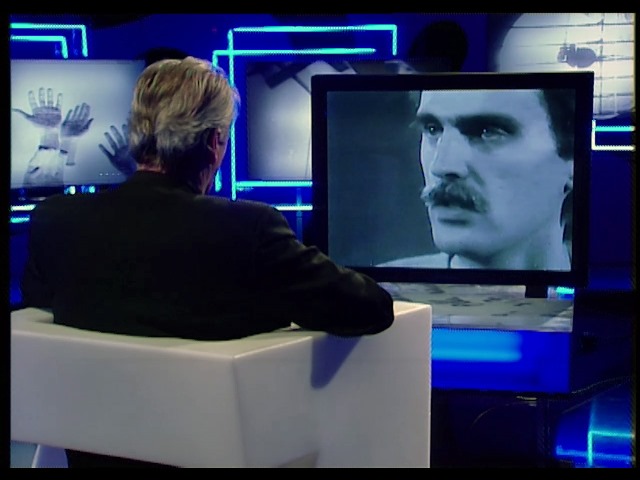
'DM/1978 Talks to DM/2010'. In this media project by Dalibo Martinis, the artist answers questions he posed to himself over 30 years before.

‘DM/1978 Talks to DM/2010’. In this media project by Dalibo Martinis, the artist answers questions he posed to himself over 30 years before. {credit}Dalibo Martinis{/credit}

A different, even more startling, type of body illusion is presented by Croatian artist Dalibor Martinis in a video interview between two of his ‘selves’, separated by more than three decades. In 1978, at 31, he video-recorded a series of questions, in English, addressed to his future self. The mature Martinis responds in 2010 in a Croatian television show. He finds his younger self “a bit puffed up”, and comments “if we are at all the same person, it is neither you nor I”.

Across town, a darkened exhibition room at the Schering Foundation hosts the mesmerizing installation Smoking Mirror. It was created by two Brazilian artists: one, Otavio Schipper, has a degree in physics; the other, jazz musician Sergio Krakowski, a PhD in mathematics.

The artwork comprises three reflecting objects suspended from the ceiling, each inspired by the working tools of the astronomer-astrologer mathematician John Dee, advisor to the Tudor Queen Elizabeth I. One is a large obsidian mirror, another a glass sphere filled with water, and the third, a circular, concave surface coated with gold. (The originals are held in the British Museum.) Sound waves emitted from speakers on opposite walls during a 26-minute sound composition by Krakowski cause the objects to turn slowly, shifting their mutual reflections as ever-changing lighting plays on their surfaces.

And the mesmeric sounds? The brain-wave frequencies recorded during different states of consciousness (awake, sleeping, dreaming); frequencies of resonances in the Earth’s atmosphere; spoken sequences of numbers recorded from the mysterious shortwave numbers radio stations in the airways whose purposes may be espionage. The installation keeps just this side of mysticism, but its draw is like that of Narcissus to his pool. The sensory domination does, as intended, channel the minds of visitors, turning thoughts inwards.

 Alison Abbott is Nature’s senior European correspondent.

Mirror Images runs at the Museum of Medical History at the Charité, Berlin, Germany, until 3 April 2016. Smoking Mirror runs at the Schering Foundation, Berlin, Germany, until 23 January 2016.


For Nature’s full coverage of science in culture, visit www.nature.com/news/booksandarts.
The making of Alice

Posted on behalf of Alysoun Sanders

Alice and the White Rabbit.

John Tenniel’s illustration of Alice and the White Rabbit in Alice’s Adventures in Wonderland.{credit}© Macmillan Publishers Ltd{/credit}

On 19 October 1863 an unknown mathematician, Charles L. Dodgson, was introduced to the publisher Alexander Macmillan in Oxford by Thomas Combe, director of the Clarendon Press and printer to Oxford University. Macmillan’s publishing business, established with his brother in 1843, was growing. He had built a reputation among scholars and authors as a leading academic publisher in fields such as mathematics and geology.

Dodgson, a master and tutor at Christ Church, Oxford, was friends with the Christ Church dean Henry George Liddell. On 4 July 1862 Dodgson, his friend the Reverend Robinson Duckworth and Liddell’s eldest daughters Lorina, Alice and Edith, rowed up the Thames to Godstow — the “golden afternoon” when Dodgson responded to Alice’s pleas for a story with the rudiments of what would become Alice’s Adventures in Wonderland. The first version was a handwritten and self-illustrated manuscript, Alice’s Adventures Underground, which Dodgson presented to Alice in 1864. The final book would be published by Macmillan under Dodgson’s pen name, Lewis Carroll.

Carroll insisted on a bold red cover for Alice’s Adventures.{credit}© Macmillan Publishers Ltd{/credit}

Macmillan had published Charles Kingsley’s children’s novel The Water Babies in 1863 to contemporary acclaim. Realising the potential of Carroll’s tale, he agreed to take it on a commission basis: Carroll paid for the printing and marketing, while Macmillan was paid a set commission on sales. Macmillan went on to publish all of Carroll’s books, as well as many of his works written under his own name, on mathematics, geometry and logic (as well as Lawn Tennis Tournaments: The True Method of Assigning Prizes, with a Proof of the Fallacy of the Present Method).

So, intertwined with the story of Carroll’s intrepid heroine Alice is the story of another remarkable journey — the long alliance of a brilliant author and enabling publisher who together created a world tale. Alice’s Adventures in Wonderland has never been out of print with Macmillan since 1865, and has been translated into more than 170 languages.

A deep bond

Carroll and Macmillan had a rare mutual respect, love of literature, and interest in education, new technologies, innovation and scientific enquiry. (A rich source for the depth of this relationship is the volumes of their outgoing correspondence in the Macmillan archive at the British Library.) The writer did not attend Macmillan’s famous “Tobacco Parliaments”, where a scientific magazine, which became Nature, was mooted. He preferred to keep his identity secret, but regularly visited Macmillan and his family and sent them puzzle books to try out before publication.

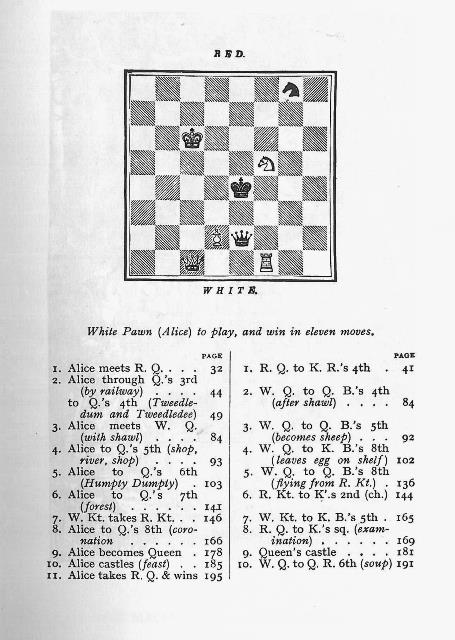
Chess diagram from Through the Looking-Glass, with the Kings in place (Macmillan, 1871).

Chess diagram from Through the Looking-Glass, with the Kings in place (Macmillan, 1871).{credit}© Macmillan Publishers Ltd.{/credit}

The relationship between the two men was not without some tension, however. Carroll took a great interest in the printing, design and production of his books, discussing all aspects of the process with Macmillan. His eye for beauty, order and perfection and his expertise in the then intricate, difficult technology of photography drew him to such technicalities. This could backfire. He frequently delayed publication because he was unhappy with the quality of production (or instructing the printers to let the paper dry for long enough before binding). In 1878, he insisted that slips should be inserted into copies of Through the Looking-Glass, and What Alice Found There after observing that both the Kings had vanished from the chess-diagram in the front of the book.

Carroll’s meticulous instructions extended to securing parcels: a diagram showing how the string was to be knotted hung in the Macmillan post-room for many years. His careful analysis of accounts for his books, in particular the Alice volumes, caused him to question booksellers’ profits – a concern shared by Alexander and later addressed by his nephew, Frederick Macmillan, leading to the Net Book Agreement of 1899.

A technological tale

At the start of Alice’s Adventures, Alice wonders, “what is the use of a book…without pictures or conversations?” Up to this time, children’s books were sparsely illustrated. The creative Carroll — ever interested in visual impact, particularly on his young readers — realised their importance in storytelling, however, and asked artist John Tenniel, cartoonist at the satirical magazine Punch, to illustrate the book.

These classic drawings have become as well known as the story. Beautifully capturing Alice and the characters in Wonderland and the looking-glass world, they are cleverly incorporated into the text through innovative positioning on the page.

An electrotype of Tenniel's illustration of Alice and the Cheshire Cat in Alice's Adventures, and the printed result.

An electrotype of Tenniel’s illustration of Alice and the Cheshire Cat in Alice’s Adventures, and the printed result.{credit}© Macmillan Publishers Ltd{/credit}

Tenniel first made pencil drawings, then created a tracing from which the main features were transferred in reverse to a woodblock; the drawing was finished on the block, which was then sent to be engraved by the Dalziel brothers, George and Edward. The leading Victorian commercial wood engravers, the Dalziels also worked with artistic luminaries of the day, including pre-Raphaelites John Everett Millais and Edward Burne-Jones. Printing was not done from the blocks; more durable copper electrotypes (electros) were cast to save the wood.

Macmillan suggested their use — ultimately, sound advice from one who could not have foreseen how many copies would eventually be printed. The electros wore out after several thousand printings, after which they were melted down and recast.

The 'Mouse's Tale' in Alice's Adventures was too tricky to set in type, so was treated like an illustration.

The ‘Mouse’s Tale’ in Alice’s Adventures was too tricky to set in type, so was treated like an illustration.{credit}© Macmillan Publishers Ltd.{/credit}

A set of electros was held by the printer Richard Clay, who continued to print from them until the introduction of letterpress in the 1960s. A spare set is still held in the Macmillan archive, including an electro for the ‘Mouse’s Tale’. This section of text had to be treated like an illustration; it was too tricky to set, being narrow and serpentine like a tail. (For more on this, see The Complete Alice.)

After Carroll’s death, the woodblocks were handed over by his estate to Macmillan. In 1932, they were displayed at the Lewis Carroll Centenary exhibition in London, after which they were thought to have been moved to a museum or library.

However, in October 1984 Macmillan’s company secretary was called to the National Westminster Bank to open several metal trunks that had lain in its Covent Garden vault for years. To his amazement, he found the woodblocks, stored there in almost perfect conditions.

It was decided to take one unique printing from the blocks, which had never been printed from directly. This was skilfully done by the Rocket Press — 92 prints in a limited edition of 250 copies, together with a specially commissioned book on the engravings. It is copies of these prints that have been scanned to create the images for the 150th anniversary editions published by Pan Macmillan in 2015. The blocks are now in the British Library.

Alexander Macmillan's descendant Lord Stockton with Lord Boardman, chairman of the National Westminster Bank, look at the original woodblocks made by the Dalziel brothers for Tenniel's illustrations for the Alice books

Lord Stockton (great-great grandson of Alexander’s brother Daniel Macmillan) and Lord Boardman, chairman of the National Westminster Bank, look at the original woodblocks made by the Dalziel brothers from Tenniel’s illustrations.{credit}© Macmillan Publishers Ltd.{/credit}

Publishing disaster — and triumph

In 1865, Carroll was keen for the first edition of Alice’s Adventures to come out as close as possible to the day on which the story was first told, three years before. Despite long delays, it was printed by the Clarendon Press in good time. Dodgson ordered a specially bound white vellum copy to be received by Alice Liddell on 4 July.

Then, on 19 July, the exacting Tenniel wrote to say that he was dissatisfied with the printing of the illustrations. As there were also faults with the printing of the text, all copies were withdrawn. The book, reprinted by Richard Clay, was finally published on 11 November that year in time for the Christmas market (and so bearing the year 1866 on the title page).

It was originally agreed that the unbound sheets of the faulty edition would be sold as waste paper. Instead, US firm David Appleton & Co bought them and 1,952 copies (of the original 2,000 copy print run) were sent to New York. The title page was redone with a New York imprint dated 1866, and the sheets machine-folded and put into cloth bindings. Of the copies not sent to the United States, just a few are known to have survived, and are extremely valuable.

The Macmillan file copy of the rejected printing, including 10 of Tenniel’s original preliminary pencil drawings, was acquired by Lord Swaythling around 1899. Eventually it made its way to collector Justin G. Schiller, who identified the purple markings as those made by Macmillan staff to show corrections for the new printing.

Within three weeks, 500 copies of the corrected November edition had been sold. On 23 December, The London Review deemed it “a delightful book for children” and “for grown-up people, provided they have wisdom or sympathy enough to enjoy a piece of downright hearty drollery”. That it was a trove of mathematical conundrums had yet to be discovered.

At Carroll’s death in 1898, the total number of copies sold by Macmillan exceeded 150,000.

A page from the 'Macmillan Editions Book' showing print runs from the end of 1865 to the end of 1875.

A page from the ‘Macmillan Editions Book’ showing print runs from the end of 1865 to the end of 1875.{credit}© Macmillan Publishers Ltd{/credit}

Almost four years after Alice’s Adventures was published, Nature emerged on 4 November 1869. It is likely that the profits from book publishing, including those from the Alice books, enabled Macmillan to continue to publish the journal for many years. Carroll himself became a contributor to Nature.

The phenomenally fruitful and occasionally fraught partnership of author and publisher lasted for over three decades. It was a bond Carroll publicly celebrated as a factor in the success of the Alice books. In his The Profits of Authorship (Macmillan, 1884), he wrote:

The publisher contributes about as much as the bookseller in time and bodily labour, but in mental toil and trouble a great deal more. I speak…having myself, for some twenty years, inflicted on that most patient and painstaking firm, Messrs. Macmillan and Co., about as much wear and worry as ever publishers have lived through. The day when they undertake a book for me is a dies nefastus for them. From that day till the book is out – an interval of some two or three years on an average – there is no pause in the ‘pelting of the pitiless storm’ of directions and questions on every conceivable detail. To say that every question gets a courteous and thoughtful reply – that they are still outside a lunatic asylum – and that they still regard me with some degree of charity – is to speak volumes in praise of their good temper and of their health, bodily and mental.

The electro of Alice and the White Rabbit.

The electro of Alice and the White Rabbit.{credit}© Macmillan Publishers Ltd.{/credit}

Alysoun Sanders is the archivist for Macmillan Publishers Ltd.

See Macmillan’s ‘Alice: 150 years’ website here. Mathematical Wonderlands: Lewis Carroll, the Alice books and beyond — a new ebook collection of pieces by and about Carroll in Macmillan publications, Nature and Scientific American — is available here. (Morton Cohen’s The Selected Letters of Lewis Carroll, published by Palgrave, also offers fascinating insights into Carroll as mathematician.) The British Library’s exhibition Alice in Wonderland runs from 20 November to 17 April 2016. 


All images are from The Macmillan Archive, © Macmillan Publishers Ltd.

For Nature’s full coverage of science in culture, visit www.nature.com/news/booksandarts.