The deck stacked against women in science

Posted on behalf of Nicola Jones
xxx

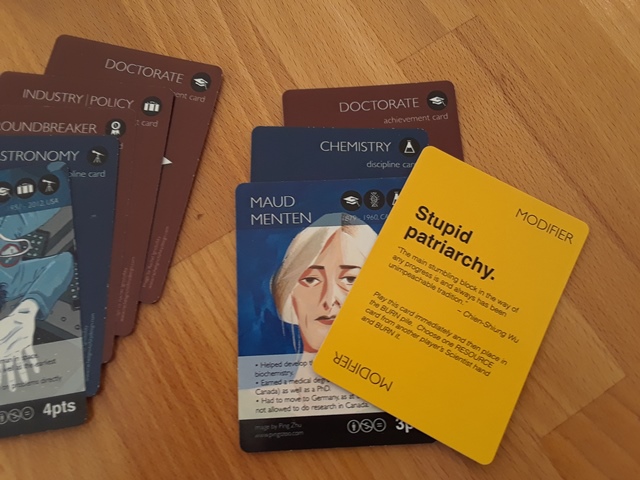
The card deck featuring women in science and engineering.{credit}Nicola Jones{/credit}

The player on my left has the biochemist Maud Menten’s career well on track. Suddenly another player slaps a “stupid patriarchy” card on Menten’s head, and she has to earn her doctorate all over again. So goes a novel card game devoted to women in science and engineering, designed to highlight these unsung researchers and the barriers and boons that women in these fields experience.
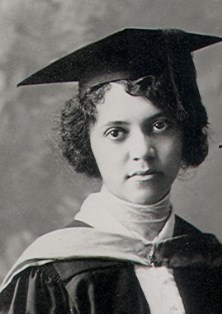
Alice Ball, the chemistry student who

Alice Ball, the chemist who isolated an early effective treatment for leprosy.{credit}University of Hawaii{/credit}

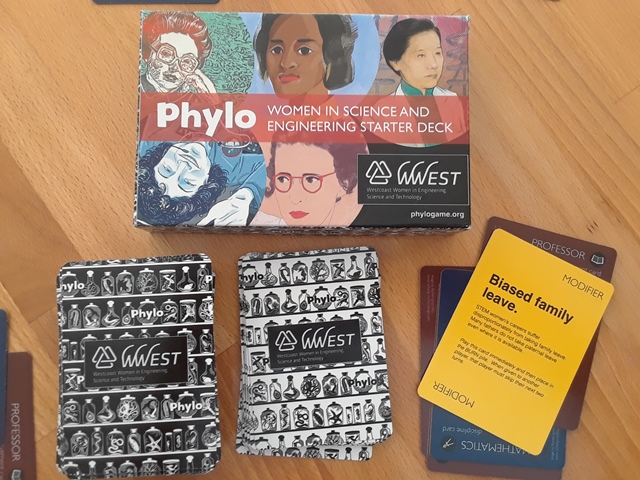
Menten (1879-1960) was one of the first women in Canada to earn a medical degree atop her PhD. But at the time women weren’t allowed to do research at Canadian universities; she had to conduct her famous work on enzyme kinetics in the United States and Germany. Menten is one of 21 pioneering women scientists, mostly from North America, featured in the game — the latest in a series that began in 2000 with a biodiversity game called Phylo. The card deck was developed by an innovative science outreach programme at Vancouver’s University of British Columbia (UBC), in collaboration with Westcoast Women in Engineering, Science and Technology (WWEST) at Burnaby’s Simon Fraser University (SFU). Players complete researchers’ careers by collecting cards for achievements such as degrees, and try to avoid setbacks — such as the “tokenism” card, which wipes a scientist in play off the table.

“These are my favourites,” says computer engineer and WWEST chair Lesley Shannon, pointing to Alice Ball and Hedy Lamarr. Ball (1892-1916), the first woman and African-American Masters graduate from the University of Hawaii, developed a critical leprosy treatment. After her early death, university president Arthur Dean took credit for her work. Hollywood star Lamarr (1914-2000) co-invented frequency technologies used in WiFi and beyond.

Hollywood star and xxx Hedy Lamarr.

Hollywood star Hedy Lamarr co-invented key frequency technologies.{credit}MGM{/credit}

Shannon and I put the game through its paces with three researchers from SFU: applied ecologist Anne Salomon, glaciologist Gwenn Flowers and physicist Sarah Johnson. We try to figure out the best strategies and which cards to play: scientists with more complex careers are worth more points. Completing the challenging career of a woman of colour nets a bonus point. Modifier cards can help as well as hinder progress: “mentors are awesome”, for example, gives a player a boost via an extra card.

The discussion provoked by the game is as interesting as the action. Sighs of recognition greet the setback card “ways of the Queen Bee”, which marks how women scientists sometimes undermine female colleagues. “I’ve been there,” says Shannon. Johnson counters: “I haven’t experienced this — perhaps because I haven’t had many female colleagues.”

Some have positive stories to tell: Salomon recalls one senior female mentor who offered to review her grant requests, in the name of building up a “good old girls’ club”. Since, she has tried to pay that idea forwards, helping more women to be invited onto panels or keynote lectures, get funding and publish. “We retain the rigour of peer review,” she says, “but that back door works to even the balance.”

Although women have, since the 1990s, earned about half of US science and engineering undergraduate degrees, as of a 2011 study they still held fewer than 25% of STEM jobs, were paid 86 cents on the dollar, and were seriously under-represented in degrees for fields like engineering. A recent study in Science showed that girls tend to think less of their intellectual abilities as early as age six. When 96 children were told a story about a “really, really smart” adult and asked to pick a face to match the story, for example, 5-year-old boys and girls both picked someone of their own gender about 70% of the time. But among 6- and 7-year-old girls, this percentage dropped to about half. More role models are among the many fixes proposed to shift the entrenched bias.
xxx

{credit}Nicola Jones{/credit}

WWEST’s mission is to help reverse such trends, in part by funding outreach projects. So when David Ng — who handles educational outreach for UBC’s Michael Smith Laboratories — approached them with the idea for the game in 2015, it was a good fit. Ng’s initiatives have included literary science magazine Science Creative Quarterly and other card sets (such as Phylo).

The games are crowd-sourced; anyone can invent one, or contribute to one, and the sets are available to download for free. If you play it, you start to get at least an inkling of the challenges around gender equity,” says Ng. “This is just a starter deck. Hopefully people will add to it.”

While aimed at pre-teens, when Shannon says many girls begin to turn away from science, the appeal of the women-in-science game is broader. Some of the harsher modifier cards (such as one that reads “mistaken for a janitor”) could, note Shannon and Ng, be removed from the game for more-impressionable age groups.

Mid-game, Johnson looks at the cards on the table and comments: “They’re all overachievers”. These women, she notes, had to be smarter and work harder to get the same recognition as male scientists — echoing her own undergraduate experience. “All of the female physics majors I knew were A students. This was not true of the men,” she says. That’s just one thing this worthy game aims to reverse.

Nicola Jones is a freelance science writer and editor living in Pemberton, British Columbia.

Download the game at https://www.sfu.ca/wwest/projects/phylo-card-deck.html

For more on science and culture, see: https://go.nature.com/2CMOwaL

 

The 30-year-old snowman

Snowman, 1987/2016 (multimedia), by Peter Fischli and David Weiss.

Snowman, 1987/2016 (multimedia), by Peter Fischli and David Weiss.{credit}Peter Fischli and David Weiss © the artists, courtesy Matthew Marks Gallery; photo: Mary Ellen Hawkins, courtesy SFMOMA{/credit}


Posted on behalf of Michael White

It stands there trapped in a frosty cage: a 30-year-old snowman in a state of bliss, its currant-shaped eyes peering out over a lopsided grin in a face dotted with frozen florets.

The glass-fronted aluminum cooler currently sits at the San Francisco Museum of Modern Art. Above the sculpture, entitled simply Snowman, the understorey citizens of a redwood forest sway in the United States’ largest living wall. The tensions are inescapable: snow, a natural process, in a totemic form, in a machined box, surviving on electricity, juxtaposed against an artificial ecosystem. The installation is a brilliant encapsulation of our mixed-up global environment now — from polar melt to green cities.

Snowman was constructed in 1987 by Swiss artistic duo Peter Fischli and David Weiss for the Römerbrücke power plant in Saarbrücken, Germany. Toying with the idea that human enterprise could prolong an inherently transient existence, they crafted a technically fascinating sculpture. Its scaffolding is, as Fischli puts it, a “skinny snowman” constructed from copper. Under controlled humidity and temperature, the snowman grows and shrinks and alters itself – one day the eyes narrower, the next a different twist to the smile. The snow also alters the chamber’s microclimate; technicians adjust the dials to prevent a runaway snowman.

It’s not all fun and games and engineering. The snowman’s remarkable longevity and technical underpinnings provoke reflections on our climate, and the possibility that we too may be forced to control our own environment.

What of the Paris Agreement’s ambitious goal of keeping global warming to no more than 1.5 ⁰C? Doing so, without geoengineering, looks almost impossibly optimistic. With geoengineering, we will become the snowman, our climatic stability reliant on fiddling with dials. Only this time the outcome is uncertain and fraught with ethical dilemmas, ranging from disrupted monsoons to a rain of metallic nanoparticles.

Snowman would perish without electricity, as its intentionally obvious, preposterously long power cord reminds. Yet its built-in grin fizzes with joy. There is, after all, always the next installation. What of our own shrinking cryosphere, much of which is in rapid retreat? Technically, we can probably prevent the loss of the biggest chunks of ice, such as the Greenland and West Antarctic Ice Sheets. But I doubt that we’ll be feeling blissed-out about it.

Michael White is senior editor in physical sciences at Nature. He tweets at @MWClimateSci.

Snowman by Peter Fischli and David Weiss is on view at the San Francisco Museum of Modern Art through March 2018.


For Nature’s full coverage of science in culture, visit www.nature.com/news/booksandarts.

Rocket woman

xxxx

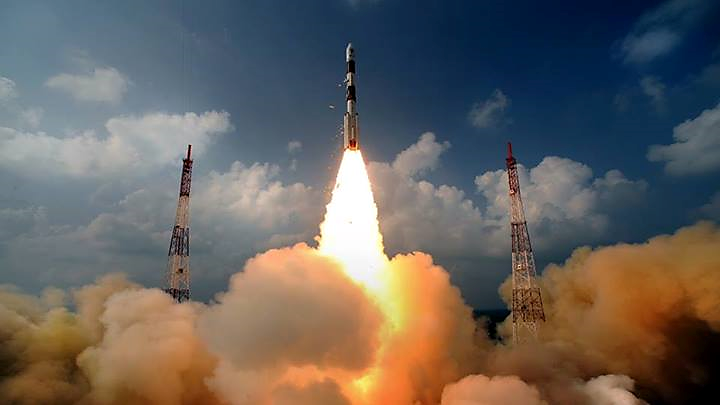
The Polar Satellite Launch Vehicle of the Indian Space Research Organisation, which carried the Mars Orbiter Mission satellite Mangalyaan. The payload included instruments developed by Dutta and her team.{credit}ISRO{/credit}

3Q: Moumita Dutta

A physicist at the Indian Space Research Organisation’s Space Applications Centre, Moumita Dutta was part of the team that put a probe into Mars orbit in 2014. The instruments they designed for the Mangalyaan are still beaming back data. Now India is gearing up for its third planetary mission in 2018 — Chandrayaan-2, a return to the Moon. As Dutta prepares to take part in the London Science Museum’s Illuminating India events, she talks about the lure of optics, the challenge of crafting super-light sensors, and the rise in Indian women entering space science.  

Tell me about your work with the Indian Space Research Organisation (ISRO).

Moumitta Dutta.

Moumitta Dutta.

In my childhood I had dreamed about space, aliens, the Universe, the stars – particularly the aliens! But I didn’t think I would be involved in space science. I became interested in physics when I saw the magnificent colours coming out of a prism in an experiment at school. I ended up doing a master’s in applied physics, specialising in optics. Then one morning in 2004 I read in the local newspaper that India was preparing for its first lunar mission, and I thought ‘What a phenomenal thing’. From that moment on I wanted to join the ISRO. A year and a half later, I did, ending up working on two sensors that would fly on the Chandrayaan-1 project [India’s first lunar mission, which launched in 2008 and found evidence of water before losing contact with Earth.] My base is the Space Applications Centre in Ahmedabad, mainly working on optical sensors for studying Earth and for planetary missions. For India’s 2018 lunar mission, Chandrayaan-2, we will use advanced versions of the sensors flown in the last mission, carrying out a very detailed study of the lunar surface and mineralogical mapping. There will be an orbiter, a lander and a rover, with mounted instruments to carry out experiments on the surface.

Mangalyaan launched just 18 months from its conception, costing a relatively low US$75 million.  What challenges did you face in building its sensors? 

All the sensors were designed in India: a colour camera, an infrared spectrometer generating a thermal map of the Martian surface and a methane sensor. We had 15 months or so to develop them. The main challenge was to make them very compact, lightweight and low-power, because the mission was to be launched with minimum fuel. We fought for every gram. The sensors were all first of a kind, and to develop them quickly we had to use off-the-shelf — rather than space-qualified — components, then test each under extreme conditions. The team of almost 500 engineers working  across the centres on the mission worked day and night. I feel like people worked from their heart and no one cared about the clock. The mindset was that they were working for our country, and the mission had to be successful. When we received the first signal after the spacecraft was captured into Mars orbit, a wave of joy spread across the country. The project team members became the superstars of India, with people even holding their pictures on placards, like film stars. Eagerness about Indian space research has rocketed. Three years on, the orbiter still transmits data from all the sensors, which we are analysing today.

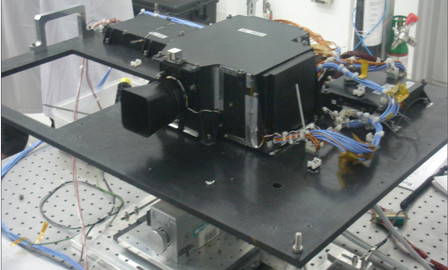
Methane sensor for Mars.

Methane sensor for Mangalyaan.{credit}Space Application Centre, ISRO{/credit}

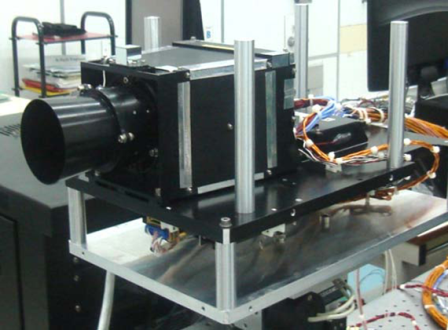
Mars colour camera.

Colour camera for Mangalyaan.{credit}Space Application Centre, ISRO{/credit}

Is space science in India welcoming women?

In the past few years we have seen a significant increase in the number of women joining Indian space science: right now, they constitute 20% or 25% of ISRO. The organisation is always ready to welcome women. As a government body, we get a minimum of six months’ maternity leave, for example, and women are given equal responsibilities. I feel like it’s not about whether someone is a man or woman, it is all about how they can handle the challenges. Now, whenever I give a talk and a small girl comes up to me and says, “I want to work for ISRO, I want to be an astronaut,” I feel wonderful. Women scientists of ISRO have also featured in the media, including Vogue India; and when our work is recognised, we represent the contributions of all the women involved.  That is the best part of it.

Interview by Elizabeth Gibney, a senior reporter for Nature based in London. This interview was edited for brevity and clarity.

Dutta will be appear in conversation with space scientist Maggie Aderin-Pocock at the London Science Museum’s Lates: Illuminating India on 29 November.


For Nature’s full coverage of science in culture, visit www.nature.com/news/booksandarts.

Machines moved by mind

3Q: José Millán

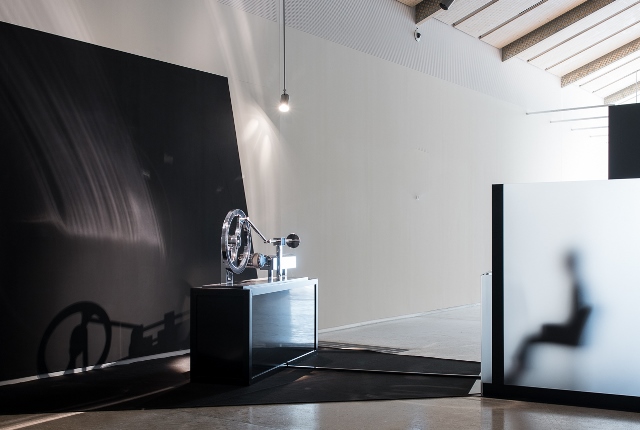
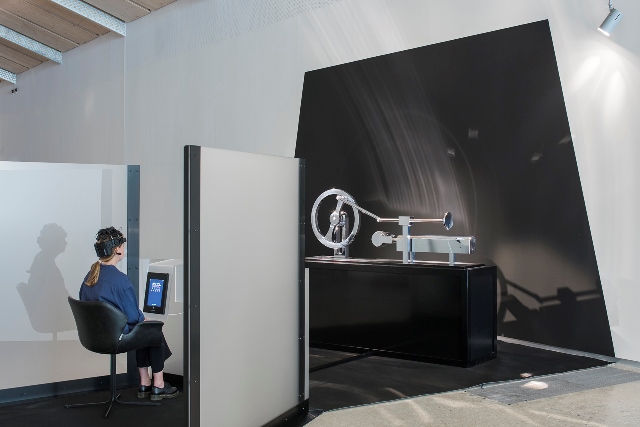
A 'mental worker' (behind screen at right) with Machine 1 at the exhibition Mental Work.

A visitor (behind screen at right) driving Machine 1 using the force of their own thoughts, at the exhibition Mental Work.{credit}© Photography Adrien Baraka / Mental Work{/credit}

At Mental Work, an exhibition at the Swiss Federal Institute of Technology Lausanne ArtLab (EPFL), visitors can drive simple machines using the force of their own thoughts. Probing the rapidly changing relationship between humans and technology, these artworks will also generate vast amounts of data that will be shared with researchers around the world. The show is a collaboration between experimental philosopher Jonathan Keats and EPFL neuroengineer José Millán, who develops brain-machine interfaces (BMIs) to help people with paralysis. Here, Millán talks pistons, probability and the debate over who or what is in control.

What will visitors experience at the show?

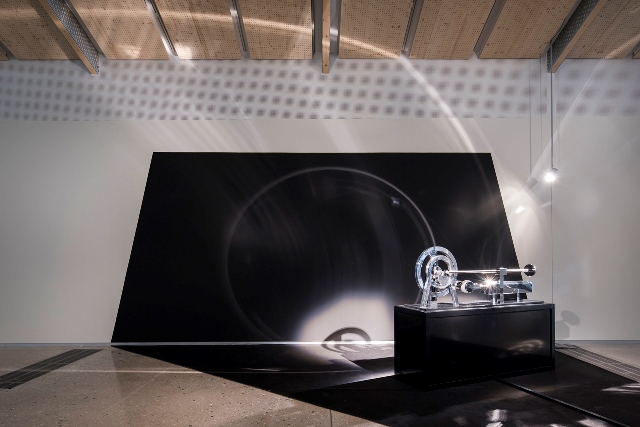
Some will be active participants in three experiments; others will watch them work. The participants, or ‘mental workers’, wear an EEG helmet studded with 19 dry electrodes — which continuously pick up electrical activity in their brains. In the first experiment they sit in front of a 2-metre-long construction (Machine 1) comprising a piston, fly-wheel and horizontal shaft. Using mental imagery, they try to move the piston onto the fly wheel; this starts the wheel turning, driving the shaft through a bolt. The brain-machine interface or BMI that makes this possible is an algorithm that has to be trained to ‘read’ the mind of each driver. The driver instigates the training by making a binary movement of the hand or foot, such as clenching and opening a fist, while simultaneously imagining the piston moving or stopping. The algorithm learns the stop-go instructions from patterns of the data from the electrodes, and converts them into commands for the piston. Because the data are always noisy and variable, the command is based on probability; but we program the piston motor to generate movement only when the probability is high — usually in the 70-90% range.

xxx

Another view of a ‘mental worker’ with Machine 1.{credit}© Photography Adrien Baraka / Mental Work{/credit}

What happens in the other two experiments?

They are more complex, and so are the machines. Participants take the role of either ‘driver’ or ‘supervisor’. Supervisors may change the level of probability through their own mental imagery, so the driver has a harder or easier (but messier) job of getting the machine to work. Or the supervisors may use their mental imagery to instruct the BMI to stop using mental imagery altogether, and switch to a different algorithm that use patterns of alpha waves — the brain-wide oscillations generated when the brain is at rest — to drive movement. In this case, the supervisor also uses mental imagery to instruct the driver to relax and ‘empty’ his or her brain. This is the part I am terrified about! We can get this to work in the lab, but it gets so complicated we don’t know what will happen when it is tested in more open conditions. We’ll also distribute a questionnaire asking participants whether they felt they were controlling the machines or if the machines were controlling them.


xxx

Machine 2, where ‘drivers’ have their threshold adjusted using a brain-machine interface or BMI.{credit}© Photography Adrien Baraka / Mental Work{/credit}

What do you want to emerge from the exhibition?

We are entering a cognitive revolution in which we will increasingly use many different new technologies to tap into or extend the capabilities of our brains. I hope that Mental Work will help generate a societal debate about this. Could brain power be used to carry out real work in the real world? What would that mean for employment? Will machines take control of our minds, or will our minds always have the control of machines? Personally, I am optimistic – I think the future is up to us. But the debate needs to start now. I hope visitors to this show will also enjoy the aesthetics of these artistic machines. Meanwhile, the data will be very valuable scientifically. We will capture and share it with the BMI research community, which is constantly trying to improve interfaces, for example by increasing the probability that brain signals are correctly read. Our experience suggests that many participants improve their performance as they move from one machine to another, and I expect that the research community will also be able to develop better machine-learning techniques for BMI users. At the end of the day what I really want is help BMI users, particularly  people with paralysis, to generate brain signals that are more stable and easier to decode.

Interview by Alison Abbott, senior European correspondent for Nature. She tweets at @alison_c_abbott

 This interview has been edited for length and clarity.

Mental Work runs from 27 October – 31 January 2018. The first two weeks are open for registered participants only, so any visitors wishing to participate as ‘mental workers’ must first sign up on the website mentalwork.net. The show opens to the general public on 13 November. It will subsequently move on to swissnex San Francisco in California. 


For Nature’s full coverage of science in culture, visit www.nature.com/news/booksandarts.

Imaging exodus: a thermographic lens on refugees

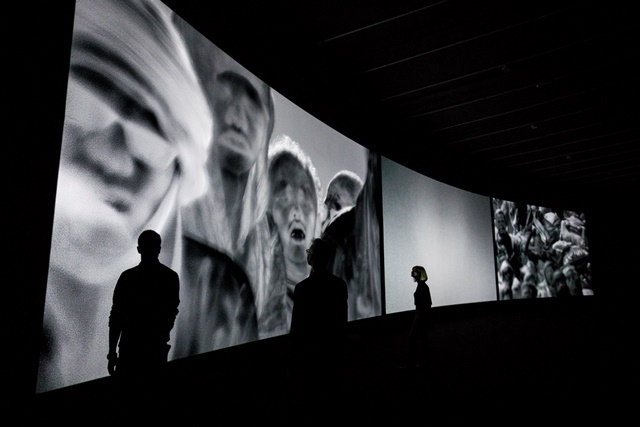
Incoming: installation view, by Richard Mosse in collaboration with Trevor Tweeten and Ben Frost, at The Curve, Barbican Centre, London.

Incoming: installation view, by Richard Mosse in collaboration with Trevor Tweeten and Ben Frost, at The Curve, Barbican Centre, London.{credit}Photo by Tristan Fewings/Getty images{/credit}

Posted on behalf of Philip Parker

Like war photography, images of the refugee crisis can elicit a disorienting mix of empathy and disbelief. Photographer Nilüfer Demir’s 2015 image of lifeless toddler Alan Kurdi, face down on a Turkish beach, is a case in point. Now film installation Incoming at London’s Barbican, by Irish photographer Richard Mosse, offers an original, unsettling perspective on the crisis.

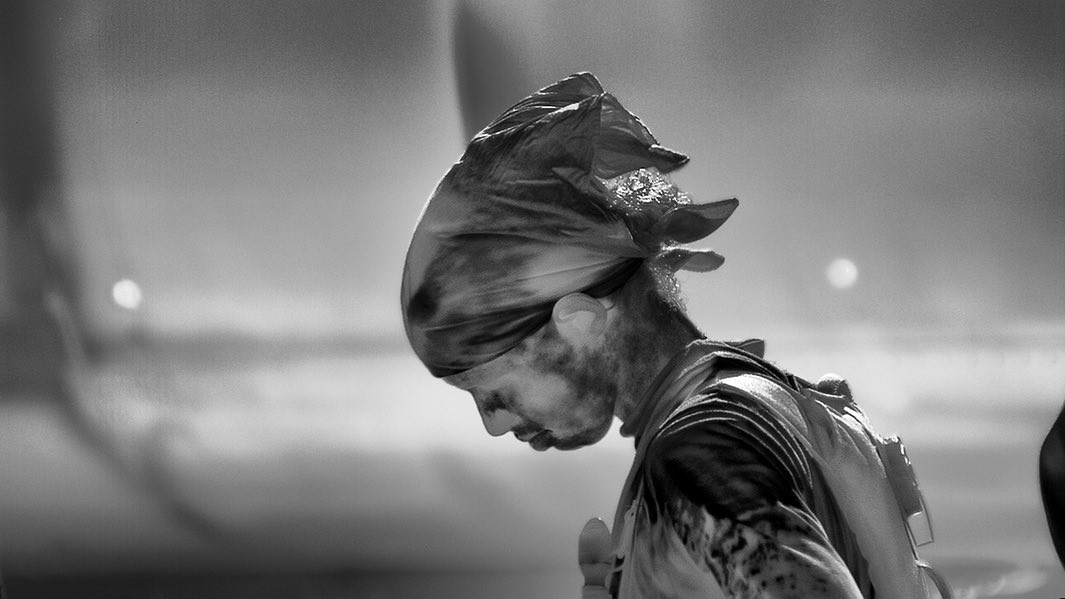
To escape some of the tropes of documentary photography, Mosse has experimented with non-standard processes such as 16-millimetre infrared film, which colourises in pinks and purples. For Incoming, he used a ‘camera’ classified as a weapon — a military-grade device created by a drone and missile designer that uses thermographic technology to detect people at 30 kilometres. Controlled by the International Traffic in Arms Regulations, it was designed for use in ballistics targeting and surveillance. For the show (which finishes on 23 April, moving to Melbourne, Australia, in the autumn), the images of refugees on journeys from the Middle East to Europe are displayed across a triptych of three 8-metre-wide curving screens. Mosse has repurposed a technology of war for ostensibly humanitarian ends.

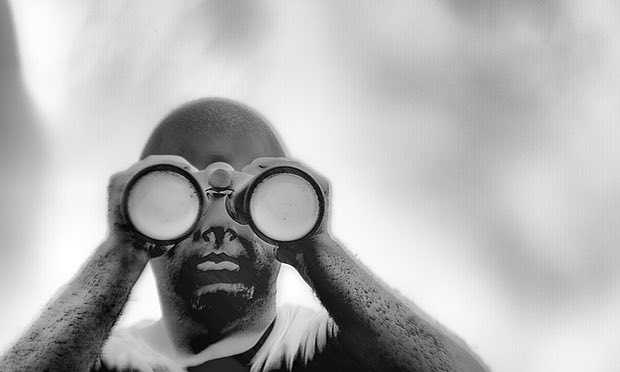
Still frame from Incoming, 2015–2016. Three-screen video installation by Richard Mosse in collaboration with Trevor Tweeten and Ben Frost.

Still frame from Incoming, 2015–2016. Three-screen video installation by Richard Mosse in collaboration with Trevor Tweeten and Ben Frost.{credit}Courtesy of the artist, Jack Shainman Gallery, New York and carlier|gebauer, Berlin.{/credit}

The device — capable of resolving fine detail in darkness and through fog and smoke — was ideal for capturing subjects in difficult conditions. It uses middle-wavelength infrared, with optics specially created from the rare earth germanium, and sensors made from cadmium telluride to detect heat contours. Mosse and his cinematographer had to devise a rig to carry the 23-kilogram camera, plus steadicam and computer.

They spent two years filming the routes trekked by refugees – from Syria, Iraq and Afghanistan across the Aegean, through North Africa into Europe, and inside camps in Greece and Germany. The 50-minute Incoming captures the gritty realities: a rescue at sea; a lorry lumbering, overloaded with human cargo. But the imaging renders these scenes uncanny. The people are negatives, variations in skin colour evened out and noses and lips whitened; every fold in their clothes is etched, but they are rendered in shades of grey. A man appears to be washing his face in oil (water appears black). A fire in a camp billows like grey liquid. One beautifully composed scene picks out kites being flown in front of a bare mountain range, but as the imaging gives no sense of scale, the black darts resemble a fleet of stealth bombers. Mosse has slowed the footage to less than half its usual 60 frames a second, giving it a balletic aesthetic at odds with the raw subject matter.

Still frame from Incoming, 2015–2016. Three-screen video installation by Richard Mosse in collaboration with Trevor Tweeten and Ben Frost.

Still frame from Incoming, 2015–2016. Three-screen video installation by Richard Mosse in collaboration with Trevor Tweeten and Ben Frost.{credit}Courtesy of the artist, Jack Shainman Gallery, New York and carlier|gebauer, Berlin.{/credit}

Mosse often lingers over his subjects — we spend a long time staring at hairs on the arm of a distant policeman. In more intimate scenes, the detail serves to distort. Ultra-closeups of the postmortem of a child who drowned at sea is clinical and disturbingly unemotional, even with the high-pitched wail of a saw carving a bone sample for DNA identification. Each person’s eyes are black apertures, any sense of the individual erased.

Mosse shot almost every scene without his subjects’ knowledge. In a British Journal of Photography article on Incoming, he was quoted as saying that this allowed authenticity and “portraiture of extraordinary tenderness”. In my view, the technology renders real people with real grief and hopes into an anonymous mass – of the other, the migrant, the stateless. For soldiers, this distancing is undoubtedly an advantage; as a viewer, I became alienated.

Richard Mosse in collaboration with Trevor Tweeten and Ben Frost, The Curve, Barbican Centre.

Richard Mosse in collaboration with Trevor Tweeten and Ben Frost,
The Curve, Barbican Centre.{credit}Photo by Tristan Fewings/Getty images{/credit}

The United Nations estimates that over 65 million people are displaced globally, more than at any time since the Second World War. With climate change and political instability ongoing, that figure looks likely to increase. In an accompanying book, Mosse claims that he wished to reconcile the camera’s capacities with the “harsh, disparate, unpredictable and frequently tragic narratives of migration and displacement”. But we know the name of Alan Kurdi, the subject of Demir’s unforgettable photograph; the unnamed, monochrome hordes in Mosse’s film ultimately become abstractions. For all the thermal imaging, Incoming left me cold.

Philip Parker trained as a scientist, worked in publishing and with campaigning organisations. He is currently Stamp Strategy Manager for Royal Mail. He tweets at @parkerpj01.

Incoming is at The Curve Gallery at the Barbican, London, until 23 April, and will travel to Melbourne, Australia, in autumn 2017. It is co-commissioned by the Barbican and the National Gallery of Victoria in Melbourne.


For Nature’s full coverage of science in culture, visit www.nature.com/news/booksandarts.

Change Agent: CRISPR-flavoured fiction

Posted on behalf of Sara Reardon

9781101984666It’s 2045, and the genetic editing system CRISPR has become a mainstay of society, producing everything from housecat-sized tigers to geopolitical intrigues. The United Nations has approved a sensible list of gene edits that can be legally used to eliminate specific genetic diseases from human embryos. This international concord works as well as one could expect from a sluggish bureaucracy trying to rein in a lucrative new enterprise. Before the treaty’s ink is dry, underground labs in Asia are offering “vanity edits” to parents willing to pay for smarter, healthier children. A single CRISPR snip to a gene that reduces the risk of heart disease might be routine and relatively cheap; altering the many genes that contribute to a complex feature like intelligence will cost much more. And that’s before you factor in the legal consequences if you get caught designing your perfect baby. As one illicit geneticist says, “all genetics is warfare”.

So begins Change Agent: a sci-fi thriller set in Southeast Asia with colourful and scientifically believable elements embellishing a fairly tired plot. Former software developer Daniel Suarez drew on still-cutting-edge research for his novel, one of the first to namecheck CRISPR as the catalyst for dystopia.

In Suarez’s imagined future, crime involving genetically modified humans has become so pervasive that international police organisation INTERPOL has devoted massive resources to dealing with it. But when detective Kenneth Durand finds himself hot on the heels of an organized crime ring in Singapore, he gets jabbed with a “change agent”. He awakens weeks later, shocked to find his body inexplicably transformed into that of the cartel’s ringleader, Marcus Demang Wyckes.

No one believes Durand’s explanation, least of all fellow INTERPOL agents who see him as the man whose face is on every wanted poster in Asia. After all, even the best scientists in 2045 believe it is impossible to genetically edit a living person. So Durand-as-Wyckes sets off alone to track down the real Wyckes and find a way to reverse-engineer his own body. That journey takes him through a landscape of sci-fi cliché – an underground nightclub of bio-enhancement enthusiasts, a shadowy Chinese trafficking ring with an invisible leader, intrusive augmented-reality ads.

Biotechnological flights of fancy

Yet Suarez has sprinkled the narrative with clever ideas inspired by current technologies. Singapore’s streets crawl with drug addicts, who tattoo molecular compounds onto their bodies so that dealers with 3-D printers can synthesize the drugs to deliver personalized highs. The Burmese government, which is waging genocide on its hill tribes, destroys their crops with gene drives — a controversial technology that can destroy populations by introducing genes that kill offspring. Nearly every other page is a glimpse into some biotechnological flight of fancy.

Suarez’s descriptions of the capacities and limitations of CRISPR, among other real-life technologies, are clear and mostly accurate, with minimal artistic licence. It’s the novel’s plot that — although fast-moving — fails to impress. As Durand flees his pursuers, he fights an unconvincing war with himself, as Wyckes’ grafted-on persona tries to drive him to violence. The enemies and allies that he picks up along the way are hackneyed and forgettable. This is especially true of the moustache-twirling Wyckes, whose denouement would be described as disappointing if we had cared about him in the first place. I won’t spoil everything, but suffice to say that Suarez wastes his most original idea in Wyckes’s bizarre engineered hitman, whose clever biochemical makeup repulses normal humans.

When we finally meet the CRISPRers, it’s in coastal Thailand (where else?). Potential parents sit through a parade of perfect children as if it’s a presentation for timeshare vacation condos. Predictably, the youngsters are a cover for the criminals’ more profitable product: children engineered with defective brains and enhanced muscles that make them disciplined workers and soldiers. Certainly people in 2045 must have read Brave New World. And meanwhile, readers will experience less shock than scepticism over how INTERPOL ever let crime get this bad right under their noses.

Perhaps that dulled reaction is what makes Change Agent most memorable. We have become so used to fictional explorations and academic treatises on engineering humans — from Mary Shelley’s Frankenstein to recent editorials in Nature — that the deranged possibilities presented by the technologies fail to thrill us any more. In an era stranger than fiction, sci-fi writers are increasingly hard-pressed to generate the requisite surprise, even as the scientific advances motor on.

Sara Reardon is a reporter for Nature working on biomedical research and policy, based in Washington DC. She tweets at @Sara_Reardon.


For Nature’s full coverage of science in culture, visit www.nature.com/news/booksandarts.

Snapping Earth for more than seven decades

Posted on behalf of Elizabeth Gibney

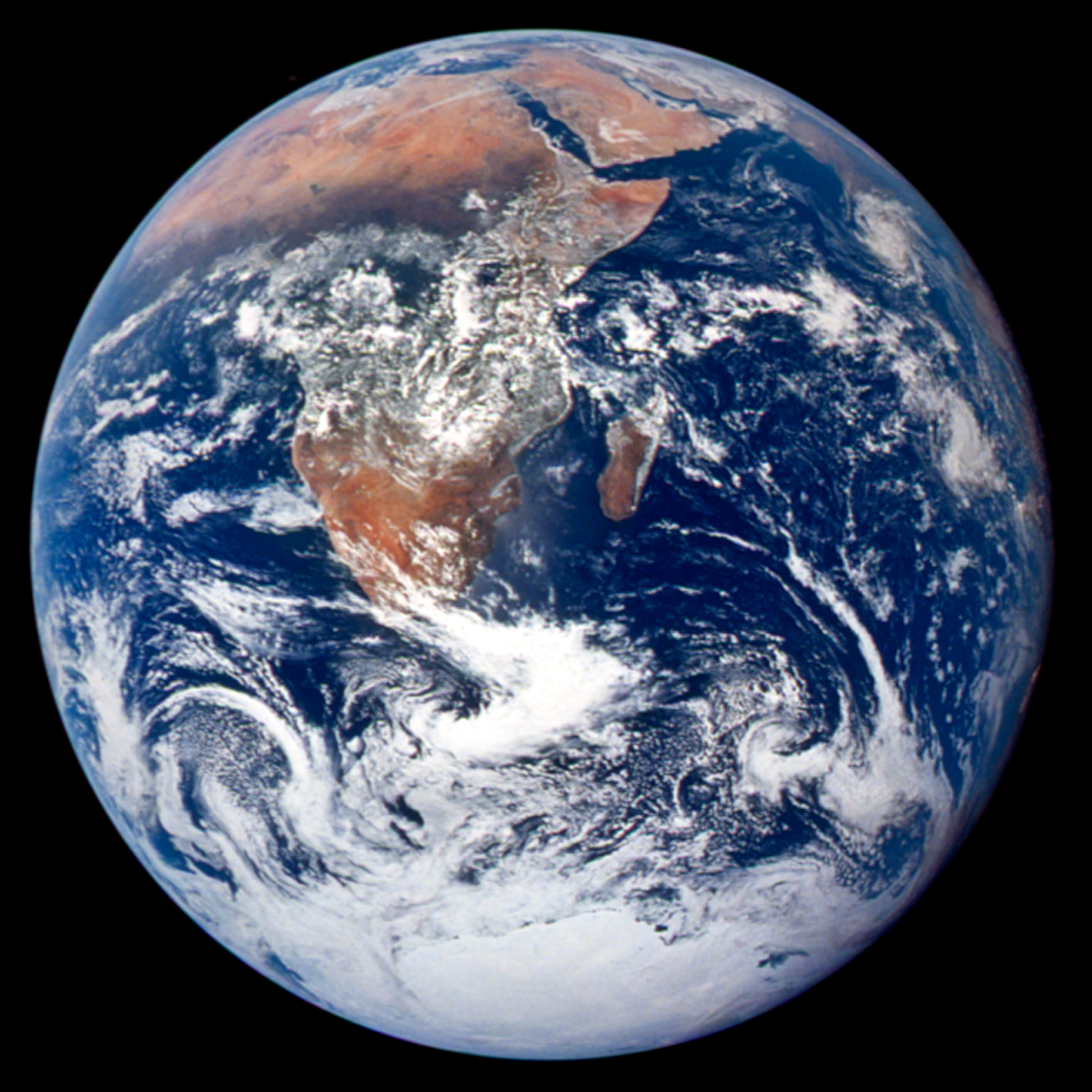
The 'Blue Marble' image of Earth by the Apollo 17 crew in 1972.

The ‘Blue Marble’ image of Earth captured by the Apollo 17 crew in 1972. {credit}NASA{/credit}

For centuries, the only way to ‘see’ Earth whole was through globes and maps; its grandeur was merely glimpsed in mountain vistas or across a stretch of ocean. That changed in the 1940s, when the first images of the planet were snapped from rockets probing the border of space, 100 kilometres up. The imaginable became the visible.

Since then, satellites and spacecraft have beamed down shots from ever greater distances and in growing detail. Now Nature Video has captured the most iconic of these in the film Portraits of a Planet: Earth from Space.

These images have massively boosted science and technology – from weather forecasting to monitoring natural disasters, forest cover and climate change. And they have had a subtler psychological impact. Revealing this majestic, finite, vulnerable entity framed in blackness has elicited deep responses feeding into policy and culture.

Going ballistic

The first images of Earth from space — from 1946 and 1947 — were black-and-white, grainy and remarkable partly for the fact that they happened at all. Both were taken by cameras retrofitted into the empty nosecone of V-2 rockets, long-range ballistic missiles the United States captured from Germany at the end of the Second World War.

In 1946, all that protected the film during the rocket’s crash landing was a steel cassette. When the photos were first projected onto a screen, “the scientists just went nuts”, recalled Fred Rulli, a member of the rocket’s recovery team, in an interview with Air and Space magazine. The following year’s project nudged the rocket further into space to 160 kilometres, bringing more detailed images clearly revealing Earth’s curvature.

Taken in March 1947, these pioneering NASA images of Earth were the first taken from an altitude of more than 100 kilometres. Cameras retrofitted into the empty nosecone of V-2 rockets were deployed to take the shots.

Taken in March 1947, these pioneering NASA images of Earth were taken from an altitude of 160 kilometres – then a record high. Cameras retrofitted into the empty nosecone of V-2 rockets were deployed to take the shots.{credit}Johns Hopkins Applied Physics Laboratory{/credit}

The cold-war space race soon pushed cameras to greater heights. In 1957, the Soviet Union launched its first satellite, Sputnik; the US quickly followed suit. Three years later, the newly formed NASA put TIROS 1, its first weather satellite, into orbit, which sent video back to Earth using dual television cameras. TIROS 1 proved that such images could provide be used to monitor cloud formation, one of the first indications of the potential scientific power of satellites.

In 1960, cameras aboard NASA's first weather satellite TIROS-1 captured Earth.

In 1960, cameras aboard NASA’s first weather satellite TIROS 1 shot Earth.{credit}NASA{/credit}

Human-crewed efforts began with the orbital missions of Yuri Gagarin in 1961 and John Glenn in 1962. But it was not until 24 December 1968 that Apollo 8 astronaut Bill Anders captured arguably the most iconic image of Earth. Later dubbed ‘Earthrise’, it was the first to show the planet from the perspective of another celestial body, as a luminous blue hemisphere rising above the Moon’s horizon. Anders had had to fight to get the long-lens camera on board, and deviated from the craft’s flight plan to get the snap (as he wrote in his obituary of Glenn earlier this year).

That awe-inspiring image was a shot across the bows of the cold war. It was also transformational for earthbound observers: the moniker ‘Spaceship Earth’ gained traction as people fully grasped the planet’s limits. Ultimately, ‘Earthrise’ supercharged the nascent environmental movement in the United States particularly, pioneered by environmentalists, scientists and thinkers such as Buckminster Fuller; and it proved a trigger for the US Earth Day, which launched in 1970.

That grassroots clamour, bolstered by works such as biologist Rachel Carson’s 1962 Silent Spring, had an influence on policy shifts at the federal level. The period from 1970 to 1973 saw the Environmental Protection Agency established and the US Clean Air Act, Clean Water Act and Endangered Species Act passed. Anders notes, “I wouldn’t say [Earthrise] was the only reason, but it certainly was an important reason motivating folks to take better care of our planet.”

'Earthrise' - possibly the most iconic portrait of Earth - was captured by astronaut Bill Anders from Apollo 8, the first crewed lunar mission.

‘Earthrise’ – possibly the most iconic portrait of the planet – was captured by astronaut Bill Anders from Apollo 8, the first crewed lunar mission, in 1968.{credit}NASA{/credit}

The spectacular ’Blue Marble’ (see opening image), shot by the crew of Apollo 17 in 1972, fuelled further activism; it has been recreated by NASA many times over. The photograph captured Earth with the Sun behind the camera illuminating most of the globe, and from a distance (45,000 kilometres from the planet) no one has managed since.

Inspired by the potential of such astounding images, the US Geological Survey and NASA launched the first satellite in the Landsat programme in 1972, to chart Earth’s terrain in detail. Landsat satellites have documented burning oil wells in the first Gulf War, the impact of Hurricane Katrina and deforestation in the Amazon. Landsat’s false-colour rendering of Alaska’s Malaspina glacier, taken with a thermal imaging camera, is mesmerizingly beautiful.

In 1991, Landsat satellites captured lit oil wells in Kuwait , which burned for 10 months.

Landsat satellite images of lit oil wells in Kuwait during the Gulf War, in 1991. They burned for 10 months.{credit}NASA{/credit}


This Landsat image, shot in 200, captures the majestic flow of Alaska's Malaspina Glacier. This false-colour composite was created using infrared, near infrared and green wavelengths.

Shot in 2000, this false-colour composite showing the majestic flow of Alaska’s Malaspina Glacier was created using infrared, near infrared and green wavelengths.{credit}NASA/USGS{/credit}

In recent years, a parade of Earth monitoring and robotic exploration craft have added countless images to the file. In 2012, over 312 orbits, the Suomi National Polar-orbiting Partnership satellite built up a night-side image of Earth and its lit-up cities in ‘The Black Marble’. In 2013, NASA’s Cassini craft turned around in the outer Solar System to capture Earth — a pinprick of light — through the rings and moons of backlit Saturn.

Composite image 'The Black Marble' was taken by Suomi NPP, a joint National Oceanic and Atmospheric Administration and NASA satellite, in 2012

Composite image ‘The Black Marble’ was taken by Suomi NPP, a joint National Oceanic and Atmospheric Administration and NASA satellite, in 2012.{credit}NASA{/credit}

Called ‘The Day the Earth Smiled’, that shot was taken from more than 1.2 billion kilometres away, making it a far cry from the images of our planet revealed some 70 years ago. But while the photographs have become ever more impressive, rarely are they as powerful as those first images of the ‘ground beneath our feet’ in its sublime entirety.

'The Day the Earth Smiled', taken by NASA's Cassini craft in 2013, shows Earth through Saturn's rings. The image spans some 650,000 kilometres and is a mosaic crafted from photographs taken over four hours.

‘The Day the Earth Smiled’, taken by NASA’s Cassini craft in 2013, shows Earth through Saturn’s rings. The image spans some 650,000 kilometres and is a mosaic crafted from photographs taken over four hours.{credit}NASA{/credit}

Elizabeth Gibney is a reporter on physics for Nature based in London. She tweets at @LizzieGibney. 


For Nature’s full coverage of science in culture, visit www.nature.com/news/booksandarts.

From tin men to Terminator: Robots reviewed

Posted on behalf of Celeste Biever

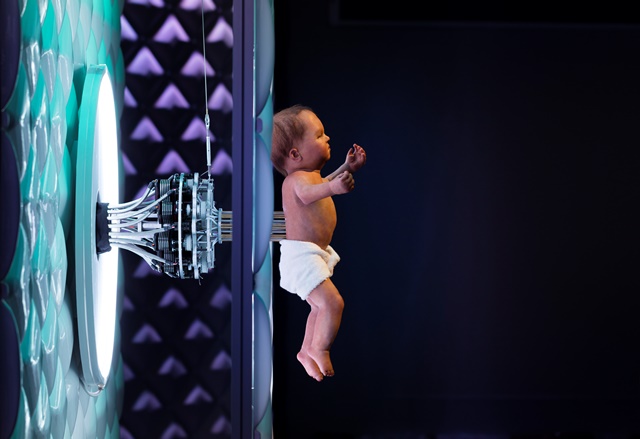
Animatronic baby, John Nolan Studio

Animatronic baby, John Nolan Studio.{credit}Plastiques Photography, courtesy of the Science Museum{/credit}

The baby’s skin looks soft and its hair downy as it blinks and stretches out its arms. Then I spot the plug and mass of wires protruding from its back.

Brainchild of London-based John Nolan Studio, the animatronic infant is a fitting start to the blockbuster Robots exhibition at London’s Science Museum. Its impressively comprehensive array of automatons is a reminder both of machine-like qualities in people, and of the challenges of imitating humans in mechanical form.

Historical automata crowd the first section, ‘Marvel’. A small, hand-carved mechanical monk from the 1560s was crafted to walk and beat its breast in contrition. Is this really a robot? Yes, says chief curator Ben Russell, who has long pondered this question: “A robot is a machine that looks life-like or behaves in life-like ways.” This summary proved a tough but useful curatorial filter, he says.

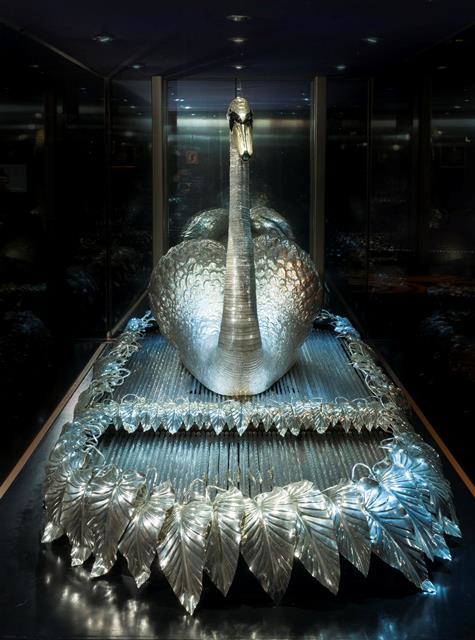
Clockwork 'Silver Swan', John Joseph Merlin, 1773.

Clockwork ‘Silver Swan’, John Joseph Merlin, 1773.{credit}The Board of Trustees of the Science Museum{/credit}

Another highlight here is the Silver Swan, a life-sized clockwork bird on a glass pool crafted in 1773 by Belgian inventor and instrument-maker John Joseph Merlin, whose work inspired Charles Babbage. (The automaton is on loan from the Bowes Museum in county Durham, northern England.) In his 1869 travelogue The Innocents Abroad, American writer Mark Twain noted the avian wonder ‘swimming’ as “comfortably and unconcernedly as if he had been born in a morass instead of a jeweller’s shop”. The lifelike movements of its serpentine neck still impress – but visitors beware: to preserve the delicate machine, it will only play at certain times.

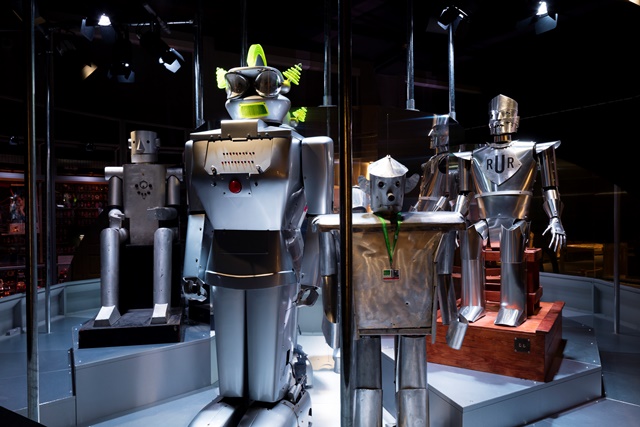
Classic twentieth-century robots Sitting Robot, Cygan, George and Eric (left to right).

Classic twentieth-century robots Sitting Robot, Cygan, George and Eric (left to right).{credit}Plastiques Photography, courtesy of the Science Museum.{/credit}

A clutch of robots classiques includes an impressive collection of dumb but engaging tin-giants dating back to the 1920s. Eric is arguably the star. The replica we see was commissioned for the exhibition and paid for by a Kickstarter campaign. Amateur engineer William Richards and mechanic Alan Reffell built the original Eric in 1928 for the annual Society of Model Engineers exhibition in London, where it a gave a speech as a stand-in for the Duke of York. Its feet bolted to a 12-volt electric motor, Eric could also stand, sit down and move its arms.

As I gaze at a Terminator from 2009 film Terminator Salvation, I’m reminded of how popular culture, as well as science and engineering, shaped the modern concept of a robot. The intimidating android “had to be there”, says Russell. “This is what people think a robot is like.”  Another delight for aficionados is a 1923 first-edition copy of Czech writer Karel Čapek’s play R.U.R. (Rossum’s Universal Robots), which coined the word ‘robot’.

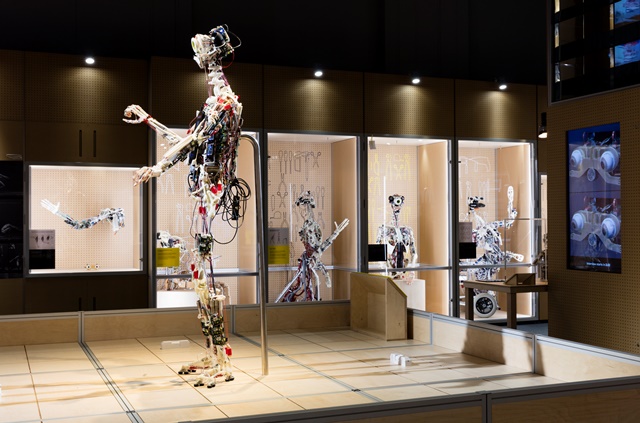
ECCEROBOT, Rob Knight and Owen Holland, 2004-2011.

ECCEROBOT, Rob Knight and Owen Holland, 2004-2011.{credit}Plastiques Photography, courtesy of the Science Museum.{/credit}

It’s one thing to dream, quite another to construct. The reality check is a gaggle of bots from a range of top labs — experiments shedding light on what it means to be human. Here are multiple versions of the life-sized ECCEROBOT (Embodied Cognition in a Compliantly Engineered Robot), each a skeletal display of tendons and bones. Built by robotics engineer Rob Knight, cognitive roboticist Owen Holland and the ECCEROBOT Consortium between 2004 and 2011, the series explores embodied cognition: how the structure of the human body shapes the evolution of intelligence and consciousness.

Juxtaposing several attempts at creating bipeds, this section also showcases the joy of tinkering. Honda’s well-resourced P2, unveiled in 1996, was the first full-bodied robot to walk on two legs. It stands next to the Shadow Biped — a pair of legs snaked through with wires and gauges, developed by inventor Richard Greenhill and other members of the Shadow Robot Project Group in a London attic from 1987 to 1997. (It managed a few wobbling steps.) The group evolved into the Shadow Robot Company, makers of the dexterous robotic hand on display.

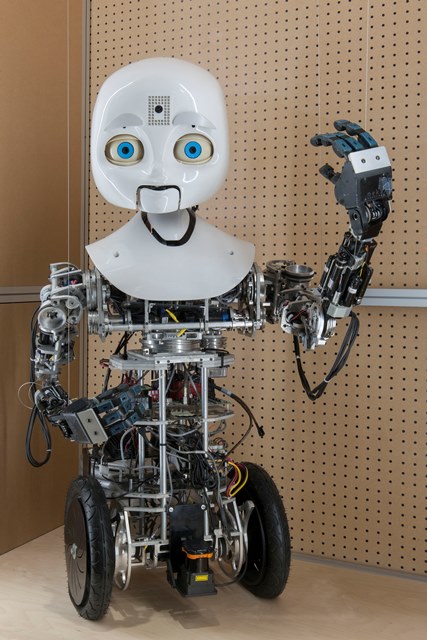
Nexi, Cynthia Breazeal, 2008.

Nexi, Cynthia Breazeal, 2008.{credit}The Board of Trustees of the Science Museum.{/credit}

The show’s research chops are also evident in the inclusion of Cog, the Massachusetts Institute of Technology project led by robotics pioneer Rodney Brooks that ended in 2003. The exhibit only features Cog’s head – a mess of wires and metal. While it’s not visually arresting, I was thrilled to see Cog: it was built to address the fascinating, once radical, question of whether human level intelligence could emerge from physical interactions with the environment, without any higher-level programming.

The emerging field of human-robot interaction gets a look-in with Inkha, built by Matthew Walker and Peter Longyear at King’s College London. A pair of bulbous eyes and rubbery lips attached to a metal frame, it served as a receptionist at King’s between 2003 and 2014. And the freakish, blue-eyed Nexi was built in 2008 by human-robot interaction pioneer Cynthia Breazeal of MIT. Through its ability to carefully control movements such as face-touching, Nexi was used to study the role of non-verbal communication.

Robot child Kodomoroid, Hiroshi Ishiguro Laboratories.

Robot child Kodomoroid, Hiroshi Ishiguro Laboratories.{credit}Plastiques Photography, courtesy of the Science Museum.{/credit}

Today, of course, robots have escaped the lab, showing up in factories, homes and even clinics.  As I trek through the last room, a corridor lined with a range of humanoids already out in the real world, I ponder how robots will evolve next. Will they become ever more realistic, like the alarmingly life-like robot child Kodomoroid? Its creators at Hiroshi Ishiguro Laboratories in Japan have used such ‘geminoids’ — android ‘twins’ of real individuals — to monitor reactions when compared with the human originals. Robo-toddler Kaspar, by contrast, makes a virtue of robotic limitations. Its creators at the University of Hertfordshire are examining how children with autism,  who can be overwhelmed by diverse facial expressions, react to Kaspar’s much simpler, carefully controlled mannerisms.

This is a timely show, in a society now grappling with the implications of the robot invasion, enabled by speedily evolving, hyper-sophisticated machines. It does a beautiful job of demonstrating robotics’ embarrassment of riches and how humanity got here, powered at first by belief, then dreams and most recently hardcore research and engineering. The question that scientists, engineers, consumers and industry now have to answer is: where do we point this formidable engine?

Celeste Biever is Nature’s chief news and features editor. She tweets at @celestebiever.

Robots runs at London’s Science Museum from 8 February to 3 September.


For Nature’s full coverage of science in culture, visit www.nature.com/news/booksandarts.

Thomas Bayrle: mesmerising machines

Posted on behalf of Lisa Vincenz-Donnelly

Rosenkranz (mixed media: VW engine, electric drive, sound), 2009.

Rosenkranz (mixed media: VW engine, electric drive, sound), 2009.{credit}Private Collection, Vienna. Photo: Werner Kaligofsky, VG Bild-Kunst, Bonn 2016{/credit}

In the 1950s, when the German Pop Art pioneer Thomas Bayrle first trained as a weaver, he says he was “put into a state of trance by the loud and monotonous noise of the machines — until they began to sing”. His more recent artworks, currently on display at an exhibition of wall pieces, light projections, videos and electronically driven sculptures at the Kunstbau gallery in Munich, have a similar mesmeric effect. The ‘continuous-loop’ animations and smoothly moving sculptures, accompanied by monotonous sounds, are hypnotic portrayals of mass production and the complexities of society.

In 1958, Bayrle moved on from textiles to become one of Germany’s most important post-war artists. Since the 1970s, he has famously engaged with subjects such as motorways, car and airplane engines and the nexus of humans and technology in a range of media — including silkscreen, lithography and etching – and in works such as Flugzeug (not in the exhibition). This huge collage of an airplane is made up of many thousands of depictions of airplanes. Bayrle was among the first in Germany to adopt Pop Art in the 1960s, and to create computer-generated art in the 1970s.

Thomas Bayrle with Autobahn, 2016.

Thomas Bayrle with Autobahn, 2016.{credit}Kunstbau gallery, Munich/VG Bild-Kunst, Bonn{/credit}

The unusually long Kunstbau gallery space is located at a metro station, in the underground mezzanine storey directly above the tracks. Bayrle, now 79, was inspired by the “architectural brutality” of the space to create an immense wall sculpture 30 metres long, Autobahn (which he describes as his ‘last Autobahn’ — true to his love of repetition, he has created many similar sculptures). It’s a massive grey construction of intertwined angular loops, echoing the never-ending movement of traffic. Bayrle sees motorways as the centre of humanity’s gigantic cycle of production, distribution and consumption — a dynamic that has now evolved into the main surveillance body of human mobility, the information highway.

One of the most impressive pieces, a 16-millimetre film of montages of black and white stills, Autobahnkopf, appears at first glance to be an image of an anatomical human head turning its face in all directions. A closer look reveals the image as constructed from many loops of footage of busy highways.

Monstranz, 2010 (mixed media: radial engine, electric drive, sound)

Monstranz, 2010 (mixed media: radial engine, electric drive, sound), with Autobahn (mixed media) in the background.{credit}© Thomas Bayrle and Museum Ludwig, Köln VG Bild-Kunst, Bonn 2016.{/credit}

Most compelling are sculptures created from scrap automobile parts, such as engines. Bayrle restores their working parts, exposing their solemn beauty in action, and supplies each with a unique soundtrack mixing the sound of the original machine with recordings of prayer groups. Bayrle first noticed parallels between religion and machines during his childhood. He used to live near a church, where a group of housewives stopped every Thursday to rattle off rosaries in a monotonous, yet powerful, manner. To Bayre, the rosary is like a type of machine – one that you power yourself as you work your way through its beads. And as he has noted, Tibetan prayer wheels mesh religion with machinery. In Monstranz, a nine-cylinder radial engine that once powered various utility aircrafts rotates to heavy hissing and grinding noises, merged with the recording of a church service from Cologne Cathedral. A Citroën car engine is matched to the chants of French prayer groups. The words blend into a multi-layered, repetitive, soothing soundtrack. In some pieces, the machines take on a life of their own: a Vespa engine seems to sing; a pair of windscreen wipers appears to wave.

In these extraordinary works, Bayrle captures the never-ending circle of production, distribution and consumption. As individuals, we come together in multitudes to form this massive system – like the threads that make up a fabric.

Lisa Vincenz-Donnelly is an editorial intern at Nature in Munich. She studied biochemistry in Galway, Ireland, and completed a doctoral degree at the Max-Planck-Institute of Biochemistry in Martinsried near Munich.  

 Thomas Bayrle runs at the Kunstbau, Munich to 5 March. A concurrent show, Thomas Bayrle, runs at the Institute of Contemporary Art, Miami, Florida, to 26 March.


For Nature’s full coverage of science in culture, visit www.nature.com/news/booksandarts.

The making of science

Posted on behalf of Jo Baker

Make-Shift-lock-up-1_eps fin4Scientists are makers. The specialized skills they hone in the lab over many years – from assembling robots and circuits to growing microbes and cells – mirror the practices of artisans such as seamstresses and potters. Chemists may melt, stretch and snap a glass tube to make a pipette. Jewellers rearrange silver atoms each time they warm the metal to anneal or soften it.

Bringing together makers of all stripes to innovate was the focus of MAKE:SHIFT, a two-day biennial conference this month in Manchester’s Museum of Science and Industry, home to Charles Babbage’s loom-inspired computing machines. Scientists and designers explored in talks, panel discussions and demonstrations how joint working can advance sustainability, healthcare and communities.

Across smart materials, biodesign, wearable electronics and more, the speakers showed how such collaborations have led them to think and work differently. They explored emerging trends, such as 3D printing and small-scale production. And they asked big questions, such as how the concepts of craft and making have become lost in today’s digital world of instant gratification, yet remain central to hatching new models and cultures of innovation. The following insights and individuals stood out.

Tools and workshops are increasingly accessible, linked and powerful. Fabrication labs or ‘fab labs’ – where members of the public and skilled experts recycle furniture or even edit genes – are proliferating. There are now 700 around the world. And 16 cities (including Barcelona, Boston in the US and Shenzhen) have signed up to become ‘fab cities’– aiming to produce locally 50% of what they consume by 2054. Online networking and exchanges of experience between make spaces is increasing, linking know-how in California with needs in Cape Town, for example.

Small-scale manufacturing is on the rise, aided by the Internet and cheaper production technologies such as 3D printers. Digital blueprints allow anyone with such means to construct furniture or even houses locally. Generic designs can be customized. Garment patterns that can be tweaked and knitted on demand avoid wastage. Customers increasingly care where their products come from, and value sustainability, social good and ethical work practices.

The nature of materials is being rethought. Bio-materials such as fungal webs (mycelium) can be used to ‘grow’ bricks, pots and even dresses on wood-chip, clay or textile frames. Amsterdam-based ecodesigner Maurizio Montalti of Officina Corpuscoli described how, after working with University of Utrecht microbiologists on scaling up these fungal creations, his studio began to look more like a lab. University College London materials scientist Mark Miodownik invoked a future devoid of roadworks if self-healing asphalt becomes reality.

Fungal Futures: a selection of mycorrhyzal materials by Maurizio Montalti for Officina Corpuscoli.

A selection of materials grown directly from fungi by Maurizio Montalti for Officina Corpuscoli.{credit}Fungal Futures © Maurizio Montalti-Officina Corpuscoli, 2016{/credit}

The Anthropocene offers new geologically inspired materials. ‘Fordite’, or ‘detroit agate’,  is made from fine layers of hardened car paint and can be cut and polished like semi-precious stone. We may one day dig up deposits of ‘bone marble’, retrieved from the metamorphosed skeletons of culled farm animals. The fashion industry is the second most polluting in the world, but sportswear company Adidas is scooping waste plastics out of the ocean to make its knitted footwear.

Crafts people are sensitive to people’s emotional responses to materials and objects. Yet few designers are included in research teams examining interactions between robots and humans, for example. Caroline Yan Zheng from London’s Royal College of Art is using soft robotics to make wall panels and accessories that swell or reshape in response to facial emotions. People tell her they find them comforting; one day they might be used to promote calm in hospitals.

Caroline Yan Zheng's soft robotic artefact prototype #4, exploring the performativity of kinetic silicone soft robotics.

Caroline Yan Zheng’s soft robotic artefact prototype #4, exploring the performativity of kinetic silicone.{credit}Caroline Yan Zheng, 2016{/credit}

Surgery is a craft – you don’t want your operation done by someone who has only read a book. Richard Arm from Nottingham Trent University brought in gorily realistic models of parts of the thoracic cavity that he has been making in silicone for surgeons to train on – complete with slimy finish, spurting arteries and the slash across the chest for you to dig your hand into. But introducing design innovations into the healthcare sector is difficult, Jeremy Myerson from the Royal College of Art noted; the sector is risk averse. His redesigned ambulance interior reduces the time it takes for paramedics to treat a patient’s wounds, by giving them better access to the patient and equipment. Yet, despite running it through ‘clinical trials’ successfully, it has yet to be taken up.

For making to drive innovation, many challenges need to be overcome. Craft has an old-fashioned hobbyist image, and many courses are closing as universities struggle to attract students. Yet jewellers and textile and industrial designers are open to new materials and technologies as never before, while few scientists are trained in metalworking or AutoCAD. And it is hard even to define what tacit skills and knowledge are.

Gravity Stool (detail) by Jólan van der Wiel, 2012. Photo

Jólan van der Wiel’s Gravity Stool (detail), created from magnetic plastic compounds, 2012.

That said, some technologies are overhyped. 3D printing remains expensive and impractical with many materials, such as porcelain. While printing is useful to make a detailed prototype, traditional processes like casting are often better for mass production. Also, the software needs to become more intuitive. Ann Marie Shillito of Edinburgh College of Art showed how she is using touch-sensitive ‘haptic’ computer design software to form organic shapes.

So how far can this model of local production be scaled? Ways must be found to promote collaboration between workshops, and optimize who makes what, where. And new business models are needed so that small-scale manufacturers can make a living; most workspaces depend on government grants. Nonetheless, MAKE:SHIFT was a heartening experience that highlighted what science and design have in common rather than, as is too often the case, what divides them. After all, even graphene (carbon that is 1 atomic layer thick) has been linked to traditional craft: the Japanese paper-cutting art of kirigami have been applied to graphene sheets to make stretchable electrodes, hinges and springs.

Jo Baker is senior Comment editor at Nature.


For Nature’s full coverage of science in culture, visit www.nature.com/news/booksandarts.