Last Diamonds: portraits of icebergs

Posted on behalf of Michael White
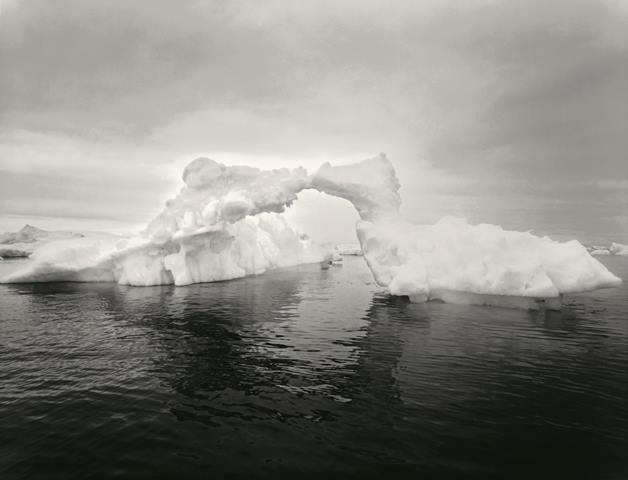
Diamond #4 (Greenland 2015)

Diamond #4 (Greenland 2015) {credit}© Francesco Bosso {/credit}

A frozen menagerie of yawning overhangs, rotting underbellies, humanistic curves, tumbled-over organ pipes confronts you.  Francesco Bosso’s Last Diamonds is a glorious, sombre collection of 25 monochrome ‘portraits’ of icebergs off the coast of Greenland, gingerly treading the boundary between art and science. Each plate, created using a traditional analog photographic process, offers haunting insight into the cryosphere, exploring a grey, often cloudy sky, a shimmering jet-black ocean, and an iceberg traversing the intersection.

An encounter with art inevitably sparks questions. Do I like it? What does it mean? And does an understanding of meaning change whether or not I like it? For some, context is all; for postmodernists, comparisons are odious and art should be understood solely on the interaction of viewer with work. Going by the latter school of thought, Bosso’s is an unqualified success.
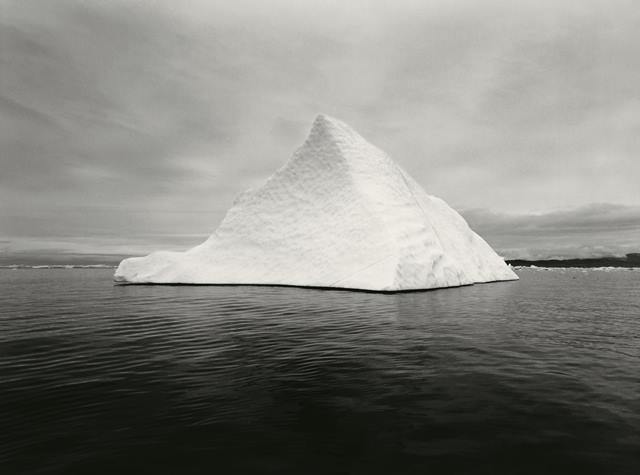
Diamond #2 (Greenland 2015)

Diamond #2 (Greenland 2015){credit}© Francesco Bosso {/credit}

His exploration of light, tone and texture evokes the work of Ansel Adams’ assistant and successor John Sexton. Where Adams was all sweeping vistas, Sexton framed more intimate shots. As with so much great landscape photography, the power of the images emerges in part from the sense of the patience and agility needed to capture a perfectly framed moment from a transient confluence of conditions.

In Diamond #2, the thin black line between iceberg and ocean echoes the sliver of distant land visible. The shared angle between cloud and ice in Diamond #5 suggests an intimate physical linkage. The formality of the images offers an elegant contrast to the turmoil of the active glacial calving fronts where they originated, somewhere out of shot.

What sets Last Diamonds apart from the bulk of landscape photography is the bewildering individuality of the ice. In contrast to the exploration of sculptural form and sheer beauty in photographic collections such as Camille Seaman’s Last Iceberg series (see review here), Bosso’s vision is more subtly varied in tone and light — and somehow, more interiorised.
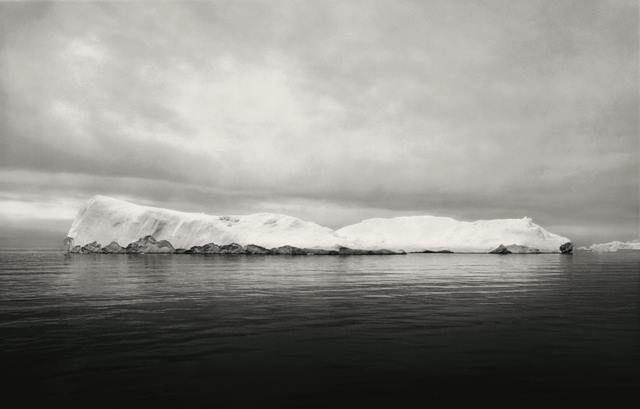
Diamond #5 (Greenland 2015)

Diamond #5 (Greenland 2015){credit}© Francesco Bosso{/credit}

Even more remarkable is the sense of disorientation spawned by a near-complete lack of scale. Humanity is absent, and what whispers of land there are cannot provide much footing. The icebergs could be 2 or 200 metres tall.

Yet this lack of context, so intriguing visually, creates a problem highlighted by the book’s title. The global loss of ice is indisputable. But in the absence of context and Bosso’s description of icebergs as “gems of nature in danger of extinction”, the viewer might conclude that we are bearing witness to the end of icebergs.

This is premature. Even in Greenland, marine-terminating glaciers — which flow to the sea, calving bergs — are unlikely to disappear within several human lifetimes. Iceberg production in Antarctica will continue into the foreseeable future. Jakobshavn Isbrae, where much of Last Diamonds was shot, has long been the poster child for a rapidly disintegrating cryosphere. But it has thickened and advanced in recent years.
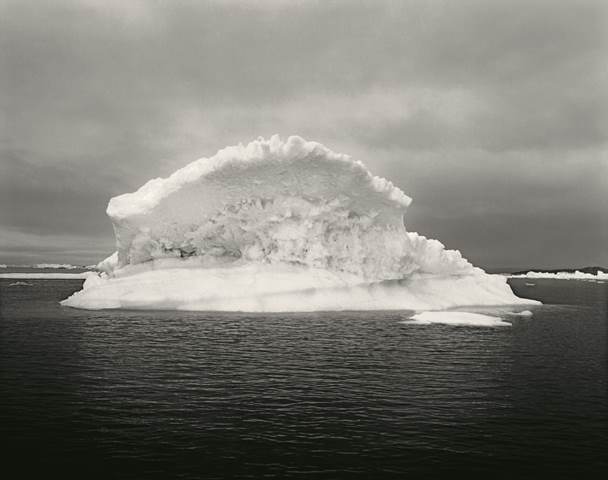
Diamond #7 (Greenland 2015)

Diamond #7 (Greenland 2015){credit}© Francesco Bosso {/credit}

Thus, Last Diamonds tends towards over-interpretation, and would have benefited from a more candid summary of cryospheric processes in a warming climate. There are two points to make. First, the calving of icebergs, even monsters such as Antarctica’s A-68, is a natural process that has occurred for millions of years. Tying any one calving or season to our activities is spectacularly difficult. Second, these activities will almost certainly produce radical changes in the extent of ice throughout the planet, if unchecked.

Art is not beholden to the subtle nuances and endless caveats of scientific discourse. Of course, Bosso’s minimalist aesthetic and stark message may be playing for dramatic effect to stimulate discussion around climate change and the cryosphere. More power to that; but the extinctions he hints at are still avoidable.

Michael White is senior editor in physical sciences at Nature. He tweets at @MWClimateSci.


For more on science and culture, see: https://go.nature.com/2CMOwaL.

The 30-year-old snowman

Snowman, 1987/2016 (multimedia), by Peter Fischli and David Weiss.

Snowman, 1987/2016 (multimedia), by Peter Fischli and David Weiss.{credit}Peter Fischli and David Weiss © the artists, courtesy Matthew Marks Gallery; photo: Mary Ellen Hawkins, courtesy SFMOMA{/credit}


Posted on behalf of Michael White

It stands there trapped in a frosty cage: a 30-year-old snowman in a state of bliss, its currant-shaped eyes peering out over a lopsided grin in a face dotted with frozen florets.

The glass-fronted aluminum cooler currently sits at the San Francisco Museum of Modern Art. Above the sculpture, entitled simply Snowman, the understorey citizens of a redwood forest sway in the United States’ largest living wall. The tensions are inescapable: snow, a natural process, in a totemic form, in a machined box, surviving on electricity, juxtaposed against an artificial ecosystem. The installation is a brilliant encapsulation of our mixed-up global environment now — from polar melt to green cities.

Snowman was constructed in 1987 by Swiss artistic duo Peter Fischli and David Weiss for the Römerbrücke power plant in Saarbrücken, Germany. Toying with the idea that human enterprise could prolong an inherently transient existence, they crafted a technically fascinating sculpture. Its scaffolding is, as Fischli puts it, a “skinny snowman” constructed from copper. Under controlled humidity and temperature, the snowman grows and shrinks and alters itself – one day the eyes narrower, the next a different twist to the smile. The snow also alters the chamber’s microclimate; technicians adjust the dials to prevent a runaway snowman.

It’s not all fun and games and engineering. The snowman’s remarkable longevity and technical underpinnings provoke reflections on our climate, and the possibility that we too may be forced to control our own environment.

What of the Paris Agreement’s ambitious goal of keeping global warming to no more than 1.5 ⁰C? Doing so, without geoengineering, looks almost impossibly optimistic. With geoengineering, we will become the snowman, our climatic stability reliant on fiddling with dials. Only this time the outcome is uncertain and fraught with ethical dilemmas, ranging from disrupted monsoons to a rain of metallic nanoparticles.

Snowman would perish without electricity, as its intentionally obvious, preposterously long power cord reminds. Yet its built-in grin fizzes with joy. There is, after all, always the next installation. What of our own shrinking cryosphere, much of which is in rapid retreat? Technically, we can probably prevent the loss of the biggest chunks of ice, such as the Greenland and West Antarctic Ice Sheets. But I doubt that we’ll be feeling blissed-out about it.

Michael White is senior editor in physical sciences at Nature. He tweets at @MWClimateSci.

Snowman by Peter Fischli and David Weiss is on view at the San Francisco Museum of Modern Art through March 2018.


For Nature’s full coverage of science in culture, visit www.nature.com/news/booksandarts.

Chasing Coral: beauty and destruction

Posted on behalf of Jeff Tollefson

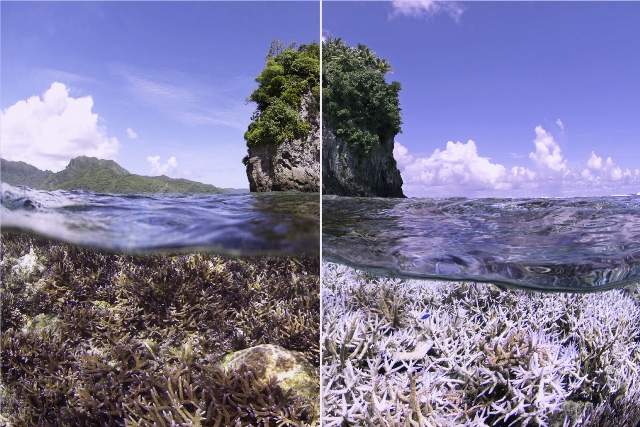
Images shot by the Chasing Coral crew graphically show the progress of the coral bleaching event in xx over xx days.

Images shot by the Chasing Coral crew graphically show the progress of the coral bleaching event that began in 2014.{credit}Chasing Coral, courtesy of Netflix{/credit}

First we take the plunge, off the boat and into the blue. Once the bubbles clear, wonders emerge. Guided by the camera, the eye is initially drawn to the obvious: turtles, rays, eels, jellies, fish. But the star of this show is a different kind of animal. The focus shifts, and we see a variety of fabulously intricate and colourful structures, some branched like trees, others spiny and globular. Each edifice in this marine metropolis was erected by corals — master builders now under unprecedented threat.

Director Jeff Orlowski begins his latest documentary, Chasing Coral, with this view of living abundance. Soon enough, we see death. Images of reefs left white and mostly lifeless give way to apocalyptic footage of dead corals, covered in algae and disintegrating in murky waters. Orlowski’s film, which launched on Netflix on 14 July, reveals the shocking reality of the global bleaching event that began in 2014, spurred by human-driven climate change and only now coming to an end.

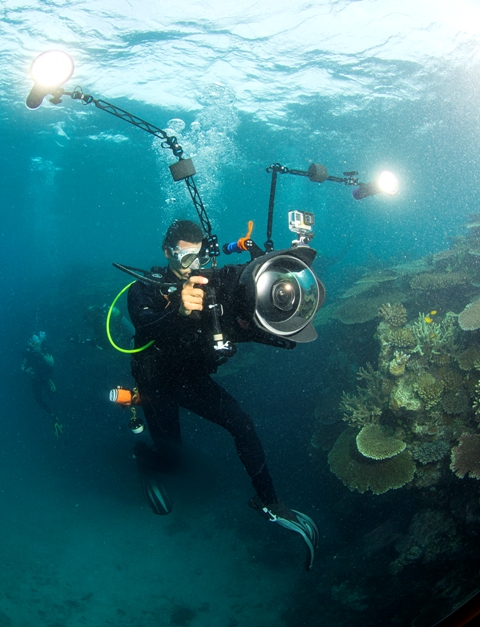
Jeff Orlowski filming corals on the Great Barrier Reef, Australia.

Jeff Orlowski filming corals on the Great Barrier Reef, Australia.{credit}Richard Vevers/Chasing Coral, courtesy of Netflix{/credit}

There are similarities between Chasing Coral and Chasing Ice, Orlowski’s 2012 documentary about melting glaciers, right down to the focus on time-lapse imagery to capture environmental degradation. But where Chasing Ice centres on James Balog, a National Geographic photographer who set up the Extreme Ice Survey to document ice shrinkage, Chasing Coral features, along with leading coral researchers, a curious collection of characters who embark on a technically daunting effort to document the transition from life to illness and death on a coral reef. The result is a fast-paced narrative arc that manages to carry a full-length film about global warming, the ultimate slow-boil.

Orlowski doesn’t hide anything. In fact, he becomes part of his own narrative through that of Richard Vevers, the man driving the project. A former advertising executive turned ocean activist and underwater photographer, Vevers relates how in 2010,  he decided to put his talents to better use: saving corals. After seeing Chasing Ice in 2013, he decided to contact Orlowski, who – in an intriguing meta-moment – makes an appearance in the film to talk about the genesis of the project.

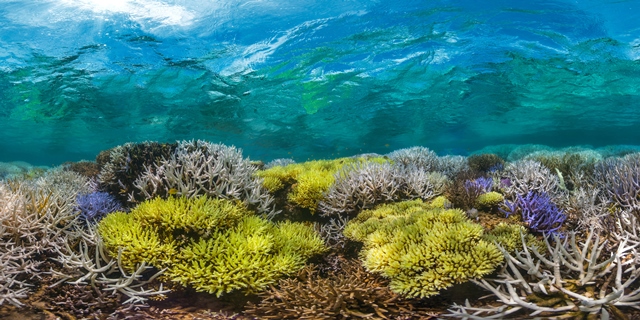
A panoramic view of fluorescing and bleaching corals in New Caledonia in the southwest Pacific, in March 2016.

A panoramic view of fluorescing and bleaching corals in New Caledonia in the southwest Pacific, in March 2016.{credit}The Ocean Agency/XL Catlin Seaview Survey{/credit}

To its credit, Chasing Coral goes beyond personalities and crises and gets into the science – as well as the challenge of communicating that science and raising public awareness. “One of the biggest issues with the ocean is that it is completely ‘out of sight, out of mind’,” Vevers says. “And that is an advertising issue.”

The first step the crew faced was acquiring a high-quality camera capable of operating underwater remotely for weeks at a time. Enter View into the Blue, a company based in Boulder, Colorado, that adapted a high-resolution underwater camera – with its own wiper system to keep the domed-glass housing case clean –  for the project. Step two: figure out where to deploy the camera. Glaciers are easy to identify and visit, and nearly all of them are melting now. But setting up a time-lapse camera to capture the death of a coral reef due to warm ocean currents requires considerable planning and a measure of serendipity.

Mark Eakin, who heads the US National Oceanic and Atmospheric Administration’s Coral Reef Watch, provided forecasts and guidance on where to deploy. Vevers and the team figured out how to power the camera and retrieve data, but an initial deployment in Hawaii failed: the cameras lost their focus after the first shot. A second try on the southern Great Barrier Reef off Queensland, Australia, saw the warm waters (fortunately) failing to arrive.

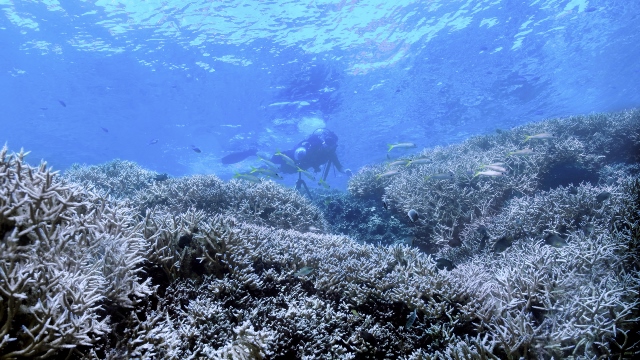
A reef decimated by warm-water currents.

A bleached reef.{credit}Chasing Coral, courtesy of Netflix{/credit}

So the team ditched the automation altogether and moved north to Lizard Island, and on to New Caledonia. Here, they manually photographed dozens of sites each day for 40 days. It worked. At one location after another, we see a rapid decline from vibrant colour and biodiversity to whitening and death. At this point the film switches to the emotional journey of ‘coral nerd’ Zachary Rago. “I’m not even sad that we are leaving, because it’s so miserable here,” Rago says when the job is complete.

Basic science is interwoven throughout. Through coral researchers such as Ruth Gates and Ove Hoegh-Guldberg, we learn about the fascinating lives of corals, which operate as a collective to build and maintain an ecosystem that supports thousands of animals, from clown fish to sharks. We hear about the symbiotic relationship corals have developed with the algae living inside them, which provide their hosts with colour and energy through photosynthesis. And we see what happens when temperatures rise: the algae shut down and corals kick them out.

Chasing Coral also brings home the implications of decades of research. This latest global bleaching event, bolstered by a powerful El Niño in 2015-2016, is the third in recorded history; the first was in 1998. Research suggests that most of the world’s corals could perish within a few decades from rising temperature and ocean acidification without immediate action to halt greenhouse gas emissions.

The film mostly glosses over the scientific endeavour itself, however. After all, Vevers is the executive director of the XL Catlin Seaview Survey, a bonafide research initiative that launched in 2012 to catalogue the world’s corals (as Nature has reported here and here). But it’s a minor point. In the end, the film accomplishes its goals. Nobody knows precisely what an ecological collapse would mean for the oceans, but Chasing Coral makes it abundantly clear that it won’t be pretty. And perhaps that’s enough to inspire action.

Jeff Tollefson is a reporter for Nature based in New York. He tweets at @jefftollef. 


For Nature’s full coverage of science in culture, visit www.nature.com/news/booksandarts.

Humboldt biography wins Royal Society prize

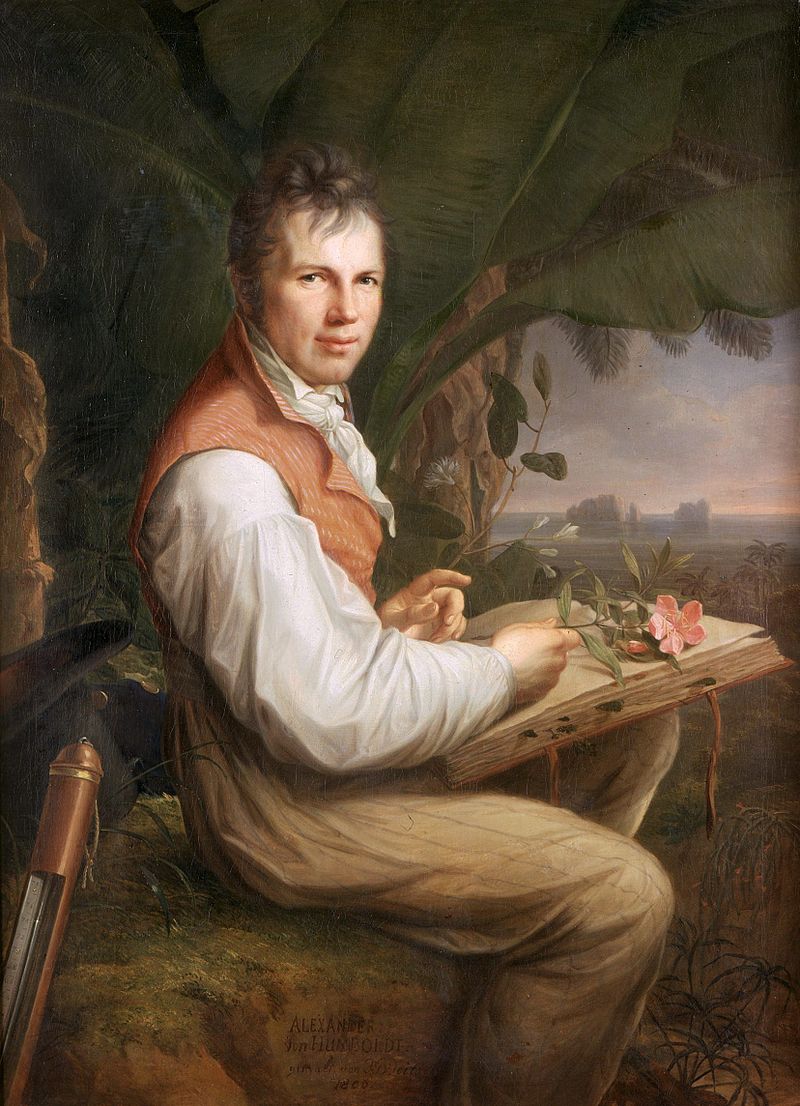
Alexander von Humboldt (oil painting by Friedrich Georg Weitsch, 1806).

Alexander von Humboldt (oil painting by Friedrich Georg Weitsch, 1806).

If fame were measured in namesakes, Alexander von Humboldt might reign supreme. The moniker of the brilliant biogeographer, naturalist and explorer graces dozens of species and phenomena, from the hog-nosed skunk Conepatus humboldtii to a sinkhole in Venezuela. Yet the Prussian polymath’s reputation has lagged somewhat behind that of, say, Charles Darwin. Andrea Wulf’s The Invention of Nature went some way towards changing all that. Now this immensely acclaimed biography is burnished anew by winning the Royal Society’s Science Book Prize, sponsored by Insight Investment.

Wulf writes as if electrified by the fierce intellect of her subject. The Invention of Nature is also a model of concision, I feel, given the range of  Humboldt’s prodigious findings over his long life (1769–1859). He defined climate zones, predicted climate change, experimented with geomagnetism and conducted a gruelling five-year expedition in South America, discovering the Peru Current and numerous plant species, making a record ascent of Chimborazo and amassing 30 volumes of data.

Andrea Wulf.

Andrea Wulf.{credit}Antonina Gern{/credit}

Wulf’s tour de force is in good company, as one of the six that were up for the prize (and all reviewed in Nature).

Tim Birkhead’s The Most Perfect Thing: Inside (and Outside) a Bird’s Egg (Bloomsbury) (reviewed here) is a 360-degree tour of the avian egg, unshelling the chequered history of oology and the natural history of the thing itself — from formation in the ovary to the functions of their elegant colouration. As reviewer John Marzluff noted, we have yet to crack all their mysteries: “Why, for example, does the egg of a chicken travel through the hen pointed end first until the very last minute, when it turns through 180° on the horizontal plane to be laid blunt end first?”

Birkhead chose the ubiquitous. In The Hunt for Vulcan: How Albert Einstein Destroyed a Planet and Deciphered the Universe (Head of Zeus) (reviewed here), Thomas Levenson chronicles the nonexistent: a planet hypothesised to explain oddities in the orbit of Mercury, only to be quashed by Einstein’s general theory of relativity. In the telling, Levenson achieves what many science writers aspire to — a narrative weaving discoveries, backstories and implications into a synthesised tapestry.

From history to the here and now — Jo Marchant’s Cure: A Journey into the Science of Mind Over Body (Canongate) (reviewed here) is a revved-up, research-packed explication of the use of mind in medicine, from meditation to guided visualisation. Marchant’s nimble reportage on the work of scientists in novel fields such as psychoneuroimmunology and her discussion of placebos are as fresh as her reminders of how stress and poverty affect wellbeing are timely.

Equally apropos for our disordered times is The Planet Remade: How Geoengineering Could Change the World by Oliver Morton (Granta) (reviewed here). Morton’s journey through climate fixes is an assured tour of the science, the history of climate interventions and, as reviewer Jane Long noted, the “ethical, political and social implications if climate intervention became available”.

Finally, Siddhartha Mukherjee’s The Gene: An Intimate History (Bodley Head) (reviewed here) is a book of two halves. Mukherjee’s treatment of early genetics controversially skips over some complexities, but  reviewer Matthew Cobb felt it picks up from the 1970s onward with compelling detail on clinical work, the burgeoning of biotech and discoveries such as the genetic basis of Huntington’s disease.

Certainly, from Mendel to CRISPR–Cas9, the story of genetics has been a wonder. Yet it’s just a strand in the grand scientific saga that, luckily for us, continues to inspire fine writers.

The judges of this year’s prize included chair Bill Bryson, whose books include A Short History of Nearly Everything, which won the Royal Society’s Aventis Prize; lecturer and Royal Society University Research Fellow Clare Burrage; American evolutionary ecologist and ornithologist Devorah Bennu (GrrlScientist); author and Science Museum Group director of external affairs Roger Highfield; and award-winning author Alastair Reynolds.


For Nature’s full coverage of science in culture, visit www.nature.com/news/booksandarts.


Five books for the COP negotiator

city-cars-traffic-eiffel-tower 3George Orwell, author of dystopian classics Nineteen Eighty-Four and Animal Farm, was a political animal par excellence. He understood how the language of politics could give “an appearance of solidity to pure wind”, as he put it in his 1946 essay Politics and the English Language. Those words should blast right through the miasmas forming over Paris as COP21 enters its second week.

Happily, 65 years after Orwell’s death, there is no shortage of miasma-busters out there, and I’ve assembled five books to prove it. But first, a closer look at the fog itself.

After decades of COP-watching, I remain as astonished by the halting nature of progress as I am by the number of spanners in their works. National politics and regional-bloc agendas are only some of the impedimenta. There are now, increasingly, external pressures such as corporate lobbying and well-meaning but often disruptive parallel actions by billionaire philanthropists. The whole looks, and often is, a hopelessly unwieldy form of decision-by-committee.

More, the COPs have accreted a culture that, like many variants of the UN model, might leave an ethnographer bemused. There are, for instance, the agreement rollouts that are vague, stretch decades into the future, or both. Climate policy analyst Oliver Geden has called the tendency “kicking the can down the road” — the “modus operandi of UN climate policy”. That pattern also popped up in Indian prime minister Narendra Modi’s announcement last week of a solar alliance involving 120 countries, including France.  India’s big date is 2030, by which time it plans to draw 40% of its energy needs from renewables — even as it formulates equally ambitious plans for its coal. France, meanwhile, currently gets 75% of its energy from nuclear, and that is only due to be reduced by 2025. Ambitious transitions, or a prime example of Orwellian doublethink (and can-kicking)?

French climate-change ambassador Laurence Tubiana, however, dubbed the solar alliance “a true game-changer”. That brings me to another staple of COP culture: hyperbole, deployed to give a sense of dynamism to the often seemingly imperceptible advance of climate decision-making. Yet a clear critique of proposed solutions is as important as sticking to the science on climate change: the facts are alarming enough.

Despite all, solutions need to emerge from the psychological push and pull of the negotiating room. On to the books that in my view could move mountains, or indeed miasmas.

Guru Madhavan’s Applied Minds: How Engineers Think (W.W. Norton, 2015) is by and about the pragmatic tribe who craft the made world (reviewed here). If it seems whimsical to imagine an engineer’s experience might translate to the delicate calibrations and manoeuvrings of negotiation, read on. Their mindset, as Madhavan shows, is focused totally on solutions. Trained in ‘modular systems thinking’, engineers handle complexity by considering the components, the interdependencies and the totality of problems. Engineers are, moreover, deft operators under constraints such as time, finance, physics and human behaviour. Finally, they have a nuanced grasp of tradeoffs and can weed out weak from strong goals. To me, pragmatic, time-sensitive grappling with multidimensional problems doesn’t seem alien in the context of the COPs, which are, after all, attempts to construct a framework. And in a broader sense, systems-thinking seems key to achieving sustainability in an inherited cascade of environmental problems.

History, by deepening our understanding of how today’s looming issues have evolved, can give some insight into solutions. Janet Biehl’s Ecology or Catastrophe: The Life of Murray Bookchin (Oxford University Press, 2015), reviewed here, reminds how 50 years ago, important thinking on climate change was already very much out there. Bookchin, an independent radical ecologist, revealed a rare grasp of the global scale of environmental problems in books such as the 1965 Crisis in Our Cities, in which he wrote: “Theoretically, after several centuries of fossil-fuel combustion, the increased heat of the atmosphere could even melt the polar ice caps”. Bookchin’s solutions to the crisis were as prescient, not least in integrating social with environmental elements. Working from a vision of urban ecotopias, he inspired and championed community-centred, solar-powered, closed-loop food production as early as the 1970s.

David Rieff’s The Reproach of Hunger (Simon and Schuster, 2015), reviewed here, is about the global food crisis, a challenge intimately linked with climate change and like it, human-driven. Rieff, a veteran writer on aid and development issues, spent six years researching this study, and it shows. It is perhaps most acute, and balanced, on why the current melee of international policy bodies, the private sector, “philanthrocapitalists” and technophiles is failing to find viable solutions to hunger. Rieff points to the greater context: a globalised, neoliberal economic system which — as others such as economist Joseph Stiglitz have pointed out — drives the inequities behind global problems, not least the wealth of a tiny minority. I commend this book to my hypothetical negotiator as a salient reminder of the politics infusing global challenges.

In Climate Shock: The Economic Consequences of a Hotter Planet (Princeton University Press, 2015), reviewed here, economists Gernot Wagner and Martin Weitzman deliver a stinging slap to the reluctant or somnolent negotiator. They creatively reframe climate change as a risk management issue — asking why, if there is a 10% chance that climate change will lead to catastrophe, we are not girding ourselves through ‘insurance’, such as pushing industry and policymakers to get on with the transition. They marshall excellent evidence to show that the longer the world waits to act, the likelier it will be that extreme events will happen. A welcome reminder that we must avoid becoming lobsters dawdling at the bottom of a slowly boiling pot.

And finally, a primer on what is at the bottom of all the horror and hoopla — fossil fuels. Two years ago I extolled The Burning Question by Mike Berners-Lee and Duncan Clark (Profile Books, 2013). It is even more relevant now. They lay out the maths, showing that we have “five times as much oil and coal and gas on the books as climate scientists think it is safe to burn”. Yet we are planning to burn it, because fossil-fuel companies treat underground reserves as an existing asset. If the stuff stayed in the ground, they note, it would be goodbye to trillions — but a real commitment to carbon curbing. At a COP partly sponsored by oil interests, my putative negotiator might want to mull over the real costs of a carbon economy.

We refer to the COPs as ‘talks’, and the negotiations themselves do proceed in a soup of arcane UN-speak. Outside those established constraints, the players in this global endeavour need to think deeply about language. It is a shaper of reality. As Orwell noted, the use of a hackneyed phrase “anaesthetizes a portion of one’s brain”. By contrast, lucid and original language and the independent thinking it fosters — as seen in these five exemplary books — are a “necessary first step towards political regeneration” and some dispelling of the murk.


For Nature’s full coverage of science in culture, visit www.nature.com/news/booksandarts.