Double Shift: schooling Syria’s child refugees

xxx

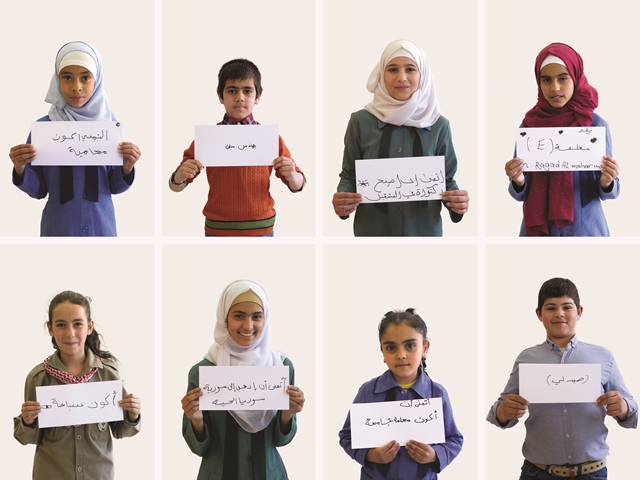
Jordanian and Syrian pupils in Al-Arqam school’s double-shift programme declare their ambitions, from doctor and ship’s engineer to teacher, swimmer and professor.{credit}Paula Ellguth, Marjam Fels{/credit}

Imagine this. You’re 12 years old. Half your family has been killed in conflict, and you find yourself in a country where every other word is a mystery. You’re desperate for stability — not least, school enrolment.

This is reality for many of the 8 million children who make up half the world’s refugees. Education is one of the biggest hurdles they face: only half have access to primary schooling. Potentially, they are a lost generation, at risk from abuse, trafficking and criminalisation, disenfranchised in ways and magnitudes unimaginable to many. A country’s loss of intellectual capital is tragic: how much more so, losing the intellectual future its children represent.

Now, a rich multimedia web documentary is revealing how Jordan — a nation hosting 657,000 registered Syrian refugees — is lighting a candle in the murk. Called Double Shift, the video, audio and text showcase the findings of an innovative social-science research project looking at how the “double shift” educational system, in which different groups are taught morning and evening, is working in the country. Already deployed for decades in Jordan and in other nations from Uganda to the United States, the system is being rolled out anew to accommodate children fleeing the war: Lebanon has adopted it, and Jordan, as Double Shift documents, is following suit to serve 160,000 school-aged Syrian refugees.
xxx

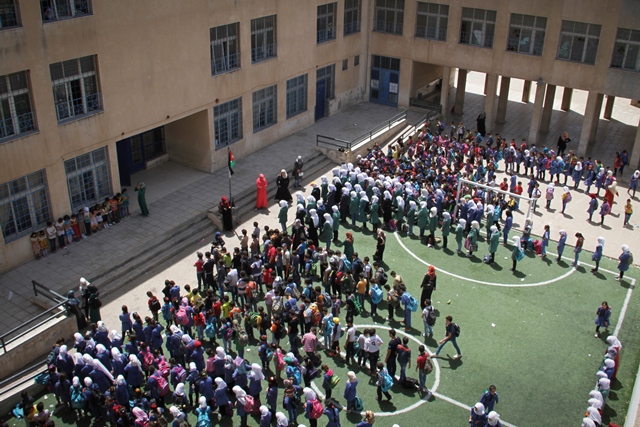
The noon switchover from the Jordanian to the Syrian cohort allows few close encounters. A football club and Saturday centre bridge the gap.{credit}Paula Ellguth, Marjam Fels{/credit}

Double Shift is a joint effort by the WZB Berlin Social Science Center and the European Bank for Reconstruction and Development. Its team of social scientists and visual designers used a variety of methods to capture data from Syrian refugee children in a Jordanian school, from “cultural probe” — giving students digital cameras to document their daily lives — to participatory workshops.

The findings reflect the day-to-day complexities child refugees cope with, notes Steffen Huck, director of WZB research unit Economics of Change. “Some showed the traumatic effects of the war in Syria,” he says. A questionnaire given to 88 Jordanian and Syrian students at Al-Arqam school in Sahab, southeast of Amman, is a case in point. It suggests overwhelming positivity about the school, with 90% reporting approval and more than half finding the classroom clean and safe. A subjective assessment hints at different insights.

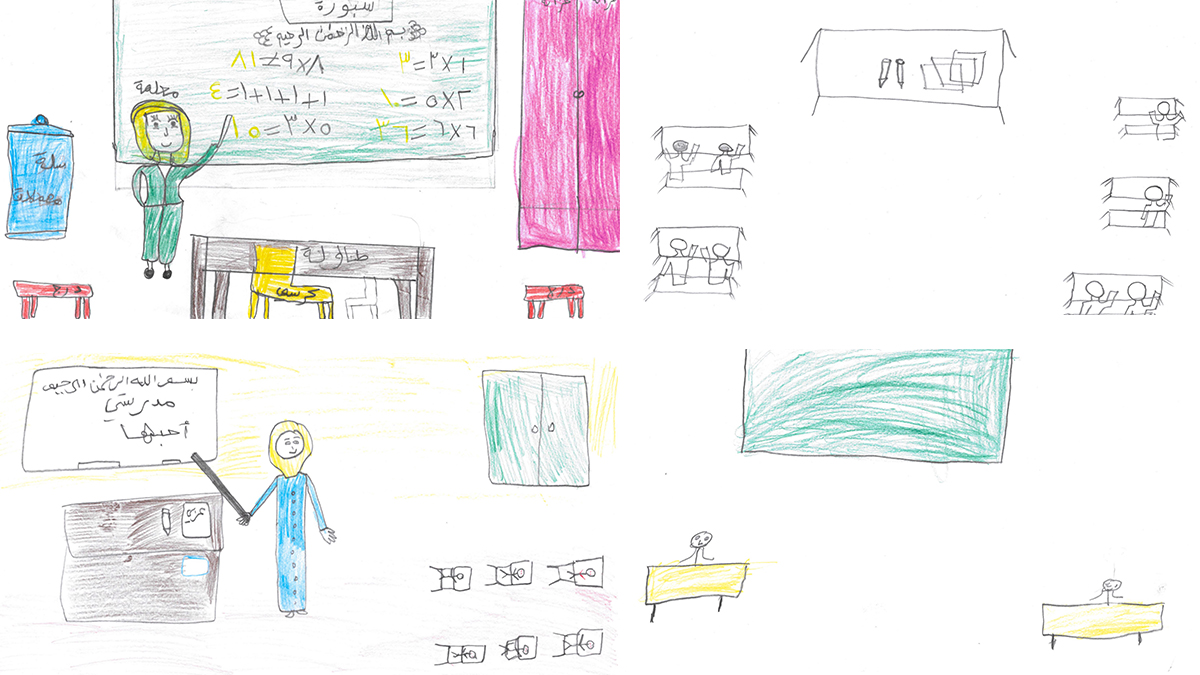
Each student was supplied with five colours and a pen and asked to draw their classroom. “The Jordanian children used significantly more colours than the Syrian,” Huck said. “They also painted in a larger portion of the sheet of paper.” Huck speculates that these differences could indicate relatively withdrawn psychological states among the Syrian children.
xxx

At Al-Arqam school, the differences in coverage and colour use between the Jordanian children’s drawings (left) and those of the Syrian child refugees were marked.{credit}Paula Ellguth, Marjam Fels{/credit}

Jordan’s public schools are already under strain, with teachers, classrooms, water, cooling and heating all in short supply. Class sizes can number 45. The pressures on both teachers and pupils are clear, and the separate shifts (Jordanian children in the morning, Syrian in the afternoon) risk entrenching difference. Yet as Double Shift documents, Al-Arqam is building bridges through a mixed soccer club and Saturday centre for study and play.

Meanwhile, Huck and colleagues have done the maths on another gain: US$167,552,165.00. That is their figure for the total net benefit to the country’s economy of enrolling 50,000 Syrian child refugees in Jordanian schools. As it happens, a new cohort of that size is poised to enter the educational system, thanks  to international funding and support from agencies such as UNICEF.

“As the Syrian civil war drags on with no end in sight,” Huck says, “Jordan’s efforts do not only set a humanitarian example but become more and more an investment in its own future.”
xxx

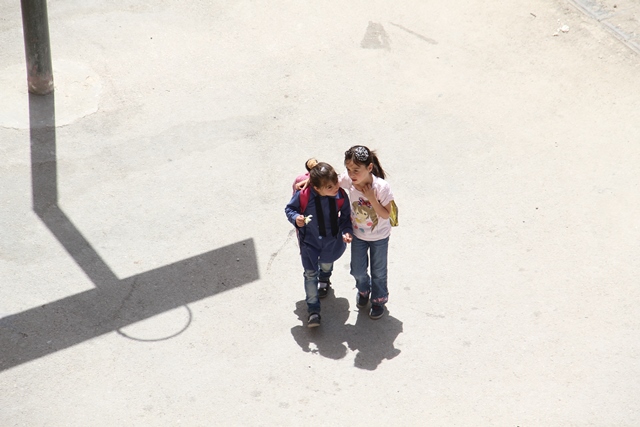
A rare meeting during the midday double-shift switchover.{credit}Paula Ellguth, Marjam Fels{/credit}

Double Shift offers a balanced examination of one school and the headteachers, parents and children who make up its community. It pans out, too, to the wider picture, where other factors come into focus.

Sarah Dryden-Peterson, who researches the nexus of education and social stability, has reported on serious issues with Lebanon’s double-shift programme on the non-profit Brookings Institute website. She reveals that Syrian children may be bullied, and that teachers may be exhausted and poorly trained to cope with their pupils’ psychological trauma. But solutions to fast-moving, critical situations often are partial or quasi-experimental.

If a ‘war child’ is to become an engineer, a surgeon, a pilot — as so many of the children interviewed by Double Shift passionately wish — it’s bedrock we need, not sand. As Dryden-Peterson has noted:

The average length of exile for refugees is 17 years. That’s the equivalent of a child’s whole shot at education, from birth to high school graduation… Syrian refugees do not need temporary education programs. They need access to a complete education.

Currently, debates over STEM teaching and anxieties over science in a politically chaotic world proliferate. Yet the fate of this traumatised, uprooted generation seems an afterthought to governments, who increasingly de-prioritize education in aid portfolios. Policymakers and pundits forget, perhaps, that it was refugees in flight from another appalling war who built American science and technology.


For Nature’s full coverage of science in culture, visit www.nature.com/news/booksandarts.

An immortal life: Henrietta Lacks on film

Posted on behalf of Ewen Callaway

p12871796_p_v8_aa

In the HBO film based on Rebecca Skloot’s book of the same name, Oprah Winfrey plays Henrietta Lacks’ daughter Deborah Lacks.

The idea that people should have a say over how their cells are used in research isn’t revolutionary, but it flies in the face of research practices over the past century. That it nearly became law is due in no small part to Rebecca Skloot’s 2010 bestseller The Immortal Life of Henrietta Lacks, the story of the African-American woman living in Baltimore, Maryland, whose fatal tumour – taken by scientists at Johns Hopkins Hospital in 1951 without the knowledge or permission of Lacks or her family — gave rise to the first immortal human cell line, HeLa.

The book fuelled a much-needed conversation about scientists’ moral obligations to research participants and their families. Now a powerful film adaptation of the same name, starring Oprah Winfrey as Lacks’ youngest daughter Deborah, looks set to amplify that.

Skloot’s book covered a lot of ground, and the film’s director George C. Wolfe (best known for directing and producing Broadway hits such as Tony Kushner’s Angels in America) does an admirable job cramming in details about how HeLa cells were established and their ongoing impact on research. But the movie, broadcast on 22 April on premium US television network HBO, largely covers the decade it took for Skloot to report and publish her book. It focuses in particular on her efforts to gain the trust of Lacks’ family and build an emotional bond with Deborah Lacks.

Their relationship can feel overly dramatized, although Wolfe should not be faulted for taking some dramatic licence with Skloot’s book in what is, after all, a dramatisation (she also served as an executive producer). But much of the film rings true. A scene in which Deborah Lacks questions Skloot’s financial motives and grabs her arm is exactly as described in the book.

Deborah Lacks.

Deborah Lacks.{credit}Rebecca Skloot{/credit}

By omitting some key aspects of the book — the science and history of cell culture and large swathes of Lacks’ biography — the film can feel meta. It is, after all, a film based on a book about a journalist trying to write a book. But it should encourage more people to read the story and absorb its powerful message of social injustice institutionalized by science.

US National Institutes of Health (NIH) director Francis Collins and then-deputy Kathy Hudson have noted that Lacks’ story inspired policy changes in the rules that govern research on human subjects (officially known as the Federal Policy for the Protection of Human Subjects, but widely known as the Common Rule). “The people who are participating in research and providing pieces of themselves should be providing permission as well,” Hudson told Nature in 2015, when the government floated a proposal that would have required them to get approval to reuse discarded samples of blood, urine and other specimens for studies beyond those the subject initially agreed to. But the proposal caused consternation among many scientists. They breathed a sigh of relief this year, when the  final version. of the Common Rule largely maintained the status quo. As long as a participant’s name is removed from the sample, scientists needn’t obtain new consent.

Henrietta Lacks.

Henrietta Lacks.{credit}Courtesy of the Lacks family{/credit}

That may seem like a setback in a quest for justice the Lacks family is all too familiar with. But other developments suggest that the Lacks’ story has changed how research participants are treated by scientists.

Currently, a movement for “dynamic consent” — focused on the establishment of a lasting relationship between researchers and study participants — is growing. It was pioneered by professor of health, law and policy Jane Kaye, while elements of it are being used in Australia. Participants or their relatives (in cases where they are no longer alive) are kept up to date on how their samples are used in research, and they can opt out of particular studies or remove their sample entirely.

The Lacks are finally gaining some control over HeLa cells, if not the remuneration many members have in the past and some still seek. In 2013, after researchers funded by the NIH sequenced the HeLa cell genome without the knowledge or consent of the Lacks family, Collins helped broker a deal with the family to limit access to the data. Now, all NIH-funded scientists and others who want the best quality HeLa genome must explain their research to a committee that includes a Lacks family member. It’s enough for a sequel.

Ewen Callaway is a senior reporter for Nature based in London. He tweets at @ewencallaway. 


For Nature’s full coverage of science in culture, visit www.nature.com/news/booksandarts.

Science fiction: journey to the East

Cixin Liu

Cixin Liu.{credit}Li Yibo{/credit}

Posted on behalf of Iulia Georgescu

Last week’s Chinese Sci-Fi event at the London Literature festival was irresistible: I love science fiction and have a keen interest in the Far East. The star here was Cixin Liu, whose 2008 Hugo-awarded novel The Three-Body Problem is a huge best-seller in China and, since its English translation (Head of Zeus, 2015), beyond. (See Nature’s interview with its translator, sci-fi writer Ken Liu, here.) Liu’s fellow panellist was Xiaolu Guo, the award-winning, genre-defying Chinese novelist and filmmaker now living in Britain, whose works include the 2014 I Am China and 2012 UFO In Her Eyes.

Xiaolu Guo.

Xiaolu Guo.{credit}provided by Xiaolu Guo{/credit}

Both Cixin Liu and Guo had much to say. They agreed that sci-fi is a Western concept imported into China in the late 1970s and 80s. Post-Cultural Revolution China had the perfect climate for nurturing the genre, they said. First, there was a void in fantastic and speculative literature: much of Chinese literature in the twentieth century was focused on realism. Secondly, as science education was very poor at that time, sci-fi was a means of educating about science. The public fell upon it, eager to learn more about the latest discoveries.

Although Liu was heavily influenced by Western sci-fi writers, Chinese sci-fi has unique features. The difference, he seemed to think, lies in the Christian tradition imprinted on Western fiction. For instance, there is much discussion of whether the ethical implications of human cloning are perceived differently in China (see this Nature article). Liu averred that more than that, the idea of a doomsday, so dominant in Western thought, is less so in Chinese culture, which enshrines the concept of time flowing continuously and eternally.

imagesThat said, Liu’s The Three-Body Problem is about the end of the world — which is perhaps one of the reasons for its international popularity. (Japanese sci-fi is rich in apocalyptic scenarios too, for example in classics such as Kobo Abe’s Inter Ice Age 4, Sakyo Komatsu’s Japan Sinks, or the Neon Genesis Evangelion media franchise.)

Liu and Guo agreed that for them, the appeal of sci-fi lies in its departure from realism. Guo suggested that sci-fi is perhaps the only way for writers living in China to talk about political and social issues, as with Jingfang Hao‘s Hugo-winning novelette Folding Beijing (set in a future where three social classes inhabit Beijing in different spatial dimensions that only occasionally overlap). For Liu, sci-fi allows him to explore a bigger picture – humanity as a whole and its place in the Universe, as in the last book of his Three-Body trilogy, set in the very distant future.

The event made me realize anew how little of contemporary Asian literature has been translated into English. I hope that Liu’s popularity prompts publishers to more translations: I already have a long wish list.

Iulia Georgescu is senior editor, Nature Physics.


Access Natures science fiction special here; and Natures science-fiction column Futures (and Future Conditional blog) here. For Nature’s full coverage of science in culture, visit www.nature.com/news/booksandarts.